
Introduction to Retail
Adarsh Institute of Management and Information Technology
December 2019
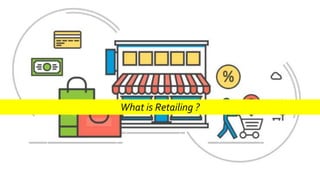
What is Retailing ?
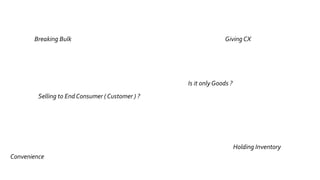
Breaking Bulk
Selling to End Consumer ( Customer ) ?
Is it only Goods ?
Holding Inventory
Giving CX
Convenience
“Retailing includes all the activities involved in selling goods or services to the final consumes, for personal, non-business use. “
- Philip Kotler
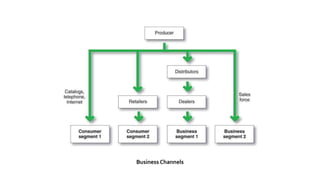
Business Channels
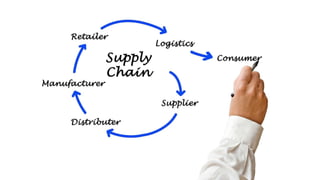
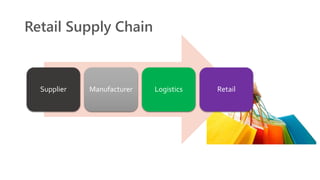
Retail Supply Chain
Supplier Manufacturer Logistics Retail
Retail Formats
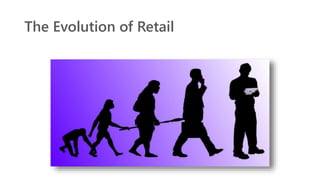
The Evolution of Retail
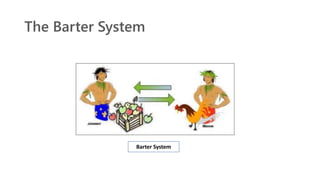
The Barter System
Barter System
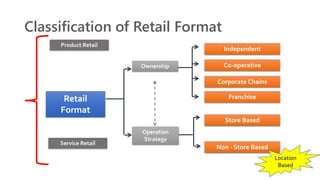
Classification of Retail Format
Retail
Format
Ownership
Operation
Strategy
Independent
Co-operative
Corporate Chains
Franchise
Store Based
Non - Store Based
Product Retail
Service Retail
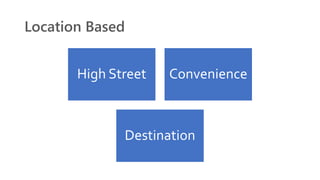
Location
Based
Location Based
High Street Convenience
Destination
Weekly Markets
Village Fairs
Melas
Convenience Stores
Mom and Pop/Kiranas
Hawkers
Janata Bazaar
Khadi Stores
Other Cooperatives
Exclusive Brand Outlets
Hyper/Super Markets
Department Stores
Shopping Malls
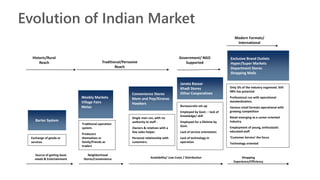
Traditional/Pervasive
Reach
Government/ NGO
Supported
Historic/Rural
Reach
Modern Formats/
International
Source of getting basic
needs & Entertainment
Neighborhood
Stores/Convenience Availability/ Low Costs / Distribution Shopping
Experience/Efficiency
Traditional operation
system.
Producers
themselves or
family/friends as
traders
Single man run, with no
authority to staff .
Owners & relatives with a
few sales helper.
Personal relationship with
customers.
Bureaucratic set-up
Employed by Govt. – lack of
knowledge/ skill
Employed for a lifetime by
Govt.
Lack of service orientation
Lack of technology in
operation
Only 2% of the industry organized. Still
98% has potential
Professional run with operational
standardization.
Various retail formats operational with
growing competition
Retail emerging as a career oriented
industry
Employment of young, enthusiastic
educated staff
‘Customer Service’ the focus
Technology oriented
Barter System
Exchange of goods or
services
Evolution of Indian Market
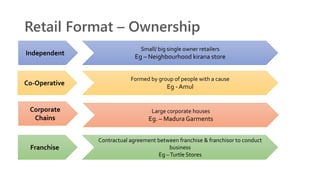
Retail Format – Ownership
Co-Operative
Independent
Corporate
Chains
Franchise
Small/ big single owner retailers
Eg – Neighbourhood kirana store
Formed by group of people with a cause
Eg - Amul
Large corporate houses
Eg. – Madura Garments
Contractual agreement between franchise & franchisor to conduct
business
Eg –Turtle Stores
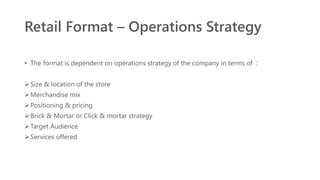
Retail Format – Operations Strategy
• The format is dependent on operations strategy of the company in terms of :
Size & location of the store
Merchandise mix
Positioning & pricing
Brick & Mortar or Click & mortar strategy
Target Audience
Services offered
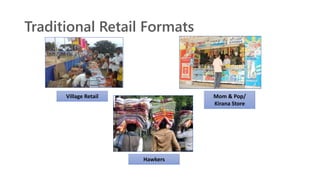
Traditional Retail Formats
Village Retail Mom & Pop/
Kirana Store
Hawkers
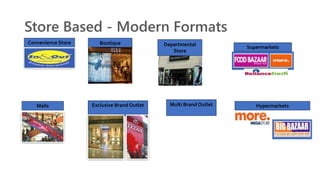
Store Based - Modern Formats
Convenience Store
Hypermarkets
Supermarkets
Exclusive Brand Outlet
Boutique
Multi Brand OutletMalls
Departmental
Store
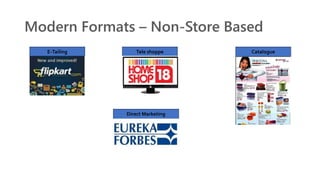
Modern Formats – Non-Store Based
E-Tailing Tele shoppe Catalogue
Direct Marketing
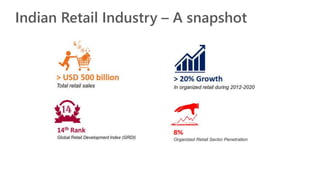
Indian Retail Industry – A snapshot
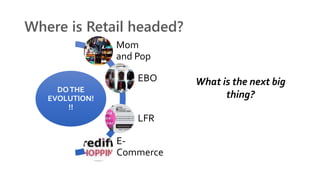
Where is Retail headed?
DOTHE
EVOLUTION!
!!
Mom
and Pop
EBO
LFR
E-
Commerce
What is the next big
thing?
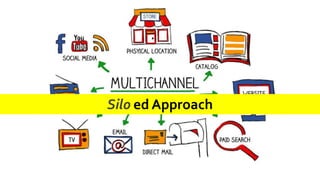
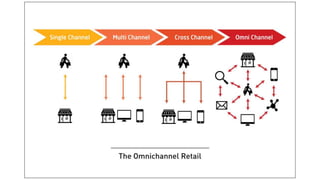
Silo ed Approach
Business Channels
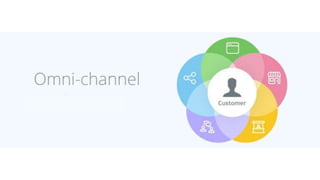
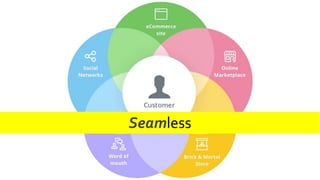
Seamless
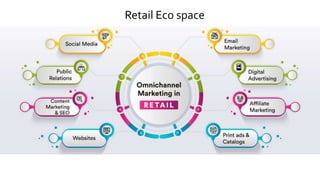
Retail Eco space
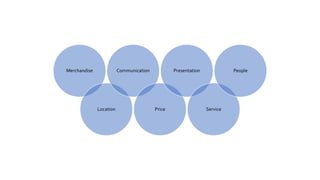
The Retail Mix
What do we mean by Retail Mix
Combination of factors -To satisfy customer needs - Influence their purchase
decision
Merchandise
Location
Communication
Price
Presentation
Service
People
Retail Operations
Retail Operations involves managing the day-to-day functions of retail
establishments .
Retail Operations professionals manage retail establishments on a daily basis,
and are responsible for maximizing store profits – For the regions and for the
geographies
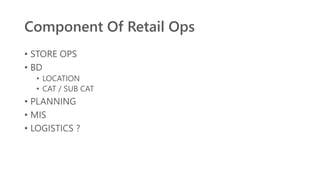
Component Of Retail Ops
• STORE OPS
• BD
• LOCATION
• CAT / SUB CAT
• PLANNING
• MIS
• LOGISTICS ?
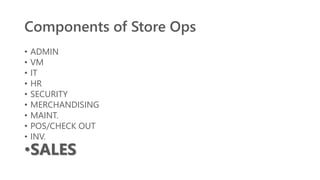
Components of Store Ops
• ADMIN
• VM
• IT
• HR
• SECURITY
• MERCHANDISING
• MAINT.
• POS/CHECK OUT
• INV.
•SALES
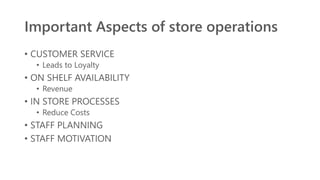
Important Aspects of store operations
• CUSTOMER SERVICE
• Leads to Loyalty
• ON SHELF AVAILABILITY
• Revenue
• IN STORE PROCESSES
• Reduce Costs
• STAFF PLANNING
• STAFF MOTIVATION
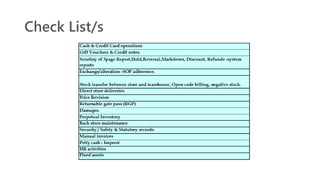
Check List/s
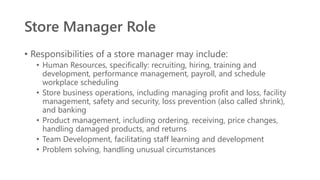
Store Manager Role
• Responsibilities of a store manager may include:
• Human Resources, specifically: recruiting, hiring, training and
development, performance management, payroll, and schedule
workplace scheduling
• Store business operations, including managing profit and loss, facility
management, safety and security, loss prevention (also called shrink),
and banking
• Product management, including ordering, receiving, price changes,
handling damaged products, and returns
• Team Development, facilitating staff learning and development
• Problem solving, handling unusual circumstances
Customer Entry
• Approach
• Parking
• Valet
• Greeting
• Store Directory
• VM
• Signages
• Baggage Counter
• Walk In
• Entries
Merchandise
• Section Hygiene
• VM
• Product
• Ease of Selection
POS / CHECK OUT
• BILLING
• Discount
• Cash / Card
• Tender
• Checkpoint
Operations
• Contact initiated by an employee increases
likelihood a shopper will buy something
• The most important factor in determining a
shopper’s opinion of the service he receives is
waiting time
• Adding sound, light and color to the register area
can ease customers from the anxiety of the financial
transaction
Customer Segments
• When shopping, men:
• Move faster, spend less time looking
• Look at price tags less often and can be more easily upgraded to a
more expensive item
• Get a thrill from the experience of paying
• Hate asking for directions
Customer Segments
• When shopping, women:
• Spend more money when shopping with other women
• Are more demanding of the shopping environment
• Older shoppers:
• Must have easy to read signs
• See a lot more black, white and red, and a lot less of other colors
• Need brightly lit stores
Customer Segments
• Children
• If stores are not child friendly, parents will be deterred to enter
• Make merchandise reachable
• Childproof the store
• Be able to divert the attention of a restless child
• Design a good area for children
• Generation X
• Are attracted to the specialty-store environment if the merchandise is
up-to-date
KPI
For Retail Operations
RETAIL KPI
• Sales/Square Feet
• Sales/Employee
• Inv. Shrinkage/sales
• AverageTransaction (sales/# of transactions)
• Items PerTicket (total items sold/total transactions)
• Conversion Rate (total transactions/total traffic)
• Total Sales
• Sales compared to last year (or any other period)
• Wage Cost
• Average Sale per Customer/Transaction
RETAIL KPI
Sales per Hour (for store or associate) – selling hours / labor hours only:
• Sales Per Hour
• Average Sale
• InventoryTurn
• Average Gross Margin
• Customers per day/week
• Items per customer
RETAIL KPI
• Sales compared to last year (or any other period):
• Sales per Square Foot:
• Wage Cost:
• Average Sale per Customer/Transaction:
• Units per Customer/Transaction:
• Conversion rate:
• Sales per Hour (for store or associate) – selling hours only:
• Sales per Hour (for store or associate) – total labor hours:
• Time Spent in the Store
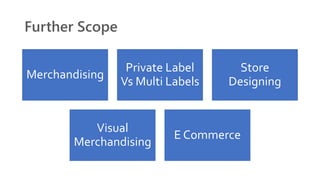
Further Scope
Merchandising
Private Label
Vs Multi Labels
Store
Designing
Visual
Merchandising
E Commerce
Thank You.

Retail for the Uninitiated !!

  • 2.
    Introduction to Retail AdarshInstitute of Management and Information Technology December 2019
  • 3.
  • 4.
    Breaking Bulk Selling toEnd Consumer ( Customer ) ? Is it only Goods ? Holding Inventory Giving CX Convenience
  • 5.
    “Retailing includes allthe activities involved in selling goods or services to the final consumes, for personal, non-business use. “ - Philip Kotler
  • 7.
  • 8.
    Retail Supply Chain SupplierManufacturer Logistics Retail
  • 9.
  • 10.
  • 11.
  • 12.
    Classification of RetailFormat Retail Format Ownership Operation Strategy Independent Co-operative Corporate Chains Franchise Store Based Non - Store Based Product Retail Service Retail Location Based
  • 13.
    Location Based High StreetConvenience Destination
  • 14.
    Weekly Markets Village Fairs Melas ConvenienceStores Mom and Pop/Kiranas Hawkers Janata Bazaar Khadi Stores Other Cooperatives Exclusive Brand Outlets Hyper/Super Markets Department Stores Shopping Malls Traditional/Pervasive Reach Government/ NGO Supported Historic/Rural Reach Modern Formats/ International Source of getting basic needs & Entertainment Neighborhood Stores/Convenience Availability/ Low Costs / Distribution Shopping Experience/Efficiency Traditional operation system. Producers themselves or family/friends as traders Single man run, with no authority to staff . Owners & relatives with a few sales helper. Personal relationship with customers. Bureaucratic set-up Employed by Govt. – lack of knowledge/ skill Employed for a lifetime by Govt. Lack of service orientation Lack of technology in operation Only 2% of the industry organized. Still 98% has potential Professional run with operational standardization. Various retail formats operational with growing competition Retail emerging as a career oriented industry Employment of young, enthusiastic educated staff ‘Customer Service’ the focus Technology oriented Barter System Exchange of goods or services Evolution of Indian Market
  • 15.
    Retail Format –Ownership Co-Operative Independent Corporate Chains Franchise Small/ big single owner retailers Eg – Neighbourhood kirana store Formed by group of people with a cause Eg - Amul Large corporate houses Eg. – Madura Garments Contractual agreement between franchise & franchisor to conduct business Eg –Turtle Stores
  • 16.
    Retail Format –Operations Strategy • The format is dependent on operations strategy of the company in terms of : Size & location of the store Merchandise mix Positioning & pricing Brick & Mortar or Click & mortar strategy Target Audience Services offered
  • 17.
    Traditional Retail Formats VillageRetail Mom & Pop/ Kirana Store Hawkers
  • 18.
    Store Based -Modern Formats Convenience Store Hypermarkets Supermarkets Exclusive Brand Outlet Boutique Multi Brand OutletMalls Departmental Store
  • 19.
    Modern Formats –Non-Store Based E-Tailing Tele shoppe Catalogue Direct Marketing
  • 20.
    Indian Retail Industry– A snapshot
  • 21.
    Where is Retailheaded? DOTHE EVOLUTION! !! Mom and Pop EBO LFR E- Commerce What is the next big thing?
  • 23.
  • 25.
  • 26.
  • 27.
  • 28.
  • 29.
    What do wemean by Retail Mix Combination of factors -To satisfy customer needs - Influence their purchase decision
  • 30.
  • 31.
  • 32.
    Retail Operations involvesmanaging the day-to-day functions of retail establishments . Retail Operations professionals manage retail establishments on a daily basis, and are responsible for maximizing store profits – For the regions and for the geographies
  • 33.
    Component Of RetailOps • STORE OPS • BD • LOCATION • CAT / SUB CAT • PLANNING • MIS • LOGISTICS ?
  • 34.
    Components of StoreOps • ADMIN • VM • IT • HR • SECURITY • MERCHANDISING • MAINT. • POS/CHECK OUT • INV. •SALES
  • 35.
    Important Aspects ofstore operations • CUSTOMER SERVICE • Leads to Loyalty • ON SHELF AVAILABILITY • Revenue • IN STORE PROCESSES • Reduce Costs • STAFF PLANNING • STAFF MOTIVATION
  • 36.
  • 37.
    Store Manager Role •Responsibilities of a store manager may include: • Human Resources, specifically: recruiting, hiring, training and development, performance management, payroll, and schedule workplace scheduling • Store business operations, including managing profit and loss, facility management, safety and security, loss prevention (also called shrink), and banking • Product management, including ordering, receiving, price changes, handling damaged products, and returns • Team Development, facilitating staff learning and development • Problem solving, handling unusual circumstances
  • 38.
    Customer Entry • Approach •Parking • Valet • Greeting • Store Directory • VM • Signages • Baggage Counter • Walk In • Entries
  • 39.
    Merchandise • Section Hygiene •VM • Product • Ease of Selection
  • 40.
    POS / CHECKOUT • BILLING • Discount • Cash / Card • Tender • Checkpoint
  • 41.
    Operations • Contact initiatedby an employee increases likelihood a shopper will buy something • The most important factor in determining a shopper’s opinion of the service he receives is waiting time • Adding sound, light and color to the register area can ease customers from the anxiety of the financial transaction
  • 42.
    Customer Segments • Whenshopping, men: • Move faster, spend less time looking • Look at price tags less often and can be more easily upgraded to a more expensive item • Get a thrill from the experience of paying • Hate asking for directions
  • 43.
    Customer Segments • Whenshopping, women: • Spend more money when shopping with other women • Are more demanding of the shopping environment • Older shoppers: • Must have easy to read signs • See a lot more black, white and red, and a lot less of other colors • Need brightly lit stores
  • 44.
    Customer Segments • Children •If stores are not child friendly, parents will be deterred to enter • Make merchandise reachable • Childproof the store • Be able to divert the attention of a restless child • Design a good area for children • Generation X • Are attracted to the specialty-store environment if the merchandise is up-to-date
  • 45.
  • 46.
    RETAIL KPI • Sales/SquareFeet • Sales/Employee • Inv. Shrinkage/sales • AverageTransaction (sales/# of transactions) • Items PerTicket (total items sold/total transactions) • Conversion Rate (total transactions/total traffic) • Total Sales • Sales compared to last year (or any other period) • Wage Cost • Average Sale per Customer/Transaction
  • 47.
    RETAIL KPI Sales perHour (for store or associate) – selling hours / labor hours only: • Sales Per Hour • Average Sale • InventoryTurn • Average Gross Margin • Customers per day/week • Items per customer
  • 48.
    RETAIL KPI • Salescompared to last year (or any other period): • Sales per Square Foot: • Wage Cost: • Average Sale per Customer/Transaction: • Units per Customer/Transaction: • Conversion rate: • Sales per Hour (for store or associate) – selling hours only: • Sales per Hour (for store or associate) – total labor hours: • Time Spent in the Store
  • 49.
    Further Scope Merchandising Private Label VsMulti Labels Store Designing Visual Merchandising E Commerce
  • 50.

Editor's Notes

  • #4 CONTENT 1. INTRODUCTION TO RETAILING (CONCEPT,TYPES OF RETAILERS, RETAIL FORMATS,RETAIL MIX AND RETAIL STRATEGY) 2. KEY ELEMENTS OF STORE OPERATIONS AND MANAGING TOUCH POINTS 3. ROLE OF A STORE MANAGER, STORE DESIGN AND LAYOUTS,VISUAL MERCHANDISING 4. MERCHANDISING CONCEPT, CPFR, PRIVATE LABELS
  • #23 https://www.youtube.com/watch?v=XxeOl1CCNOw