The Resume & LinkedIn
Presented by Michael T. Breslin
Lally Office of Career Management and Professional Development
9/9/2015
What does the resume do?
How does the resume do that?
• Summary
• Writing descriptors
• Strategic use of Keywords
• Appealing to ATS
• Any other basics we can get to
Agenda
• Who are you?
• Who is the person who gets the job you want?
Gap Analysis
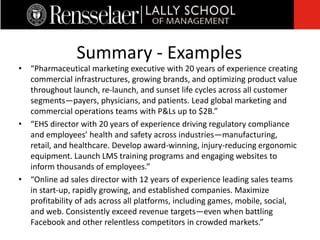
• “Pharmaceutical marketing executive with 20 years of experience creating
commercial infrastructures, growing brands, and optimizing product value
throughout launch, re-launch, and sunset life cycles across all customer
segments—payers, physicians, and patients. Lead global marketing and
commercial operations teams with P&Ls up to $2B.”
• “EHS director with 20 years of experience driving regulatory compliance
and employees’ health and safety across industries—manufacturing,
retail, and healthcare. Develop award-winning, injury-reducing ergonomic
equipment. Launch LMS training programs and engaging websites to
inform thousands of employees.”
• “Online ad sales director with 12 years of experience leading sales teams
in start-up, rapidly growing, and established companies. Maximize
profitability of ads across all platforms, including games, mobile, social,
and web. Consistently exceed revenue targets—even when battling
Facebook and other relentless competitors in crowded markets.”
Summary - Examples
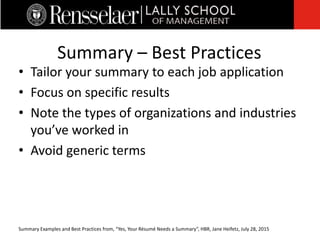
• Tailor your summary to each job application
• Focus on specific results
• Note the types of organizations and industries
you’ve worked in
• Avoid generic terms
Summary – Best Practices
Summary Examples and Best Practices from, “Yes, Your Résumé Needs a Summary”, HBR, Jane Heifetz, July 28, 2015
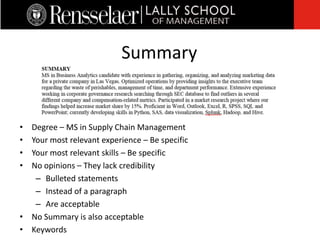
• Degree – MS in Supply Chain Management
• Your most relevant experience – Be specific
• Your most relevant skills – Be specific
• No opinions – They lack credibility
– Bulleted statements
– Instead of a paragraph
– Are acceptable
• No Summary is also acceptable
• Keywords
Summary
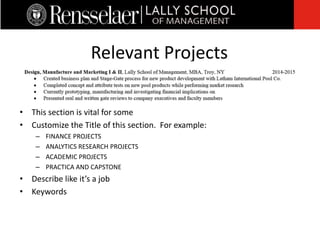
• This section is vital for some
• Customize the Title of this section. For example:
– FINANCE PROJECTS
– ANALYTICS RESEARCH PROJECTS
– ACADEMIC PROJECTS
– PRACTICA AND CAPSTONE
• Describe like it’s a job
• Keywords
Relevant Projects
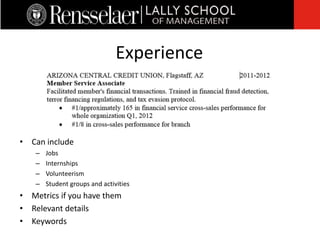
• Can include
– Jobs
– Internships
– Volunteerism
– Student groups and activities
• Metrics if you have them
• Relevant details
• Keywords
Experience
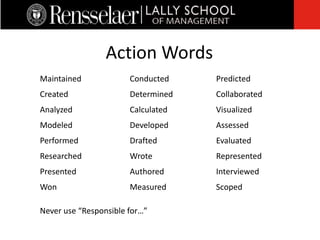
Action Words
 Conducted
 Determined
 Calculated
 Developed
 Drafted
 Wrote
 Authored
 Measured
 Maintained
 Created
 Analyzed
 Modeled
 Performed
 Researched
 Presented
 Won
 Predicted
 Collaborated
 Visualized
 Assessed
 Evaluated
 Represented
 Interviewed
 Scoped
 Never use “Responsible for…”
No tables/text boxes on the resume
• Unless you PDF it
Don’t use these statements
• “To obtain a position where I can use my skills to further my career…”
• “…where I can exhibit hard work and enthusiasm…”
• “Highly motivated, enthusiastic, people person…”
• “…looking to gain experience…”
How many pages?
Warnings
• Every responsibility, experience, accomplishment
• Longer than one page? Good!
• You don’t know what the next job will require
• Edit and reformat once we have a target
Master Resume
Other Resources
• Name
• Headline
• Summary
• Experience
• Anything else we can get to
LinkedIn Agenda
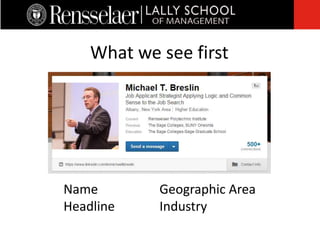
What we see first
Name Geographic Area
Headline Industry
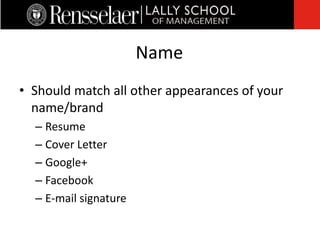
• Should match all other appearances of your
name/brand
– Resume
– Cover Letter
– Google+
– Facebook
– E-mail signature
Name
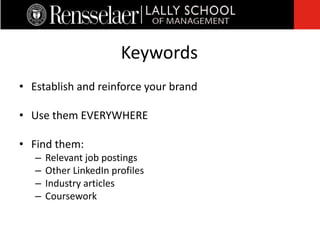
• Establish and reinforce your brand
• Use them EVERYWHERE
• Find them:
– Relevant job postings
– Other LinkedIn profiles
– Industry articles
– Coursework
Keywords
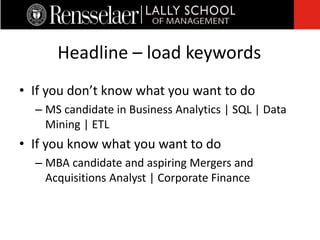
• If you don’t know what you want to do
– MS candidate in Business Analytics | SQL | Data
Mining | ETL
• If you know what you want to do
– MBA candidate and aspiring Mergers and
Acquisitions Analyst | Corporate Finance
Headline – load keywords
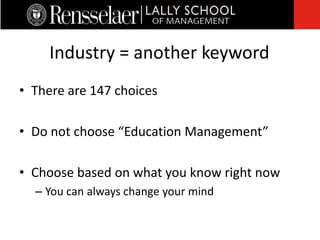
• There are 147 choices
• Do not choose “Education Management”
• Choose based on what you know right now
– You can always change your mind
Industry = another keyword
• Tell your story
– Motivations
• “I love using my portfolio analysis skills to solve complicated
asset allocation issues”
– Skills
• “Through my MS in Quantitative Finance, I’ve developed the
ability to…”
– Aspirations
• “I’m looking to begin my career (with a type of company/in a
specific industry)”
– “When I’m not elbow deep in VBA macros, I run
obstacle races and…”
– List your keywords and skills
Summary
• Present Job Title
– MS in Supply Chain candidate
• Do not use this as your default Headline
• Keywords in Job Titles – SEO looks for them
– Supply Chain Intern
– Operations Project Assistant
– New Product Development Associate
Experience
• Tell your story
– Humans are hardwired to respond to stories
• Why did you do this job?
• What did you learn?
• What types of people did you work with?
• How are you better now because of it?
• Use keywords throughout
More Experience
• Many opportunities for keywords
• Supports your story and your brand
Still More Experience
• These should be relevant and descriptive
– Pictures
– Presentations
– Portfolios
– Video
• LinkedIn =/= Facebook
Add Media
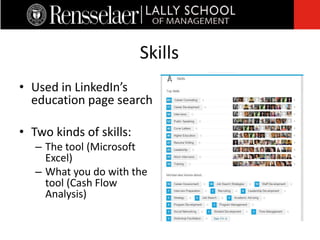
• Used in LinkedIn’s
education page search
• Two kinds of skills:
– The tool (Microsoft
Excel)
– What you do with the
tool (Cash Flow
Analysis)
Skills
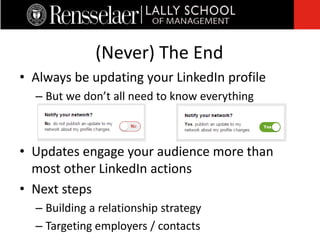
• Always be updating your LinkedIn profile
– But we don’t all need to know everything
• Updates engage your audience more than
most other LinkedIn actions
• Next steps
– Building a relationship strategy
– Targeting employers / contacts
(Never) The End

Resume LinkedIn PDW Sep2015

  • 1.
    The Resume &LinkedIn Presented by Michael T. Breslin Lally Office of Career Management and Professional Development 9/9/2015
  • 2.
    What does theresume do?
  • 3.
    How does theresume do that?
  • 4.
    • Summary • Writingdescriptors • Strategic use of Keywords • Appealing to ATS • Any other basics we can get to Agenda
  • 5.
    • Who areyou? • Who is the person who gets the job you want? Gap Analysis
  • 6.
    • “Pharmaceutical marketingexecutive with 20 years of experience creating commercial infrastructures, growing brands, and optimizing product value throughout launch, re-launch, and sunset life cycles across all customer segments—payers, physicians, and patients. Lead global marketing and commercial operations teams with P&Ls up to $2B.” • “EHS director with 20 years of experience driving regulatory compliance and employees’ health and safety across industries—manufacturing, retail, and healthcare. Develop award-winning, injury-reducing ergonomic equipment. Launch LMS training programs and engaging websites to inform thousands of employees.” • “Online ad sales director with 12 years of experience leading sales teams in start-up, rapidly growing, and established companies. Maximize profitability of ads across all platforms, including games, mobile, social, and web. Consistently exceed revenue targets—even when battling Facebook and other relentless competitors in crowded markets.” Summary - Examples
  • 7.
    • Tailor yoursummary to each job application • Focus on specific results • Note the types of organizations and industries you’ve worked in • Avoid generic terms Summary – Best Practices Summary Examples and Best Practices from, “Yes, Your Résumé Needs a Summary”, HBR, Jane Heifetz, July 28, 2015
  • 8.
    • Degree –MS in Supply Chain Management • Your most relevant experience – Be specific • Your most relevant skills – Be specific • No opinions – They lack credibility – Bulleted statements – Instead of a paragraph – Are acceptable • No Summary is also acceptable • Keywords Summary
  • 9.
    • This sectionis vital for some • Customize the Title of this section. For example: – FINANCE PROJECTS – ANALYTICS RESEARCH PROJECTS – ACADEMIC PROJECTS – PRACTICA AND CAPSTONE • Describe like it’s a job • Keywords Relevant Projects
  • 10.
    • Can include –Jobs – Internships – Volunteerism – Student groups and activities • Metrics if you have them • Relevant details • Keywords Experience
  • 11.
    Action Words  Conducted Determined  Calculated  Developed  Drafted  Wrote  Authored  Measured  Maintained  Created  Analyzed  Modeled  Performed  Researched  Presented  Won  Predicted  Collaborated  Visualized  Assessed  Evaluated  Represented  Interviewed  Scoped  Never use “Responsible for…”
  • 12.
    No tables/text boxeson the resume • Unless you PDF it Don’t use these statements • “To obtain a position where I can use my skills to further my career…” • “…where I can exhibit hard work and enthusiasm…” • “Highly motivated, enthusiastic, people person…” • “…looking to gain experience…” How many pages? Warnings
  • 13.
    • Every responsibility,experience, accomplishment • Longer than one page? Good! • You don’t know what the next job will require • Edit and reformat once we have a target Master Resume
  • 14.
  • 15.
    • Name • Headline •Summary • Experience • Anything else we can get to LinkedIn Agenda
  • 16.
    What we seefirst Name Geographic Area Headline Industry
  • 17.
    • Should matchall other appearances of your name/brand – Resume – Cover Letter – Google+ – Facebook – E-mail signature Name
  • 18.
    • Establish andreinforce your brand • Use them EVERYWHERE • Find them: – Relevant job postings – Other LinkedIn profiles – Industry articles – Coursework Keywords
  • 19.
    • If youdon’t know what you want to do – MS candidate in Business Analytics | SQL | Data Mining | ETL • If you know what you want to do – MBA candidate and aspiring Mergers and Acquisitions Analyst | Corporate Finance Headline – load keywords
  • 20.
    • There are147 choices • Do not choose “Education Management” • Choose based on what you know right now – You can always change your mind Industry = another keyword
  • 21.
    • Tell yourstory – Motivations • “I love using my portfolio analysis skills to solve complicated asset allocation issues” – Skills • “Through my MS in Quantitative Finance, I’ve developed the ability to…” – Aspirations • “I’m looking to begin my career (with a type of company/in a specific industry)” – “When I’m not elbow deep in VBA macros, I run obstacle races and…” – List your keywords and skills Summary
  • 22.
    • Present JobTitle – MS in Supply Chain candidate • Do not use this as your default Headline • Keywords in Job Titles – SEO looks for them – Supply Chain Intern – Operations Project Assistant – New Product Development Associate Experience
  • 23.
    • Tell yourstory – Humans are hardwired to respond to stories • Why did you do this job? • What did you learn? • What types of people did you work with? • How are you better now because of it? • Use keywords throughout More Experience
  • 24.
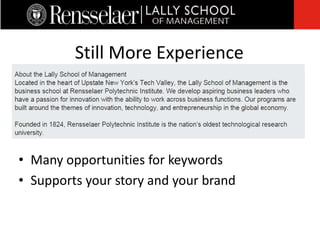
    • Many opportunitiesfor keywords • Supports your story and your brand Still More Experience
  • 25.
    • These shouldbe relevant and descriptive – Pictures – Presentations – Portfolios – Video • LinkedIn =/= Facebook Add Media
  • 26.
    • Used inLinkedIn’s education page search • Two kinds of skills: – The tool (Microsoft Excel) – What you do with the tool (Cash Flow Analysis) Skills
  • 27.
    • Always beupdating your LinkedIn profile – But we don’t all need to know everything • Updates engage your audience more than most other LinkedIn actions • Next steps – Building a relationship strategy – Targeting employers / contacts (Never) The End

Editor's Notes

  • #3 Just one thing It gets you an interview
  • #4 Shows adequate communication skills Displays a customized profile Uses appropriate keywords Offers proof rather than opinion
  • #6 Pairs Describe your strengths Brag Present the facts Don’t forget to include WHO YOU WILL BE!!! Group What are employers looking for? NO ONE IS ALLOWED TO SAY “EXPERIENCE” Strengths
  • #7 What do these Summaries do well?
  • #9 Write one Paragraph or Bullets
  • #10 This section is not always necessary. If you have internship experience, student leadership positions, etc., you may not need to make the case for your fit using your academic projects. Examine your academic works as you think about jobs/industries of interest. Be ready to incorporate them when appropriate.   The section can also be modified to fit the job/industry. For example: FINANCE PROJECTS MANAGEMENT PRESENTATIONS MARKETING PROJECTS AND PRESENTATIONS FINANCE SIMULATION EXPERIENCE   The options are limited only by your experience and how it matches up to your industry of choice
  • #11 Ideally, you will use the format above, which works perfectly for those who have relevant experience with measurable impacts and accomplishments. Some of you do not. In those cases, we will create a bulleted list of detailed descriptors. This bit of advice goes for all parts of the resume. Spend time thinking about your experiences from a stranger’s perspective. You know exactly what you mean with every word you write on this document. You have mental shorthand that fills in the blanks when your language is actually quite vague. The employer does not have access to your mental shorthand. You must translate your experiences to some extent so a stranger from industry X will be able to comprehend the logic and meaning of your work.
  • #14 This section can include your computer skills (software and hardware). It can also include skills relevant to your industry. Financial simulation, modeling, etc. When in doubt about listing a language, ask yourself this question: Would I be comfortable answering if I was asked a question in (insert language here) during the interview? If the answer is yes, list the skill. If the answer is no, list it with the qualifier “Basic” in front of it. Only list languages in this section that are not the native language of the country in which you are applying (i.e. do not list “English” on your resume if you are applying for jobs in the U.S.). This section should only be included for a resume that is headed for Applicant Tracking Software (ATS) or online applications. This section will be populated by terms pulled from the job advertisement. The object is to create a section that will cause the software algorithm to pass your resume through so a human will look at it. Enough of the “right” language will cause this to happen.
  • #15 This section can include your computer skills (software and hardware). It can also include skills relevant to your industry. Financial simulation, modeling, etc. When in doubt about listing a language, ask yourself this question: Would I be comfortable answering if I was asked a question in (insert language here) during the interview? If the answer is yes, list the skill. If the answer is no, list it with the qualifier “Basic” in front of it. Only list languages in this section that are not the native language of the country in which you are applying (i.e. do not list “English” on your resume if you are applying for jobs in the U.S.). This section should only be included for a resume that is headed for Applicant Tracking Software (ATS) or online applications. This section will be populated by terms pulled from the job advertisement. The object is to create a section that will cause the software algorithm to pass your resume through so a human will look at it. Enough of the “right” language will cause this to happen.
  • #18 English name?
  • #19 Quickly: What are keywords for Finance? Supply Chain? Business Analytics? Marketing? Tech Commercialization?
  • #25 This is where I work, so I added these.
  • #28 Turn off