Putting America Back to Work A Career Networking Seminar   August 18, 2009
Getting a job is where it begins, NOT where it ends! Managing your own career is a critical skill Two critical aspects of managing your career Your reputation (your brand) Your network (your delivery) must be practiced frequently is about managing relationships Your brand is about you Professionally Personally Know the risks How do you know you have created an effective network? Network comes to you Interviewing frequently (formally and informally) You are not caught off guard
Social Networking Simple Techniques: One-on-one (networking)  Strength of “weak ties” Build your network as it happens When colleagues/managers move on to other companies or divisions One to many (broadcasting)  Create your very own personal broadcasting medium Find and follow the experts  “ birds of a feather” Create an online presence Update/customize your resume & register with job boards Create online accounts Linkedin.com Facebook.com Twitter.com  Know what is personal & what is professional Consider a “consulting gig” Practice your networking skills Reconnect with past colleagues Seek out both formal & informal interviews Create an online presence Update/customize your resume & register with job boards
Developing A Dynamic Resume Overview: What a Resume Should So for You Showcase your core skills and competencies and highlight career accomplishments/successes/goals. Contain your relevant work history, document relevant training and educational background. Show you are qualified candidate and prompt a potential employer to contact you for more information. Getting Started The resume is a first impression of you, so it must be an effective marketing tool. Determine the job you want to target and research their responsibilities and qualifications. Make a list of your skills/abilities that are relevant to the jobs you are targeting. Identify experiences/accomplishments that show your proficiency in the skills required for job. Summarize your abilities, accomplishments and skills into a brief, concise document. Parts of a Resume Personal Information :  name, address, contact numbers and email address. Objective Statement :  a brief description of who you are and what you want to do. Summary of Qualifications/Specialized Skills :  a brief statement (1-3 sentences) that gives a quick impression of you and your overall qualifications for the job.  The statement should be followed by 4-6 strengths or areas of expertise that support your objective. Significant Work Experience & Accomplishments :  start with most current employer, list 2-4 accomplishments – and should be written in an “action results” format, underscoring your key role in the success.  Education, Specialized Training and Professional Memberships/Organizational Affiliations:   list any specialized courses, certifications or awards.
As the market place for jobs continues to grow and become more and more competitive, talent has to leverage the resources available to stand out amongst the pack. Search engine technology is at the forefront of helping talent gain access the right company, the right position and most importantly the right career. Our goal is to share with everyone the value behind using the internet and search to find that next great opportunity. Our focus will be in a few key areas: The Misconception about the job market today. Why on-line really does work if you leverage it. The “how to” on registering, searching and the technology that drives it. Understand what employers are doing to get your attention and how they are reviewing you. Resources you can utilize to put yourself in front of the right opportunity Managing your career is an ongoing process. Knowing where to start, taking advantage of all the tools at your disposal and remembering to brand yourself is what will keep you marketable and finding success .  Careerbuilder.com
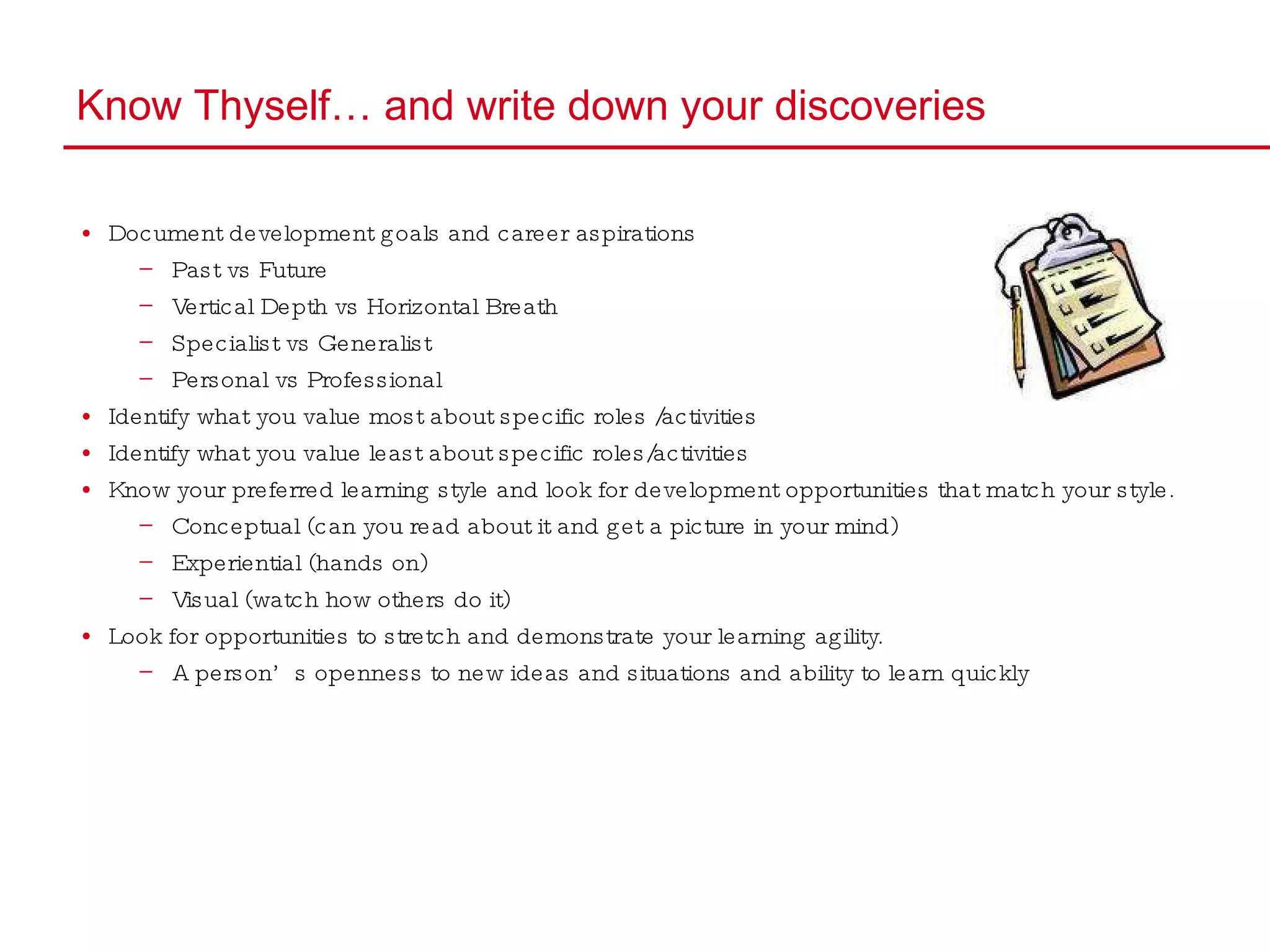
Know Thyself… and write down your discoveries Document development goals and career aspirations Past vs Future Vertical Depth vs Horizontal Breath  Specialist vs Generalist  Personal vs Professional  Identify what you value most about specific roles /activities Identify what you value least about specific roles/activities Know your preferred learning style and look for development opportunities that match your style.  Conceptual (can you read about it and get a picture in your mind) Experiential (hands on) Visual (watch how others do it)  Look for opportunities to stretch and demonstrate your learning agility.  A person’s openness to new ideas and situations and ability to learn quickly
Exactly, What Is A Brand? A person’s perception of a product, service, experience or organization. Branding is an ART and a SCIENCE. Interbrand l Creating and managing brand value
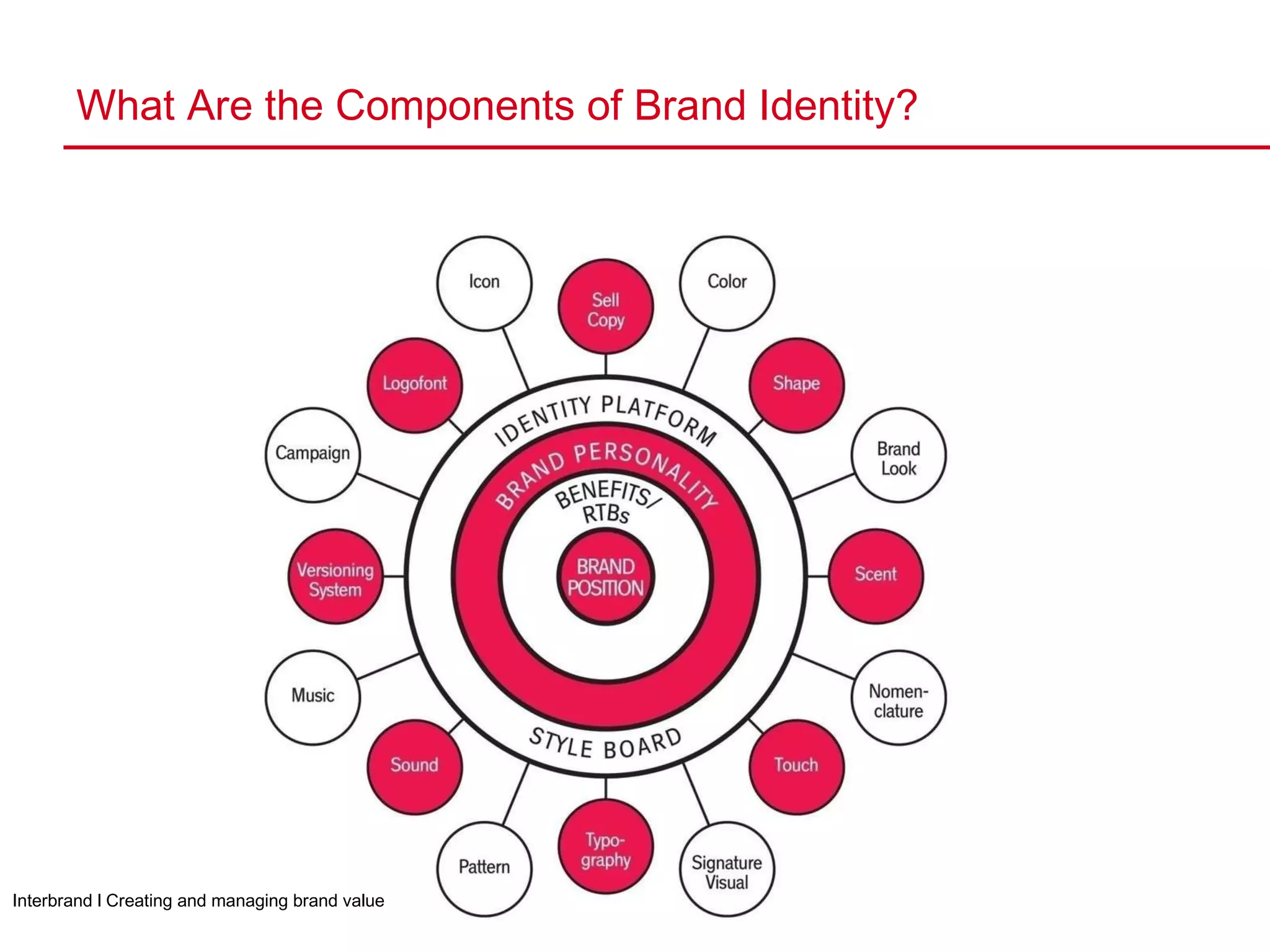
What Are the Components of Brand Identity? Interbrand l Creating and managing brand value
What Is Your Personal Brand? How do you dress? What’s on your web site? How do you speak in conversation? What’s on your answering machine? How do you look on paper? What does your email address say about you? What is your “trademark phrase”?
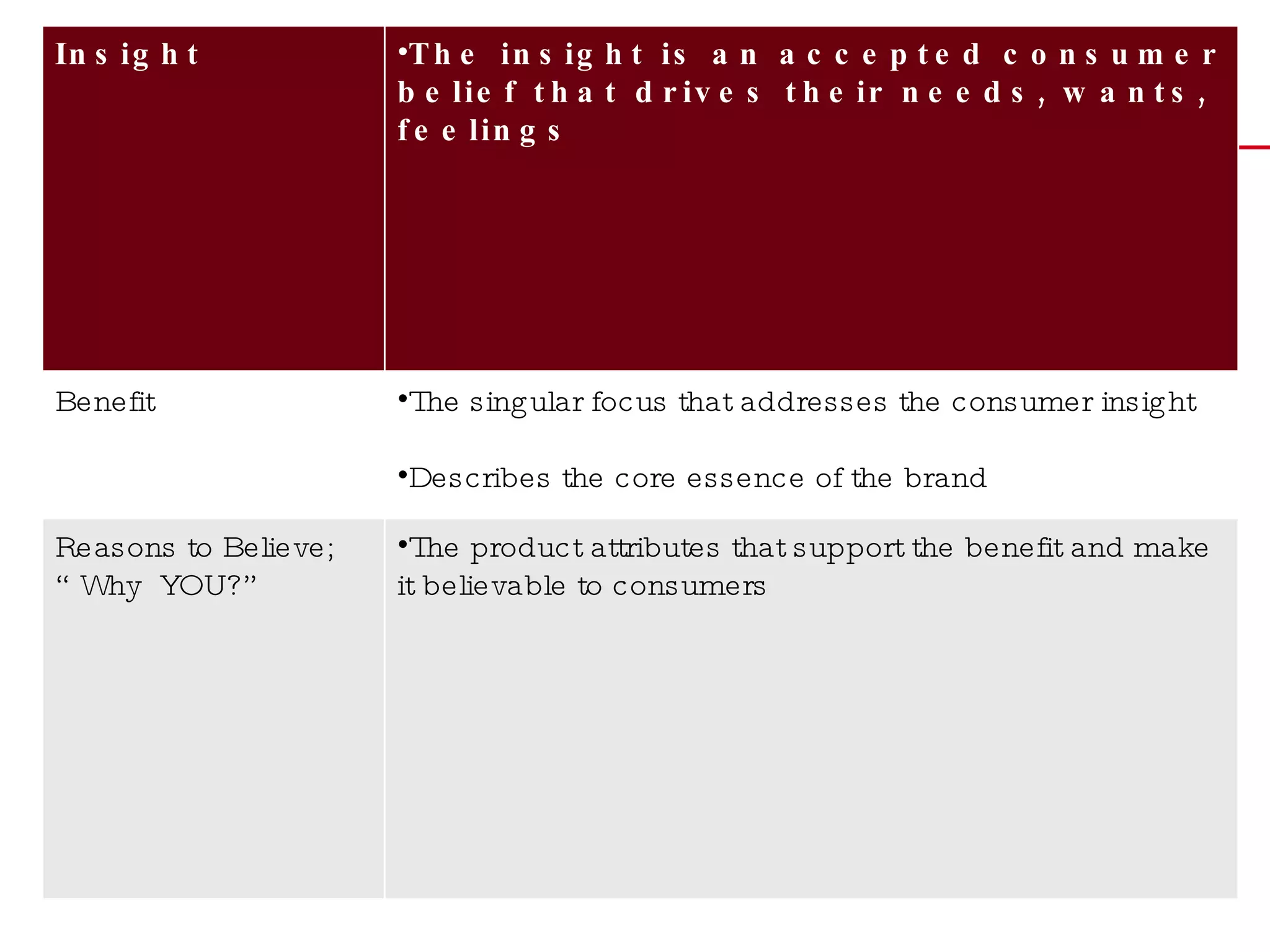
Insight The insight is an accepted consumer belief that drives their needs, wants, feelings Benefit The singular focus that addresses the consumer insight Describes the core essence of the brand Reasons to Believe; “ Why  YOU?” The product attributes that support the benefit and make it believable to consumers
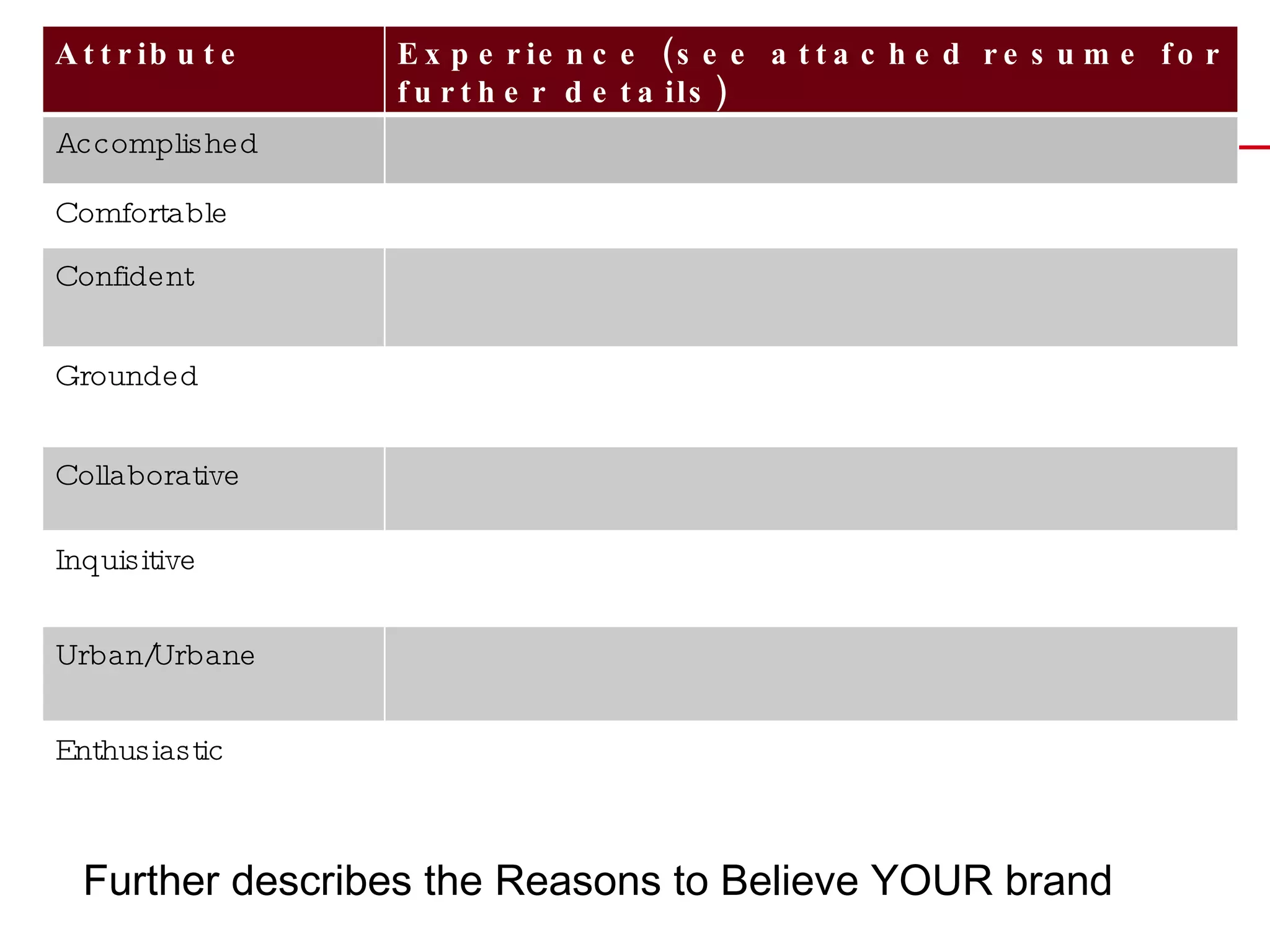
Further describes the Reasons to Believe YOUR brand Attribute Experience (see attached resume for further details) Accomplished Comfortable Confident Grounded Collaborative Inquisitive Urban/Urbane Enthusiastic
Key Takeaways Know your audience Know yourself Understand the competition Effectively promote your brand,  taking  appropriate  risks Recommended Reading: Me 2.0: Build a Powerful Brand to Achieve Career Success by  Dan Schawbel
Development Framework/Personal Assessment Obtain ongoing feedback : Review feedback from formal processes Performance Plans – past 5 years Assessments- past 10 years Development Programs Incorporate feedback from informal processes  Coaching sessions  Development conversations Peer/Mentor feedback Personal reflection and insight Input from others that know you well and see you in action  Align Strengths, Interests, and Values: Document the skills/competencies used in your past jobs and capabilities needed for future roles Look for  High Importance  skills and  Low Proficiency  assessment of your skills to focus on the  core 1 or 2 to develop Identify Opportunities of focus: Document your assessment of your strengths and weaknesses Be brutally honest with yourself Take Action on Your Development: Focus your career development on 1 to 2 critical areas of focus Look to outside resources and programs to address your development gaps and opportunities Prepare to review with a mentor or coach and validate others perceptions
Establishing Your Core Value System Brand Your personal brand is made up of the core values you stand for : You need to be authentic and consistent with your core values  What are your personal values by which you operate daily? Understand that your values are hard to re-establish once they have been compromised  Some questions to ask yourself: How do you demonstrate your core values in interviews? Are you interviewing with companies who exhibit the same core values as you do? Do you exhibit the same core values in your personal and professional life? My Core Value System consists of:  ____________________________________________________________________________________________________________________________________________________________________________________________________________________________________________________________________________________________________________ I Stand For:  ____________________________________________________________________________________________________________________________________________________________________________________________________________________________________________________________________________________________________________
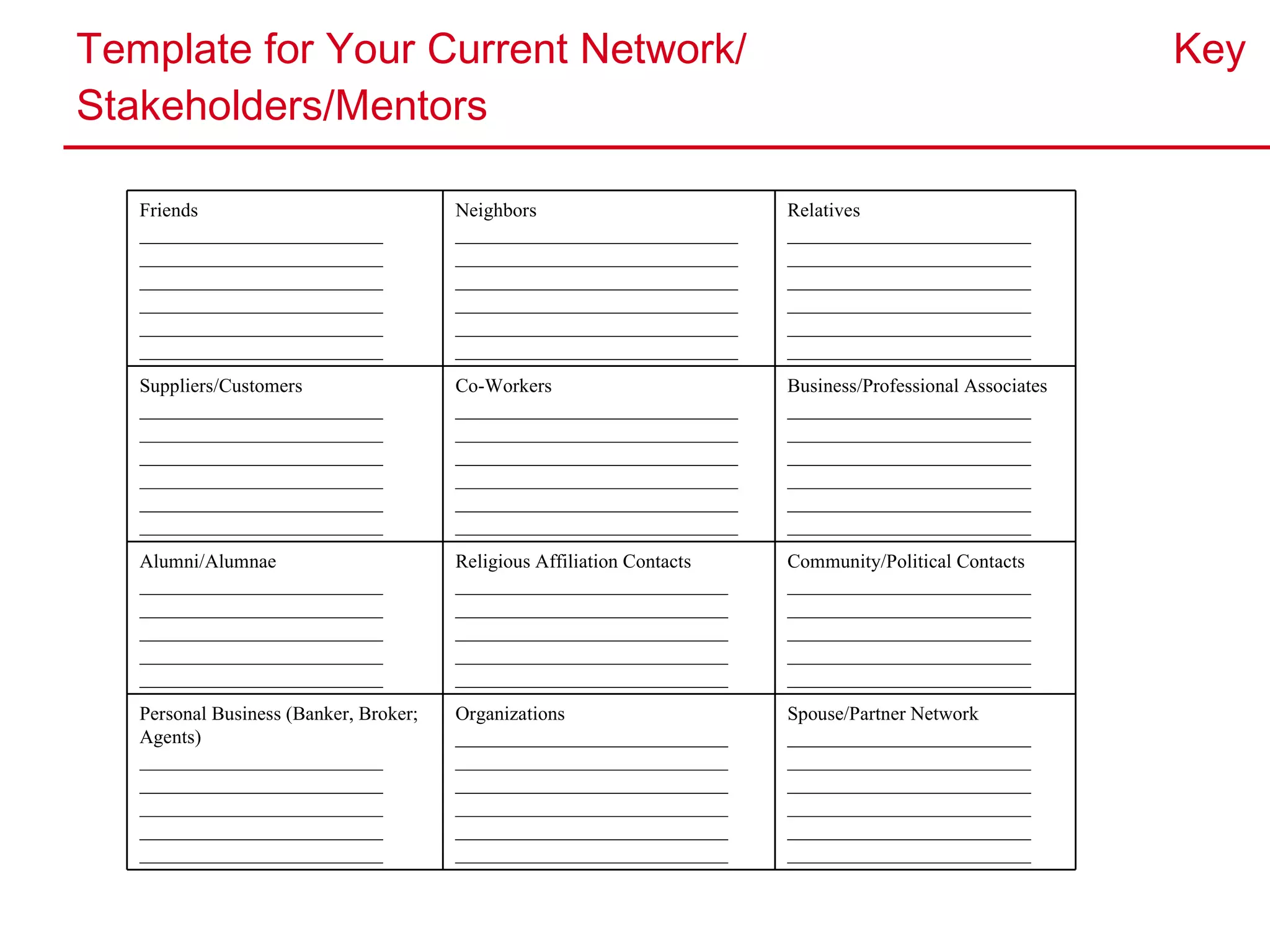
Identify your own “Board of Directors” Identify a list of key stakeholders and other interested parties with a vested interest in YOU, inc.  Consider a broad set of directors who know you well and will see you in various settings Create your  “board” and key stakeholder network Friends, Neighbors, Relatives, Suppliers/Customers Co-workers, Business/Professional Associates  Alumni, Religious Affiliation Contacts  Community Political Contacts,  Personal Business (Banker, Broker, Agents) Organizations, Spouse / Partner Network  Make contact with them regarding your goals and expectations … share with them your development focus and career aspirations.  Over communicate to your network… but don’t over do it Use technology but hand written notes still have more meaning  Establish a Mentor relationship Someone who has an expertise in your area of interest or who has been successful with their career  Someone you trust and respect Meet on a regular basis to learn from his/her experiences Where to find a mentor Former teachers Friends  and former colleagues  Managers and executives  People in your field Subject Matter Experts  Use your Network to research other industries and potential mentors  Focus your relationship with your Mentor on your key development need such as: Build your knowledgebase and learn a new core area of expertise More variety in background and experience More composure under stress Broader, better interpersonal skills Becoming more problem focused and results oriented
Appendix Template for Development Preparation Template for Your Current Network/Mentors/Key Stakeholders References and Self Guided Sites Job Boards and Posting Websites
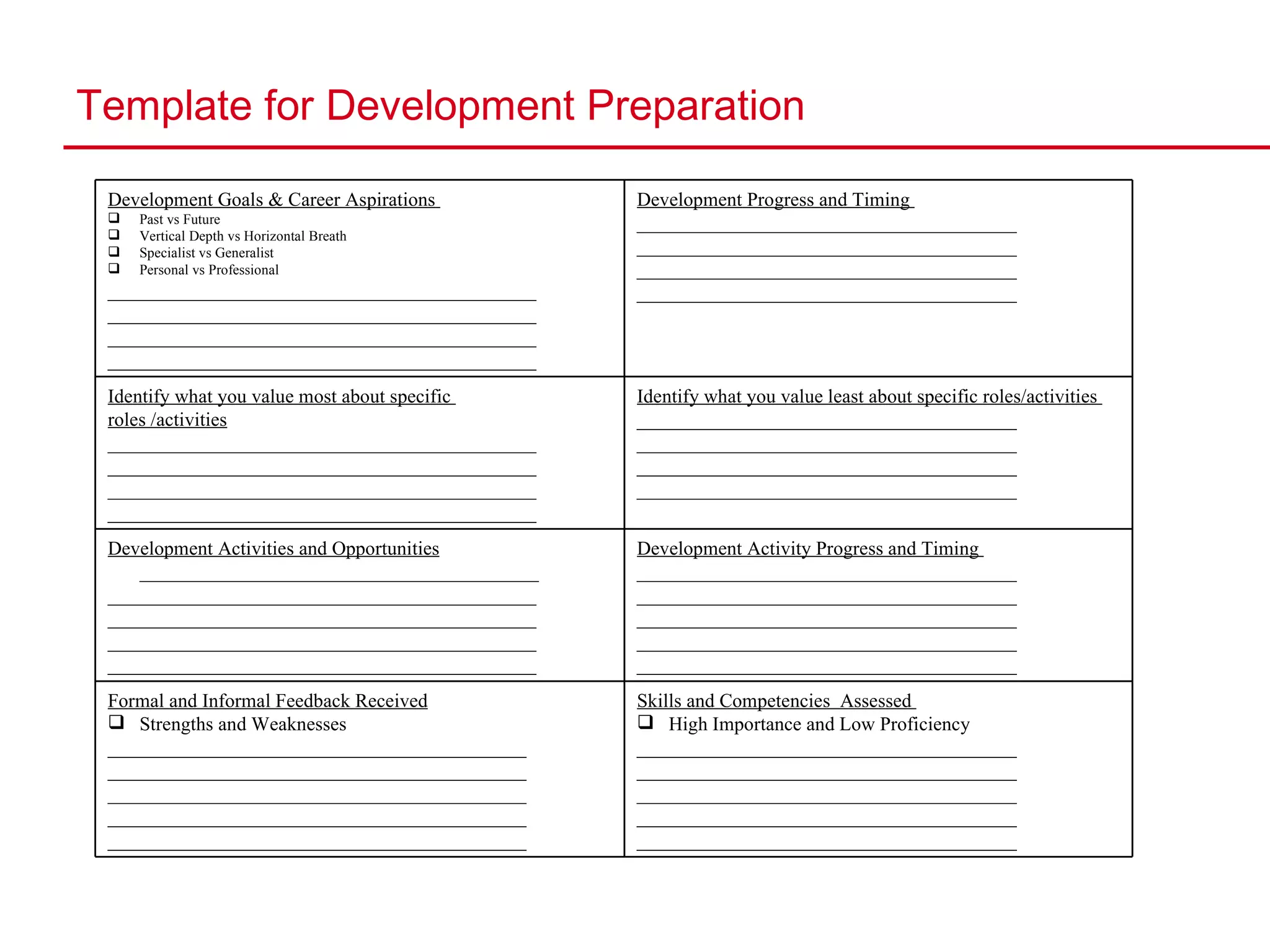
Template for Development Preparation Development Goals & Career Aspirations  Past vs Future Vertical Depth vs Horizontal Breath  Specialist vs Generalist  Personal vs Professional  ____________________________________________ ____________________________________________ ____________________________________________ ____________________________________________ Development Progress and Timing  _______________________________________ _______________________________________ _______________________________________ _______________________________________ Identify what you value most about specific  roles /activities ____________________________________________ ____________________________________________ ____________________________________________ ____________________________________________ Identify what you value least about specific roles/activities  _______________________________________ _______________________________________ _______________________________________ _______________________________________ Development Activities and Opportunities  _________________________________________ ____________________________________________ ____________________________________________ ____________________________________________ ____________________________________________ Development Activity Progress and Timing  _______________________________________ _______________________________________ _______________________________________ _______________________________________ _______________________________________ Formal and Informal Feedback Received Strengths and Weaknesses  ___________________________________________ ___________________________________________ ___________________________________________ ___________________________________________ ___________________________________________ Skills and Competencies  Assessed  High Importance and Low Proficiency  _______________________________________ _______________________________________ _______________________________________ _______________________________________ _______________________________________
Template for Your Current Network/  Key Stakeholders/Mentors Friends _________________________ _________________________ _________________________ _________________________ _________________________ _________________________ Neighbors _____________________________ _____________________________ _____________________________ _____________________________ _____________________________ _____________________________ Relatives _________________________ _________________________ _________________________ _________________________ _________________________ _________________________ Suppliers/Customers  _________________________ _________________________ _________________________ _________________________ _________________________ _________________________ Co-Workers _____________________________ _____________________________ _____________________________ _____________________________ _____________________________ _____________________________ Business/Professional Associates _________________________ _________________________ _________________________ _________________________ _________________________ _________________________ Alumni/Alumnae _________________________ _________________________ _________________________ _________________________ _________________________ Religious Affiliation Contacts ____________________________ ____________________________ ____________________________ ____________________________ ____________________________ Community/Political Contacts _________________________ _________________________ _________________________ _________________________ _________________________ Personal Business (Banker, Broker; Agents) _________________________ _________________________ _________________________ _________________________ _________________________ Organizations ____________________________ ____________________________ ____________________________ ____________________________ ____________________________ ____________________________ Spouse/Partner Network _________________________ _________________________ _________________________ _________________________ _________________________ _________________________
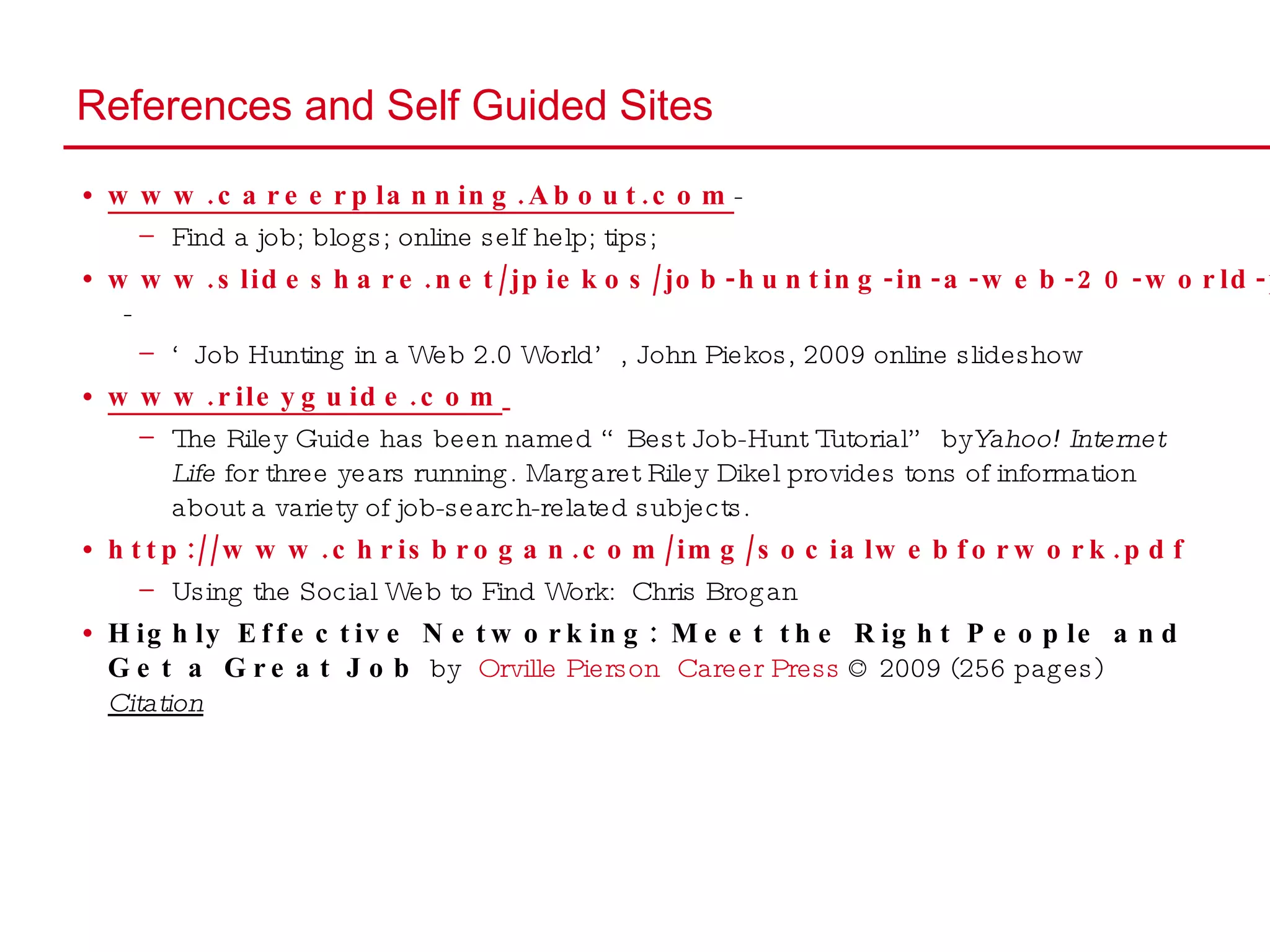
References and Self Guided Sites www.careerplanning.About.com -  Find a job; blogs; online self help; tips;  www.slideshare.net/jpiekos/job-hunting-in-a-web-20-world-presentation   -  ‘ Job Hunting in a Web 2.0 World’, John Piekos, 2009 online slideshow www.rileyguide.com   The Riley Guide has been named “Best Job-Hunt Tutorial” by  Yahoo! Internet Life  for three years running. Margaret Riley Dikel provides tons of information about a variety of job-search-related subjects. http://www.chrisbrogan.com/img/socialwebforwork.pdf   Using the Social Web to Find Work:  Chris Brogan Highly Effective Networking: Meet the Right People and Get a Great Job  by  Orville Pierson   Career Press  © 2009 (256 pages)  Citation
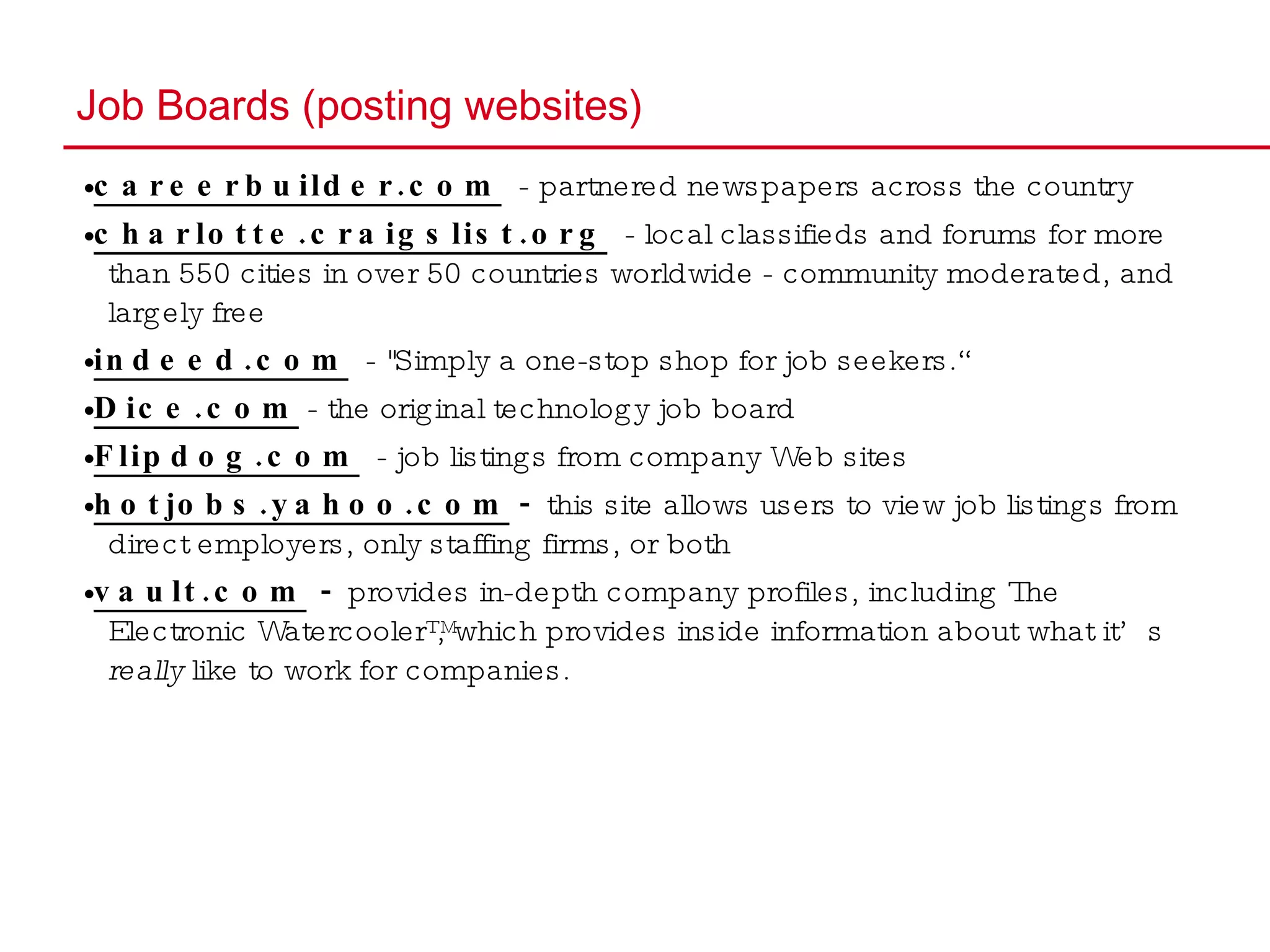
Job Boards (posting websites) • careerbuilder.com   - partnered newspapers across the country • charlotte.craigslist.org   - local classifieds and forums for more than 550 cities in over 50 countries worldwide - community moderated, and largely free • indeed.com   - "Simply a one-stop shop for job seekers.“ • Dice.com  - the original technology job board • Flipdog.com   - job listings from company Web sites • hotjobs.yahoo.com   -  this site allows users to view job listings from direct employers, only staffing firms, or both • vault.com  -  provides in-depth company profiles, including The Electronic Watercooler™, which provides inside information about what it’s  really  like to work for companies.
Stepping Out Now may be the time to follow your dream of starting your own business. Some of the nation’s most successful companies were formed during difficult economic times. Starting your own business requires passion, lots of hard work, and finding ways to increase likelihood of success. Kauffman Foundation’s FastTrac programs are designed to help entrepreneurs with skills needed to create, manage, and grow successful businesses. Developed by entrepreneurs, facilitated by entrepreneurs, for entrepreneurs. Program begins with the business idea through ten steps to “make it happen”. FastTrac in Charlotte begins week of July 6.  No participation fee Apply at  www.fasttrac.org Charlotte contact is George McAllister (704) 548-1090 [email_address] National sponsors Kauffman Foundation Deluxe Corporation Foundation
CPCC – Corporate & Continuing Education  Programs for Changing Careers http://www.cpcc.edu/changingcareers As a catalyst for economic growth in the region, CPCC works with many community agencies and businesses to identify areas where jobs currently exist or may be in demand in the future.  In turn, the college provides educational programs to help individuals develop the knowledge and skills necessary to be successful in these industries.   The US Department of Labor's Occupational Outlook Handbook cites an  associate degree or higher as the most significant level of postsecondary education or training for 12 of the 20 fastest growing occupations .  As Charlotte-Mecklenburg's community college, CPCC offers over 100 associate degrees, diplomas or certificates; many that prepare individuals for careers in these fast growing industries.   Approximately 60% of the students in the Corporate & Continuing Education (CCE) division have graduated from college and are at CPCC to add credentials to their resumes. Whether your goal is a degree, a certificate, a job-related skill or a program in our Lifelong Learning Institute, CPCC can help you Get There! CPCC has available Short-Term education and training programs.  These programs can be completed in  15-18 months  and offer the knowledge and skills necessary to effectively compete for tomorrow's jobs in demand. Based on information from our region's economic developers and projections from the  Occupational Outlook Handbook , the following industries are projected to be among the fastest growing occupations and those with strong job potential in the Charlotte-Mecklenburg region:  Automotive - Education - Energy - Engineering - Entrepreneurship - Financial Services - Healthcare - Heavy Equipment - Information Technology - Integrated Systems Technology - Office Administration-Personnel  Administration - Process Improvement - Public Safety - Small Businesses - Supply Chain Management - Sustainable Technologies - Technical Careers   More information is available at  http://www.cpcc.edu/changingcareers All programs and services listed as  non-credit  are offered through the college's  Corporate & Continuing Education division (CCE).   These courses and certificates start at various times throughout the calendar year and registration is on-going as space is available.  For more information or to register for non-credit programs, please call  704.330.4223  or click the link:  http://cce.cpcc.edu/register-now  . Many of the programs offered by CCE qualify for funding through the Workforce Investment Act.  Contact the ESC, Workforce Development Board, JobLink or check the NC STARS website ( www.ncstars.org ) to see which courses in your area  qualify.
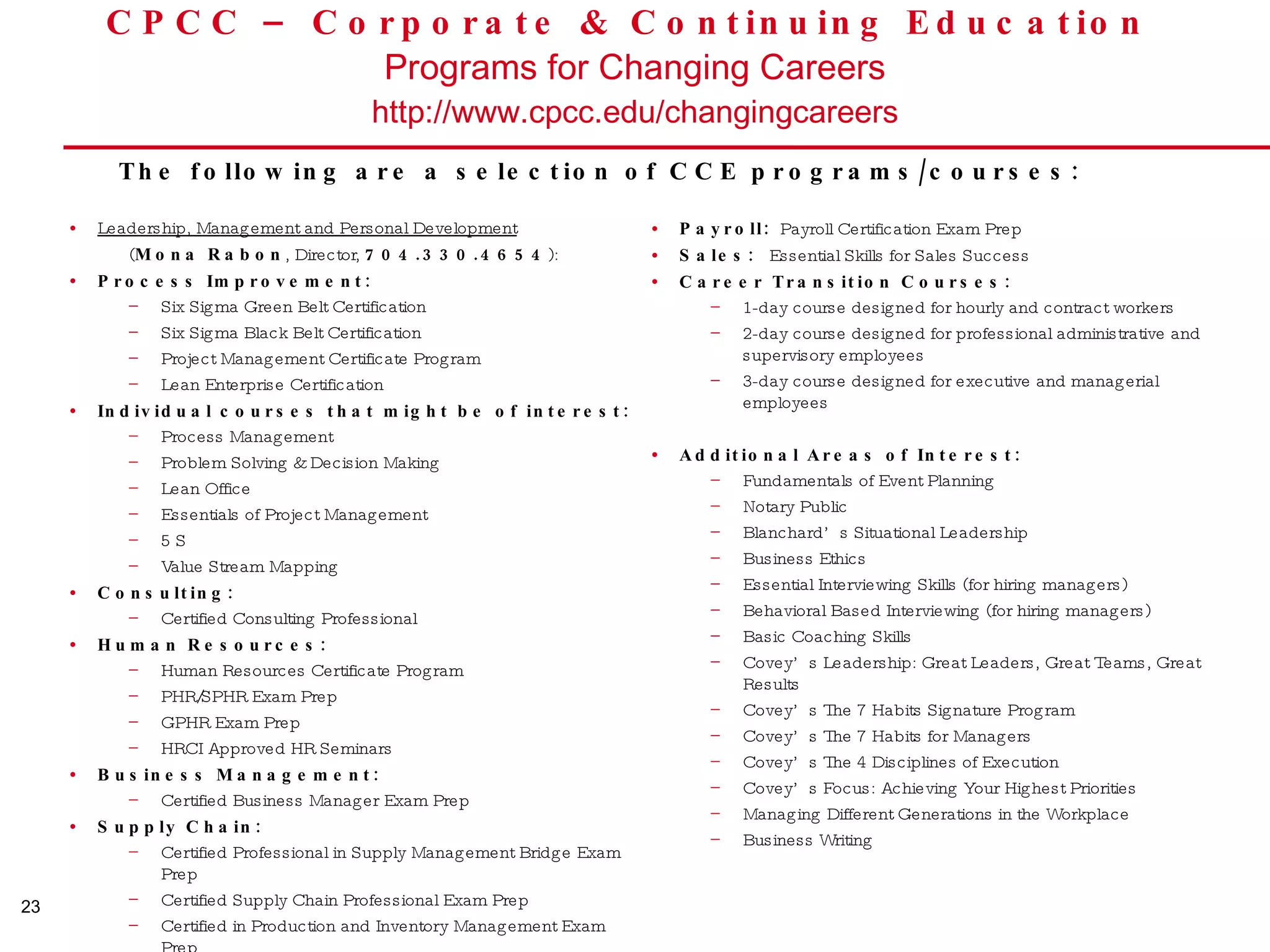
CPCC – Corporate & Continuing Education  Programs for Changing Careers http://www.cpcc.edu/changingcareers Leadership, Management and Personal Development   ( Mona Rabon , Director,  704.330.4654 ):  Process Improvement: Six Sigma Green Belt Certification Six Sigma Black Belt Certification Project Management Certificate Program Lean Enterprise Certification Individual courses that might be of interest: Process Management Problem Solving & Decision Making Lean Office Essentials of Project Management 5 S Value Stream Mapping Consulting:  Certified Consulting Professional Human Resources: Human Resources Certificate Program PHR/SPHR Exam Prep GPHR Exam Prep HRCI Approved HR Seminars Business Management:  Certified Business Manager Exam Prep Supply Chain: Certified Professional in Supply Management Bridge Exam Prep Certified Supply Chain Professional Exam Prep Certified in Production and Inventory Management Exam Prep  Payroll:   Payroll Certification Exam Prep Sales:  Essential Skills for Sales Success Career Transition Courses: 1-day course designed for hourly and contract workers 2-day course designed for professional administrative and supervisory employees 3-day course designed for executive and managerial employees Additional Areas of Interest: Fundamentals of Event Planning Notary Public Blanchard’s Situational Leadership  Business Ethics Essential Interviewing Skills (for hiring managers) Behavioral Based Interviewing (for hiring managers) Basic Coaching Skills Covey’s Leadership: Great Leaders, Great Teams, Great Results Covey’s The 7 Habits Signature Program  Covey’s The 7 Habits for Managers Covey’s The 4 Disciplines of Execution Covey’s Focus: Achieving Your Highest Priorities Managing Different Generations in the Workplace Business Writing The following are a selection of CCE programs/courses:
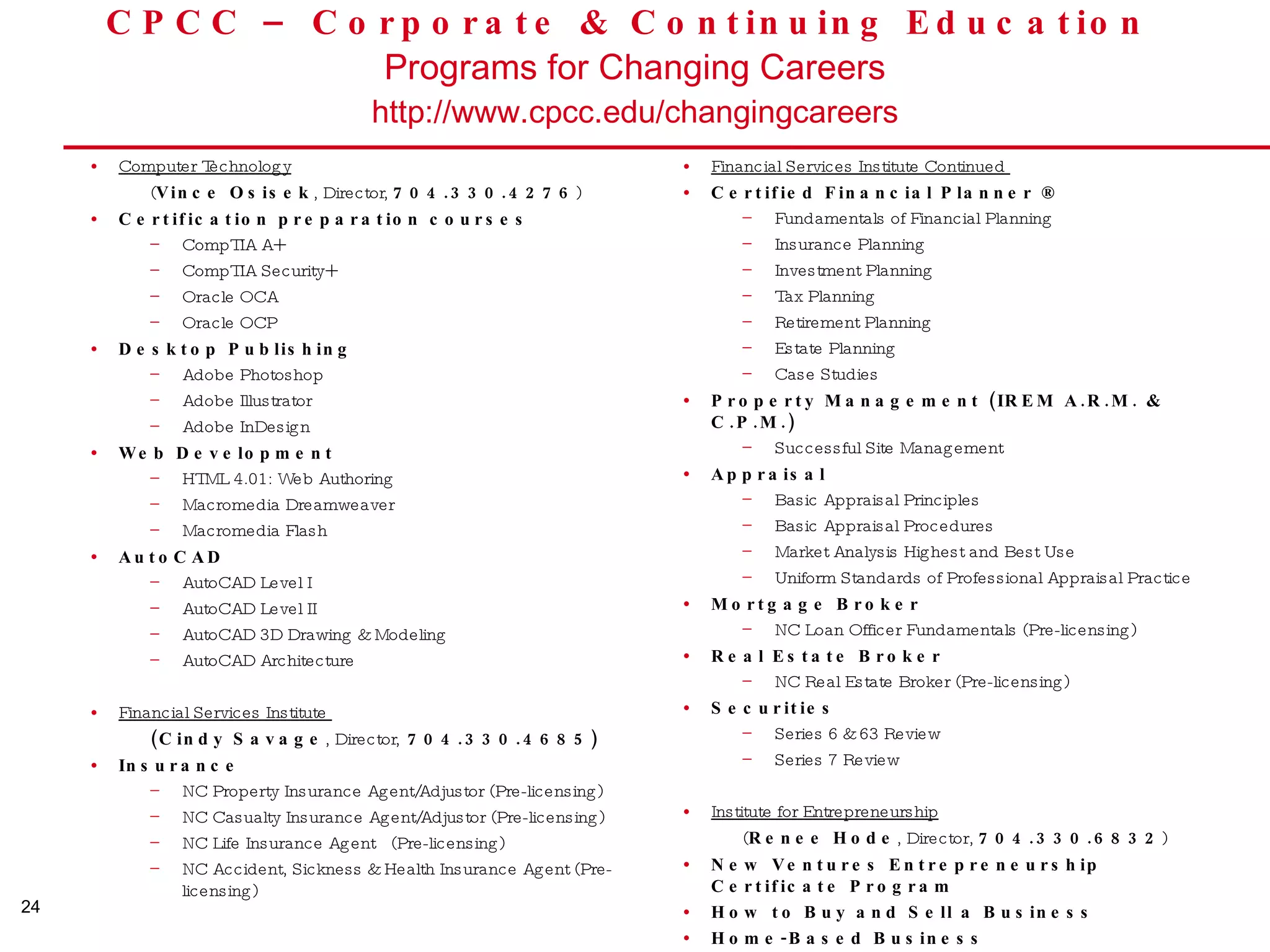
CPCC – Corporate & Continuing Education  Programs for Changing Careers http://www.cpcc.edu/changingcareers Computer Technology   ( Vince Osisek , Director,  704.330.4276 ) Certification preparation courses CompTIA A+ CompTIA Security+ Oracle OCA Oracle OCP Desktop Publishing Adobe Photoshop Adobe Illustrator Adobe InDesign Web Development HTML 4.01: Web Authoring Macromedia Dreamweaver Macromedia Flash AutoCAD AutoCAD Level I AutoCAD Level II AutoCAD 3D Drawing & Modeling AutoCAD Architecture Financial Services Institute  (Cindy Savage , Director,  704.330.4685) Insurance  NC Property Insurance Agent/Adjustor (Pre-licensing) NC Casualty Insurance Agent/Adjustor (Pre-licensing)  NC Life Insurance Agent  (Pre-licensing) NC Accident, Sickness & Health Insurance Agent (Pre-licensing) Financial Services Institute Continued  Certified Financial Planner ®  Fundamentals of Financial Planning Insurance Planning  Investment Planning Tax Planning  Retirement Planning  Estate Planning  Case Studies  Property Management (IREM A.R.M. & C.P.M.)  Successful Site Management  Appraisal   Basic Appraisal Principles  Basic Appraisal Procedures Market Analysis Highest and Best Use Uniform Standards of Professional Appraisal Practice  Mortgage Broker NC Loan Officer Fundamentals (Pre-licensing)  Real Estate Broker NC Real Estate Broker (Pre-licensing) Securities  Series 6 & 63 Review  Series 7 Review Institute for Entrepreneurship   ( Renee Hode , Director,  704.330.6832 ) New Ventures Entrepreneurship Certificate Program  How to Buy and Sell a Business  Home-Based Business
UNC Charlotte Program Overviews & Contacts Programs 18 doctoral programs 62 master’s degree programs 55 graduate-credit certificate programs (typically take 12-15 months to complete, enrolled on a part-time basis) 19 continuing education certificate programs (typically take 3-4 months to complete) 90 baccalaureate degree programs Examples of Graduate Credit Certificates Health Information Technology (approval pending) Nonprofit Management Community Health Promotion Management of Information Technology Information Security and Privacy Gerontology Technical/Professional Writing Instructional Systems Technology Teaching – in many specialty areas Examples of Continuing Education Programs Basic Web Design Search Engine Optimization, Marketing, and Metrics Project Management and Advanced Project Management Business Process Management Business Analysis Finance and Accounting for the Non-Financial Manager Human Resource (Generalist and Advanced) Training and Development (Generalist and Advanced) Paralegal New Workforce Development ARRA-funded Initiatives workforce.uncc.edu  Workforce Development Program Manager (e-mail  [email_address] ) Condensed-format delivery of four certificate programs,  with special add-on career module Graduate-credit certificates in  5-6 months Continuing Education certificates in  5-6 weeks For More Information on Graduate Programs Next General Information Session will be on June 24, 10:30 – 11:30 a.m., on the Main Campus Next MBA/MBA in Sports Marketing and Management Information Session will be on June 10, 12:00 – 1:30 p.m., at UNC Charlotte Uptown Or make an appointment to meet with Maryanne Maree-Sams by contacting her via e-mail at  [email_address] .  She can also be reached by phone at 704-687-7243. For More Information on Continuing Education Programs Contact me, Connie Martin (and, soon, our new Workforce Development Program Manager), at  [email_address] Or call our Continuing Education Office at 704-687-8900
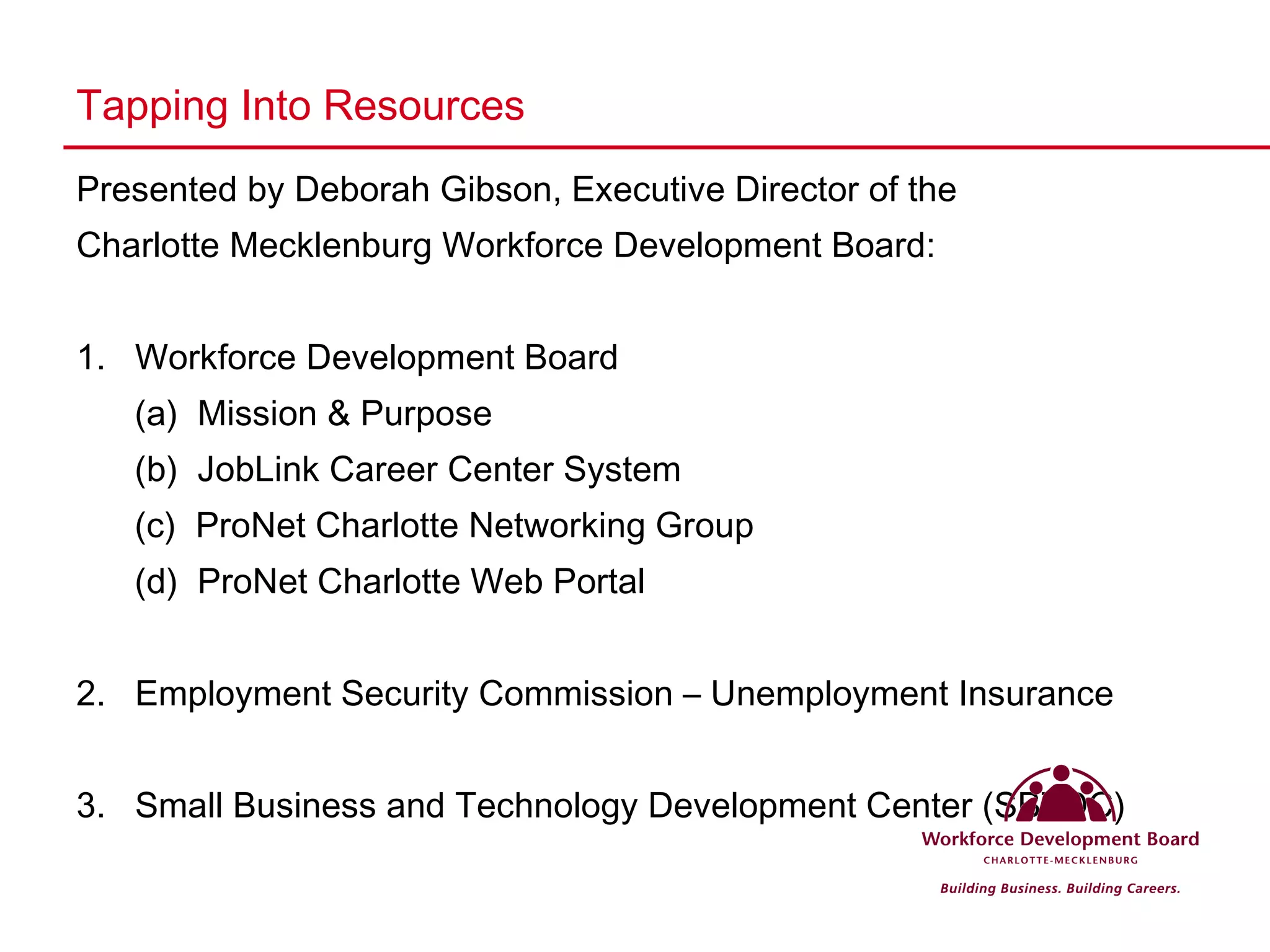
Tapping Into Resources Presented by Deborah Gibson, Executive Director of the  Charlotte Mecklenburg Workforce Development Board: 1.  Workforce Development Board (a)  Mission & Purpose (b)  JobLink Career Center System (c)  ProNet Charlotte Networking Group (d)  ProNet Charlotte Web Portal 2.  Employment Security Commission – Unemployment Insurance 3.  Small Business and Technology Development Center (SBTDC)
Creating Financial Stability Katherine M. (Kitt) Kirchner   (704) 341-5122  Financial Advisor, Merrill Lynch Global Wealth Management   [email_address]   *Asset allocation, diversification and systematic investment do not assure a profit or protect against loss in a declining market. Distribution Options Keep assets with “old” company plan Roll assets to “new” company plan Roll assets to an investment firm IRA Access to Funds All withdrawals treated as ordinary income Beware of  penalties Limited penalty-free withdrawal options available Investment Considerations Asset allocation depends on time horizon, risk tolerance, and financial goals A financial advisor can help you plan Investment “Rules” Invest for the long term Invest systematically  Don’t try to time the market Diversify with quality investments Don’t forget inflation Become and expert or rely on one Professional Management Customized investment strategies Investment risk mitigation Tax consideration Estate planning services Insurance analysis Retirement planning services
Thank you! Thank you!

Overview8.18

  • 1.
    Putting America Backto Work A Career Networking Seminar August 18, 2009
  • 2.
    Getting a jobis where it begins, NOT where it ends! Managing your own career is a critical skill Two critical aspects of managing your career Your reputation (your brand) Your network (your delivery) must be practiced frequently is about managing relationships Your brand is about you Professionally Personally Know the risks How do you know you have created an effective network? Network comes to you Interviewing frequently (formally and informally) You are not caught off guard
  • 3.
    Social Networking SimpleTechniques: One-on-one (networking) Strength of “weak ties” Build your network as it happens When colleagues/managers move on to other companies or divisions One to many (broadcasting) Create your very own personal broadcasting medium Find and follow the experts “ birds of a feather” Create an online presence Update/customize your resume & register with job boards Create online accounts Linkedin.com Facebook.com Twitter.com Know what is personal & what is professional Consider a “consulting gig” Practice your networking skills Reconnect with past colleagues Seek out both formal & informal interviews Create an online presence Update/customize your resume & register with job boards
  • 4.
    Developing A DynamicResume Overview: What a Resume Should So for You Showcase your core skills and competencies and highlight career accomplishments/successes/goals. Contain your relevant work history, document relevant training and educational background. Show you are qualified candidate and prompt a potential employer to contact you for more information. Getting Started The resume is a first impression of you, so it must be an effective marketing tool. Determine the job you want to target and research their responsibilities and qualifications. Make a list of your skills/abilities that are relevant to the jobs you are targeting. Identify experiences/accomplishments that show your proficiency in the skills required for job. Summarize your abilities, accomplishments and skills into a brief, concise document. Parts of a Resume Personal Information : name, address, contact numbers and email address. Objective Statement : a brief description of who you are and what you want to do. Summary of Qualifications/Specialized Skills : a brief statement (1-3 sentences) that gives a quick impression of you and your overall qualifications for the job. The statement should be followed by 4-6 strengths or areas of expertise that support your objective. Significant Work Experience & Accomplishments : start with most current employer, list 2-4 accomplishments – and should be written in an “action results” format, underscoring your key role in the success. Education, Specialized Training and Professional Memberships/Organizational Affiliations: list any specialized courses, certifications or awards.
  • 5.
    As the marketplace for jobs continues to grow and become more and more competitive, talent has to leverage the resources available to stand out amongst the pack. Search engine technology is at the forefront of helping talent gain access the right company, the right position and most importantly the right career. Our goal is to share with everyone the value behind using the internet and search to find that next great opportunity. Our focus will be in a few key areas: The Misconception about the job market today. Why on-line really does work if you leverage it. The “how to” on registering, searching and the technology that drives it. Understand what employers are doing to get your attention and how they are reviewing you. Resources you can utilize to put yourself in front of the right opportunity Managing your career is an ongoing process. Knowing where to start, taking advantage of all the tools at your disposal and remembering to brand yourself is what will keep you marketable and finding success . Careerbuilder.com
  • 6.
    Know Thyself… andwrite down your discoveries Document development goals and career aspirations Past vs Future Vertical Depth vs Horizontal Breath Specialist vs Generalist Personal vs Professional Identify what you value most about specific roles /activities Identify what you value least about specific roles/activities Know your preferred learning style and look for development opportunities that match your style. Conceptual (can you read about it and get a picture in your mind) Experiential (hands on) Visual (watch how others do it) Look for opportunities to stretch and demonstrate your learning agility. A person’s openness to new ideas and situations and ability to learn quickly
  • 7.
    Exactly, What IsA Brand? A person’s perception of a product, service, experience or organization. Branding is an ART and a SCIENCE. Interbrand l Creating and managing brand value
  • 8.
    What Are theComponents of Brand Identity? Interbrand l Creating and managing brand value
  • 9.
    What Is YourPersonal Brand? How do you dress? What’s on your web site? How do you speak in conversation? What’s on your answering machine? How do you look on paper? What does your email address say about you? What is your “trademark phrase”?
  • 10.
    Insight The insightis an accepted consumer belief that drives their needs, wants, feelings Benefit The singular focus that addresses the consumer insight Describes the core essence of the brand Reasons to Believe; “ Why YOU?” The product attributes that support the benefit and make it believable to consumers
  • 11.
    Further describes theReasons to Believe YOUR brand Attribute Experience (see attached resume for further details) Accomplished Comfortable Confident Grounded Collaborative Inquisitive Urban/Urbane Enthusiastic
  • 12.
    Key Takeaways Knowyour audience Know yourself Understand the competition Effectively promote your brand, taking appropriate risks Recommended Reading: Me 2.0: Build a Powerful Brand to Achieve Career Success by Dan Schawbel
  • 13.
    Development Framework/Personal AssessmentObtain ongoing feedback : Review feedback from formal processes Performance Plans – past 5 years Assessments- past 10 years Development Programs Incorporate feedback from informal processes Coaching sessions Development conversations Peer/Mentor feedback Personal reflection and insight Input from others that know you well and see you in action Align Strengths, Interests, and Values: Document the skills/competencies used in your past jobs and capabilities needed for future roles Look for High Importance skills and Low Proficiency assessment of your skills to focus on the core 1 or 2 to develop Identify Opportunities of focus: Document your assessment of your strengths and weaknesses Be brutally honest with yourself Take Action on Your Development: Focus your career development on 1 to 2 critical areas of focus Look to outside resources and programs to address your development gaps and opportunities Prepare to review with a mentor or coach and validate others perceptions
  • 14.
    Establishing Your CoreValue System Brand Your personal brand is made up of the core values you stand for : You need to be authentic and consistent with your core values What are your personal values by which you operate daily? Understand that your values are hard to re-establish once they have been compromised Some questions to ask yourself: How do you demonstrate your core values in interviews? Are you interviewing with companies who exhibit the same core values as you do? Do you exhibit the same core values in your personal and professional life? My Core Value System consists of: ____________________________________________________________________________________________________________________________________________________________________________________________________________________________________________________________________________________________________________ I Stand For: ____________________________________________________________________________________________________________________________________________________________________________________________________________________________________________________________________________________________________________
  • 15.
    Identify your own“Board of Directors” Identify a list of key stakeholders and other interested parties with a vested interest in YOU, inc. Consider a broad set of directors who know you well and will see you in various settings Create your “board” and key stakeholder network Friends, Neighbors, Relatives, Suppliers/Customers Co-workers, Business/Professional Associates Alumni, Religious Affiliation Contacts Community Political Contacts, Personal Business (Banker, Broker, Agents) Organizations, Spouse / Partner Network Make contact with them regarding your goals and expectations … share with them your development focus and career aspirations. Over communicate to your network… but don’t over do it Use technology but hand written notes still have more meaning Establish a Mentor relationship Someone who has an expertise in your area of interest or who has been successful with their career Someone you trust and respect Meet on a regular basis to learn from his/her experiences Where to find a mentor Former teachers Friends and former colleagues Managers and executives People in your field Subject Matter Experts Use your Network to research other industries and potential mentors Focus your relationship with your Mentor on your key development need such as: Build your knowledgebase and learn a new core area of expertise More variety in background and experience More composure under stress Broader, better interpersonal skills Becoming more problem focused and results oriented
  • 16.
    Appendix Template forDevelopment Preparation Template for Your Current Network/Mentors/Key Stakeholders References and Self Guided Sites Job Boards and Posting Websites
  • 17.
    Template for DevelopmentPreparation Development Goals & Career Aspirations Past vs Future Vertical Depth vs Horizontal Breath Specialist vs Generalist Personal vs Professional ____________________________________________ ____________________________________________ ____________________________________________ ____________________________________________ Development Progress and Timing _______________________________________ _______________________________________ _______________________________________ _______________________________________ Identify what you value most about specific roles /activities ____________________________________________ ____________________________________________ ____________________________________________ ____________________________________________ Identify what you value least about specific roles/activities _______________________________________ _______________________________________ _______________________________________ _______________________________________ Development Activities and Opportunities _________________________________________ ____________________________________________ ____________________________________________ ____________________________________________ ____________________________________________ Development Activity Progress and Timing _______________________________________ _______________________________________ _______________________________________ _______________________________________ _______________________________________ Formal and Informal Feedback Received Strengths and Weaknesses ___________________________________________ ___________________________________________ ___________________________________________ ___________________________________________ ___________________________________________ Skills and Competencies Assessed High Importance and Low Proficiency _______________________________________ _______________________________________ _______________________________________ _______________________________________ _______________________________________
  • 18.
    Template for YourCurrent Network/ Key Stakeholders/Mentors Friends _________________________ _________________________ _________________________ _________________________ _________________________ _________________________ Neighbors _____________________________ _____________________________ _____________________________ _____________________________ _____________________________ _____________________________ Relatives _________________________ _________________________ _________________________ _________________________ _________________________ _________________________ Suppliers/Customers _________________________ _________________________ _________________________ _________________________ _________________________ _________________________ Co-Workers _____________________________ _____________________________ _____________________________ _____________________________ _____________________________ _____________________________ Business/Professional Associates _________________________ _________________________ _________________________ _________________________ _________________________ _________________________ Alumni/Alumnae _________________________ _________________________ _________________________ _________________________ _________________________ Religious Affiliation Contacts ____________________________ ____________________________ ____________________________ ____________________________ ____________________________ Community/Political Contacts _________________________ _________________________ _________________________ _________________________ _________________________ Personal Business (Banker, Broker; Agents) _________________________ _________________________ _________________________ _________________________ _________________________ Organizations ____________________________ ____________________________ ____________________________ ____________________________ ____________________________ ____________________________ Spouse/Partner Network _________________________ _________________________ _________________________ _________________________ _________________________ _________________________
  • 19.
    References and SelfGuided Sites www.careerplanning.About.com - Find a job; blogs; online self help; tips; www.slideshare.net/jpiekos/job-hunting-in-a-web-20-world-presentation - ‘ Job Hunting in a Web 2.0 World’, John Piekos, 2009 online slideshow www.rileyguide.com The Riley Guide has been named “Best Job-Hunt Tutorial” by Yahoo! Internet Life for three years running. Margaret Riley Dikel provides tons of information about a variety of job-search-related subjects. http://www.chrisbrogan.com/img/socialwebforwork.pdf Using the Social Web to Find Work: Chris Brogan Highly Effective Networking: Meet the Right People and Get a Great Job by  Orville Pierson   Career Press © 2009 (256 pages) Citation
  • 20.
    Job Boards (postingwebsites) • careerbuilder.com - partnered newspapers across the country • charlotte.craigslist.org - local classifieds and forums for more than 550 cities in over 50 countries worldwide - community moderated, and largely free • indeed.com - "Simply a one-stop shop for job seekers.“ • Dice.com - the original technology job board • Flipdog.com - job listings from company Web sites • hotjobs.yahoo.com - this site allows users to view job listings from direct employers, only staffing firms, or both • vault.com - provides in-depth company profiles, including The Electronic Watercooler™, which provides inside information about what it’s really like to work for companies.
  • 21.
    Stepping Out Nowmay be the time to follow your dream of starting your own business. Some of the nation’s most successful companies were formed during difficult economic times. Starting your own business requires passion, lots of hard work, and finding ways to increase likelihood of success. Kauffman Foundation’s FastTrac programs are designed to help entrepreneurs with skills needed to create, manage, and grow successful businesses. Developed by entrepreneurs, facilitated by entrepreneurs, for entrepreneurs. Program begins with the business idea through ten steps to “make it happen”. FastTrac in Charlotte begins week of July 6. No participation fee Apply at www.fasttrac.org Charlotte contact is George McAllister (704) 548-1090 [email_address] National sponsors Kauffman Foundation Deluxe Corporation Foundation
  • 22.
    CPCC – Corporate& Continuing Education Programs for Changing Careers http://www.cpcc.edu/changingcareers As a catalyst for economic growth in the region, CPCC works with many community agencies and businesses to identify areas where jobs currently exist or may be in demand in the future.  In turn, the college provides educational programs to help individuals develop the knowledge and skills necessary to be successful in these industries.   The US Department of Labor's Occupational Outlook Handbook cites an  associate degree or higher as the most significant level of postsecondary education or training for 12 of the 20 fastest growing occupations .  As Charlotte-Mecklenburg's community college, CPCC offers over 100 associate degrees, diplomas or certificates; many that prepare individuals for careers in these fast growing industries.   Approximately 60% of the students in the Corporate & Continuing Education (CCE) division have graduated from college and are at CPCC to add credentials to their resumes. Whether your goal is a degree, a certificate, a job-related skill or a program in our Lifelong Learning Institute, CPCC can help you Get There! CPCC has available Short-Term education and training programs.  These programs can be completed in 15-18 months and offer the knowledge and skills necessary to effectively compete for tomorrow's jobs in demand. Based on information from our region's economic developers and projections from the Occupational Outlook Handbook , the following industries are projected to be among the fastest growing occupations and those with strong job potential in the Charlotte-Mecklenburg region:  Automotive - Education - Energy - Engineering - Entrepreneurship - Financial Services - Healthcare - Heavy Equipment - Information Technology - Integrated Systems Technology - Office Administration-Personnel  Administration - Process Improvement - Public Safety - Small Businesses - Supply Chain Management - Sustainable Technologies - Technical Careers More information is available at http://www.cpcc.edu/changingcareers All programs and services listed as non-credit are offered through the college's Corporate & Continuing Education division (CCE).  These courses and certificates start at various times throughout the calendar year and registration is on-going as space is available.  For more information or to register for non-credit programs, please call 704.330.4223 or click the link: http://cce.cpcc.edu/register-now . Many of the programs offered by CCE qualify for funding through the Workforce Investment Act. Contact the ESC, Workforce Development Board, JobLink or check the NC STARS website ( www.ncstars.org ) to see which courses in your area qualify.
  • 23.
    CPCC – Corporate& Continuing Education Programs for Changing Careers http://www.cpcc.edu/changingcareers Leadership, Management and Personal Development ( Mona Rabon , Director, 704.330.4654 ):  Process Improvement: Six Sigma Green Belt Certification Six Sigma Black Belt Certification Project Management Certificate Program Lean Enterprise Certification Individual courses that might be of interest: Process Management Problem Solving & Decision Making Lean Office Essentials of Project Management 5 S Value Stream Mapping Consulting: Certified Consulting Professional Human Resources: Human Resources Certificate Program PHR/SPHR Exam Prep GPHR Exam Prep HRCI Approved HR Seminars Business Management: Certified Business Manager Exam Prep Supply Chain: Certified Professional in Supply Management Bridge Exam Prep Certified Supply Chain Professional Exam Prep Certified in Production and Inventory Management Exam Prep  Payroll: Payroll Certification Exam Prep Sales: Essential Skills for Sales Success Career Transition Courses: 1-day course designed for hourly and contract workers 2-day course designed for professional administrative and supervisory employees 3-day course designed for executive and managerial employees Additional Areas of Interest: Fundamentals of Event Planning Notary Public Blanchard’s Situational Leadership Business Ethics Essential Interviewing Skills (for hiring managers) Behavioral Based Interviewing (for hiring managers) Basic Coaching Skills Covey’s Leadership: Great Leaders, Great Teams, Great Results Covey’s The 7 Habits Signature Program Covey’s The 7 Habits for Managers Covey’s The 4 Disciplines of Execution Covey’s Focus: Achieving Your Highest Priorities Managing Different Generations in the Workplace Business Writing The following are a selection of CCE programs/courses:
  • 24.
    CPCC – Corporate& Continuing Education Programs for Changing Careers http://www.cpcc.edu/changingcareers Computer Technology ( Vince Osisek , Director, 704.330.4276 ) Certification preparation courses CompTIA A+ CompTIA Security+ Oracle OCA Oracle OCP Desktop Publishing Adobe Photoshop Adobe Illustrator Adobe InDesign Web Development HTML 4.01: Web Authoring Macromedia Dreamweaver Macromedia Flash AutoCAD AutoCAD Level I AutoCAD Level II AutoCAD 3D Drawing & Modeling AutoCAD Architecture Financial Services Institute (Cindy Savage , Director, 704.330.4685) Insurance NC Property Insurance Agent/Adjustor (Pre-licensing) NC Casualty Insurance Agent/Adjustor (Pre-licensing) NC Life Insurance Agent  (Pre-licensing) NC Accident, Sickness & Health Insurance Agent (Pre-licensing) Financial Services Institute Continued Certified Financial Planner ® Fundamentals of Financial Planning Insurance Planning Investment Planning Tax Planning Retirement Planning Estate Planning Case Studies Property Management (IREM A.R.M. & C.P.M.) Successful Site Management Appraisal   Basic Appraisal Principles Basic Appraisal Procedures Market Analysis Highest and Best Use Uniform Standards of Professional Appraisal Practice  Mortgage Broker NC Loan Officer Fundamentals (Pre-licensing) Real Estate Broker NC Real Estate Broker (Pre-licensing) Securities Series 6 & 63 Review Series 7 Review Institute for Entrepreneurship ( Renee Hode , Director, 704.330.6832 ) New Ventures Entrepreneurship Certificate Program How to Buy and Sell a Business Home-Based Business
  • 25.
    UNC Charlotte ProgramOverviews & Contacts Programs 18 doctoral programs 62 master’s degree programs 55 graduate-credit certificate programs (typically take 12-15 months to complete, enrolled on a part-time basis) 19 continuing education certificate programs (typically take 3-4 months to complete) 90 baccalaureate degree programs Examples of Graduate Credit Certificates Health Information Technology (approval pending) Nonprofit Management Community Health Promotion Management of Information Technology Information Security and Privacy Gerontology Technical/Professional Writing Instructional Systems Technology Teaching – in many specialty areas Examples of Continuing Education Programs Basic Web Design Search Engine Optimization, Marketing, and Metrics Project Management and Advanced Project Management Business Process Management Business Analysis Finance and Accounting for the Non-Financial Manager Human Resource (Generalist and Advanced) Training and Development (Generalist and Advanced) Paralegal New Workforce Development ARRA-funded Initiatives workforce.uncc.edu Workforce Development Program Manager (e-mail [email_address] ) Condensed-format delivery of four certificate programs, with special add-on career module Graduate-credit certificates in 5-6 months Continuing Education certificates in 5-6 weeks For More Information on Graduate Programs Next General Information Session will be on June 24, 10:30 – 11:30 a.m., on the Main Campus Next MBA/MBA in Sports Marketing and Management Information Session will be on June 10, 12:00 – 1:30 p.m., at UNC Charlotte Uptown Or make an appointment to meet with Maryanne Maree-Sams by contacting her via e-mail at [email_address] . She can also be reached by phone at 704-687-7243. For More Information on Continuing Education Programs Contact me, Connie Martin (and, soon, our new Workforce Development Program Manager), at [email_address] Or call our Continuing Education Office at 704-687-8900
  • 26.
    Tapping Into ResourcesPresented by Deborah Gibson, Executive Director of the Charlotte Mecklenburg Workforce Development Board: 1. Workforce Development Board (a) Mission & Purpose (b) JobLink Career Center System (c) ProNet Charlotte Networking Group (d) ProNet Charlotte Web Portal 2. Employment Security Commission – Unemployment Insurance 3. Small Business and Technology Development Center (SBTDC)
  • 27.
    Creating Financial StabilityKatherine M. (Kitt) Kirchner (704) 341-5122 Financial Advisor, Merrill Lynch Global Wealth Management [email_address] *Asset allocation, diversification and systematic investment do not assure a profit or protect against loss in a declining market. Distribution Options Keep assets with “old” company plan Roll assets to “new” company plan Roll assets to an investment firm IRA Access to Funds All withdrawals treated as ordinary income Beware of penalties Limited penalty-free withdrawal options available Investment Considerations Asset allocation depends on time horizon, risk tolerance, and financial goals A financial advisor can help you plan Investment “Rules” Invest for the long term Invest systematically Don’t try to time the market Diversify with quality investments Don’t forget inflation Become and expert or rely on one Professional Management Customized investment strategies Investment risk mitigation Tax consideration Estate planning services Insurance analysis Retirement planning services
  • 28.

Editor's Notes

  • #8 In this case, the product is YOU!!
  • #9 Classic Brand Management model- These are ownable assets, central to the brand’s essence. How can we personalize them? Color ( at the top ) Think of Tiffany Blue Sound (on the left) think of the NBC chimes or the Microsoft Windows startup sound
  • #10 CAUTION: Situational- what works in the profession or environment you’re going into? Often, new grads make mail mistakes either overtly (e.g. fratboy @yahoo.com) or even subtly (john.doe@university.edu – not using a permanent email address) Dating myself- Answering machine vs. outgoing message  Where appropriate, think about using a headshot on your resume (good article on The Ladders.com recently about this topic) Color- a Design manager in our office wears only black; the only exception was her wedding day My trademark phrase is “all the best” versus “regards” or “good luck” Focus on a few equity assets and do them well!
  • #11 Think about this as a tool you can use in your job search, even if it is not literally articulated. If I’m a finance person what does this mean for me?
  • #13 About $12 on Amazon.com Discover Create Communicate Maintain Know your audience Know yourself Promote your brand, taking appropriate risks