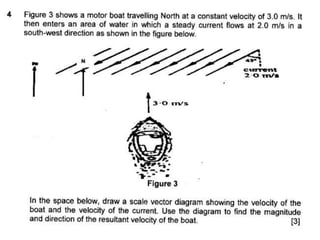
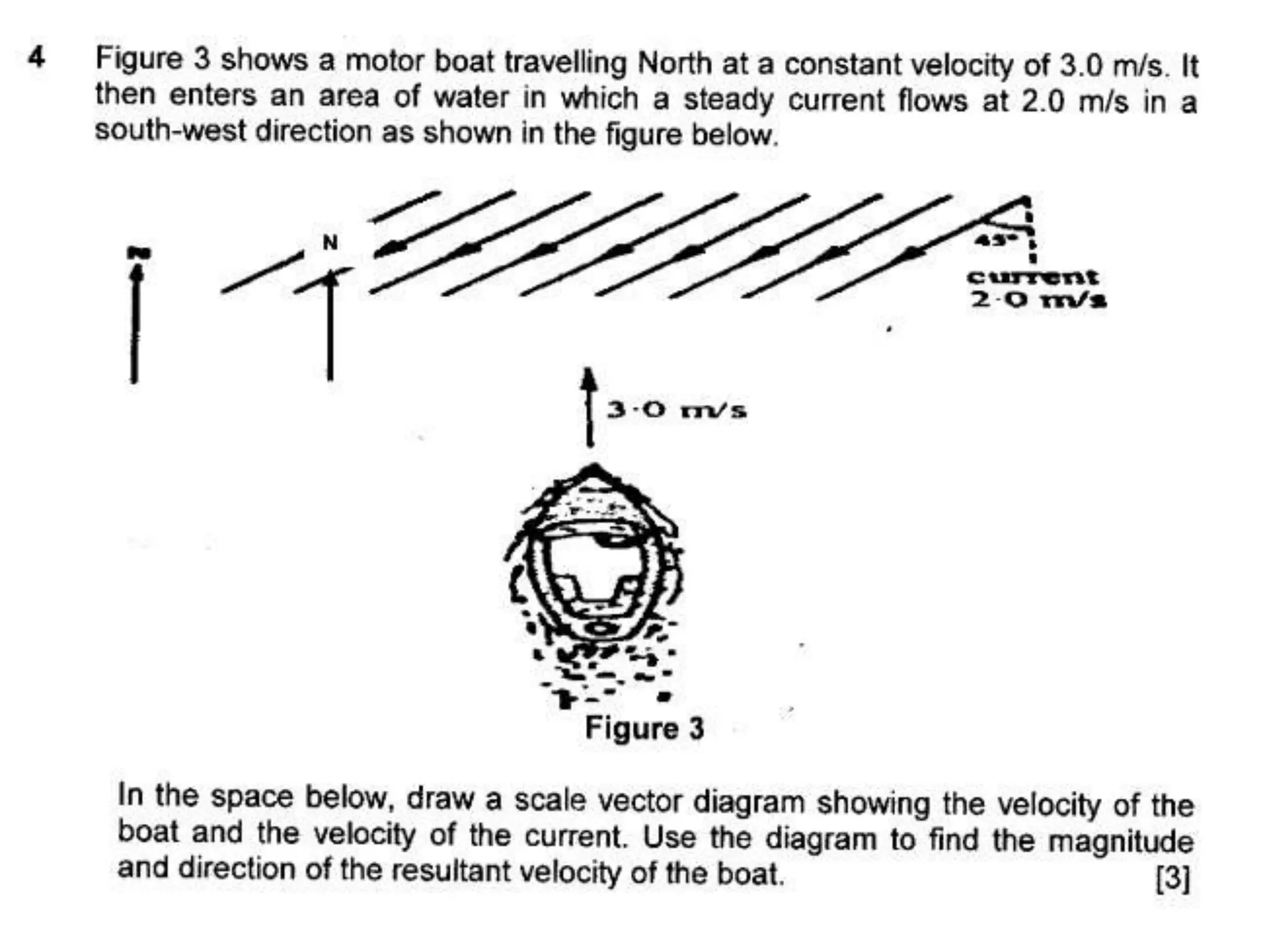
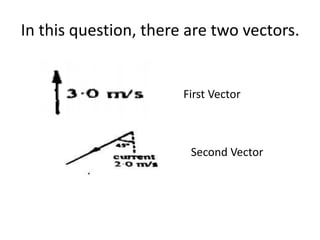
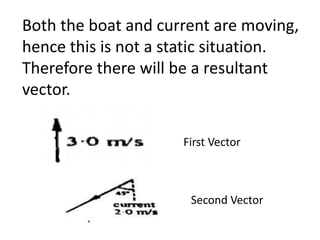
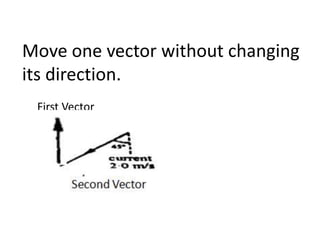
In this question, there are two vectors.


                       First Vector


                        Second Vector
Both the boat and current are moving,
hence this is not a static situation.
Therefore there will be a resultant
vector.

                     First Vector


                      Second Vector
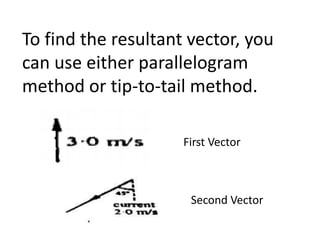
To find the resultant vector, you
can use either parallelogram
method or tip-to-tail method.

                     First Vector


                      Second Vector
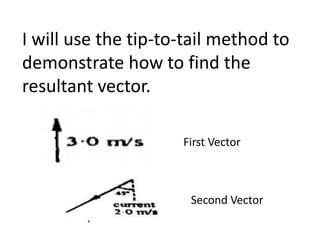
I will use the tip-to-tail method to
demonstrate how to find the
resultant vector.

                     First Vector


                      Second Vector
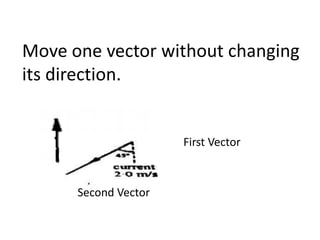
Move one vector without changing
its direction.


                      First Vector


      Second Vector
Move one vector without changing
its direction.
 First Vector


         Second Vector
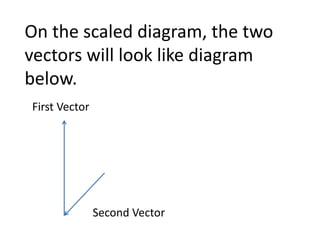
On the scaled diagram, the two
vectors will look like diagram
below.
First Vector


               Second Vector
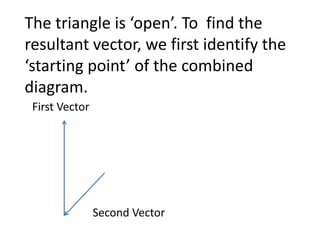
The triangle is ‘open’. To find the
resultant vector, we first identify the
‘starting point’ of the combined
diagram.
 First Vector


                Second Vector
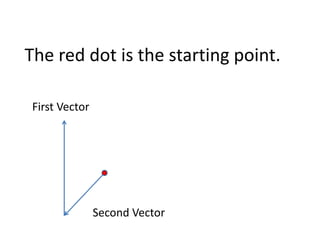
The red dot is the starting point.

 First Vector


                Second Vector
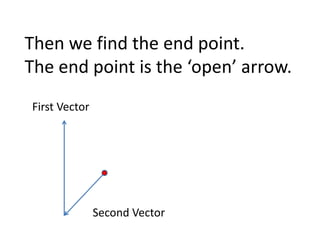
Then we find the end point.
The end point is the ‘open’ arrow.
First Vector


               Second Vector
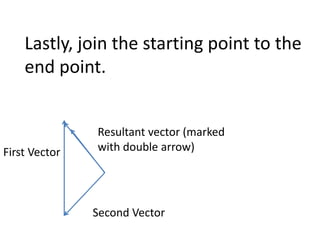
Lastly, join the starting point to the
    end point.


               Resultant vector (marked
First Vector   with double arrow)


               Second Vector

Resultan vector tip-to-tail method

  • 3.
    In this question,there are two vectors. First Vector Second Vector
  • 4.
    Both the boatand current are moving, hence this is not a static situation. Therefore there will be a resultant vector. First Vector Second Vector
  • 5.
    To find theresultant vector, you can use either parallelogram method or tip-to-tail method. First Vector Second Vector
  • 6.
    I will usethe tip-to-tail method to demonstrate how to find the resultant vector. First Vector Second Vector
  • 7.
    Move one vectorwithout changing its direction. First Vector Second Vector
  • 8.
    Move one vectorwithout changing its direction. First Vector Second Vector
  • 9.
    On the scaleddiagram, the two vectors will look like diagram below. First Vector Second Vector
  • 10.
    The triangle is‘open’. To find the resultant vector, we first identify the ‘starting point’ of the combined diagram. First Vector Second Vector
  • 11.
    The red dotis the starting point. First Vector Second Vector
  • 12.
    Then we findthe end point. The end point is the ‘open’ arrow. First Vector Second Vector
  • 13.
    Lastly, join thestarting point to the end point. Resultant vector (marked First Vector with double arrow) Second Vector