1
1
Designing and Building a
Results-Based Monitoring
and Evaluation System:
A Tool for Public Sector Management
2
2
The Power of Measuring Results
• If you do not measure results, you can not tell
success from failure
• If you can not see success, you can not
reward it
• If you can not reward success, you are probably
rewarding failure
• If you can not see success, you can not learn
from it
• If you can not recognize failure, you can not
correct it
• If you can demonstrate results, you can win
public support
Adapted from Osborne & Gaebler, 1992
3
3
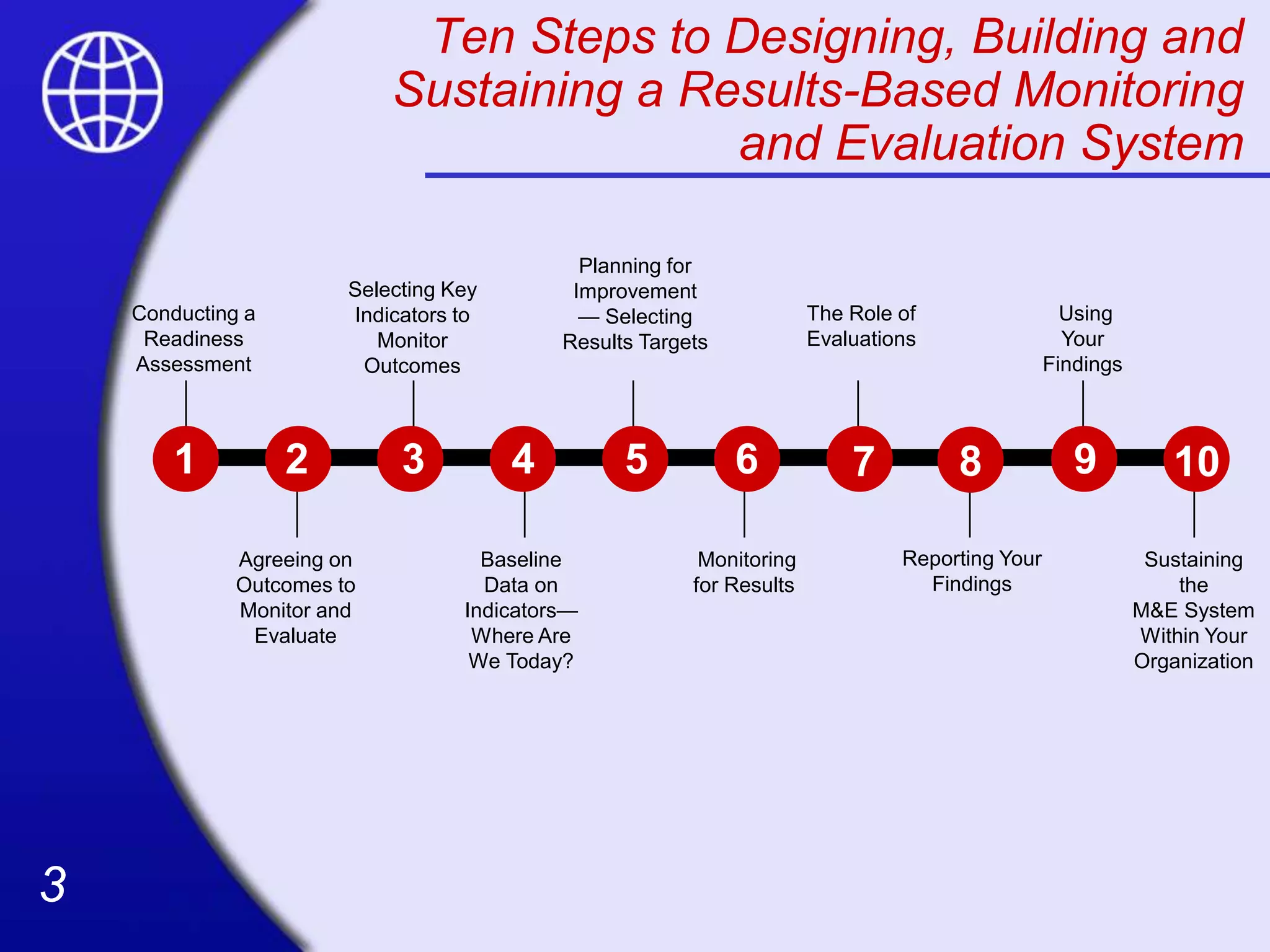
Ten Steps to Designing, Building and
Sustaining a Results-Based Monitoring
and Evaluation System
Conducting a
Readiness
Assessment
Agreeing on
Outcomes to
Monitor and
Evaluate
Selecting Key
Indicators to
Monitor
Outcomes
Baseline
Data on
Indicators—
Where Are
We Today?
Planning for
Improvement
— Selecting
Results Targets
Monitoring
for Results
The Role of
Evaluations
Reporting Your
Findings
Using
Your
Findings
Sustaining
the
M&E System
Within Your
Organization
1 2 3 4 5 6 7 9 10
8
4
4
Introduction to Results-Based Monitoring
and Evaluation
• Results-based monitoring and evaluation
measures how well governments are performing
• Results-based monitoring and evaluation is a
management tool!
• Results-based monitoring and evaluation
emphasizes assessing how outcomes are being
achieved over time
What Are We Talking About?
5
5
Remember
• Monitoring and evaluation are two separate, but interrelated
strategies to collect data and report the findings on how well
(or not) the public sector is performing
• During this workshop, we will be discussing:
– Monitoring as a tool
– Evaluation as a tool
– How the two interrelate to support good
public management
– The ten steps to build a results-based monitoring and
evaluation system to measure government performance
6
6
Reasons to Do Results-Based M&E
• Provides crucial information about public sector
performance
• Provides a view over time on the status of a
project, program, or policy
• Promotes credibility and public confidence by
reporting on the results of programs
• Helps formulate and justify budget requests
• Identifies potentially promising programs
or practices
7
7
Reasons to Do
Results-Based M&E (cont.)
• Focuses attention on achieving outcomes
important to the organization and
its stakeholders
• Provides timely, frequent information to staff
• Helps establish key goals and objectives
• Permits managers to identify and take action
to correct weaknesses
• Supports a development agenda that is
shifting towards greater accountability
for aid lending
8
8
Definition
Results-Based Monitoring
(what we will call “monitoring”)
is a continuous process of collecting and analyzing
information to compare how well a project, program
or policy is performing against expected results
9
9
Major Activities Where
Results Monitoring Is Needed
• Setting goals and objectives
• Reporting to Parliament and other
stakeholders
• Managing projects, programs
and policies
• Reporting to donors
• Allocating resources
10
10
A New Emphasis on Both Implementation
and Results-Based Monitoring
• Traditional monitoring focuses on
implementation monitoring
– This involves tracking inputs ($$, resources,
strategies), activities (what actually took place)
and outputs (the products or services produced)
– This approach focuses on monitoring how well a
project, program or policy is being implemented
– Often used to assess compliance with workplans
and budget
11
11
• Results-based monitoring involves the
regular collection of information on
how effectively government (or any
organization) is performing
• Results-based monitoring demonstrates
whether a project, program, or policy is
achieving its stated goals
A New Emphasis on Both Implementation
and Results-Based Monitoring
12
12
Results Based Monitoring
Requires Attention to Causal Logic ---or The
Theory of Change
• What is the “ logic” of the overall project, program or
policy design?
• How do each of the components of the program
help to establish an If-Then relation
• Is there a theory behind the change expected or
seen? In other words does the change follow the
logic proposed?
• Does this theory or logic hold during
implementation?
13
13
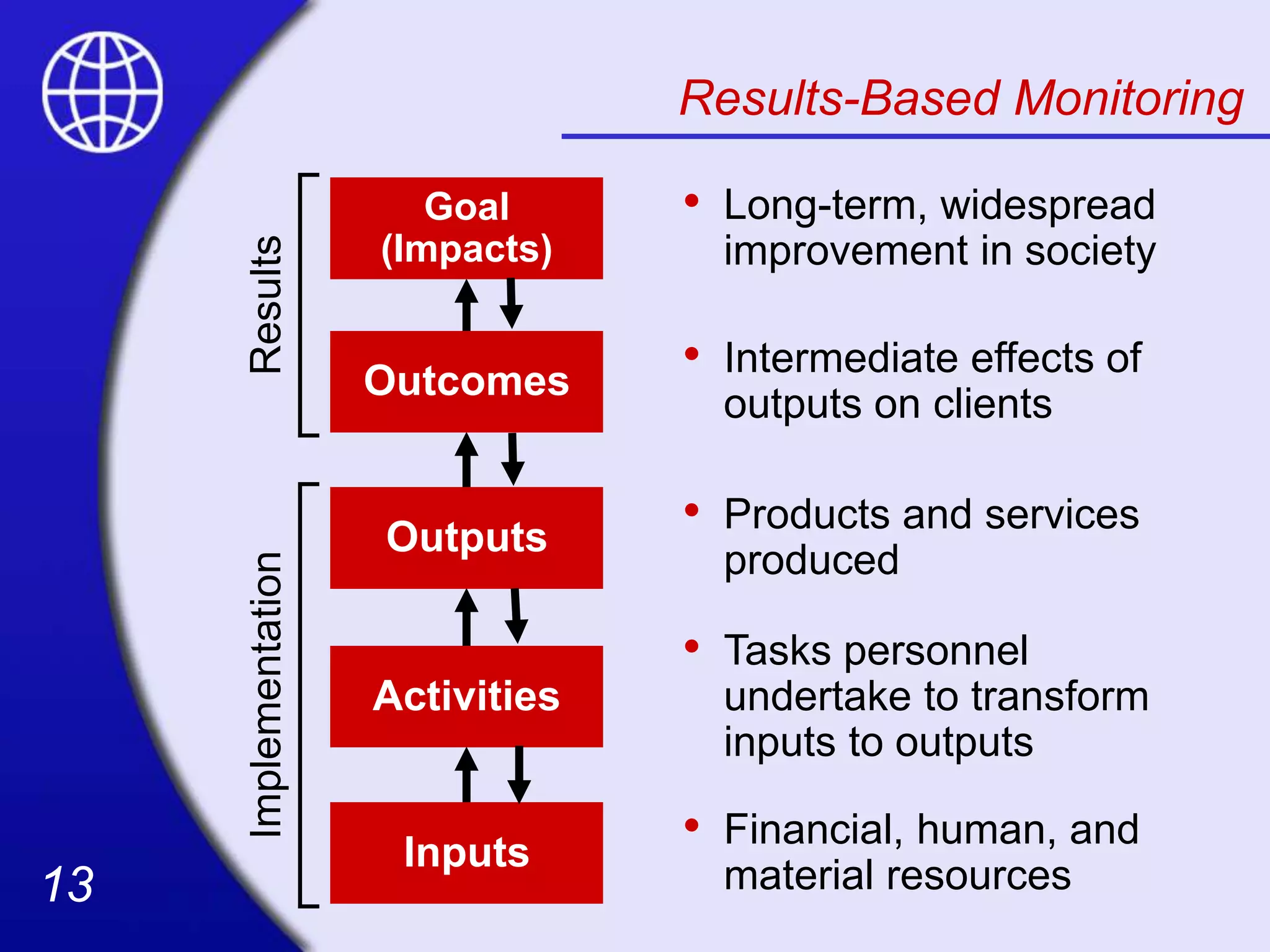
Results-Based Monitoring
Outcomes
• Intermediate effects of
outputs on clients
Outputs
• Products and services
produced
Activities
• Tasks personnel
undertake to transform
inputs to outputs
Inputs
• Financial, human, and
material resources
Goal
(Impacts)
• Long-term, widespread
improvement in society
Implementation
Results
14
14
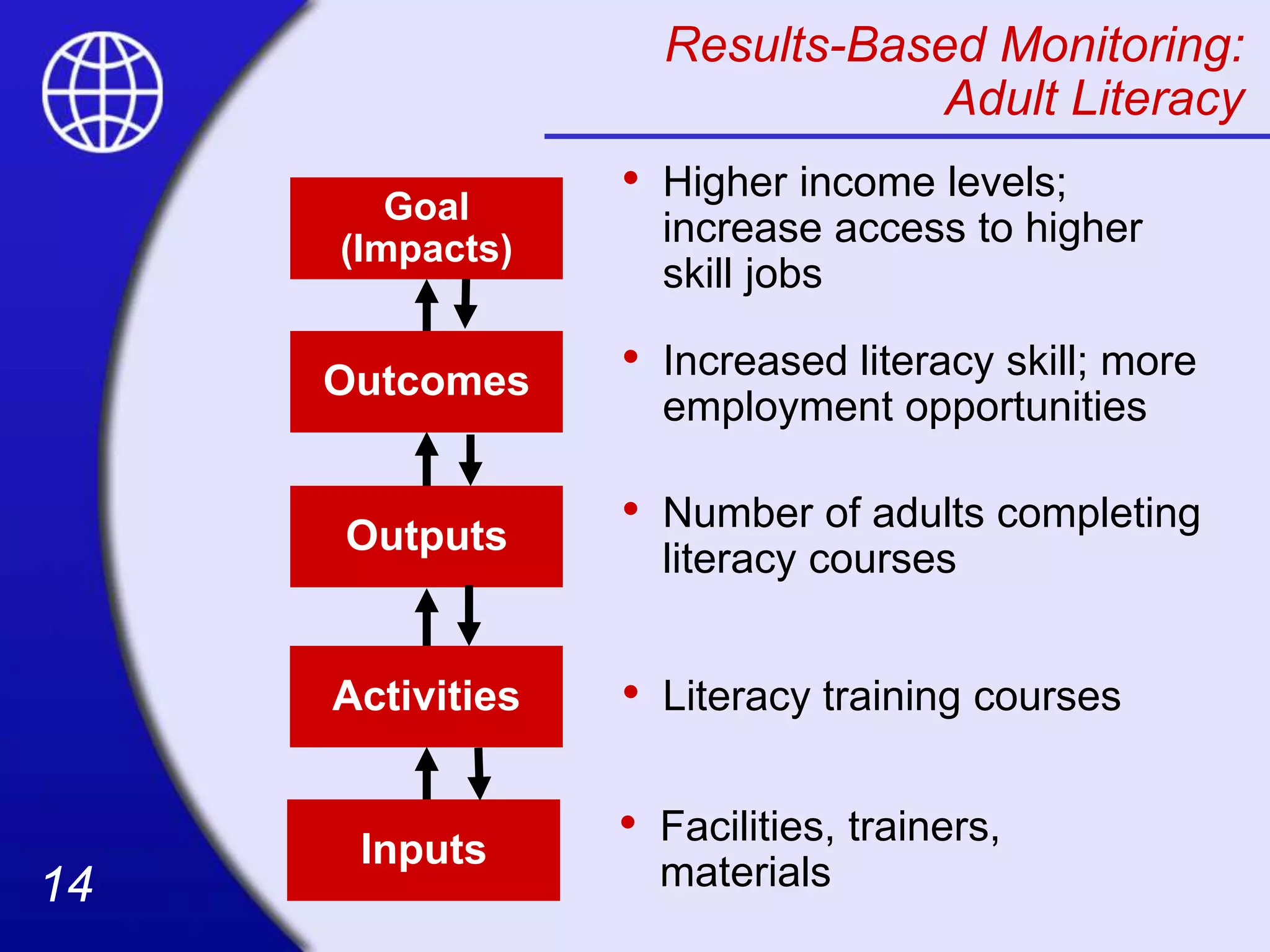
Results-Based Monitoring:
Adult Literacy
Outcomes • Increased literacy skill; more
employment opportunities
Outputs
• Number of adults completing
literacy courses
Activities • Literacy training courses
Inputs
• Facilities, trainers,
materials
Goal
(Impacts)
• Higher income levels;
increase access to higher
skill jobs
15
15
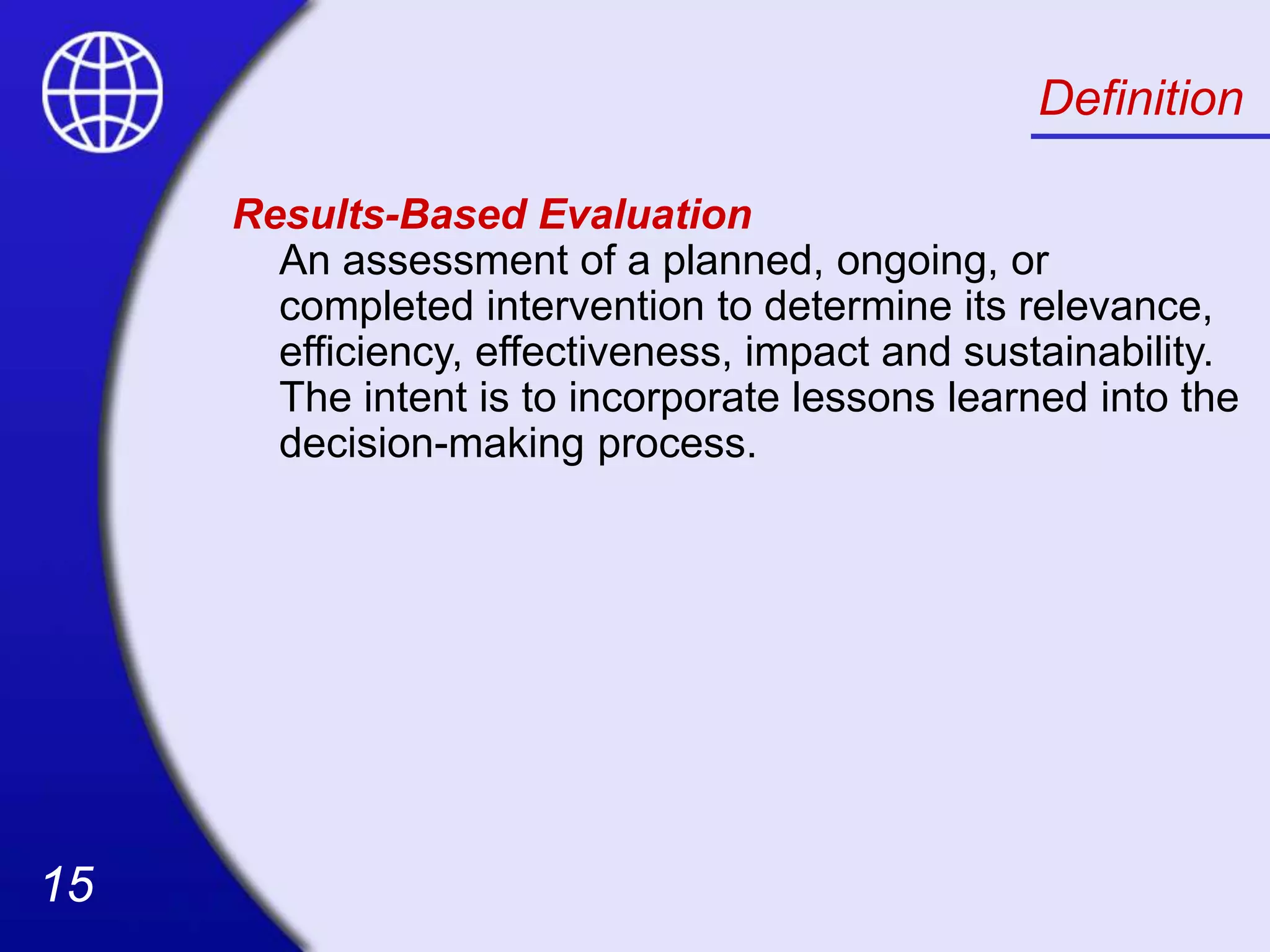
Definition
Results-Based Evaluation
An assessment of a planned, ongoing, or
completed intervention to determine its relevance,
efficiency, effectiveness, impact and sustainability.
The intent is to incorporate lessons learned into the
decision-making process.
16
16
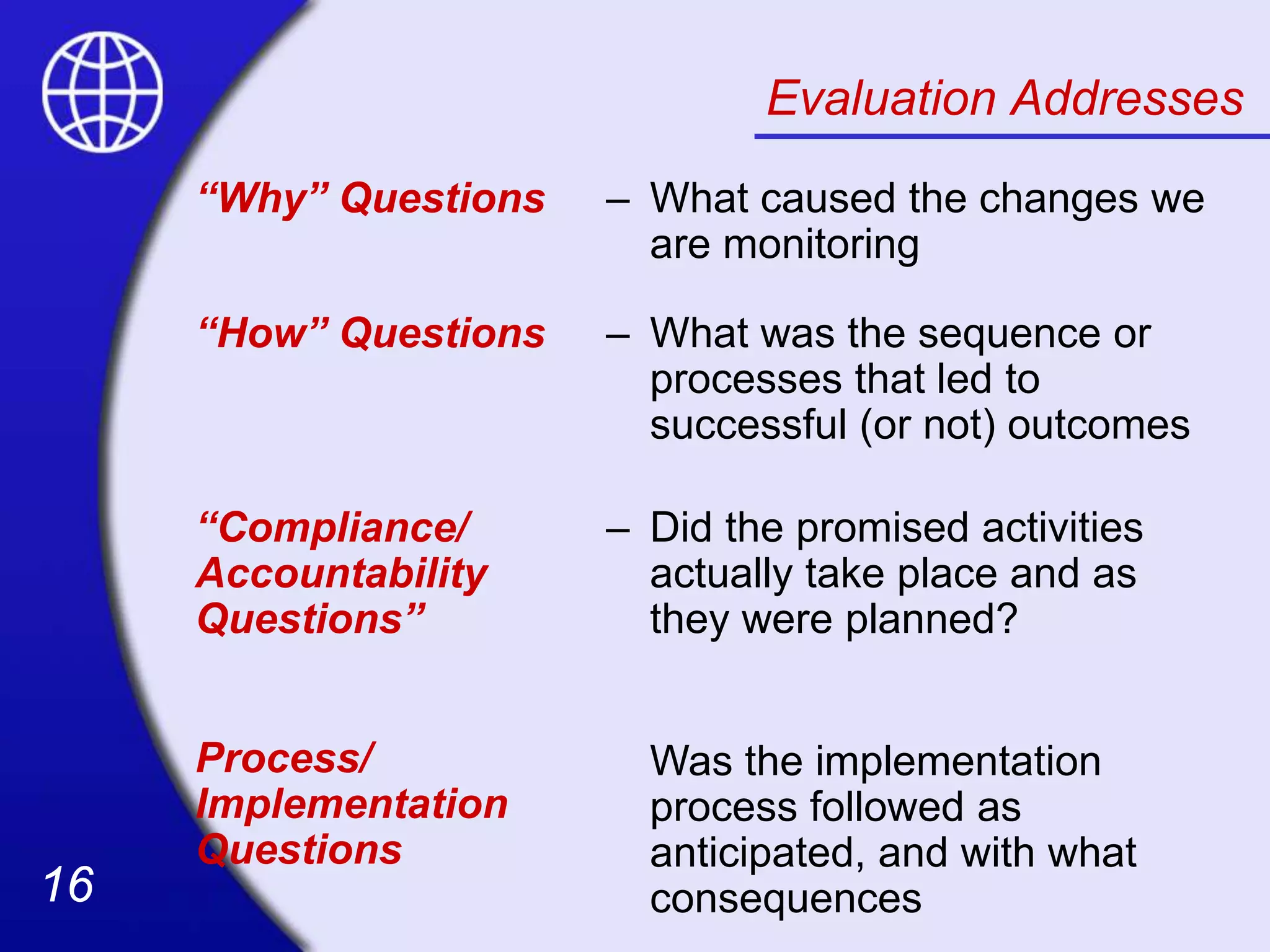
Evaluation Addresses
“Why” Questions – What caused the changes we
are monitoring
“How” Questions – What was the sequence or
processes that led to
successful (or not) outcomes
“Compliance/
Accountability
Questions”
Process/
Implementation
Questions
– Did the promised activities
actually take place and as
they were planned?
Was the implementation
process followed as
anticipated, and with what
consequences
17
17
Designing Good Evaluations
• Getting the questions right is critical
• Answering the questions is critical
• Supporting public sector decision-making with
credible and useful information is critical
18
18
Designing Good Evaluations
“Better to have an approximate answer to
the right question, than an exact answer to
the wrong question.”
Paraphrased from statistician
John W. Tukey
19
19
Designing Good Evaluations
“Better to be approximately correct
than precisely wrong.”
Paraphrased from
Bertrand Russell
20
20
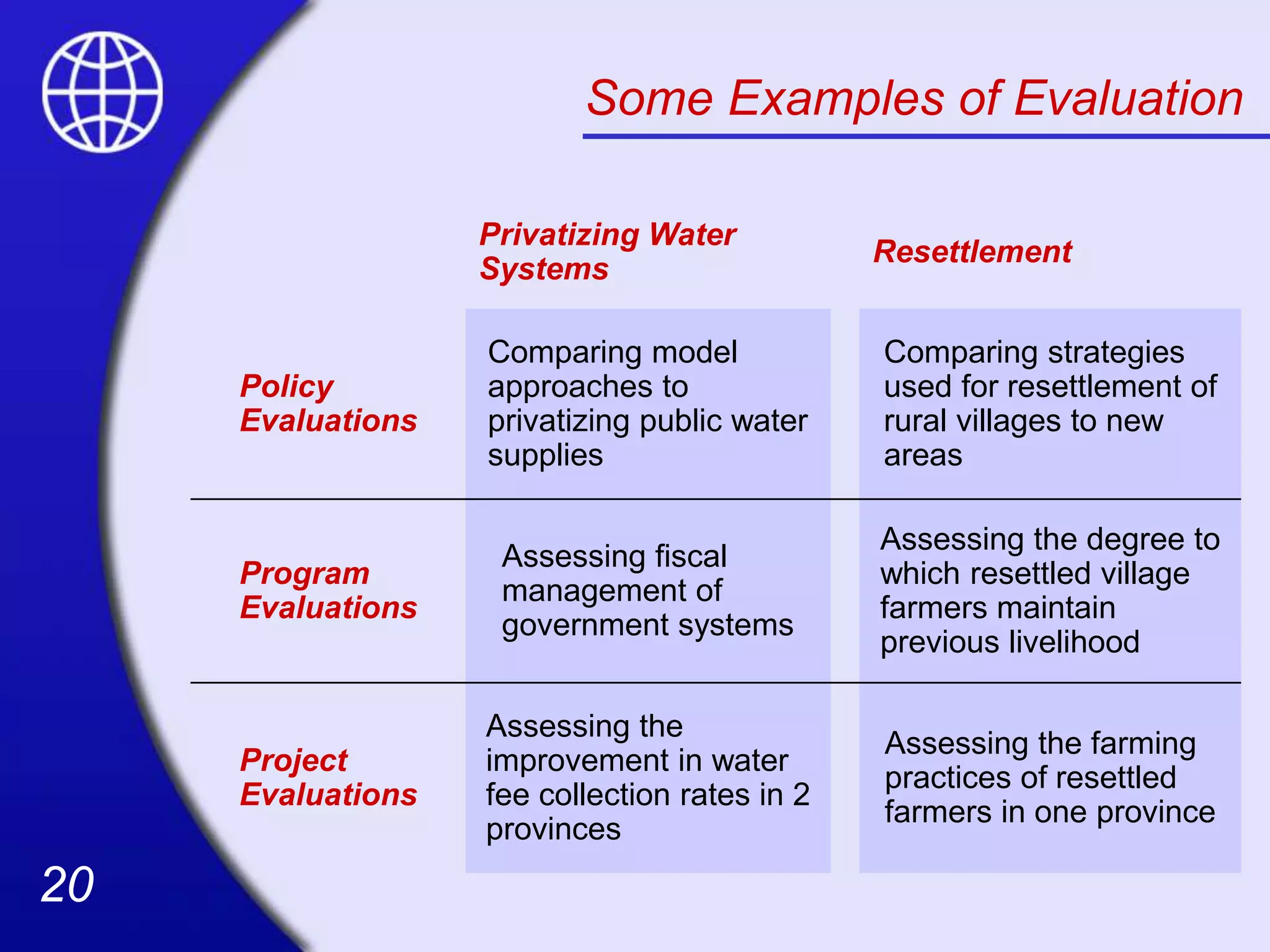
Some Examples of Evaluation
Privatizing Water
Systems
Resettlement
Policy
Evaluations
Comparing model
approaches to
privatizing public water
supplies
Comparing strategies
used for resettlement of
rural villages to new
areas
Program
Evaluations
Assessing fiscal
management of
government systems
Assessing the degree to
which resettled village
farmers maintain
previous livelihood
Project
Evaluations
Assessing the
improvement in water
fee collection rates in 2
provinces
Assessing the farming
practices of resettled
farmers in one province
21
21
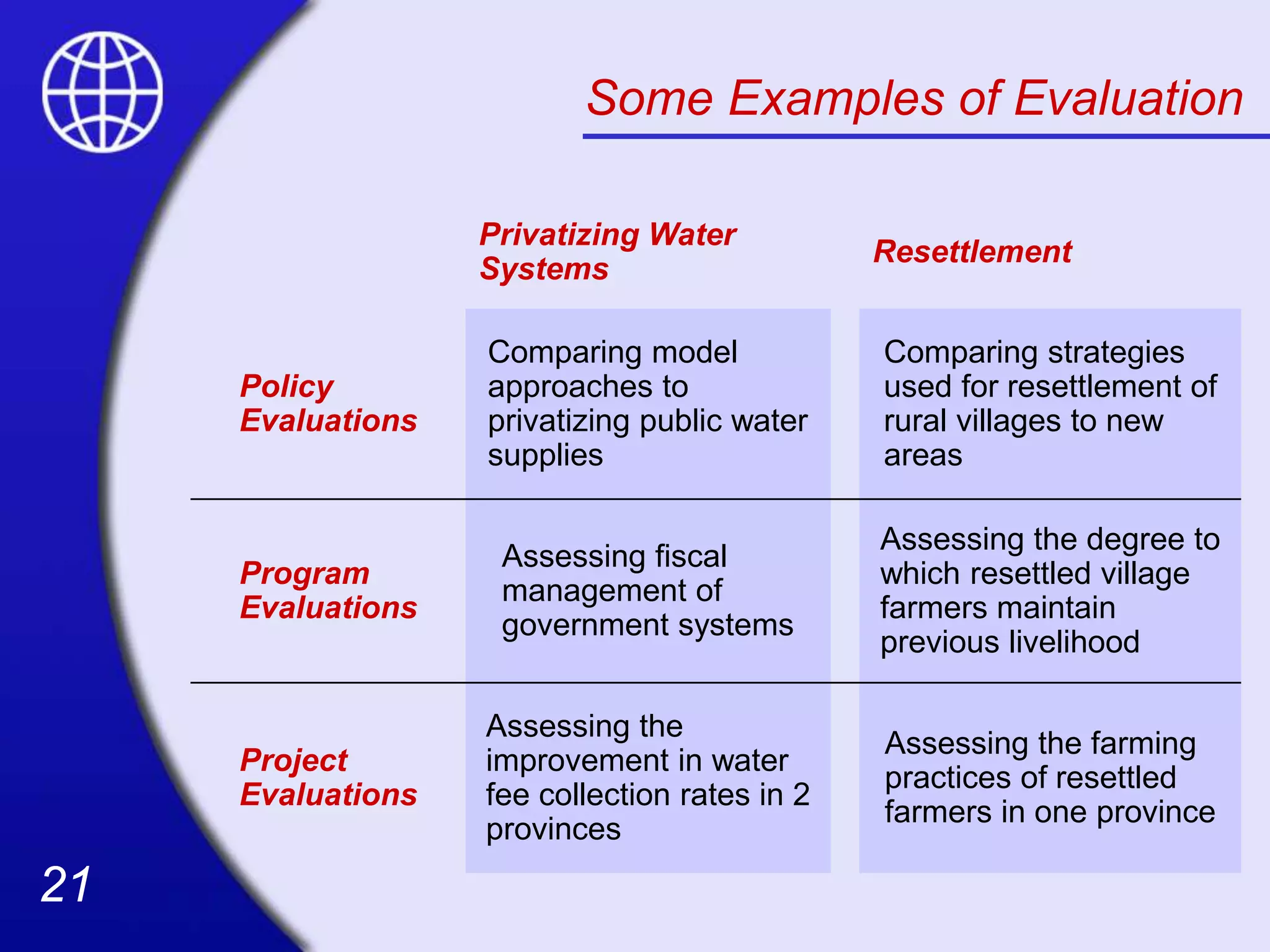
Some Examples of Evaluation
Privatizing Water
Systems
Resettlement
Policy
Evaluations
Comparing model
approaches to
privatizing public water
supplies
Comparing strategies
used for resettlement of
rural villages to new
areas
Program
Evaluations
Assessing fiscal
management of
government systems
Assessing the degree to
which resettled village
farmers maintain
previous livelihood
Project
Evaluations
Assessing the
improvement in water
fee collection rates in 2
provinces
Assessing the farming
practices of resettled
farmers in one province
22
22
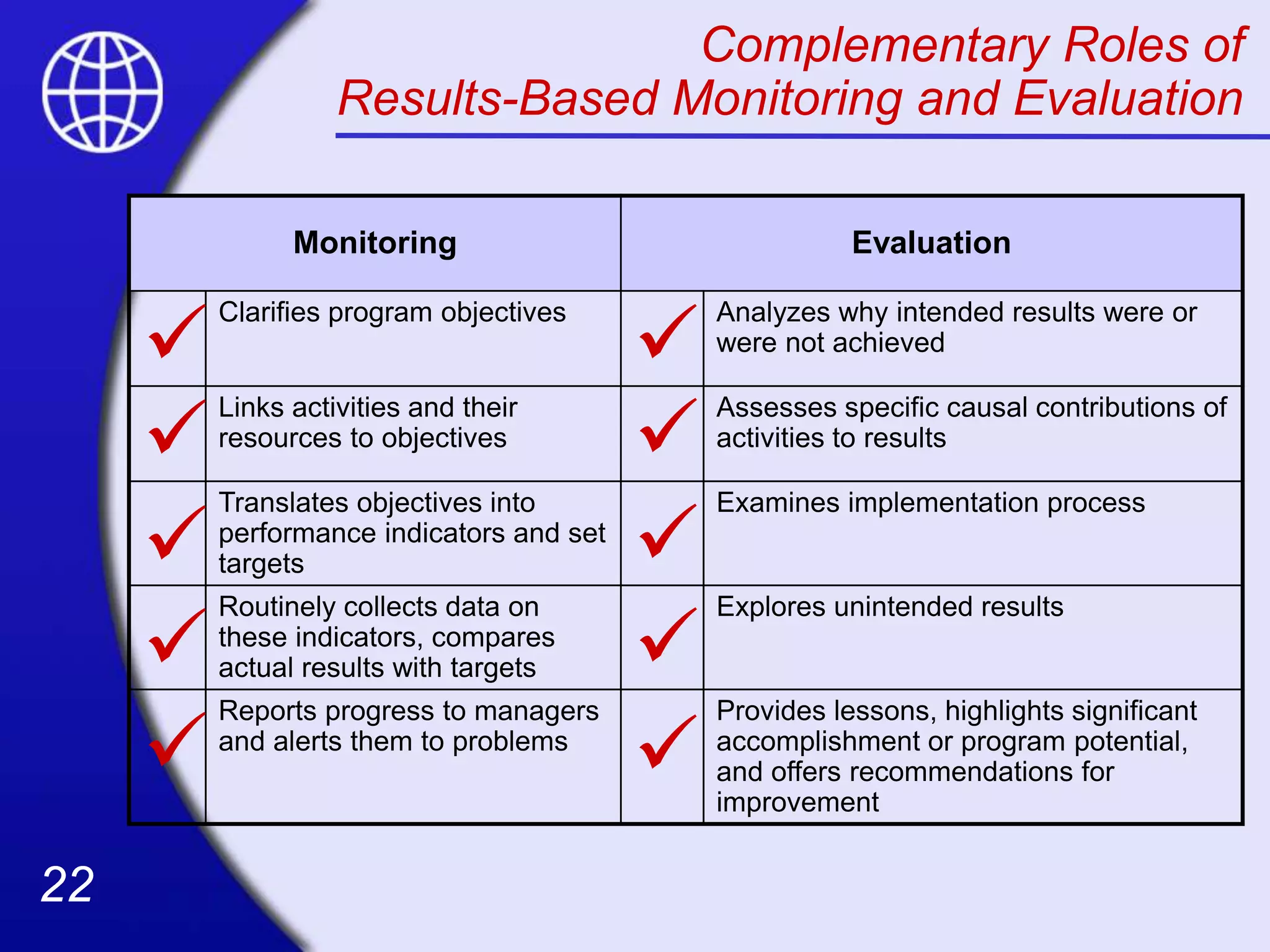
Complementary Roles of
Results-Based Monitoring and Evaluation
Monitoring Evaluation
Clarifies program objectives Analyzes why intended results were or
were not achieved
Links activities and their
resources to objectives
Assesses specific causal contributions of
activities to results
Translates objectives into
performance indicators and set
targets
Examines implementation process
Routinely collects data on
these indicators, compares
actual results with targets
Explores unintended results
Reports progress to managers
and alerts them to problems
Provides lessons, highlights significant
accomplishment or program potential,
and offers recommendations for
improvement










23
23
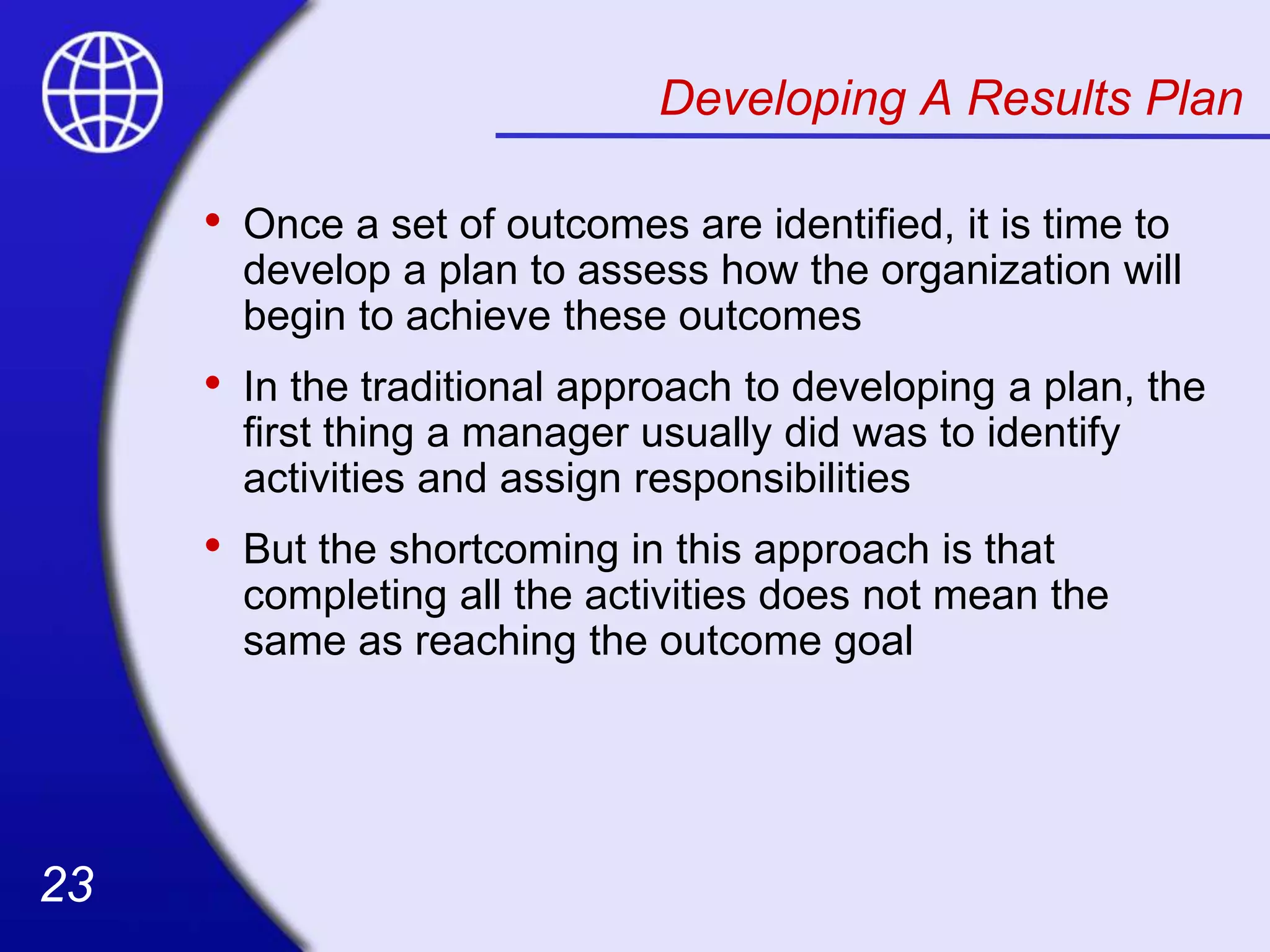
Developing A Results Plan
• Once a set of outcomes are identified, it is time to
develop a plan to assess how the organization will
begin to achieve these outcomes
• In the traditional approach to developing a plan, the
first thing a manager usually did was to identify
activities and assign responsibilities
• But the shortcoming in this approach is that
completing all the activities does not mean the
same as reaching the outcome goal
24
24
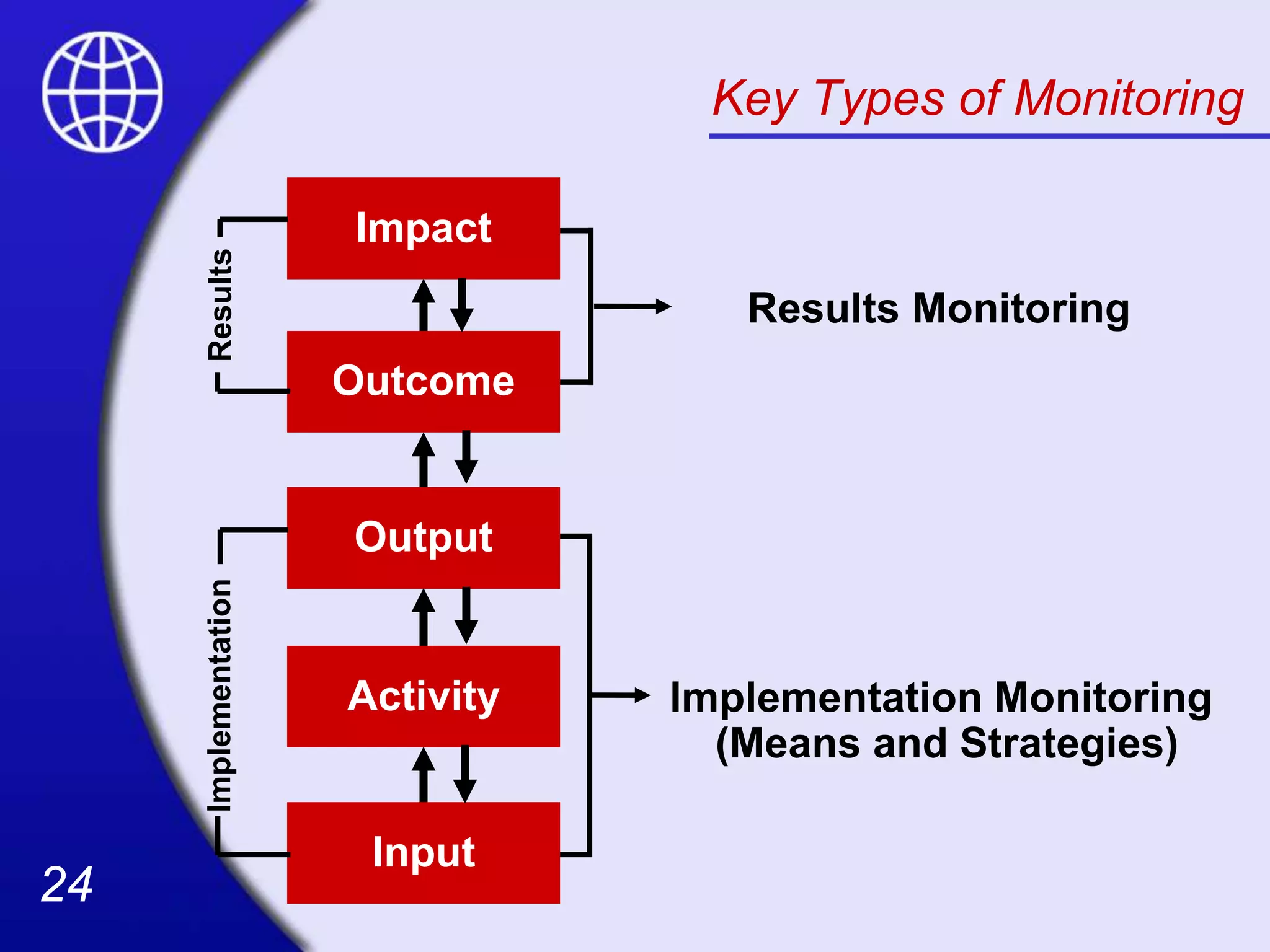
Key Types of Monitoring
Output
Activity
Input
Outcome
Impact
Results Monitoring
Implementation Monitoring
(Means and Strategies)
Implementation
Results
25
25
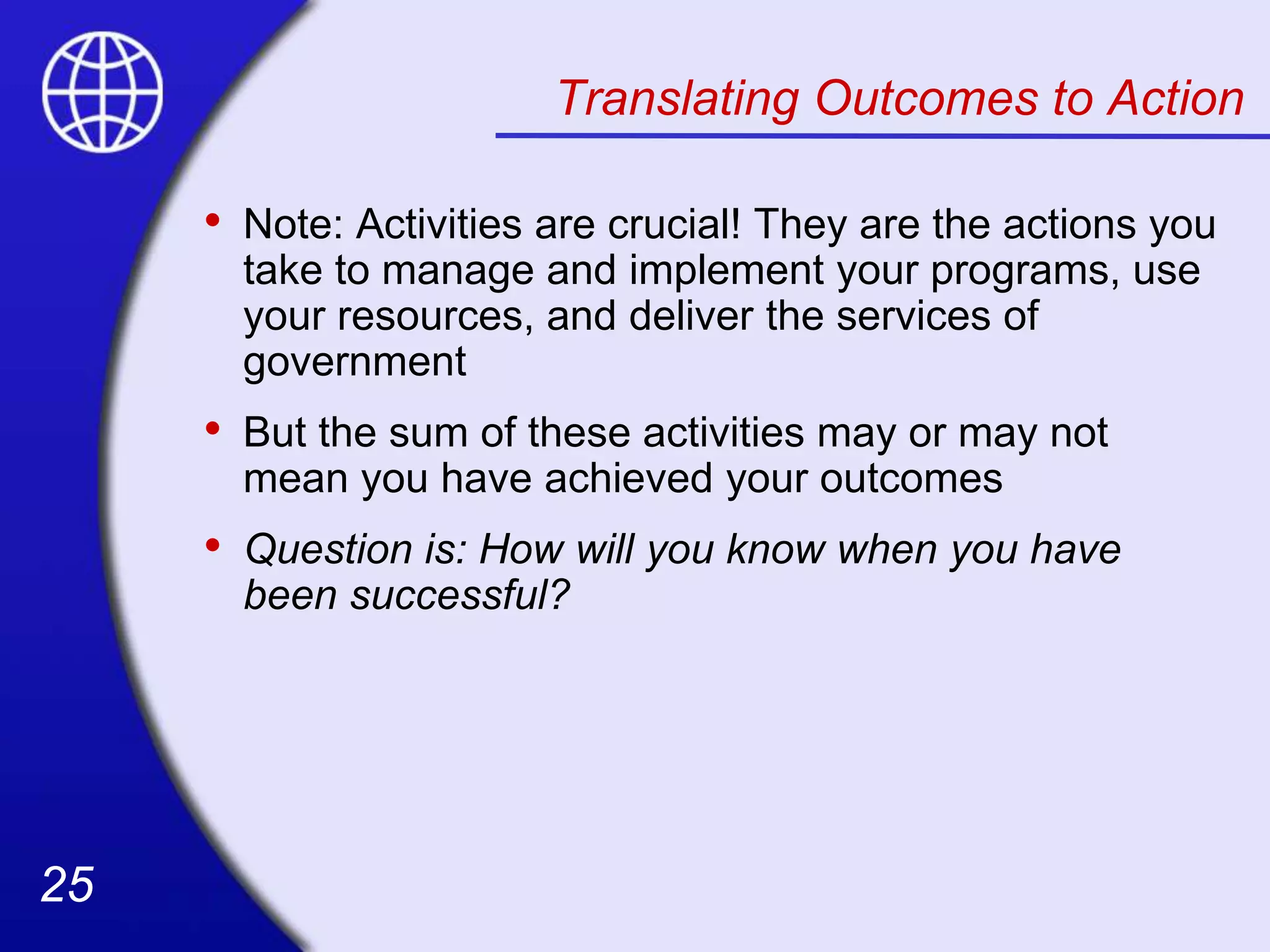
Translating Outcomes to Action
• Note: Activities are crucial! They are the actions you
take to manage and implement your programs, use
your resources, and deliver the services of
government
• But the sum of these activities may or may not
mean you have achieved your outcomes
• Question is: How will you know when you have
been successful?
26
26
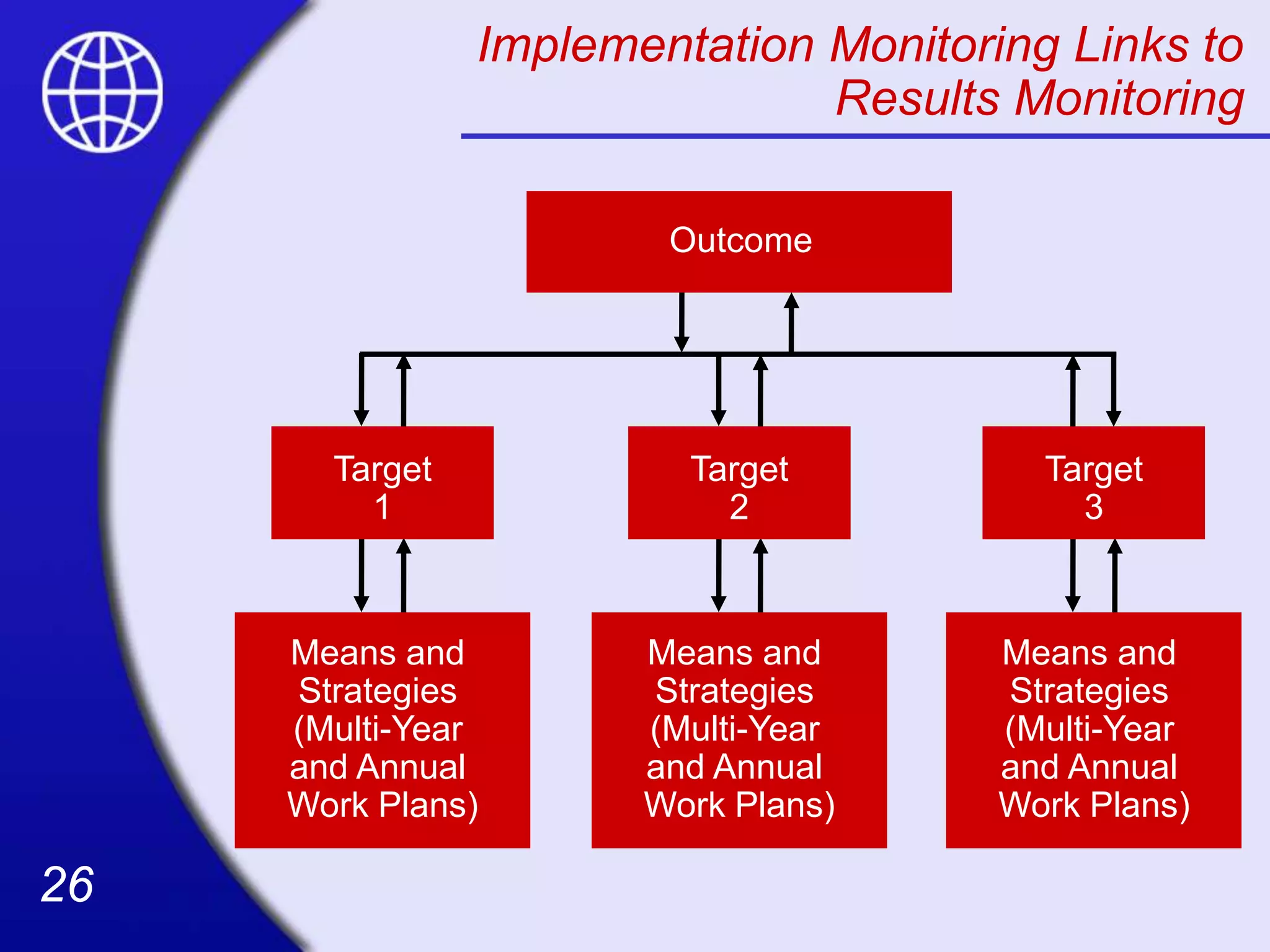
Implementation Monitoring Links to
Results Monitoring
Outcome
Target
2
Means and
Strategies
(Multi-Year
and Annual
Work Plans)
Means and
Strategies
(Multi-Year
and Annual
Work Plans)
Target
1
Target
3
Means and
Strategies
(Multi-Year
and Annual
Work Plans)
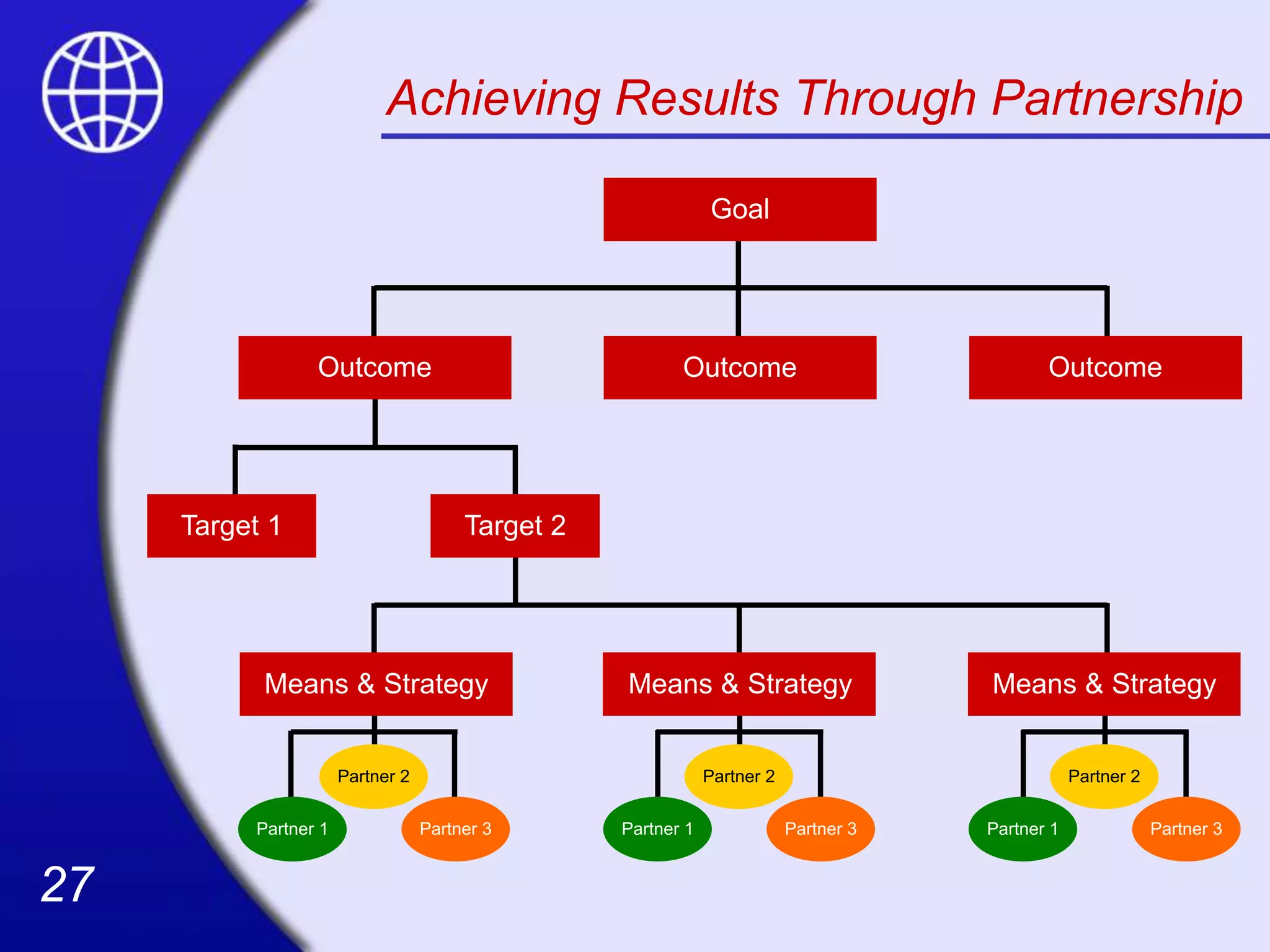
27
27
Partner 1 Partner 3
Partner 2
Partner 1 Partner 3
Partner 2
Partner 1 Partner 3
Partner 2
Achieving Results Through Partnership
Goal
Outcome
Outcome Outcome
Target 2
Target 1
Means & Strategy Means & Strategy Means & Strategy

Ten_Steps_Results_Based_MESystem.ppt

  • 1.
    1 1 Designing and Buildinga Results-Based Monitoring and Evaluation System: A Tool for Public Sector Management
  • 2.
    2 2 The Power ofMeasuring Results • If you do not measure results, you can not tell success from failure • If you can not see success, you can not reward it • If you can not reward success, you are probably rewarding failure • If you can not see success, you can not learn from it • If you can not recognize failure, you can not correct it • If you can demonstrate results, you can win public support Adapted from Osborne & Gaebler, 1992
  • 3.
    3 3 Ten Steps toDesigning, Building and Sustaining a Results-Based Monitoring and Evaluation System Conducting a Readiness Assessment Agreeing on Outcomes to Monitor and Evaluate Selecting Key Indicators to Monitor Outcomes Baseline Data on Indicators— Where Are We Today? Planning for Improvement — Selecting Results Targets Monitoring for Results The Role of Evaluations Reporting Your Findings Using Your Findings Sustaining the M&E System Within Your Organization 1 2 3 4 5 6 7 9 10 8
  • 4.
    4 4 Introduction to Results-BasedMonitoring and Evaluation • Results-based monitoring and evaluation measures how well governments are performing • Results-based monitoring and evaluation is a management tool! • Results-based monitoring and evaluation emphasizes assessing how outcomes are being achieved over time What Are We Talking About?
  • 5.
    5 5 Remember • Monitoring andevaluation are two separate, but interrelated strategies to collect data and report the findings on how well (or not) the public sector is performing • During this workshop, we will be discussing: – Monitoring as a tool – Evaluation as a tool – How the two interrelate to support good public management – The ten steps to build a results-based monitoring and evaluation system to measure government performance
  • 6.
    6 6 Reasons to DoResults-Based M&E • Provides crucial information about public sector performance • Provides a view over time on the status of a project, program, or policy • Promotes credibility and public confidence by reporting on the results of programs • Helps formulate and justify budget requests • Identifies potentially promising programs or practices
  • 7.
    7 7 Reasons to Do Results-BasedM&E (cont.) • Focuses attention on achieving outcomes important to the organization and its stakeholders • Provides timely, frequent information to staff • Helps establish key goals and objectives • Permits managers to identify and take action to correct weaknesses • Supports a development agenda that is shifting towards greater accountability for aid lending
  • 8.
    8 8 Definition Results-Based Monitoring (what wewill call “monitoring”) is a continuous process of collecting and analyzing information to compare how well a project, program or policy is performing against expected results
  • 9.
    9 9 Major Activities Where ResultsMonitoring Is Needed • Setting goals and objectives • Reporting to Parliament and other stakeholders • Managing projects, programs and policies • Reporting to donors • Allocating resources
  • 10.
    10 10 A New Emphasison Both Implementation and Results-Based Monitoring • Traditional monitoring focuses on implementation monitoring – This involves tracking inputs ($$, resources, strategies), activities (what actually took place) and outputs (the products or services produced) – This approach focuses on monitoring how well a project, program or policy is being implemented – Often used to assess compliance with workplans and budget
  • 11.
    11 11 • Results-based monitoringinvolves the regular collection of information on how effectively government (or any organization) is performing • Results-based monitoring demonstrates whether a project, program, or policy is achieving its stated goals A New Emphasis on Both Implementation and Results-Based Monitoring
  • 12.
    12 12 Results Based Monitoring RequiresAttention to Causal Logic ---or The Theory of Change • What is the “ logic” of the overall project, program or policy design? • How do each of the components of the program help to establish an If-Then relation • Is there a theory behind the change expected or seen? In other words does the change follow the logic proposed? • Does this theory or logic hold during implementation?
  • 13.
    13 13 Results-Based Monitoring Outcomes • Intermediateeffects of outputs on clients Outputs • Products and services produced Activities • Tasks personnel undertake to transform inputs to outputs Inputs • Financial, human, and material resources Goal (Impacts) • Long-term, widespread improvement in society Implementation Results
  • 14.
    14 14 Results-Based Monitoring: Adult Literacy Outcomes• Increased literacy skill; more employment opportunities Outputs • Number of adults completing literacy courses Activities • Literacy training courses Inputs • Facilities, trainers, materials Goal (Impacts) • Higher income levels; increase access to higher skill jobs
  • 15.
    15 15 Definition Results-Based Evaluation An assessmentof a planned, ongoing, or completed intervention to determine its relevance, efficiency, effectiveness, impact and sustainability. The intent is to incorporate lessons learned into the decision-making process.
  • 16.
    16 16 Evaluation Addresses “Why” Questions– What caused the changes we are monitoring “How” Questions – What was the sequence or processes that led to successful (or not) outcomes “Compliance/ Accountability Questions” Process/ Implementation Questions – Did the promised activities actually take place and as they were planned? Was the implementation process followed as anticipated, and with what consequences
  • 17.
    17 17 Designing Good Evaluations •Getting the questions right is critical • Answering the questions is critical • Supporting public sector decision-making with credible and useful information is critical
  • 18.
    18 18 Designing Good Evaluations “Betterto have an approximate answer to the right question, than an exact answer to the wrong question.” Paraphrased from statistician John W. Tukey
  • 19.
    19 19 Designing Good Evaluations “Betterto be approximately correct than precisely wrong.” Paraphrased from Bertrand Russell
  • 20.
    20 20 Some Examples ofEvaluation Privatizing Water Systems Resettlement Policy Evaluations Comparing model approaches to privatizing public water supplies Comparing strategies used for resettlement of rural villages to new areas Program Evaluations Assessing fiscal management of government systems Assessing the degree to which resettled village farmers maintain previous livelihood Project Evaluations Assessing the improvement in water fee collection rates in 2 provinces Assessing the farming practices of resettled farmers in one province
  • 21.
    21 21 Some Examples ofEvaluation Privatizing Water Systems Resettlement Policy Evaluations Comparing model approaches to privatizing public water supplies Comparing strategies used for resettlement of rural villages to new areas Program Evaluations Assessing fiscal management of government systems Assessing the degree to which resettled village farmers maintain previous livelihood Project Evaluations Assessing the improvement in water fee collection rates in 2 provinces Assessing the farming practices of resettled farmers in one province
  • 22.
    22 22 Complementary Roles of Results-BasedMonitoring and Evaluation Monitoring Evaluation Clarifies program objectives Analyzes why intended results were or were not achieved Links activities and their resources to objectives Assesses specific causal contributions of activities to results Translates objectives into performance indicators and set targets Examines implementation process Routinely collects data on these indicators, compares actual results with targets Explores unintended results Reports progress to managers and alerts them to problems Provides lessons, highlights significant accomplishment or program potential, and offers recommendations for improvement          
  • 23.
    23 23 Developing A ResultsPlan • Once a set of outcomes are identified, it is time to develop a plan to assess how the organization will begin to achieve these outcomes • In the traditional approach to developing a plan, the first thing a manager usually did was to identify activities and assign responsibilities • But the shortcoming in this approach is that completing all the activities does not mean the same as reaching the outcome goal
  • 24.
    24 24 Key Types ofMonitoring Output Activity Input Outcome Impact Results Monitoring Implementation Monitoring (Means and Strategies) Implementation Results
  • 25.
    25 25 Translating Outcomes toAction • Note: Activities are crucial! They are the actions you take to manage and implement your programs, use your resources, and deliver the services of government • But the sum of these activities may or may not mean you have achieved your outcomes • Question is: How will you know when you have been successful?
  • 26.
    26 26 Implementation Monitoring Linksto Results Monitoring Outcome Target 2 Means and Strategies (Multi-Year and Annual Work Plans) Means and Strategies (Multi-Year and Annual Work Plans) Target 1 Target 3 Means and Strategies (Multi-Year and Annual Work Plans)
  • 27.
    27 27 Partner 1 Partner3 Partner 2 Partner 1 Partner 3 Partner 2 Partner 1 Partner 3 Partner 2 Achieving Results Through Partnership Goal Outcome Outcome Outcome Target 2 Target 1 Means & Strategy Means & Strategy Means & Strategy