
RESTful Web Services

           20-Jan-2011


        Gordon Dickens
   gordon@gordondickens.com
Who Am I?
   Instructor/Mentor

   Active Tweeter for Open Source Tech Topics
    twitter.com/gdickens

   Certified Instructor for

   DZone Most Valuable Blogger
    dzone.com/page/mvbs – dzone.com/user/284679
    Technophile Blog - technophile.gordondickens.com

   GitZone:github.com/gordonad

   LinkedIn:linkedin.com/in/gordondickens


                                                       2
Web Services
 What are Web Services?
   SOA
   Remote messaging between systems


 SOAP != Web Services
 Web Services != SOAP
 SOAP !opposite of REST
 REST !opposite of SOAP


                                       3
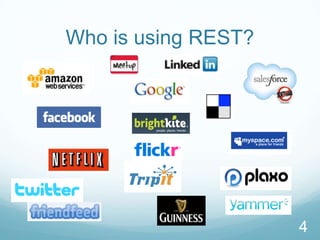
Who is using REST?


                     4
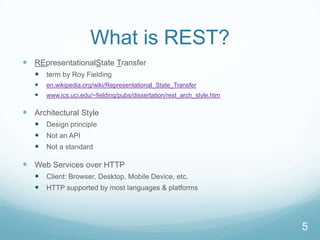
What is REST?
 REpresentationalState Transfer
    term by Roy Fielding
      en.wikipedia.org/wiki/Representational_State_Transfer
      www.ics.uci.edu/~fielding/pubs/dissertation/rest_arch_style.htm

 Architectural Style
    Design principle
    Not an API
    Not a standard

 Web Services over HTTP
    Client: Browser, Desktop, Mobile Device, etc.
    HTTP supported by most languages & platforms


                                                                         5
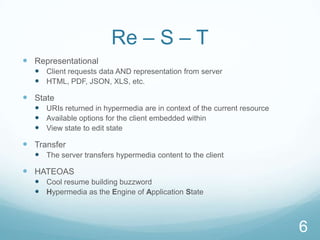
Re – S – T
 Representational
   Client requests data AND representation from server
   HTML, PDF, JSON, XLS, etc.

 State
   URIs returned in hypermedia are in context of the current resource
   Available options for the client embedded within
   View state to edit state

 Transfer
   The server transfers hypermedia content to the client

 HATEOAS
   Cool resume building buzzword
   Hypermedia as the Engine of Application State


                                                                         6
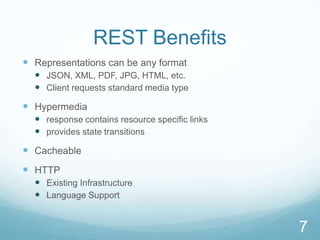
REST Benefits
 Representations can be any format
   JSON, XML, PDF, JPG, HTML, etc.
   Client requests standard media type
 Hypermedia
   response contains resource specific links
   provides state transitions
 Cacheable
 HTTP
   Existing Infrastructure
   Language Support


                                                7
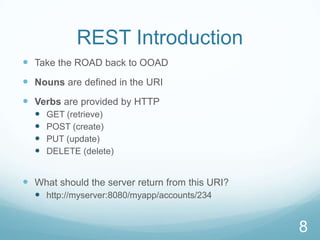
REST Introduction
 Take the ROAD back to OOAD
 Nouns are defined in the URI
 Verbs are provided by HTTP
     GET (retrieve)
     POST (create)
     PUT (update)
     DELETE (delete)


 What should the server return from this URI?
   http://myserver:8080/myapp/accounts/234


                                                 8
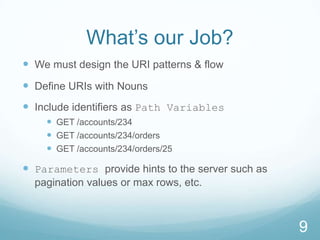
What’s our Job?
 We must design the URI patterns & flow
 Define URIs with Nouns
 Include identifiers as Path Variables
     GET /accounts/234
     GET /accounts/234/orders
     GET /accounts/234/orders/25

 Parameters provide hints to the server such as
  pagination values or max rows, etc.


                                                   9
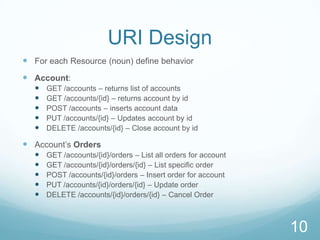
URI Design
 For each Resource (noun) define behavior
 Account:
     GET /accounts – returns list of accounts
     GET /accounts/{id} – returns account by id
     POST /accounts – inserts account data
     PUT /accounts/{id} – Updates account by id
     DELETE /accounts/{id} – Close account by id

 Account’s Orders
     GET /accounts/{id}/orders – List all orders for account
     GET /accounts/{id}/orders/{id} – List specific order
     POST /accounts/{id}/orders – Insert order for account
     PUT /accounts/{id}/orders/{id} – Update order
     DELETE /accounts/{id}/orders/{id} – Cancel Order


                                                                10
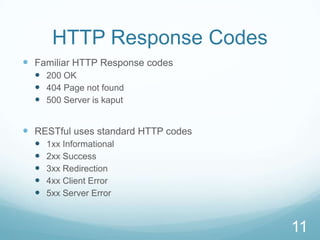
HTTP Response Codes
 Familiar HTTP Response codes
   200 OK
   404 Page not found
   500 Server is kaput


 RESTful uses standard HTTP codes
     1xx Informational
     2xx Success
     3xx Redirection
     4xx Client Error
     5xx Server Error


                                     11
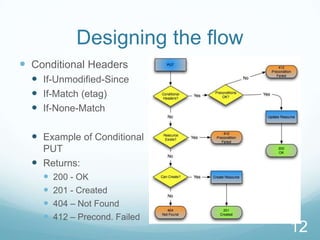
Designing the flow
 Conditional Headers
   If-Unmodified-Since
   If-Match (etag)
   If-None-Match

   Example of Conditional
    PUT
   Returns:
     200 - OK
     201 - Created
     404 – Not Found
     412 – Precond. Failed
                                 12
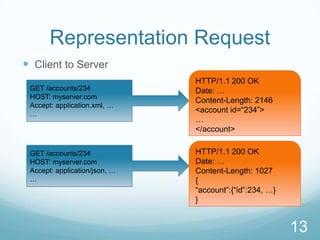
Representation Request
 Client to Server
                               HTTP/1.1 200 OK
 GET /accounts/234             Date: …
 HOST: myserver.com
                               Content-Length: 2146
 Accept: application.xml, …
 …
                               <account id=“234”>
                               …
                               </account>


 GET /accounts/234             HTTP/1.1 200 OK
 HOST: myserver.com            Date: …
 Accept: application/json, …   Content-Length: 1027
 …                             {
                               “account”:{“id”:234, …}
                               }


                                                         13
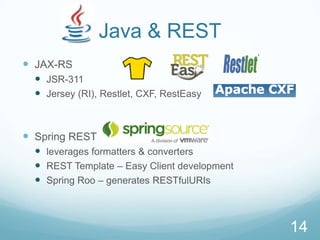
Java & REST
 JAX-RS
   JSR-311
   Jersey (RI), Restlet, CXF, RestEasy


 Spring REST
   leverages formatters & converters
   REST Template – Easy Client development
   Spring Roo – generates RESTfulURIs


                                              14
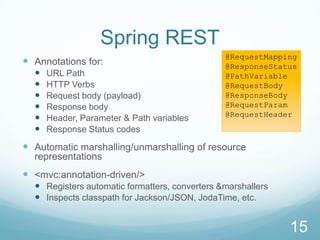
Spring REST
                                                @RequestMapping
 Annotations for:                              @ResponseStatus
     URL Path                                  @PathVariable
     HTTP Verbs                                @RequestBody
     Request body (payload)                    @ResponseBody
     Response body                             @RequestParam
                                                @RequestHeader
     Header, Parameter & Path variables
     Response Status codes

 Automatic marshalling/unmarshalling of resource
  representations
 <mvc:annotation-driven/>
   Registers automatic formatters, converters &marshallers
   Inspects classpath for Jackson/JSON, JodaTime, etc.


                                                              15
Security - Data
 Same as other messaging approaches


 Encapsulation:
   SSL, TLS, IPsec, etc.


 Encryption:
   PGP, S/MIME, etc.


                                       16
Security - Auth
 Authentication:
      Basic, Digest, X509, etc.
      Spring Security

    Client Sends
   GET /account/123

      Server Responds with:
   HTTP/1.1 401 Unauthorized
   WWW-Authenticate: Basic realm=”MyApp Realm”


 Authorization
      Standard web.xml security configuration
      Spring Security
      OAuth


                                                 17
“An open protocol to allow secure API authorization in a
    simple and standard method from desktop to web
                      applications.”

                    http://oauth.net


              code.google.com/p/oauth/

                                                       18
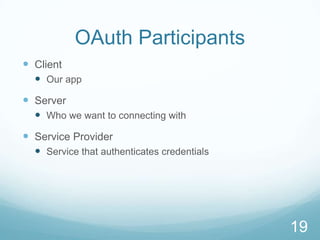
OAuth Participants
 Client
   Our app
 Server
   Who we want to connecting with
 Service Provider
   Service that authenticates credentials


                                             19
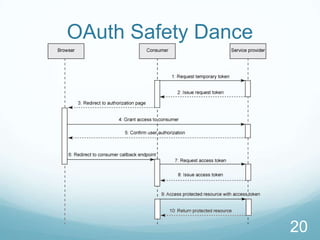
OAuth Safety Dance


                     20
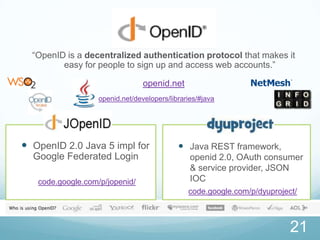
“OpenID is a decentralized authentication protocol that makes it
         easy for people to sign up and access web accounts.”

                                 openid.net
                   openid.net/developers/libraries/#java


 OpenID 2.0 Java 5 impl for                 Java REST framework,
  Google Federated Login                        openid 2.0, OAuth consumer
                                                & service provider, JSON
   code.google.com/p/jopenid/                   IOC
                                               code.google.com/p/dyuproject/


                                                                          21
Questions?
Email: gordon@gordondickens.com

Twitter: twitter.com/gdickens

Blog: technophile.gordondickens.com

Git: github.com/gordonad

LinkedIn: linkedin.com/in/gordondickens


                                          22

RESTful Web Services

  • 1.
    RESTful Web Services 20-Jan-2011 Gordon Dickens gordon@gordondickens.com
  • 2.
    Who Am I?  Instructor/Mentor  Active Tweeter for Open Source Tech Topics twitter.com/gdickens  Certified Instructor for  DZone Most Valuable Blogger dzone.com/page/mvbs – dzone.com/user/284679 Technophile Blog - technophile.gordondickens.com  GitZone:github.com/gordonad  LinkedIn:linkedin.com/in/gordondickens 2
  • 3.
    Web Services  Whatare Web Services?  SOA  Remote messaging between systems  SOAP != Web Services  Web Services != SOAP  SOAP !opposite of REST  REST !opposite of SOAP 3
  • 4.
    Who is usingREST? 4
  • 5.
    What is REST? REpresentationalState Transfer  term by Roy Fielding  en.wikipedia.org/wiki/Representational_State_Transfer  www.ics.uci.edu/~fielding/pubs/dissertation/rest_arch_style.htm  Architectural Style  Design principle  Not an API  Not a standard  Web Services over HTTP  Client: Browser, Desktop, Mobile Device, etc.  HTTP supported by most languages & platforms 5
  • 6.
    Re – S– T  Representational  Client requests data AND representation from server  HTML, PDF, JSON, XLS, etc.  State  URIs returned in hypermedia are in context of the current resource  Available options for the client embedded within  View state to edit state  Transfer  The server transfers hypermedia content to the client  HATEOAS  Cool resume building buzzword  Hypermedia as the Engine of Application State 6
  • 7.
    REST Benefits  Representationscan be any format  JSON, XML, PDF, JPG, HTML, etc.  Client requests standard media type  Hypermedia  response contains resource specific links  provides state transitions  Cacheable  HTTP  Existing Infrastructure  Language Support 7
  • 8.
    REST Introduction  Takethe ROAD back to OOAD  Nouns are defined in the URI  Verbs are provided by HTTP  GET (retrieve)  POST (create)  PUT (update)  DELETE (delete)  What should the server return from this URI?  http://myserver:8080/myapp/accounts/234 8
  • 9.
    What’s our Job? We must design the URI patterns & flow  Define URIs with Nouns  Include identifiers as Path Variables  GET /accounts/234  GET /accounts/234/orders  GET /accounts/234/orders/25  Parameters provide hints to the server such as pagination values or max rows, etc. 9
  • 10.
    URI Design  Foreach Resource (noun) define behavior  Account:  GET /accounts – returns list of accounts  GET /accounts/{id} – returns account by id  POST /accounts – inserts account data  PUT /accounts/{id} – Updates account by id  DELETE /accounts/{id} – Close account by id  Account’s Orders  GET /accounts/{id}/orders – List all orders for account  GET /accounts/{id}/orders/{id} – List specific order  POST /accounts/{id}/orders – Insert order for account  PUT /accounts/{id}/orders/{id} – Update order  DELETE /accounts/{id}/orders/{id} – Cancel Order 10
  • 11.
    HTTP Response Codes Familiar HTTP Response codes  200 OK  404 Page not found  500 Server is kaput  RESTful uses standard HTTP codes  1xx Informational  2xx Success  3xx Redirection  4xx Client Error  5xx Server Error 11
  • 12.
    Designing the flow Conditional Headers  If-Unmodified-Since  If-Match (etag)  If-None-Match  Example of Conditional PUT  Returns:  200 - OK  201 - Created  404 – Not Found  412 – Precond. Failed 12
  • 13.
    Representation Request  Clientto Server HTTP/1.1 200 OK GET /accounts/234 Date: … HOST: myserver.com Content-Length: 2146 Accept: application.xml, … … <account id=“234”> … </account> GET /accounts/234 HTTP/1.1 200 OK HOST: myserver.com Date: … Accept: application/json, … Content-Length: 1027 … { “account”:{“id”:234, …} } 13
  • 14.
    Java & REST JAX-RS  JSR-311  Jersey (RI), Restlet, CXF, RestEasy  Spring REST  leverages formatters & converters  REST Template – Easy Client development  Spring Roo – generates RESTfulURIs 14
  • 15.
    Spring REST @RequestMapping  Annotations for: @ResponseStatus  URL Path @PathVariable  HTTP Verbs @RequestBody  Request body (payload) @ResponseBody  Response body @RequestParam @RequestHeader  Header, Parameter & Path variables  Response Status codes  Automatic marshalling/unmarshalling of resource representations  <mvc:annotation-driven/>  Registers automatic formatters, converters &marshallers  Inspects classpath for Jackson/JSON, JodaTime, etc. 15
  • 16.
    Security - Data Same as other messaging approaches  Encapsulation:  SSL, TLS, IPsec, etc.  Encryption:  PGP, S/MIME, etc. 16
  • 17.
    Security - Auth Authentication:  Basic, Digest, X509, etc.  Spring Security  Client Sends GET /account/123  Server Responds with: HTTP/1.1 401 Unauthorized WWW-Authenticate: Basic realm=”MyApp Realm”  Authorization  Standard web.xml security configuration  Spring Security  OAuth 17
  • 18.
    “An open protocolto allow secure API authorization in a simple and standard method from desktop to web applications.” http://oauth.net code.google.com/p/oauth/ 18
  • 19.
    OAuth Participants  Client  Our app  Server  Who we want to connecting with  Service Provider  Service that authenticates credentials 19
  • 20.
  • 21.
    “OpenID is adecentralized authentication protocol that makes it easy for people to sign up and access web accounts.” openid.net openid.net/developers/libraries/#java  OpenID 2.0 Java 5 impl for  Java REST framework, Google Federated Login openid 2.0, OAuth consumer & service provider, JSON code.google.com/p/jopenid/ IOC code.google.com/p/dyuproject/ 21
  • 22.
    Questions? Email: gordon@gordondickens.com Twitter: twitter.com/gdickens Blog:technophile.gordondickens.com Git: github.com/gordonad LinkedIn: linkedin.com/in/gordondickens 22