Eclipse, OSGi and API Tooling


                                                                   Chris Aniszczyk (EclipseSource)
                                                                            zx@eclipsesource.com
                                                                           http://eclipsesource.com


1
1       Eclipse, OSGi and API Tooling | Chris Aniszczyk | © 2010 EclipseSource
Who am I?
    • Chris Aniszczyk
         Senior Software Engineer at EclipseSource
         Plug-in Development Environment (PDE) Co-Lead
         Been doing OSGi before it was en vogue
         Committer Representative on Eclipse’s Board of Directors
         Co-author Eclipse RCP Book 2nd Edition
         I dabble with many things at Eclipse.org
    • My blog
       http://aniszczyk.org
    • Follow me on Twitter
       http://twitter.com/caniszczyk


2
2          Eclipse, OSGi and API Tooling | Chris Aniszczyk | © 2010 EclipseSource
Overview
    • The need for tooling
    • Tooling features
    • Tooling in action!
    • Future work
    • Summary
    • Q&A


3
2        Eclipse, OSGi and API Tooling | Chris Aniszczyk | © 2010 EclipseSource
The need for tooling

    Remember Kirk’s gigantic Modularity diagram?


4
3    Eclipse, OSGi and API Tooling | Chris Aniszczyk | © 2010 EclipseSource
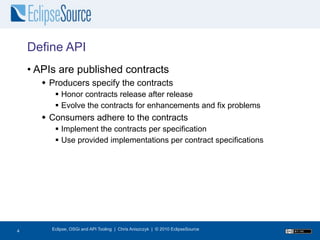
Define API
    • APIs are published contracts
       Producers specify the contracts
           Honor contracts release after release
           Evolve the contracts for enhancements and fix problems
       Consumers adhere to the contracts
           Implement the contracts per specification
           Use provided implementations per contract specifications


5
4        Eclipse, OSGi and API Tooling | Chris Aniszczyk | © 2010 EclipseSource
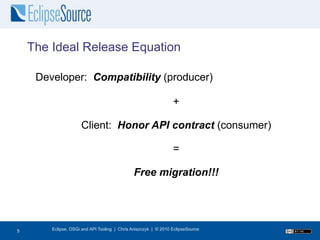
The Ideal Release Equation

     Developer: Compatibility (producer)

                                                                 +

                     Client: Honor API contract (consumer)

                                                                 =

                                              Free migration!!!


6
5       Eclipse, OSGi and API Tooling | Chris Aniszczyk | © 2010 EclipseSource
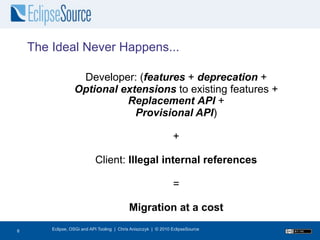
The Ideal Never Happens...

                   Developer: (features + deprecation +
                  Optional extensions to existing features +
                            Replacement API +
                              Provisional API)

                                                                 +

                            Client: Illegal internal references

                                                                 =

                                            Migration at a cost

7
6       Eclipse, OSGi and API Tooling | Chris Aniszczyk | © 2010 EclipseSource
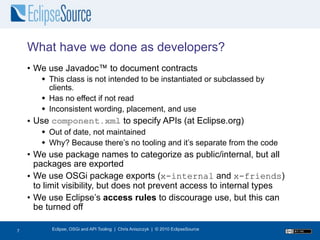
What have we done as developers?
    • We use Javadoc™ to document contracts
        This class is not intended to be instantiated or subclassed by
         clients.
        Has no effect if not read
        Inconsistent wording, placement, and use
    • Use component.xml to specify APIs (at Eclipse.org)
        Out of date, not maintained
        Why? Because there’s no tooling and it’s separate from the code
    • We use package names to categorize as public/internal, but all
      packages are exported
    • We use OSGi package exports (x-internal and x-friends)
      to limit visibility, but does not prevent access to internal types
    • We use Eclipse’s access rules to discourage use, but this can
      be turned off

8
7         Eclipse, OSGi and API Tooling | Chris Aniszczyk | © 2010 EclipseSource
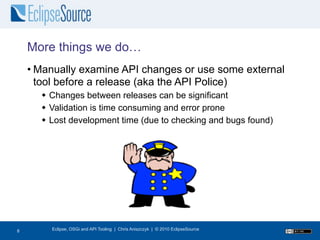
More things we do…
    • Manually examine API changes or use some external
      tool before a release (aka the API Police)
       Changes between releases can be significant
       Validation is time consuming and error prone
       Lost development time (due to checking and bugs found)


9
8       Eclipse, OSGi and API Tooling | Chris Aniszczyk | © 2010 EclipseSource
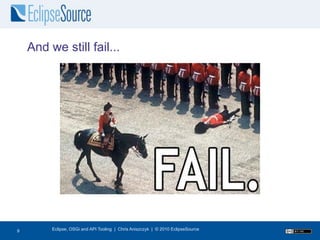
And we still fail...


10
 9        Eclipse, OSGi and API Tooling | Chris Aniszczyk | © 2010 EclipseSource
And we still fail...
     • At Eclipse, we have had issues with projects
       unintentionally breaking API...
     • Outside of Eclipse, it highly varies...
        “Commons collections 3.0 is binary compatible with version
         2.1 and 2.0 except for certain methods on one class. As the
         release was a major version, this is permitted, however it
         was unintentional and an error... the chosen solution is to
         provide a work around by releasing v2.1.1 and v3.1.”


     • Surely you’ve come across API issues, right?


11
10        Eclipse, OSGi and API Tooling | Chris Aniszczyk | © 2010 EclipseSource
Disclaimer
     • This presentation isn’t about API design

     • API design is still your problem
         Designing quality APIs is tough
         Ensuring consistent behavior
         Evolving APIs is tricky


     • But there are things that tooling can help with…

12
11        Eclipse, OSGi and API Tooling | Chris Aniszczyk | © 2010 EclipseSource
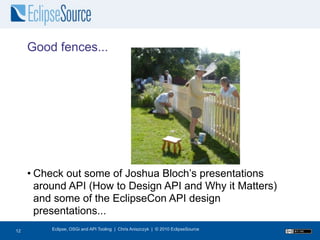
Good fences...


     • Check out some of Joshua Bloch’s presentations
       around API (How to Design API and Why it Matters)
       and some of the EclipseCon API design
       presentations...
13
12        Eclipse, OSGi and API Tooling | Chris Aniszczyk | © 2010 EclipseSource
API Tooling Features


14
13   Eclipse, OSGi and API Tooling | Chris Aniszczyk | © 2010 EclipseSource
API Tooling to the Rescue!
     • Reports
           Illegal API use
           Binary incompatibility relative to a baseline
           Incorrect bundle version numbers
           Missing or malformed @since tags
           Leakage of non-APIs types inside APIs
           Execution Environment validation
     • Tightly integrated toolset in the Eclipse SDK
         Currently limited to Plug-in projects/OSGi bundles
         Runs as a builder (auto-build, incremental and full builds)
         Immediate feedback as you develop and use APIs


15
14          Eclipse, OSGi and API Tooling | Chris Aniszczyk | © 2010 EclipseSource
Specifying API Contracts
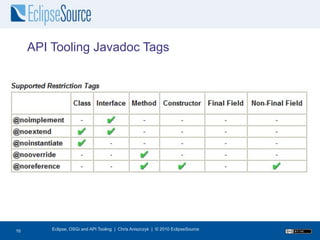
     • Use Javadoc tags
         E.g. @noimplement, @noextend, @noreference, @noinstantiate


     • Benefits
         Contracts live with the code for producers and consumers
         Content assist helps developers
         Available for projects that are not using 1.5 annotations
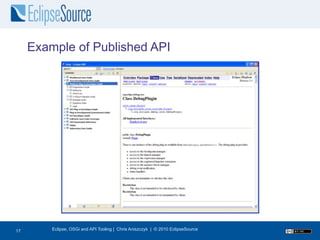
         Restrictions appear in published Javadoc APIs in a standard
          way
         Tools can process tags


16
15          Eclipse, OSGi and API Tooling | Chris Aniszczyk | © 2010 EclipseSource
API Tooling Javadoc Tags


17
16       Eclipse, OSGi and API Tooling | Chris Aniszczyk | © 2010 EclipseSource
Example of Published API


18
17       Eclipse, OSGi and API Tooling | Chris Aniszczyk | © 2010 EclipseSource
API Usage
     • Once the APIs are specified, the user needs to make
       sure that he/she is using them appropriately.
     • API usage is flagging any kind of illegal usage of API:
       reference to an API that is not supposed to be
       referenced, implementation of an interface that is not
       supposed to be implemented, ….
     • A consequence of wrong API usage is a potential
       binary incompatible change error.


19
18        Eclipse, OSGi and API Tooling | Chris Aniszczyk | © 2010 EclipseSource
Why API Usage Scans?
     API producers can see what internals are being used
     •   Inform clients how to use proper API
     •   Determine what new API needs to be added
     •   Know what clients will be broken
     •   Avoid breaking internals until clients have migrated


20
19         Eclipse, OSGi and API Tooling | Chris Aniszczyk | © 2010 EclipseSource
Validating Binary Compatibility
     • Evolving APIs such that they are backwards
       compatible with existing binaries
        http://wiki.eclipse.org/index.php/Evolving_Java-based_APIs
        It is easy to get it wrong
        Now the tooling takes care of this


     • The user simply specifies an API baseline
        Generally this means pointing to the previous release (N – 1)


21
20        Eclipse, OSGi and API Tooling | Chris Aniszczyk | © 2010 EclipseSource
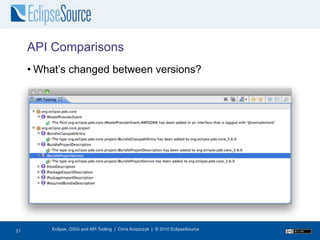
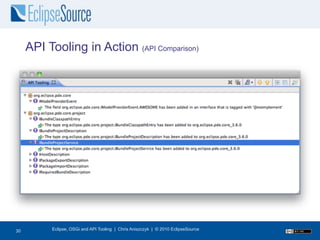
API Comparisons
     • What’s changed between versions?


22
21       Eclipse, OSGi and API Tooling | Chris Aniszczyk | © 2010 EclipseSource
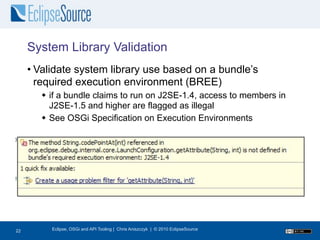
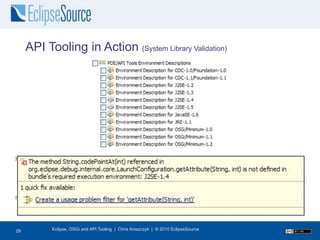
System Library Validation
     • Validate system library use based on a bundle’s
       required execution environment (BREE)
        if a bundle claims to run on J2SE-1.4, access to members in
         J2SE-1.5 and higher are flagged as illegal
        See OSGi Specification on Execution Environments


23
22        Eclipse, OSGi and API Tooling | Chris Aniszczyk | © 2010 EclipseSource
Migration Assistance
     • “What will be broken if I move to a new version?”
     • “Will my plug-in still run on an older target version?”
     • We simply re-resolve the references against X, with
       the code in X+1
     • Of course you can get the same information if you
       compile, but that requires more setup...


24
23        Eclipse, OSGi and API Tooling | Chris Aniszczyk | © 2010 EclipseSource
Bundle version number management
     • http://wiki.eclipse.org/index.php/Version_Numbering
     • The tooling takes care of letting the user know when
       the minor or major version of a bundle should be
       changed according to rules described in the
       document:
         A new API that is not a breaking change requires the minor
          version to be incremented
         A new API that is a breaking change requires the major
          version to be incremented
     • No support for the micro version yet...
         Technically speaking, this version should be changed as
          soon as any modification is made in the source code:
          comment change, method body change,…
25
24        Eclipse, OSGi and API Tooling | Chris Aniszczyk | © 2010 EclipseSource
OSGi Versioning 101
     • major.minor.micro.qualifier
          major - An incompatible update; breaking API
          minor - A backward compatible update; API stable
          micro - A bug fix
          qualifier - build date; lexicographic


     • Versions should encode compatibility at the bundle
       and package level... aid in evolution...

     • They aren’t a marketing number!


26
25          Eclipse, OSGi and API Tooling | Chris Aniszczyk | © 2010 EclipseSource
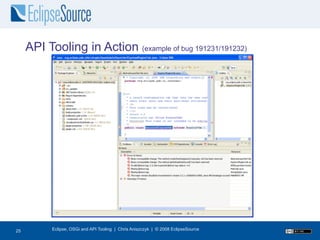
API Tooling in Action (example of bug 191231/191232)


27
25         Eclipse, OSGi and API Tooling | Chris Aniszczyk | © 2008 EclipseSource
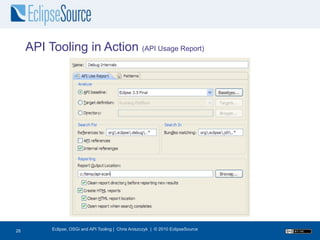
API Tooling in Action (API Usage Report)


28
26        Eclipse, OSGi and API Tooling | Chris Aniszczyk | © 2010 EclipseSource
API Tooling in Action (System Library Validation)


29
29         Eclipse, OSGi and API Tooling | Chris Aniszczyk | © 2010 EclipseSource
API Tooling in Action (API Comparison)


30
30        Eclipse, OSGi and API Tooling | Chris Aniszczyk | © 2010 EclipseSource
API Tooling Parts


31
31   Eclipse, OSGi and API Tooling | Chris Aniszczyk | © 2010 EclipseSource
API Profile and API Components
     • These are the two major pieces used by the API
       tooling tools to make diagnosis on the code
     • An API profile can be seen like a PDE target platform
     • An API profile is a collection of API components
     • It is initialized using an Eclipse SDK installation
       plugins directory (or some other directory of bundles)
     • Inside the IDE, a profile corresponding to the
       workbench contents is automatically created


32
32        Eclipse, OSGi and API Tooling | Chris Aniszczyk | © 2010 EclipseSource
API Description
     • This contains the specific restrictions for all the API
       types of an API component
     • It is kept up-to-date inside the workbench by using
       resource listeners
     • It is exported inside the binary bundles or generated at
       build time using an ant task.


33
33        Eclipse, OSGi and API Tooling | Chris Aniszczyk | © 2010 EclipseSource
Filtering of API Problems
     • Each component can define a problem filter
     • The filtering can be used to remove from reports
       known breakages.
     • For example, an API breakage has been approved by
       the PMC and you don’t want to get it reported for each
       build.
     • The problem filter is also part of the binary plug-in


34
34        Eclipse, OSGi and API Tooling | Chris Aniszczyk | © 2010 EclipseSource
Two aspects: IDE and build process
     • Each feature is available from within the IDE or inside
       a headless build process via Ant tasks
     • The IDE support is required to help the Eclipse
       developer while the code is written
     • The build process support is required to provide
       feedback during the Eclipse build. This also allows
       other projects to use it inside their builds.


35
35        Eclipse, OSGi and API Tooling | Chris Aniszczyk | © 2010 EclipseSource
Build support
     • Addition of new ant tasks:
         Generation of .api_description file
         Comparison of SDK drops: binary compatibility, api usage
          reports
     • Integration inside the Eclipse builds (headless mode)
     • Integration inside ant build (no Eclipse running)


36
22        Eclipse, OSGi and API Tooling | Chris Aniszczyk | © 2010 EclipseSource
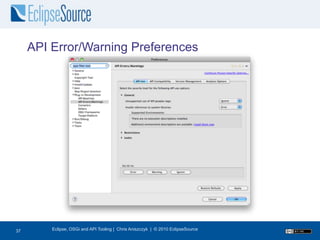
API Error/Warning Preferences


37
37       Eclipse, OSGi and API Tooling | Chris Aniszczyk | © 2010 EclipseSource
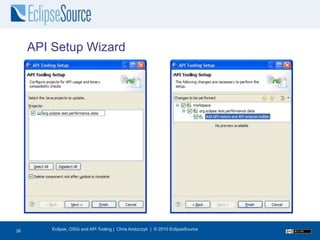
API Setup Wizard


38
38       Eclipse, OSGi and API Tooling | Chris Aniszczyk | © 2010 EclipseSource
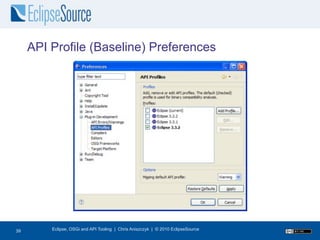
API Profile (Baseline) Preferences


39
39       Eclipse, OSGi and API Tooling | Chris Aniszczyk | © 2010 EclipseSource
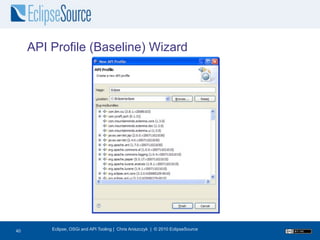
API Profile (Baseline) Wizard


40
40       Eclipse, OSGi and API Tooling | Chris Aniszczyk | © 2010 EclipseSource
Future work


41
41   Eclipse, OSGi and API Tooling | Chris Aniszczyk | © 2010 EclipseSource
To be done...
     • Handling of package level versioning
     • Support extended to support more than just bundles
         Pure Java™ projects
         Plug-in extension points
     • Improve integration with Eclipse rel-eng build reporting
     • Determine compatible version range of required bundles

     • And what you might suggest...


42
42         Eclipse, OSGi and API Tooling | Chris Aniszczyk | © 2010 EclipseSource
Summary


43
43   Eclipse, OSGi and API Tooling | Chris Aniszczyk | © 2010 EclipseSource
API Tooling Summary
     • Help you to define your API restrictions
     • Keep a consistent and standard presentation of API
       restrictions
     • Detect binary breakage between a baseline and the
       current version
     • Detect wrong API usage
     • Detect wrong @since tags and inconsistent bundle
       versioning
     • Detect Execution Environment problems...
     • Supports more than just Eclipse (hi OSGi folks)!

44
44        Eclipse, OSGi and API Tooling | Chris Aniszczyk | © 2010 EclipseSource
Links
     • Wiki
         http://wiki.eclipse.org/Api_Tooling

     • Bugzilla
         https://bugs.eclipse.org/bugs/enter_bug.cgi?product=PDE


     • Get Involved
        https://dev.eclipse.org/mailman/listinfo/pde-dev


45
45        Eclipse, OSGi and API Tooling | Chris Aniszczyk | © 2010 EclipseSource
Q & A

46
46   Eclipse, OSGi and API Tooling | Chris Aniszczyk | © 2010 EclipseSource

OSGi, Eclipse and API Tooling

  • 1.
    Eclipse, OSGi andAPI Tooling Chris Aniszczyk (EclipseSource) zx@eclipsesource.com http://eclipsesource.com 1 1 Eclipse, OSGi and API Tooling | Chris Aniszczyk | © 2010 EclipseSource
  • 2.
    Who am I? • Chris Aniszczyk  Senior Software Engineer at EclipseSource  Plug-in Development Environment (PDE) Co-Lead  Been doing OSGi before it was en vogue  Committer Representative on Eclipse’s Board of Directors  Co-author Eclipse RCP Book 2nd Edition  I dabble with many things at Eclipse.org • My blog  http://aniszczyk.org • Follow me on Twitter  http://twitter.com/caniszczyk 2 2 Eclipse, OSGi and API Tooling | Chris Aniszczyk | © 2010 EclipseSource
  • 3.
    Overview • The need for tooling • Tooling features • Tooling in action! • Future work • Summary • Q&A 3 2 Eclipse, OSGi and API Tooling | Chris Aniszczyk | © 2010 EclipseSource
  • 4.
    The need fortooling Remember Kirk’s gigantic Modularity diagram? 4 3 Eclipse, OSGi and API Tooling | Chris Aniszczyk | © 2010 EclipseSource
  • 5.
    Define API • APIs are published contracts  Producers specify the contracts  Honor contracts release after release  Evolve the contracts for enhancements and fix problems  Consumers adhere to the contracts  Implement the contracts per specification  Use provided implementations per contract specifications 5 4 Eclipse, OSGi and API Tooling | Chris Aniszczyk | © 2010 EclipseSource
  • 6.
    The Ideal ReleaseEquation Developer: Compatibility (producer) + Client: Honor API contract (consumer) = Free migration!!! 6 5 Eclipse, OSGi and API Tooling | Chris Aniszczyk | © 2010 EclipseSource
  • 7.
    The Ideal NeverHappens... Developer: (features + deprecation + Optional extensions to existing features + Replacement API + Provisional API) + Client: Illegal internal references = Migration at a cost 7 6 Eclipse, OSGi and API Tooling | Chris Aniszczyk | © 2010 EclipseSource
  • 8.
    What have wedone as developers? • We use Javadoc™ to document contracts  This class is not intended to be instantiated or subclassed by clients.  Has no effect if not read  Inconsistent wording, placement, and use • Use component.xml to specify APIs (at Eclipse.org)  Out of date, not maintained  Why? Because there’s no tooling and it’s separate from the code • We use package names to categorize as public/internal, but all packages are exported • We use OSGi package exports (x-internal and x-friends) to limit visibility, but does not prevent access to internal types • We use Eclipse’s access rules to discourage use, but this can be turned off 8 7 Eclipse, OSGi and API Tooling | Chris Aniszczyk | © 2010 EclipseSource
  • 9.
    More things wedo… • Manually examine API changes or use some external tool before a release (aka the API Police)  Changes between releases can be significant  Validation is time consuming and error prone  Lost development time (due to checking and bugs found) 9 8 Eclipse, OSGi and API Tooling | Chris Aniszczyk | © 2010 EclipseSource
  • 10.
    And we stillfail... 10 9 Eclipse, OSGi and API Tooling | Chris Aniszczyk | © 2010 EclipseSource
  • 11.
    And we stillfail... • At Eclipse, we have had issues with projects unintentionally breaking API... • Outside of Eclipse, it highly varies...  “Commons collections 3.0 is binary compatible with version 2.1 and 2.0 except for certain methods on one class. As the release was a major version, this is permitted, however it was unintentional and an error... the chosen solution is to provide a work around by releasing v2.1.1 and v3.1.” • Surely you’ve come across API issues, right? 11 10 Eclipse, OSGi and API Tooling | Chris Aniszczyk | © 2010 EclipseSource
  • 12.
    Disclaimer • This presentation isn’t about API design • API design is still your problem  Designing quality APIs is tough  Ensuring consistent behavior  Evolving APIs is tricky • But there are things that tooling can help with… 12 11 Eclipse, OSGi and API Tooling | Chris Aniszczyk | © 2010 EclipseSource
  • 13.
    Good fences... • Check out some of Joshua Bloch’s presentations around API (How to Design API and Why it Matters) and some of the EclipseCon API design presentations... 13 12 Eclipse, OSGi and API Tooling | Chris Aniszczyk | © 2010 EclipseSource
  • 14.
    API Tooling Features 14 13 Eclipse, OSGi and API Tooling | Chris Aniszczyk | © 2010 EclipseSource
  • 15.
    API Tooling tothe Rescue! • Reports  Illegal API use  Binary incompatibility relative to a baseline  Incorrect bundle version numbers  Missing or malformed @since tags  Leakage of non-APIs types inside APIs  Execution Environment validation • Tightly integrated toolset in the Eclipse SDK  Currently limited to Plug-in projects/OSGi bundles  Runs as a builder (auto-build, incremental and full builds)  Immediate feedback as you develop and use APIs 15 14 Eclipse, OSGi and API Tooling | Chris Aniszczyk | © 2010 EclipseSource
  • 16.
    Specifying API Contracts • Use Javadoc tags  E.g. @noimplement, @noextend, @noreference, @noinstantiate • Benefits  Contracts live with the code for producers and consumers  Content assist helps developers  Available for projects that are not using 1.5 annotations  Restrictions appear in published Javadoc APIs in a standard way  Tools can process tags 16 15 Eclipse, OSGi and API Tooling | Chris Aniszczyk | © 2010 EclipseSource
  • 17.
    API Tooling JavadocTags 17 16 Eclipse, OSGi and API Tooling | Chris Aniszczyk | © 2010 EclipseSource
  • 18.
    Example of PublishedAPI 18 17 Eclipse, OSGi and API Tooling | Chris Aniszczyk | © 2010 EclipseSource
  • 19.
    API Usage • Once the APIs are specified, the user needs to make sure that he/she is using them appropriately. • API usage is flagging any kind of illegal usage of API: reference to an API that is not supposed to be referenced, implementation of an interface that is not supposed to be implemented, …. • A consequence of wrong API usage is a potential binary incompatible change error. 19 18 Eclipse, OSGi and API Tooling | Chris Aniszczyk | © 2010 EclipseSource
  • 20.
    Why API UsageScans? API producers can see what internals are being used • Inform clients how to use proper API • Determine what new API needs to be added • Know what clients will be broken • Avoid breaking internals until clients have migrated 20 19 Eclipse, OSGi and API Tooling | Chris Aniszczyk | © 2010 EclipseSource
  • 21.
    Validating Binary Compatibility • Evolving APIs such that they are backwards compatible with existing binaries  http://wiki.eclipse.org/index.php/Evolving_Java-based_APIs  It is easy to get it wrong  Now the tooling takes care of this • The user simply specifies an API baseline  Generally this means pointing to the previous release (N – 1) 21 20 Eclipse, OSGi and API Tooling | Chris Aniszczyk | © 2010 EclipseSource
  • 22.
    API Comparisons • What’s changed between versions? 22 21 Eclipse, OSGi and API Tooling | Chris Aniszczyk | © 2010 EclipseSource
  • 23.
    System Library Validation • Validate system library use based on a bundle’s required execution environment (BREE)  if a bundle claims to run on J2SE-1.4, access to members in J2SE-1.5 and higher are flagged as illegal  See OSGi Specification on Execution Environments 23 22 Eclipse, OSGi and API Tooling | Chris Aniszczyk | © 2010 EclipseSource
  • 24.
    Migration Assistance • “What will be broken if I move to a new version?” • “Will my plug-in still run on an older target version?” • We simply re-resolve the references against X, with the code in X+1 • Of course you can get the same information if you compile, but that requires more setup... 24 23 Eclipse, OSGi and API Tooling | Chris Aniszczyk | © 2010 EclipseSource
  • 25.
    Bundle version numbermanagement • http://wiki.eclipse.org/index.php/Version_Numbering • The tooling takes care of letting the user know when the minor or major version of a bundle should be changed according to rules described in the document:  A new API that is not a breaking change requires the minor version to be incremented  A new API that is a breaking change requires the major version to be incremented • No support for the micro version yet...  Technically speaking, this version should be changed as soon as any modification is made in the source code: comment change, method body change,… 25 24 Eclipse, OSGi and API Tooling | Chris Aniszczyk | © 2010 EclipseSource
  • 26.
    OSGi Versioning 101 • major.minor.micro.qualifier  major - An incompatible update; breaking API  minor - A backward compatible update; API stable  micro - A bug fix  qualifier - build date; lexicographic • Versions should encode compatibility at the bundle and package level... aid in evolution... • They aren’t a marketing number! 26 25 Eclipse, OSGi and API Tooling | Chris Aniszczyk | © 2010 EclipseSource
  • 27.
    API Tooling inAction (example of bug 191231/191232) 27 25 Eclipse, OSGi and API Tooling | Chris Aniszczyk | © 2008 EclipseSource
  • 28.
    API Tooling inAction (API Usage Report) 28 26 Eclipse, OSGi and API Tooling | Chris Aniszczyk | © 2010 EclipseSource
  • 29.
    API Tooling inAction (System Library Validation) 29 29 Eclipse, OSGi and API Tooling | Chris Aniszczyk | © 2010 EclipseSource
  • 30.
    API Tooling inAction (API Comparison) 30 30 Eclipse, OSGi and API Tooling | Chris Aniszczyk | © 2010 EclipseSource
  • 31.
    API Tooling Parts 31 31 Eclipse, OSGi and API Tooling | Chris Aniszczyk | © 2010 EclipseSource
  • 32.
    API Profile andAPI Components • These are the two major pieces used by the API tooling tools to make diagnosis on the code • An API profile can be seen like a PDE target platform • An API profile is a collection of API components • It is initialized using an Eclipse SDK installation plugins directory (or some other directory of bundles) • Inside the IDE, a profile corresponding to the workbench contents is automatically created 32 32 Eclipse, OSGi and API Tooling | Chris Aniszczyk | © 2010 EclipseSource
  • 33.
    API Description • This contains the specific restrictions for all the API types of an API component • It is kept up-to-date inside the workbench by using resource listeners • It is exported inside the binary bundles or generated at build time using an ant task. 33 33 Eclipse, OSGi and API Tooling | Chris Aniszczyk | © 2010 EclipseSource
  • 34.
    Filtering of APIProblems • Each component can define a problem filter • The filtering can be used to remove from reports known breakages. • For example, an API breakage has been approved by the PMC and you don’t want to get it reported for each build. • The problem filter is also part of the binary plug-in 34 34 Eclipse, OSGi and API Tooling | Chris Aniszczyk | © 2010 EclipseSource
  • 35.
    Two aspects: IDEand build process • Each feature is available from within the IDE or inside a headless build process via Ant tasks • The IDE support is required to help the Eclipse developer while the code is written • The build process support is required to provide feedback during the Eclipse build. This also allows other projects to use it inside their builds. 35 35 Eclipse, OSGi and API Tooling | Chris Aniszczyk | © 2010 EclipseSource
  • 36.
    Build support • Addition of new ant tasks:  Generation of .api_description file  Comparison of SDK drops: binary compatibility, api usage reports • Integration inside the Eclipse builds (headless mode) • Integration inside ant build (no Eclipse running) 36 22 Eclipse, OSGi and API Tooling | Chris Aniszczyk | © 2010 EclipseSource
  • 37.
    API Error/Warning Preferences 37 37 Eclipse, OSGi and API Tooling | Chris Aniszczyk | © 2010 EclipseSource
  • 38.
    API Setup Wizard 38 38 Eclipse, OSGi and API Tooling | Chris Aniszczyk | © 2010 EclipseSource
  • 39.
    API Profile (Baseline)Preferences 39 39 Eclipse, OSGi and API Tooling | Chris Aniszczyk | © 2010 EclipseSource
  • 40.
    API Profile (Baseline)Wizard 40 40 Eclipse, OSGi and API Tooling | Chris Aniszczyk | © 2010 EclipseSource
  • 41.
    Future work 41 41 Eclipse, OSGi and API Tooling | Chris Aniszczyk | © 2010 EclipseSource
  • 42.
    To be done... • Handling of package level versioning • Support extended to support more than just bundles  Pure Java™ projects  Plug-in extension points • Improve integration with Eclipse rel-eng build reporting • Determine compatible version range of required bundles • And what you might suggest... 42 42 Eclipse, OSGi and API Tooling | Chris Aniszczyk | © 2010 EclipseSource
  • 43.
    Summary 43 43 Eclipse, OSGi and API Tooling | Chris Aniszczyk | © 2010 EclipseSource
  • 44.
    API Tooling Summary • Help you to define your API restrictions • Keep a consistent and standard presentation of API restrictions • Detect binary breakage between a baseline and the current version • Detect wrong API usage • Detect wrong @since tags and inconsistent bundle versioning • Detect Execution Environment problems... • Supports more than just Eclipse (hi OSGi folks)! 44 44 Eclipse, OSGi and API Tooling | Chris Aniszczyk | © 2010 EclipseSource
  • 45.
    Links • Wiki  http://wiki.eclipse.org/Api_Tooling • Bugzilla  https://bugs.eclipse.org/bugs/enter_bug.cgi?product=PDE • Get Involved  https://dev.eclipse.org/mailman/listinfo/pde-dev 45 45 Eclipse, OSGi and API Tooling | Chris Aniszczyk | © 2010 EclipseSource
  • 46.
    Q & A 46 46 Eclipse, OSGi and API Tooling | Chris Aniszczyk | © 2010 EclipseSource