
GET


Gábor Török @ EPAM/Szeged
   Introduction, overview


   Best practices


   Java support
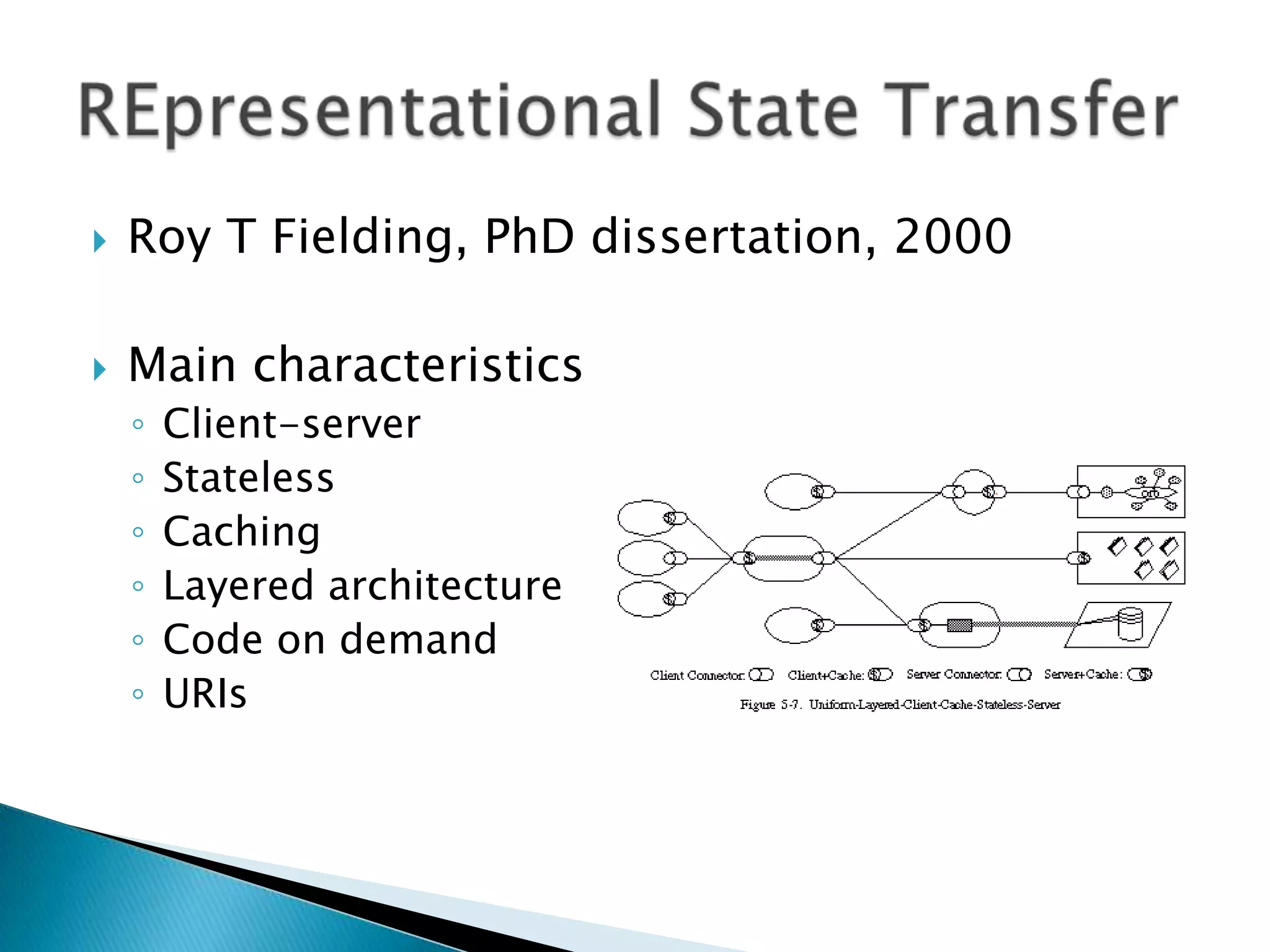
   Roy T Fielding, PhD dissertation, 2000

   Main characteristics
    ◦   Client-server
    ◦   Stateless
    ◦   Caching
    ◦   Layered architecture
    ◦   Code on demand
    ◦   URIs
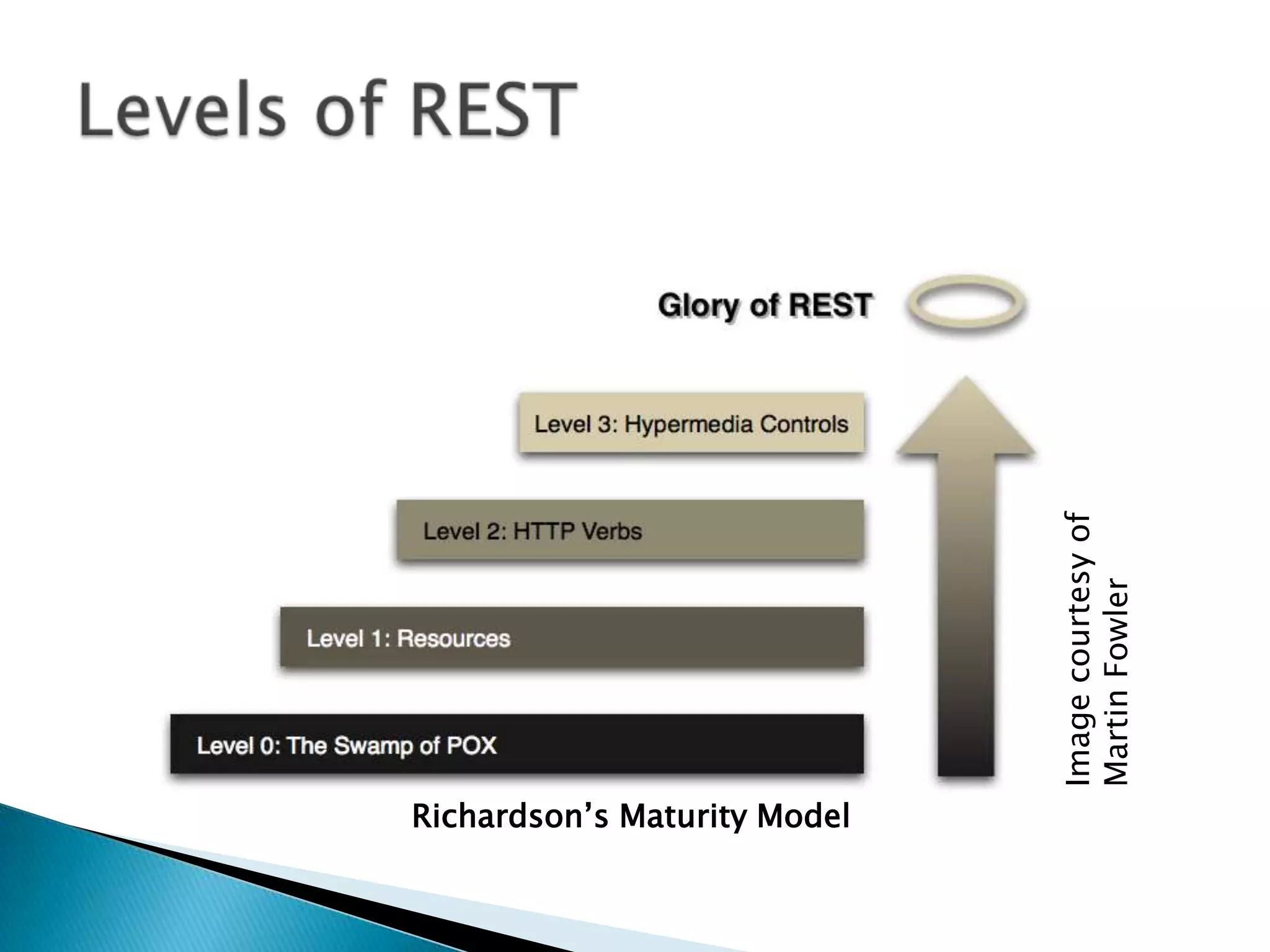
Richardson’s Maturity Model


                              Image courtesy of
                              Martin Fowler
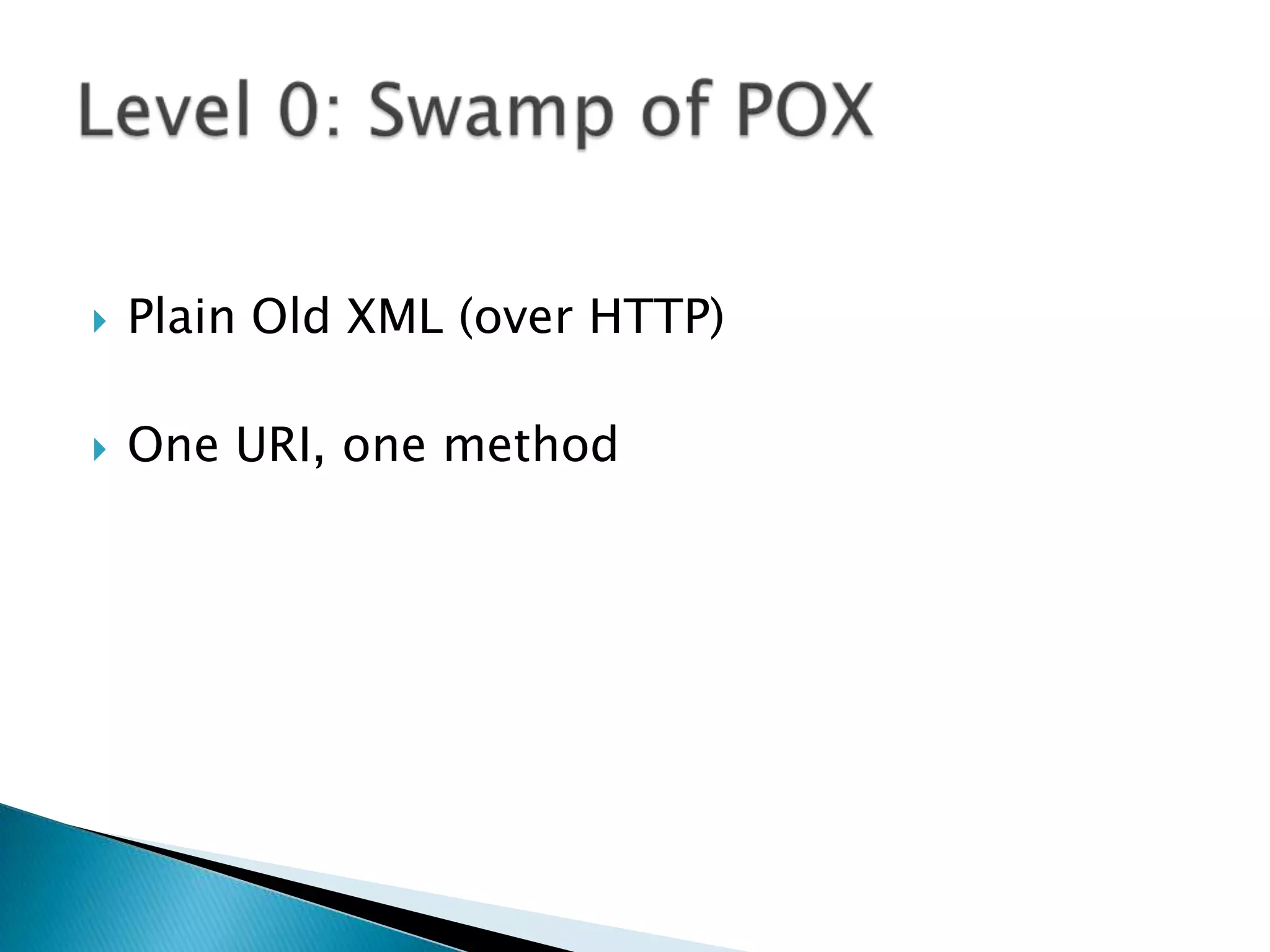
   Plain Old XML (over HTTP)

   One URI, one method
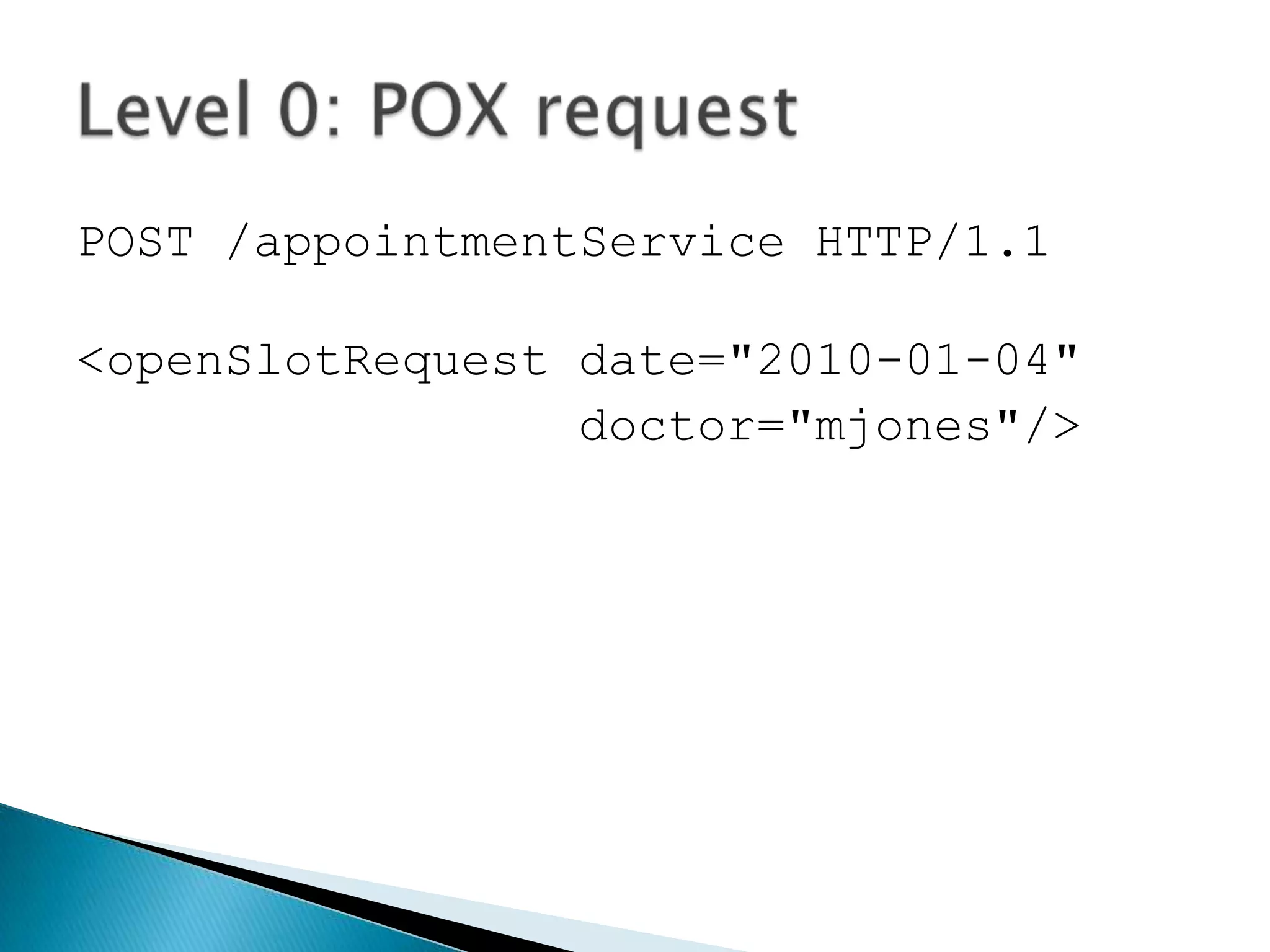
POST /appointmentService HTTP/1.1

<openSlotRequest date="2010-01-04"
                 doctor="mjones"/>
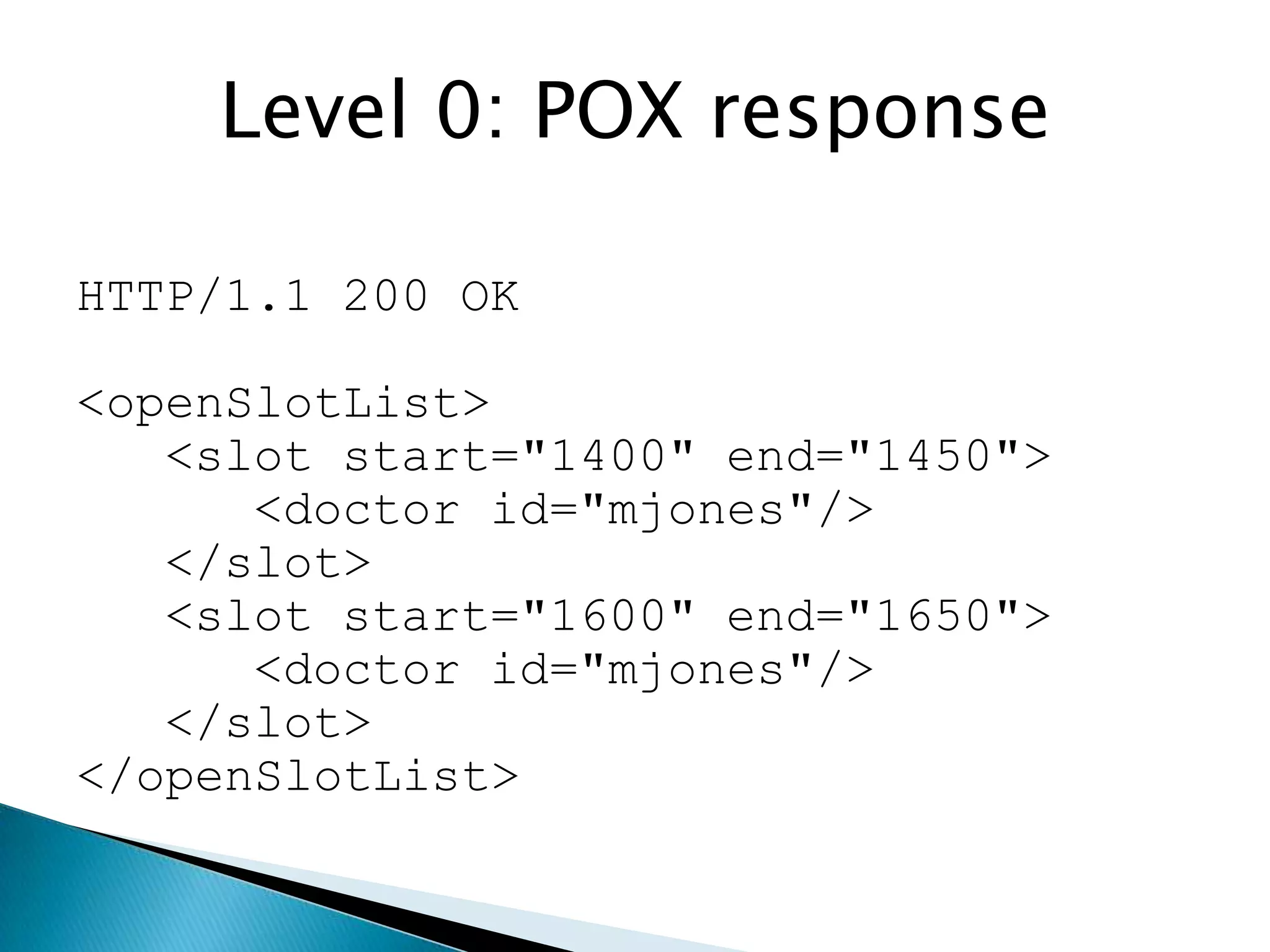
Level 0: POX response

HTTP/1.1 200 OK

<openSlotList>
   <slot start="1400" end="1450">
      <doctor id="mjones"/>
   </slot>
   <slot start="1600" end="1650">
      <doctor id="mjones"/>
   </slot>
</openSlotList>
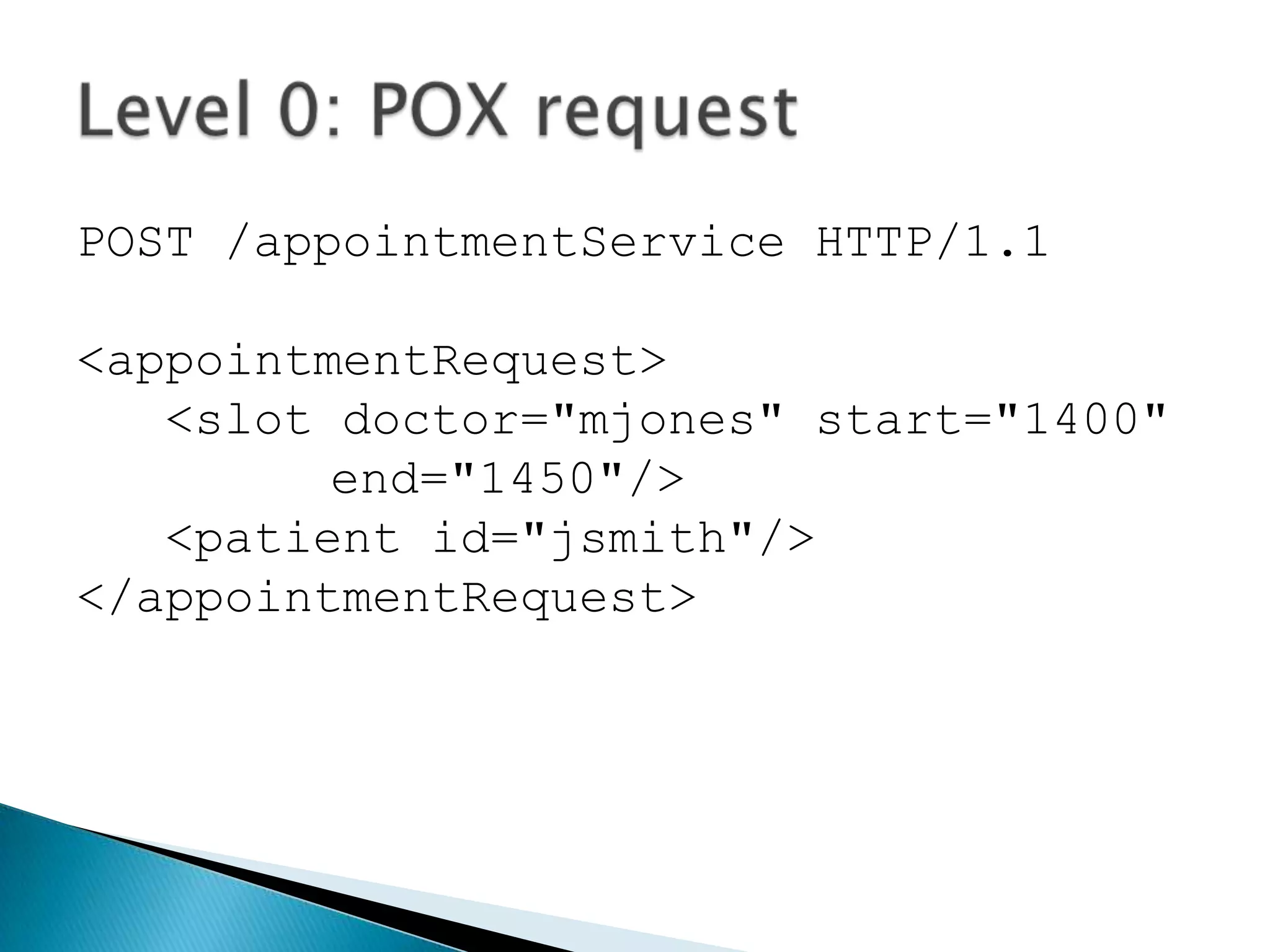
POST /appointmentService HTTP/1.1

<appointmentRequest>
   <slot doctor="mjones" start="1400"
         end="1450"/>
   <patient id="jsmith"/>
</appointmentRequest>
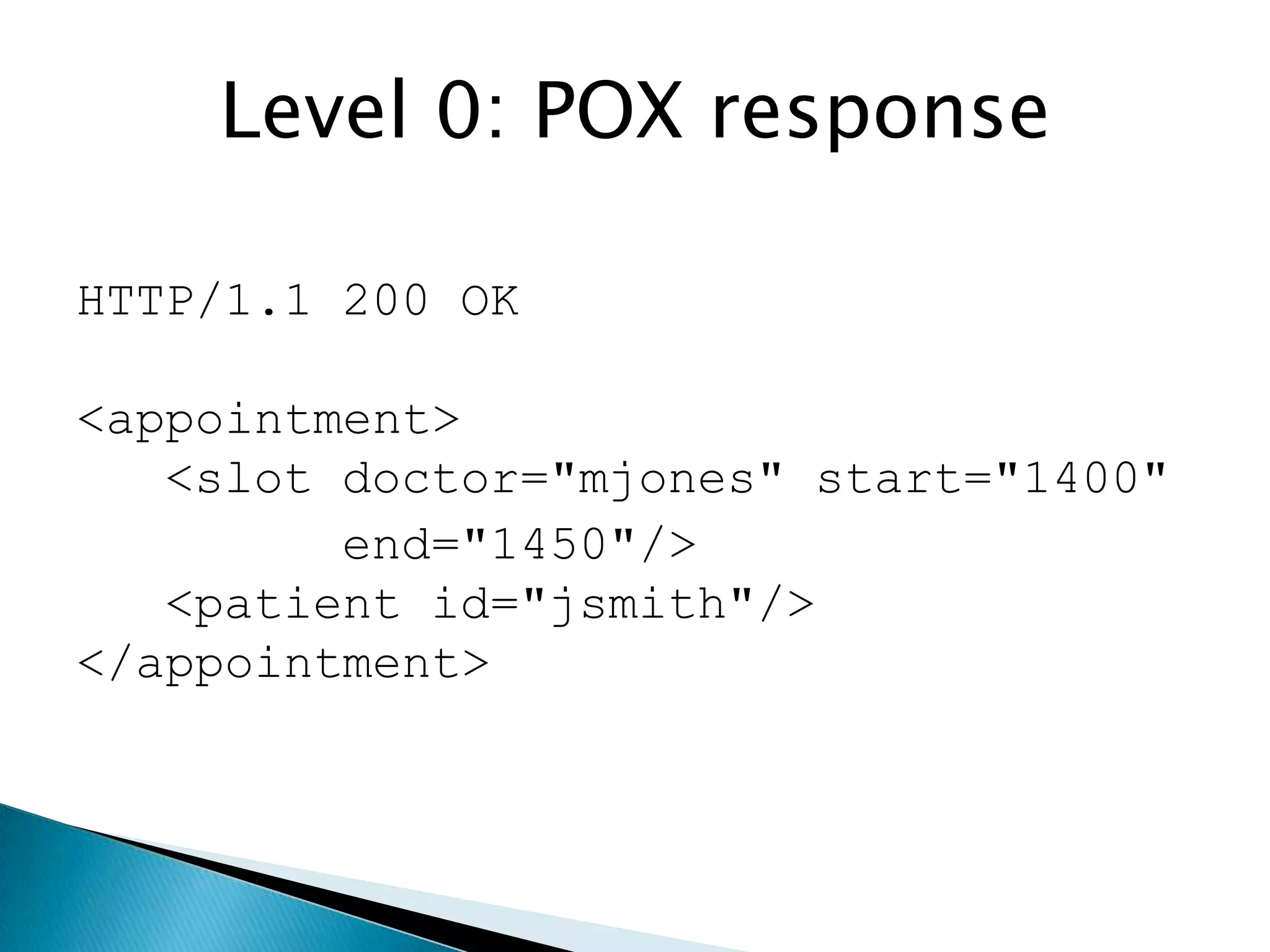
Level 0: POX response

HTTP/1.1 200 OK

<appointment>
   <slot doctor="mjones" start="1400"
         end="1450"/>
   <patient id="jsmith"/>
</appointment>
Many URIs, one method
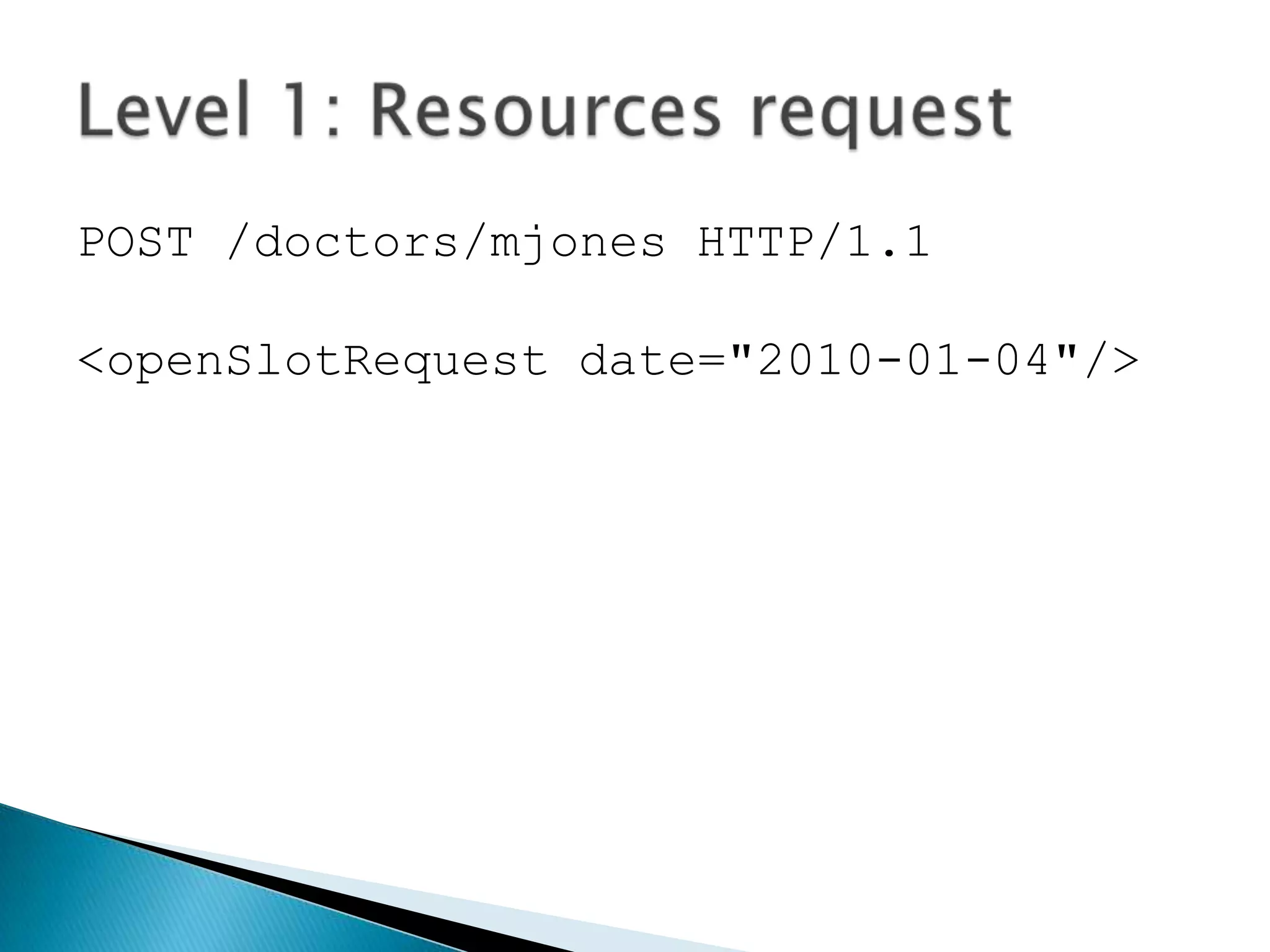
POST /doctors/mjones HTTP/1.1

<openSlotRequest date="2010-01-04"/>
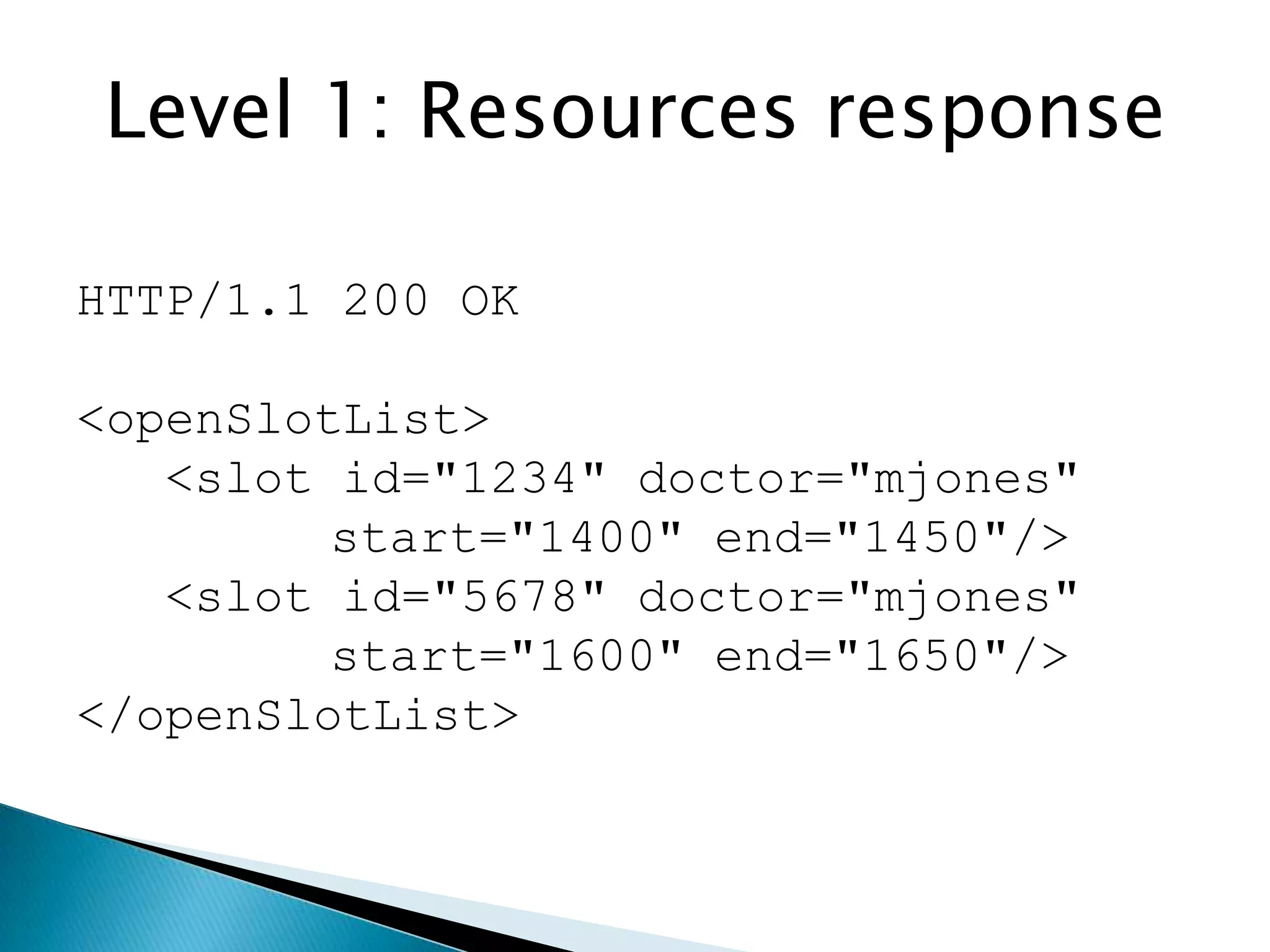
Level 1: Resources response

HTTP/1.1 200 OK

<openSlotList>
   <slot id="1234" doctor="mjones"
         start="1400" end="1450"/>
   <slot id="5678" doctor="mjones"
         start="1600" end="1650"/>
</openSlotList>
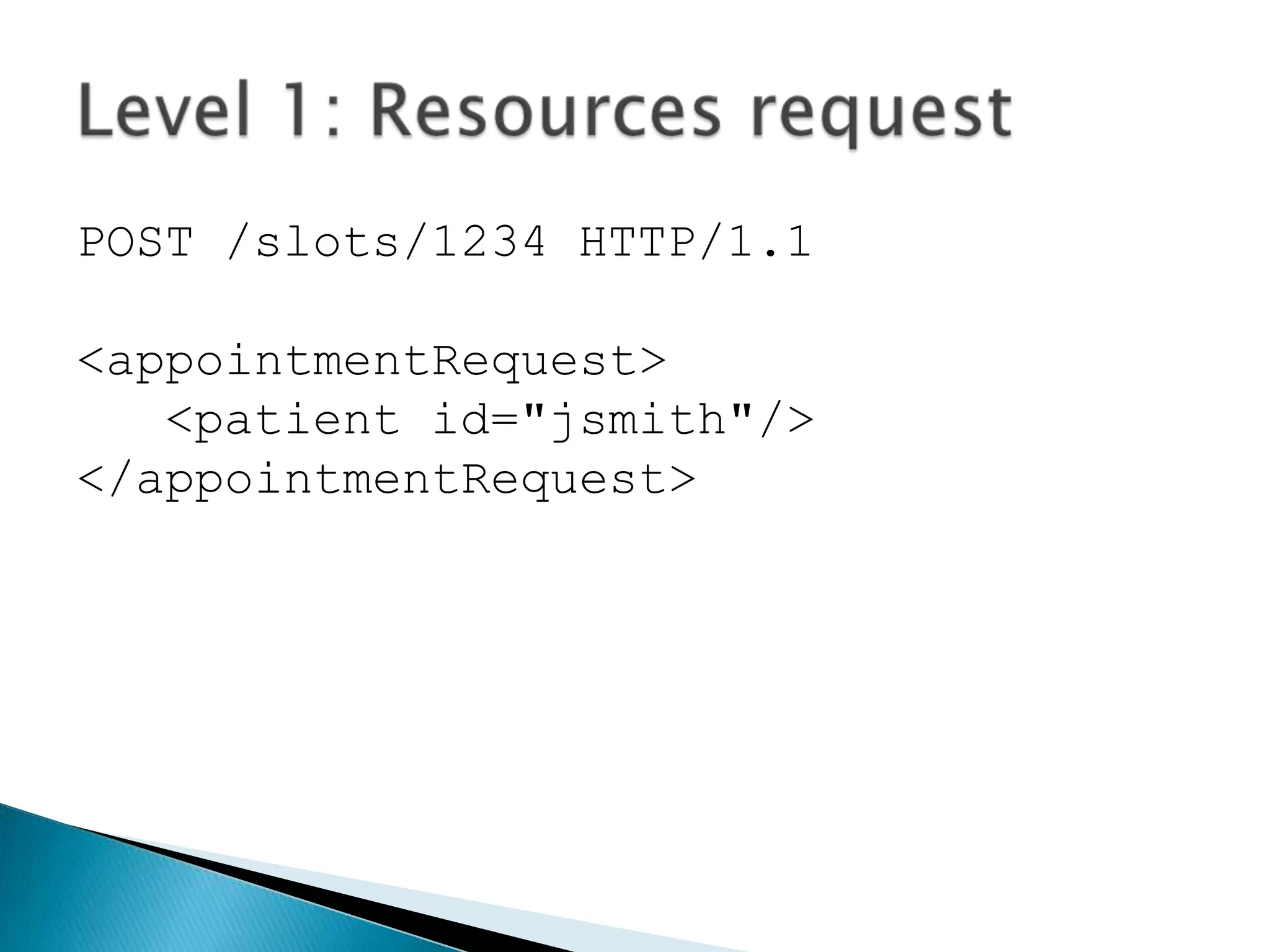
POST /slots/1234 HTTP/1.1

<appointmentRequest>
   <patient id="jsmith"/>
</appointmentRequest>
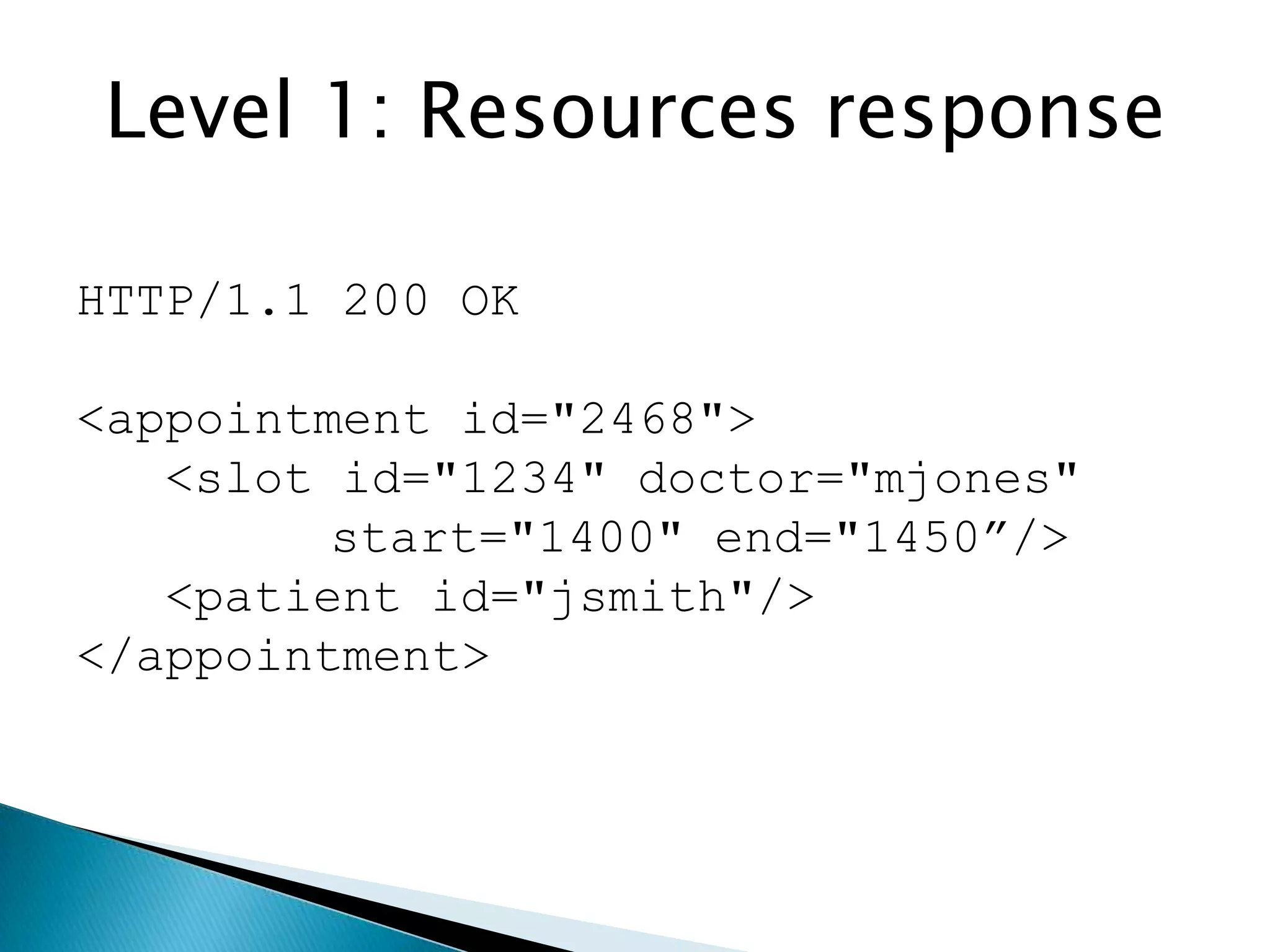
Level 1: Resources response

HTTP/1.1 200 OK

<appointment id="2468">
   <slot id="1234" doctor="mjones"
         start="1400" end="1450”/>
   <patient id="jsmith"/>
</appointment>
   Many URIs, many (HTTP) methods


   This is what most call REST


   Best practices follow
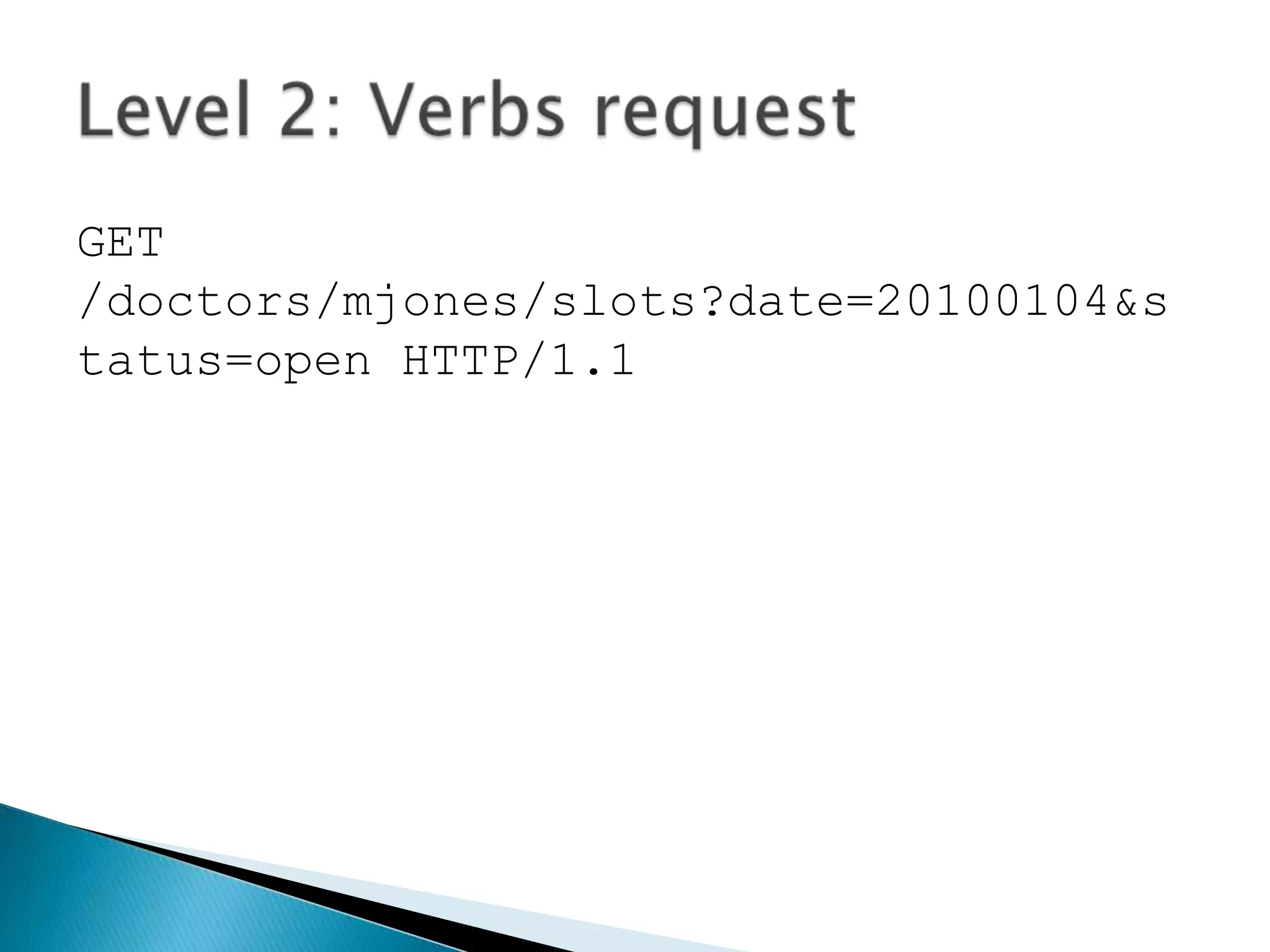
GET
/doctors/mjones/slots?date=20100104&s
tatus=open HTTP/1.1
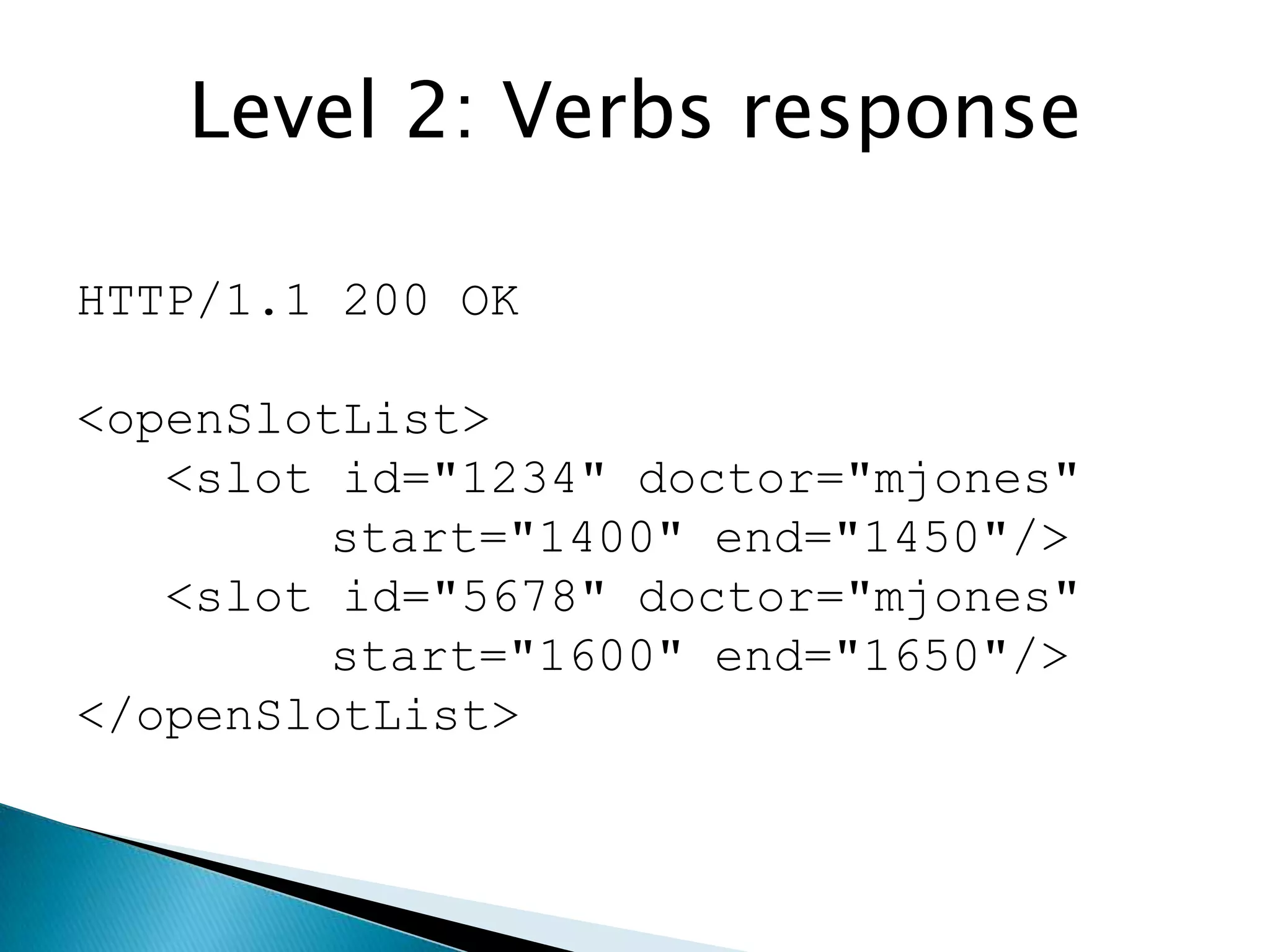
Level 2: Verbs response

HTTP/1.1 200 OK

<openSlotList>
   <slot id="1234" doctor="mjones"
         start="1400" end="1450"/>
   <slot id="5678" doctor="mjones"
         start="1600" end="1650"/>
</openSlotList>
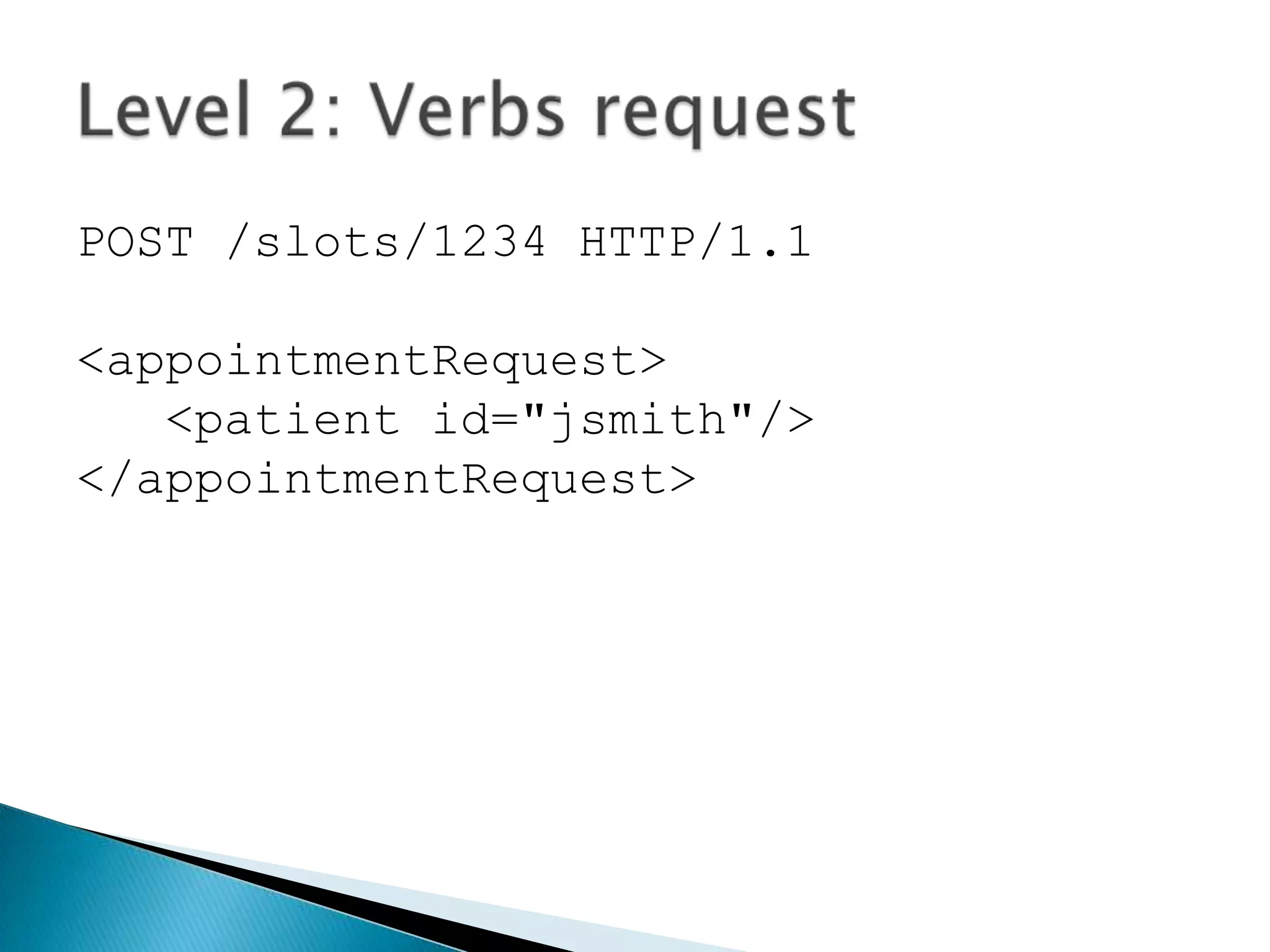
POST /slots/1234 HTTP/1.1

<appointmentRequest>
   <patient id="jsmith"/>
</appointmentRequest>
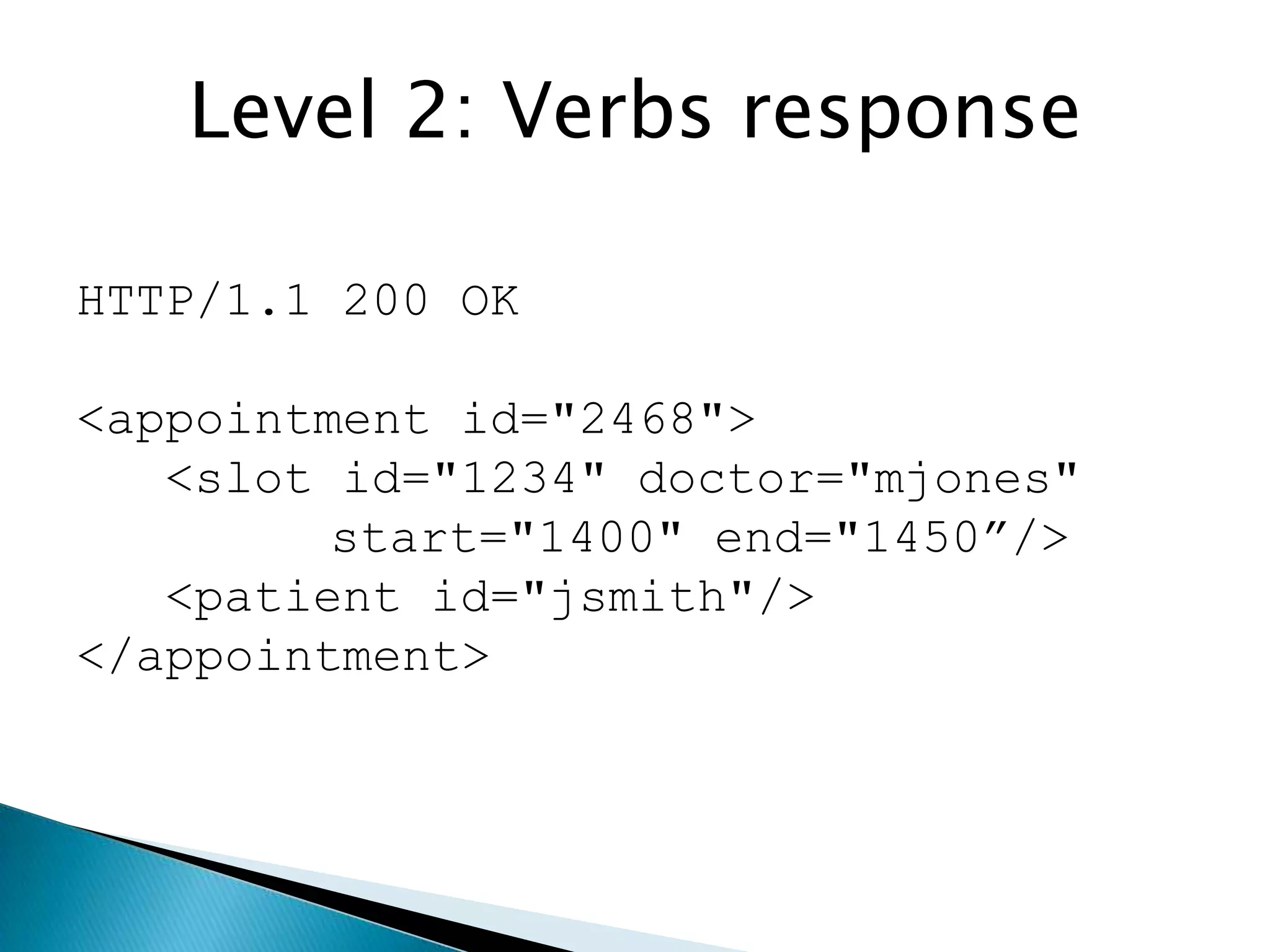
Level 2: Verbs response

HTTP/1.1 200 OK

<appointment id="2468">
   <slot id="1234" doctor="mjones"
         start="1400" end="1450”/>
   <patient id="jsmith"/>
</appointment>
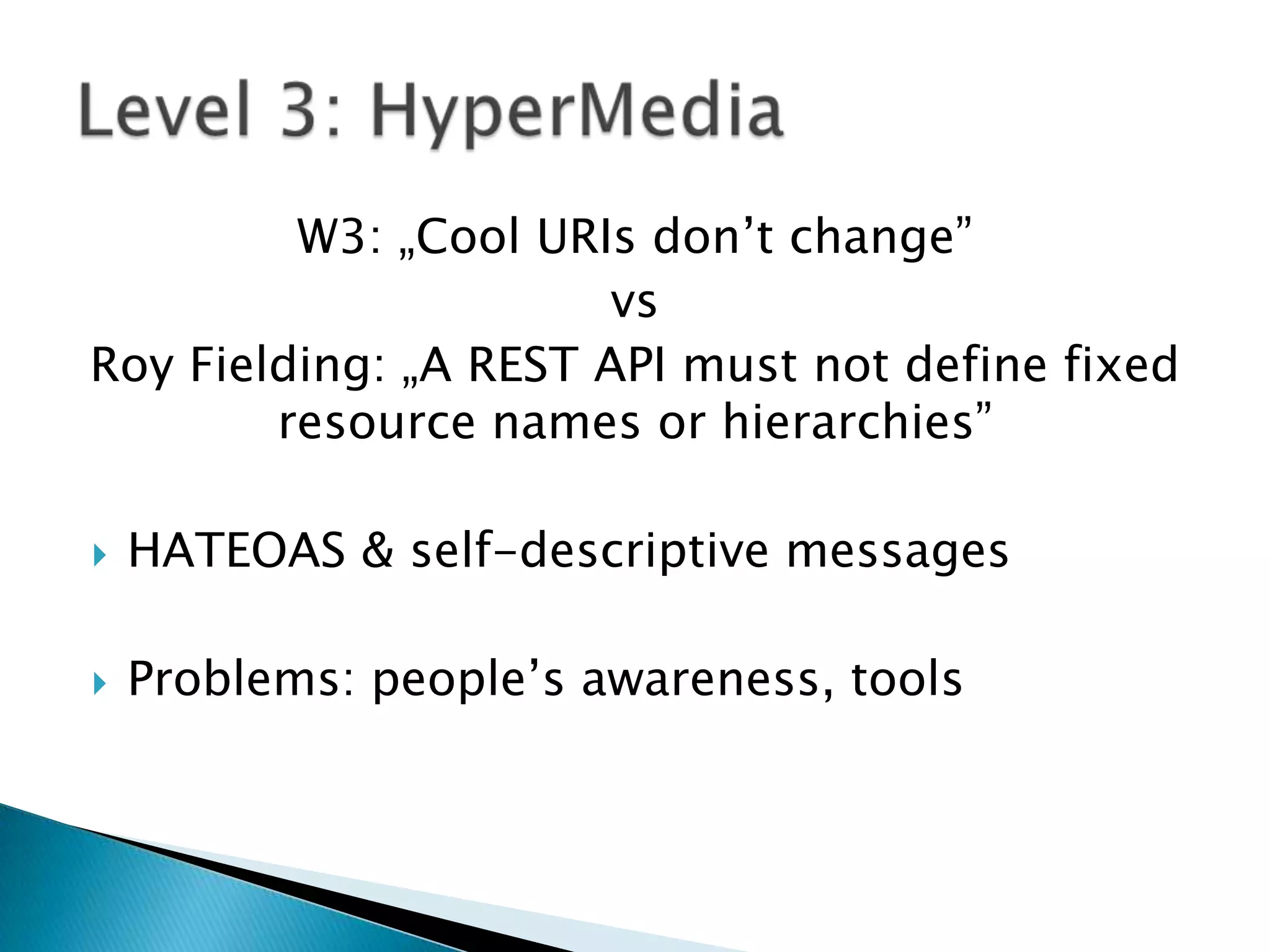
W3: „Cool URIs don’t change”
                       vs
Roy Fielding: „A REST API must not define fixed
        resource names or hierarchies”

   HATEOAS & self-descriptive messages

   Problems: people’s awareness, tools
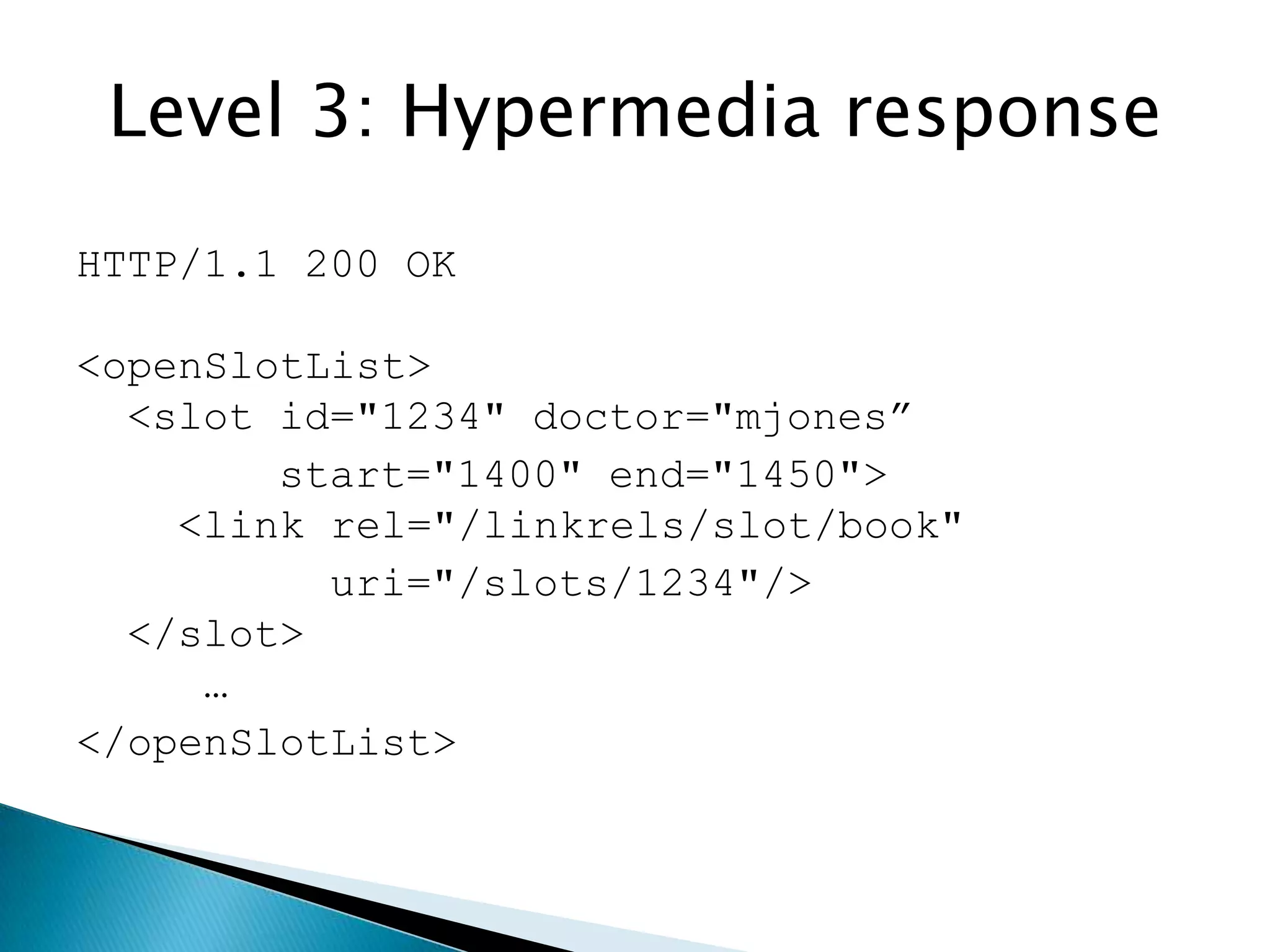
Level 3: Hypermedia response
HTTP/1.1 200 OK

<openSlotList>
  <slot id="1234" doctor="mjones”
        start="1400" end="1450">
    <link rel="/linkrels/slot/book"
          uri="/slots/1234"/>
  </slot>
     …
</openSlotList>
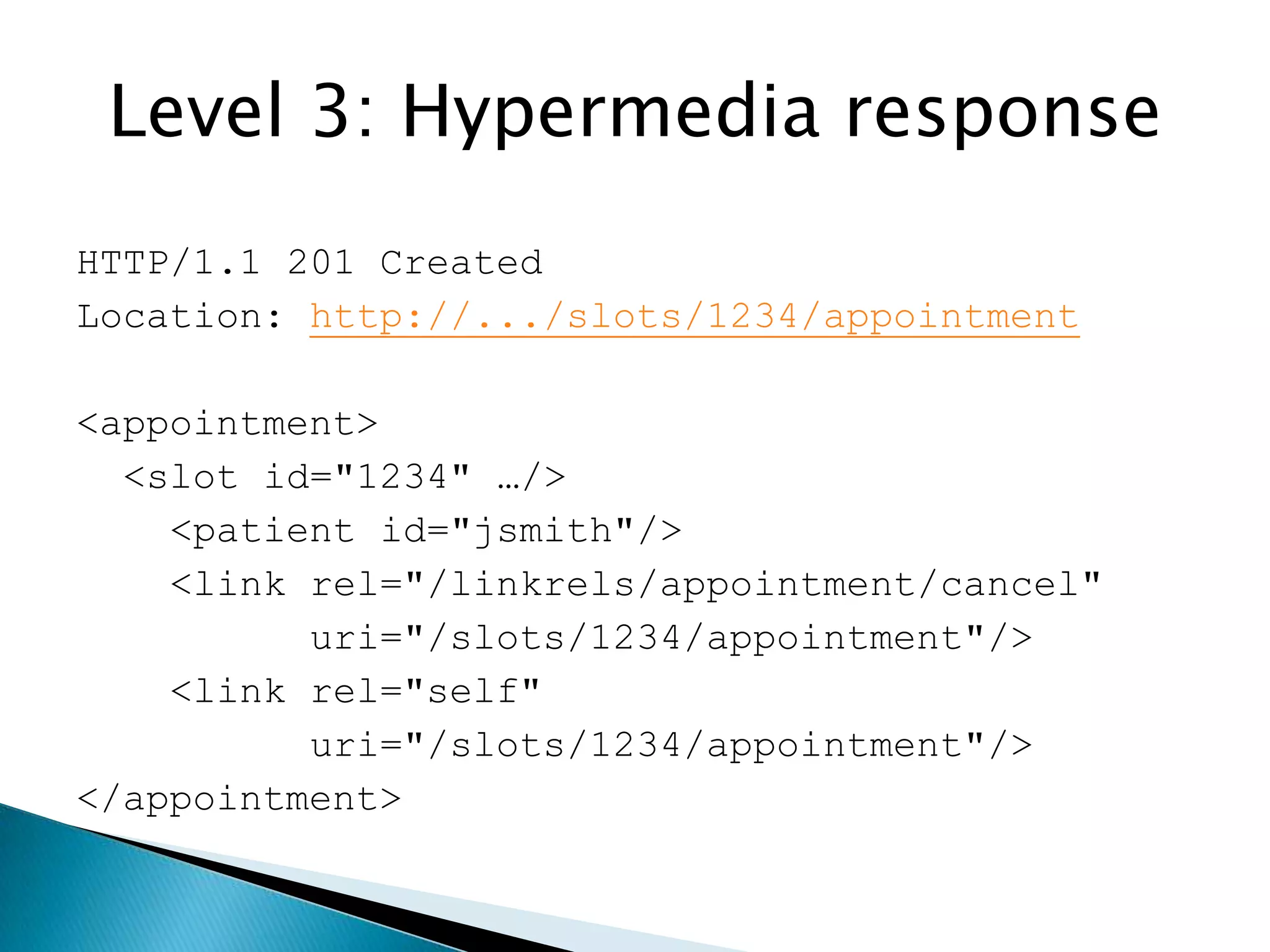
Level 3: Hypermedia response
HTTP/1.1 201 Created
Location: http://.../slots/1234/appointment

<appointment>
  <slot id="1234" …/>
    <patient id="jsmith"/>
    <link rel="/linkrels/appointment/cancel"
          uri="/slots/1234/appointment"/>
    <link rel="self"
          uri="/slots/1234/appointment"/>
</appointment>
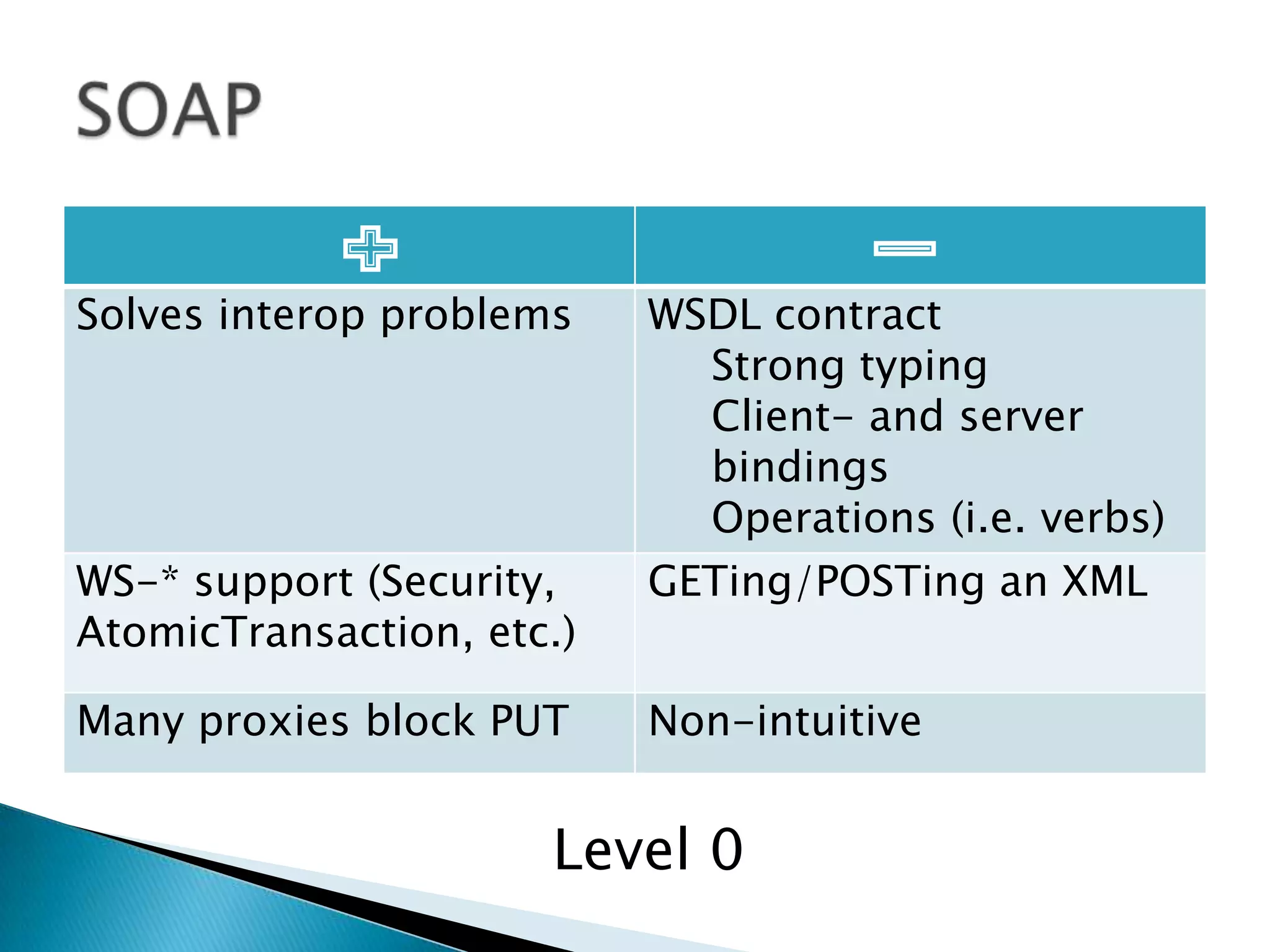
Solves interop problems    WSDL contract
                             Strong typing
                             Client- and server
                             bindings
                             Operations (i.e. verbs)
WS-* support (Security,    GETing/POSTing an XML
AtomicTransaction, etc.)

Many proxies block PUT     Non-intuitive


                      Level 0
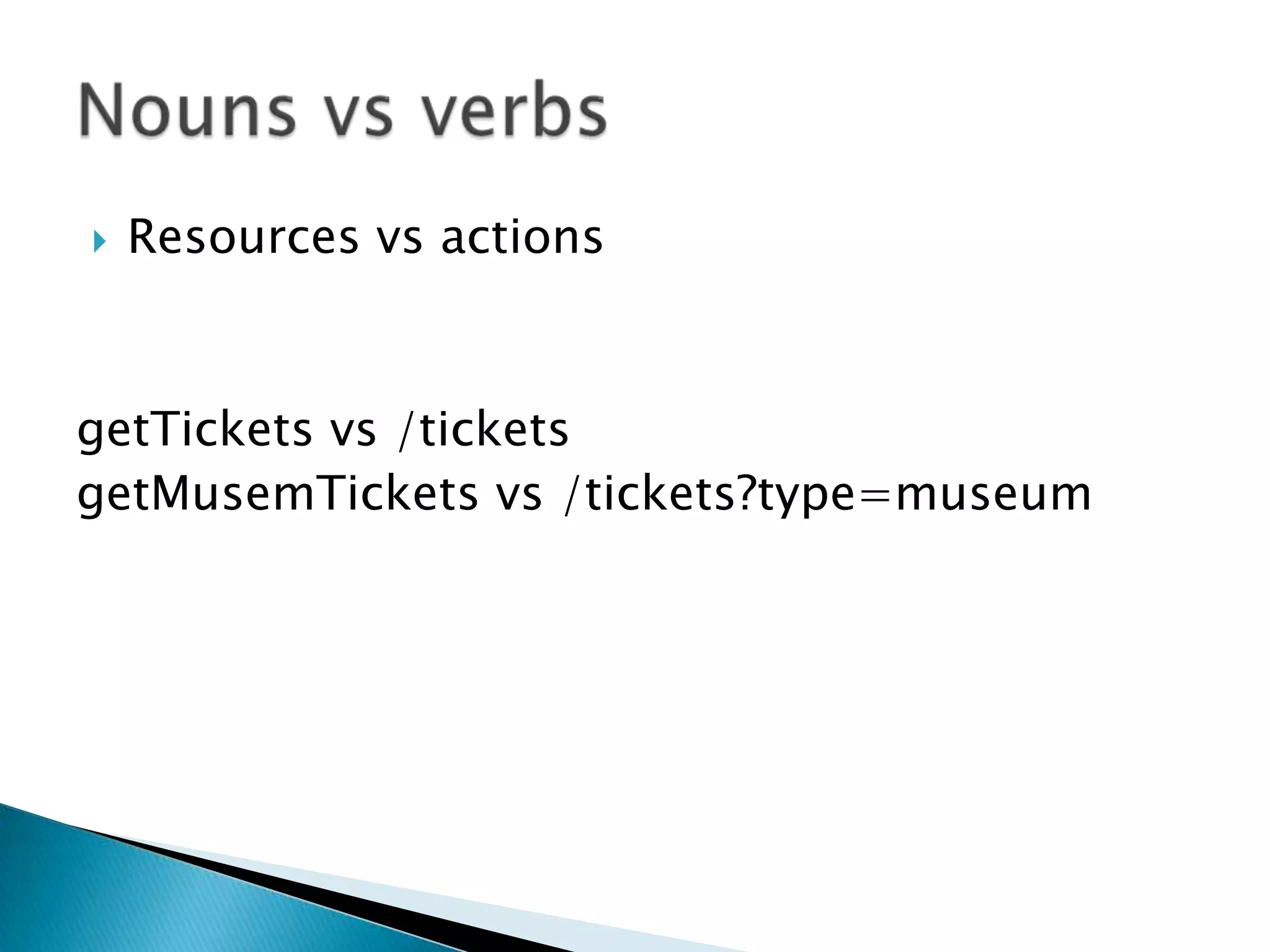
   Resources vs actions


getTickets vs /tickets
getMusemTickets vs /tickets?type=museum
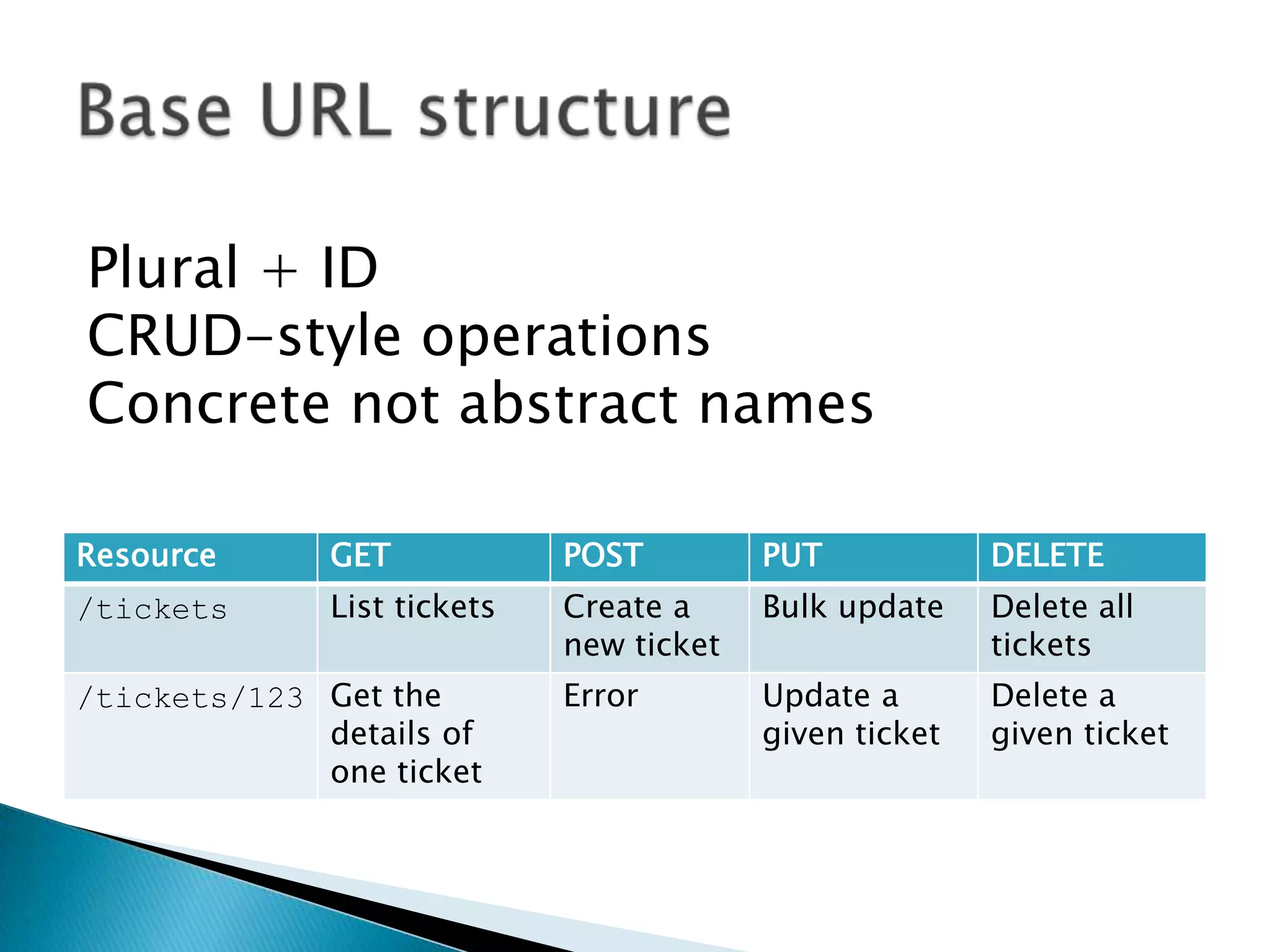
Plural + ID
CRUD-style operations
Concrete not abstract names

Resource      GET            POST         PUT            DELETE
/tickets      List tickets   Create a     Bulk update    Delete all
                             new ticket                  tickets
/tickets/123 Get the         Error        Update a       Delete a
             details of                   given ticket   given ticket
             one ticket
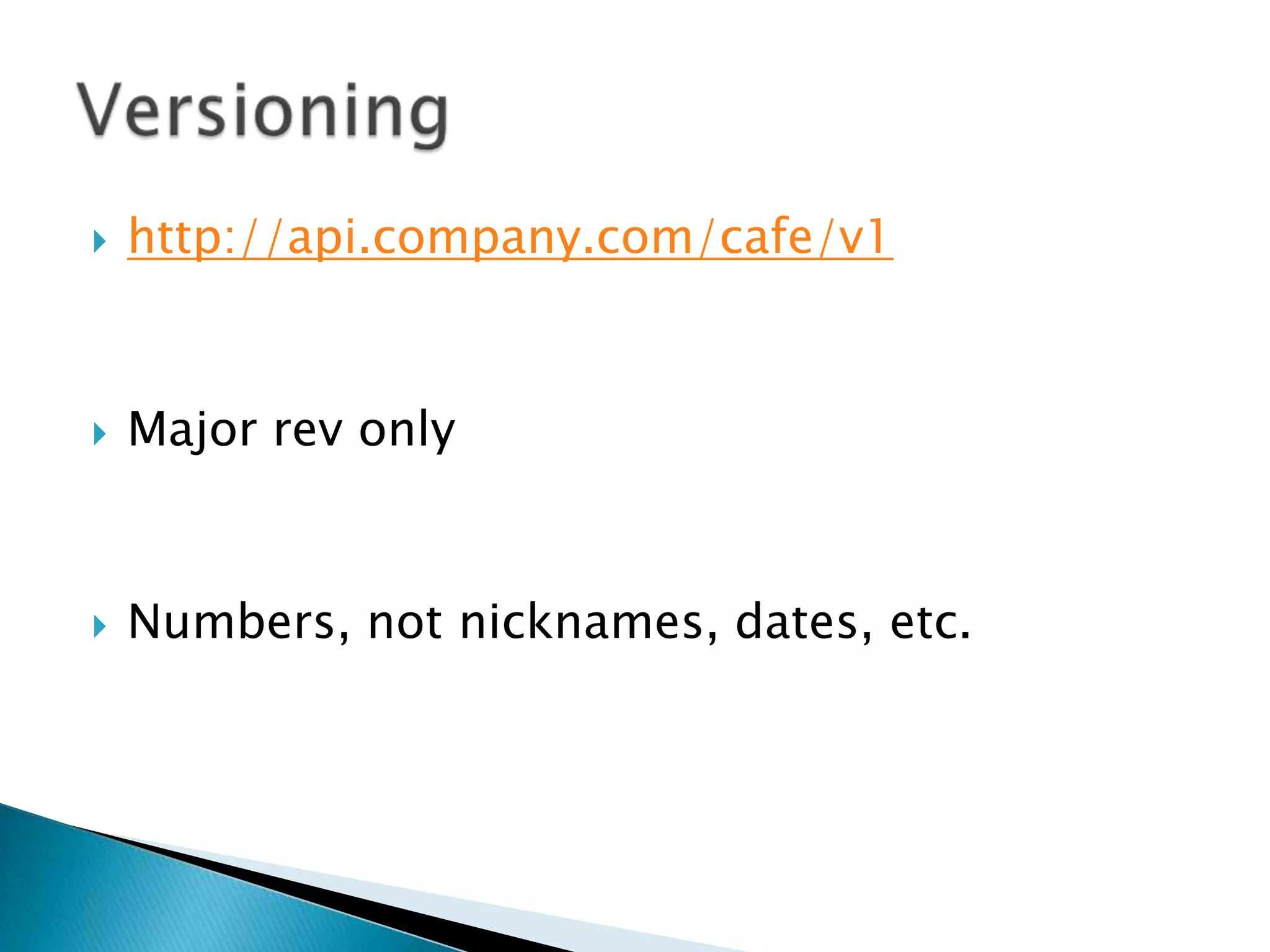
   http://api.company.com/cafe/v1


   Major rev only


   Numbers, not nicknames, dates, etc.
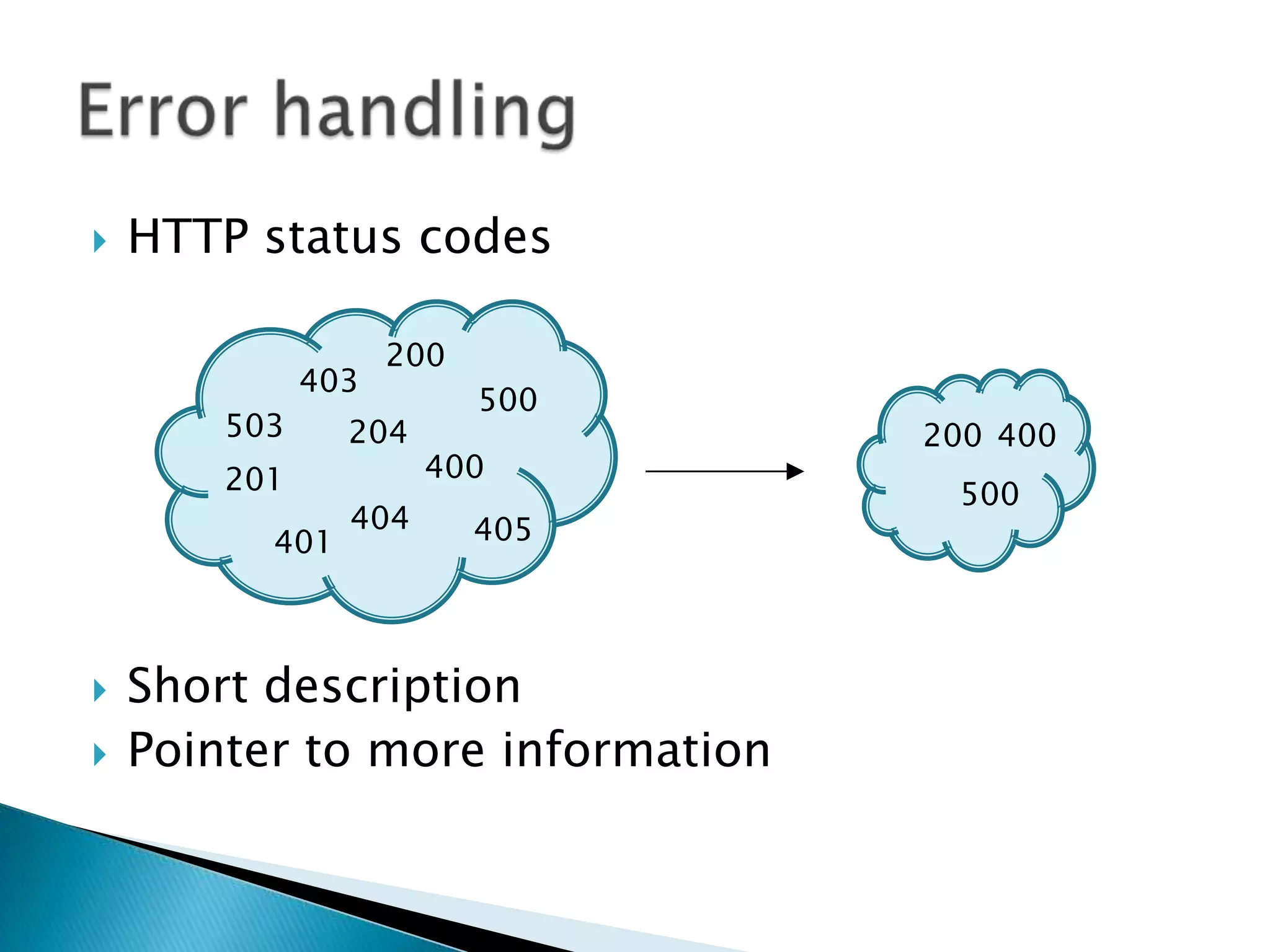
   HTTP status codes

                    200
              403
                          500
        503     204               200 400
        201           400
                                   500
                404       405
          401


   Short description
   Pointer to more information
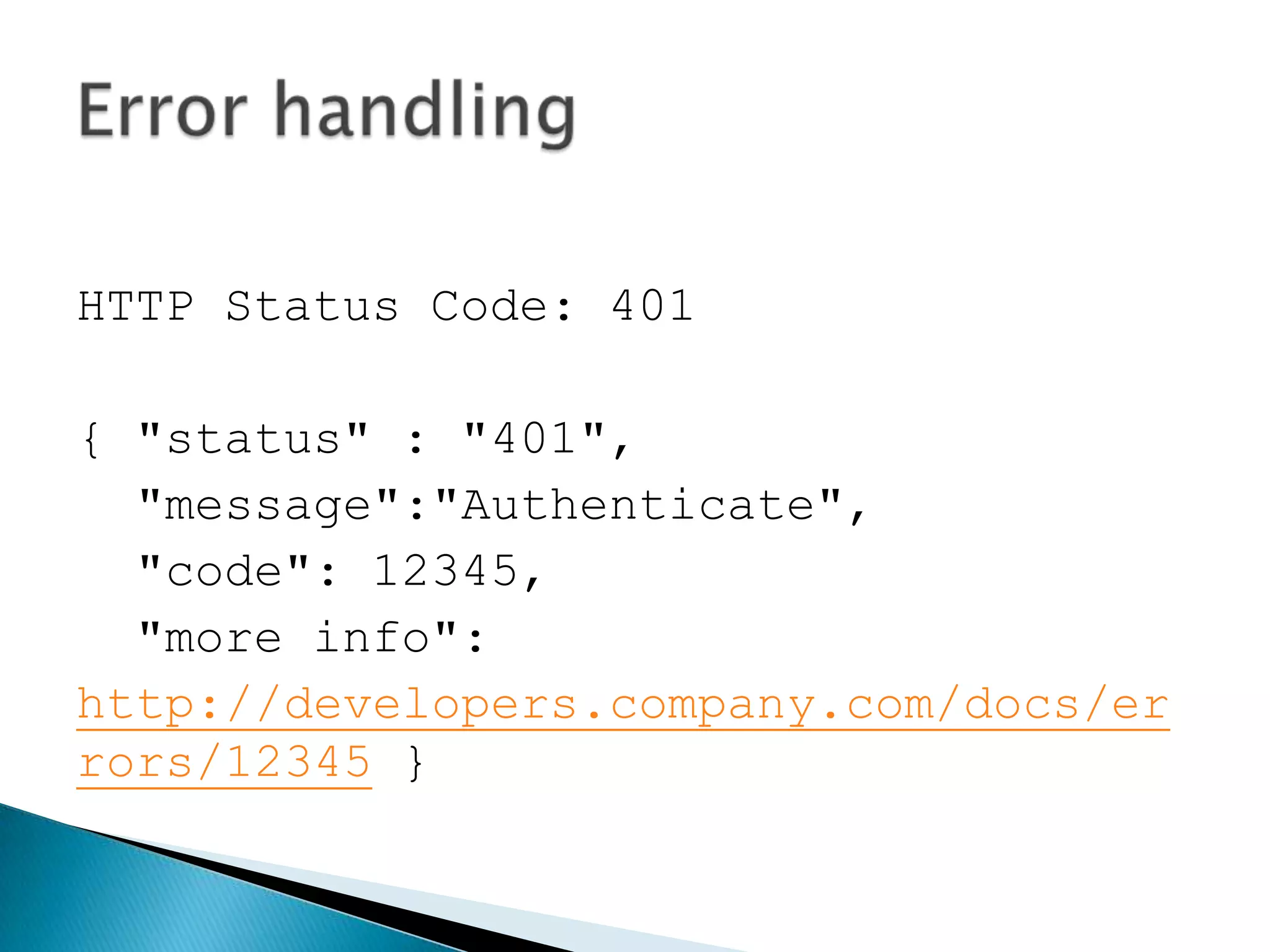
HTTP Status Code: 401

{ "status" : "401",
  "message":"Authenticate",
  "code": 12345,
  "more info":
http://developers.company.com/docs/er
rors/12345 }
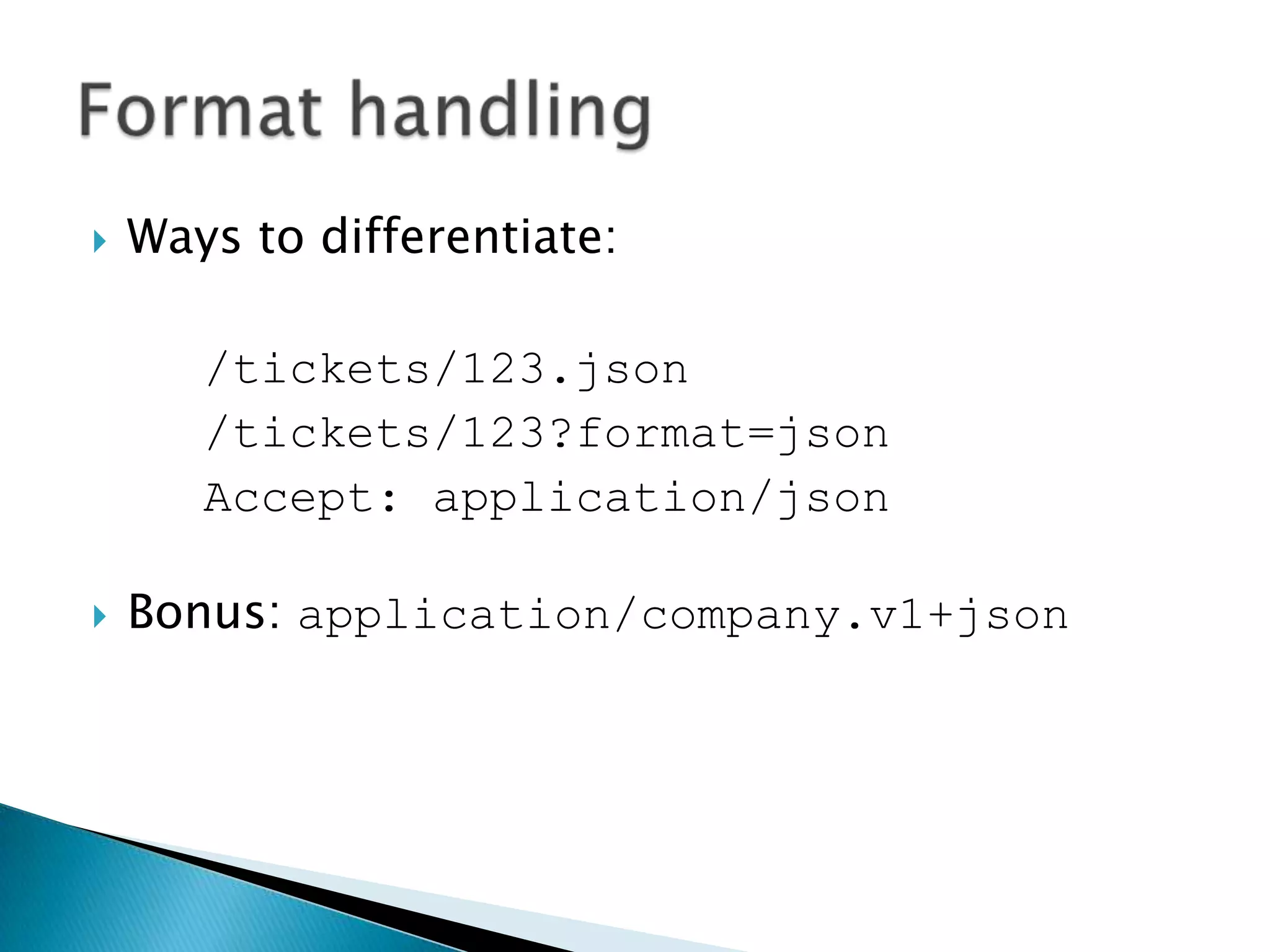
   Ways to differentiate:

       /tickets/123.json
       /tickets/123?format=json
       Accept: application/json

   Bonus: application/company.v1+json
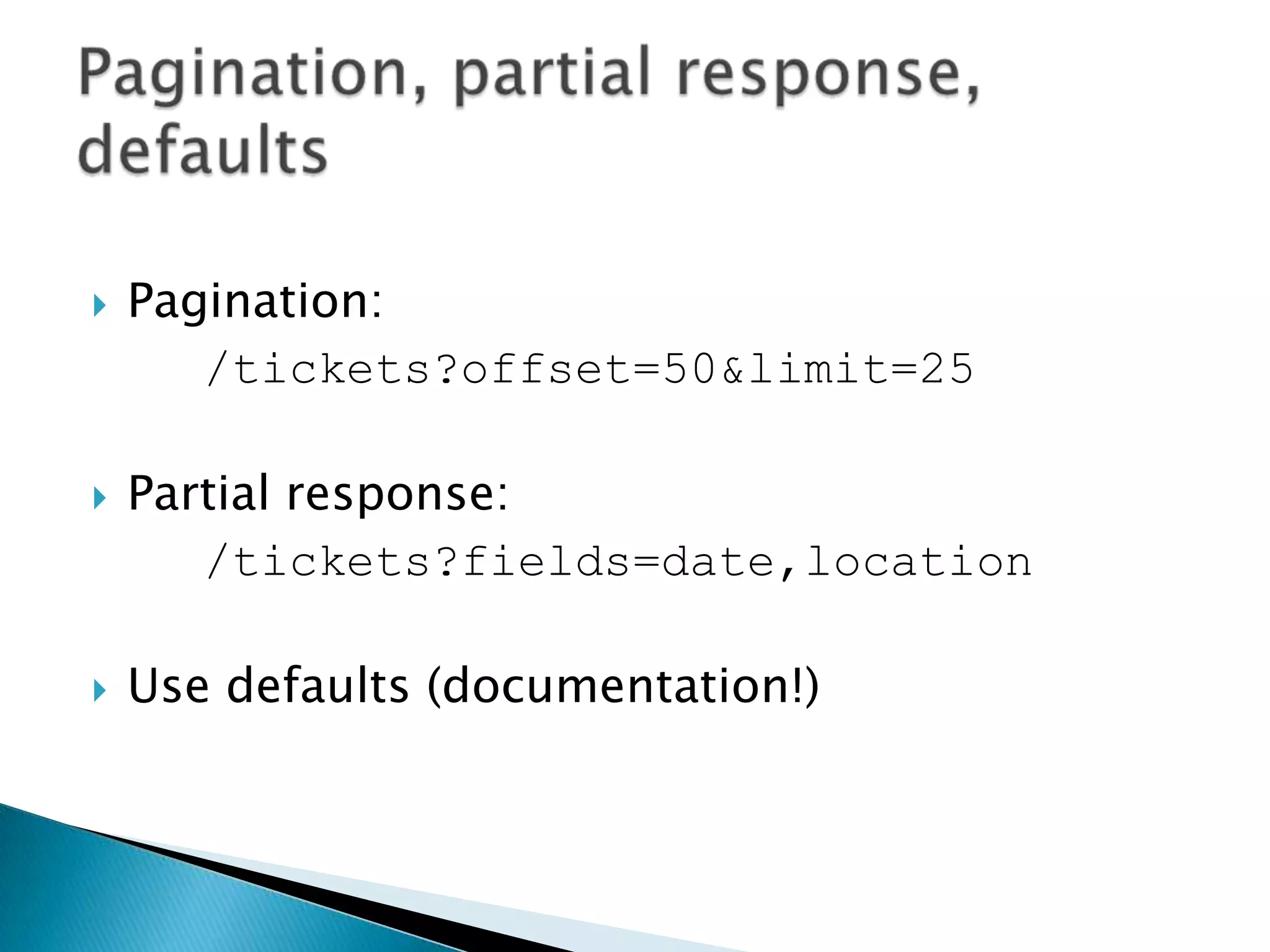
   Pagination:
       /tickets?offset=50&limit=25

   Partial response:
       /tickets?fields=date,location

   Use defaults (documentation!)
   Session management – REST is stateless


   Caching – it’s very much encouraged!


   What if nouns are not appropriate – use verbs
   Security – preferred is OAuth, lot of
    Basic/Digest over HTTPS in practice

   Subdomains:
    ◦ api
    ◦ developers for SDK


   Clean REST
   JSR 311: Java API for RESTful Web Services

 Annotation-driven
@GET, @Path, @PathParam, @Consumes

 Implementations
Jersey, Restlet, RESTeasy, Apache CXF

   Jax-rs-hateoas
jax-rs example.java
   Spring MVC application essentially

 Annotation-driven + XML configuration
@RequestMapping et al. + view
resolvers, message converters, et al.

   spring-hateoas
spring mvc example.java
   CRUD for JPA-entities using REST semantics

   @RestResource

   Pagination and sorting support

   spring-hateoas
spring data rest.java
   Roy Fielding’s dissertation

   REST in Practice from O’Reilly

   Apigee blog & video tutorials

   Articles, forums
   Levels of REST – REST ≠ CRUD


   Consistent view of best practices


   Java support
   Has been in the industry since late ’90s

   Has been @EPAM since 2009, acted as a Dev
    Lead/PM, now Solutions Architect

   Has mobile + enterprise background

             gabor.i.torok@gmail.com
Rest in practice

Rest in practice

  • 1.
  • 2.
    Introduction, overview  Best practices  Java support
  • 4.
    Roy T Fielding, PhD dissertation, 2000  Main characteristics ◦ Client-server ◦ Stateless ◦ Caching ◦ Layered architecture ◦ Code on demand ◦ URIs
  • 5.
    Richardson’s Maturity Model Image courtesy of Martin Fowler
  • 6.
    Plain Old XML (over HTTP)  One URI, one method
  • 7.
    POST /appointmentService HTTP/1.1 <openSlotRequestdate="2010-01-04" doctor="mjones"/>
  • 8.
    Level 0: POXresponse HTTP/1.1 200 OK <openSlotList> <slot start="1400" end="1450"> <doctor id="mjones"/> </slot> <slot start="1600" end="1650"> <doctor id="mjones"/> </slot> </openSlotList>
  • 9.
    POST /appointmentService HTTP/1.1 <appointmentRequest> <slot doctor="mjones" start="1400" end="1450"/> <patient id="jsmith"/> </appointmentRequest>
  • 10.
    Level 0: POXresponse HTTP/1.1 200 OK <appointment> <slot doctor="mjones" start="1400" end="1450"/> <patient id="jsmith"/> </appointment>
  • 11.
  • 12.
  • 13.
    Level 1: Resourcesresponse HTTP/1.1 200 OK <openSlotList> <slot id="1234" doctor="mjones" start="1400" end="1450"/> <slot id="5678" doctor="mjones" start="1600" end="1650"/> </openSlotList>
  • 14.
    POST /slots/1234 HTTP/1.1 <appointmentRequest> <patient id="jsmith"/> </appointmentRequest>
  • 15.
    Level 1: Resourcesresponse HTTP/1.1 200 OK <appointment id="2468"> <slot id="1234" doctor="mjones" start="1400" end="1450”/> <patient id="jsmith"/> </appointment>
  • 16.
    Many URIs, many (HTTP) methods  This is what most call REST  Best practices follow
  • 17.
  • 18.
    Level 2: Verbsresponse HTTP/1.1 200 OK <openSlotList> <slot id="1234" doctor="mjones" start="1400" end="1450"/> <slot id="5678" doctor="mjones" start="1600" end="1650"/> </openSlotList>
  • 19.
    POST /slots/1234 HTTP/1.1 <appointmentRequest> <patient id="jsmith"/> </appointmentRequest>
  • 20.
    Level 2: Verbsresponse HTTP/1.1 200 OK <appointment id="2468"> <slot id="1234" doctor="mjones" start="1400" end="1450”/> <patient id="jsmith"/> </appointment>
  • 21.
    W3: „Cool URIsdon’t change” vs Roy Fielding: „A REST API must not define fixed resource names or hierarchies”  HATEOAS & self-descriptive messages  Problems: people’s awareness, tools
  • 22.
    Level 3: Hypermediaresponse HTTP/1.1 200 OK <openSlotList> <slot id="1234" doctor="mjones” start="1400" end="1450"> <link rel="/linkrels/slot/book" uri="/slots/1234"/> </slot> … </openSlotList>
  • 23.
    Level 3: Hypermediaresponse HTTP/1.1 201 Created Location: http://.../slots/1234/appointment <appointment> <slot id="1234" …/> <patient id="jsmith"/> <link rel="/linkrels/appointment/cancel" uri="/slots/1234/appointment"/> <link rel="self" uri="/slots/1234/appointment"/> </appointment>
  • 24.
    Solves interop problems WSDL contract Strong typing Client- and server bindings Operations (i.e. verbs) WS-* support (Security, GETing/POSTing an XML AtomicTransaction, etc.) Many proxies block PUT Non-intuitive Level 0
  • 26.
    Resources vs actions getTickets vs /tickets getMusemTickets vs /tickets?type=museum
  • 27.
    Plural + ID CRUD-styleoperations Concrete not abstract names Resource GET POST PUT DELETE /tickets List tickets Create a Bulk update Delete all new ticket tickets /tickets/123 Get the Error Update a Delete a details of given ticket given ticket one ticket
  • 28.
    http://api.company.com/cafe/v1  Major rev only  Numbers, not nicknames, dates, etc.
  • 29.
    HTTP status codes 200 403 500 503 204 200 400 201 400 500 404 405 401  Short description  Pointer to more information
  • 30.
    HTTP Status Code:401 { "status" : "401", "message":"Authenticate", "code": 12345, "more info": http://developers.company.com/docs/er rors/12345 }
  • 31.
    Ways to differentiate: /tickets/123.json /tickets/123?format=json Accept: application/json  Bonus: application/company.v1+json
  • 32.
    Pagination: /tickets?offset=50&limit=25  Partial response: /tickets?fields=date,location  Use defaults (documentation!)
  • 33.
    Session management – REST is stateless  Caching – it’s very much encouraged!  What if nouns are not appropriate – use verbs
  • 34.
    Security – preferred is OAuth, lot of Basic/Digest over HTTPS in practice  Subdomains: ◦ api ◦ developers for SDK  Clean REST
  • 36.
    JSR 311: Java API for RESTful Web Services  Annotation-driven @GET, @Path, @PathParam, @Consumes  Implementations Jersey, Restlet, RESTeasy, Apache CXF  Jax-rs-hateoas
  • 37.
  • 38.
    Spring MVC application essentially  Annotation-driven + XML configuration @RequestMapping et al. + view resolvers, message converters, et al.  spring-hateoas
  • 39.
  • 40.
    CRUD for JPA-entities using REST semantics  @RestResource  Pagination and sorting support  spring-hateoas
  • 41.
  • 43.
    Roy Fielding’s dissertation  REST in Practice from O’Reilly  Apigee blog & video tutorials  Articles, forums
  • 44.
    Levels of REST – REST ≠ CRUD  Consistent view of best practices  Java support
  • 45.
    Has been in the industry since late ’90s  Has been @EPAM since 2009, acted as a Dev Lead/PM, now Solutions Architect  Has mobile + enterprise background gabor.i.torok@gmail.com

Editor's Notes

  • #5 Roy Fielding &amp; hisdissertationOne of theprincipalauthorsof HTTP specCo-founder of Apache HTTP server projectWasheavilyinvolvedin HTML and URIsDissertationNo mention of CRUD or POSTLater Fielding saysinhisblogthateven HTTP itself is not a mandatory part of REST (but URI is)HATEOAS is more importantthan CRUD (hypertextdrivesappstatechanges; contentnegotiation)Layeredsystem: gateways, loadbalancers, firewalls, sharedcaches, etc.
  • #6 Per Roy F: fromlevel 0-2 it’s not REST, 3 IS REST … thetermREST has beenmostlycoupledwithCRUD-likeaccesstodomainobjects0 – URI tunneling:oneURI, one HTTP method POST to a single URI, allattributesasparameter  lookslike SOAP w/o envelope  part of the Web, limited use of availablefeaturesFirewallfriendly (HTTP)Lackssophistication1 – resources … manyURIs, one HTTP method  lots of thought-to-be-RESTfulservices  stilltoocomplex2 – verbs … manyURIs, many HTTP methods  verynice, butstill limited to CRUD scenariosonly3 – hypermedia  resourcesdescribetheirowncapabilities and interconnections  it’s like a HTML pagefromwhereyoucan go vialinks  inadditiontolinks, it’s alsoaboutcontentnegotiation – own (MIME) types, dynamicdiscoveryLevel 1 tackles the question of handling complexity by using divide and conquer, breaking a large service endpoint down into multiple resources.Level 2 introduces a standard set of verbs so that we handle similar situations in the same way, removing unnecessary variation.Level 3 introduces discoverability, providing a way of making a protocol more self-documenting.
  • #7 Itcan be anythingelsethan XML, really (JSON, YAML, etc)RPC-stylesolutionBasicallylike SOAP
  • #22 PronounciationHate o’sHateyo’ assHate eeohsExamples:Get the second 50 items from 500, we may get a link back to the first 50 as well as the thirdWe get the resource data along with possible actions we may take upon it  these actions may depend on my authority (authorization)http://www.soatothecloud.com/2012/04/api-gateway-support-for-hateoas-first.html  great JSON example + mention of Gateway APIhttp://timelessrepo.com/haters-gonna-hateoas  good XML example  link tonew comment, commentstoblogentry + toselfproblems that it solves- w3c: coolurisdon’t change  http://www.w3.org/Provider/Style/URI.htmlREST calls return with content in a requested format  these formats have their media types with hints (links) as to what clients can do with the resource  application state may change while „jumping” from one resource to another  self-descriptive messagesREST APIs require the user to know that fixed URL structure (i.e. conventions)  client rewrite is needed when API changesWith SOAP clients figure out what they can do with a given resource from the WSDL  client-side (SOAP) vs server-side (HATEOAS)  fixed vs dynamicproblems that it causesMany applications simply map their backend (DB) object to HTTP (api)  resources != domain objects  resources == domain objects + metadataNew resource definitions might (and should) have their own MIME typesProblemsPeopledon’t understandit’s a problemNo tooling for thisLinkscould be part of theresponseheader  http://blog.steveklabnik.com/posts/2011-08-07-some-people-understand-rest-and-http
  • #23 Each slot now has a link element which contains a URI to tell us how to book an appointment.
  • #25 SOAPProtocolvsarchitecturalstyle SOAP has a standard whereas REST doesn’tOperationsvsresources verbsvsnounsRigid (typecheckingin SOAP – sometimesit’s a goodthing), light-weight (REST needs no wrapper, like XML in SOAP)Non-intuitivenessvssimplicity  in REST URL describes almost everything and quiteintuitivetouse &amp; modifySecurity: WS-Securityvs HTTPS/TLS  message-levelvstunnel-levelsecurity  http://blogs.msdn.com/b/vbertocci/archive/2005/04/25/end-to-end-security-or-why-you-shouldn-t-drive-your-motorcycle-naked.aspxWS-AtomicTransaction  ACID transactions over a serviceManyproxiesblock PUT (badto REST)
  • #28 Safety &amp; Idempotencysafe: no side-effectsIdempotent: can be repeatedinsuccessionwithoutfailureGET is safe and idempotentPUT and DELETE arenotsafe, butidempotentPOST is neithersafenoridempotentAssociationbetweenresources: /owners/123/dogs don’t go deeperthan /resource/identifier/resourceUse ‚?’ for attributes  /dogs?color=blackBe consistent, no mixed plurals&amp;singularsConcretethingslikecoffee, beer NOT drink
  • #29 api.company.comPut version # asmuchinthe front aspossibleMajor version # onlyDatesas version #s  long, hardtoremember, whichdateformat?Optionalversioning and alwaystakethelatestifomitted
  • #30 200 – OK201 – created204 – No content (after DELETE)400 – Badrequest401 – unauthorized403 – Forbidden404 – notfound405 – methodnotallowed500 – internalerror503 – Service unavailablewithRetry-AfterheaderUltimatelythefollowingthreeshould be enough: 200, 400 (pointingourwherevalidationfailed) and 500
  • #32 JSON wins over otherformats, like XML
  • #33 PATCH - http://weblog.rubyonrails.org/2012/2/26/edge-rails-patch-is-the-new-primary-http-method-for-updates
  • #34 Session managementCaching – reducenetworktraffic, loadon servers, latency, hidenetworkfailuresLocal cache + server cacheActions in the absence of resources  use verbs, like /currencyconverter/convert?from=EUR&amp;to=BYR&amp;amount=1000
  • #35 Thingsremovedfrom here tokeeptime:PATCH - http://weblog.rubyonrails.org/2012/2/26/edge-rails-patch-is-the-new-primary-http-method-for-updates noteveryoneknowswhat HTTP methodsare forParameters/attributes in URL or as part of HTTP header  much easier to develop if in URLSuppress HTTP response codes  usefulwhenourcode is runningin a containerthatintercepts HTTP commslike status codes
  • #36 Wadl – web applicationdescriptionlanguage (W3.org), wadl2java tool
  • #41 Spring Data REST (SDR) representsthebottom-upapproach, whereSDRcomesfromthedomainobjectlayer … it’s notreallyRESTful, imo
  • #46 Has beenintheindustrysince 1998Developer, tester, architect, project managerMobile, enterpriseForum nokiachampion(?), blogger