
OPEN-TRAVEL
AND RESTFUL RESOURCES
 Championed by the Web community


Roni Schuetz,
Enterprise Software Architect
Miami, April 2012


©2010 Hewlett-Packard Development Company, L.P.
The information contained herein is subject to change without
notice
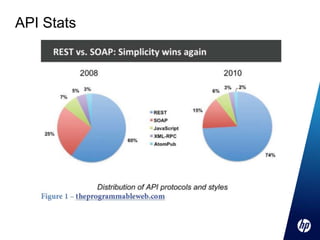
API Stats


http://www.programmableweb.com/apis
API Stats
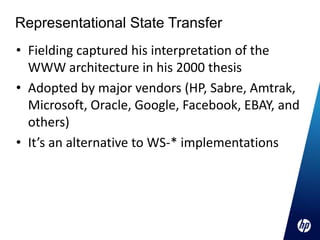
Representational State Transfer
• Fielding captured his interpretation of the
  WWW architecture in his 2000 thesis
• Adopted by major vendors (HP, Sabre, Amtrak,
  Microsoft, Oracle, Google, Facebook, EBAY, and
  others)
• It’s an alternative to WS-* implementations
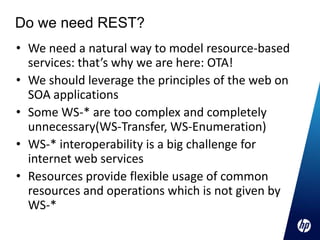
Do we need REST?
• We need a natural way to model resource-based
  services: that’s why we are here: OTA!
• We should leverage the principles of the web on
  SOA applications
• Some WS-* are too complex and completely
  unnecessary(WS-Transfer, WS-Enumeration)
• WS-* interoperability is a big challenge for
  internet web services
• Resources provide flexible usage of common
  resources and operations which is not given by
  WS-*
REST in one slide
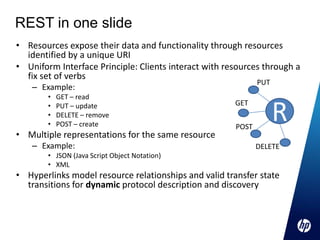
• Resources expose their data and functionality through resources
  identified by a unique URI
• Uniform Interface Principle: Clients interact with resources through a
  fix set of verbs
                                                              PUT
    – Example:
        •   GET – read

                                                                    R
        •   PUT – update                               GET
        •   DELETE – remove
        •   POST – create                              POST
• Multiple representations for the same resource
    – Example:                                                DELETE
        • JSON (Java Script Object Notation)
        • XML
• Hyperlinks model resource relationships and valid transfer state
  transitions for dynamic protocol description and discovery
REST Principles
• Resource based - not service based
• Addressability - name everything that matters
• Statelessness - no stateful messages exchange
  with a resource
• Relationships - expressed through links
• HTTP based
Resource based
• A resource is something “interesting” in your system
   – Can be anything
      • Spreadsheet
      • Printer
      • Inventory, Schedule, Flights
   – Others?
• Making your system Web-friendly increases its surface
  area
• You expose many resources, rather than few web
  service endpoints
• Good approach is to think in NOUN’s which appear in
  the travel domain
• The VERB’s are the actions on the noun
   – sounds familiar
HTTP based?
• REST principles are not HTTP dependent
• Typically REST should be implemented as an
  HTTP architectural style
• REST expresses dependencies on HTTP specific
  concepts such as verbs, URIs and headers
• In the future maybe non HTTP-based REST
RESTful Services best practices
•   Representation agnostic
•   Versioning
•   Service Description
•   Exception Handling
•   Security
•   Service Repository
Q&A
Thank you


Roni Schuetz, roni.schuetz@hp.com
References & Resources
•   http://www.xml.com/pub/a/2004/12/01/restful-web.html
•   http://www.infoq.com/articles/webber-rest-workflow
•   http://www.infoq.com/presentations/BPM-with-REST
•   http://books.google.ch/books?id=XUaErakHsoAC
•   http://www.soapatterns.org/atomic_service_transaction.php
•   http://www.soaprinciples.com/service_statelessness.php
GET vs. POST Retrieving Paradigm
• To retrieve a “thing” from a Resource we have
  2 options:
  – The HTTP GET options:                                    PUT
     • GET ./order/221

                                                                   R
                                                      GET
     • GET ./order?id=221
                                                      POST
  – The HTTP POST option:                                    DELETE
     • POST /order
        – id = 221 [key value] … add as much as you need!
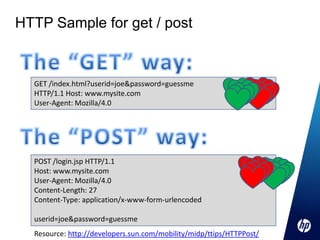
HTTP Sample for get / post


  GET /index.html?userid=joe&password=guessme
  HTTP/1.1 Host: www.mysite.com
  User-Agent: Mozilla/4.0


  POST /login.jsp HTTP/1.1
  Host: www.mysite.com
  User-Agent: Mozilla/4.0
  Content-Length: 27
  Content-Type: application/x-www-form-urlencoded

  userid=joe&password=guessme
  Resource: http://developers.sun.com/mobility/midp/ttips/HTTPPost/
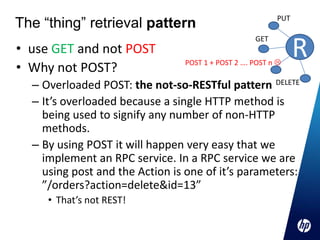
The “thing” retrieval pattern                            PUT


                                                               R
                                                   GET
• use GET and not POST
                                POST 1 + POST 2 …. POST n 
• Why not POST?
  – Overloaded POST: the not-so-RESTful pattern DELETE
  – It’s overloaded because a single HTTP method is
    being used to signify any number of non-HTTP
    methods.
  – By using POST it will happen very easy that we
    implement an RPC service. In a RPC service we are
    using post and the Action is one of it’s parameters:
    ”/orders?action=delete&id=13”
     • That’s not REST!
PUT vs. POST Creation Paradigm

• To create a new “thing” shall I use PUT or
  POST?

  There is a clear principle for this paradigm:
     • If the client is responsible for creating the ID’s of the
       “thing” use a PUT
         – E.g: “./users/roni” <- roni is unique and given by the client -
           this is a new URI!
     • If the server is responsible for creating the ID of the
       “thing” use a POST
         – E.g. “./users/” and as a post key/value the client transfers
           username=roni and prob. to id would be an auto generated
           number.
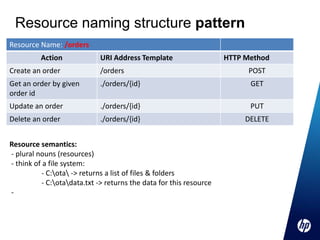
Resource naming structure pattern
Resource Name: /orders
          Action             URI Address Template                   HTTP Method
Create an order              /orders                                     POST
Get an order by given        ./orders/{id}                                GET
order id
Update an order              ./orders/{id}                                PUT
Delete an order              ./orders/{id}                               DELETE


Resource semantics:
- plural nouns (resources)
- think of a file system:
          - C:ota -> returns a list of files & folders
          - C:otadata.txt -> returns the data for this resource
-
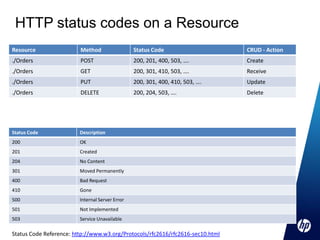
HTTP status codes on a Resource
Resource                 Method                  Status Code                    CRUD - Action
./Orders                 POST                    200, 201, 400, 503, ….         Create
./Orders                 GET                     200, 301, 410, 503, ….         Receive
./Orders                 PUT                     200, 301, 400, 410, 503, ….    Update
./Orders                 DELETE                  200, 204, 503, ….              Delete


Status Code              Description
200                      OK
201                      Created
204                      No Content
301                      Moved Permanently
400                      Bad Request
410                      Gone
500                      Internal Server Error
501                      Not Implemented
503                      Service Unavailable

Status Code Reference: http://www.w3.org/Protocols/rfc2616/rfc2616-sec10.html
PUT
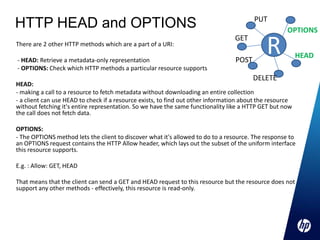
HTTP HEAD and OPTIONS                                                                                OPTIONS
There are 2 other HTTP methods which are a part of a URI:

- HEAD: Retrieve a metadata-only representation
                                                                                 GET

                                                                                 POST
                                                                                             R            HEAD
- OPTIONS: Check which HTTP methods a particular resource supports
                                                                                        DELETE
HEAD:
- making a call to a resource to fetch metadata without downloading an entire collection
- a client can use HEAD to check if a resource exists, to find out other information about the resource
without fetching it's entire representation. So we have the same functionality like a HTTP GET but now
the call does not fetch data.

OPTIONS:
- The OPTIONS method lets the client to discover what it's allowed to do to a resource. The response to
an OPTIONS request contains the HTTP Allow header, which lays out the subset of the uniform interface
this resource supports.

E.g. : Allow: GET, HEAD

That means that the client can send a GET and HEAD request to this resource but the resource does not
support any other methods - effectively, this resource is read-only.
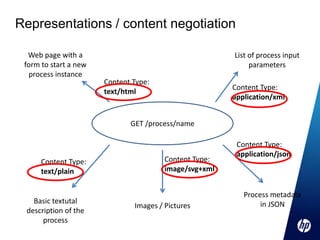
Representations / content negotiation

  Web page with a                                       List of process input
 form to start a new                                         parameters
   process instance
                       Content Type:
                                                        Content Type:
                       text/html
                                                        application/xml


                              GET /process/name

                                                         Content Type:
                                                         application/json
      Content Type:                     Content Type:
      text/plain                        image/svg+xml


                                                           Process metadata
   Basic textutal                                               in JSON
                               Images / Pictures
 description of the
      process
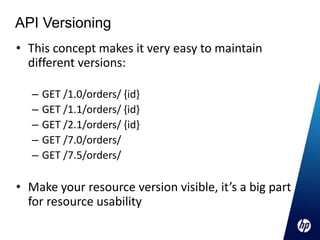
API Versioning
• This concept makes it very easy to maintain
  different versions:

   –   GET /1.0/orders/ {id}
   –   GET /1.1/orders/ {id}
   –   GET /2.1/orders/ {id}
   –   GET /7.0/orders/
   –   GET /7.5/orders/

• Make your resource version visible, it’s a big part
  for resource usability
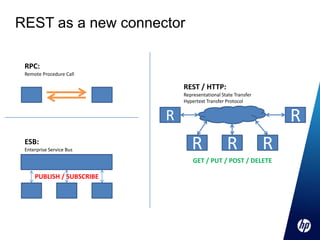
REST as a new connector

 RPC:
 Remote Procedure Call

                               REST / HTTP:
                               Representational State Transfer
                               Hypertext Transfer Protocol


                           R                                         R
 ESB:
 Enterprise Service Bus           R               R              R
                                   GET / PUT / POST / DELETE

     PUBLISH / SUBSCRIBE
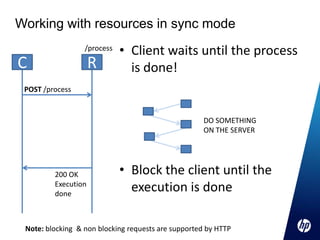
Working with resources in sync mode
                  /process
                             • Client waits until the process
C                    R         is done!
 POST /process


                                                     DO SOMETHING
                                                     ON THE SERVER


         200 OK              • Block the client until the
         Execution
         done
                               execution is done

 Note: blocking & non blocking requests are supported by HTTP
Working with resources in async mode
                    /process
                               • Client starts a long running
C                   R            process
 POST /process                 • Asynchronously process
      202 ACCEPTED               between the client and the
      Location: x
                                 started process
                               • Retrieve the current state of
                                 the started process
 GET /process/x

           200 OK


 Note: blocking & non blocking requests are supported by HTTP

RESTful for opentravel.org by HP

  • 1.
    OPEN-TRAVEL AND RESTFUL RESOURCES Championed by the Web community Roni Schuetz, Enterprise Software Architect Miami, April 2012 ©2010 Hewlett-Packard Development Company, L.P. The information contained herein is subject to change without notice
  • 2.
  • 3.
  • 4.
    Representational State Transfer •Fielding captured his interpretation of the WWW architecture in his 2000 thesis • Adopted by major vendors (HP, Sabre, Amtrak, Microsoft, Oracle, Google, Facebook, EBAY, and others) • It’s an alternative to WS-* implementations
  • 5.
    Do we needREST? • We need a natural way to model resource-based services: that’s why we are here: OTA! • We should leverage the principles of the web on SOA applications • Some WS-* are too complex and completely unnecessary(WS-Transfer, WS-Enumeration) • WS-* interoperability is a big challenge for internet web services • Resources provide flexible usage of common resources and operations which is not given by WS-*
  • 6.
    REST in oneslide • Resources expose their data and functionality through resources identified by a unique URI • Uniform Interface Principle: Clients interact with resources through a fix set of verbs PUT – Example: • GET – read R • PUT – update GET • DELETE – remove • POST – create POST • Multiple representations for the same resource – Example: DELETE • JSON (Java Script Object Notation) • XML • Hyperlinks model resource relationships and valid transfer state transitions for dynamic protocol description and discovery
  • 7.
    REST Principles • Resourcebased - not service based • Addressability - name everything that matters • Statelessness - no stateful messages exchange with a resource • Relationships - expressed through links • HTTP based
  • 8.
    Resource based • Aresource is something “interesting” in your system – Can be anything • Spreadsheet • Printer • Inventory, Schedule, Flights – Others? • Making your system Web-friendly increases its surface area • You expose many resources, rather than few web service endpoints • Good approach is to think in NOUN’s which appear in the travel domain • The VERB’s are the actions on the noun – sounds familiar
  • 9.
    HTTP based? • RESTprinciples are not HTTP dependent • Typically REST should be implemented as an HTTP architectural style • REST expresses dependencies on HTTP specific concepts such as verbs, URIs and headers • In the future maybe non HTTP-based REST
  • 10.
    RESTful Services bestpractices • Representation agnostic • Versioning • Service Description • Exception Handling • Security • Service Repository
  • 11.
  • 12.
    Thank you Roni Schuetz,roni.schuetz@hp.com
  • 13.
    References & Resources • http://www.xml.com/pub/a/2004/12/01/restful-web.html • http://www.infoq.com/articles/webber-rest-workflow • http://www.infoq.com/presentations/BPM-with-REST • http://books.google.ch/books?id=XUaErakHsoAC • http://www.soapatterns.org/atomic_service_transaction.php • http://www.soaprinciples.com/service_statelessness.php
  • 14.
    GET vs. POSTRetrieving Paradigm • To retrieve a “thing” from a Resource we have 2 options: – The HTTP GET options: PUT • GET ./order/221 R GET • GET ./order?id=221 POST – The HTTP POST option: DELETE • POST /order – id = 221 [key value] … add as much as you need!
  • 15.
    HTTP Sample forget / post GET /index.html?userid=joe&password=guessme HTTP/1.1 Host: www.mysite.com User-Agent: Mozilla/4.0 POST /login.jsp HTTP/1.1 Host: www.mysite.com User-Agent: Mozilla/4.0 Content-Length: 27 Content-Type: application/x-www-form-urlencoded userid=joe&password=guessme Resource: http://developers.sun.com/mobility/midp/ttips/HTTPPost/
  • 16.
    The “thing” retrievalpattern PUT R GET • use GET and not POST POST 1 + POST 2 …. POST n  • Why not POST? – Overloaded POST: the not-so-RESTful pattern DELETE – It’s overloaded because a single HTTP method is being used to signify any number of non-HTTP methods. – By using POST it will happen very easy that we implement an RPC service. In a RPC service we are using post and the Action is one of it’s parameters: ”/orders?action=delete&id=13” • That’s not REST!
  • 17.
    PUT vs. POSTCreation Paradigm • To create a new “thing” shall I use PUT or POST? There is a clear principle for this paradigm: • If the client is responsible for creating the ID’s of the “thing” use a PUT – E.g: “./users/roni” <- roni is unique and given by the client - this is a new URI! • If the server is responsible for creating the ID of the “thing” use a POST – E.g. “./users/” and as a post key/value the client transfers username=roni and prob. to id would be an auto generated number.
  • 18.
    Resource naming structurepattern Resource Name: /orders Action URI Address Template HTTP Method Create an order /orders POST Get an order by given ./orders/{id} GET order id Update an order ./orders/{id} PUT Delete an order ./orders/{id} DELETE Resource semantics: - plural nouns (resources) - think of a file system: - C:ota -> returns a list of files & folders - C:otadata.txt -> returns the data for this resource -
  • 19.
    HTTP status codeson a Resource Resource Method Status Code CRUD - Action ./Orders POST 200, 201, 400, 503, …. Create ./Orders GET 200, 301, 410, 503, …. Receive ./Orders PUT 200, 301, 400, 410, 503, …. Update ./Orders DELETE 200, 204, 503, …. Delete Status Code Description 200 OK 201 Created 204 No Content 301 Moved Permanently 400 Bad Request 410 Gone 500 Internal Server Error 501 Not Implemented 503 Service Unavailable Status Code Reference: http://www.w3.org/Protocols/rfc2616/rfc2616-sec10.html
  • 20.
    PUT HTTP HEAD andOPTIONS OPTIONS There are 2 other HTTP methods which are a part of a URI: - HEAD: Retrieve a metadata-only representation GET POST R HEAD - OPTIONS: Check which HTTP methods a particular resource supports DELETE HEAD: - making a call to a resource to fetch metadata without downloading an entire collection - a client can use HEAD to check if a resource exists, to find out other information about the resource without fetching it's entire representation. So we have the same functionality like a HTTP GET but now the call does not fetch data. OPTIONS: - The OPTIONS method lets the client to discover what it's allowed to do to a resource. The response to an OPTIONS request contains the HTTP Allow header, which lays out the subset of the uniform interface this resource supports. E.g. : Allow: GET, HEAD That means that the client can send a GET and HEAD request to this resource but the resource does not support any other methods - effectively, this resource is read-only.
  • 21.
    Representations / contentnegotiation Web page with a List of process input form to start a new parameters process instance Content Type: Content Type: text/html application/xml GET /process/name Content Type: application/json Content Type: Content Type: text/plain image/svg+xml Process metadata Basic textutal in JSON Images / Pictures description of the process
  • 22.
    API Versioning • Thisconcept makes it very easy to maintain different versions: – GET /1.0/orders/ {id} – GET /1.1/orders/ {id} – GET /2.1/orders/ {id} – GET /7.0/orders/ – GET /7.5/orders/ • Make your resource version visible, it’s a big part for resource usability
  • 23.
    REST as anew connector RPC: Remote Procedure Call REST / HTTP: Representational State Transfer Hypertext Transfer Protocol R R ESB: Enterprise Service Bus R R R GET / PUT / POST / DELETE PUBLISH / SUBSCRIBE
  • 24.
    Working with resourcesin sync mode /process • Client waits until the process C R is done! POST /process DO SOMETHING ON THE SERVER 200 OK • Block the client until the Execution done execution is done Note: blocking & non blocking requests are supported by HTTP
  • 25.
    Working with resourcesin async mode /process • Client starts a long running C R process POST /process • Asynchronously process 202 ACCEPTED between the client and the Location: x started process • Retrieve the current state of the started process GET /process/x 200 OK Note: blocking & non blocking requests are supported by HTTP

Editor's Notes

  • #22 content type is sent from the client to the server
  • #24 REST Services can be considered in BPM tools as a connector