Spring Social

Messaging Friends & Influencing
           People

           ETE 2011
         Apr 27-28, 2011
Who Am I?

• Instructor/Mentor

• Active Tweeter for Open Source Tech
  Topics
  twitter.com/gdickens


• Certified Instructor for

• DZone Most Valuable Blogger
  dzone.com/page/mvbs – dzone.com/user/284679
  Technophile Blog   - technophile.gordondickens.com
                                                       2
Agenda

•   Spring & REST
•   Spring Social
•   Security with OAuth
•   Spring Mobile
•   Spring Android
•   Spring iPhone
•   Spring Greenhouse
                          3
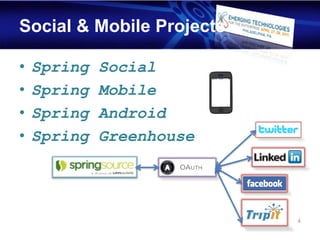
Social & Mobile Projects

•   Spring   Social
•   Spring   Mobile
•   Spring   Android
•   Spring   Greenhouse


                           4
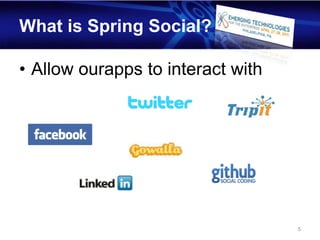
What is Spring Social?

• Allow ourapps to interact with


                                   5
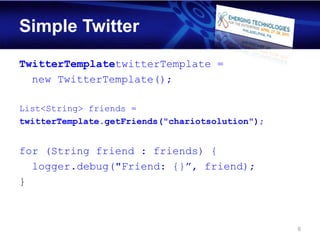
Simple Twitter
TwitterTemplatetwitterTemplate =
  new TwitterTemplate();

List<String> friends =
twitterTemplate.getFriends("chariotsolution");


for (String friend : friends) {
  logger.debug("Friend: {}”, friend);
}


                                                 6
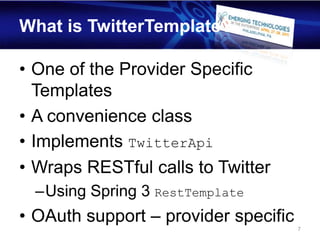
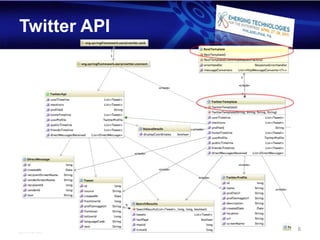
What is TwitterTemplate?

• One of the Provider Specific
  Templates
• A convenience class
• Implements TwitterApi
• Wraps RESTful calls to Twitter
  –Using Spring 3 RestTemplate
• OAuth support – provider specific
                                      7
Twitter API


              8
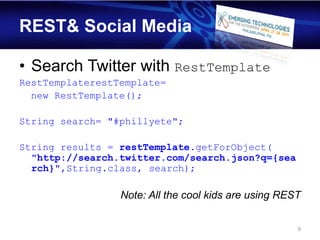
REST& Social Media

• Search Twitter with RestTemplate
RestTemplaterestTemplate=
  new RestTemplate();

String search= "#phillyete";

String results = restTemplate.getForObject(
  "http://search.twitter.com/search.json?q={sea
  rch}",String.class, search);

                 Note: All the cool kids are using REST


                                                      9
Who is using REST?


                     10
Spring REST

• Added in Spring 3.0
• RestTemplate
  – Client side
• Spring MVC
  – Server side
  – <mvc:annotation-driven/>
  – Annotations
  – Content Negotiation
  – Web page support for PUT & DELETE
     • HiddenHttpMethodFilter


                                        11
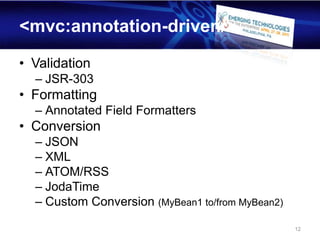
<mvc:annotation-driven/>

• Validation
  – JSR-303
• Formatting
  – Annotated Field Formatters
• Conversion
  – JSON
  – XML
  – ATOM/RSS
  – JodaTime
  – Custom Conversion (MyBean1 to/from MyBean2)

                                                  12
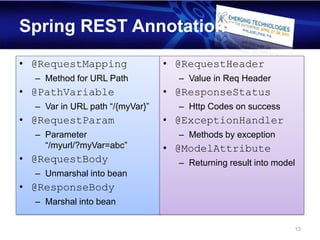
Spring REST Annotations
• @RequestMapping                • @RequestHeader
  – Method for URL Path            – Value in Req Header
• @PathVariable                  • @ResponseStatus
  – Var in URL path “/{myVar}”     – Http Codes on success
• @RequestParam                  • @ExceptionHandler
  – Parameter                      – Methods by exception
    “/myurl/?myVar=abc”          • @ModelAttribute
• @RequestBody                     – Returning result into model
  – Unmarshal into bean
• @ResponseBody
  – Marshal into bean

                                                               13
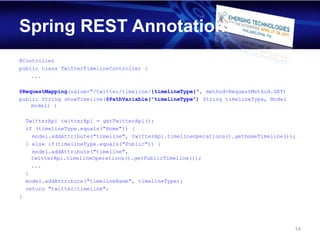
Spring REST Annotations
@Controller
public class TwitterTimelineController {
    ...

@RequestMapping(value="/twitter/timeline/{timelineType}", method=RequestMethod.GET)
public String showTimeline(@PathVariable("timelineType") String timelineType, Model
    model) {

    TwitterApi twitterApi = getTwitterApi();
    if (timelineType.equals("Home")) {
      model.addAttribute("timeline", twitterApi.timelineOperations().getHomeTimeline());
    } else if(timelineType.equals("Public")) {
      model.addAttribute("timeline",
      twitterApi.timelineOperations().getPublicTimeline());
      ...
    }
    model.addAttribute("timelineName", timelineType);
    return "twitter/timeline";
}


                                                                                       14
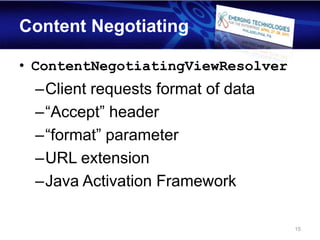
Content Negotiating

• ContentNegotiatingViewResolver
 –Client requests format of data
 –“Accept” header
 –“format” parameter
 –URL extension
 –Java Activation Framework

                                   15
Templates to the Rescue

• Template for each Social Media Provider
  – TwitterTemplate, LinkedInTemplate,   etc.

• Provider Specific
  – Authentication Support
  – API methods

• For other providers:
  – Roll your own
  – RestTemplate    is our friend
                                                16
Template API Calls

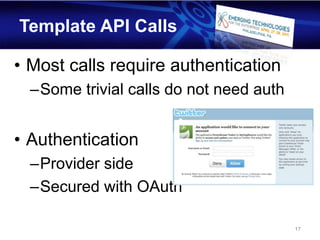
• Most calls require authentication
  –Some trivial calls do not need auth


• Authentication
  –Provider side
  –Secured with OAuth

                                         17
Authenticating


“An open protocol to allow secure API
     authorization in a simple and
   standard method from desktop to
          web applications.”
           http://oauth.net

     code.google.com/p/oauth/
                                    18
OAuth Participants

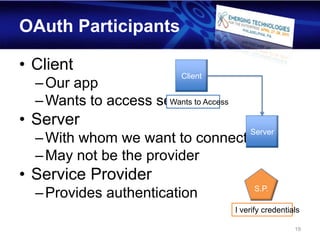
• Client
                          Client
  – Our app
  – Wants to access serverto Access
                      Wants

• Server
                                          Server
  – With whom we want to connect
  – May not be the provider
• Service Provider
  – Provides authentication                S.P.

                                      I verify credentials

                                                        19
OAuth Flavors

• 1.0a
  –More complex


• 2.0


                  20
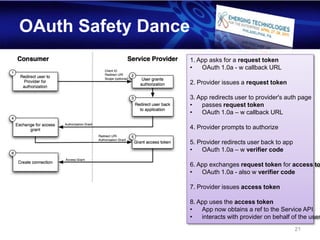
OAuth Safety Dance
                     1. App asks for a request token
                     •   OAuth 1.0a - w callback URL

                     2. Provider issues a request token

                     3. App redirects user to provider's auth page
                     •   passes request token
                     •   OAuth 1.0a – w callback URL

                     4. Provider prompts to authorize

                     5. Provider redirects user back to app
                     •   OAuth 1.0a – w verifier code

                     6. App exchanges request token for access to
                     •   OAuth 1.0a - also w verifier code

                     7. Provider issues access token

                     8. App uses the access token
                     •   App now obtains a ref to the Service API
                     •   interacts with provider on behalf of the user
                                                              21
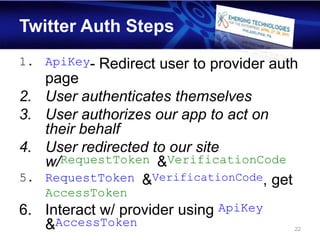
Twitter Auth Steps
1. ApiKey-   Redirect user to provider auth
     page
2.   User authenticates themselves
3.   User authorizes our app to act on
     their behalf
4.   User redirected to our site
     w/RequestToken &VerificationCode
5.   RequestToken &VerificationCode, get
     AccessToken
6. Interact w/ provider using ApiKey
   &AccessToken                            22
Template & OAuth Summary

• Provider specific template
• OAuth support within template

• How do we manage provider login
  and credential storage?
           We need CPR!
                                  23
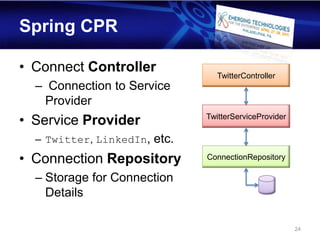
Spring CPR

• Connect Controller            TwitterController
  – Connection to Service
   Provider
• Service Provider            TwitterServiceProvider

  – Twitter, LinkedIn, etc.
• Connection Repository       ConnectionRepository

  – Storage for Connection
    Details

                                                       24
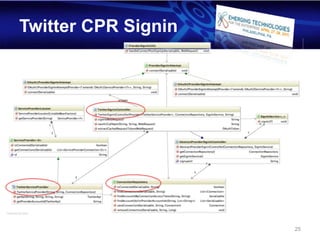
Twitter CPR Signin


                     25
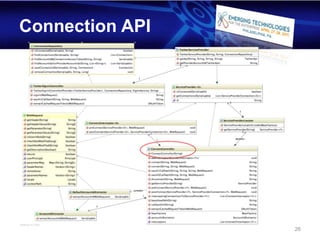
Connection API


                 26
CPR - Controller
<bean class=”o.sf.social.web.connect.ConnectController">
<constructor-arg value="${application.url}”/>
</bean>


• application.url
   – Base secure URL for this application
   – used to construct the callback URL
   – passed to the service providers


                                                           27
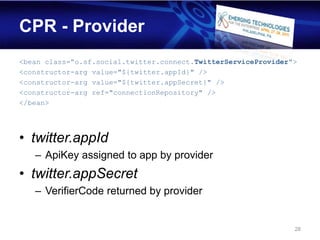
CPR - Provider
<bean class=”o.sf.social.twitter.connect.TwitterServiceProvider">
<constructor-arg value="${twitter.appId}" />
<constructor-arg value="${twitter.appSecret}" />
<constructor-arg ref="connectionRepository" />
</bean>


• twitter.appId
   – ApiKey assigned to app by provider
• twitter.appSecret
   – VerifierCode returned by provider


                                                                28
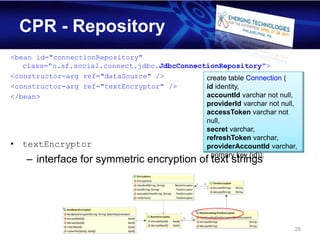
CPR - Repository
<bean id="connectionRepository"
   class=”o.sf.social.connect.jdbc.JdbcConnectionRepository">
<constructor-arg ref="dataSource" />          create table Connection (
<constructor-arg ref="textEncryptor" />       id identity,
</bean>                                       accountId varchar not null,
                                              providerId varchar not null,
                                              accessToken varchar not
                                              null,
                                              secret varchar,
                                              refreshToken varchar,
• textEncryptor                               providerAccountId varchar,
                                               primary key (id));
    – interface for symmetric encryption of text strings


                                                                         29
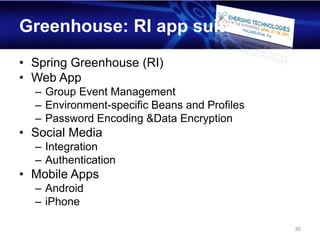
Greenhouse: RI app suite
• Spring Greenhouse (RI)
• Web App
  – Group Event Management
  – Environment-specific Beans and Profiles
  – Password Encoding &Data Encryption
• Social Media
  – Integration
  – Authentication
• Mobile Apps
  – Android
  – iPhone

                                              30
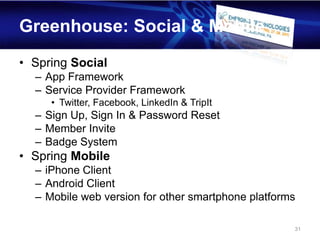
Greenhouse: Social & Mobile
• Spring Social
  – App Framework
  – Service Provider Framework
     • Twitter, Facebook, LinkedIn & TripIt
  – Sign Up, Sign In & Password Reset
  – Member Invite
  – Badge System
• Spring Mobile
  – iPhone Client
  – Android Client
  – Mobile web version for other smartphone platforms

                                                    31
Spring Mobile

• Server Side
• Spring MVC Extension
• Key Facets:
 1. Mobile Device Detection
 2. Site Preference Management
 3. Site Switching

                                 32
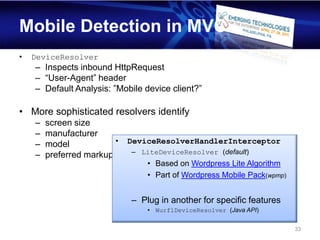
Mobile Detection in MVC
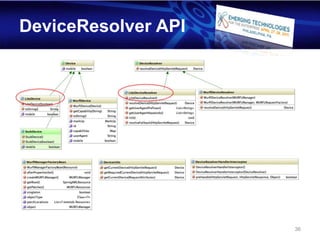
•   DeviceResolver
    – Inspects inbound HttpRequest
    – “User-Agent” header
    – Default Analysis: ”Mobile device client?”

• More sophisticated resolvers identify
    –   screen size
    –   manufacturer
    –   model            •   DeviceResolverHandlerInterceptor
    –   preferred markup     – LiteDeviceResolver (default)
                                 • Based on Wordpress Lite Algorithm
                                 • Part of Wordpress Mobile Pack(wpmp)


                             – Plug in another for specific features
                                 • WurflDeviceResolver (Java API)


                                                                         33
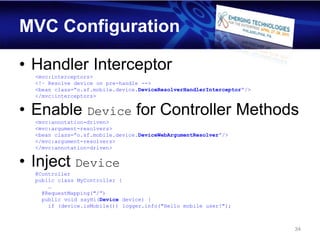
MVC Configuration

• Handler Interceptor
  <mvc:interceptors>
  <!– Resolve device on pre-handle -->
  <bean class=”o.sf.mobile.device.DeviceResolverHandlerInterceptor”/>
  </mvc:interceptors>


• Enable Device for Controller Methods
  <mvc:annotation-driven>
  <mvc:argument-resolvers>
  <bean class=”o.sf.mobile.device.DeviceWebArgumentResolver”/>
  </mvc:argument-resolvers>
  </mvc:annotation-driven>


• Inject Device
  @Controller
  public class MyController {
      …
    @RequestMapping("/”)
    public void sayHi(Device device) {
      if (device.isMobile()) logger.info("Hello mobile user!");


                                                                        34
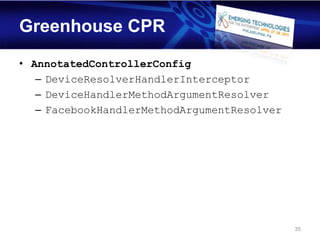
Greenhouse CPR
• AnnotatedControllerConfig
   – DeviceResolverHandlerInterceptor
   – DeviceHandlerMethodArgumentResolver
   – FacebookHandlerMethodArgumentResolver


                                             35
DeviceResolver API


                     36
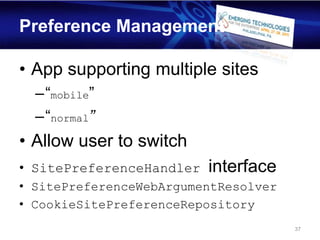
Preference Management

• App supporting multiple sites
  –“mobile”
  –“normal”
• Allow user to switch
• SitePreferenceHandler   interface
• SitePreferenceWebArgumentResolver
• CookieSitePreferenceRepository
                                      37
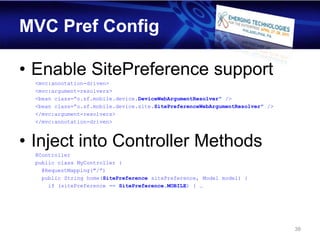
MVC Pref Config

• Enable SitePreference support
  <mvc:annotation-driven>
  <mvc:argument-resolvers>
  <bean class=”o.sf.mobile.device.DeviceWebArgumentResolver" />
  <bean class=”o.sf.mobile.device.site.SitePreferenceWebArgumentResolver" />
  </mvc:argument-resolvers>
  </mvc:annotation-driven>


• Inject into Controller Methods
  @Controller
  public class MyController {
    @RequestMapping("/”)
    public String home(SitePreference sitePreference, Model model) {
      if (sitePreference == SitePreference.MOBILE) { …


                                                                               38
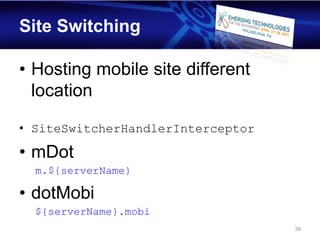
Site Switching

• Hosting mobile site different
  location

• SiteSwitcherHandlerInterceptor

• mDot
  m.${serverName}

• dotMobi
  ${serverName}.mobi
                                   39
Spring Android

• Client tools
• Http Components
• RestTemplate
•   Object to JSON Marshaling
•   Object to XML Marshaling
•   RSS and Atom Support
•   Greenhouse app in Android market
    – https://market.android.com/details?id=com.springsource.greenho
      use

                                                                  40
Spring iPhone
• Greenhouse for iPhone client

• Download & Install the iOS SDK

• Project source code from the git
   – git clone git://git.springsource.org/greenhouse/iphone.git

• Open the Greenhouse.xcodeproj in Xcode

• Expects Greenhouse web app running locally

• Greenhouse App in iTunes
   – http://itunes.apple.com/us/app/greenhouse/id395862873?mt=8


                                                                  41
Spring Social Showcase

• Twitter, Facebook, TripIt
• MVC Application
• CPR configuration


                              42
Summary

• Spring Social
     • App collaboration with SM Sites
     • Security through OAuth
• Spring REST
     • Significant for Social & Mobile
     • RestTemplate Rules!
• Spring Mobile
  – MVC Support for Mobile Devices
• Spring Android
  – Client Tools, based on RestTemplate

                                          43
Q& F

• Questions?

• Followup
  – Learn REST…
  – Spring Social Showcase
  – Spring Greenhouse
• Contact me
  – technophile.gordondickens.com
  – gordon@gordondickens.com
                                    44

Spring Social - Messaging Friends & Influencing People

  • 1.
    Spring Social Messaging Friends& Influencing People ETE 2011 Apr 27-28, 2011
  • 2.
    Who Am I? •Instructor/Mentor • Active Tweeter for Open Source Tech Topics twitter.com/gdickens • Certified Instructor for • DZone Most Valuable Blogger dzone.com/page/mvbs – dzone.com/user/284679 Technophile Blog - technophile.gordondickens.com 2
  • 3.
    Agenda • Spring & REST • Spring Social • Security with OAuth • Spring Mobile • Spring Android • Spring iPhone • Spring Greenhouse 3
  • 4.
    Social & MobileProjects • Spring Social • Spring Mobile • Spring Android • Spring Greenhouse 4
  • 5.
    What is SpringSocial? • Allow ourapps to interact with 5
  • 6.
    Simple Twitter TwitterTemplatetwitterTemplate = new TwitterTemplate(); List<String> friends = twitterTemplate.getFriends("chariotsolution"); for (String friend : friends) { logger.debug("Friend: {}”, friend); } 6
  • 7.
    What is TwitterTemplate? •One of the Provider Specific Templates • A convenience class • Implements TwitterApi • Wraps RESTful calls to Twitter –Using Spring 3 RestTemplate • OAuth support – provider specific 7
  • 8.
  • 9.
    REST& Social Media •Search Twitter with RestTemplate RestTemplaterestTemplate= new RestTemplate(); String search= "#phillyete"; String results = restTemplate.getForObject( "http://search.twitter.com/search.json?q={sea rch}",String.class, search); Note: All the cool kids are using REST 9
  • 10.
    Who is usingREST? 10
  • 11.
    Spring REST • Addedin Spring 3.0 • RestTemplate – Client side • Spring MVC – Server side – <mvc:annotation-driven/> – Annotations – Content Negotiation – Web page support for PUT & DELETE • HiddenHttpMethodFilter 11
  • 12.
    <mvc:annotation-driven/> • Validation – JSR-303 • Formatting – Annotated Field Formatters • Conversion – JSON – XML – ATOM/RSS – JodaTime – Custom Conversion (MyBean1 to/from MyBean2) 12
  • 13.
    Spring REST Annotations •@RequestMapping • @RequestHeader – Method for URL Path – Value in Req Header • @PathVariable • @ResponseStatus – Var in URL path “/{myVar}” – Http Codes on success • @RequestParam • @ExceptionHandler – Parameter – Methods by exception “/myurl/?myVar=abc” • @ModelAttribute • @RequestBody – Returning result into model – Unmarshal into bean • @ResponseBody – Marshal into bean 13
  • 14.
    Spring REST Annotations @Controller publicclass TwitterTimelineController { ... @RequestMapping(value="/twitter/timeline/{timelineType}", method=RequestMethod.GET) public String showTimeline(@PathVariable("timelineType") String timelineType, Model model) { TwitterApi twitterApi = getTwitterApi(); if (timelineType.equals("Home")) { model.addAttribute("timeline", twitterApi.timelineOperations().getHomeTimeline()); } else if(timelineType.equals("Public")) { model.addAttribute("timeline", twitterApi.timelineOperations().getPublicTimeline()); ... } model.addAttribute("timelineName", timelineType); return "twitter/timeline"; } 14
  • 15.
    Content Negotiating • ContentNegotiatingViewResolver –Client requests format of data –“Accept” header –“format” parameter –URL extension –Java Activation Framework 15
  • 16.
    Templates to theRescue • Template for each Social Media Provider – TwitterTemplate, LinkedInTemplate, etc. • Provider Specific – Authentication Support – API methods • For other providers: – Roll your own – RestTemplate is our friend 16
  • 17.
    Template API Calls •Most calls require authentication –Some trivial calls do not need auth • Authentication –Provider side –Secured with OAuth 17
  • 18.
    Authenticating “An open protocolto allow secure API authorization in a simple and standard method from desktop to web applications.” http://oauth.net code.google.com/p/oauth/ 18
  • 19.
    OAuth Participants • Client Client – Our app – Wants to access serverto Access Wants • Server Server – With whom we want to connect – May not be the provider • Service Provider – Provides authentication S.P. I verify credentials 19
  • 20.
    OAuth Flavors • 1.0a –More complex • 2.0 20
  • 21.
    OAuth Safety Dance 1. App asks for a request token • OAuth 1.0a - w callback URL 2. Provider issues a request token 3. App redirects user to provider's auth page • passes request token • OAuth 1.0a – w callback URL 4. Provider prompts to authorize 5. Provider redirects user back to app • OAuth 1.0a – w verifier code 6. App exchanges request token for access to • OAuth 1.0a - also w verifier code 7. Provider issues access token 8. App uses the access token • App now obtains a ref to the Service API • interacts with provider on behalf of the user 21
  • 22.
    Twitter Auth Steps 1.ApiKey- Redirect user to provider auth page 2. User authenticates themselves 3. User authorizes our app to act on their behalf 4. User redirected to our site w/RequestToken &VerificationCode 5. RequestToken &VerificationCode, get AccessToken 6. Interact w/ provider using ApiKey &AccessToken 22
  • 23.
    Template & OAuthSummary • Provider specific template • OAuth support within template • How do we manage provider login and credential storage? We need CPR! 23
  • 24.
    Spring CPR • ConnectController TwitterController – Connection to Service Provider • Service Provider TwitterServiceProvider – Twitter, LinkedIn, etc. • Connection Repository ConnectionRepository – Storage for Connection Details 24
  • 25.
  • 26.
  • 27.
    CPR - Controller <beanclass=”o.sf.social.web.connect.ConnectController"> <constructor-arg value="${application.url}”/> </bean> • application.url – Base secure URL for this application – used to construct the callback URL – passed to the service providers 27
  • 28.
    CPR - Provider <beanclass=”o.sf.social.twitter.connect.TwitterServiceProvider"> <constructor-arg value="${twitter.appId}" /> <constructor-arg value="${twitter.appSecret}" /> <constructor-arg ref="connectionRepository" /> </bean> • twitter.appId – ApiKey assigned to app by provider • twitter.appSecret – VerifierCode returned by provider 28
  • 29.
    CPR - Repository <beanid="connectionRepository" class=”o.sf.social.connect.jdbc.JdbcConnectionRepository"> <constructor-arg ref="dataSource" /> create table Connection ( <constructor-arg ref="textEncryptor" /> id identity, </bean> accountId varchar not null, providerId varchar not null, accessToken varchar not null, secret varchar, refreshToken varchar, • textEncryptor providerAccountId varchar, primary key (id)); – interface for symmetric encryption of text strings 29
  • 30.
    Greenhouse: RI appsuite • Spring Greenhouse (RI) • Web App – Group Event Management – Environment-specific Beans and Profiles – Password Encoding &Data Encryption • Social Media – Integration – Authentication • Mobile Apps – Android – iPhone 30
  • 31.
    Greenhouse: Social &Mobile • Spring Social – App Framework – Service Provider Framework • Twitter, Facebook, LinkedIn & TripIt – Sign Up, Sign In & Password Reset – Member Invite – Badge System • Spring Mobile – iPhone Client – Android Client – Mobile web version for other smartphone platforms 31
  • 32.
    Spring Mobile • ServerSide • Spring MVC Extension • Key Facets: 1. Mobile Device Detection 2. Site Preference Management 3. Site Switching 32
  • 33.
    Mobile Detection inMVC • DeviceResolver – Inspects inbound HttpRequest – “User-Agent” header – Default Analysis: ”Mobile device client?” • More sophisticated resolvers identify – screen size – manufacturer – model • DeviceResolverHandlerInterceptor – preferred markup – LiteDeviceResolver (default) • Based on Wordpress Lite Algorithm • Part of Wordpress Mobile Pack(wpmp) – Plug in another for specific features • WurflDeviceResolver (Java API) 33
  • 34.
    MVC Configuration • HandlerInterceptor <mvc:interceptors> <!– Resolve device on pre-handle --> <bean class=”o.sf.mobile.device.DeviceResolverHandlerInterceptor”/> </mvc:interceptors> • Enable Device for Controller Methods <mvc:annotation-driven> <mvc:argument-resolvers> <bean class=”o.sf.mobile.device.DeviceWebArgumentResolver”/> </mvc:argument-resolvers> </mvc:annotation-driven> • Inject Device @Controller public class MyController { … @RequestMapping("/”) public void sayHi(Device device) { if (device.isMobile()) logger.info("Hello mobile user!"); 34
  • 35.
    Greenhouse CPR • AnnotatedControllerConfig – DeviceResolverHandlerInterceptor – DeviceHandlerMethodArgumentResolver – FacebookHandlerMethodArgumentResolver 35
  • 36.
  • 37.
    Preference Management • Appsupporting multiple sites –“mobile” –“normal” • Allow user to switch • SitePreferenceHandler interface • SitePreferenceWebArgumentResolver • CookieSitePreferenceRepository 37
  • 38.
    MVC Pref Config •Enable SitePreference support <mvc:annotation-driven> <mvc:argument-resolvers> <bean class=”o.sf.mobile.device.DeviceWebArgumentResolver" /> <bean class=”o.sf.mobile.device.site.SitePreferenceWebArgumentResolver" /> </mvc:argument-resolvers> </mvc:annotation-driven> • Inject into Controller Methods @Controller public class MyController { @RequestMapping("/”) public String home(SitePreference sitePreference, Model model) { if (sitePreference == SitePreference.MOBILE) { … 38
  • 39.
    Site Switching • Hostingmobile site different location • SiteSwitcherHandlerInterceptor • mDot m.${serverName} • dotMobi ${serverName}.mobi 39
  • 40.
    Spring Android • Clienttools • Http Components • RestTemplate • Object to JSON Marshaling • Object to XML Marshaling • RSS and Atom Support • Greenhouse app in Android market – https://market.android.com/details?id=com.springsource.greenho use 40
  • 41.
    Spring iPhone • Greenhousefor iPhone client • Download & Install the iOS SDK • Project source code from the git – git clone git://git.springsource.org/greenhouse/iphone.git • Open the Greenhouse.xcodeproj in Xcode • Expects Greenhouse web app running locally • Greenhouse App in iTunes – http://itunes.apple.com/us/app/greenhouse/id395862873?mt=8 41
  • 42.
    Spring Social Showcase •Twitter, Facebook, TripIt • MVC Application • CPR configuration 42
  • 43.
    Summary • Spring Social • App collaboration with SM Sites • Security through OAuth • Spring REST • Significant for Social & Mobile • RestTemplate Rules! • Spring Mobile – MVC Support for Mobile Devices • Spring Android – Client Tools, based on RestTemplate 43
  • 44.
    Q& F • Questions? •Followup – Learn REST… – Spring Social Showcase – Spring Greenhouse • Contact me – technophile.gordondickens.com – gordon@gordondickens.com 44

Editor's Notes

  • #7 Demo Here – Simple JUnit Test
  • #21 OAuth Core 1.0 Revision A was created to address a session fixation attack identified in the OAuth Core 1.0 specification as detailed in http://oauth.net/advisories/2009-1.
  • #22 Request TokenVerifier Code - The OAuth Verifier is a verification code tied to the Request Token. The OAuth Verifier and Request Token both must be provided in exchange for an Access Token. They also both expire together.