Spring in the Enterprise
Session Topics

1.   What is Spring & Why use it?

2.   Architecting in Spring

3.   Enterprise Spring

4.   Spring & SOA

5.   Modular Spring w/ OSGi

6.   Spring RAD & Tools
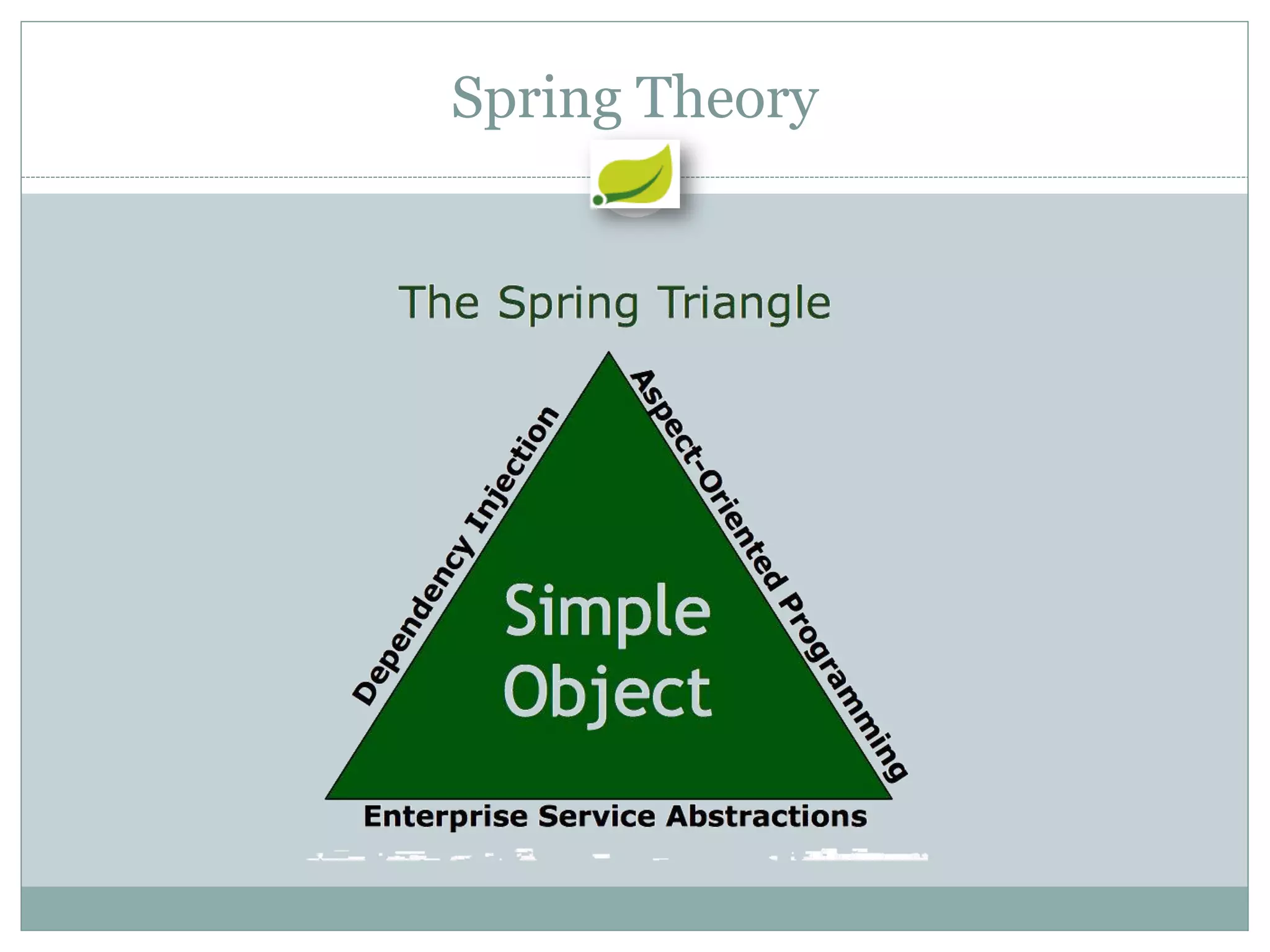
Spring Theory
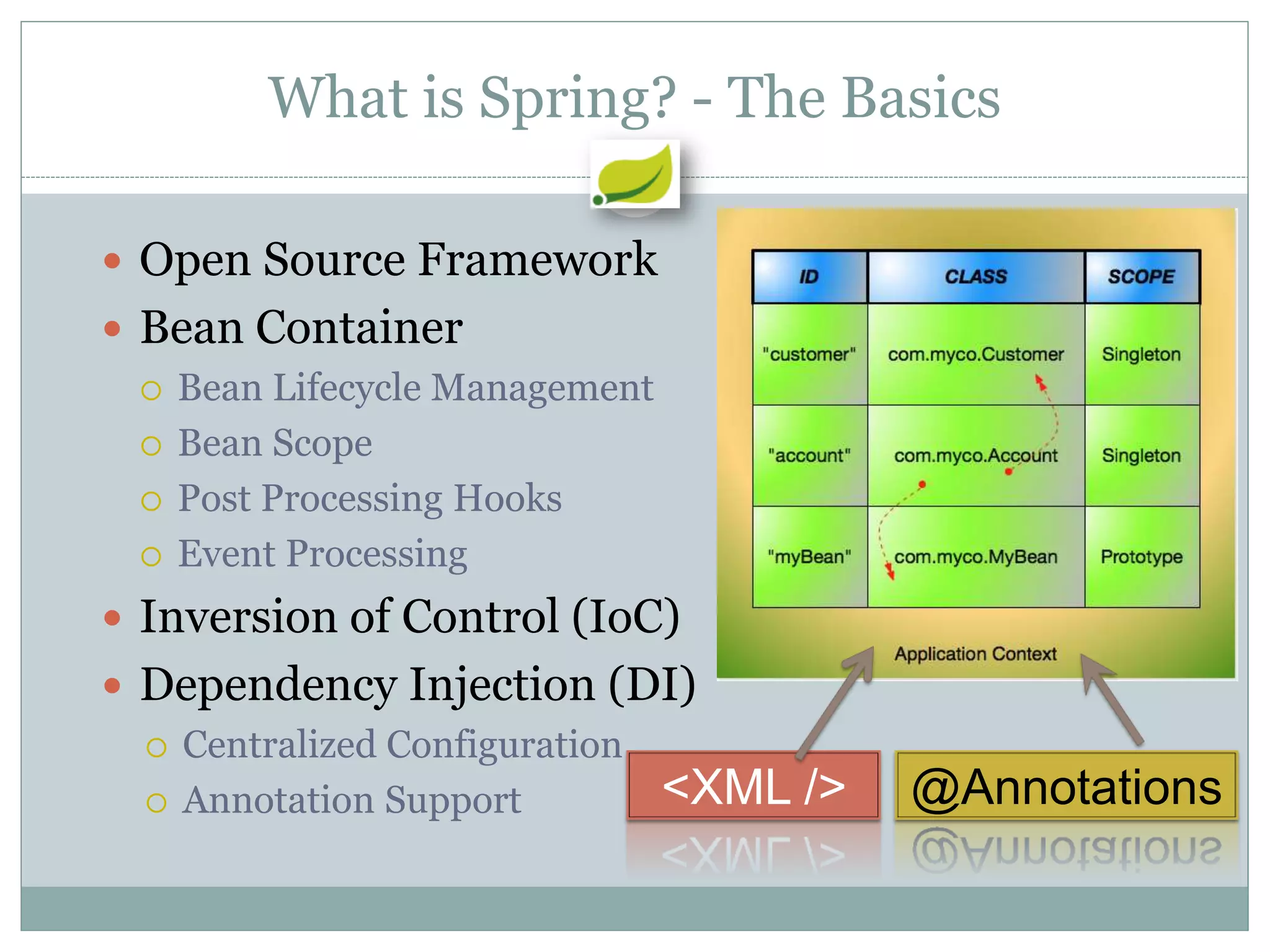
What is Spring? - The Basics

 Open Source Framework
 Bean Container
   Bean Lifecycle Management

   Bean Scope

   Post Processing Hooks

   Event Processing

 Inversion of Control (IoC)
 Dependency Injection (DI)
   Centralized Configuration

   Annotation Support        <XML   />   @Annotations
What is Spring? - Features

 Core
   Standard Java Apps
                                  Web Flow
                                    Stateful Page Flows
 Spring MVC
   Powerful controller config
   Flexible data formatting      Enterprise Integration
   RESTful
                                    JMS

 Rich Web Applications             Remoting
   Web Flow                        Spring Integration
   BlazeDS (Flex)
                                    Spring Batch
   Spring Faces (JSF)
   Spring JS                       Web Services
   Spring JSP/JSTL
Why Use Spring? – Core Benefits

 POJOs
   Our Java Beans

   GOAL: Beans are technology & platform agnostic

 Bean Lifecycle & Dependency Management
   no more “new myClass()”

 Standard Java Technologies
   JSR-303, JSR-250, JSR-317, etc.

 Data Management
   Conversion, Marshaling, Formatting

   Data from WS, UI, Remoting, Integration, JMS, etc.
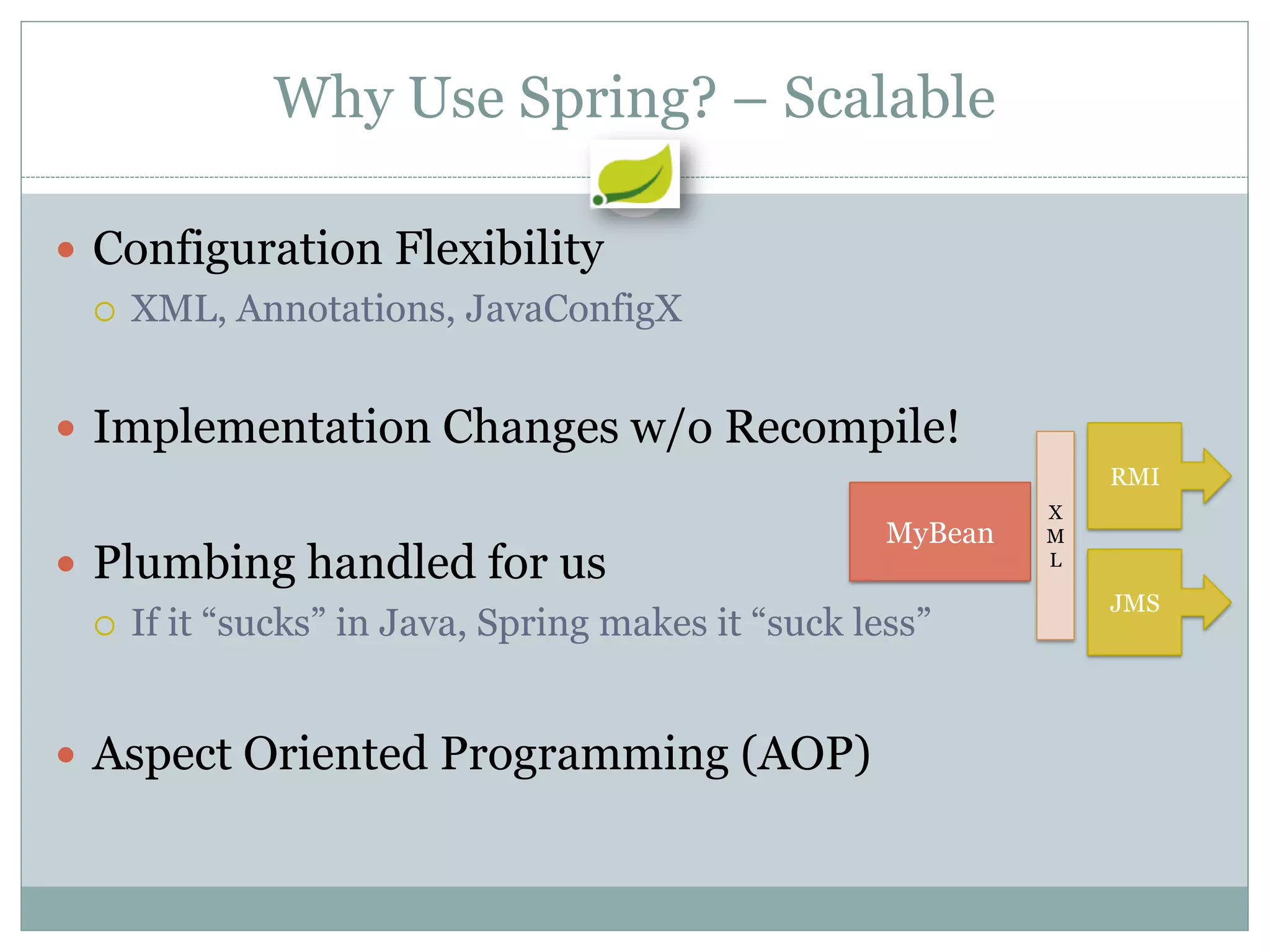
Why Use Spring? – Scalable

 Configuration Flexibility
   XML, Annotations, JavaConfigX


 Implementation Changes w/o Recompile!
                                                                RMI
                                                            X
                                                   MyBean   M
 Plumbing handled for us                                   L

                                                                JMS
   If it “sucks” in Java, Spring makes it “suck less”


 Aspect Oriented Programming (AOP)
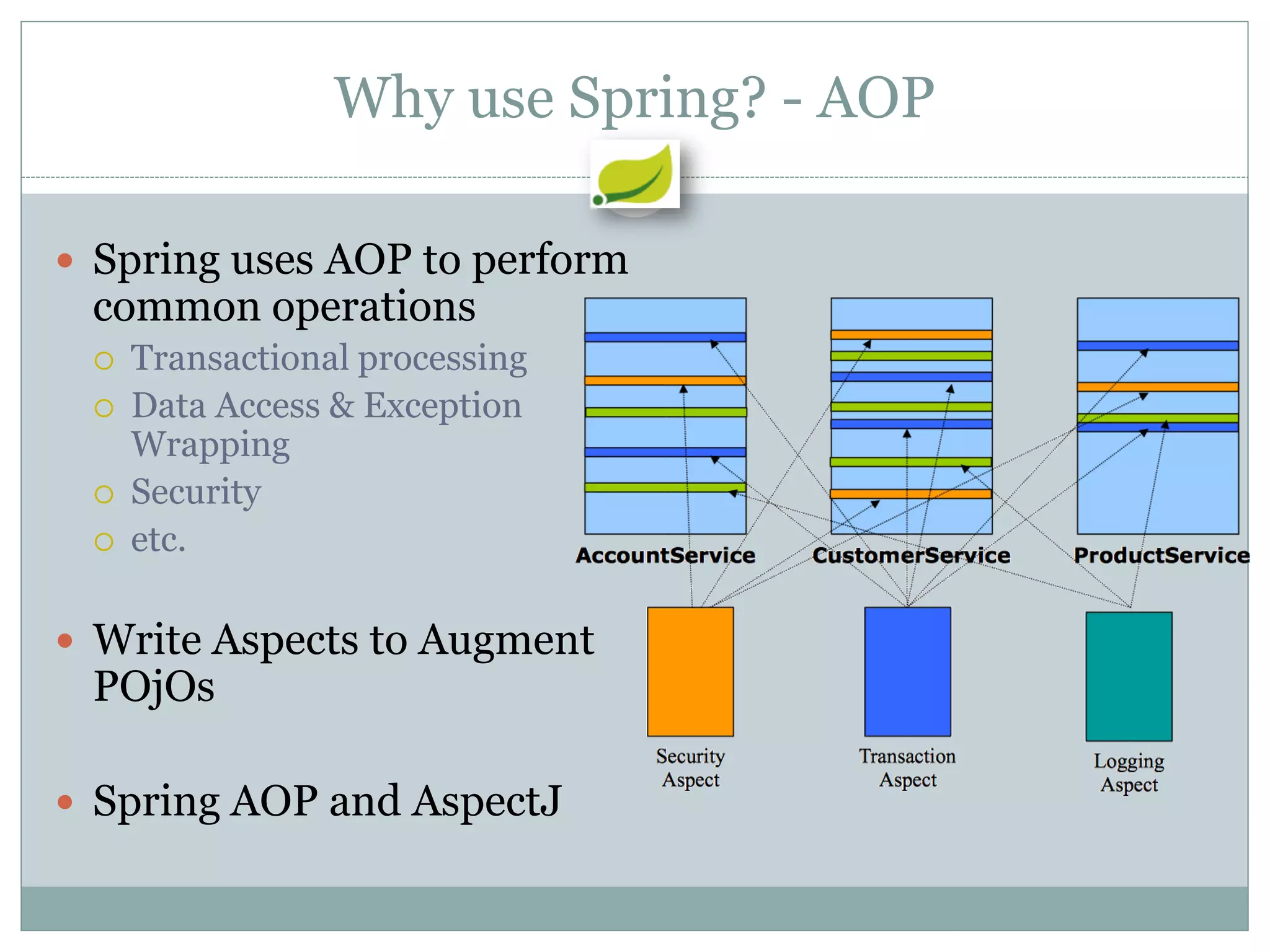
Why use Spring? - AOP

 Spring uses AOP to perform
 common operations
    Transactional processing
    Data Access & Exception
     Wrapping
    Security
    etc.

 Write Aspects to Augment
 POjOs

 Spring AOP and AspectJ
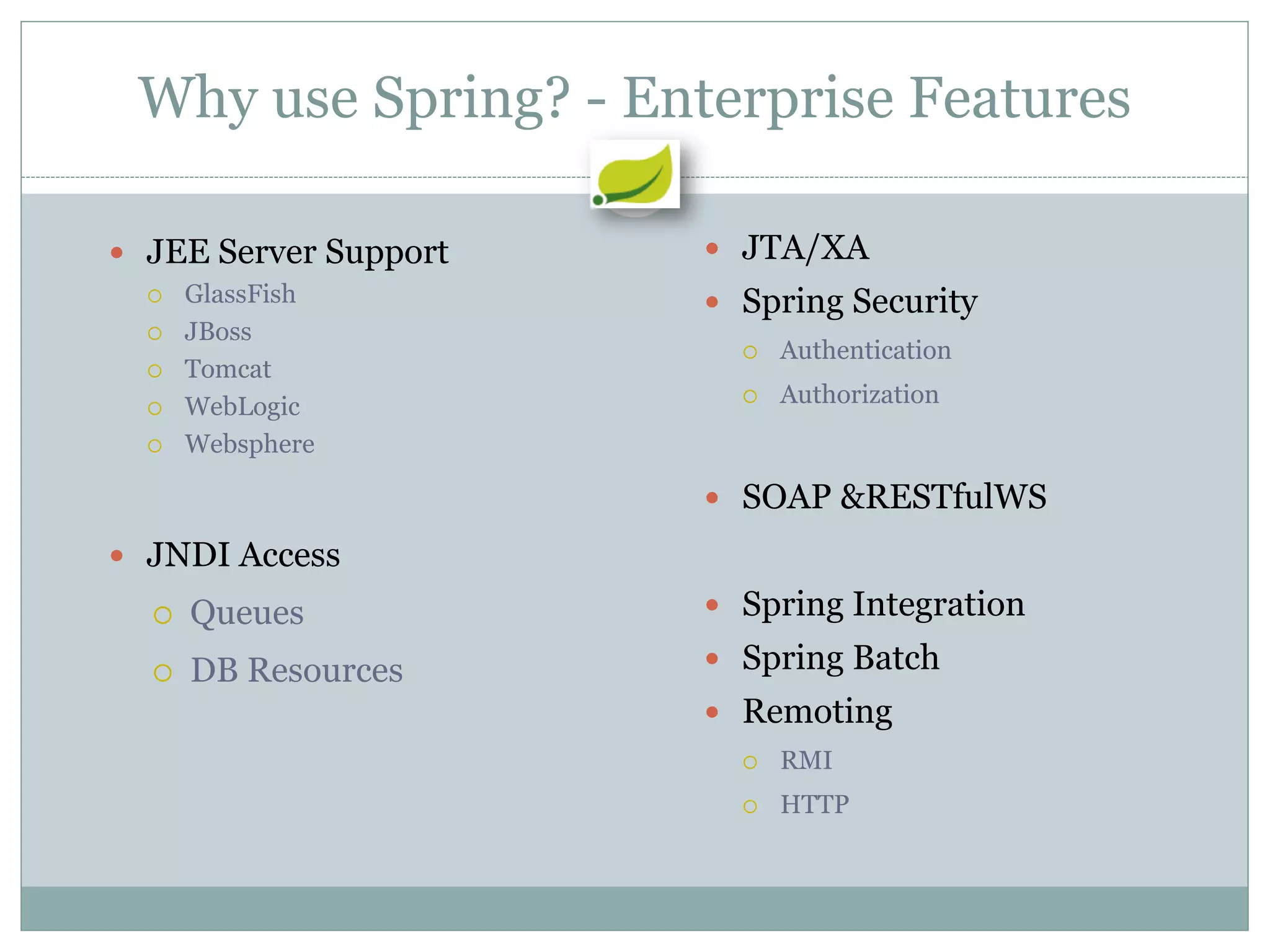
Why use Spring? - Enterprise Features

 JEE Server Support    JTA/XA
     GlassFish         Spring Security
     JBoss
                            Authentication
     Tomcat
     WebLogic              Authorization
     Websphere

                        SOAP &RESTfulWS
 JNDI Access
     Queues            Spring Integration

     DB Resources      Spring Batch
                        Remoting
                            RMI
                            HTTP
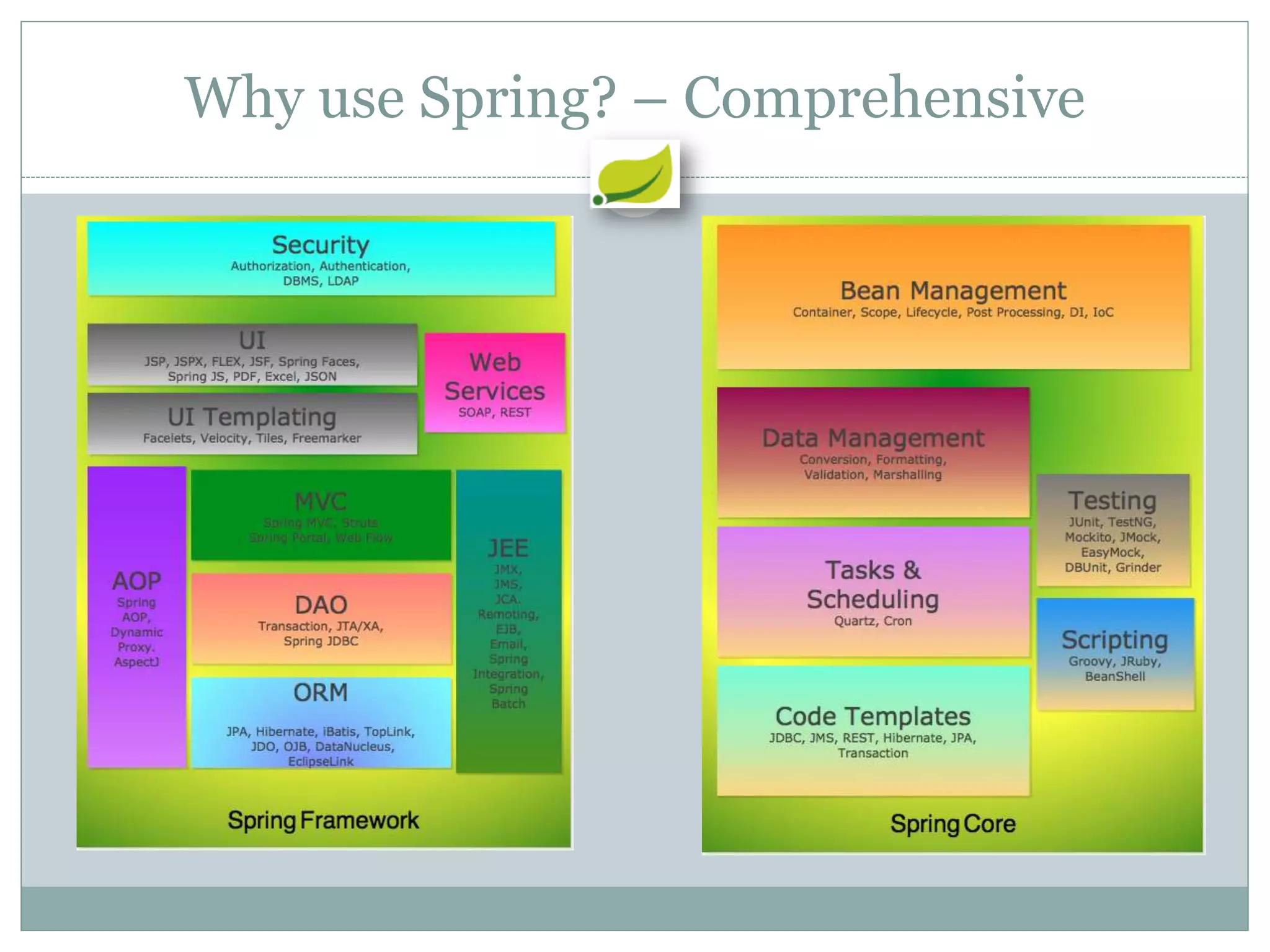
Why use Spring? – Comprehensive
Session Topics

1.   What is Spring & Why use it?

2.   Architecting in Spring

3.   Enterprise Spring

4.   Spring & SOA

5.   Modular Spring w/ OSGi

6.   Spring RAD & Tools
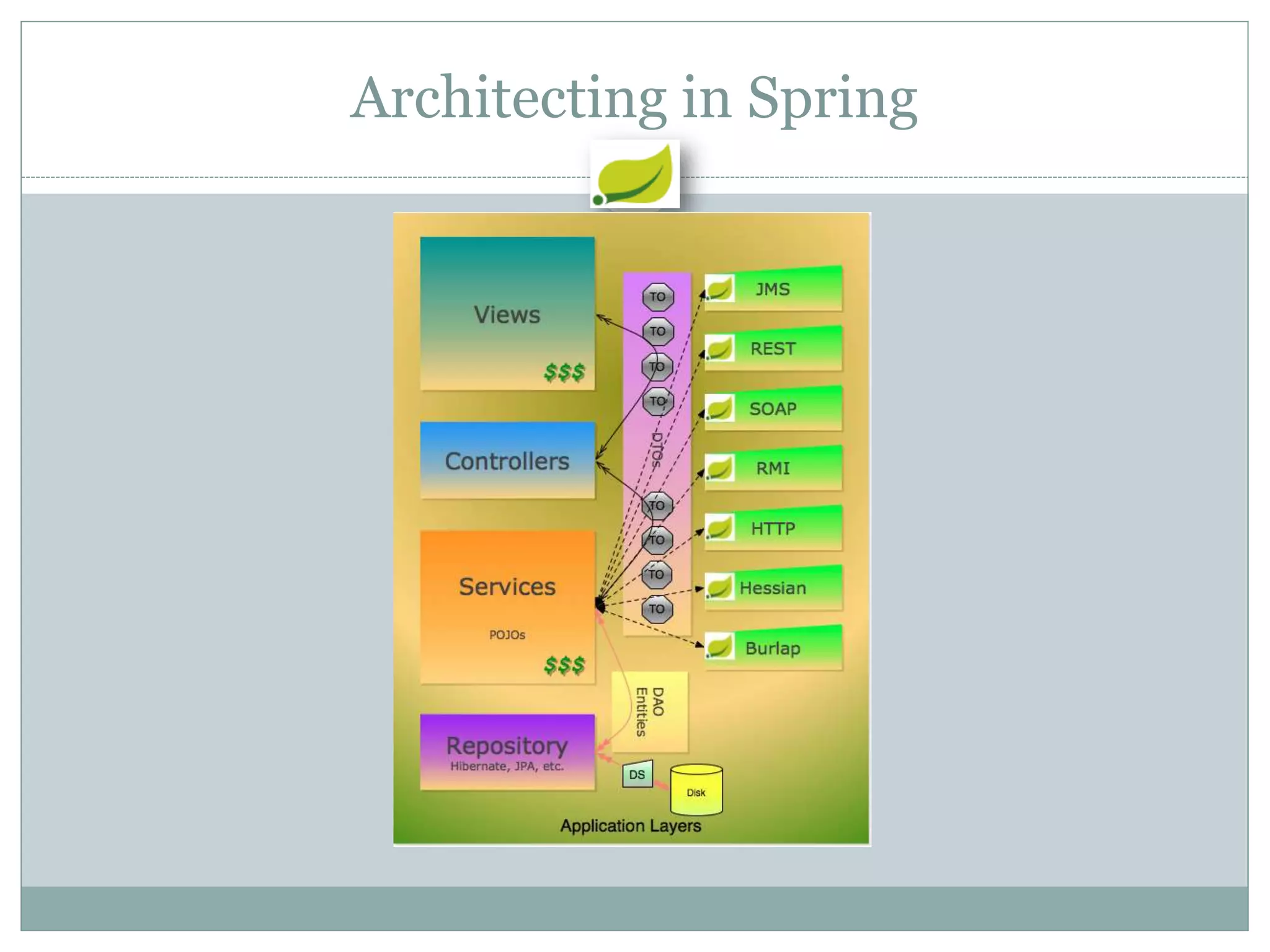
Architecting in Spring
Architecting Services with POJOs

 Plain Old Java Objects
 Create Services as POJOs
 Expose Services via Configuration
 Do Not:
   import, extend or inject framework or technology specific
    classes


Gordo’s Rule
 It’s Not a POJO if you have plumbing/framework
  references in the “imports”.
Session Topics

1.   What is Spring & Why use it?

2.   Architecting in Spring

3.   Enterprise Spring

4.   Spring & SOA

5.   Modular Spring w/ OSGi

6.   Spring RAD & Tools
Enterprise Spring Projects


     Spring Web Flow

     Spring Security

     Spring Integration

     Spring Batch
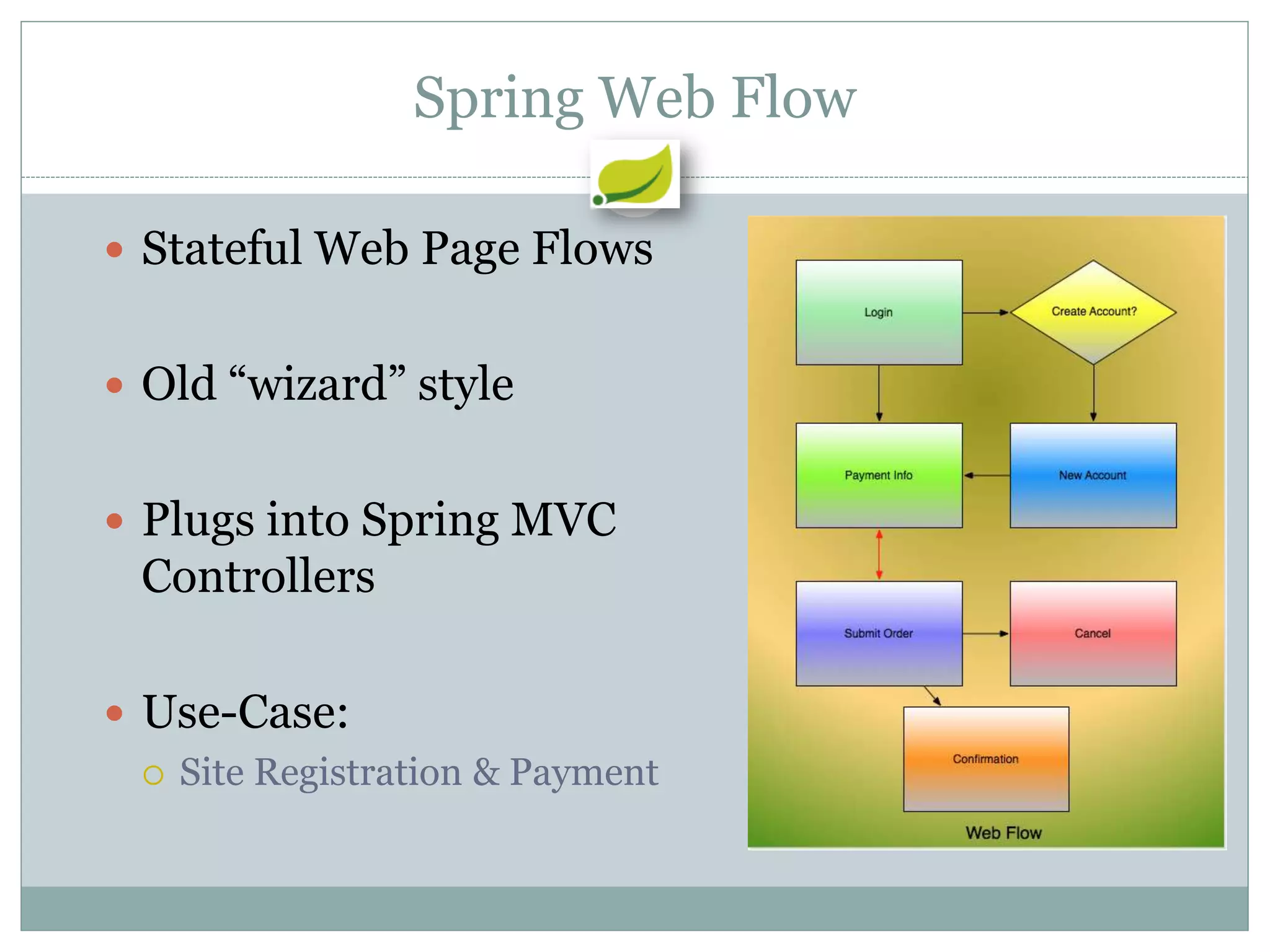
Spring Web Flow

 Stateful Web Page Flows


 Old “wizard” style


 Plugs into Spring MVC
  Controllers

 Use-Case:
   Site Registration & Payment
Spring Security

 Separates Authentication from Authorization
 Simple to configure
 Feature Rich
   Users, Roles, Groups, Voters, ACL

 Authentication
   DBMS – existing or custom
   LDAP

 Authorization
   UI Components
   Methods
   URLs
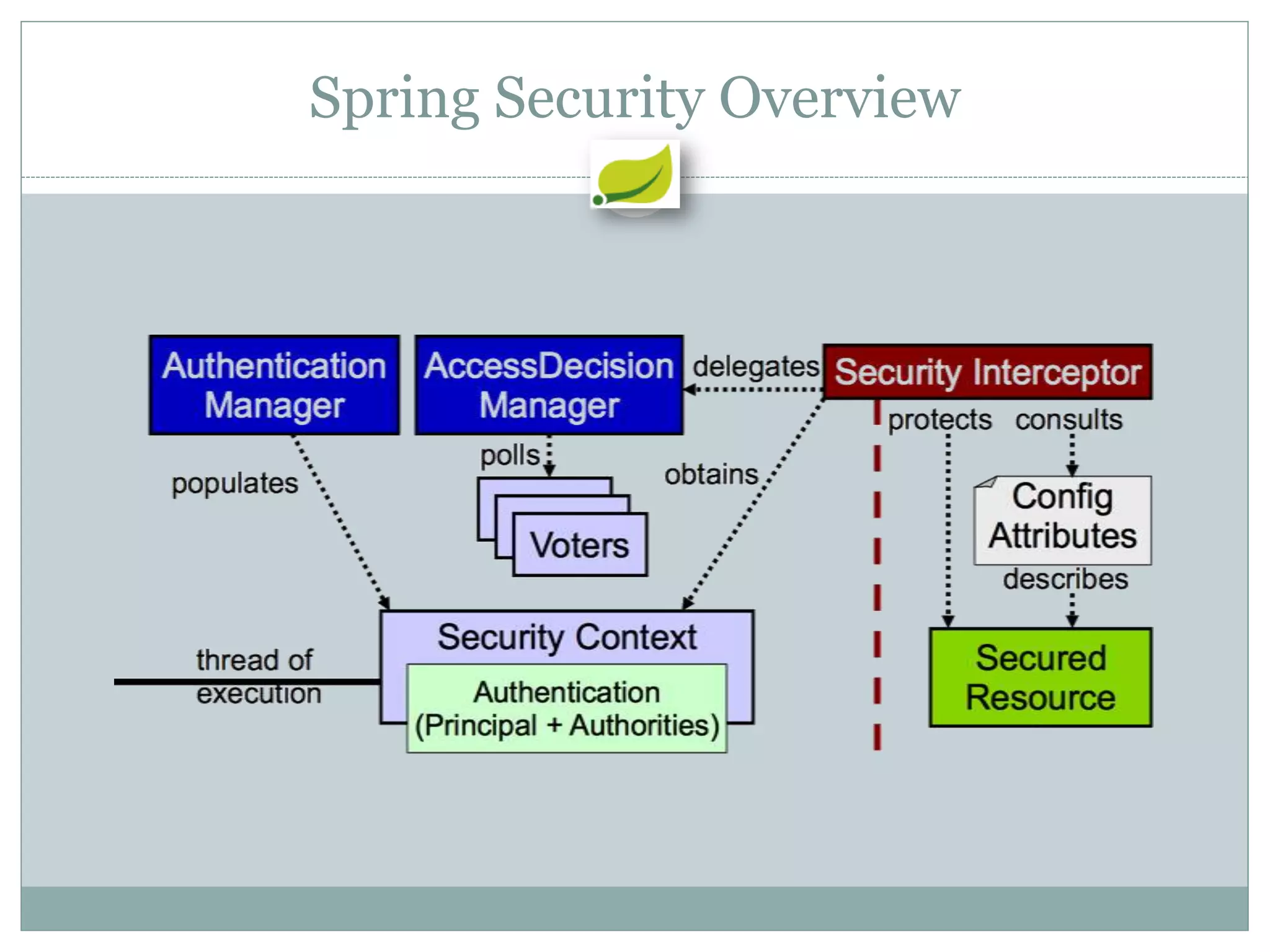
Spring Security Overview
Spring Integration

 Enterprise Messaging


 Message Driven Solution


 Message Routing, Transformation, Filtering


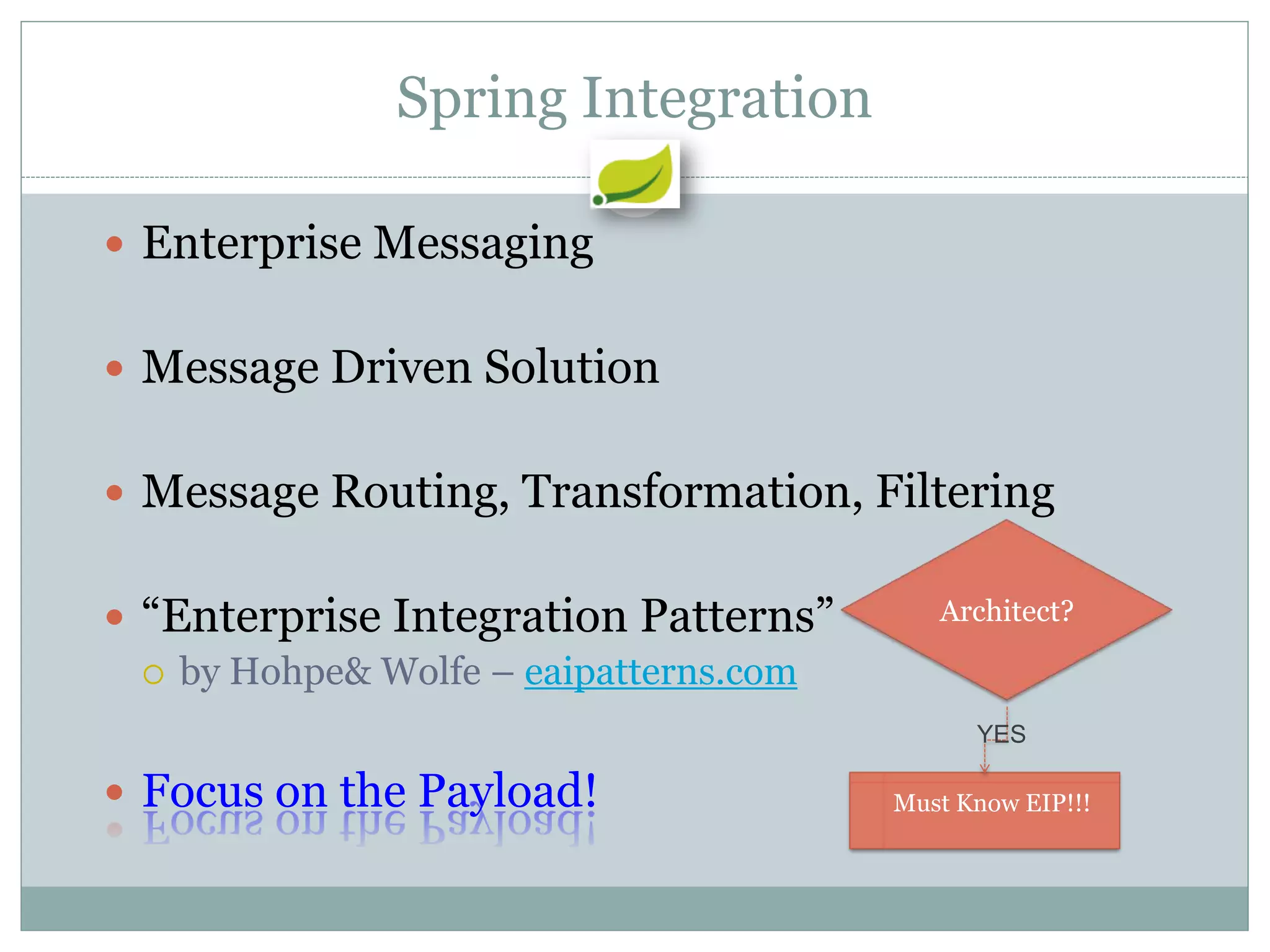
 “Enterprise Integration Patterns”        Architect?

   by Hohpe& Wolfe – eaipatterns.com

                                              YES

 Focus on the Payload!                 Must Know EIP!!!
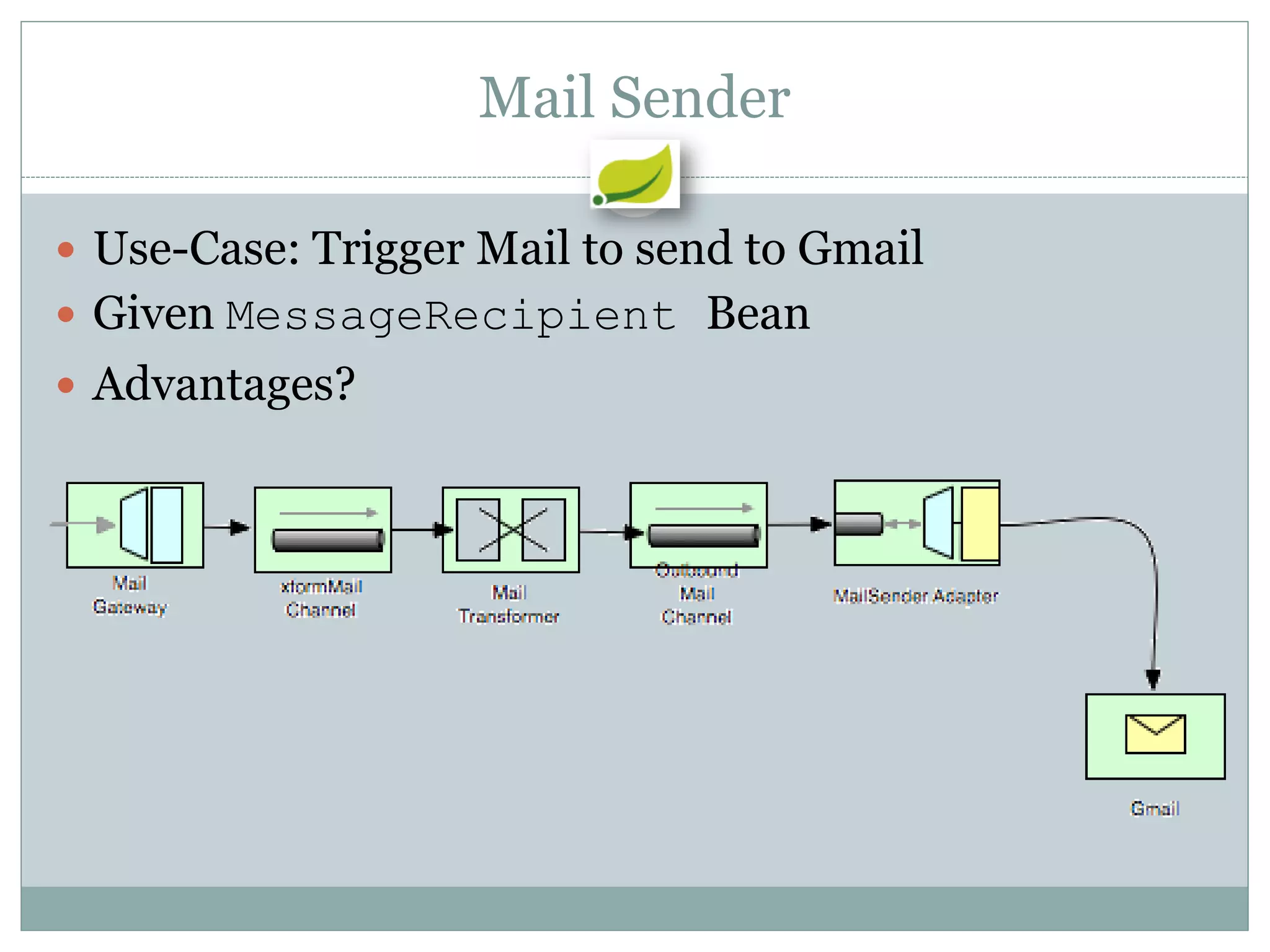
Mail Sender

 Use-Case: Trigger Mail to send to Gmail
 Given MessageRecipient Bean
 Advantages?
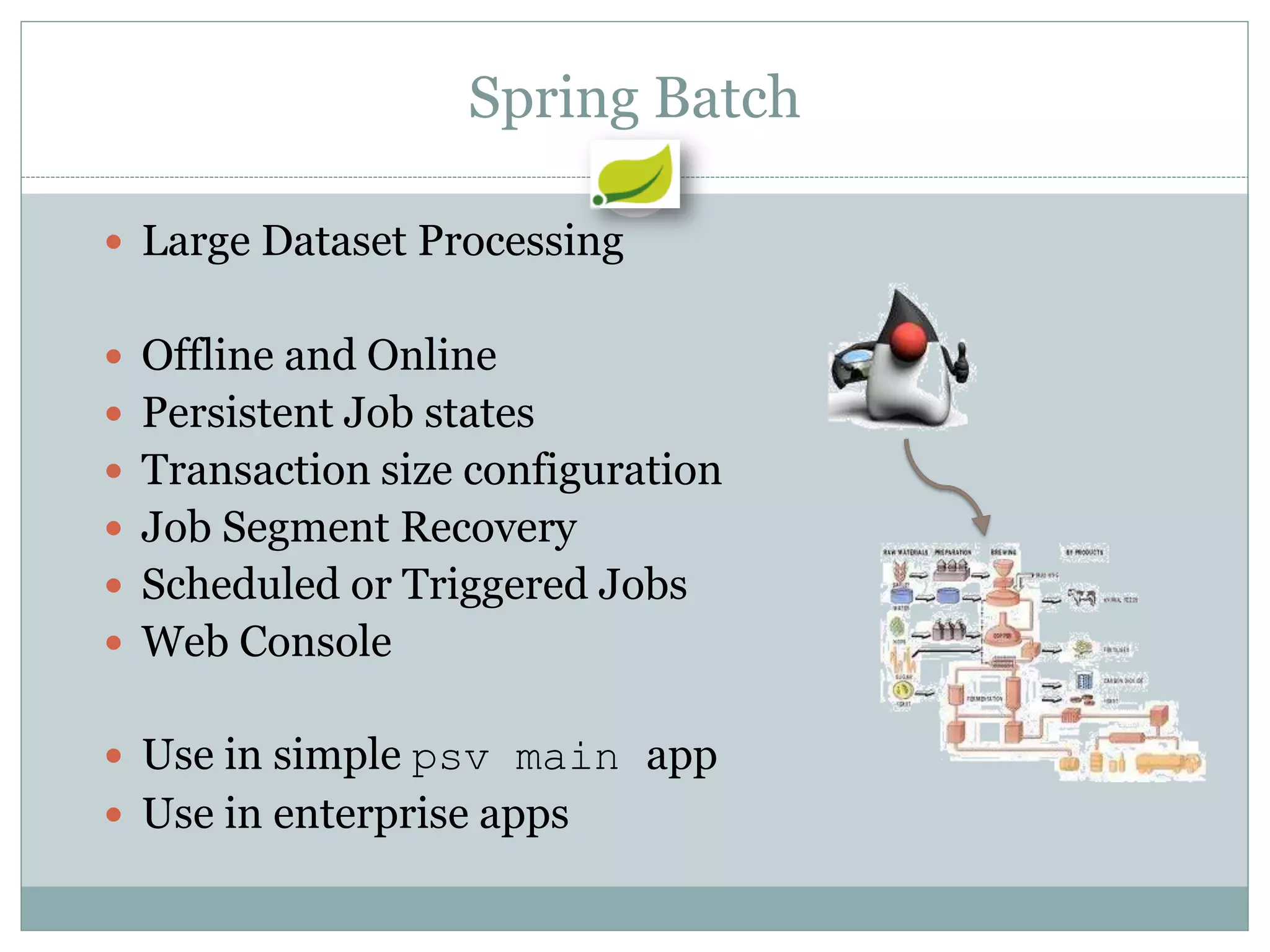
Spring Batch

 Large Dataset Processing


 Offline and Online
 Persistent Job states
 Transaction size configuration
 Job Segment Recovery
 Scheduled or Triggered Jobs
 Web Console


 Use in simple psv main app
 Use in enterprise apps
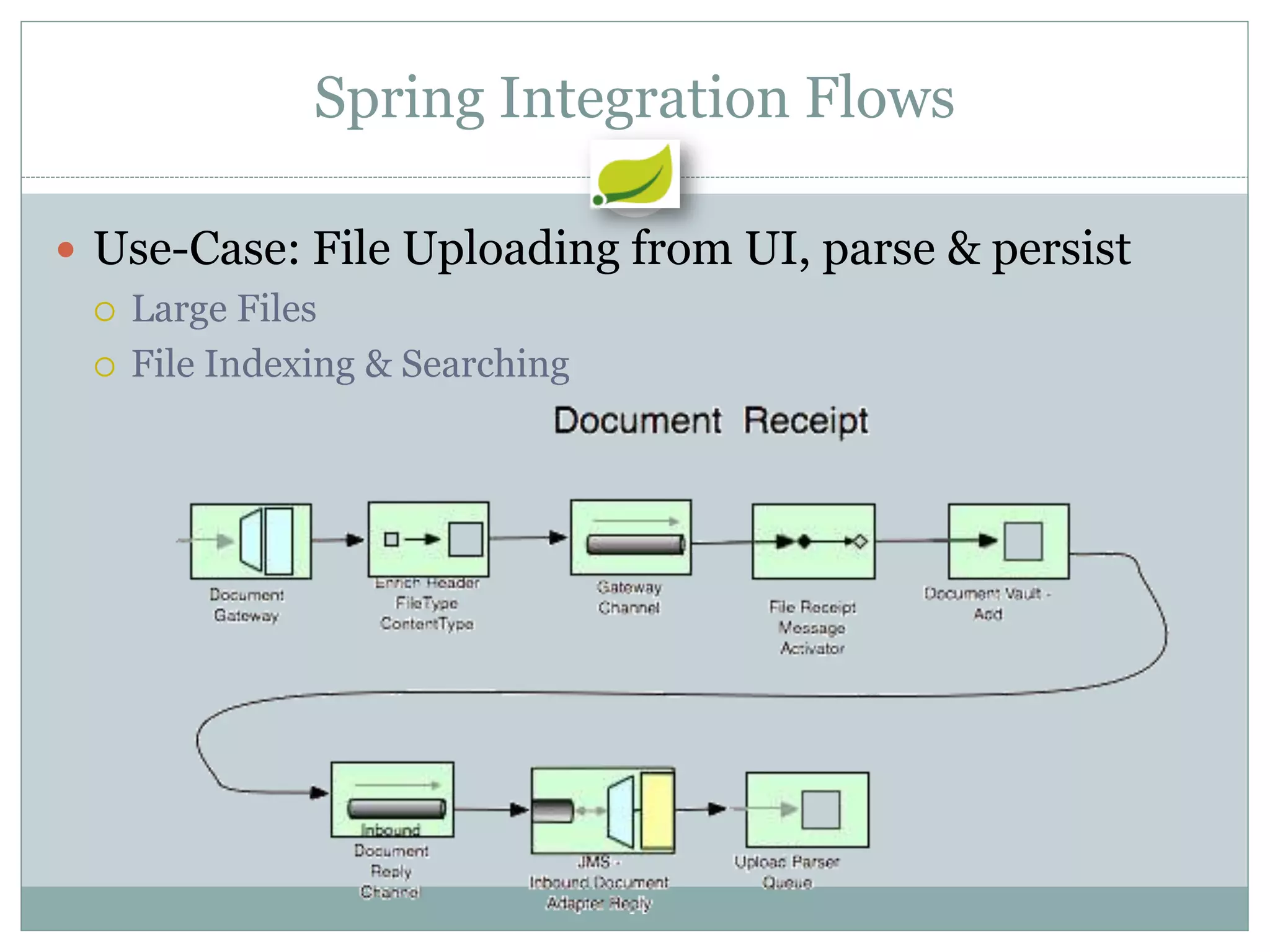
Spring Integration Flows

 Use-Case: File Uploading from UI, parse & persist
   Large Files

   File Indexing & Searching
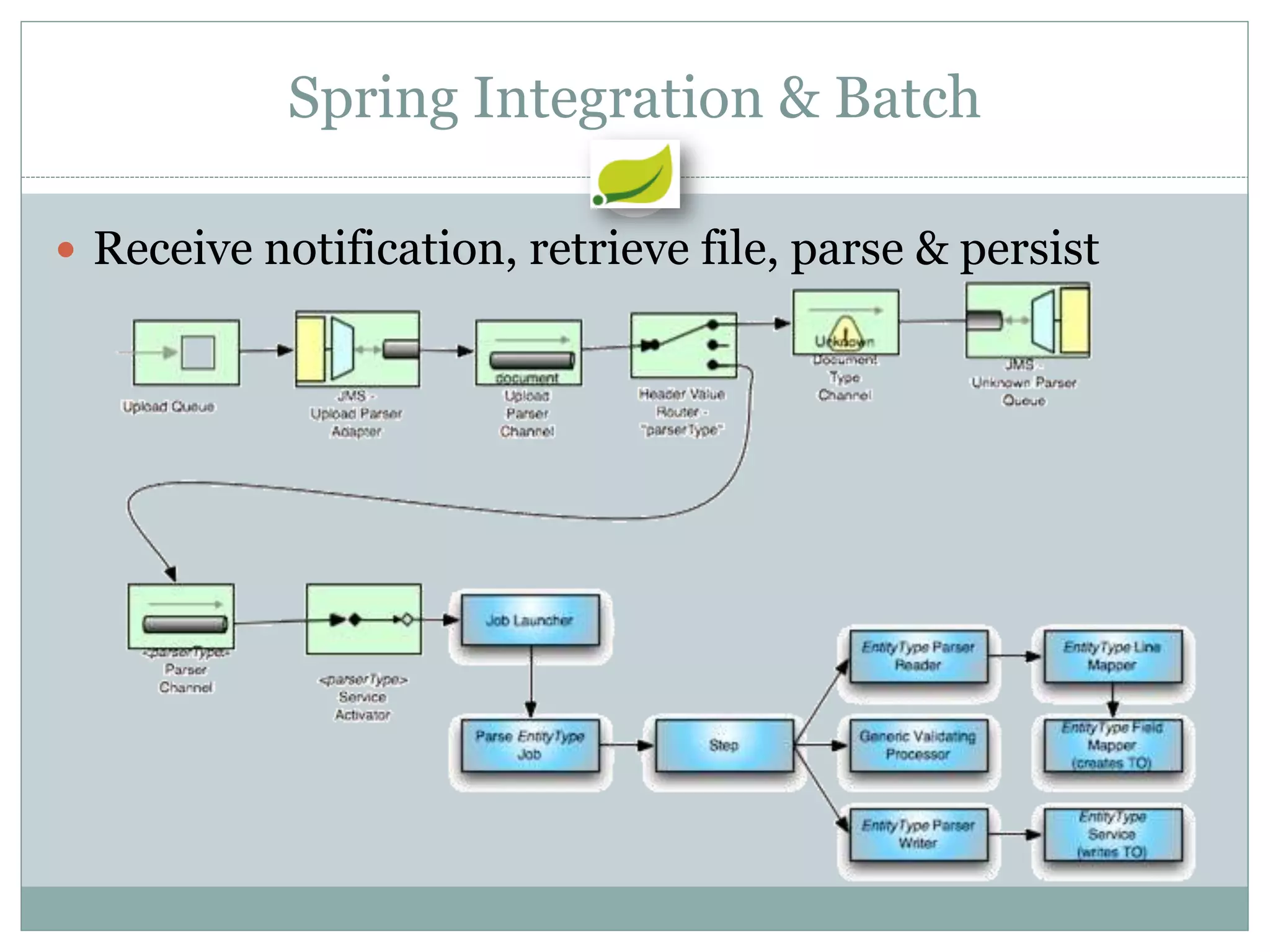
Spring Integration & Batch

 Receive notification, retrieve file, parse & persist
Session Topics

1.   What is Spring & Why use it?

2.   Architecting in Spring

3.   Enterprise Spring

4.   Spring & SOA

5.   Modular Spring w/ OSGi

6.   Spring RAD & Tools
Spring & SOA

 Spring SOAP Web Services


 Spring RESTful Web Services


 Spring Remoting
   RMI

   HTTP

   Hessian & Burlap

   Corba IIOP

   EJB Invocation
Session Topics

1.   What is Spring & Why use it?

2.   Architecting in Spring

3.   Enterprise Spring

4.   Spring & SOA

5.   Modular Spring w/ OSGi

6.   Spring RAD & Tools
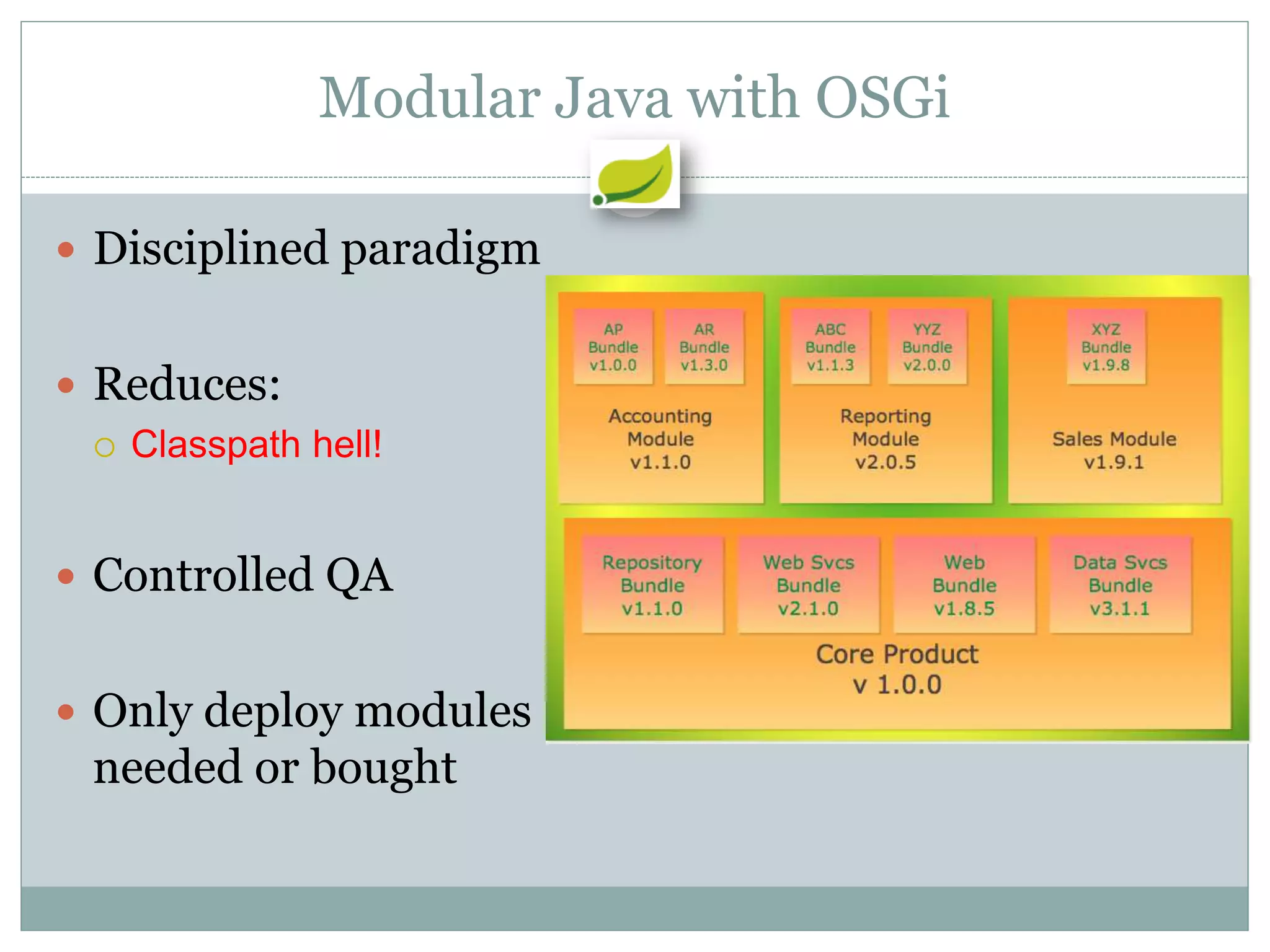
Modular Java with OSGi

 Disciplined paradigm


 Reduces:
   Classpath hell!


 Controlled QA


 Only deploy modules
  needed or bought
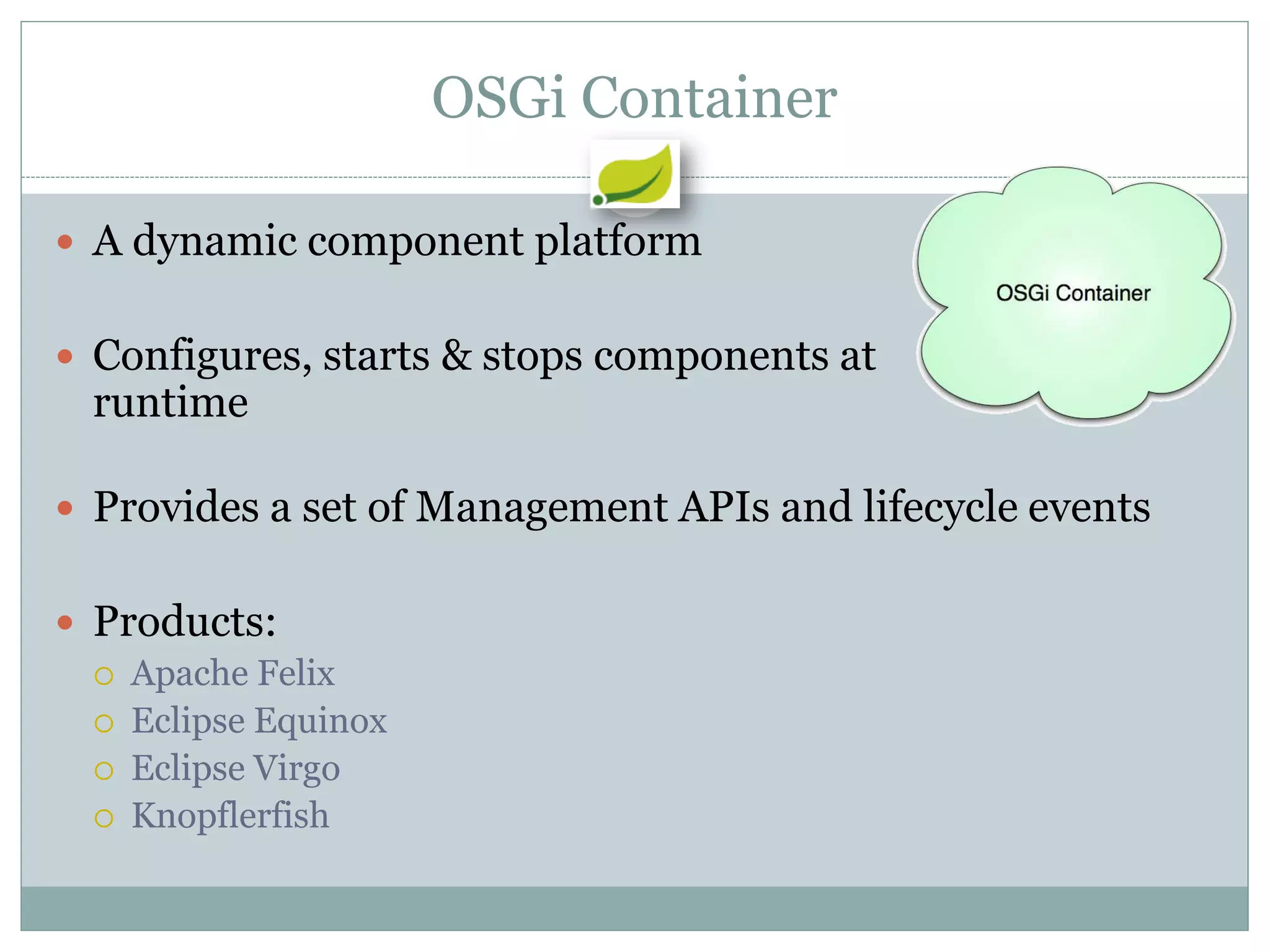
OSGi Container

 A dynamic component platform


 Configures, starts & stops components at
  runtime

 Provides a set of Management APIs and lifecycle events


 Products:
   Apache Felix
   Eclipse Equinox
   Eclipse Virgo
   Knopflerfish
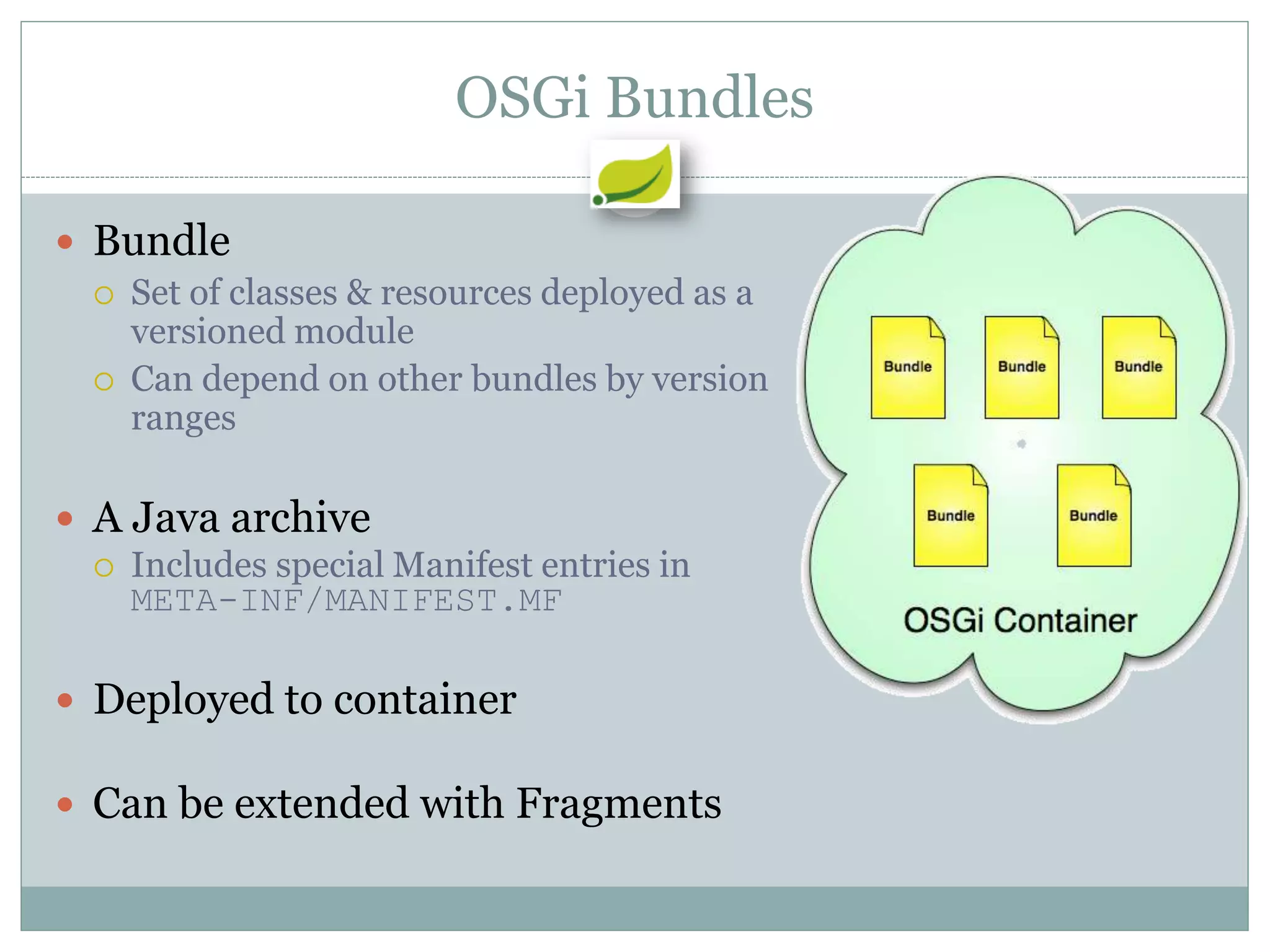
OSGi Bundles

 Bundle
   Set of classes & resources deployed as a
    versioned module
   Can depend on other bundles by version
    ranges

 A Java archive
   Includes special Manifest entries in
    META-INF/MANIFEST.MF

 Deployed to container

 Can be extended with Fragments
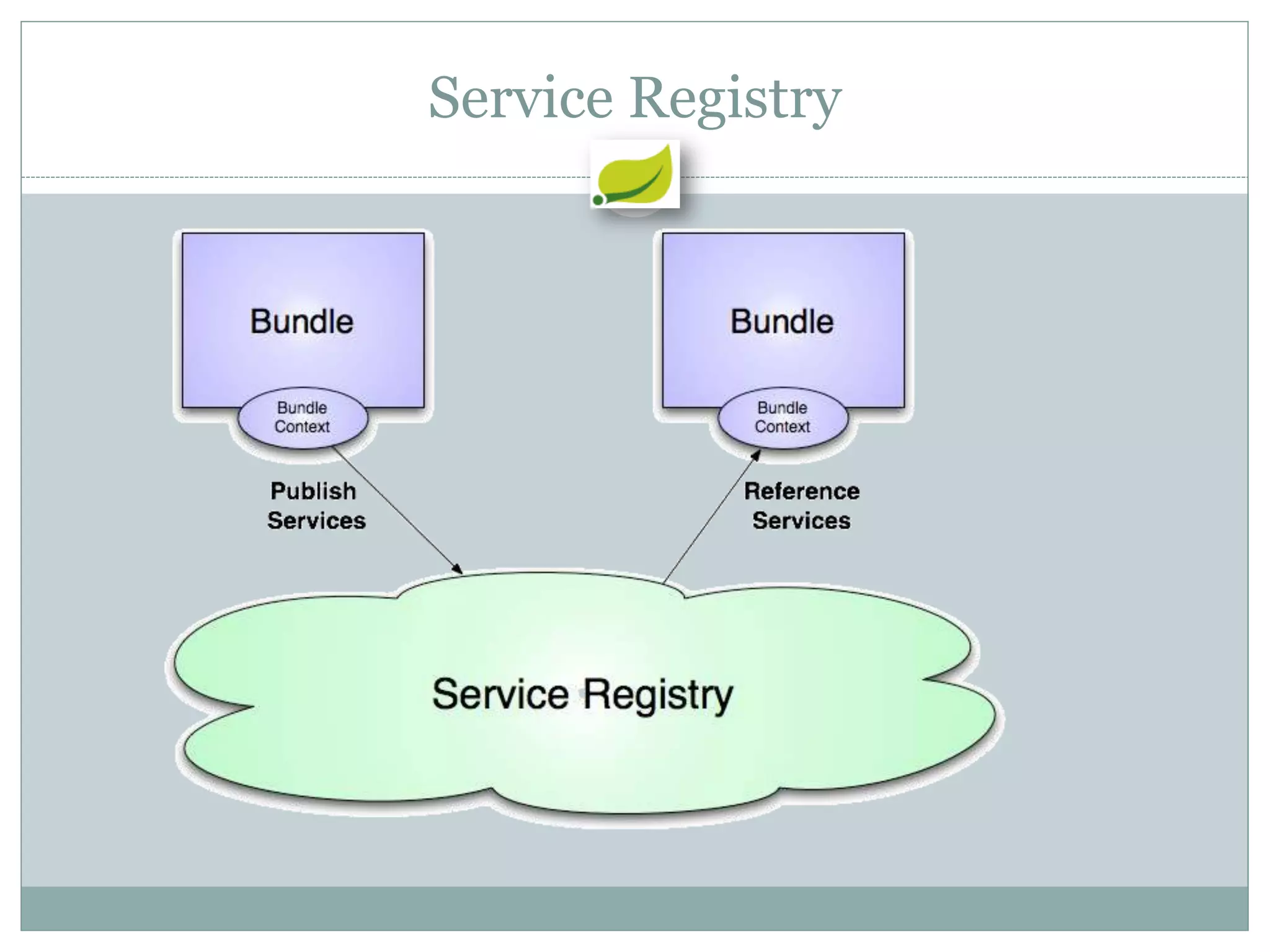
Service Registry
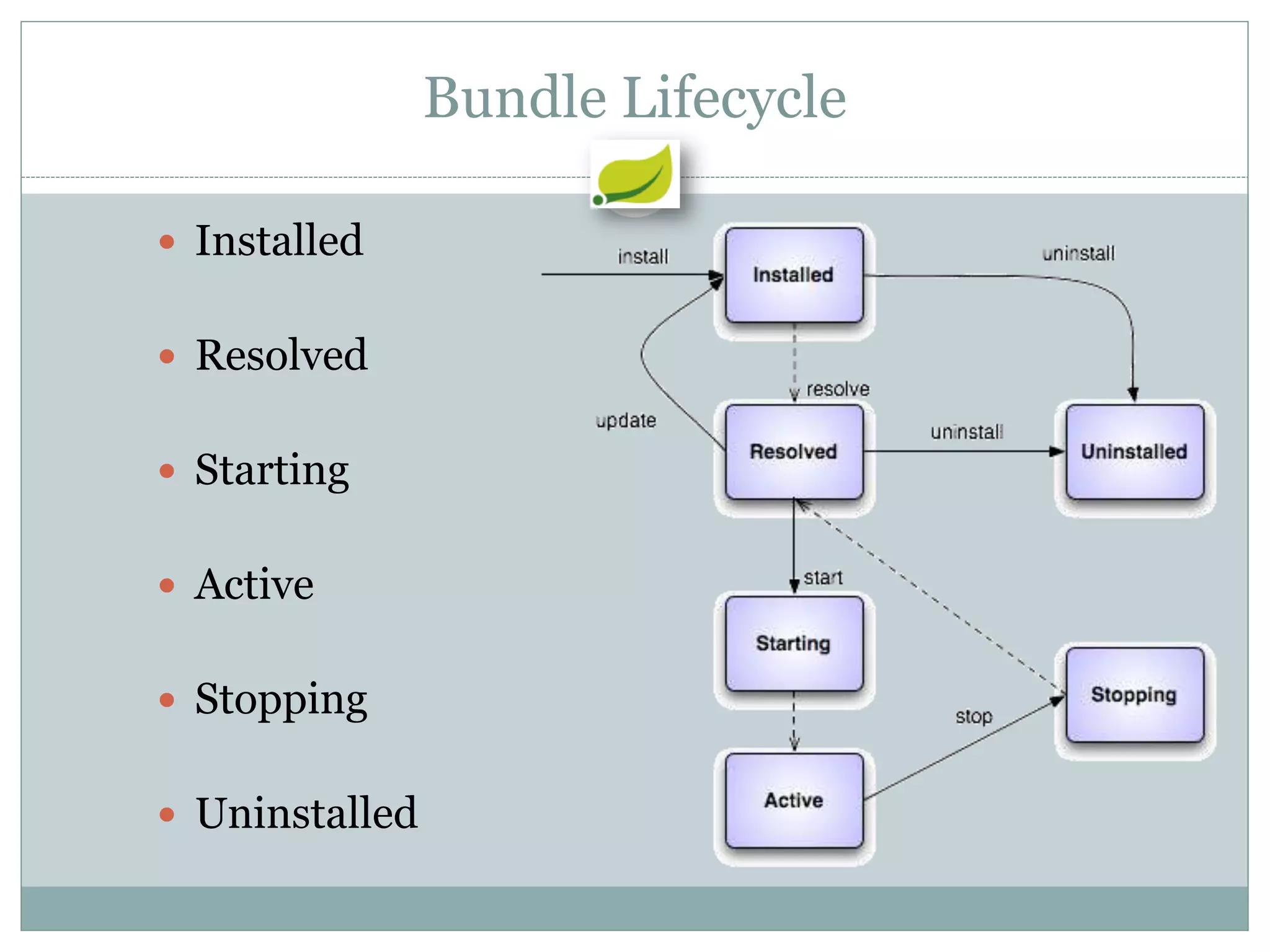
Bundle Lifecycle

 Installed


 Resolved


 Starting


 Active


 Stopping


 Uninstalled
Modular Java - OSGi

 Eclipse Gemini
   Formerly: Spring Dynamic Modules
   Spring Blueprint service – Bundle extension for Bean Context
   Bundle activation
   Service registration

 Eclipse Virgo
   Formerly: Spring dm Server
   Full OSGi server platform
   Bundle Provisioning
   Console Management & Logging
   Modular UI Components
   Module Scoping
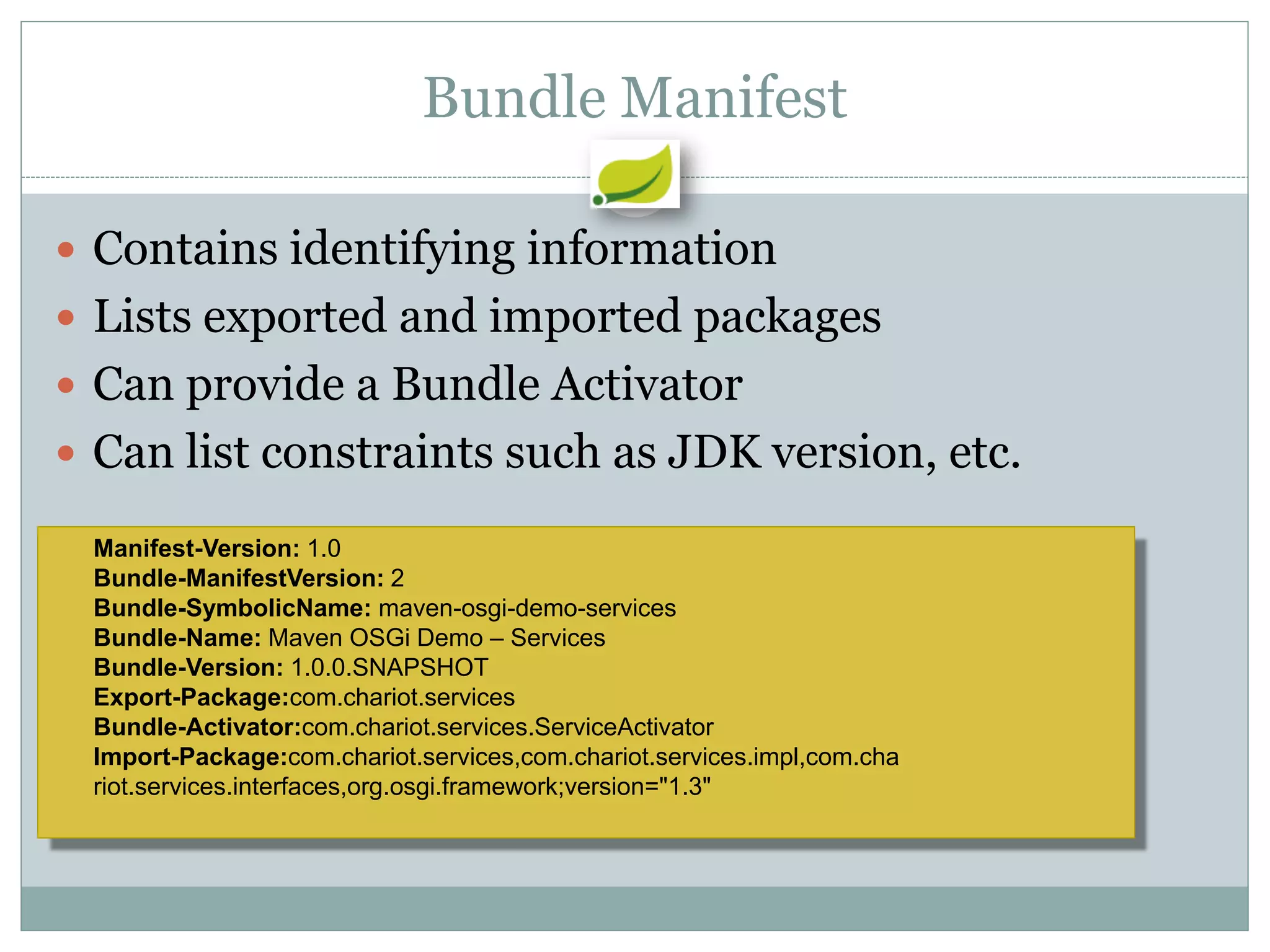
Bundle Manifest

 Contains identifying information
 Lists exported and imported packages
 Can provide a Bundle Activator
 Can list constraints such as JDK version, etc.

 Manifest-Version: 1.0
 Bundle-ManifestVersion: 2
 Bundle-SymbolicName: maven-osgi-demo-services
 Bundle-Name: Maven OSGi Demo – Services
 Bundle-Version: 1.0.0.SNAPSHOT
 Export-Package:com.chariot.services
 Bundle-Activator:com.chariot.services.ServiceActivator
 Import-Package:com.chariot.services,com.chariot.services.impl,com.cha
 riot.services.interfaces,org.osgi.framework;version="1.3"
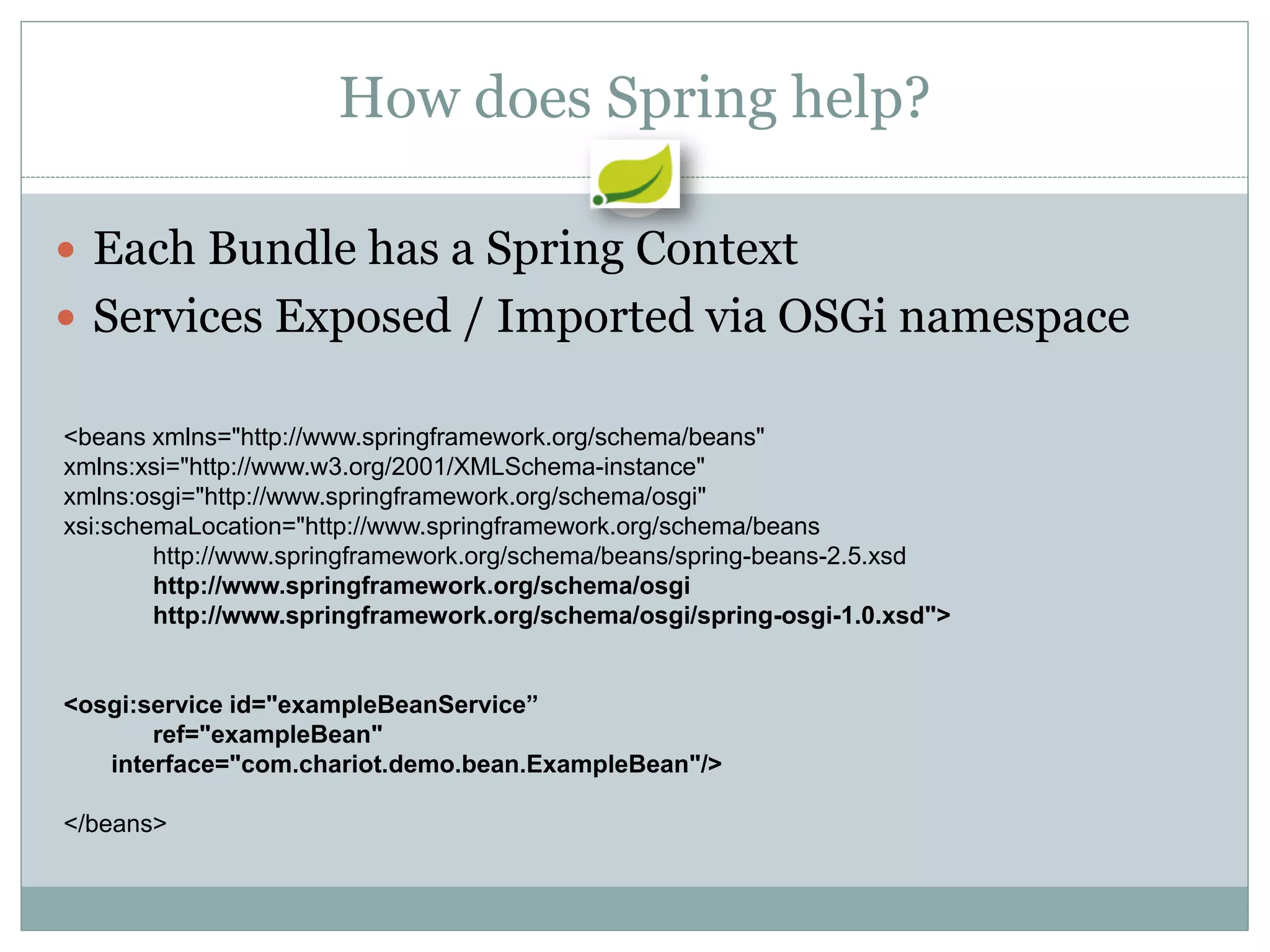
How does Spring help?

 Each Bundle has a Spring Context
 Services Exposed / Imported via OSGi namespace

<beans xmlns="http://www.springframework.org/schema/beans"
xmlns:xsi="http://www.w3.org/2001/XMLSchema-instance"
xmlns:osgi="http://www.springframework.org/schema/osgi"
xsi:schemaLocation="http://www.springframework.org/schema/beans
        http://www.springframework.org/schema/beans/spring-beans-2.5.xsd
        http://www.springframework.org/schema/osgi
        http://www.springframework.org/schema/osgi/spring-osgi-1.0.xsd">


<osgi:service id="exampleBeanService”
       ref="exampleBean"
   interface="com.chariot.demo.bean.ExampleBean"/>

</beans>
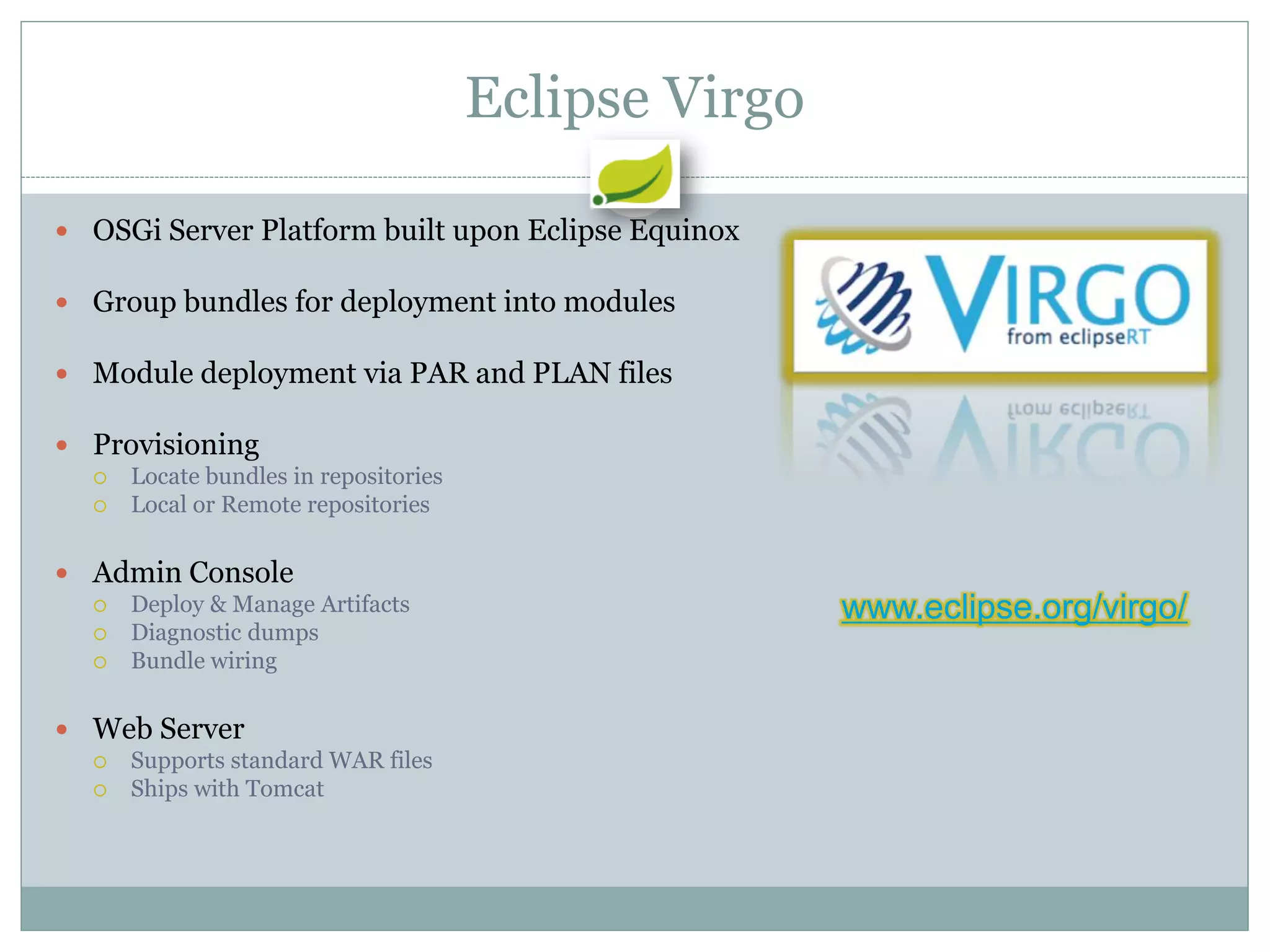
Eclipse Virgo

 OSGi Server Platform built upon Eclipse Equinox

 Group bundles for deployment into modules

 Module deployment via PAR and PLAN files

 Provisioning
     Locate bundles in repositories
     Local or Remote repositories

 Admin Console
     Deploy & Manage Artifacts                        www.eclipse.org/virgo/
     Diagnostic dumps
     Bundle wiring

 Web Server
     Supports standard WAR files
     Ships with Tomcat
Session Topics

1.   What is Spring & Why use it?

2.   Architecting in Spring

3.   Enterprise Spring

4.   Spring & SOA

5.   Modular Spring w/ OSGi

6.   Spring RAD & Tools
RAD Tools

 Roo
   Build and configure Java objects

   Interactive management

   Demonstrates Best Practices

   Database Reverse engineering

 Grails
   Built on the Spring & Hibernate platform

   Dynamic coding with Groovy language

   Completely supports Java libraries

   Hundreds of plug-ins
SpringSource Tool Suite

 Built on the very popular Eclipse IDE


 Provides Spring specific features


 View components
   Bean Dependency Relationships

   Integration Flows


 Supports Roo, Grails & Groovy
Summary

 Comprehensive framework


 Java Standards


 Extensible


 Focus on Problem Domain


 Configure System Domain


 Designed RI for Eclipse OSGi Modular Projects

Enterprise Spring Building Scalable Applications

  • 1.
    Spring in theEnterprise
  • 2.
    Session Topics 1. What is Spring & Why use it? 2. Architecting in Spring 3. Enterprise Spring 4. Spring & SOA 5. Modular Spring w/ OSGi 6. Spring RAD & Tools
  • 3.
  • 4.
    What is Spring?- The Basics  Open Source Framework  Bean Container  Bean Lifecycle Management  Bean Scope  Post Processing Hooks  Event Processing  Inversion of Control (IoC)  Dependency Injection (DI)  Centralized Configuration  Annotation Support <XML /> @Annotations
  • 5.
    What is Spring?- Features  Core  Standard Java Apps  Web Flow  Stateful Page Flows  Spring MVC  Powerful controller config  Flexible data formatting  Enterprise Integration  RESTful  JMS  Rich Web Applications  Remoting  Web Flow  Spring Integration  BlazeDS (Flex)  Spring Batch  Spring Faces (JSF)  Spring JS  Web Services  Spring JSP/JSTL
  • 6.
    Why Use Spring?– Core Benefits  POJOs  Our Java Beans  GOAL: Beans are technology & platform agnostic  Bean Lifecycle & Dependency Management  no more “new myClass()”  Standard Java Technologies  JSR-303, JSR-250, JSR-317, etc.  Data Management  Conversion, Marshaling, Formatting  Data from WS, UI, Remoting, Integration, JMS, etc.
  • 7.
    Why Use Spring?– Scalable  Configuration Flexibility  XML, Annotations, JavaConfigX  Implementation Changes w/o Recompile! RMI X MyBean M  Plumbing handled for us L JMS  If it “sucks” in Java, Spring makes it “suck less”  Aspect Oriented Programming (AOP)
  • 8.
    Why use Spring?- AOP  Spring uses AOP to perform common operations  Transactional processing  Data Access & Exception Wrapping  Security  etc.  Write Aspects to Augment POjOs  Spring AOP and AspectJ
  • 9.
    Why use Spring?- Enterprise Features  JEE Server Support  JTA/XA  GlassFish  Spring Security  JBoss  Authentication  Tomcat  WebLogic  Authorization  Websphere  SOAP &RESTfulWS  JNDI Access  Queues  Spring Integration  DB Resources  Spring Batch  Remoting  RMI  HTTP
  • 10.
    Why use Spring?– Comprehensive
  • 11.
    Session Topics 1. What is Spring & Why use it? 2. Architecting in Spring 3. Enterprise Spring 4. Spring & SOA 5. Modular Spring w/ OSGi 6. Spring RAD & Tools
  • 12.
  • 13.
    Architecting Services withPOJOs  Plain Old Java Objects  Create Services as POJOs  Expose Services via Configuration  Do Not:  import, extend or inject framework or technology specific classes Gordo’s Rule  It’s Not a POJO if you have plumbing/framework references in the “imports”.
  • 14.
    Session Topics 1. What is Spring & Why use it? 2. Architecting in Spring 3. Enterprise Spring 4. Spring & SOA 5. Modular Spring w/ OSGi 6. Spring RAD & Tools
  • 15.
    Enterprise Spring Projects Spring Web Flow Spring Security Spring Integration Spring Batch
  • 16.
    Spring Web Flow Stateful Web Page Flows  Old “wizard” style  Plugs into Spring MVC Controllers  Use-Case:  Site Registration & Payment
  • 17.
    Spring Security  SeparatesAuthentication from Authorization  Simple to configure  Feature Rich  Users, Roles, Groups, Voters, ACL  Authentication  DBMS – existing or custom  LDAP  Authorization  UI Components  Methods  URLs
  • 18.
  • 19.
    Spring Integration  EnterpriseMessaging  Message Driven Solution  Message Routing, Transformation, Filtering  “Enterprise Integration Patterns” Architect?  by Hohpe& Wolfe – eaipatterns.com YES  Focus on the Payload! Must Know EIP!!!
  • 20.
    Mail Sender  Use-Case:Trigger Mail to send to Gmail  Given MessageRecipient Bean  Advantages?
  • 21.
    Spring Batch  LargeDataset Processing  Offline and Online  Persistent Job states  Transaction size configuration  Job Segment Recovery  Scheduled or Triggered Jobs  Web Console  Use in simple psv main app  Use in enterprise apps
  • 22.
    Spring Integration Flows Use-Case: File Uploading from UI, parse & persist  Large Files  File Indexing & Searching
  • 23.
    Spring Integration &Batch  Receive notification, retrieve file, parse & persist
  • 24.
    Session Topics 1. What is Spring & Why use it? 2. Architecting in Spring 3. Enterprise Spring 4. Spring & SOA 5. Modular Spring w/ OSGi 6. Spring RAD & Tools
  • 25.
    Spring & SOA Spring SOAP Web Services  Spring RESTful Web Services  Spring Remoting  RMI  HTTP  Hessian & Burlap  Corba IIOP  EJB Invocation
  • 26.
    Session Topics 1. What is Spring & Why use it? 2. Architecting in Spring 3. Enterprise Spring 4. Spring & SOA 5. Modular Spring w/ OSGi 6. Spring RAD & Tools
  • 27.
    Modular Java withOSGi  Disciplined paradigm  Reduces:  Classpath hell!  Controlled QA  Only deploy modules needed or bought
  • 28.
    OSGi Container  Adynamic component platform  Configures, starts & stops components at runtime  Provides a set of Management APIs and lifecycle events  Products:  Apache Felix  Eclipse Equinox  Eclipse Virgo  Knopflerfish
  • 29.
    OSGi Bundles  Bundle  Set of classes & resources deployed as a versioned module  Can depend on other bundles by version ranges  A Java archive  Includes special Manifest entries in META-INF/MANIFEST.MF  Deployed to container  Can be extended with Fragments
  • 30.
  • 31.
    Bundle Lifecycle  Installed Resolved  Starting  Active  Stopping  Uninstalled
  • 32.
    Modular Java -OSGi  Eclipse Gemini  Formerly: Spring Dynamic Modules  Spring Blueprint service – Bundle extension for Bean Context  Bundle activation  Service registration  Eclipse Virgo  Formerly: Spring dm Server  Full OSGi server platform  Bundle Provisioning  Console Management & Logging  Modular UI Components  Module Scoping
  • 33.
    Bundle Manifest  Containsidentifying information  Lists exported and imported packages  Can provide a Bundle Activator  Can list constraints such as JDK version, etc. Manifest-Version: 1.0 Bundle-ManifestVersion: 2 Bundle-SymbolicName: maven-osgi-demo-services Bundle-Name: Maven OSGi Demo – Services Bundle-Version: 1.0.0.SNAPSHOT Export-Package:com.chariot.services Bundle-Activator:com.chariot.services.ServiceActivator Import-Package:com.chariot.services,com.chariot.services.impl,com.cha riot.services.interfaces,org.osgi.framework;version="1.3"
  • 34.
    How does Springhelp?  Each Bundle has a Spring Context  Services Exposed / Imported via OSGi namespace <beans xmlns="http://www.springframework.org/schema/beans" xmlns:xsi="http://www.w3.org/2001/XMLSchema-instance" xmlns:osgi="http://www.springframework.org/schema/osgi" xsi:schemaLocation="http://www.springframework.org/schema/beans http://www.springframework.org/schema/beans/spring-beans-2.5.xsd http://www.springframework.org/schema/osgi http://www.springframework.org/schema/osgi/spring-osgi-1.0.xsd"> <osgi:service id="exampleBeanService” ref="exampleBean" interface="com.chariot.demo.bean.ExampleBean"/> </beans>
  • 35.
    Eclipse Virgo  OSGiServer Platform built upon Eclipse Equinox  Group bundles for deployment into modules  Module deployment via PAR and PLAN files  Provisioning  Locate bundles in repositories  Local or Remote repositories  Admin Console  Deploy & Manage Artifacts www.eclipse.org/virgo/  Diagnostic dumps  Bundle wiring  Web Server  Supports standard WAR files  Ships with Tomcat
  • 36.
    Session Topics 1. What is Spring & Why use it? 2. Architecting in Spring 3. Enterprise Spring 4. Spring & SOA 5. Modular Spring w/ OSGi 6. Spring RAD & Tools
  • 37.
    RAD Tools  Roo  Build and configure Java objects  Interactive management  Demonstrates Best Practices  Database Reverse engineering  Grails  Built on the Spring & Hibernate platform  Dynamic coding with Groovy language  Completely supports Java libraries  Hundreds of plug-ins
  • 38.
    SpringSource Tool Suite Built on the very popular Eclipse IDE  Provides Spring specific features  View components  Bean Dependency Relationships  Integration Flows  Supports Roo, Grails & Groovy
  • 39.
    Summary  Comprehensive framework Java Standards  Extensible  Focus on Problem Domain  Configure System Domain  Designed RI for Eclipse OSGi Modular Projects