Department of Urban Design and Planning,
Faculty of Architecture, Silpakorn University
ผูชวยศาสตราจารย ดร.สิงหนาท แสงสีหนาท
การบรรยายเรื่อง “สภาพแวดลอมที่ตอบสนอง”
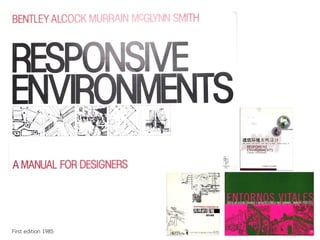
First edition 1985
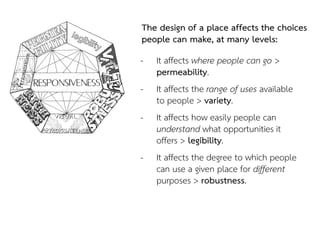
The design of a place affects the choices
people can make, at many levels:
- It affects where people can go >
permeability.
- It affects the range of uses available
to people > variety.
- It affects how easily people can
understand what opportunities it
offers > legibility.
- It affects the degree to which people
can use a given place for different
purposes > robustness.
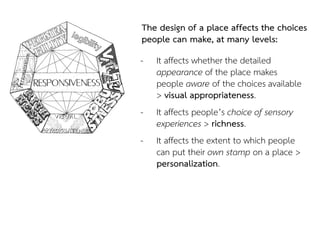
The design of a place affects the choices
people can make, at many levels:
- It affects whether the detailed
appearance of the place makes
people aware of the choices available
> visual appropriateness.
- It affects people’s choice of sensory
experiences > richness.
- It affects the extent to which people
can put their own stamp on a place >
personalization.
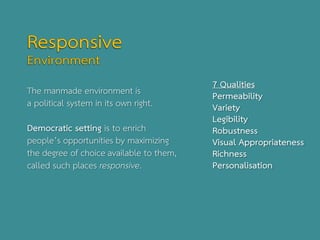
The manmade environment is
a political system in its own right.
Democratic setting is to enrich
people’s opportunities by maximizing
the degree of choice available to them,
called such places responsive.
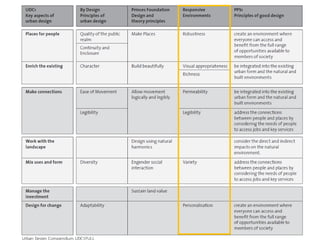
7 Qualities
Permeability
Variety
Legibility
Robustness
Visual Appropriateness
Richness
Personalisation
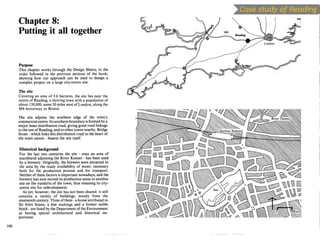
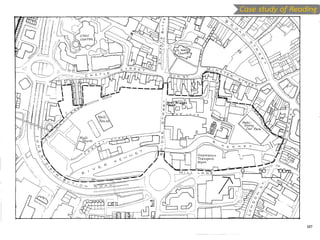
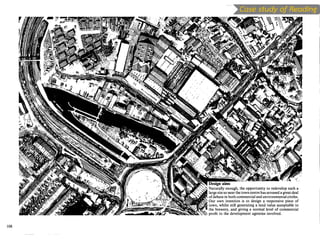
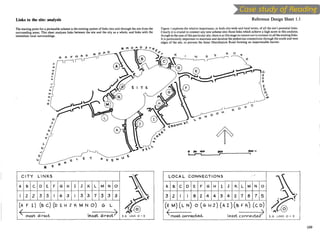
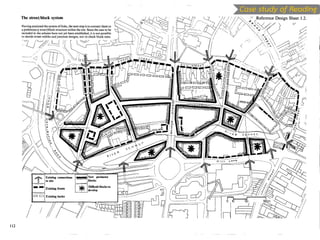
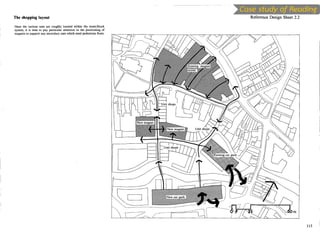
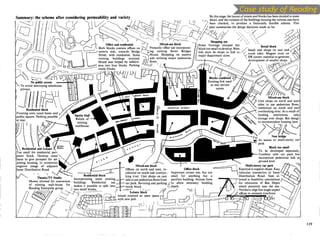
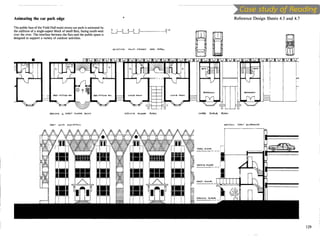
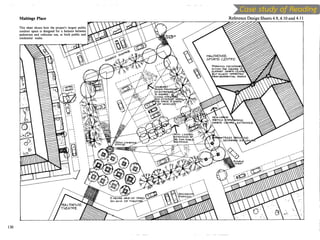
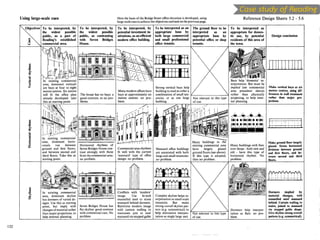
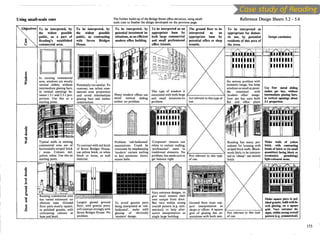
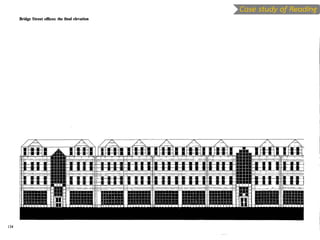
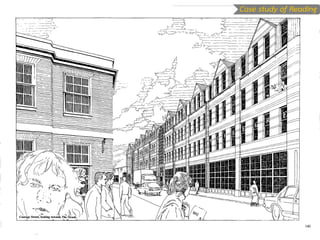
Case study of Reading
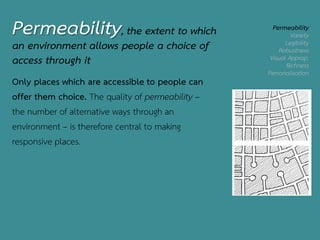
Permeability, the extent to which
an environment allows people a choice of
access through it
Permeability
Variety
Legibility
Robustness
Visual Approp.
Richness
Personalisation
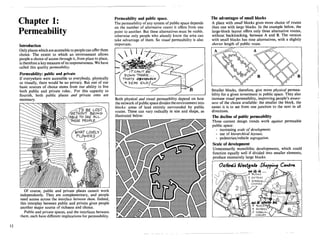
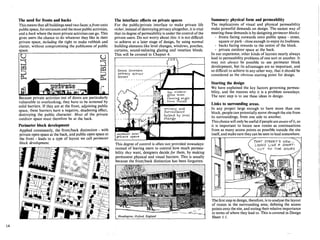
Only places which are accessible to people can
offer them choice. The quality of permeability –
the number of alternative ways through an
environment – is therefore central to making
responsive places.
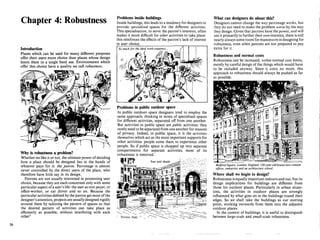
Permeability, the extent to which
an environment allows people a choice of
access through it
- Accessible places
- Small blocks
- Visual permeability
- Physical permeability
- Public-private interface
- Links to surrounding areas
- Etc.
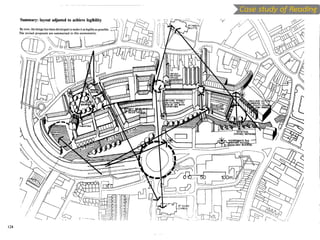
Case study of Reading
Permeability
Variety
Legibility
Robustness
Visual Approp.
Richness
Personalisation
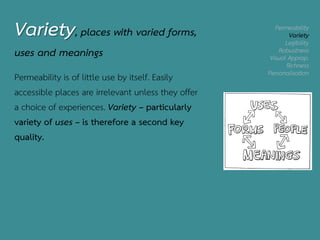
Variety, places with varied forms,
uses and meanings
Permeability is of little use by itself. Easily
accessible places are irrelevant unless they offer
a choice of experiences. Variety – particularly
variety of uses – is therefore a second key
quality.
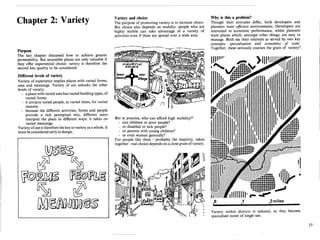
Variety and Choices
Variety and Choices
Variety and Choices
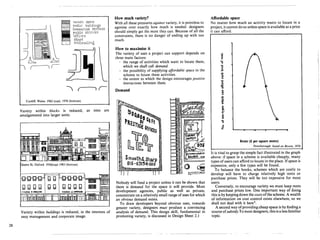
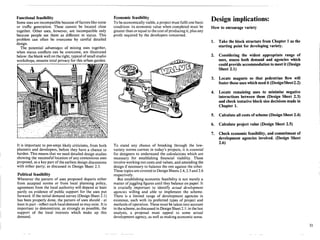
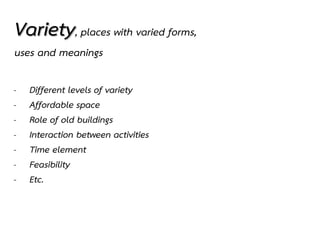
Variety, places with varied forms,
uses and meanings
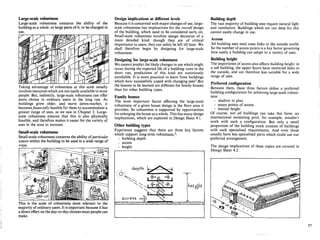
- Different levels of variety
- Affordable space
- Role of old buildings
- Interaction between activities
- Time element
- Feasibility
- Etc.
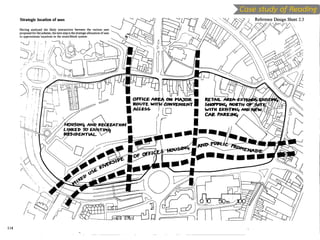
Case study of Reading
Permeability
Variety
Legibility
Robustness
Visual Approp.
Richness
Personalisation
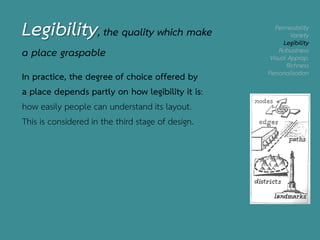
Legibility, the quality which make
a place graspable
In practice, the degree of choice offered by
a place depends partly on how legibility it is:
how easily people can understand its layout.
This is considered in the third stage of design.
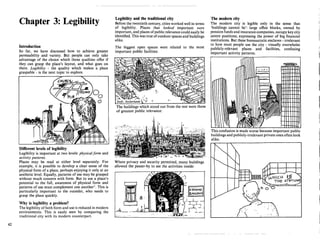
Legibility, the quality which make
a place graspable
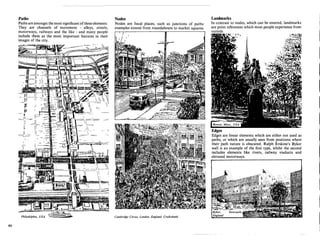
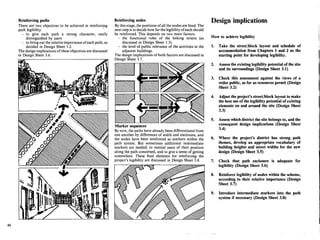
- Problems of modern city
- Legible layouts
- Physical elements (Path, Node, Edge, District, Landmark)
- Reinforcing paths
- Reinforcing nodes
- Etc.
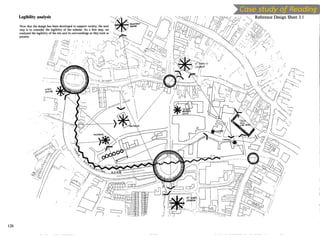
Case study of Reading
Permeability
Variety
Legibility
Robustness
Visual Approp.
Richness
Personalisation
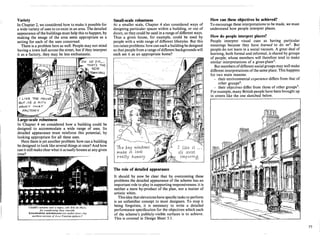
Robustness, places which can be used
for many different purposes
Places which can be used for many different
purposes offer their users more choice than
places whose design limits them to a single fixed
use. Environments which offer this choice have a
quality we call robustness.
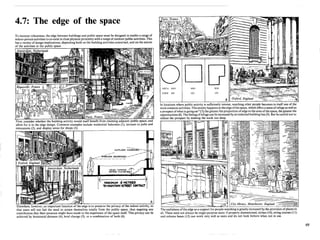
Robustness, places which can be used
for many different purposes
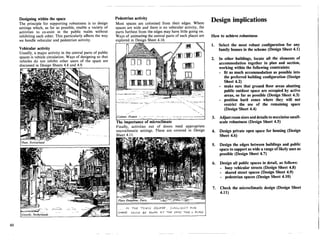
- Public outdoor space
- Large-scale robustness
- Small-scale robustness
- Active building fronts
- Pedestrian activity
- Microclimate
- Etc.
Case study of Reading
Permeability
Variety
Legibility
Robustness
Visual Appropriateness
Richness
Personalisation
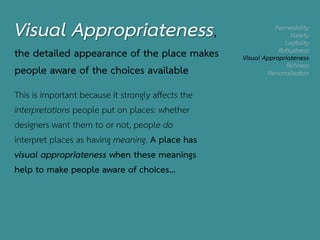
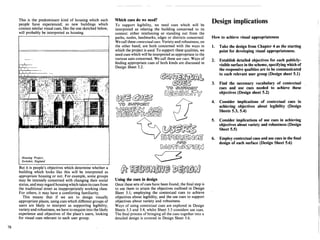
Visual Appropriateness,
the detailed appearance of the place makes
people aware of the choices available
This is important because it strongly affects the
interpretations people put on places: whether
designers want them to or not, people do
interpret places as having meaning. A place has
visual appropriateness when these meanings
help to make people aware of choices…
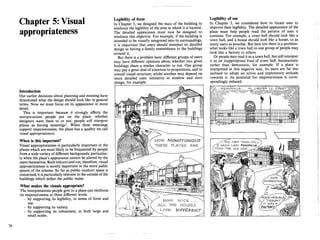
Visual Appropriateness,
the detailed appearance of the place makes
people aware of the choices available
- Legibility of Forms
- Legibility of Uses
- Role of detailed appearance
- Contextual cues and use cues
- Etc.
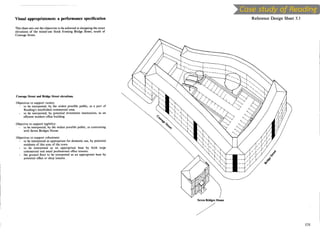
Case study of Reading
Permeability
Variety
Legibility
Robustness
Visual Appropriateness
Richness
Personalisation
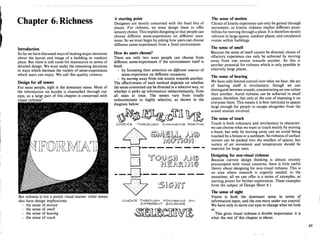
Richness, a variety of sense-experiences
which users can enjoy
The decisions about appearance already discussed still leave
room for manoeuvre at the most detailed level of design.
We must make the remaining decisions in ways which
increase the choice of sense-experiences which users
can enjoy. This further level of choice is called richness.
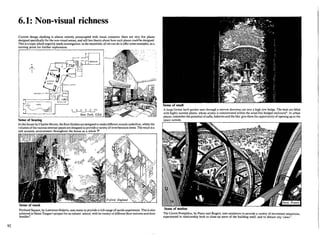
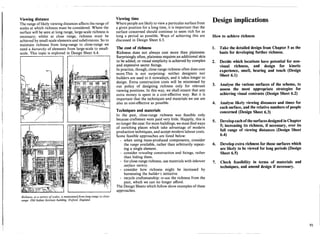
Richness, a variety of sense-experiences
which users can enjoy
- All senses
- Visual contrasts and distances
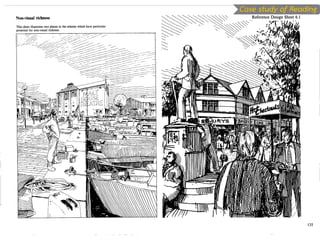
- Non visual richness (motion, smell, hearing, touch)
- Etc.
Case study of Reading
Permeability
Variety
Legibility
Robustness
Visual Appropriateness
Richness
Personalisation
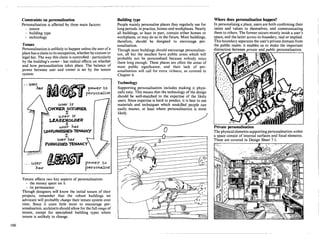
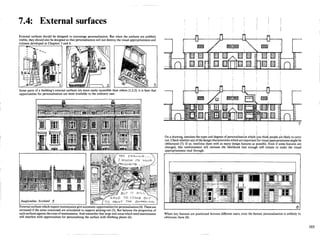
Personalisation, the stamp of
people’s own tastes and values
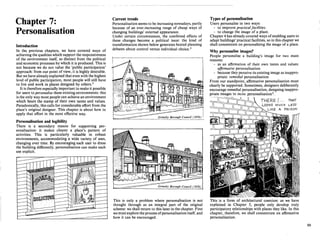
It is … especially important that we make it possible for
users to personalise places: this is the only way most
people can put their own stamp in their environment.
Personalisation, the stamp of
people’s own tastes and values
- Personalisation and legibility
- Public personalisation
- Public impact
- Etc.
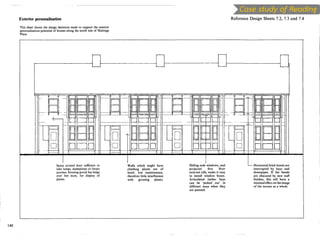
Case study of Reading
Urban Design Compendium UDC1FULL
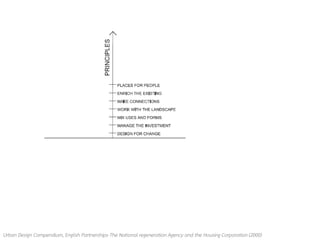
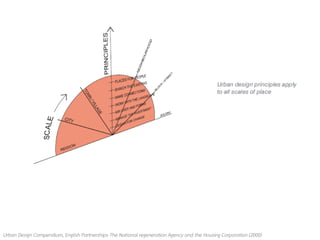
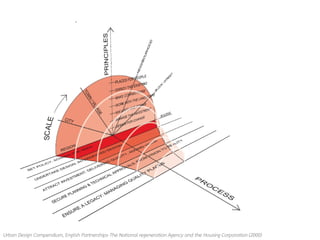
Urban Design Compendium, English Partnerships-The National regeneration Agency and the Housing Corporation (2000)

Responsive Environment - บททบทวนทฤษฏีสภาพแวดล้อมที่ตอบสนอง การออกแบบชุมชนเมือง การสร้างถิ่นที่ placemaking