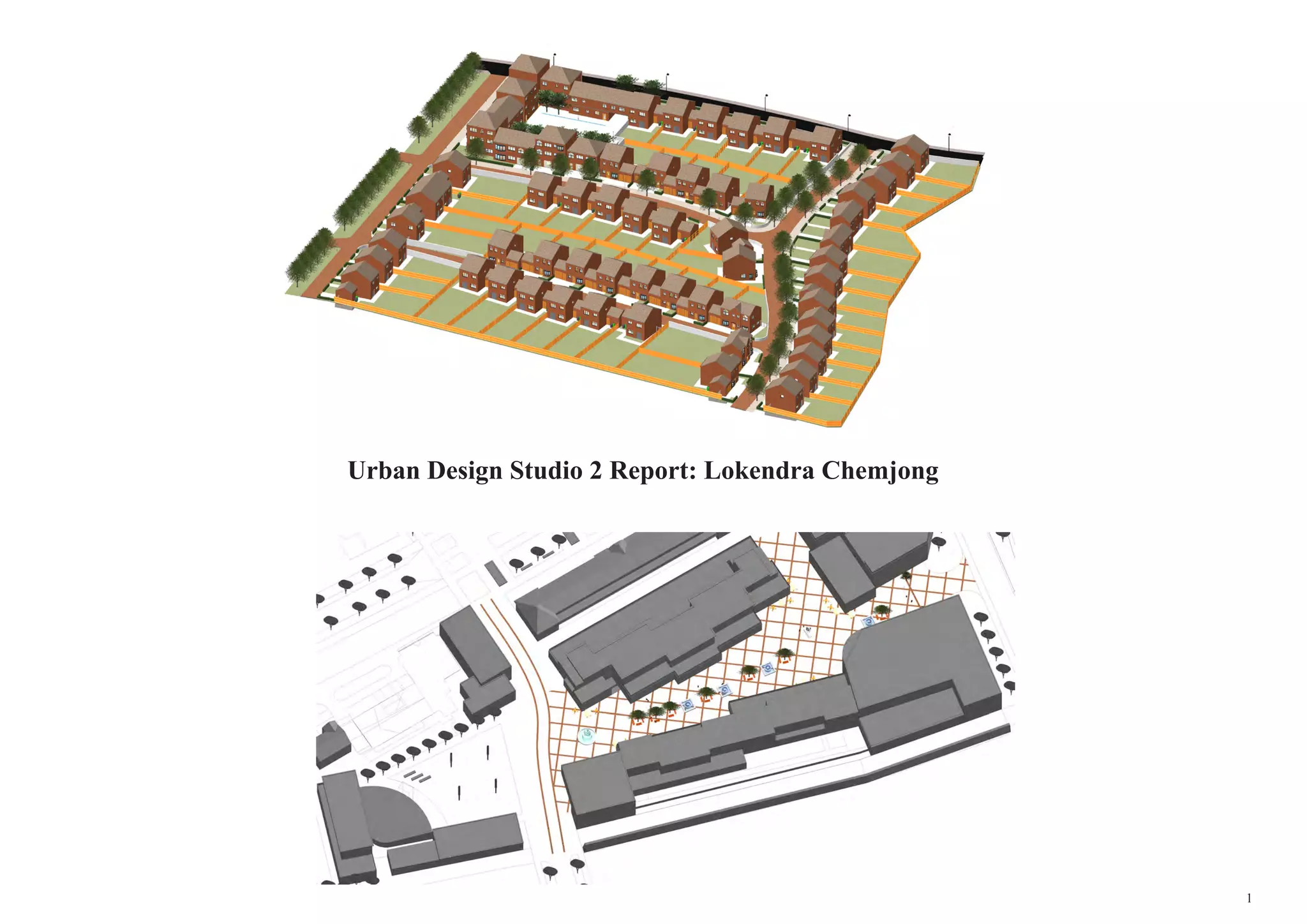
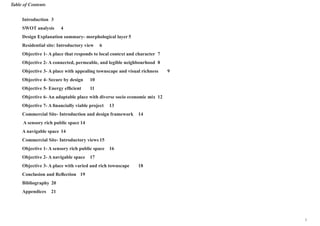
Urban Design Studio 2 Report: Lokendra Chemjong
1
Table of Contents
Introduction 	3
SWOT analysis	 4
Design Explanation summary- morphological layer	5
Residential site: Introductory view	 6
Objective 1- A place that responds to local context and character	 7
Objective 2- A connected, permeable, and legible neighbourhood	 8
Objective 3- A place with appealing townscape and visual richness	 9
Objective 4- Secure by design	 10
Objective 5- Energy efficient	 11
Objective 6- An adaptable place with diverse socio economic mix	 12
Objective 7- A financially viable project	 13
Commercial Site- Introduction and design framework	 14
A sensory rich public space	14
A navigable space	14
Commercial Site- Introductory views	15
Objective 1- A sensory rich public space	 16
Objective 2- A navigable space	 17
Objective 3- A place with varied and rich townscape	 18
Conclusion and Reflection	 19
Bibliography	20
Appendices	21
2
Introduction
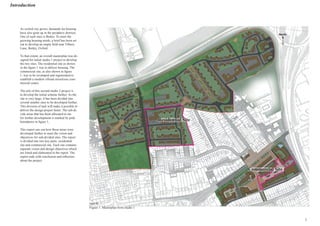
Residential Site
Commercial Site
Figure 1: Masterplan from studio 1
3
As oxford city grows, demands for housing
have also gone up in the periphery districts.
One of such sites is Botley. To meet the
growing housing needs, a brief has been set
out to develop an empty field near Tilbury
Lane, Botley, Oxford.
To that extent, an overall masterplan was de-
signed for initial studio 1 project to develop
the two sites. The residential site as shown
in the figure 1 was to deliver housing. The
commercial site, as also shown in figure
1, was to be revamped and regenerated to
establish a modern vibrant mixed-use com-
mercial centre.
The aim of this second studio 2 project is
to develop the initial scheme further. As the
site is very large, it has been divided into
several smaller sites to be developed further.
This division of task will make it possible to
deliver the design project faster. The sub-di-
vide areas that has been allocated to me
for further development is marked by pink
boundaries in figure 1,
This report sets out how those areas were
developed further to meet the vision and
objectives for sub-divided sites. The report
is divided into two key parts: residential
site and commercial site. Each site contains
separate vision and design objectives which
are listed and elaborated in the report. The
report ends with conclusion and reflection
about the project.
SWOT analysis
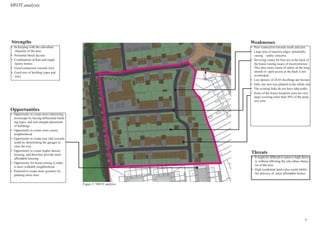
•	 Poor connection towards south and east
•	 Large area of inactive edges, potentially
raising safety concerns
•	 Servicing routes for bins are at the back of
the house raising issues of inconvenience.
This also raises issues of safety as the long
stretch of open access at the back is not
overlooked
•	 Low density of 28.85 dwellings per hectare
•	 Only one new tree planted in the whole site
•	 The existing links do not have side-walks
•	 Some of the house footprint sizes are very
large covering more than 50% of the prop-
erty area
•	 It might be difficult to achieve high densi-
ty without affecting the sub-urban charac-
ter of the area
•	 High residential land value could inhibit
the delivery of more affordable homes
•	 In-keeping with the sub-urban
character of the area
•	 Perimeter block layouts
•	 Combination of flats and single
family homes
•	 Good connection towards west
•	 Good mix of building types and
sizes
•	 Opportunity to create more interesting
townscape by having differential build-
ing types, and non-straight placement
of buildings
•	 Opportunity to create more secure
neighborhood
•	 Opportunity to create new link towards
south by demolishing the garages to
clear the way
•	 Opportunity to create higher density
housing, and therefore provide more
affordable housing
•	 Opportunity for home-zoning to make
it more walkable neighborhood
•	 Potential to create more greenery by
planting more trees
Strengths Weaknesses
Opportunities
Threats
North
Figure 2: SWOT analysis
4
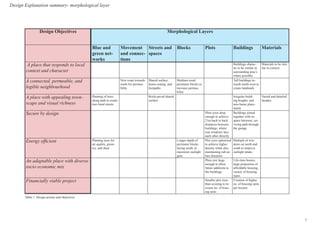
Design Explanation summary- morphological layer
Design Objectives Morphological Layers
Blue and
green net-
works
Movement
and connec-
tions
Streets and
spaces
Blocks Plots Buildings Materials
A place that responds to local
context and character
Buildings charac-
ter to be similar to
surrounding area’s
where possible
Materials to be sim-
ilar to context
A connected, permeable, and
legible neighbourhood
New route towards
south for permea-
bility
Shared surface,
home-zoning, and
footpaths
Medium-sized
perimeter blocks to
increase permea-
bility
Tall buildings to-
wards north-west to
create landmark
A place with appealing town-
scape and visual richness
Planting of trees
along path to create
tree-lined streets
Brick-paved shared
surface
Irregular build-
ing heights, and
non-linear place-
ments
Varied and detailed
facades
Secure by design Plots sizes deep
enough to achieve
21m back to back
distances between
buildings, where
rear windows face
each other directly
Buildings joined
together with no
space between; ser-
vicing path through
the garage
Energy efficient Planting trees for
air quality, green-
ery, and shed
Longer depth of
perimeter blocks
facing south, to
maximize sunlight
gain
Plot sizes optimized
to achieve higher
density while also
maintaining sub-ur-
ban character
Multiple of win-
dows on north and
south to improve
sunlight intake
An adaptable place with diverse
socio economic mix
Plots size large
enough to allow
future additions to
the buildings
Life-time homes,
large proportion of
affordable housing,
variety of housing
types
Financially viable project	 Smaller plot sizes
than existing to in-
crease no. of hous-
ing units
Creation of higher
no. of housing units
per hectare
Table 1: Design actions and objectives
5
Residential site: Introductory view
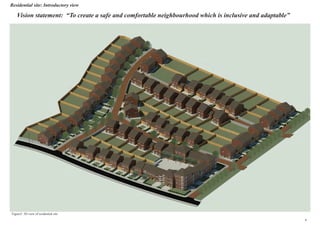
Vision statement: “To create a safe and comfortable neighbourhood which is inclusive and adaptable”
Figure3: 3D view of residential site
6
Objective 1- A place that responds to local context and character
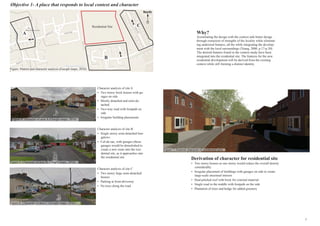
Character analysis of site A
•	 Two storey brick houses with ga-
rages on side
•	 Mostly detached and semi-de-
tached
•	 Two-way road with footpath on
side
•	 Irregular building placements
Character analysis of site B
•	 Single storey semi-detached bun-
galows
•	 Cul-de-sac, with garages (these
garages would be demolished to
create a new route into the resi-
dential site, as it approaches into
the residential site
Character analysis of site C
•	 Two storey large semi-detached
houses
•	 Parking at front-driveway
•	 No trees along the road
Derivation of character for residential site
•	 Two storey houses as one storey would reduce the overall density
considerably
•	 Irregular placement of buildings with garages on side to create
large-scale structural interest
•	 Dual-pitched roof with brick for external material
•	 Single road in the middle with footpath on the side
•	 Plantation of trees and hedge for added greenery
Figure 4: character of area A (Google maps, 2016)
Figure 5: Character of area B: Google maps, 2016)
Figure 6: Character of area C (Google maps, 2016)
Figure 7: General character of residential area
A
B
CResidential Site
North
Figure: Pattern and character analysis (Google maps, 2016)
Why?
Assimilating the design with the context aids better design
through extraction of strengths of the locality while eliminat-
ing undesired features, all the while integrating the develop-
ment with the local surroundings (Yeang, 2000, p.17-p.30).
The desired features found in the context-study have been
integrated into the residential site. The features for the new
residential development will be derived from the existing
context while still forming a distinct identity.
7
Objective 2- A connected, permeable, and legible neighbourhood
Why?
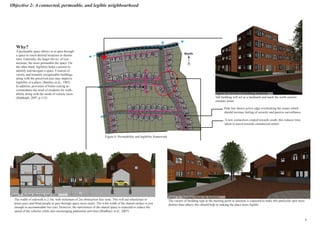
A permeable space allows us to pass through
a space to reach desired locations in shorter
time. Generally, the larger the no. of con-
nections, the more permeable the space. On
the other hand, legibility helps a person to
identify and navigate a space. Creation of
variety and instantly recognizable buildings
along with the perceived uses may improve
legibility of a place. (Bentley et al., 1985)
In addition, provision of home-zoning ac-
commodates the need of residents for walk-
ability along with the needs of vehicle users
(Biddulph, 2007, p.115). Tall building will act as a landmark and mark the north-eastern
entrance point.
The width of sidewalk is 2.5m, with minimum of 2m obstruction free zone. This will aid wheelchair or
pram users and blind people to pass through space more easily. The 4.8m width of the shared surface is just
enough to accommodate two cars. However, the narrowness of the shared space is expected to reduce the
speed of the vehicles while also encouraging pedestrian activities (Bradbury et al., 2007)
The variety of building type at the meeting point or junction is expected to make this particular spot more
distinct than others; this should help in making the place more legible.
A new connection created towards south; this reduces time
taken to travel towards commercial centre.
North
Figure 9: Section showing road width
Figure 10: 3d view of building landmark
Figure 11: Building variety for legibility
Figure 8: Permeability and legibility framework
Pink line shows active edge overlooking the routes which
should increase feeling of security and passive surveillance
8
Objective 3- A place with appealing townscape and visual richness
Why?
Visual richness and interest is borne not just out of
architectural detailing but also through the way large
structures or buildings are arranged over a space.
Gordon Cullen (1961) explores the concept of serial
vision which has been used as inspiration or guidance
to create interesting townscape and visual richness in
the residential site.
By creating a more exciting and rich environment, it is
hoped that the residential site will be more attractive
space to live in, which stimulates the mind and vision
of residents and the visitors alike while also helping to
create a distinct identity for the place.
The large windows will be visible from further away, the smaller windows
will be visible as one approaches nearer, all the while helping to create
richness on the front facade through the presence high number and variety
of windows or elements (Bentley et al, 1985).
Red Maple circa
9m tall
Hawthorn circa
7.4m tall
Green hedge circa
0.8m tall
Brick pavement for
shared surface
Rough granite
100mm squares for
sidewalk
Polished granite
250mm squares for
private surface
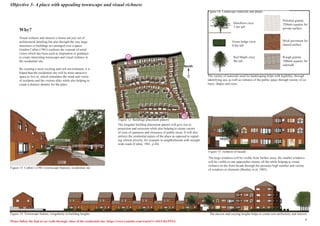
The variety of materials used for landscaping helps with legibility, through
identifying use, as well as richness of the public space through variety of co-
lours, shapes and sizes.
Please follow the link to see walk-through video of the residential site: https://www.youtube.com/watch?v=dTcU8erP5X4
Here
Deflection
Anticipation
Projection and recession
Intimacy
Figure 13: Cullen’s (1961) townscape features, residential site
The uneven and varying heights helps to create non-uniformity and interest.Figure 14: Townscape feature, irregularity in building heights
Figure 16: Landscape materials and plants
Figure 15: richness of facade
The irregular building placement pattern will give rise to
projection and recession while also helping to create variety
of sizes of openness and closeness of public street. It will also
enforce the residential nature of the place as opposed to signal-
ing vehicle priority, for example in neighborhoods with straight
wide roads (Cullen, 1961, p.44).
North
15
13
Figure 12: Buildings placement pattern
9
Objective 4- Secure by design
Wooden
fence
1.8m high
Brick
fence
1.8m high
Lockable
Metal gate
1.8m high
Brick
fence 1 m
high
Pedestrian
street light
3.5m high
Green
hedge
0.8m high
Street
light
7.5m
high
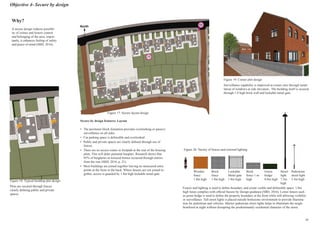
Fences and lighting is used to define boundary and create visible and defensible space. 1.8m
high fence complies with official Secure by Design guidance (SBD, 2016). Lower fences such
as green hedge is used to define the property boundary at the front while still allowing visibility
or surveillance. Tall street lights is placed outside homezone environment to provide illumina-
tion for pedestrian and vehicles. Shorter pedestrian street lights helps to illuminate the neigh-
bourhood at night without disrupting the predominantly residential character of the street.
Why?
A secure design reduces possibil-
ity of crimes and fosters control
and belonging of the area; impor-
tantly, it enhances feeling of safety
and peace of mind (SBD, 2016).
Surveillance capability is improved at corner sites through instal-
lation of windows at side elevation. The building itself is secured
through 1.8 high brick wall and lockable metal gate.
Secure by design features: Layout
•	 The perimeter block formation provides overlooking or passive
surveillance on all sides
•	 Car parking space is defensible and overlooked
•	 Public and private spaces are clearly defined through use of
fences.
•	 There are no access routes or footpath at the rear of the housing
plots. This will deter potential burglars. Research shows that
85% of burglaries at terraced homes occurred through entries
from the rear (SBD, 2016, p. 21).
•	 Most buildings are joined together leaving no unsecured entry
points at the front or the back. Where houses are not joined to-
gether, access is guarded by 1.8m high lockable metal gate.
Plots are secured through fences
clearly defining public and private
spaces.
Figure 17: Secure layout design
Figure 18: Typical building plot design
Figure 20: Variety of fences and external lighting
Figure 19: Corner plot design
19
18
North
10
Objective 5- Energy efficient
Sunlight and
air circulation
Insulation
of roof and
external
walls
Option to install solar
panels
Recycling
facility
Why?
In the context of global warming and EU-wide carbon reduction targets, new
development should adapt to play incremental role in energy and carbon reduc-
tion. The financial value of energy efficient design relates to savings in energy
bill. Equally, if not more importantly, the amenity value of energy efficient project
include being able to enjoy fresh air and sunlight inside the room and outside.
Figure 21: Building energy efficiency framework
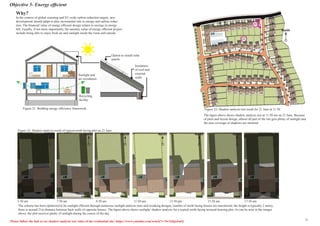
The scheme has been optimized to be sunlight efficient through numerous sunlight analysis tests and tweaking designs; number of north facing houses are maximized; the height is typically 2 storey,
there is around 21m distance between back walls of opposite houses. The figure above shows sunlight/ shadow analysis for a typical north facing terraced housing plot. As can be seen in the images
above, the plot receives plenty of sunlight during the course of the day.
5:50 am 7:50 am 9:50 am 11:50 am 13:50 pm 15:50 am 17:50 am
North North North North North North North
Figure 22: Shadow analysis result of typical north facing plot on 21 June
The figure above shows shadow analysis test at 11:50 am on 21 June. Because
of plots and layout design, almost all part of the site gets plenty of sunlight and
the area coverage of shadows are minimal.
Figure 23: Shadow analysis test result for 21 June at 11:50
North
22
21
Please follow the link to see shadow analysis test video of the residential site: https://www.youtube.com/watch?v=5wXi6joJsnQ 11
Objective 6- An adaptable place with diverse socio economic mix
Why?
The residential development hopes to provide inclusive and adaptable neighbour-
hood which meets the needs of people from diverse socio-economic and age back-
ground. In practical terms, this means providing affordable units, adaptable homes
that is comfortable and suit all ages and meets diverse needs.
The need to provide affordable and adaptable units couldn’t be more pronounced.
The median age of UK population has grown from 34 in 1974 A.D. to 40 in 2014
A.D. The proportion of people 65 or older is predicted to continue to rise as a share
of the total population (ONS, 2016). Similarly, the average cost of a house in vale
of white horse was £349,849 in 2015 (Provisor, 2016). The figure 24 below illus-
trates the rising gap between median income and mortgage requirements. Besides
the financial cost, if affordablity and adaptability are not managed, it could give rise
further social issues and larger stock of unaffordable and unfit homes.
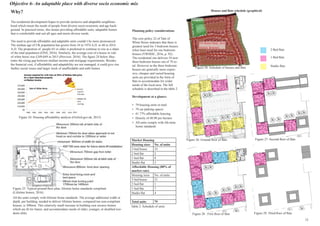
Planning policy considerations
The core policy 22 of Vale of
White Horse indicates that there is
greatest need for 3 bedroom houses
whist least need for one bedroom
houses (VWHDC, 2016, p. 92).
The residential site delivers 54 new
three bedroom houses out of 79 to-
tal. However as the three bedroom
houses are generally more expen-
sive, cheaper and varied housing
units are provided in the form of
flats to accommodate for wider
needs of the local area. The full
schedule is described in the table 2.
Development at a glance:
•	 79 housing units in total
•	 79 car parking spaces
•	 41.77% affordable housing
•	 Density of 40.98 per hectare
•	 All units comply with life-time
home standards
Market Housing
Housing sizes No. of units
3 bed house 33
2 bed flat 2
1 bed flat 8
Studio flat 3
Affordable Housing (80% of
market rate)
Housing sizes No. of units
3 bed house 21
2 bed flat 1
1 bed flat 7
Studio flat 4
Total units 79
All the units comply with lifetime home standards. The average additional width or
depth, per building, needed to deliver lifetime homes, compared ton non-compliant
houses, is 300mm. This relatively small increase in building cost secures homes
which are fit for future, and accommodates needs of older, younger, or disabled resi-
dents alike.
Figure 25: Typical ground floor plan, lifetime home standards compliant
(Lifetime homes, 2016)
Figure 26: Ground floor of flats
Figure 28 : First floor of flats
Figure 27: Second floor of flats
Figure 29: Third floor of flats
Houses and flats schedule (graphical)
2 Bed flats
1 Bed flats
Studio flats
Table 2: Schedule of units
Figure 24: Housing affordablity analysis (Oxford.gov.uk, 2015)
54 three-bed, two
storey houses
25 Flats
Figure 30: Schedule of houses and flats
12
Why?
Developer needs to take financial risk in-order to fund
and build the project. From a developer’s point of view,
the potential profit margin should reflect the risks in-
volved. If the profit margin is too low, the development
may not attract investors which would mean that the
project may not be built.
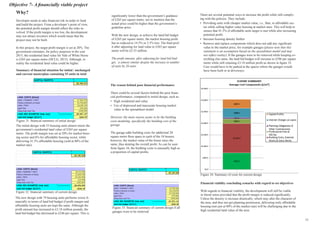
In this project, the target profit margin is set at 20%. The
government estimates, for policy purposes in the year
2015, the residential land value for Vale of White Horse
is £265 per square metre (DCLG, 2015). Although, in
reality the residential land value could be higher.
Summary of financial situation for initial / unchanged
and current masterplan containing 53 units in total
The initial design with 53 housing units almost meets the
government’s residential land value of £265 per square
metre. The profit margin was set at 20% for market hous-
ing sector and 6% for affordable housing sector, while
delivering 41.5% affordable housing (sold at 80% of the
market rate).
Financial viability concluding remarks with regard to set objectives
With regards to financial viability, the development will still be viable
in literal sense provided that the profit margin is reduced significantly.
Unless the density is increase drastically, which may alter the character of
the area, and thus not get planning permission, delivering truly affordable
housing (not just at 80% of the market rate) will be challenging due to the
high residential land value of the area.
The reason behind poor financial performance
There could be several factors behind the poor finan-
cial performance, compared to initial design, such as:
•	 High residential and value
•	 Use of depressed and inaccurate housing market
value in the spreadsheet model
However, the main reason seems to be the building
costs modeling, specifically the building cost of the
garage.
The garage adds building costs for additional 20
square metre floor space to each of the 54 houses;
however, the market value of the house stays the
same, thus denting the overall profit. As can be seen
from figure 34, the building costs is unusually high as
a proportion of capital profits.
There are several potential ways to increase the profit while still comply-
ing with the policies. They include:
•	 Providing units with cheaper market value, i.e., flats, to affordable sec-
tor while selling higher value housing at market rates. This will help to
ensure that 41.5% of affordable units target is met while also increasing
potential profit.
•	 Increase housing density further
•	 Remove and replace components which does not add any significant
value to the market price, for example garages (please note that this
statement is an assumption based on the spreadsheet model and may
not reflect reality). If the garages were to be removed while keeping ev-
erything else same, the land bid budget will increase to £296 per square
metre while still retaining £3.18 million profit as shown in figure 33.
Cars would have to be parked at the spaces where the garages would
have been built or at driveways.
The new design with 79 housing units performs worse fi-
nancially in terms of land bid budget if profit margin and
affordable housing units are kept the same. Although the
profit amount has increased to £3.18 million pounds, the
land bid budget has decreased to £246 per square. This is
significantly lower than the government’s guidance
of £265 per square metre; not to mention that the
actual price could be higher than the government’s
guideline price.
With the new design, to achieve the land bid budget
of £265 per square metre, the market housing profit
has to reduced to 14.5% or 5.5% less. The final prof-
it after adjusting for land value to £265 per square
metre will be £2.53 million.
The profit amount, after adjusting for land bid bud-
get, is almost similar despite the increase in number
of units by 26 units.
Objective 7- A financially viable project
Figure 31: financial summary of initial design
Figure 32: financial summary of current design
Figure 33: financial summary of current design if all
garages were to be removed
Figure 34: Summary of costs for current design
13
Commercial Site- Introduction and design framework
The existing commercial centre located at Botley, Oxford, though loved,
has started to age. Therefore, Vale of White Horse district council wants to
redevelop the site to provide new hight quality housing, jobs, and commer-
cial spaces. Some of those issues were addressed in urban design studio 1
project. The brief for urban design studio 2 project is to design the public
space element of the site.
This section of the report discusses the vision and objectives of the site and
how will they be achieved.
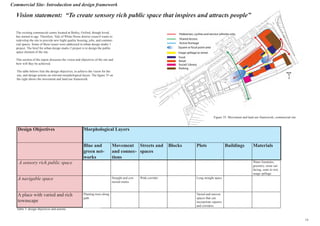
Vision statement: “To create sensory rich public space that inspires and attracts people”
The table belows lists the design objectives, to achieve the vision for the
site, and design actions on relevant morphological layers. The figure 35 on
the right shows the movement and land use framework.
Figure 35: Movement and land use framework, commercial site
Design Objectives Morphological Layers
Blue and
green net-
works
Movement
and connec-
tions
Streets and
spaces
Blocks Plots Buildings Materials
A sensory rich public space Water fountains,
greenery, stone sur-
facing, seats to rest,
usage spillage
A navigable space Straight and con-
nected routes
Wide corridor Long straight space
A place with varied and rich
townscape
Planting trees along
path
Varied and uneven
spaces that can
incorporate squares
and corridors
Table 3: design objectives and actions
14
Commercial Site- Introductory views
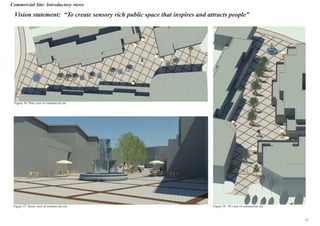
Vision statement: “To create sensory rich public space that inspires and attracts people”
Figure 36: Plan view of commercial site
Figure 37: Street view of commercial site Figure 38: 3D view of commercial site
15
Objective 1- A sensory rich public space
Please follow the link to see shadow analysis test video of the commercial site: https://www.youtube.com/watch?v=nt1c1Zf6fxU
Why?
We make sense of our surroundings through our senses. Wonderful places helps
create memory and encourage us to visit again. The way to deliver those wonder-
ful experiences is to provide a rich sensory experience (Gibson, 1966).
The public space at commercial centre should be able to attract and retain visitors.
Delivering rich and positive sensory experience can be a way to meet those aims,
and bring the commercial centre to life through experiences such as music, green-
ery, conversations and interactions, visual attractiveness etc.
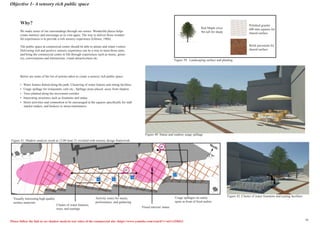
Below are some of the list of actions taken to create a sensory rich public space:
•	 Water feature dotted along the path; Clustering of water feature and sitting facilities
•	 Usage spillage for restaurants, cafe etc.; Spillage areas placed away from shadow
•	 Trees planted along the movement corridor
•	 Interesting structures such as fountains and statue
•	 Street activities and commotion to be encouraged at the squares specifically for stall
market traders, and buskers or street entertainers
Cluster of water features,
trees, and seatings
Visual interest/ statue
Activity zones for music,
performance, and gathering
Visually interesting high quality
surface materials
Usage spillages on sunny
spots in front of food outlets
North
Figure 41: Shadow analysis result at 12:00 June 21 overlaid with sensory design framework
Red Maple circa
9m tall for shade
Brick pavement for
shared surface
Polished granite
600 mm squares for
shared surface
Figure 39: Landscaping surface and planting
Figure 40: Statue and outdoor usage spillage
Figure 42: Cluster of water fountains and seating facilities
40
42
16
Objective 2- A navigable space
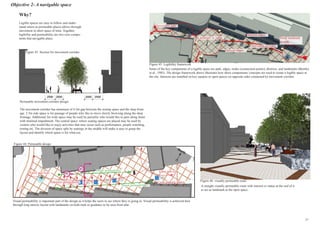
Permeable movement corridor design:
The movement corridor has minimum of 4.5m gap between the resting space and the shop front-
age. 2.5m side space is for passage of people who like to move slowly browsing along the shop
frontage. Additional 2m wide space may be used by passerby who would like to pass along faster
with minimal impediment. The central space, where seating spaces are placed may be used by
visitors who would like to enjoy activities that may occur such as performance, people watching,
resting etc. The division of space split by seatings in the middle will make it easy to grasp the
layout and identify which space is for what use.
North
Figure 44: Permeable design
43
Visual permeability
Visual permeability
Sideways permeability
Entry and exitsEntry and exits
Cycle parking spaces
Visual permeability is important part of the design as it helps the users to see where they re going to. Visual permeability is achieved here
through long narrow layout with landmarks on both ends as guidance to be seen from afar.
17
Why?
Legible spaces are easy to follow and under-
stand where as permeable places allows through
movement in short space of time. Together,
legibility and permeability are two core compo-
nents that navigable place.
Some of the key components of a legible space are path, edges, nodes (connection points), districts, and landmarks (Bentley
et al., 1985). The design framework above illustrates how these components/ concepts are used to create a legible space at
the site. Interests are installed on key squares or open spaces on opposite sides connected by movement corridor.
Figure 45: Legibility framework
Small landmark
at node
Landmark or statue
Secondary gate
Movement corridor
Defined edges
Defined edges
Figure 43: Section for movement corridor
A straight visually permeable route with interest or statue at the end of it
to act as landmark at the open space.
Figure 46: visually permeable route
46
Objective 3- A place with varied and rich townscape
Please follow the link to see the walk through video of the commercial site: https://www.youtube.com/watch?v=4A6Qd7g60M8 18
Why?
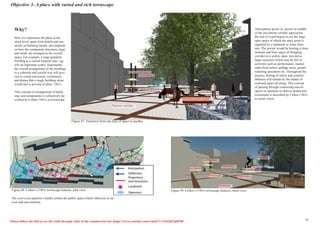
How we experience the place at the
street level, apart from details and ma-
terials on building facade, also depends
on how the component structures, large
and small, are arranged in the overall
space. For example, a large grandeur
building at a central location may sig-
nify an important centre. Importantly,
the overall arrangement of the buildings
in a coherent and careful way will give
rise to visual enjoyment, excitement,
and drama that a single building alone
would fail to provide (Cullen, 1961).
This concept of arrangement of build-
ings and components is collectively de-
scribed by Cullen (1961) as townscape.
Anticipation grows as person in middle
of the movement corridor approaches
the end of it and begins to see the large
open space of which the entry point is
signified by a landmark or water foun-
tain. The person would be leaving a close
intimate and busy space of shopping
corridor to a widely open, less dense,
large enclosure which may be full of
activities such as performance, market
stalls,food outlets spillage areas, people
watching spectators etc. Throughout the
journey, feeling of safety and comfort-
ableness will remain by the means of
enclosed space all along. This concept
of passing through connecting narrow
spaces to openness to deliver drama and
excitement is described by Cullen (1961)
as serial vision.
Narrow corridor
Large open space
Intimate public space
Outdoor activities
Anticipation
Figure 48: Cullen’s (1961) townscape features, plan view
Figure 47: Transition from one type of space to another
Figure 49: Cullen’s (1961) townscape features, street view
The criss-cross patterns visually unifies the public space which otherwise in un-
even and non-uniform.
47
Conclusion and Reflection
19
Residential Site
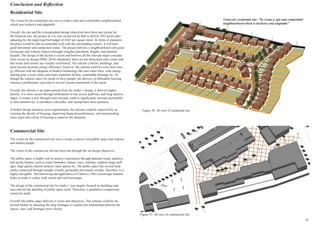
The vision for the residential site was to create a safe and comfortable neighbourhood
which was inclusive and adaptable.
Overall, the aim and the correspondent design objectives have been met except for
the financial aim, the project as it is now would not be able to deliver 20% profit after
adjusting for the target land bid budget of £265 per square metre. In terms of character,
the place would be able to assimilate well with the surrounding context. It will have
good movement and connection routes. The project delivers a neighbourhood with good
townscape and richness features through irregular placement, heights, and detailed
facades. The design of the layout is secure and borrows all the relevant major concepts
from secure by design (SBD, 2016) standards); there are not unsecured entry routes and
the streets and corners are visually overlooked. The scheme’s blocks, buildings, and
plots layouts promote energy efficiency; however, the scheme could be even more ener-
gy efficient with the adoption of modern technology like rain water filter, solar energy
sharing grid, a local refuse and water treatment facility, sustainable drainage etc. Al-
though the scheme caters for needs of diver people, the delivery of affordable housing
remains a problematic issue due to several reasons mentioned in the report.
Overall, the scheme is an improvement from the studio 1 design; it delivers higher
density; it is more secure through elimination of rear access pathways and long inactive
edges; it creates a new through route towards south to significantly increase permeabili-
ty and connectivity; it introduces sidewalks, and incorporates more greenery.
If further design iterations were implemented, the scheme could be improved by in-
creasing the density of housing, improving financial performance, and incorporating
more types and colour of housing to improve the character.
Commercial Site
The vision for the commercial site was to create a sensory rich public space that inspires
and attracts people.
The vision of the commercial site has been met through the set design objectives.
The public space is highly rich in sensory experiences through planned visual, auditory,
and tactile features such as water fountains, statues, trees, seatings, outdoor usage spill-
ages, high quality shared surfaces, open spaces etc. The public space has several land-
marks connected through straight visually permeable movement corridor; therefore, it is
highly navigable. The borrowing and application of Cullen’s (1961) townscape features
helps to make it a place with varied and rich townscape.
The design of the commercial site for studio 1 was largely focused on buildings and
uses and not the detailing of public space itself. Therefore, a qualitative comparisons
cannot be made.
Overall, the public space delivers it vision and objectives. This scheme could be im-
proved further by detailing the shop frontages to explore the relationship between the
spaces, uses, and frontages more closely.
Vision for residential site: “To create a safe and comfortable
neighbourhood which is inclusive and adaptable”
Figure 50: 3d view of residential site
Figure 51: 3d view of commercial site
Bibliography
Bentley, I, Alcock, A, Murrain, P, McGlynn, S, Smith G (1985). Responsive environments. A manual for designers: Architectural Press, London. Available at http://www.amazon.co.uk/Responsive-Environments-Sue-Mc-
Glynn-ebook (Downloaded: 04 May 2016).
Biddulph, M. (2007). Introduction to residential layout. Routledge.
Bradbury, A., Cameron, A., Castell, B., Jones, P., Pharoah, T., Reid, S. and Young, A., (2007). Manual For Streets. UK: Thomas Telford Ltd./DfT. Carmona, M. (2010). Public places, urban spaces: the dimensions of urban
design. Routledge.
Cullen, G. (1961). The concise townscape. Routledge.
DCLG, 2015. Land value estimates for policy appraisal. London: Department for Communities and Local Government (DCLG), p.11. Available at: https://www.gov.uk/government/uploads/system/uploads/attachment_data/
file/407155/February_2015_Land_value_publication_FINAL.pdf (Accessed 01/05/16).
DETR, (2000). By Design. London: (Department of the Environment, Transport and the Regions), p.28.
Gehl, J. (2013). Cities for people. Island press.
Gehl, J. (2011). Life between buildings: using public space. Island Press.
Gibson, J. J. (1966). The senses considered as perceptual systems.
Google maps, (2016). Botley. [image] Available at: https://www.google.co.uk/maps/place/Botley,+Oxford/@51.7529301,-1.3032589,16.39z/data=!4m5!3m4!1s0x4876c661870d65c9:0x9bc2f53e680dee6c!8m2!3d51.750186
!4d-1.301084 (Accessed 04/05/16).
Jacobs, J. (1961). The death and life of great American cities. Vintage.
Lifetime Homes (2016) Lifetime Homes. [Online] Available at: http://www.lifetimehomes.org.uk/index.php (accessed 04/ 05/ 16).
Lucas, R., & Romice, O. (2008). Representing sensory experience in urban design. Design Principles and Practices: An International Journal, 2(4), 83-94.
Malnar, J. M. (2004). Sensory design. University of Minnesota Press.
Nasar, J. L. (1990). The evaluative image of the city. Journal of the American Planning Association, 56(1), 41-53.
Office for National Statistics (ONS) (2016) [ARCHIVED CONTENT] Ageing of the UK population - ONS. [Online] Available at: http://webarchive.nationalarchives.gov.uk/20160105160709/http://www.ons.gov.uk/ons/rel/
pop-estimate/population-estimates-for-uk--england-and-wales--scotland-and-northern-ireland/mid-2014/sty-ageing-of-the-uk-population.html (accessed 03/ 05/ 16).
Oxford.gov.uk (2015) Key facts about Vale of White Horse discrict. [Online] Available at: http://www.oxford.gov.uk/districtdata/download/downloads/id/130/vale_of_white_horse_key_facts_2015.pdf (accessed 05/ 05/ 16).
Proviser (2016) Vale of White Horse Average House Prices in 2015. [Online] Available at: http://www.proviser.com/regional/la_ua/vale_of_white_horse/house_price_explorer/average/2015 (accessed 06/ 05/ 16).
SBD (2016) Secure by Design Homes (1st edition). London: Secure by Design Available at: http://www.securedbydesign.com/wp-content/uploads/2016/03/Secured_by_Design_Homes_2016_V1.pdf (accessed 04/ 05/ 16).
Sheridan, T., & Van Lengen, K. (2003). Hearing architecture: Exploring and designing the aural environment. Journal of Architectural Education, 57(2), 37-44.
Vale of White Horse District Council (VWHDC), (2014). Vale Local Plan 2031. Wallingford.
Yeang, L. D. (2000). Urban design compendium. English Partnerships/Housing Corporation, London. Available at http://cfg.homesandcommunities.co.uk/urban-design-compendium?page_id=5542&page=202 (Downloaded
05/05/2015).
20
Appendices
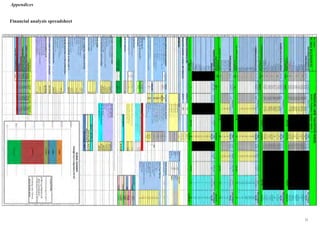
Financial analysis spreadsheet
21
SCALE ( @A2 )
CHECKED BYDRAWN BY DATE
PROJECT
TITLE
PROJECT NUMBER
DRAWING NUMBER
CLIENT
REV
1 : 500
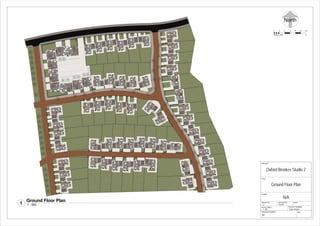
Ground Floor Plan
Oxford Brookes Studio 2
N/A
LC Checker
A2
Project Number
1 : 500
Ground Floor Plan
1
North
0
SCALE 1:
2520151055
m500
SCALE ( @A2 )
CHECKED BYDRAWN BY DATE
PROJECT
TITLE
PROJECT NUMBER
DRAWING NUMBER
CLIENT
REV
1 : 500
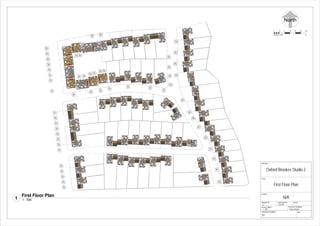
First Floor Plan
Oxford Brookes Studio 2
N/A
LC Checker
A3
Project Number
1 : 500
First Floor Plan
1
North
0
SCALE 1:
2520151055
m500
SCALE ( @A2 )
CHECKED BYDRAWN BY DATE
PROJECT
TITLE
PROJECT NUMBER
DRAWING NUMBER
CLIENT
REV
1 : 500
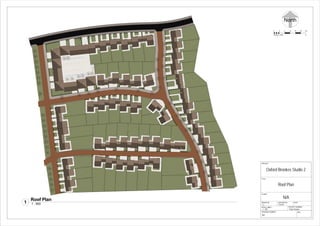
Roof Plan
Oxford Brookes Studio 2
N/A
LC Checker
A4
Project Number
1 : 500
Roof Plan
1
North
0
SCALE 1:
2520151055
m500
SCALE ( @A2 )
CHECKED BYDRAWN BY DATE
PROJECT
TITLE
PROJECT NUMBER
DRAWING NUMBER
CLIENT
REV
1 : 200
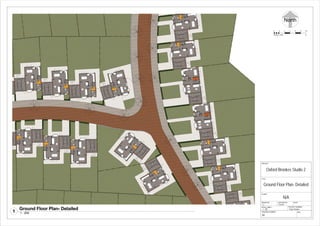
Ground Floor Plan- Detailed
Oxford Brookes Studio 2
N/A
LC Checker
A6
Project Number
1 : 200
Ground Floor Plan- Detailed
1
North
0
SCALE 1:
1086422
m200
SCALE ( @A2 )
CHECKED BYDRAWN BY DATE
PROJECT
TITLE
PROJECT NUMBER
DRAWING NUMBER
CLIENT
REV
1 : 500
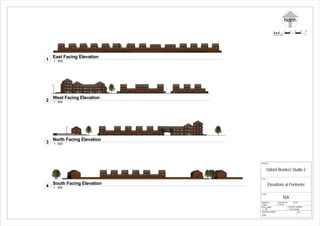
Elevations at Perimeter
Oxford Brookes Studio 2
N/A
Author Checker
A10
Project Number
1 : 500
East Facing Elevation
1
1 : 500
West Facing Elevation
2
1 : 500
North Facing Elevation
3
1 : 500
South Facing Elevation
4
North
0
SCALE 1:
2520151055
m500

OB_Studio2_Urban Design1

  • 1.
    Urban Design Studio2 Report: Lokendra Chemjong 1
  • 2.
    Table of Contents Introduction 3 SWOT analysis 4 Design Explanation summary- morphological layer 5 Residential site: Introductory view 6 Objective 1- A place that responds to local context and character 7 Objective 2- A connected, permeable, and legible neighbourhood 8 Objective 3- A place with appealing townscape and visual richness 9 Objective 4- Secure by design 10 Objective 5- Energy efficient 11 Objective 6- An adaptable place with diverse socio economic mix 12 Objective 7- A financially viable project 13 Commercial Site- Introduction and design framework 14 A sensory rich public space 14 A navigable space 14 Commercial Site- Introductory views 15 Objective 1- A sensory rich public space 16 Objective 2- A navigable space 17 Objective 3- A place with varied and rich townscape 18 Conclusion and Reflection 19 Bibliography 20 Appendices 21 2
  • 3.
    Introduction Residential Site Commercial Site Figure1: Masterplan from studio 1 3 As oxford city grows, demands for housing have also gone up in the periphery districts. One of such sites is Botley. To meet the growing housing needs, a brief has been set out to develop an empty field near Tilbury Lane, Botley, Oxford. To that extent, an overall masterplan was de- signed for initial studio 1 project to develop the two sites. The residential site as shown in the figure 1 was to deliver housing. The commercial site, as also shown in figure 1, was to be revamped and regenerated to establish a modern vibrant mixed-use com- mercial centre. The aim of this second studio 2 project is to develop the initial scheme further. As the site is very large, it has been divided into several smaller sites to be developed further. This division of task will make it possible to deliver the design project faster. The sub-di- vide areas that has been allocated to me for further development is marked by pink boundaries in figure 1, This report sets out how those areas were developed further to meet the vision and objectives for sub-divided sites. The report is divided into two key parts: residential site and commercial site. Each site contains separate vision and design objectives which are listed and elaborated in the report. The report ends with conclusion and reflection about the project.
  • 4.
    SWOT analysis • Poorconnection towards south and east • Large area of inactive edges, potentially raising safety concerns • Servicing routes for bins are at the back of the house raising issues of inconvenience. This also raises issues of safety as the long stretch of open access at the back is not overlooked • Low density of 28.85 dwellings per hectare • Only one new tree planted in the whole site • The existing links do not have side-walks • Some of the house footprint sizes are very large covering more than 50% of the prop- erty area • It might be difficult to achieve high densi- ty without affecting the sub-urban charac- ter of the area • High residential land value could inhibit the delivery of more affordable homes • In-keeping with the sub-urban character of the area • Perimeter block layouts • Combination of flats and single family homes • Good connection towards west • Good mix of building types and sizes • Opportunity to create more interesting townscape by having differential build- ing types, and non-straight placement of buildings • Opportunity to create more secure neighborhood • Opportunity to create new link towards south by demolishing the garages to clear the way • Opportunity to create higher density housing, and therefore provide more affordable housing • Opportunity for home-zoning to make it more walkable neighborhood • Potential to create more greenery by planting more trees Strengths Weaknesses Opportunities Threats North Figure 2: SWOT analysis 4
  • 5.
    Design Explanation summary-morphological layer Design Objectives Morphological Layers Blue and green net- works Movement and connec- tions Streets and spaces Blocks Plots Buildings Materials A place that responds to local context and character Buildings charac- ter to be similar to surrounding area’s where possible Materials to be sim- ilar to context A connected, permeable, and legible neighbourhood New route towards south for permea- bility Shared surface, home-zoning, and footpaths Medium-sized perimeter blocks to increase permea- bility Tall buildings to- wards north-west to create landmark A place with appealing town- scape and visual richness Planting of trees along path to create tree-lined streets Brick-paved shared surface Irregular build- ing heights, and non-linear place- ments Varied and detailed facades Secure by design Plots sizes deep enough to achieve 21m back to back distances between buildings, where rear windows face each other directly Buildings joined together with no space between; ser- vicing path through the garage Energy efficient Planting trees for air quality, green- ery, and shed Longer depth of perimeter blocks facing south, to maximize sunlight gain Plot sizes optimized to achieve higher density while also maintaining sub-ur- ban character Multiple of win- dows on north and south to improve sunlight intake An adaptable place with diverse socio economic mix Plots size large enough to allow future additions to the buildings Life-time homes, large proportion of affordable housing, variety of housing types Financially viable project Smaller plot sizes than existing to in- crease no. of hous- ing units Creation of higher no. of housing units per hectare Table 1: Design actions and objectives 5
  • 6.
    Residential site: Introductoryview Vision statement: “To create a safe and comfortable neighbourhood which is inclusive and adaptable” Figure3: 3D view of residential site 6
  • 7.
    Objective 1- Aplace that responds to local context and character Character analysis of site A • Two storey brick houses with ga- rages on side • Mostly detached and semi-de- tached • Two-way road with footpath on side • Irregular building placements Character analysis of site B • Single storey semi-detached bun- galows • Cul-de-sac, with garages (these garages would be demolished to create a new route into the resi- dential site, as it approaches into the residential site Character analysis of site C • Two storey large semi-detached houses • Parking at front-driveway • No trees along the road Derivation of character for residential site • Two storey houses as one storey would reduce the overall density considerably • Irregular placement of buildings with garages on side to create large-scale structural interest • Dual-pitched roof with brick for external material • Single road in the middle with footpath on the side • Plantation of trees and hedge for added greenery Figure 4: character of area A (Google maps, 2016) Figure 5: Character of area B: Google maps, 2016) Figure 6: Character of area C (Google maps, 2016) Figure 7: General character of residential area A B CResidential Site North Figure: Pattern and character analysis (Google maps, 2016) Why? Assimilating the design with the context aids better design through extraction of strengths of the locality while eliminat- ing undesired features, all the while integrating the develop- ment with the local surroundings (Yeang, 2000, p.17-p.30). The desired features found in the context-study have been integrated into the residential site. The features for the new residential development will be derived from the existing context while still forming a distinct identity. 7
  • 8.
    Objective 2- Aconnected, permeable, and legible neighbourhood Why? A permeable space allows us to pass through a space to reach desired locations in shorter time. Generally, the larger the no. of con- nections, the more permeable the space. On the other hand, legibility helps a person to identify and navigate a space. Creation of variety and instantly recognizable buildings along with the perceived uses may improve legibility of a place. (Bentley et al., 1985) In addition, provision of home-zoning ac- commodates the need of residents for walk- ability along with the needs of vehicle users (Biddulph, 2007, p.115). Tall building will act as a landmark and mark the north-eastern entrance point. The width of sidewalk is 2.5m, with minimum of 2m obstruction free zone. This will aid wheelchair or pram users and blind people to pass through space more easily. The 4.8m width of the shared surface is just enough to accommodate two cars. However, the narrowness of the shared space is expected to reduce the speed of the vehicles while also encouraging pedestrian activities (Bradbury et al., 2007) The variety of building type at the meeting point or junction is expected to make this particular spot more distinct than others; this should help in making the place more legible. A new connection created towards south; this reduces time taken to travel towards commercial centre. North Figure 9: Section showing road width Figure 10: 3d view of building landmark Figure 11: Building variety for legibility Figure 8: Permeability and legibility framework Pink line shows active edge overlooking the routes which should increase feeling of security and passive surveillance 8
  • 9.
    Objective 3- Aplace with appealing townscape and visual richness Why? Visual richness and interest is borne not just out of architectural detailing but also through the way large structures or buildings are arranged over a space. Gordon Cullen (1961) explores the concept of serial vision which has been used as inspiration or guidance to create interesting townscape and visual richness in the residential site. By creating a more exciting and rich environment, it is hoped that the residential site will be more attractive space to live in, which stimulates the mind and vision of residents and the visitors alike while also helping to create a distinct identity for the place. The large windows will be visible from further away, the smaller windows will be visible as one approaches nearer, all the while helping to create richness on the front facade through the presence high number and variety of windows or elements (Bentley et al, 1985). Red Maple circa 9m tall Hawthorn circa 7.4m tall Green hedge circa 0.8m tall Brick pavement for shared surface Rough granite 100mm squares for sidewalk Polished granite 250mm squares for private surface The variety of materials used for landscaping helps with legibility, through identifying use, as well as richness of the public space through variety of co- lours, shapes and sizes. Please follow the link to see walk-through video of the residential site: https://www.youtube.com/watch?v=dTcU8erP5X4 Here Deflection Anticipation Projection and recession Intimacy Figure 13: Cullen’s (1961) townscape features, residential site The uneven and varying heights helps to create non-uniformity and interest.Figure 14: Townscape feature, irregularity in building heights Figure 16: Landscape materials and plants Figure 15: richness of facade The irregular building placement pattern will give rise to projection and recession while also helping to create variety of sizes of openness and closeness of public street. It will also enforce the residential nature of the place as opposed to signal- ing vehicle priority, for example in neighborhoods with straight wide roads (Cullen, 1961, p.44). North 15 13 Figure 12: Buildings placement pattern 9
  • 10.
    Objective 4- Secureby design Wooden fence 1.8m high Brick fence 1.8m high Lockable Metal gate 1.8m high Brick fence 1 m high Pedestrian street light 3.5m high Green hedge 0.8m high Street light 7.5m high Fences and lighting is used to define boundary and create visible and defensible space. 1.8m high fence complies with official Secure by Design guidance (SBD, 2016). Lower fences such as green hedge is used to define the property boundary at the front while still allowing visibility or surveillance. Tall street lights is placed outside homezone environment to provide illumina- tion for pedestrian and vehicles. Shorter pedestrian street lights helps to illuminate the neigh- bourhood at night without disrupting the predominantly residential character of the street. Why? A secure design reduces possibil- ity of crimes and fosters control and belonging of the area; impor- tantly, it enhances feeling of safety and peace of mind (SBD, 2016). Surveillance capability is improved at corner sites through instal- lation of windows at side elevation. The building itself is secured through 1.8 high brick wall and lockable metal gate. Secure by design features: Layout • The perimeter block formation provides overlooking or passive surveillance on all sides • Car parking space is defensible and overlooked • Public and private spaces are clearly defined through use of fences. • There are no access routes or footpath at the rear of the housing plots. This will deter potential burglars. Research shows that 85% of burglaries at terraced homes occurred through entries from the rear (SBD, 2016, p. 21). • Most buildings are joined together leaving no unsecured entry points at the front or the back. Where houses are not joined to- gether, access is guarded by 1.8m high lockable metal gate. Plots are secured through fences clearly defining public and private spaces. Figure 17: Secure layout design Figure 18: Typical building plot design Figure 20: Variety of fences and external lighting Figure 19: Corner plot design 19 18 North 10
  • 11.
    Objective 5- Energyefficient Sunlight and air circulation Insulation of roof and external walls Option to install solar panels Recycling facility Why? In the context of global warming and EU-wide carbon reduction targets, new development should adapt to play incremental role in energy and carbon reduc- tion. The financial value of energy efficient design relates to savings in energy bill. Equally, if not more importantly, the amenity value of energy efficient project include being able to enjoy fresh air and sunlight inside the room and outside. Figure 21: Building energy efficiency framework The scheme has been optimized to be sunlight efficient through numerous sunlight analysis tests and tweaking designs; number of north facing houses are maximized; the height is typically 2 storey, there is around 21m distance between back walls of opposite houses. The figure above shows sunlight/ shadow analysis for a typical north facing terraced housing plot. As can be seen in the images above, the plot receives plenty of sunlight during the course of the day. 5:50 am 7:50 am 9:50 am 11:50 am 13:50 pm 15:50 am 17:50 am North North North North North North North Figure 22: Shadow analysis result of typical north facing plot on 21 June The figure above shows shadow analysis test at 11:50 am on 21 June. Because of plots and layout design, almost all part of the site gets plenty of sunlight and the area coverage of shadows are minimal. Figure 23: Shadow analysis test result for 21 June at 11:50 North 22 21 Please follow the link to see shadow analysis test video of the residential site: https://www.youtube.com/watch?v=5wXi6joJsnQ 11
  • 12.
    Objective 6- Anadaptable place with diverse socio economic mix Why? The residential development hopes to provide inclusive and adaptable neighbour- hood which meets the needs of people from diverse socio-economic and age back- ground. In practical terms, this means providing affordable units, adaptable homes that is comfortable and suit all ages and meets diverse needs. The need to provide affordable and adaptable units couldn’t be more pronounced. The median age of UK population has grown from 34 in 1974 A.D. to 40 in 2014 A.D. The proportion of people 65 or older is predicted to continue to rise as a share of the total population (ONS, 2016). Similarly, the average cost of a house in vale of white horse was £349,849 in 2015 (Provisor, 2016). The figure 24 below illus- trates the rising gap between median income and mortgage requirements. Besides the financial cost, if affordablity and adaptability are not managed, it could give rise further social issues and larger stock of unaffordable and unfit homes. Planning policy considerations The core policy 22 of Vale of White Horse indicates that there is greatest need for 3 bedroom houses whist least need for one bedroom houses (VWHDC, 2016, p. 92). The residential site delivers 54 new three bedroom houses out of 79 to- tal. However as the three bedroom houses are generally more expen- sive, cheaper and varied housing units are provided in the form of flats to accommodate for wider needs of the local area. The full schedule is described in the table 2. Development at a glance: • 79 housing units in total • 79 car parking spaces • 41.77% affordable housing • Density of 40.98 per hectare • All units comply with life-time home standards Market Housing Housing sizes No. of units 3 bed house 33 2 bed flat 2 1 bed flat 8 Studio flat 3 Affordable Housing (80% of market rate) Housing sizes No. of units 3 bed house 21 2 bed flat 1 1 bed flat 7 Studio flat 4 Total units 79 All the units comply with lifetime home standards. The average additional width or depth, per building, needed to deliver lifetime homes, compared ton non-compliant houses, is 300mm. This relatively small increase in building cost secures homes which are fit for future, and accommodates needs of older, younger, or disabled resi- dents alike. Figure 25: Typical ground floor plan, lifetime home standards compliant (Lifetime homes, 2016) Figure 26: Ground floor of flats Figure 28 : First floor of flats Figure 27: Second floor of flats Figure 29: Third floor of flats Houses and flats schedule (graphical) 2 Bed flats 1 Bed flats Studio flats Table 2: Schedule of units Figure 24: Housing affordablity analysis (Oxford.gov.uk, 2015) 54 three-bed, two storey houses 25 Flats Figure 30: Schedule of houses and flats 12
  • 13.
    Why? Developer needs totake financial risk in-order to fund and build the project. From a developer’s point of view, the potential profit margin should reflect the risks in- volved. If the profit margin is too low, the development may not attract investors which would mean that the project may not be built. In this project, the target profit margin is set at 20%. The government estimates, for policy purposes in the year 2015, the residential land value for Vale of White Horse is £265 per square metre (DCLG, 2015). Although, in reality the residential land value could be higher. Summary of financial situation for initial / unchanged and current masterplan containing 53 units in total The initial design with 53 housing units almost meets the government’s residential land value of £265 per square metre. The profit margin was set at 20% for market hous- ing sector and 6% for affordable housing sector, while delivering 41.5% affordable housing (sold at 80% of the market rate). Financial viability concluding remarks with regard to set objectives With regards to financial viability, the development will still be viable in literal sense provided that the profit margin is reduced significantly. Unless the density is increase drastically, which may alter the character of the area, and thus not get planning permission, delivering truly affordable housing (not just at 80% of the market rate) will be challenging due to the high residential land value of the area. The reason behind poor financial performance There could be several factors behind the poor finan- cial performance, compared to initial design, such as: • High residential and value • Use of depressed and inaccurate housing market value in the spreadsheet model However, the main reason seems to be the building costs modeling, specifically the building cost of the garage. The garage adds building costs for additional 20 square metre floor space to each of the 54 houses; however, the market value of the house stays the same, thus denting the overall profit. As can be seen from figure 34, the building costs is unusually high as a proportion of capital profits. There are several potential ways to increase the profit while still comply- ing with the policies. They include: • Providing units with cheaper market value, i.e., flats, to affordable sec- tor while selling higher value housing at market rates. This will help to ensure that 41.5% of affordable units target is met while also increasing potential profit. • Increase housing density further • Remove and replace components which does not add any significant value to the market price, for example garages (please note that this statement is an assumption based on the spreadsheet model and may not reflect reality). If the garages were to be removed while keeping ev- erything else same, the land bid budget will increase to £296 per square metre while still retaining £3.18 million profit as shown in figure 33. Cars would have to be parked at the spaces where the garages would have been built or at driveways. The new design with 79 housing units performs worse fi- nancially in terms of land bid budget if profit margin and affordable housing units are kept the same. Although the profit amount has increased to £3.18 million pounds, the land bid budget has decreased to £246 per square. This is significantly lower than the government’s guidance of £265 per square metre; not to mention that the actual price could be higher than the government’s guideline price. With the new design, to achieve the land bid budget of £265 per square metre, the market housing profit has to reduced to 14.5% or 5.5% less. The final prof- it after adjusting for land value to £265 per square metre will be £2.53 million. The profit amount, after adjusting for land bid bud- get, is almost similar despite the increase in number of units by 26 units. Objective 7- A financially viable project Figure 31: financial summary of initial design Figure 32: financial summary of current design Figure 33: financial summary of current design if all garages were to be removed Figure 34: Summary of costs for current design 13
  • 14.
    Commercial Site- Introductionand design framework The existing commercial centre located at Botley, Oxford, though loved, has started to age. Therefore, Vale of White Horse district council wants to redevelop the site to provide new hight quality housing, jobs, and commer- cial spaces. Some of those issues were addressed in urban design studio 1 project. The brief for urban design studio 2 project is to design the public space element of the site. This section of the report discusses the vision and objectives of the site and how will they be achieved. Vision statement: “To create sensory rich public space that inspires and attracts people” The table belows lists the design objectives, to achieve the vision for the site, and design actions on relevant morphological layers. The figure 35 on the right shows the movement and land use framework. Figure 35: Movement and land use framework, commercial site Design Objectives Morphological Layers Blue and green net- works Movement and connec- tions Streets and spaces Blocks Plots Buildings Materials A sensory rich public space Water fountains, greenery, stone sur- facing, seats to rest, usage spillage A navigable space Straight and con- nected routes Wide corridor Long straight space A place with varied and rich townscape Planting trees along path Varied and uneven spaces that can incorporate squares and corridors Table 3: design objectives and actions 14
  • 15.
    Commercial Site- Introductoryviews Vision statement: “To create sensory rich public space that inspires and attracts people” Figure 36: Plan view of commercial site Figure 37: Street view of commercial site Figure 38: 3D view of commercial site 15
  • 16.
    Objective 1- Asensory rich public space Please follow the link to see shadow analysis test video of the commercial site: https://www.youtube.com/watch?v=nt1c1Zf6fxU Why? We make sense of our surroundings through our senses. Wonderful places helps create memory and encourage us to visit again. The way to deliver those wonder- ful experiences is to provide a rich sensory experience (Gibson, 1966). The public space at commercial centre should be able to attract and retain visitors. Delivering rich and positive sensory experience can be a way to meet those aims, and bring the commercial centre to life through experiences such as music, green- ery, conversations and interactions, visual attractiveness etc. Below are some of the list of actions taken to create a sensory rich public space: • Water feature dotted along the path; Clustering of water feature and sitting facilities • Usage spillage for restaurants, cafe etc.; Spillage areas placed away from shadow • Trees planted along the movement corridor • Interesting structures such as fountains and statue • Street activities and commotion to be encouraged at the squares specifically for stall market traders, and buskers or street entertainers Cluster of water features, trees, and seatings Visual interest/ statue Activity zones for music, performance, and gathering Visually interesting high quality surface materials Usage spillages on sunny spots in front of food outlets North Figure 41: Shadow analysis result at 12:00 June 21 overlaid with sensory design framework Red Maple circa 9m tall for shade Brick pavement for shared surface Polished granite 600 mm squares for shared surface Figure 39: Landscaping surface and planting Figure 40: Statue and outdoor usage spillage Figure 42: Cluster of water fountains and seating facilities 40 42 16
  • 17.
    Objective 2- Anavigable space Permeable movement corridor design: The movement corridor has minimum of 4.5m gap between the resting space and the shop front- age. 2.5m side space is for passage of people who like to move slowly browsing along the shop frontage. Additional 2m wide space may be used by passerby who would like to pass along faster with minimal impediment. The central space, where seating spaces are placed may be used by visitors who would like to enjoy activities that may occur such as performance, people watching, resting etc. The division of space split by seatings in the middle will make it easy to grasp the layout and identify which space is for what use. North Figure 44: Permeable design 43 Visual permeability Visual permeability Sideways permeability Entry and exitsEntry and exits Cycle parking spaces Visual permeability is important part of the design as it helps the users to see where they re going to. Visual permeability is achieved here through long narrow layout with landmarks on both ends as guidance to be seen from afar. 17 Why? Legible spaces are easy to follow and under- stand where as permeable places allows through movement in short space of time. Together, legibility and permeability are two core compo- nents that navigable place. Some of the key components of a legible space are path, edges, nodes (connection points), districts, and landmarks (Bentley et al., 1985). The design framework above illustrates how these components/ concepts are used to create a legible space at the site. Interests are installed on key squares or open spaces on opposite sides connected by movement corridor. Figure 45: Legibility framework Small landmark at node Landmark or statue Secondary gate Movement corridor Defined edges Defined edges Figure 43: Section for movement corridor A straight visually permeable route with interest or statue at the end of it to act as landmark at the open space. Figure 46: visually permeable route 46
  • 18.
    Objective 3- Aplace with varied and rich townscape Please follow the link to see the walk through video of the commercial site: https://www.youtube.com/watch?v=4A6Qd7g60M8 18 Why? How we experience the place at the street level, apart from details and ma- terials on building facade, also depends on how the component structures, large and small, are arranged in the overall space. For example, a large grandeur building at a central location may sig- nify an important centre. Importantly, the overall arrangement of the buildings in a coherent and careful way will give rise to visual enjoyment, excitement, and drama that a single building alone would fail to provide (Cullen, 1961). This concept of arrangement of build- ings and components is collectively de- scribed by Cullen (1961) as townscape. Anticipation grows as person in middle of the movement corridor approaches the end of it and begins to see the large open space of which the entry point is signified by a landmark or water foun- tain. The person would be leaving a close intimate and busy space of shopping corridor to a widely open, less dense, large enclosure which may be full of activities such as performance, market stalls,food outlets spillage areas, people watching spectators etc. Throughout the journey, feeling of safety and comfort- ableness will remain by the means of enclosed space all along. This concept of passing through connecting narrow spaces to openness to deliver drama and excitement is described by Cullen (1961) as serial vision. Narrow corridor Large open space Intimate public space Outdoor activities Anticipation Figure 48: Cullen’s (1961) townscape features, plan view Figure 47: Transition from one type of space to another Figure 49: Cullen’s (1961) townscape features, street view The criss-cross patterns visually unifies the public space which otherwise in un- even and non-uniform. 47
  • 19.
    Conclusion and Reflection 19 ResidentialSite The vision for the residential site was to create a safe and comfortable neighbourhood which was inclusive and adaptable. Overall, the aim and the correspondent design objectives have been met except for the financial aim, the project as it is now would not be able to deliver 20% profit after adjusting for the target land bid budget of £265 per square metre. In terms of character, the place would be able to assimilate well with the surrounding context. It will have good movement and connection routes. The project delivers a neighbourhood with good townscape and richness features through irregular placement, heights, and detailed facades. The design of the layout is secure and borrows all the relevant major concepts from secure by design (SBD, 2016) standards); there are not unsecured entry routes and the streets and corners are visually overlooked. The scheme’s blocks, buildings, and plots layouts promote energy efficiency; however, the scheme could be even more ener- gy efficient with the adoption of modern technology like rain water filter, solar energy sharing grid, a local refuse and water treatment facility, sustainable drainage etc. Al- though the scheme caters for needs of diver people, the delivery of affordable housing remains a problematic issue due to several reasons mentioned in the report. Overall, the scheme is an improvement from the studio 1 design; it delivers higher density; it is more secure through elimination of rear access pathways and long inactive edges; it creates a new through route towards south to significantly increase permeabili- ty and connectivity; it introduces sidewalks, and incorporates more greenery. If further design iterations were implemented, the scheme could be improved by in- creasing the density of housing, improving financial performance, and incorporating more types and colour of housing to improve the character. Commercial Site The vision for the commercial site was to create a sensory rich public space that inspires and attracts people. The vision of the commercial site has been met through the set design objectives. The public space is highly rich in sensory experiences through planned visual, auditory, and tactile features such as water fountains, statues, trees, seatings, outdoor usage spill- ages, high quality shared surfaces, open spaces etc. The public space has several land- marks connected through straight visually permeable movement corridor; therefore, it is highly navigable. The borrowing and application of Cullen’s (1961) townscape features helps to make it a place with varied and rich townscape. The design of the commercial site for studio 1 was largely focused on buildings and uses and not the detailing of public space itself. Therefore, a qualitative comparisons cannot be made. Overall, the public space delivers it vision and objectives. This scheme could be im- proved further by detailing the shop frontages to explore the relationship between the spaces, uses, and frontages more closely. Vision for residential site: “To create a safe and comfortable neighbourhood which is inclusive and adaptable” Figure 50: 3d view of residential site Figure 51: 3d view of commercial site
  • 20.
    Bibliography Bentley, I, Alcock,A, Murrain, P, McGlynn, S, Smith G (1985). Responsive environments. A manual for designers: Architectural Press, London. Available at http://www.amazon.co.uk/Responsive-Environments-Sue-Mc- Glynn-ebook (Downloaded: 04 May 2016). Biddulph, M. (2007). Introduction to residential layout. Routledge. Bradbury, A., Cameron, A., Castell, B., Jones, P., Pharoah, T., Reid, S. and Young, A., (2007). Manual For Streets. UK: Thomas Telford Ltd./DfT. Carmona, M. (2010). Public places, urban spaces: the dimensions of urban design. Routledge. Cullen, G. (1961). The concise townscape. Routledge. DCLG, 2015. Land value estimates for policy appraisal. London: Department for Communities and Local Government (DCLG), p.11. Available at: https://www.gov.uk/government/uploads/system/uploads/attachment_data/ file/407155/February_2015_Land_value_publication_FINAL.pdf (Accessed 01/05/16). DETR, (2000). By Design. London: (Department of the Environment, Transport and the Regions), p.28. Gehl, J. (2013). Cities for people. Island press. Gehl, J. (2011). Life between buildings: using public space. Island Press. Gibson, J. J. (1966). The senses considered as perceptual systems. Google maps, (2016). Botley. [image] Available at: https://www.google.co.uk/maps/place/Botley,+Oxford/@51.7529301,-1.3032589,16.39z/data=!4m5!3m4!1s0x4876c661870d65c9:0x9bc2f53e680dee6c!8m2!3d51.750186 !4d-1.301084 (Accessed 04/05/16). Jacobs, J. (1961). The death and life of great American cities. Vintage. Lifetime Homes (2016) Lifetime Homes. [Online] Available at: http://www.lifetimehomes.org.uk/index.php (accessed 04/ 05/ 16). Lucas, R., & Romice, O. (2008). Representing sensory experience in urban design. Design Principles and Practices: An International Journal, 2(4), 83-94. Malnar, J. M. (2004). Sensory design. University of Minnesota Press. Nasar, J. L. (1990). The evaluative image of the city. Journal of the American Planning Association, 56(1), 41-53. Office for National Statistics (ONS) (2016) [ARCHIVED CONTENT] Ageing of the UK population - ONS. [Online] Available at: http://webarchive.nationalarchives.gov.uk/20160105160709/http://www.ons.gov.uk/ons/rel/ pop-estimate/population-estimates-for-uk--england-and-wales--scotland-and-northern-ireland/mid-2014/sty-ageing-of-the-uk-population.html (accessed 03/ 05/ 16). Oxford.gov.uk (2015) Key facts about Vale of White Horse discrict. [Online] Available at: http://www.oxford.gov.uk/districtdata/download/downloads/id/130/vale_of_white_horse_key_facts_2015.pdf (accessed 05/ 05/ 16). Proviser (2016) Vale of White Horse Average House Prices in 2015. [Online] Available at: http://www.proviser.com/regional/la_ua/vale_of_white_horse/house_price_explorer/average/2015 (accessed 06/ 05/ 16). SBD (2016) Secure by Design Homes (1st edition). London: Secure by Design Available at: http://www.securedbydesign.com/wp-content/uploads/2016/03/Secured_by_Design_Homes_2016_V1.pdf (accessed 04/ 05/ 16). Sheridan, T., & Van Lengen, K. (2003). Hearing architecture: Exploring and designing the aural environment. Journal of Architectural Education, 57(2), 37-44. Vale of White Horse District Council (VWHDC), (2014). Vale Local Plan 2031. Wallingford. Yeang, L. D. (2000). Urban design compendium. English Partnerships/Housing Corporation, London. Available at http://cfg.homesandcommunities.co.uk/urban-design-compendium?page_id=5542&page=202 (Downloaded 05/05/2015). 20
  • 21.
  • 22.
    SCALE ( @A2) CHECKED BYDRAWN BY DATE PROJECT TITLE PROJECT NUMBER DRAWING NUMBER CLIENT REV 1 : 500 Ground Floor Plan Oxford Brookes Studio 2 N/A LC Checker A2 Project Number 1 : 500 Ground Floor Plan 1 North 0 SCALE 1: 2520151055 m500
  • 23.
    SCALE ( @A2) CHECKED BYDRAWN BY DATE PROJECT TITLE PROJECT NUMBER DRAWING NUMBER CLIENT REV 1 : 500 First Floor Plan Oxford Brookes Studio 2 N/A LC Checker A3 Project Number 1 : 500 First Floor Plan 1 North 0 SCALE 1: 2520151055 m500
  • 24.
    SCALE ( @A2) CHECKED BYDRAWN BY DATE PROJECT TITLE PROJECT NUMBER DRAWING NUMBER CLIENT REV 1 : 500 Roof Plan Oxford Brookes Studio 2 N/A LC Checker A4 Project Number 1 : 500 Roof Plan 1 North 0 SCALE 1: 2520151055 m500
  • 25.
    SCALE ( @A2) CHECKED BYDRAWN BY DATE PROJECT TITLE PROJECT NUMBER DRAWING NUMBER CLIENT REV 1 : 200 Ground Floor Plan- Detailed Oxford Brookes Studio 2 N/A LC Checker A6 Project Number 1 : 200 Ground Floor Plan- Detailed 1 North 0 SCALE 1: 1086422 m200
  • 26.
    SCALE ( @A2) CHECKED BYDRAWN BY DATE PROJECT TITLE PROJECT NUMBER DRAWING NUMBER CLIENT REV 1 : 500 Elevations at Perimeter Oxford Brookes Studio 2 N/A Author Checker A10 Project Number 1 : 500 East Facing Elevation 1 1 : 500 West Facing Elevation 2 1 : 500 North Facing Elevation 3 1 : 500 South Facing Elevation 4 North 0 SCALE 1: 2520151055 m500