Topic
review
1. Urban design principles, forms and
shapes or pattern.
2. The Image of the City
3. Responsive Environment
4. Creating and Identifying the Sense of
Place & Sense of Time
Lesson 2.1: Urban design principles,
forms and shapes or pattern
PLANNING 2
URBAN DESIGN
Lesson 3: Rules, and Process in Urban Design
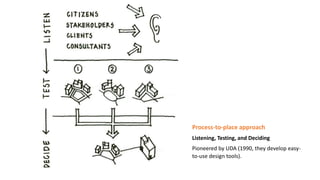
Process-to-place approach
Listening, Testing, and Deciding
Pioneered by UDA (1990, they develop easy-
to-use design tools).
Who listens best?
Men or Women…
Who listens best?
Men are often accused wanting to “Fix things” too early on in a
discussion.
Women are often intent on formulating the problem when they are
discussing something, and they need to be listened to – even
questioned – to help ensure the clarity in the formulation.
Note: Too-early-problem solving merely indicate a desire to escape
from effort of the problem-formulating conversation.
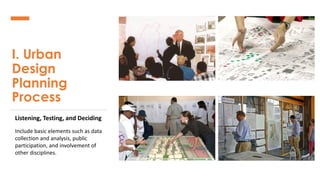
I. Urban
Design
Planning
Process
Listening, Testing, and Deciding
Include basic elements such as data
collection and analysis, public
participation, and involvement of
other disciplines.
I. The Urban Design Planning Process
Essential attributes of an urban design planning process:
1. Public outreach
2. Involvement of Major Stakeholders
3. Multi-Disciplinary team
4. Focus on Implementation
5. Design as a Tool for Decision-making
I. The Urban Design Planning Process
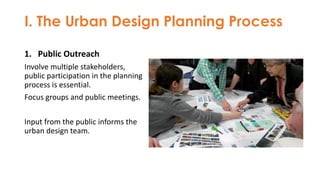
1. Public Outreach
Involve multiple stakeholders,
public participation in the planning
process is essential.
Focus groups and public meetings.
Input from the public informs the
urban design team.
I. The Urban Design Planning Process
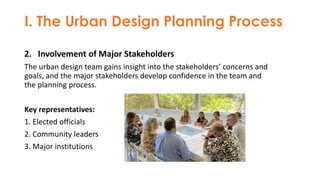
2. Involvement of Major Stakeholders
The urban design team gains insight into the stakeholders’ concerns and
goals, and the major stakeholders develop confidence in the team and
the planning process.
Key representatives:
1. Elected officials
2. Community leaders
3. Major institutions
“We have 1,600 local government units
(LGUs) and not many of them have experts
in planning, and planners are under
engineering departments.
Many of them are political appointees,”
Felino A. Palafox, Jr.
Palafox Associates principal
architect-urban planner and founder
I. The Urban Design Planning Process
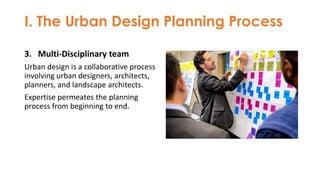
3. Multi-Disciplinary team
Urban design is a collaborative process
involving urban designers, architects,
planners, and landscape architects.
Expertise permeates the planning
process from beginning to end.
I. The Urban Design Planning Process
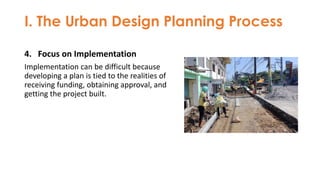
4. Focus on Implementation
Implementation can be difficult because
developing a plan is tied to the realities of
receiving funding, obtaining approval, and
getting the project built.
I. The Urban Design Planning Process
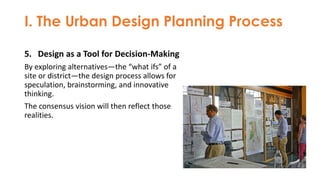
5. Design as a Tool for Decision-Making
By exploring alternatives—the “what ifs” of a
site or district—the design process allows for
speculation, brainstorming, and innovative
thinking.
The consensus vision will then reflect those
realities.
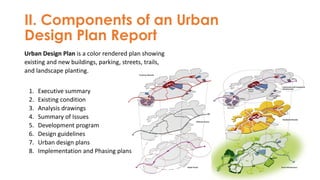
II. Components of an Urban
Design Plan Report
Urban Design Plan is a color rendered plan showing
existing and new buildings, parking, streets, trails,
and landscape planting.
1. Executive summary
2. Existing condition
3. Analysis drawings
4. Summary of Issues
5. Development program
6. Design guidelines
7. Urban design plans
8. Implementation and Phasing plans
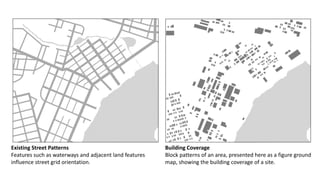
Existing Street Patterns
Features such as waterways and adjacent land features
influence street grid orientation.
Building Coverage
Block patterns of an area, presented here as a figure ground
map, showing the building coverage of a site.
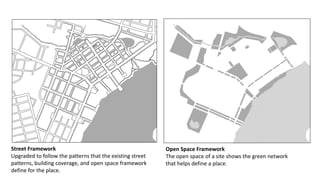
Street Framework
Upgraded to follow the patterns that the existing street
patterns, building coverage, and open space framework
define for the place.
Open Space Framework
The open space of a site shows the green network
that helps define a place.
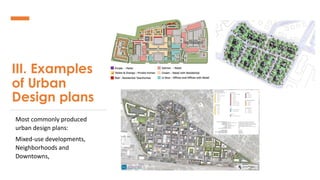
III. Examples
of Urban
Design plans
Most commonly produced
urban design plans:
Mixed-use developments,
Neighborhoods and
Downtowns,
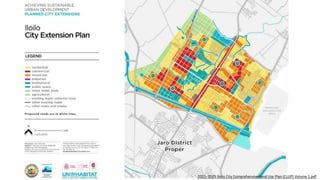
II. Examples of Urban Design plans
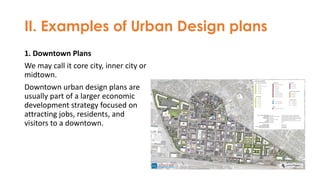
1. Downtown Plans
We may call it core city, inner city or
midtown.
Downtown urban design plans are
usually part of a larger economic
development strategy focused on
attracting jobs, residents, and
visitors to a downtown.
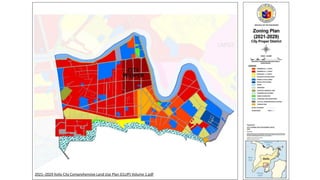
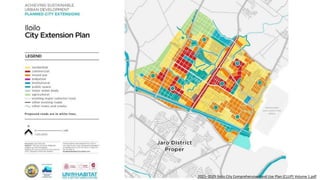
2021–2029 Iloilo City Comprehensive Land Use Plan (CLUP) Volume 1.pdf
II. Examples of Urban Design plans
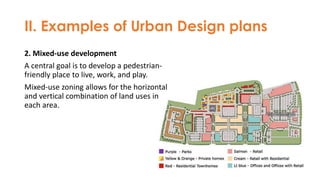
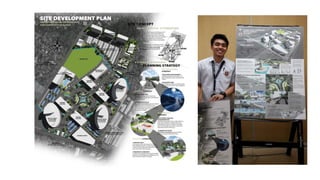
2. Mixed-use development
A central goal is to develop a pedestrian-
friendly place to live, work, and play.
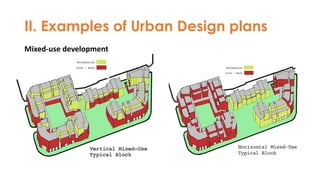
Mixed-use zoning allows for the horizontal
and vertical combination of land uses in
each area.
II. Examples of Urban Design plans
Mixed-use development
2021–2029 Iloilo City Comprehensive Land Use Plan (CLUP) Volume 1.pdf
II. Examples of Urban Design plans
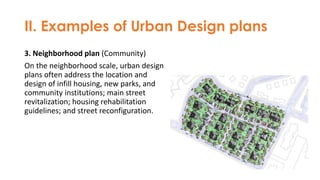
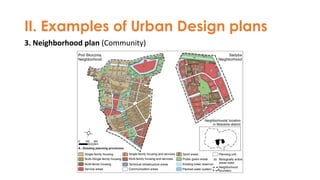
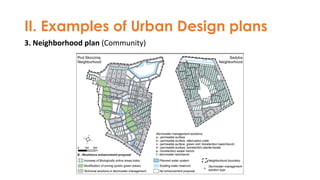
3. Neighborhood plan (Community)
On the neighborhood scale, urban design
plans often address the location and
design of infill housing, new parks, and
community institutions; main street
revitalization; housing rehabilitation
guidelines; and street reconfiguration.
2021–2029 Iloilo City Comprehensive Land Use Plan (CLUP) Volume 1.pdf
II. Examples of Urban Design plans
3. Neighborhood plan (Community)
Neighborhood planning succeeds when the process is cyclical, small successes
are emphasized, and the issue of identifying neighborhood leaders and
legitimacy is addressed at the onset.
Sponsors of neighborhood plans include cities:
• Community development organizations
• Foundations
• Private developers
II. Examples of Urban Design plans
3. Neighborhood plan (Community)
The Plan Elements:
❑ General housekeeping
❑ Planning process validation
❑ Neighborhood establishment
❑ Functional elements (Plans)
❑ Implementation Framework
II. Examples of Urban Design plans
3. Neighborhood plan (Community)
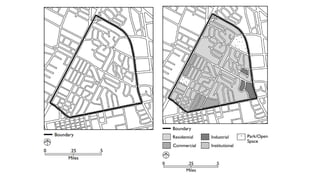
The Functional Elements:
Most neighborhood plans address functional elements, such as housing, safety, land
use, and recreation as separate topics.
❑ Residential
❑ Transportation/Circulation/Pedestrian Access
❑ Land Use/Zoning
❑ Infrastructure/Utilities
II. Examples of Urban Design plans
3. Neighborhood plan (Community)
II. Examples of Urban Design plans
3. Neighborhood plan (Community)
PLANNING 2
URBAN DESIGN
Lesson 3: Rules, and Process in Urban Design

3_RULES AND PROCESS IN URBAN DESIGN - Copy.pdf

  • 1.
    Topic review 1. Urban designprinciples, forms and shapes or pattern. 2. The Image of the City 3. Responsive Environment 4. Creating and Identifying the Sense of Place & Sense of Time Lesson 2.1: Urban design principles, forms and shapes or pattern
  • 2.
    PLANNING 2 URBAN DESIGN Lesson3: Rules, and Process in Urban Design
  • 3.
    Process-to-place approach Listening, Testing,and Deciding Pioneered by UDA (1990, they develop easy- to-use design tools).
  • 4.
  • 5.
    Who listens best? Menare often accused wanting to “Fix things” too early on in a discussion. Women are often intent on formulating the problem when they are discussing something, and they need to be listened to – even questioned – to help ensure the clarity in the formulation. Note: Too-early-problem solving merely indicate a desire to escape from effort of the problem-formulating conversation.
  • 6.
    I. Urban Design Planning Process Listening, Testing,and Deciding Include basic elements such as data collection and analysis, public participation, and involvement of other disciplines.
  • 7.
    I. The UrbanDesign Planning Process Essential attributes of an urban design planning process: 1. Public outreach 2. Involvement of Major Stakeholders 3. Multi-Disciplinary team 4. Focus on Implementation 5. Design as a Tool for Decision-making
  • 8.
    I. The UrbanDesign Planning Process 1. Public Outreach Involve multiple stakeholders, public participation in the planning process is essential. Focus groups and public meetings. Input from the public informs the urban design team.
  • 9.
    I. The UrbanDesign Planning Process 2. Involvement of Major Stakeholders The urban design team gains insight into the stakeholders’ concerns and goals, and the major stakeholders develop confidence in the team and the planning process. Key representatives: 1. Elected officials 2. Community leaders 3. Major institutions
  • 10.
    “We have 1,600local government units (LGUs) and not many of them have experts in planning, and planners are under engineering departments. Many of them are political appointees,” Felino A. Palafox, Jr. Palafox Associates principal architect-urban planner and founder
  • 11.
    I. The UrbanDesign Planning Process 3. Multi-Disciplinary team Urban design is a collaborative process involving urban designers, architects, planners, and landscape architects. Expertise permeates the planning process from beginning to end.
  • 12.
    I. The UrbanDesign Planning Process 4. Focus on Implementation Implementation can be difficult because developing a plan is tied to the realities of receiving funding, obtaining approval, and getting the project built.
  • 13.
    I. The UrbanDesign Planning Process 5. Design as a Tool for Decision-Making By exploring alternatives—the “what ifs” of a site or district—the design process allows for speculation, brainstorming, and innovative thinking. The consensus vision will then reflect those realities.
  • 14.
    II. Components ofan Urban Design Plan Report Urban Design Plan is a color rendered plan showing existing and new buildings, parking, streets, trails, and landscape planting. 1. Executive summary 2. Existing condition 3. Analysis drawings 4. Summary of Issues 5. Development program 6. Design guidelines 7. Urban design plans 8. Implementation and Phasing plans
  • 15.
    Existing Street Patterns Featuressuch as waterways and adjacent land features influence street grid orientation. Building Coverage Block patterns of an area, presented here as a figure ground map, showing the building coverage of a site.
  • 16.
    Street Framework Upgraded tofollow the patterns that the existing street patterns, building coverage, and open space framework define for the place. Open Space Framework The open space of a site shows the green network that helps define a place.
  • 17.
    III. Examples of Urban Designplans Most commonly produced urban design plans: Mixed-use developments, Neighborhoods and Downtowns,
  • 18.
    II. Examples ofUrban Design plans 1. Downtown Plans We may call it core city, inner city or midtown. Downtown urban design plans are usually part of a larger economic development strategy focused on attracting jobs, residents, and visitors to a downtown.
  • 19.
    2021–2029 Iloilo CityComprehensive Land Use Plan (CLUP) Volume 1.pdf
  • 20.
    II. Examples ofUrban Design plans 2. Mixed-use development A central goal is to develop a pedestrian- friendly place to live, work, and play. Mixed-use zoning allows for the horizontal and vertical combination of land uses in each area.
  • 21.
    II. Examples ofUrban Design plans Mixed-use development
  • 22.
    2021–2029 Iloilo CityComprehensive Land Use Plan (CLUP) Volume 1.pdf
  • 24.
    II. Examples ofUrban Design plans 3. Neighborhood plan (Community) On the neighborhood scale, urban design plans often address the location and design of infill housing, new parks, and community institutions; main street revitalization; housing rehabilitation guidelines; and street reconfiguration.
  • 25.
    2021–2029 Iloilo CityComprehensive Land Use Plan (CLUP) Volume 1.pdf
  • 26.
    II. Examples ofUrban Design plans 3. Neighborhood plan (Community) Neighborhood planning succeeds when the process is cyclical, small successes are emphasized, and the issue of identifying neighborhood leaders and legitimacy is addressed at the onset. Sponsors of neighborhood plans include cities: • Community development organizations • Foundations • Private developers
  • 27.
    II. Examples ofUrban Design plans 3. Neighborhood plan (Community) The Plan Elements: ❑ General housekeeping ❑ Planning process validation ❑ Neighborhood establishment ❑ Functional elements (Plans) ❑ Implementation Framework
  • 28.
    II. Examples ofUrban Design plans 3. Neighborhood plan (Community) The Functional Elements: Most neighborhood plans address functional elements, such as housing, safety, land use, and recreation as separate topics. ❑ Residential ❑ Transportation/Circulation/Pedestrian Access ❑ Land Use/Zoning ❑ Infrastructure/Utilities
  • 30.
    II. Examples ofUrban Design plans 3. Neighborhood plan (Community)
  • 31.
    II. Examples ofUrban Design plans 3. Neighborhood plan (Community)
  • 32.
    PLANNING 2 URBAN DESIGN Lesson3: Rules, and Process in Urban Design