The Respiratory System
By
Shaik Afsar, M.Pharm, (Ph.D)
Department of Pharmacology
Gokula Krishna College of Pharmacy, Sullurpet, Nellore Dist
The Respiratory System
 The human respiratory system allows one to
obtain oxygen, eliminate carbon dioxide.
 Breathing consists of two phases,
inspiration and expiration
 Inspiration- the process of taking in air
 Expiration- the process of blowing out air
Pulmonary ventilation
Air moves in and out of lungs
Continuous replacement of gases in alveoli (air sacs)
External respiration
Gas exchange between blood and air at alveoli
O2 (oxygen) in air diffuses into blood
CO2 (carbon dioxide) in blood diffuses into air
Transport of respiratory gases
Between the lungs and the cells of the body
Performed by the cardiovascular system
Blood is the transporting fluid
Internal respiration
Gas exchange in capillaries between blood and tissue cells
O2 in blood diffuses into tissues
CO2 waste in tissues diffuses into blood
Respiration Includes
The organs of the respiratory system are:
Nose
Pharynx (Throat)
Larynx (Voice box)
Trachea (Wind Pipe)
Two bronchi (one bronchus to each lung)
Bronchioles and smaller air passages
Two lungs and their coverings, the pleura
muscles of respiration — the intercostal muscles and the
diaphragm.
THE PARTS OF RESPIRATORY SYSTEM CAN BE CLASSIFIED
ACCORDING TO EIGHTER STRUCTURE OR FUNCTION
Structurally:
Upper respiratory system
Lower respiratory system
Functionally:
Conducting zone
Respiratory Zone
Components of the
Upper Respiratory Tract
Includes:
Nose
Pharynx
Associated
structures
Functions of Upper Respiratory Tract
 Passageway for respiration
 Receptors for smell
 Filters incoming air to filter larger foreign
material
 Moistens and warms incoming air
Components of the Lower Respiratory Tract
 Functions:
 Larynx: maintains an open airway, routes food
and air appropriately, assists in sound
production
 Trachea: transports air to and from lungs
 Bronchi: branch into lungs
 Lungs: transport air to alveoli for gas exchange
Functions of Lower Respiratory Tract
Conducting portion (transports air).
 Includes the nose, nasal cavity, pharynx, larynx,
trachea, and progressively smaller airways, from
the primary bronchi to the terminal bronchioles
Respiratory portion (carries out gas exchange).
 Composed of small airways called respiratory
bronchioles and alveolar ducts as well as air sacs
called alveoli
NOSE AND NASAL CAVITY
Passage of Air through Nose
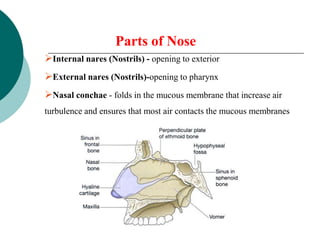
Internal nares (Nostrils) - opening to exterior
External nares (Nostrils)-opening to pharynx
Nasal conchae - folds in the mucous membrane that increase air
turbulence and ensures that most air contacts the mucous membranes
Parts of Nose
rich supply of capillaries warm the inspired air
olfactory mucosa – mucous membranes that
contain smell receptors
respiratory mucosa – pseudostratified ciliated
columnar epithelium containing goblet cells that
secrete mucus which traps inhaled particles,
lysozyme kills bacteria and lymphocytes and
IgA antibodies that protect against bacteria
Linings of Nose
Provides airway
Moistens and warms air
Filtering and cleaning air
Humidification
Resonating chamber for speech
Olfactory receptors
Rhinoplasty: surgery to change shape of external nose
Functions of Nose
Para nasal Sinuses
Four bones of the skull contain paired air spaces called the Para
nasal sinuses - frontal, ethmoidal, sphenoidal, maxillary
Decrease skull bone weight
Warm, moisten and filter incoming air
Add resonance to voice.
Communicate with the nasal cavity by ducts.
Lined by Pseudo stratified ciliated columnar epithelium.
Can get infected: sinusitis
Pharynx
The pharynx is a tube 12 to 14 cm long that extends from
the base of the skull to the level of the 6th cervical vertebra.
It lies behind the nose, mouth and larynx and is wider at its
upper end.
Common space used by both the respiratory and digestive
systems.
Commonly called the throat.
Originates posterior to the nasal and oral cavities and
extends inferiorly near the level of the bifurcation of the
larynx and esophagus.
Common pathway for both air and food.
Pharynx is divided into three parts:
Nasopharynx,
Oropharynx and
Laryngopharynx.
Houses tonsils (they respond to inhaled antigens)
Uvula closes off nasopharynx during swallowing so food
doesn’t go into nose
Epiglottis posterior to the tongue: keeps food out of
airway
Lined with stratified squamous epithelium for protection
Functions of Pharynx
Passageway for air and food.
Warming and humidifying.
Taste.
Hearing.
Protection.
Speech.
Larynx (Voice Box)
 Extends from the level of the 4th to the 6th cervical
vertebrae
 Attaches to hyoid bone superiorly
 Inferiorly is continuous with trachea (windpipe)
Three functions:
1. Produces vocalizations (speech)
2. Provides an open airway (breathing)
3. Switching mechanism to route air and food into
proper channels
Closed during swallowing
Open during breathing
The larynx is composed of several irregularly shaped
cartilages attached to each other by ligaments and membranes.
The main cartilages are:
• 1 thyroid cartilage
• 1 cricoid cartilage
• 2 arytenoid cartilages
• 1 epiglottis
Hyaline Cartilage
Elastic Cartilage
Sound Production
Functions
Production of sound
Speech
Protection of the lower respiratory tract
Passageway for air
Humidifying, filtering and warming
Trachea
A flexible tube also called windpipe.
Extends through the mediastinum and lies anterior to the
esophagus and inferior to the larynx.
Anterior and lateral walls of the trachea supported by 15 to
20 C-shaped tracheal cartilages.
Cartilage rings reinforce and provide rigidity to the tracheal
wall to ensure that the trachea remains open at all times
Posterior part of tube lined by trachealis muscle
Lined by ciliated pseudostratified columnar epithelium.
At the level of the sternal angle, the trachea
bifurcates into two smaller tubes, called the right
and left primary bronchi.
Each primary bronchus projects laterally toward
each lung.
Functions
Support and patency
Mucociliary escalator
Cough reflex
Warming, humidifying and filtering of air
Bronchi and bronchioles
The two primary bronchi are formed when the trachea
divides, i.e. about the level of the 5th thoracic vertebra.
The right bronchus. This is wider, shorter and more vertical
than the left bronchus.
It is approximately 2.5 cm long. After entering the right lung
at the hilum it divides into three branches, one to each lobe.
Each branch then subdivides into numerous smaller branches.
The left bronchus. This is about 5 cm long and is narrower
than the right. After entering the lung at the hilum it divides
into two branches, one to each lobe. Each branch then
subdivides into progressively smaller tubes within the lung
substance.
Structure
The bronchi are composed of the same tissues as the
trachea. They are lined with ciliated columnar epithelium.
The bronchi progressively subdivide into
bronchioles
terminal bronchioles,
respiratory bronchioles,
alveolar ducts and
finally, alveoli.
Functions
 warming and humidifying
 support and patency
 removal of particulate matter
 cough reflex.
Lungs
There are two lungs, one lying on each side of the midline
in the thoracic cavity. They are cone-shaped and are
described as having an
apex,
a base,
costal surface and
medial surface.
The Right lung is divided into three lobes:
Superior
Middle
Inferior
The Left lung is divided into two lobes:
Superior
Inferior
Pleura and Pleural cavity
The pleura consists of a closed sac of serous membrane (one for each
lung) which contains a small amount of serous fluid. The lung is
invaginated into this sac so that it forms two layers: one adheres to the
lung and the other to the wall of the thoracic cavity
The Visceral Pleura
The Parietal Pleura
The Pleural cavity

Respiratory system

  • 1.
    The Respiratory System By ShaikAfsar, M.Pharm, (Ph.D) Department of Pharmacology Gokula Krishna College of Pharmacy, Sullurpet, Nellore Dist
  • 2.
    The Respiratory System The human respiratory system allows one to obtain oxygen, eliminate carbon dioxide.  Breathing consists of two phases, inspiration and expiration  Inspiration- the process of taking in air  Expiration- the process of blowing out air
  • 3.
    Pulmonary ventilation Air movesin and out of lungs Continuous replacement of gases in alveoli (air sacs) External respiration Gas exchange between blood and air at alveoli O2 (oxygen) in air diffuses into blood CO2 (carbon dioxide) in blood diffuses into air Transport of respiratory gases Between the lungs and the cells of the body Performed by the cardiovascular system Blood is the transporting fluid Internal respiration Gas exchange in capillaries between blood and tissue cells O2 in blood diffuses into tissues CO2 waste in tissues diffuses into blood Respiration Includes
  • 4.
    The organs ofthe respiratory system are: Nose Pharynx (Throat) Larynx (Voice box) Trachea (Wind Pipe) Two bronchi (one bronchus to each lung) Bronchioles and smaller air passages Two lungs and their coverings, the pleura muscles of respiration — the intercostal muscles and the diaphragm.
  • 6.
    THE PARTS OFRESPIRATORY SYSTEM CAN BE CLASSIFIED ACCORDING TO EIGHTER STRUCTURE OR FUNCTION Structurally: Upper respiratory system Lower respiratory system Functionally: Conducting zone Respiratory Zone
  • 8.
    Components of the UpperRespiratory Tract Includes: Nose Pharynx Associated structures
  • 9.
    Functions of UpperRespiratory Tract  Passageway for respiration  Receptors for smell  Filters incoming air to filter larger foreign material  Moistens and warms incoming air
  • 10.
    Components of theLower Respiratory Tract
  • 11.
     Functions:  Larynx:maintains an open airway, routes food and air appropriately, assists in sound production  Trachea: transports air to and from lungs  Bronchi: branch into lungs  Lungs: transport air to alveoli for gas exchange Functions of Lower Respiratory Tract
  • 12.
    Conducting portion (transportsair).  Includes the nose, nasal cavity, pharynx, larynx, trachea, and progressively smaller airways, from the primary bronchi to the terminal bronchioles Respiratory portion (carries out gas exchange).  Composed of small airways called respiratory bronchioles and alveolar ducts as well as air sacs called alveoli
  • 13.
  • 14.
    Passage of Airthrough Nose
  • 15.
    Internal nares (Nostrils)- opening to exterior External nares (Nostrils)-opening to pharynx Nasal conchae - folds in the mucous membrane that increase air turbulence and ensures that most air contacts the mucous membranes Parts of Nose
  • 16.
    rich supply ofcapillaries warm the inspired air olfactory mucosa – mucous membranes that contain smell receptors respiratory mucosa – pseudostratified ciliated columnar epithelium containing goblet cells that secrete mucus which traps inhaled particles, lysozyme kills bacteria and lymphocytes and IgA antibodies that protect against bacteria Linings of Nose
  • 17.
    Provides airway Moistens andwarms air Filtering and cleaning air Humidification Resonating chamber for speech Olfactory receptors Rhinoplasty: surgery to change shape of external nose Functions of Nose
  • 18.
    Para nasal Sinuses Fourbones of the skull contain paired air spaces called the Para nasal sinuses - frontal, ethmoidal, sphenoidal, maxillary Decrease skull bone weight Warm, moisten and filter incoming air Add resonance to voice. Communicate with the nasal cavity by ducts. Lined by Pseudo stratified ciliated columnar epithelium. Can get infected: sinusitis
  • 20.
    Pharynx The pharynx isa tube 12 to 14 cm long that extends from the base of the skull to the level of the 6th cervical vertebra. It lies behind the nose, mouth and larynx and is wider at its upper end. Common space used by both the respiratory and digestive systems. Commonly called the throat. Originates posterior to the nasal and oral cavities and extends inferiorly near the level of the bifurcation of the larynx and esophagus. Common pathway for both air and food.
  • 21.
    Pharynx is dividedinto three parts: Nasopharynx, Oropharynx and Laryngopharynx. Houses tonsils (they respond to inhaled antigens) Uvula closes off nasopharynx during swallowing so food doesn’t go into nose Epiglottis posterior to the tongue: keeps food out of airway Lined with stratified squamous epithelium for protection
  • 23.
    Functions of Pharynx Passagewayfor air and food. Warming and humidifying. Taste. Hearing. Protection. Speech.
  • 24.
    Larynx (Voice Box) Extends from the level of the 4th to the 6th cervical vertebrae  Attaches to hyoid bone superiorly  Inferiorly is continuous with trachea (windpipe) Three functions: 1. Produces vocalizations (speech) 2. Provides an open airway (breathing) 3. Switching mechanism to route air and food into proper channels Closed during swallowing Open during breathing
  • 25.
    The larynx iscomposed of several irregularly shaped cartilages attached to each other by ligaments and membranes. The main cartilages are: • 1 thyroid cartilage • 1 cricoid cartilage • 2 arytenoid cartilages • 1 epiglottis Hyaline Cartilage Elastic Cartilage
  • 27.
  • 28.
    Functions Production of sound Speech Protectionof the lower respiratory tract Passageway for air Humidifying, filtering and warming
  • 29.
  • 30.
    A flexible tubealso called windpipe. Extends through the mediastinum and lies anterior to the esophagus and inferior to the larynx. Anterior and lateral walls of the trachea supported by 15 to 20 C-shaped tracheal cartilages. Cartilage rings reinforce and provide rigidity to the tracheal wall to ensure that the trachea remains open at all times Posterior part of tube lined by trachealis muscle Lined by ciliated pseudostratified columnar epithelium.
  • 32.
    At the levelof the sternal angle, the trachea bifurcates into two smaller tubes, called the right and left primary bronchi. Each primary bronchus projects laterally toward each lung.
  • 34.
    Functions Support and patency Mucociliaryescalator Cough reflex Warming, humidifying and filtering of air
  • 35.
    Bronchi and bronchioles Thetwo primary bronchi are formed when the trachea divides, i.e. about the level of the 5th thoracic vertebra. The right bronchus. This is wider, shorter and more vertical than the left bronchus. It is approximately 2.5 cm long. After entering the right lung at the hilum it divides into three branches, one to each lobe. Each branch then subdivides into numerous smaller branches. The left bronchus. This is about 5 cm long and is narrower than the right. After entering the lung at the hilum it divides into two branches, one to each lobe. Each branch then subdivides into progressively smaller tubes within the lung substance.
  • 36.
    Structure The bronchi arecomposed of the same tissues as the trachea. They are lined with ciliated columnar epithelium. The bronchi progressively subdivide into bronchioles terminal bronchioles, respiratory bronchioles, alveolar ducts and finally, alveoli.
  • 39.
    Functions  warming andhumidifying  support and patency  removal of particulate matter  cough reflex.
  • 40.
    Lungs There are twolungs, one lying on each side of the midline in the thoracic cavity. They are cone-shaped and are described as having an apex, a base, costal surface and medial surface. The Right lung is divided into three lobes: Superior Middle Inferior The Left lung is divided into two lobes: Superior Inferior
  • 42.
    Pleura and Pleuralcavity The pleura consists of a closed sac of serous membrane (one for each lung) which contains a small amount of serous fluid. The lung is invaginated into this sac so that it forms two layers: one adheres to the lung and the other to the wall of the thoracic cavity The Visceral Pleura The Parietal Pleura The Pleural cavity