RESPIRATORY SYSTEM:
GAS EXCHANGE IN LUNGS
By group:4A
Submitted to:Dr.Bushra Zahoor
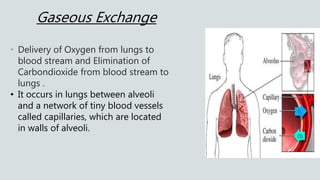
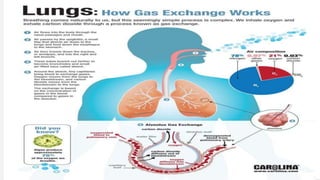
Gaseous Exchange
• Delivery of Oxygen from lungs to
blood stream and Elimination of
Carbondioxide from blood stream to
lungs .
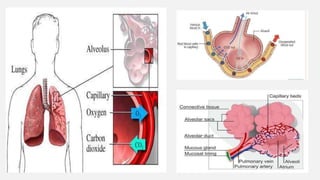
• It occurs in lungs between alveoli
and a network of tiny blood vessels
called capillaries, which are located
in walls of alveoli.
BREATHING
1. Ventilation: inspiration and expiration.
• Sequence of events that results in gas exchange .
• In terrestrial vertebrates it includes 3 steps:
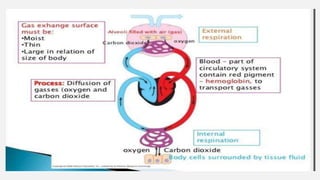
2. External respiration: Gas exchange between air (in
lungs) and blood.Blood then transport Oxygen to the
body tissue cells.
3. Internal respiration: Gas exvhange between blood and
tissue fluid. Blood then transports carbondioxide to the
lungs.
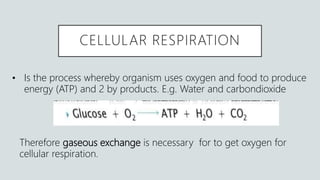
CELLULAR RESPIRATION
• Is the process whereby organism uses oxygen and food to produce
energy (ATP) and 2 by products. E.g. Water and carbondioxide
Therefore gaseous exchange is necessary for to get oxygen for
cellular respiration.
GAS EXCAHNGE BETWEEN ALVEOLAR
SPACES AND CAPILLARIES
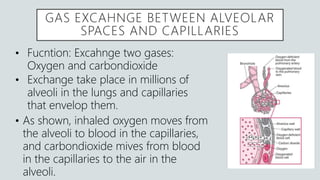
• Fucntion: Excahnge two gases:
Oxygen and carbondioxide
• Exchange take place in millions of
alveoli in the lungs and capillaries
that envelop them.
• As shown, inhaled oxygen moves from
the alveoli to blood in the capillaries,
and carbondioxide mives from blood
in the capillaries to the air in the
alveoli.
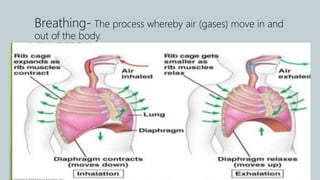
Breathing- The process whereby air (gases) move in and
out of the body.
TIDAL VENTILATION MECHANISM
• Air moves in and out of the body via the same route.
• All terrestrial vertebrates do this except for birds.
• The lungs are not completely emptied during each breathing
cycle.
• The air entering mixes with used air remaining in the lungs.
• This help to conserve water, but decrease gas-exchange
efficiency.
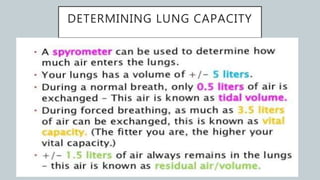
DETERMINING LUNG CAPACITY
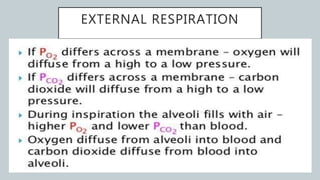
EXTERNAL RESPIRATION
• Gas exchange between air in
lungs and blood.
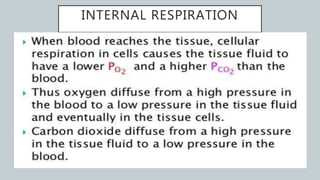
• Gas exchanhe between blood
and tissue fluid.
INTERNAL RESPIRATION
GAS EXCHANGE
• Movement driven by diffusion
gradient.
• Gasses exerts pressure, the
amount of pressure each gas
exerts is called –partial pressure
( Poxygen and Pcarbondioxide )
• Movement driven by diffusion
gradient.
• Gases exerts pressure, the amount of
pressure each gas exerts is called – partial
pressure ( Poxygen and Pcarbondioxide
)
EXTERNAL RESPIRATION
INTERNAL RESPIRATION
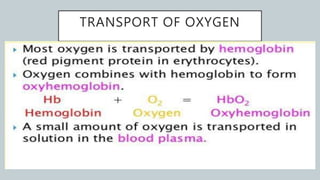
TRANSPORT OF OXYGEN
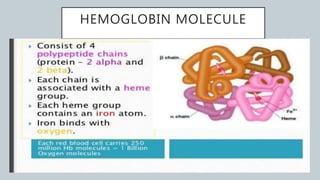
HEMOGLOBIN MOLECULE
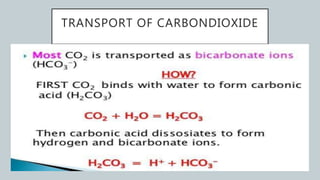
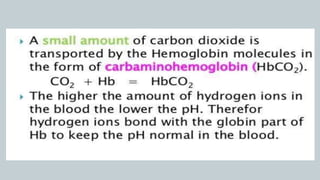
TRANSPORT OF CARBONDIOXIDE
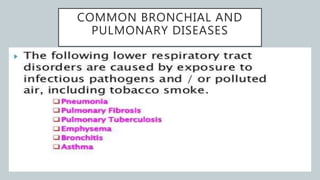
COMMON BRONCHIAL AND
PULMONARY DISEASES
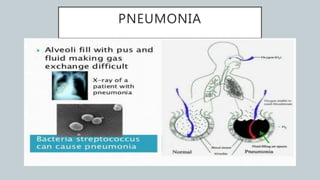
PNEUMONIA
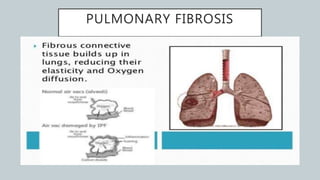
PULMONARY FIBROSIS
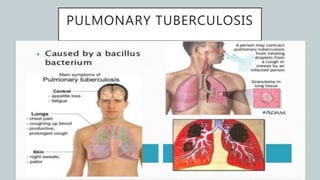
PULMONARY TUBERCULOSIS
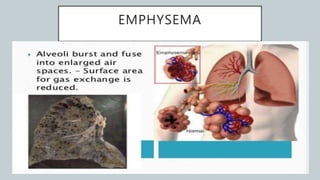
EMPHYSEMA
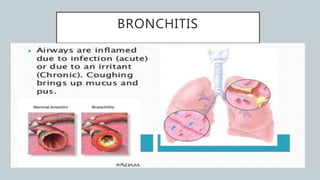
BRONCHITIS
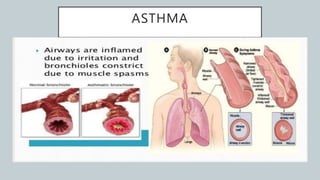
ASTHMA
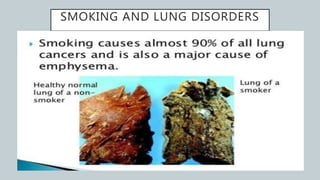
SMOKING AND LUNG DISORDERS
Thank you.

Respiratory system

  • 1.
    RESPIRATORY SYSTEM: GAS EXCHANGEIN LUNGS By group:4A Submitted to:Dr.Bushra Zahoor
  • 2.
    Gaseous Exchange • Deliveryof Oxygen from lungs to blood stream and Elimination of Carbondioxide from blood stream to lungs . • It occurs in lungs between alveoli and a network of tiny blood vessels called capillaries, which are located in walls of alveoli.
  • 3.
    BREATHING 1. Ventilation: inspirationand expiration. • Sequence of events that results in gas exchange . • In terrestrial vertebrates it includes 3 steps: 2. External respiration: Gas exchange between air (in lungs) and blood.Blood then transport Oxygen to the body tissue cells. 3. Internal respiration: Gas exvhange between blood and tissue fluid. Blood then transports carbondioxide to the lungs.
  • 5.
    CELLULAR RESPIRATION • Isthe process whereby organism uses oxygen and food to produce energy (ATP) and 2 by products. E.g. Water and carbondioxide Therefore gaseous exchange is necessary for to get oxygen for cellular respiration.
  • 7.
    GAS EXCAHNGE BETWEENALVEOLAR SPACES AND CAPILLARIES • Fucntion: Excahnge two gases: Oxygen and carbondioxide • Exchange take place in millions of alveoli in the lungs and capillaries that envelop them. • As shown, inhaled oxygen moves from the alveoli to blood in the capillaries, and carbondioxide mives from blood in the capillaries to the air in the alveoli.
  • 9.
    Breathing- The processwhereby air (gases) move in and out of the body.
  • 10.
    TIDAL VENTILATION MECHANISM •Air moves in and out of the body via the same route. • All terrestrial vertebrates do this except for birds. • The lungs are not completely emptied during each breathing cycle. • The air entering mixes with used air remaining in the lungs. • This help to conserve water, but decrease gas-exchange efficiency.
  • 11.
  • 12.
    EXTERNAL RESPIRATION • Gasexchange between air in lungs and blood. • Gas exchanhe between blood and tissue fluid. INTERNAL RESPIRATION GAS EXCHANGE • Movement driven by diffusion gradient. • Gasses exerts pressure, the amount of pressure each gas exerts is called –partial pressure ( Poxygen and Pcarbondioxide ) • Movement driven by diffusion gradient. • Gases exerts pressure, the amount of pressure each gas exerts is called – partial pressure ( Poxygen and Pcarbondioxide )
  • 13.
  • 14.
  • 15.
  • 16.
  • 17.
  • 19.
  • 20.
  • 21.
  • 22.
  • 23.
  • 24.
  • 25.
  • 26.
  • 27.