
A
Presentation on
Presented by:
Shilpi Mathur
Kiranjit Kaur
Overview of-
 Thermal Power
 Nuclear Power
 Hydro Power
 Solar Power
 Wind Power
 Biomass Power
 Geothermal Energy
 Tidal Wave Energy
 Fuels
 Nuclear Energy
 Energy stored in water
 Solar Energy
 Wind Power
 Biomass Power
 Geothermal Energy
 Tidal Power
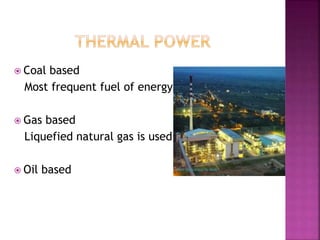
 Coal based
Most frequent fuel of energy
 Gas based
Liquefied natural gas is used
 Oil based
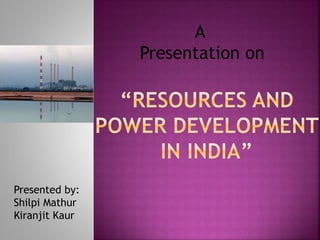
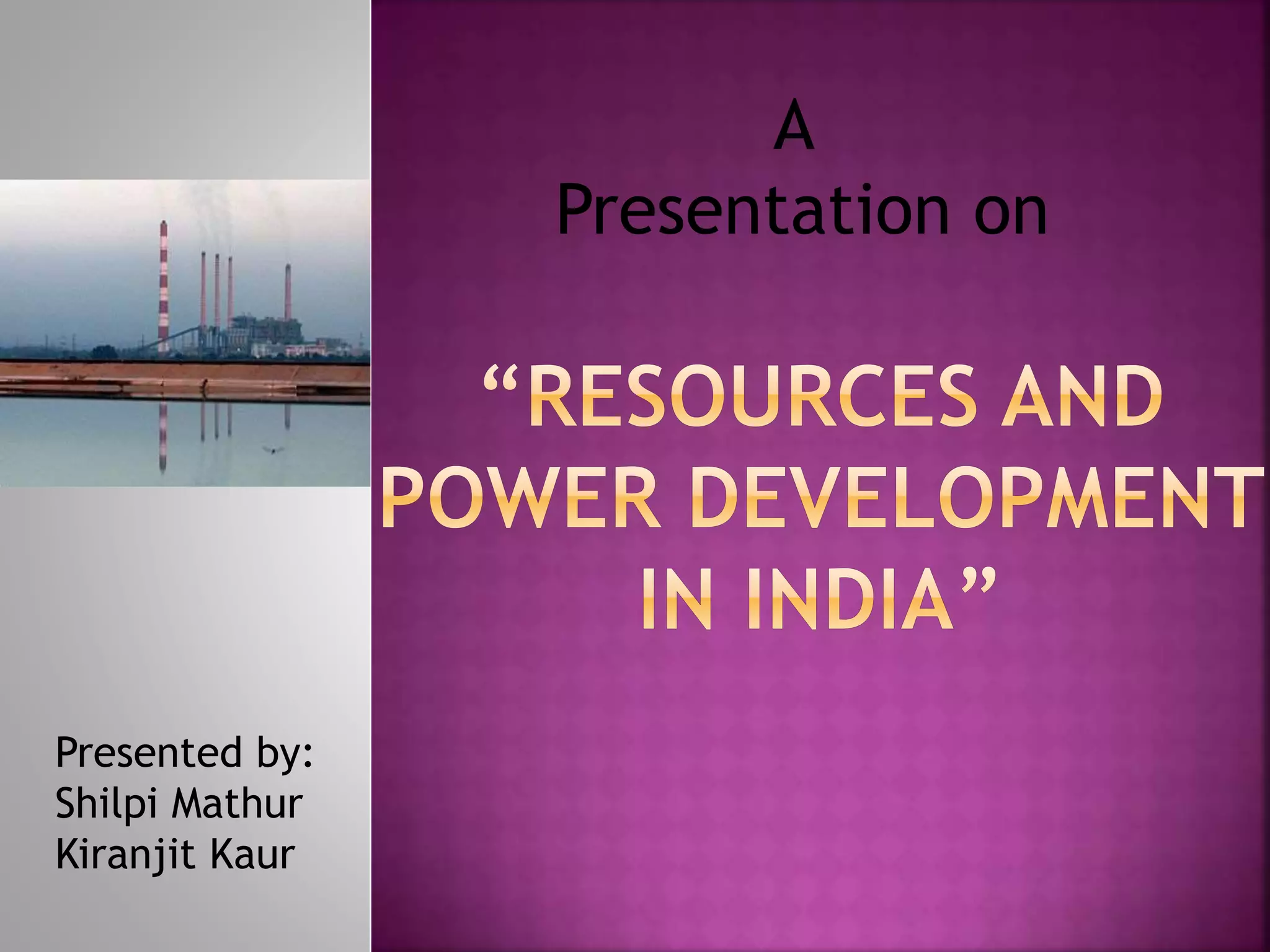
 Thermal power plant is generally a steam driven
power plant.
 Water is heated, turns into steam and spins a
steam turbine which drives an electrical
generator.
 About 70% of the electricity consumed in India is
generated through thermal power plants
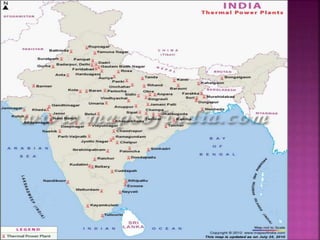
 Vindhyachal super thermal power plant is the
largest in India
 It generates 4360MW of electricity
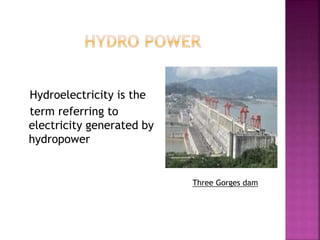
Hydroelectricity is the
term referring to
electricity generated by
hydropower
Three Gorges dam
 Production of electrical power through the use
of the gravitational force of falling or flowing
water
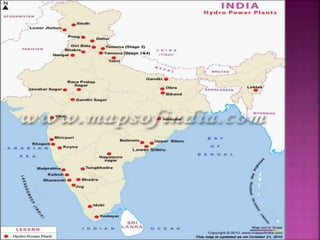
 Nathra Jhakri is the largest power plant of India
 It produces 1500MW of electricity
 India produces approximately 20% of the world’s
electricity
 India ranks 5th in the world in generation of
hydropower
 Elimination of the cost of fuel
 Hydroelectric plants have long economic
lives, with some plants still in service after
50–100 years
 Do not directly produce carbon dioxide
 Produces no waste
 Rampur Hydropower Project downstream from
Nathpa Jhakri on the River Satluj in Himachal
Pradesh
 Vishnugad Pipalkoti Hydro Power project on the
River Alaknanda in Uttarakhand
 Luhri Hydro Electric Project on the River Sutlej
in Himachal Pradesh
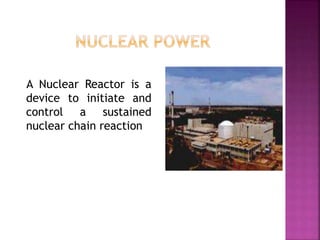
A Nuclear Reactor is a
device to initiate and
control a sustained
nuclear chain reaction
 Heat from nuclear fission is used to raise steam,
which runs through turbines
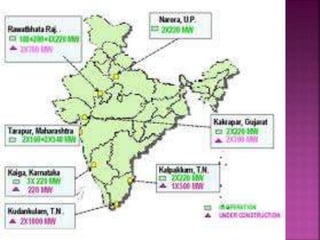
 Currently, twenty nuclear power reactors
produce 4,780 MW which is about 2.7% of total
generation
 India has a vision of becoming the world leader
in nuclear power technology
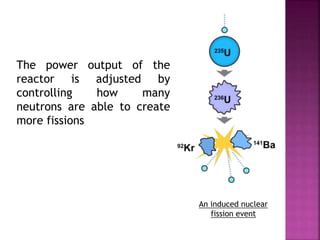
An induced nuclear
fission event
The power output of the
reactor is adjusted by
controlling how many
neutrons are able to create
more fissions
 Practically independent of geographical factor
 No combustion products
 Clean source of power which does not
contribute to air pollution
 Fuel transportation networks and large storage
facilities not required
 High risk of accidents
 Waste from nuclear energy is extremely
dangerous
 Uranium is a scarce resource
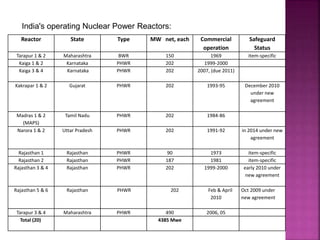
India's operating Nuclear Power Reactors:
Reactor State Type MW net, each Commercial
operation
Safeguard
Status
Tarapur 1 & 2 Maharashtra BWR 150 1969 item-specific
Kaiga 1 & 2 Karnataka PHWR 202 1999-2000
Kaiga 3 & 4 Karnataka PHWR 202 2007, (due 2011)
Kakrapar 1 & 2 Gujarat PHWR 202 1993-95 December 2010
under new
agreement
Madras 1 & 2
(MAPS)
Tamil Nadu PHWR 202 1984-86
Narora 1 & 2 Uttar Pradesh PHWR 202 1991-92 in 2014 under new
agreement
Rajasthan 1 Rajasthan PHWR 90 1973 item-specific
Rajasthan 2 Rajasthan PHWR 187 1981 item-specific
Rajasthan 3 & 4 Rajasthan PHWR 202 1999-2000 early 2010 under
new agreement
Rajasthan 5 & 6 Rajasthan PHWR 202 Feb & April
2010
Oct 2009 under
new agreement
Tarapur 3 & 4 Maharashtra PHWR 490 2006, 05
Total (20) 4385 Mwe
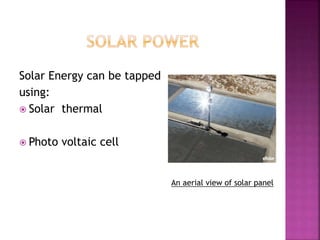
Solar Energy can be tapped
using:
 Solar thermal
 Photo voltaic cell
An aerial view of solar panel
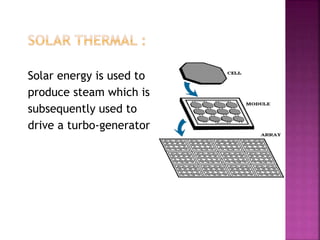
Solar energy is used to
produce steam which is
subsequently used to
drive a turbo-generator
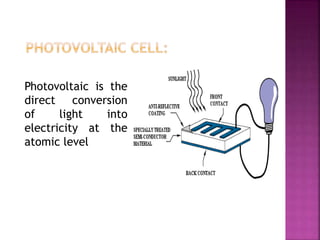
Photovoltaic is the
direct conversion
of light into
electricity at the
atomic level
 The first Indian solar thermal power project
(2X50MW) is in progress in Phalodi (Rajasthan)
 Costs 4 times as much as the coal based steam
thermal power plant
 India has desert area of 2,08,110 sq km in
Rajasthan and Gujarat
 A 60km * 60km area can produce 1,00,000 MW of
power
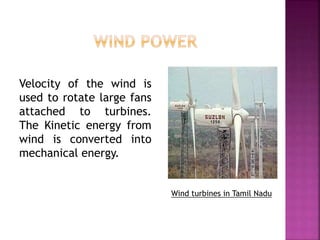
Wind turbines in Tamil Nadu
Velocity of the wind is
used to rotate large fans
attached to turbines.
The Kinetic energy from
wind is converted into
mechanical energy.
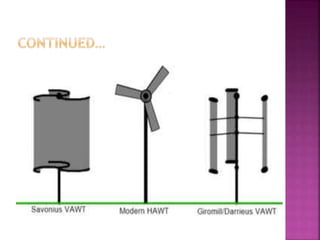
 Horizontal axis wind machines - The main rotor
shaft and electrical generator is located at the
top of a tower, and must be pointed into the
wind
 Vertical axis wind machines – They have the
main rotor shaft arranged vertically. So, does
not need to be pointed into the wind to be
effective
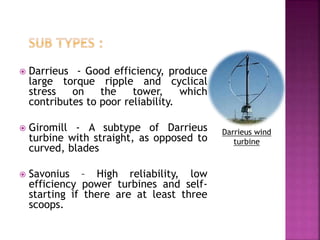
 Darrieus - Good efficiency, produce
large torque ripple and cyclical
stress on the tower, which
contributes to poor reliability.
 Giromill - A subtype of Darrieus
turbine with straight, as opposed to
curved, blades
 Savonius – High reliability, low
efficiency power turbines and self-
starting if there are at least three
scoops.
Darrieus wind
turbine
 Location of site
 Constant angular velocity
 Variation in wind velocity
 Need of a storage system
 Strong supporting structure
 Occupation of large area of land
 The turbines rotate the generator to produce
electricity.
 India has the second largest installed wind
power capacity in the world
 Installed capacity of wind power in India is
12009.14 MW
 It is estimated that 6,000 MW of additional wind
power capacity will be installed in India by 2012
 Tamil Nadu 6007 MW
 Maharashtra 2310.70 MW
 Gujarat 2175.60 MW
 Karnataka 1730.10 MW
 Rajasthan 1524.70 MW
 Madhya Pradesh 275.50 MW
 Andhra Pradesh 200.20 MW
 Kerala 32.8 MW
 Orissa 2 MW
 West Bengal 1.1 MW
Bagasse, Forestry and agro residue
& Agricultural based industrial
wastes are burnt to produce steam
Agro-residues 16,881MW
Bagasse cogeneration 5000MW
From waste 2700MW
 Indian Biomass reaches 1GW in 2010
 Has gained momentum because of limited
availability of conventional energy
 Attracts investment of over INR 600 crores every
year
 Generates more than 5000 million units of
electricity
 Employment of more than 10 million man in rural
areas
 The proposed eight plants each having a power
generation capacity of up to 8 MW would come
up in Tamil Nadu, Andhra Pradesh, Maharashtra,
Punjab and Rajasthan
 Green Planet Energy Private Limited has
invested a sum of 9.6 billion rupees on setting
up 14 biomass power projects in the state of
Punjab
 Biomass produces greenhouse emissions
 It takes considerable energy to produce biofuels
from certain feedstock
 Biomass collection is difficult
 Biomass crops not available all year
 Still an expensive source, both in terms of
producing the biomass and converting it to alcohols
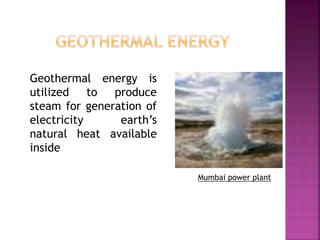
Geothermal energy is
utilized to produce
steam for generation of
electricity earth’s
natural heat available
inside
Mumbai power plant
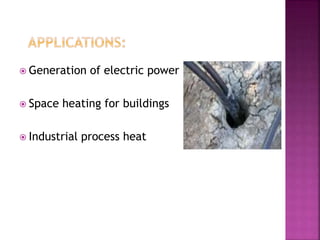
 Generation of electric power
 Space heating for buildings
 Industrial process heat
 Energy is accessed by drilling water or steam
wells
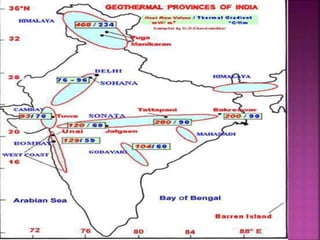
 Geothermal provinces can produce 10,600 MW
of power
 15th position in geothermal power use by
country
 Puga Valley (J&K)
 Tatapani (Chhattisgarh)
 Godavari Basin Manikaran (Himachal Pradesh)
 Bakreshwar (West Bengal)
 Tuwa (Gujarat)
 Unai (Maharashtra)
 Jalgaon (Maharashtra)
 Energy of sea tides is used to rotate turbines
which drive generators to produce electricity
 Tidal power potential in India is 8000-9000 MW
Gulf of Cambay 7000MW
Gulf of Kutch 1200MW
Sunder bans 100MW
 Dam or Dyke
 The function of dam is to form a barrier between
the sea and the basin or between one basin and
the other in case of multiple basins .
 Sluice ways
 These are used to fill the basin during the high tide
or empty the basin during the low tide.
 Power house
 Single basin arrangement
 Single ebb-cycle system
 Single tide-cycle system
 Double cycle system
 Double basin arrangement
Public sector has a share of 97%
 NHPC – National Hydroelectric Power
Corporation
 NEEPCO – Northeast Electric Power Company
 SJVNL – Satluj Jal Vidut Nigam
 Backbone of Economic Development
 Main input for Agriculture and Industry
 Energy Crisis
 Pollution
Resources and power development

Resources and power development

  • 1.
  • 2.
    Overview of-  ThermalPower  Nuclear Power  Hydro Power  Solar Power  Wind Power  Biomass Power  Geothermal Energy  Tidal Wave Energy
  • 3.
     Fuels  NuclearEnergy  Energy stored in water  Solar Energy  Wind Power  Biomass Power  Geothermal Energy  Tidal Power
  • 4.
     Coal based Mostfrequent fuel of energy  Gas based Liquefied natural gas is used  Oil based
  • 5.
     Thermal powerplant is generally a steam driven power plant.  Water is heated, turns into steam and spins a steam turbine which drives an electrical generator.  About 70% of the electricity consumed in India is generated through thermal power plants  Vindhyachal super thermal power plant is the largest in India  It generates 4360MW of electricity
  • 7.
    Hydroelectricity is the termreferring to electricity generated by hydropower Three Gorges dam
  • 8.
     Production ofelectrical power through the use of the gravitational force of falling or flowing water  Nathra Jhakri is the largest power plant of India  It produces 1500MW of electricity  India produces approximately 20% of the world’s electricity  India ranks 5th in the world in generation of hydropower
  • 9.
     Elimination ofthe cost of fuel  Hydroelectric plants have long economic lives, with some plants still in service after 50–100 years  Do not directly produce carbon dioxide  Produces no waste
  • 11.
     Rampur HydropowerProject downstream from Nathpa Jhakri on the River Satluj in Himachal Pradesh  Vishnugad Pipalkoti Hydro Power project on the River Alaknanda in Uttarakhand  Luhri Hydro Electric Project on the River Sutlej in Himachal Pradesh
  • 12.
    A Nuclear Reactoris a device to initiate and control a sustained nuclear chain reaction
  • 13.
     Heat fromnuclear fission is used to raise steam, which runs through turbines  Currently, twenty nuclear power reactors produce 4,780 MW which is about 2.7% of total generation  India has a vision of becoming the world leader in nuclear power technology
  • 14.
    An induced nuclear fissionevent The power output of the reactor is adjusted by controlling how many neutrons are able to create more fissions
  • 15.
     Practically independentof geographical factor  No combustion products  Clean source of power which does not contribute to air pollution  Fuel transportation networks and large storage facilities not required
  • 16.
     High riskof accidents  Waste from nuclear energy is extremely dangerous  Uranium is a scarce resource
  • 17.
    India's operating NuclearPower Reactors: Reactor State Type MW net, each Commercial operation Safeguard Status Tarapur 1 & 2 Maharashtra BWR 150 1969 item-specific Kaiga 1 & 2 Karnataka PHWR 202 1999-2000 Kaiga 3 & 4 Karnataka PHWR 202 2007, (due 2011) Kakrapar 1 & 2 Gujarat PHWR 202 1993-95 December 2010 under new agreement Madras 1 & 2 (MAPS) Tamil Nadu PHWR 202 1984-86 Narora 1 & 2 Uttar Pradesh PHWR 202 1991-92 in 2014 under new agreement Rajasthan 1 Rajasthan PHWR 90 1973 item-specific Rajasthan 2 Rajasthan PHWR 187 1981 item-specific Rajasthan 3 & 4 Rajasthan PHWR 202 1999-2000 early 2010 under new agreement Rajasthan 5 & 6 Rajasthan PHWR 202 Feb & April 2010 Oct 2009 under new agreement Tarapur 3 & 4 Maharashtra PHWR 490 2006, 05 Total (20) 4385 Mwe
  • 19.
    Solar Energy canbe tapped using:  Solar thermal  Photo voltaic cell An aerial view of solar panel
  • 20.
    Solar energy isused to produce steam which is subsequently used to drive a turbo-generator
  • 21.
    Photovoltaic is the directconversion of light into electricity at the atomic level
  • 22.
     The firstIndian solar thermal power project (2X50MW) is in progress in Phalodi (Rajasthan)  Costs 4 times as much as the coal based steam thermal power plant  India has desert area of 2,08,110 sq km in Rajasthan and Gujarat  A 60km * 60km area can produce 1,00,000 MW of power
  • 23.
    Wind turbines inTamil Nadu Velocity of the wind is used to rotate large fans attached to turbines. The Kinetic energy from wind is converted into mechanical energy.
  • 24.
     Horizontal axiswind machines - The main rotor shaft and electrical generator is located at the top of a tower, and must be pointed into the wind  Vertical axis wind machines – They have the main rotor shaft arranged vertically. So, does not need to be pointed into the wind to be effective
  • 26.
     Darrieus -Good efficiency, produce large torque ripple and cyclical stress on the tower, which contributes to poor reliability.  Giromill - A subtype of Darrieus turbine with straight, as opposed to curved, blades  Savonius – High reliability, low efficiency power turbines and self- starting if there are at least three scoops. Darrieus wind turbine
  • 27.
     Location ofsite  Constant angular velocity  Variation in wind velocity  Need of a storage system  Strong supporting structure  Occupation of large area of land
  • 28.
     The turbinesrotate the generator to produce electricity.  India has the second largest installed wind power capacity in the world  Installed capacity of wind power in India is 12009.14 MW  It is estimated that 6,000 MW of additional wind power capacity will be installed in India by 2012
  • 29.
     Tamil Nadu6007 MW  Maharashtra 2310.70 MW  Gujarat 2175.60 MW  Karnataka 1730.10 MW  Rajasthan 1524.70 MW  Madhya Pradesh 275.50 MW  Andhra Pradesh 200.20 MW  Kerala 32.8 MW  Orissa 2 MW  West Bengal 1.1 MW
  • 30.
    Bagasse, Forestry andagro residue & Agricultural based industrial wastes are burnt to produce steam Agro-residues 16,881MW Bagasse cogeneration 5000MW From waste 2700MW
  • 31.
     Indian Biomassreaches 1GW in 2010  Has gained momentum because of limited availability of conventional energy  Attracts investment of over INR 600 crores every year  Generates more than 5000 million units of electricity  Employment of more than 10 million man in rural areas
  • 32.
     The proposedeight plants each having a power generation capacity of up to 8 MW would come up in Tamil Nadu, Andhra Pradesh, Maharashtra, Punjab and Rajasthan  Green Planet Energy Private Limited has invested a sum of 9.6 billion rupees on setting up 14 biomass power projects in the state of Punjab
  • 33.
     Biomass producesgreenhouse emissions  It takes considerable energy to produce biofuels from certain feedstock  Biomass collection is difficult  Biomass crops not available all year  Still an expensive source, both in terms of producing the biomass and converting it to alcohols
  • 34.
    Geothermal energy is utilizedto produce steam for generation of electricity earth’s natural heat available inside Mumbai power plant
  • 35.
     Generation ofelectric power  Space heating for buildings  Industrial process heat
  • 36.
     Energy isaccessed by drilling water or steam wells  Geothermal provinces can produce 10,600 MW of power  15th position in geothermal power use by country
  • 38.
     Puga Valley(J&K)  Tatapani (Chhattisgarh)  Godavari Basin Manikaran (Himachal Pradesh)  Bakreshwar (West Bengal)  Tuwa (Gujarat)  Unai (Maharashtra)  Jalgaon (Maharashtra)
  • 39.
     Energy ofsea tides is used to rotate turbines which drive generators to produce electricity  Tidal power potential in India is 8000-9000 MW Gulf of Cambay 7000MW Gulf of Kutch 1200MW Sunder bans 100MW
  • 40.
     Dam orDyke  The function of dam is to form a barrier between the sea and the basin or between one basin and the other in case of multiple basins .  Sluice ways  These are used to fill the basin during the high tide or empty the basin during the low tide.  Power house
  • 41.
     Single basinarrangement  Single ebb-cycle system  Single tide-cycle system  Double cycle system  Double basin arrangement
  • 42.
    Public sector hasa share of 97%  NHPC – National Hydroelectric Power Corporation  NEEPCO – Northeast Electric Power Company  SJVNL – Satluj Jal Vidut Nigam
  • 43.
     Backbone ofEconomic Development  Main input for Agriculture and Industry  Energy Crisis  Pollution