Prepared By-
1
Subhendu Datta MBA-CPM (SEM1)
• Feasible Project
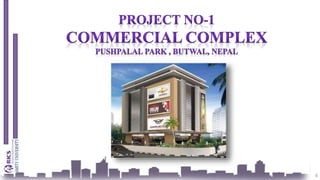
• Commercial Complex
• Metro Rail, Nagpur
• Bridge Over Yamuna River
• MLCP in Brindavan Gardens
• Recreational & Community Centre, Raipur
• References
2
3
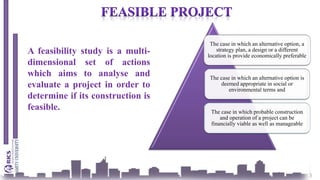
A feasibility study is a multi-
dimensional set of actions
which aims to analyse and
evaluate a project in order to
determine if its construction is
feasible.
The case in which an alternative option, a
strategy plan, a design or a different
location is provide economically preferable
The case in which an alternative option is
deemed appropriate in social or
environmental terms and
The case in which probable construction
and operation of a project can be
financially viable as well as manageable
4
5
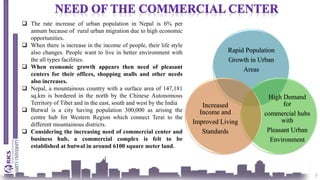
Rapid Population
Growth in Urban
Areas
High Demand
for
commercial hubs
with
Pleasant Urban
Environment
Increased
Income and
Improved Living
Standards
 The rate increase of urban population in Nepal is 6% per
annum because of rural urban migration due to high economic
opportunities.
 When there is increase in the income of people, their life style
also changes. People want to live in better environment with
the all types facilities.
 When economic growth appears then need of pleasant
centers for their offices, shopping malls and other needs
also increases.
 Nepal, a mountainous country with a surface area of 147,181
sq.km is bordered in the north by the Chinese Autonomous
Territory of Tibet and in the east, south and west by the India
 Butwal is a city having population 300,000 as arising the
centre hub for Western Region which connect Terai to the
different mountainous districts.
 Considering the increasing need of commercial center and
business hub, a commercial complex is felt to be
established at butwal in around 6100 square meter land.
6
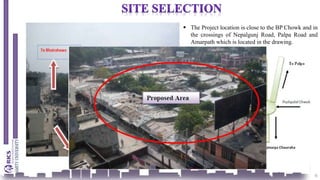
 The Project location is close to the BP Chowk and in
the crossings of Nepalgunj Road, Palpa Road and
Amarpath which is located in the drawing.
7
8
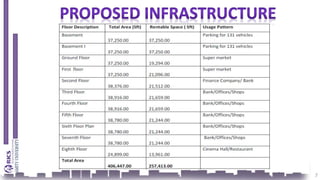
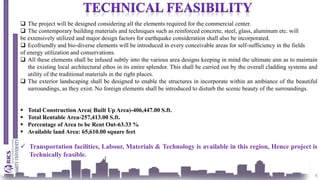
 The project will be designed considering all the elements required for the commercial center.
 The contemporary building materials and techniques such as reinforced concrete, steel, glass, aluminum etc. will
be extensively utilized and major design factors for earthquake consideration shall also be incorporated.
 Ecofriendly and bio-diverse elements will be introduced in every conceivable areas for self-sufficiency in the fields
of energy utilization and conservations.
 All these elements shall be infused subtly into the various area designs keeping in mind the ultimate aim as to maintain
the existing local architectural ethos in its entire splendor. This shall be carried out by the overall cladding systems and
utility of the traditional materials in the right places.
 The exterior landscaping shall be designed to enable the structures in incorporate within an ambiance of the beautiful
surroundings, as they exist. No foreign elements shall be introduced to disturb the scenic beauty of the surroundings.
 Total Construction Area( Built Up Area)-406,447.00 S.ft.
 Total Rentable Area-257,413.00 S.ft.
 Percentage of Area to be Rent Out-63.33 %
 Available land Area: 65,610.00 square feet
 Transportation facilities, Labour, Materials & Technology is available in this region, Hence project is
Technically feasible.
9
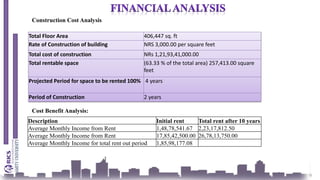
Total Floor Area 406,447 sq. ft
Rate of Construction of building NRS 3,000.00 per square feet
Total cost of construction NRs 1,21,93,41,000.00
Total rentable space (63.33 % of the total area) 257,413.00 square
feet
Projected Period for space to be rented 100% 4 years
Period of Construction 2 years
Description Initial rent Total rent after 10 years
Average Monthly Income from Rent 1,48,78,541.67 2,23,17,812.50
Average Monthly Income from Rent 17,85,42,500.00 26,78,13,750.00
Average Monthly Income for total rent out period 1,85,98,177.08
Cost Benefit Analysis:
Construction Cost Analysis
10
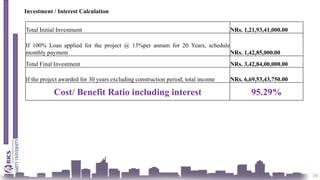
Total Initial Investment NRs. 1,21,93,41,000.00
If 100% Loan applied for the project @ 13%per annum for 20 Years, schedule
monthly payment NRs. 1,42,85,000.00
Total Final Investment NRs. 3,42,84,00,000.00
If the project awarded for 30 years excluding construction period, total income NRs. 6,69,53,43,750.00
Cost/ Benefit Ratio including interest 95.29%
Investment / Interest Calculation
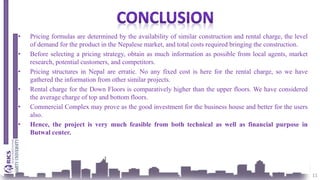
• Pricing formulas are determined by the availability of similar construction and rental charge, the level
of demand for the product in the Nepalese market, and total costs required bringing the construction.
• Before selecting a pricing strategy, obtain as much information as possible from local agents, market
research, potential customers, and competitors.
• Pricing structures in Nepal are erratic. No any fixed cost is here for the rental charge, so we have
gathered the information from other similar projects.
• Rental charge for the Down Floors is comparatively higher than the upper floors. We have considered
the average charge of top and bottom floors.
• Commercial Complex may prove as the good investment for the business house and better for the users
also.
• Hence, the project is very much feasible from both technical as well as financial purpose in
Butwal center.
11
12
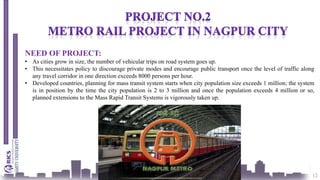
NEED OF PROJECT:
• As cities grow in size, the number of vehicular trips on road system goes up.
• This necessitates policy to discourage private modes and encourage public transport once the level of traffic along
any travel corridor in one direction exceeds 8000 persons per hour.
• Developed countries, planning for mass transit system starts when city population size exceeds 1 million; the system
is in position by the time the city population is 2 to 3 million and once the population exceeds 4 million or so,
planned extensions to the Mass Rapid Transit Systems is vigorously taken up.
13
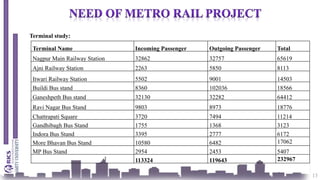
Terminal Name Incoming Passenger Outgoing Passenger Total
Nagpur Main Railway Station 32862 32757 65619
Ajni Railway Station 2263 5850 8113
Itwari Railway Station 5502 9001 14503
Buildi Bus stand 8360 102036 18566
Ganeshpeth Bus stand 32130 32282 64412
Ravi Nagar Bus Stand 9803 8973 18776
Chattrapati Square 3720 7494 11214
Gandhibagh Bus Stand 1755 1368 3123
Indora Bus Stand 3395 2777 6172
More Bhavan Bus Stand 10580 6482 17062
MP Bus Stand 2954 2453 5407
113324 119643 232967
Terminal study:
14
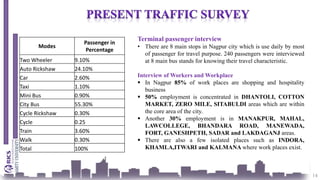
Modes
Passenger in
Percentage
Two Wheeler 9.10%
Auto Rickshaw 24.10%
Car 2.60%
Taxi 1.10%
Mini Bus 0.90%
City Bus 55.30%
Cycle Rickshaw 0.30%
Cycle 0.25
Train 3.60%
Walk 0.30%
Total 100%
Terminal passenger interview
• There are 8 main stops in Nagpur city which is use daily by most
of passenger for travel purpose. 240 passengers were interviewed
at 8 main bus stands for knowing their travel characteristic.
Interview of Workers and Workplace
 In Nagpur 85% of work places are shopping and hospitality
business
 50% employment is concentrated in DHANTOLI, COTTON
MARKET, ZERO MILE, SITABULDI areas which are within
the core area of the city.
 Another 30% employment is in MANAKPUR, MAHAL,
LAWCOLLEGE, BHANDARA ROAD, MANEWADA,
FORT, GANESHPETH, SADAR and LAKDAGANJ areas.
 There are also a few isolated places such as INDORA,
KHAMLA,ITWARI and KALMANA where work places exist.
15
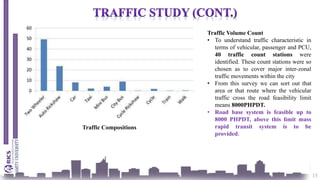
Traffic Compositions
Traffic Volume Count
• To understand traffic characteristic in
terms of vehicular, passenger and PCU,
40 traffic count stations were
identified. These count stations were so
chosen as to cover major inter-zonal
traffic movements within the city
• From this survey we can sort out that
area or that route where the vehicular
traffic cross the road feasibility limit
means 8000PHPDT.
• Road base system is feasible up to
8000 PHPDT, above this limit mass
rapid transit system is to be
provided.
16
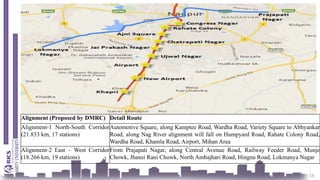
Alignment (Proposed by DMRC) Detail Route
Alignment-1 North-South Corridor
(21.833 km, 17 stations)
Automotive Square, along Kamptee Road, Wardha Road, Variety Square to Abhyankar
Road, along Nag River alignment will fall on Humpyard Road, Rahate Colony Road,
Wardha Road, Khamla Road, Airport, Mihan Area
Alignment-2 East – West Corridor
(18.266 km, 19 stations)
From Prajapati Nagar, along Central Avenue Road, Railway Feeder Road, Munje
Chowk, Jhansi Rani Chowk, North Ambajhari Road, Hingna Road, Lokmanya Nagar
17
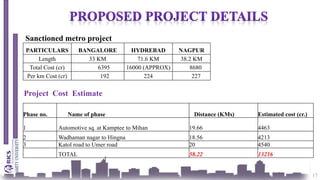
PARTICULARS BANGALORE HYDREBAD NAGPUR
Length 33 KM 71.6 KM 38.2 KM
Total Cost (cr) 6395 16000 (APPROX) 8680
Per km Cost (cr) 192 224 227
Phase no. Name of phase Distance (KMs) Estimated cost (cr.)
1 Automotive sq. at Kamptee to Mihan 19.66 4463
2 Wadhaman nagar to Hingna 18.56 4213
3 Katol road to Umer road 20 4540
TOTAL 58.22 13216
Sanctioned metro project
Project Cost Estimate
18
The benefit stream that has been evaluated and quantified includes
• Capital and operating cost of carrying the total volume of passenger traffic by existing bus system and private
vehicles in case metro project is not taken up.
• Savings in operating costs of all buses and other vehicles due to de-congestion including those that would
continue to use the existing transport network even after the metro is introduced.
• Savings in time of commuters using the metro over the existing transport modes because of faster speed of metro.
• Savings on account of prevention of accidents and pollution with introduction of metro.
• Savings in fuel consumption on account of less number of vehicles on road and congestion effect with
introduction of metro are included in those of vehicle operating cost.
19
 The population of Nagpur had already exceeded 35 lakhs and in 2021 it will cross 50 lakhs. We can say that, at the
time of2016 PHPDT of this route will exceed the limit of 8000PHPDT, so mass rapid transit system is necessary.
 As per TVC survey the studied phases are feasible and the phase 3 will be after a decade.
 The revenue generated within 3 years will be equal to total cost of project when 13% of the population will use
metro rail.
 It is the fast mode of transportation with maximum carrying capacity in less time.
 So we can conclude that Metro Rail will be feasible in Nagpur by the end of 2016.
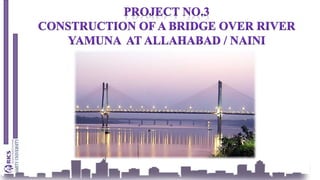
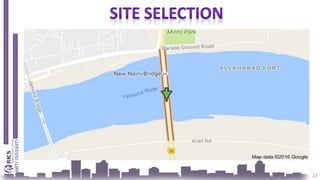
 Allahabad, about 600 km southeast of Delhi in Uttar Pradesh (UP) State
 The city is divided into the four districts of Allahabad, Naini, Jhusi and Phaphamau
 The adjacent Naini District across the River Yamuna is the industrial center where communication,
automobile, fertilizer, textile and related industry companies are located.
 The only traffic route connecting these two districts was the existing bridge over the River Yamuna
(Yamuna Bridge).
 The existing bridge (Yamuna Bridge) is a combined highway-railway bridge constructed at the end
of the 19th century, and its narrow two lanes were straining to cope with the increasing size and
weight of the vehicles
 As a result, congestion became chronic, with morning and evening rush hour traffic backed up for 40
minutes to 1 hour
 Moreover, the peak-hour traffic volume on the bridge far exceeded the transport capacity of two-lane
bridges of general roads in India.
 Therefore, also out of concern over the safety of the decaying bridge, construction of a new substitute
bridge was urgently needed.
21
22
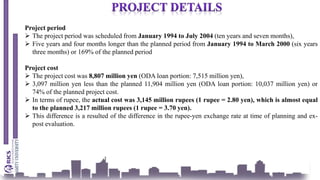
Project period
 The project period was scheduled from January 1994 to July 2004 (ten years and seven months),
 Five years and four months longer than the planned period from January 1994 to March 2000 (six years
three months) or 169% of the planned period
Project cost
 The project cost was 8,807 million yen (ODA loan portion: 7,515 million yen),
 3,097 million yen less than the planned 11,904 million yen (ODA loan portion: 10,037 million yen) or
74% of the planned project cost.
 In terms of rupee, the actual cost was 3,145 million rupees (1 rupee = 2.80 yen), which is almost equal
to the planned 3,217 million rupees (1 rupee = 3.70 yen).
 This difference is a resulted of the difference in the rupee-yen exchange rate at time of planning and ex-
post evaluation.
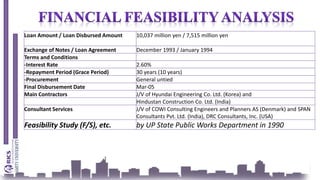
Loan Amount / Loan Disbursed Amount 10,037 million yen / 7,515 million yen
Exchange of Notes / Loan Agreement December 1993 / January 1994
Terms and Conditions
-Interest Rate 2.60%
-Repayment Period (Grace Period) 30 years (10 years)
-Procurement General untied
Final Disbursement Date Mar-05
Main Contractors J/V of Hyundai Engineering Co. Ltd. (Korea) and
Hindustan Construction Co. Ltd. (India)
Consultant Services J/V of COWI Consulting Engineers and Planners AS (Denmark) and SPAN
Consultants Pvt. Ltd. (India), DRC Consultants, Inc. (USA)
Feasibility Study (F/S), etc. by UP State Public Works Department in 1990
25
Yamuna
Bridge
(old bridge)
Naini Bridge (new bridge)
1990 2006
Actual
(reference)
Estimate Actual Achievement
rate
Passenger
car
5,168 13,130 14,342 109%
Bus 1,436 3,415 1,148 34%
Truck 3,968 20,523 5,275 26%
Total 8,568 37,068 20,765 56%
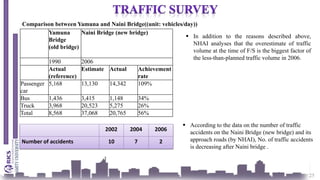
Comparison between Yamuna and Naini Bridge((unit: vehicles/day))
 In addition to the reasons described above,
NHAI analyses that the overestimate of traffic
volume at the time of F/S is the biggest factor of
the less-than-planned traffic volume in 2006.
2002 2004 2006
Number of accidents 10 7 2
 According to the data on the number of traffic
accidents on the Naini Bridge (new bridge) and its
approach roads (by NHAI), No. of traffic accidents
is decreasing after Naini bridge .
26
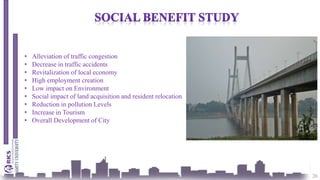
• Alleviation of traffic congestion
• Decrease in traffic accidents
• Revitalization of local economy
• High employment creation
• Low impact on Environment
• Social impact of land acquisition and resident relocation
• Reduction in pollution Levels
• Increase in Tourism
• Overall Development of City
27
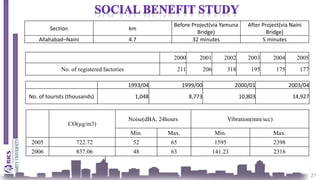
Section km
Before Project(via Yamuna
Bridge)
After Project(via Naini
Bridge)
Allahabad–Naini 4.7 32 minutes 5 minutes
2000 2001 2002 2003 2004 2005
No. of registered factories 211 206 318 195 175 177
1993/04 1999/00 2000/01 2003/04
No. of tourists (thousands) 1,048 8,773 10,803 14,927
CO(µg/m3)
Noise(dBA, 24hours Vibration(mm/scc)
Min. Max. Min. Max.
2005 722.72 52 65 1595 2398
2006 837.06 48 63 141.23 2316
28
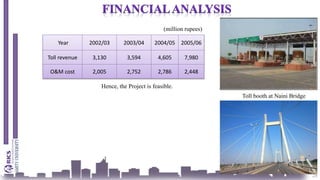
Year 2002/03 2003/04 2004/05 2005/06
Toll revenue 3,130 3,594 4,605 7,980
O&M cost 2,005 2,752 2,786 2,448
(million rupees)
Toll booth at Naini Bridge
Hence, the Project is feasible.
29
30
 Mysore is the second biggest City in the State of Karnataka. It lies130 kms from the State Headquarters,
Bangalore.
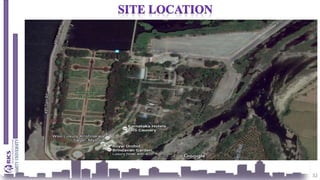
 The Brindavan Gardens is a garden located in the district of Mandya in Karnataka. It lies adjoining the
Krishnarajasagara (KRS) dam which is built across the river Cauvery.
 tthe garden is one of the major attractions near the city of Mysore
 The garden was renovated in 2005 with a cost of Rs. 5 crore. The renovation included sprucing up the
musical fountain using a digitized system and repairs of dysfunctional fountains
 Brindavan gardens and the KRS dam receive over a million tourists a year and the number is growing
at a steady rate of 5% every year. The vehicular traffic, however, is growing at a much higher rate of
20-25% year on year
 Keeping the traffic growth in mind and the requirement for better facilities at the existing parking area, a
feasibility study was desired to be carried out for developing a multi-level parking facility for all
the vehicles that currently use the parking facility
 The number of tourists is increasing at the rate of 25% every year, while the number of vehicular
traffic at Brindavan Gardens has been increasing at 5% every year
 In 2007, a private company was appointed for collection of parking and entry fee at the Brindavan
Gardens for a period of one year
31
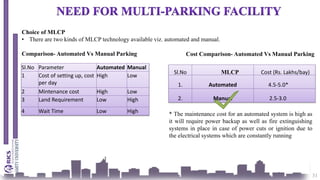
Choice of MLCP
• There are two kinds of MLCP technology available viz. automated and manual.
Comparison- Automated Vs Manual Parking
Sl.No Parameter Automated Manual
1 Cost of setting up, cost
per day
High Low
2 Mintenance cost High Low
3 Land Requirement Low High
4 Wait Time Low High * The maintenance cost for an automated system is high as
it will require power backup as well as fire extinguishing
systems in place in case of power cuts or ignition due to
the electrical systems which are constantly running
Cost Comparison- Automated Vs Manual Parking
Sl.No MLCP Cost (Rs. Lakhs/bay)
1. Automated 4.5-5.0*
2. Manual 2.5-3.0
32
33
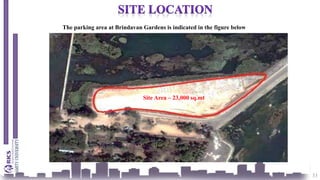
The parking area at Brindavan Gardens is indicated in the figure below
Site Area – 23,000 sq.mt
34
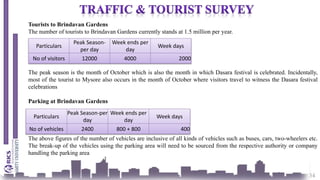
Tourists to Brindavan Gardens
The number of tourists to Brindavan Gardens currently stands at 1.5 million per year.
Particulars
Peak Season-
per day
Week ends per
day
Week days
No of visitors 12000 4000 2000
The peak season is the month of October which is also the month in which Dasara festival is celebrated. Incidentally,
most of the tourist to Mysore also occurs in the month of October where visitors travel to witness the Dasara festival
celebrations
Parking at Brindavan Gardens
Particulars
Peak Season-per
day
Week ends per
day
Week days
No of vehicles 2400 800 + 800 400
The above figures of the number of vehicles are inclusive of all kinds of vehicles such as buses, cars, two-wheelers etc.
The break-up of the vehicles using the parking area will need to be sourced from the respective authority or company
handling the parking area
35
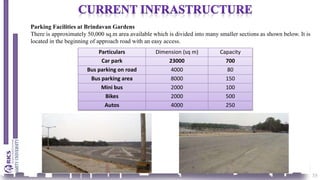
Parking Facilities at Brindavan Gardens
There is approximately 50,000 sq.m area available which is divided into many smaller sections as shown below. It is
located in the beginning of approach road with an easy access.
Particulars Dimension (sq m) Capacity
Car park 23000 700
Bus parking on road 4000 80
Bus parking area 8000 150
Mini bus 2000 100
Bikes 2000 500
Autos 4000 250
36
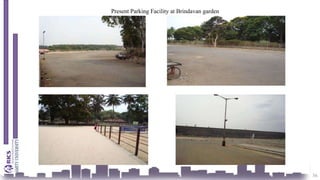
Present Parking Facility at Brindavan garden
37
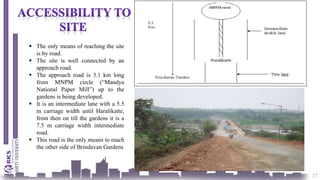
 The only means of reaching the site
is by road.
 The site is well connected by an
approach road.
 The approach road is 3.1 km long
from MNPM circle (“Mandya
National Paper Mill”) up to the
gardens is being developed.
 It is an intermediate lane with a 5.5
m carriage width until Haralikatte,
from then on till the gardens it is a
7.5 m carriage width intermediate
road.
 This road is the only means to reach
the other side of Brindavan Gardens
38
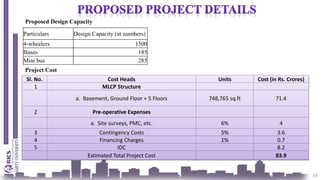
Proposed Design Capacity
Particulars Design Capacity (in numbers)
4-wheelers 1500
Buses 185
Mini bus 285
Project Cost
Sl. No. Cost Heads Units Cost (in Rs. Crores)
1 MLCP Structure
a. Basement, Ground Floor + 5 Floors 748,765 sq.ft 71.4
2 Pre-operative Expenses
a. Site surveys, PMC, etc. 6% 4
3 Contingency Costs 5% 3.6
4 Financing Charges 1% 0.7
5 IDC 8.2
Estimated Total Project Cost 83.9
39
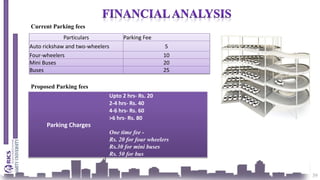
Current Parking fees
Particulars Parking Fee
Auto rickshaw and two-wheelers 5
Four-wheelers 10
Mini Buses 20
Buses 25
Parking Charges
Upto 2 hrs- Rs. 20
2-4 hrs- Rs. 40
4-6 hrs- Rs. 60
>6 hrs- Rs. 80
One time fee -
Rs. 20 for four wheelers
Rs.30 for mini buses
Rs. 50 for bus
Proposed Parking fees
40
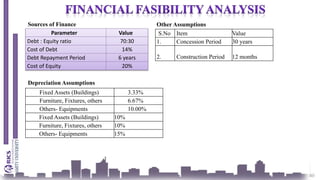
Sources of Finance
Parameter Value
Debt : Equity ratio 70:30
Cost of Debt 14%
Debt Repayment Period 6 years
Cost of Equity 20%
Depreciation Assumptions
Fixed Assets (Buildings) 3.33%
Furniture, Fixtures, others 6.67%
Others- Equipments 10.00%
Fixed Assets (Buildings) 10%
Furniture, Fixtures, others 10%
Others- Equipments 15%
Other Assumptions
S.No Item Value
1. Concession Period 30 years
2. Construction Period 12 months
41
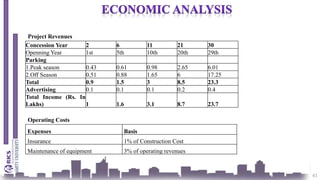
Project Revenues
Concession Year 2 6 11 21 30
Openning Year 1st 5th 10th 20th 29th
Parking
1.Peak season 0.43 0.61 0.98 2.65 6.01
2.Off Season 0.51 0.88 1.65 6 17.25
Total 0.9 1.5 3 8.5 23.3
Advertising 0.1 0.1 0.1 0.2 0.4
Total Income (Rs. In
Lakhs) 1 1.6 3.1 8.7 23.7
Operating Costs
Expenses Basis
Insurance 1% of Construction Cost
Maintenance of equipment 3% of operating revenues
42
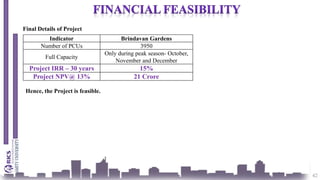
Indicator Brindavan Gardens
Number of PCUs 3950
Full Capacity
Only during peak season- October,
November and December
Project IRR – 30 years 15%
Project NPV@ 13% 21 Crore
Final Details of Project
Hence, the Project is feasible.
43
44
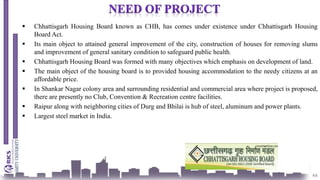
 Chhattisgarh Housing Board known as CHB, has comes under existence under Chhattisgarh Housing
Board Act.
 Its main object to attained general improvement of the city, construction of houses for removing slums
and improvement of general sanitary condition to safeguard public health.
 Chhattisgarh Housing Board was formed with many objectives which emphasis on development of land.
 The main object of the housing board is to provided housing accommodation to the needy citizens at an
affordable price.
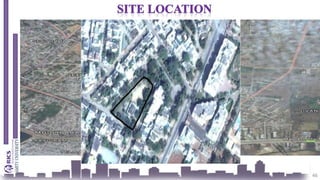
 In Shankar Nagar colony area and surrounding residential and commercial area where project is proposed,
there are presently no Club, Convention & Recreation centre facilities.
 Raipur along with neighboring cities of Durg and Bhilai is hub of steel, aluminum and power plants.
 Largest steel market in India.
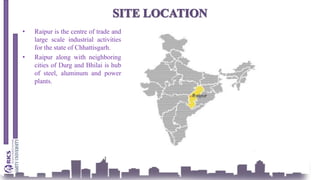
• Raipur is the centre of trade and
large scale industrial activities
for the state of Chhattisgarh.
• Raipur along with neighboring
cities of Durg and Bhilai is hub
of steel, aluminum and power
plants.
46
 Location: It is situated centre of Shankar Nagar a big residential township and near to many residential
township and commercial area hence it govern ample locational advantages.
 Road: The proposed site has been connected to Shankar Nagar main road is sufficient to ensure heavy
traffic and connectivity with the other part of city hence proposed project will attract large number of
travelers and users for lodging, restaurant and recreational purposes.
 Railway: The main railway station is about 6-7 kms from the site hence it will only help to boost traffic
for convention guest who opt to reach this place.
 Utility Lines: All utility lines (Electricity, telephone, Cable, Water supply, sewerage drainage etc.) are
available at the site. The road drainage system of the area is also in the planned manner.
 Water Supply norms: The water requirement proposes to have 100 liters per bed per day. For hotel use
which will be meet out from the own sources like tube well.
 Telecommunication: The site area equipped with Fiber optic cables and will have full access of
communications.
48
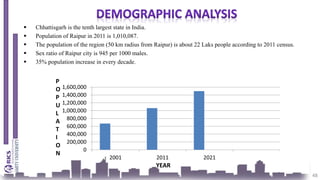
 Chhattisgarh is the tenth largest state in India.
 Population of Raipur in 2011 is 1,010,087.
 The population of the region (50 km radius from Raipur) is about 22 Laks people according to 2011 census.
 Sex ratio of Raipur city is 945 per 1000 males.
 35% population increase in every decade.
0
200,000
400,000
600,000
800,000
1,000,000
1,200,000
1,400,000
1,600,000
2001 2011 2021
YEAR
P
O
P
U
L
A
T
I
O
N
49
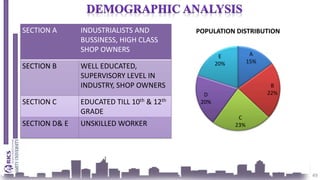
SECTION A INDUSTRIALISTS AND
BUSSINESS, HIGH CLASS
SHOP OWNERS
SECTION B WELL EDUCATED,
SUPERVISORY LEVEL IN
INDUSTRY, SHOP OWNERS
SECTION C EDUCATED TILL 10th & 12th
GRADE
SECTION D& E UNSKILLED WORKER
A
15%
B
22%
C
23%
D
20%
E
20%
POPULATION DISTRIBUTION
50
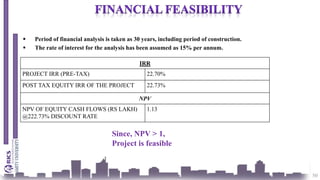
 Period of financial analysis is taken as 30 years, including period of construction.
 The rate of interest for the analysis has been assumed as 15% per annum.
IRR
PROJECT IRR (PRE-TAX) 22.70%
POST TAX EQUITY IRR OF THE PROJECT 22.73%
NPV
NPV OF EQUITY CASH FLOWS (RS LAKH)
@222.73% DISCOUNT RATE
1.13
Since, NPV > 1,
Project is feasible
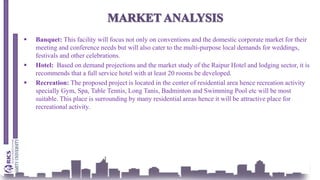
 Banquet: This facility will focus not only on conventions and the domestic corporate market for their
meeting and conference needs but will also cater to the multi-purpose local demands for weddings,
festivals and other celebrations.
 Hotel: Based on demand projections and the market study of the Raipur Hotel and lodging sector, it is
recommends that a full service hotel with at least 20 rooms be developed.
 Recreation: The proposed project is located in the center of residential area hence recreation activity
specially Gym, Spa, Table Tennis, Long Tanis, Badminton and Swimming Pool etc will be most
suitable. This place is surrounding by many residential areas hence it will be attractive place for
recreational activity.
CONCLUSION
 On the basis of the findings of the feasibility study which includes the financial analysis of the
project’s estimated construction it is recommended that the project is feasible. The demand
analysis of the end users of the sport, convention & recreation centre also validates the claims
of viability of the project.
53
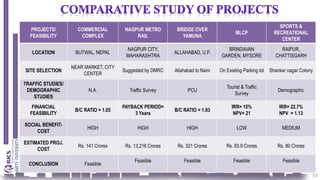
PROJECTS/
FEASIBILITY
COMMERCIAL
COMPLEX
NAGPUR METRO
RAIL
BRIDGE OVER
YAMUNA
MLCP
SPORTS &
RECREATIONAL
CENTER
LOCATION BUTWAL, NEPAL
NAGPUR CITY,
MAHARASHTRA
ALLAHABAD, U.P.
BRINDAVAN
GARDEN, MYSORE
RAIPUR,
CHATTISGARH
SITE SELECTION
NEAR MARKET, CITY
CENTER
Suggested by DMRC Allahabad to Naini On Existing Parking lot Shankar nagar Colony
TRAFFIC STUDIES/
DEMOGRAPHIC
STUDIES
N.A. Traffic Survey PCU
Tourist & Traffic
Survey
Demographic
FINANCIAL
FEASIBILITY
B/C RATIO = 1.05
PAYBACK PERIOD=
3 Years
B/C RATIO = 1.93
IRR= 15%
NPV= 21
IRR= 22.7%
NPV = 1.13
SOCIAL BENEFIT-
COST
HIGH HIGH HIGH LOW MEDIUM
ESTIMATED PROJ.
COST
Rs. 141 Crores Rs. 13,216 Crores Rs. 321 Crores Rs. 83.9 Crores Rs. 80 Crores
CONCLUSION Feasible
Feasible Feasible Feasible Feasible
54
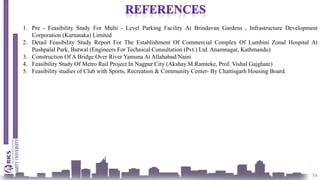
1. Pre - Feasibility Study For Multi - Level Parking Facility At Brindavan Gardens , Infrastructure Development
Corporation (Karnataka) Limited
2. Detail Feasibility Study Report For The Establishment Of Commercial Complex Of Lumbini Zonal Hospital At
Pushpalal Park, Butwal (Engineers For Technical Consultation (Pvt.) Ltd. Anamnagar, Kathmandu)
3. Construction Of A Bridge Over River Yamuna At Allahabad/Naini
4. Feasibility Study Of Metro Rail Project In Nagpur City (Akshay.M.Ramteke, Prof. Vishal Gajghate)
5. Feasibility studies of Club with Sports, Recreation & Community Center- By Chattisgarh Housing Board.
55

Construction Projects Feasibility studies

  • 1.
  • 2.
    • Feasible Project •Commercial Complex • Metro Rail, Nagpur • Bridge Over Yamuna River • MLCP in Brindavan Gardens • Recreational & Community Centre, Raipur • References 2
  • 3.
    3 A feasibility studyis a multi- dimensional set of actions which aims to analyse and evaluate a project in order to determine if its construction is feasible. The case in which an alternative option, a strategy plan, a design or a different location is provide economically preferable The case in which an alternative option is deemed appropriate in social or environmental terms and The case in which probable construction and operation of a project can be financially viable as well as manageable
  • 4.
  • 5.
    5 Rapid Population Growth inUrban Areas High Demand for commercial hubs with Pleasant Urban Environment Increased Income and Improved Living Standards  The rate increase of urban population in Nepal is 6% per annum because of rural urban migration due to high economic opportunities.  When there is increase in the income of people, their life style also changes. People want to live in better environment with the all types facilities.  When economic growth appears then need of pleasant centers for their offices, shopping malls and other needs also increases.  Nepal, a mountainous country with a surface area of 147,181 sq.km is bordered in the north by the Chinese Autonomous Territory of Tibet and in the east, south and west by the India  Butwal is a city having population 300,000 as arising the centre hub for Western Region which connect Terai to the different mountainous districts.  Considering the increasing need of commercial center and business hub, a commercial complex is felt to be established at butwal in around 6100 square meter land.
  • 6.
    6  The Projectlocation is close to the BP Chowk and in the crossings of Nepalgunj Road, Palpa Road and Amarpath which is located in the drawing.
  • 7.
  • 8.
    8  The projectwill be designed considering all the elements required for the commercial center.  The contemporary building materials and techniques such as reinforced concrete, steel, glass, aluminum etc. will be extensively utilized and major design factors for earthquake consideration shall also be incorporated.  Ecofriendly and bio-diverse elements will be introduced in every conceivable areas for self-sufficiency in the fields of energy utilization and conservations.  All these elements shall be infused subtly into the various area designs keeping in mind the ultimate aim as to maintain the existing local architectural ethos in its entire splendor. This shall be carried out by the overall cladding systems and utility of the traditional materials in the right places.  The exterior landscaping shall be designed to enable the structures in incorporate within an ambiance of the beautiful surroundings, as they exist. No foreign elements shall be introduced to disturb the scenic beauty of the surroundings.  Total Construction Area( Built Up Area)-406,447.00 S.ft.  Total Rentable Area-257,413.00 S.ft.  Percentage of Area to be Rent Out-63.33 %  Available land Area: 65,610.00 square feet  Transportation facilities, Labour, Materials & Technology is available in this region, Hence project is Technically feasible.
  • 9.
    9 Total Floor Area406,447 sq. ft Rate of Construction of building NRS 3,000.00 per square feet Total cost of construction NRs 1,21,93,41,000.00 Total rentable space (63.33 % of the total area) 257,413.00 square feet Projected Period for space to be rented 100% 4 years Period of Construction 2 years Description Initial rent Total rent after 10 years Average Monthly Income from Rent 1,48,78,541.67 2,23,17,812.50 Average Monthly Income from Rent 17,85,42,500.00 26,78,13,750.00 Average Monthly Income for total rent out period 1,85,98,177.08 Cost Benefit Analysis: Construction Cost Analysis
  • 10.
    10 Total Initial InvestmentNRs. 1,21,93,41,000.00 If 100% Loan applied for the project @ 13%per annum for 20 Years, schedule monthly payment NRs. 1,42,85,000.00 Total Final Investment NRs. 3,42,84,00,000.00 If the project awarded for 30 years excluding construction period, total income NRs. 6,69,53,43,750.00 Cost/ Benefit Ratio including interest 95.29% Investment / Interest Calculation
  • 11.
    • Pricing formulasare determined by the availability of similar construction and rental charge, the level of demand for the product in the Nepalese market, and total costs required bringing the construction. • Before selecting a pricing strategy, obtain as much information as possible from local agents, market research, potential customers, and competitors. • Pricing structures in Nepal are erratic. No any fixed cost is here for the rental charge, so we have gathered the information from other similar projects. • Rental charge for the Down Floors is comparatively higher than the upper floors. We have considered the average charge of top and bottom floors. • Commercial Complex may prove as the good investment for the business house and better for the users also. • Hence, the project is very much feasible from both technical as well as financial purpose in Butwal center. 11
  • 12.
    12 NEED OF PROJECT: •As cities grow in size, the number of vehicular trips on road system goes up. • This necessitates policy to discourage private modes and encourage public transport once the level of traffic along any travel corridor in one direction exceeds 8000 persons per hour. • Developed countries, planning for mass transit system starts when city population size exceeds 1 million; the system is in position by the time the city population is 2 to 3 million and once the population exceeds 4 million or so, planned extensions to the Mass Rapid Transit Systems is vigorously taken up.
  • 13.
    13 Terminal Name IncomingPassenger Outgoing Passenger Total Nagpur Main Railway Station 32862 32757 65619 Ajni Railway Station 2263 5850 8113 Itwari Railway Station 5502 9001 14503 Buildi Bus stand 8360 102036 18566 Ganeshpeth Bus stand 32130 32282 64412 Ravi Nagar Bus Stand 9803 8973 18776 Chattrapati Square 3720 7494 11214 Gandhibagh Bus Stand 1755 1368 3123 Indora Bus Stand 3395 2777 6172 More Bhavan Bus Stand 10580 6482 17062 MP Bus Stand 2954 2453 5407 113324 119643 232967 Terminal study:
  • 14.
    14 Modes Passenger in Percentage Two Wheeler9.10% Auto Rickshaw 24.10% Car 2.60% Taxi 1.10% Mini Bus 0.90% City Bus 55.30% Cycle Rickshaw 0.30% Cycle 0.25 Train 3.60% Walk 0.30% Total 100% Terminal passenger interview • There are 8 main stops in Nagpur city which is use daily by most of passenger for travel purpose. 240 passengers were interviewed at 8 main bus stands for knowing their travel characteristic. Interview of Workers and Workplace  In Nagpur 85% of work places are shopping and hospitality business  50% employment is concentrated in DHANTOLI, COTTON MARKET, ZERO MILE, SITABULDI areas which are within the core area of the city.  Another 30% employment is in MANAKPUR, MAHAL, LAWCOLLEGE, BHANDARA ROAD, MANEWADA, FORT, GANESHPETH, SADAR and LAKDAGANJ areas.  There are also a few isolated places such as INDORA, KHAMLA,ITWARI and KALMANA where work places exist.
  • 15.
    15 Traffic Compositions Traffic VolumeCount • To understand traffic characteristic in terms of vehicular, passenger and PCU, 40 traffic count stations were identified. These count stations were so chosen as to cover major inter-zonal traffic movements within the city • From this survey we can sort out that area or that route where the vehicular traffic cross the road feasibility limit means 8000PHPDT. • Road base system is feasible up to 8000 PHPDT, above this limit mass rapid transit system is to be provided.
  • 16.
    16 Alignment (Proposed byDMRC) Detail Route Alignment-1 North-South Corridor (21.833 km, 17 stations) Automotive Square, along Kamptee Road, Wardha Road, Variety Square to Abhyankar Road, along Nag River alignment will fall on Humpyard Road, Rahate Colony Road, Wardha Road, Khamla Road, Airport, Mihan Area Alignment-2 East – West Corridor (18.266 km, 19 stations) From Prajapati Nagar, along Central Avenue Road, Railway Feeder Road, Munje Chowk, Jhansi Rani Chowk, North Ambajhari Road, Hingna Road, Lokmanya Nagar
  • 17.
    17 PARTICULARS BANGALORE HYDREBADNAGPUR Length 33 KM 71.6 KM 38.2 KM Total Cost (cr) 6395 16000 (APPROX) 8680 Per km Cost (cr) 192 224 227 Phase no. Name of phase Distance (KMs) Estimated cost (cr.) 1 Automotive sq. at Kamptee to Mihan 19.66 4463 2 Wadhaman nagar to Hingna 18.56 4213 3 Katol road to Umer road 20 4540 TOTAL 58.22 13216 Sanctioned metro project Project Cost Estimate
  • 18.
    18 The benefit streamthat has been evaluated and quantified includes • Capital and operating cost of carrying the total volume of passenger traffic by existing bus system and private vehicles in case metro project is not taken up. • Savings in operating costs of all buses and other vehicles due to de-congestion including those that would continue to use the existing transport network even after the metro is introduced. • Savings in time of commuters using the metro over the existing transport modes because of faster speed of metro. • Savings on account of prevention of accidents and pollution with introduction of metro. • Savings in fuel consumption on account of less number of vehicles on road and congestion effect with introduction of metro are included in those of vehicle operating cost.
  • 19.
    19  The populationof Nagpur had already exceeded 35 lakhs and in 2021 it will cross 50 lakhs. We can say that, at the time of2016 PHPDT of this route will exceed the limit of 8000PHPDT, so mass rapid transit system is necessary.  As per TVC survey the studied phases are feasible and the phase 3 will be after a decade.  The revenue generated within 3 years will be equal to total cost of project when 13% of the population will use metro rail.  It is the fast mode of transportation with maximum carrying capacity in less time.  So we can conclude that Metro Rail will be feasible in Nagpur by the end of 2016.
  • 21.
     Allahabad, about600 km southeast of Delhi in Uttar Pradesh (UP) State  The city is divided into the four districts of Allahabad, Naini, Jhusi and Phaphamau  The adjacent Naini District across the River Yamuna is the industrial center where communication, automobile, fertilizer, textile and related industry companies are located.  The only traffic route connecting these two districts was the existing bridge over the River Yamuna (Yamuna Bridge).  The existing bridge (Yamuna Bridge) is a combined highway-railway bridge constructed at the end of the 19th century, and its narrow two lanes were straining to cope with the increasing size and weight of the vehicles  As a result, congestion became chronic, with morning and evening rush hour traffic backed up for 40 minutes to 1 hour  Moreover, the peak-hour traffic volume on the bridge far exceeded the transport capacity of two-lane bridges of general roads in India.  Therefore, also out of concern over the safety of the decaying bridge, construction of a new substitute bridge was urgently needed. 21
  • 22.
  • 23.
    Project period  Theproject period was scheduled from January 1994 to July 2004 (ten years and seven months),  Five years and four months longer than the planned period from January 1994 to March 2000 (six years three months) or 169% of the planned period Project cost  The project cost was 8,807 million yen (ODA loan portion: 7,515 million yen),  3,097 million yen less than the planned 11,904 million yen (ODA loan portion: 10,037 million yen) or 74% of the planned project cost.  In terms of rupee, the actual cost was 3,145 million rupees (1 rupee = 2.80 yen), which is almost equal to the planned 3,217 million rupees (1 rupee = 3.70 yen).  This difference is a resulted of the difference in the rupee-yen exchange rate at time of planning and ex- post evaluation.
  • 24.
    Loan Amount /Loan Disbursed Amount 10,037 million yen / 7,515 million yen Exchange of Notes / Loan Agreement December 1993 / January 1994 Terms and Conditions -Interest Rate 2.60% -Repayment Period (Grace Period) 30 years (10 years) -Procurement General untied Final Disbursement Date Mar-05 Main Contractors J/V of Hyundai Engineering Co. Ltd. (Korea) and Hindustan Construction Co. Ltd. (India) Consultant Services J/V of COWI Consulting Engineers and Planners AS (Denmark) and SPAN Consultants Pvt. Ltd. (India), DRC Consultants, Inc. (USA) Feasibility Study (F/S), etc. by UP State Public Works Department in 1990
  • 25.
    25 Yamuna Bridge (old bridge) Naini Bridge(new bridge) 1990 2006 Actual (reference) Estimate Actual Achievement rate Passenger car 5,168 13,130 14,342 109% Bus 1,436 3,415 1,148 34% Truck 3,968 20,523 5,275 26% Total 8,568 37,068 20,765 56% Comparison between Yamuna and Naini Bridge((unit: vehicles/day))  In addition to the reasons described above, NHAI analyses that the overestimate of traffic volume at the time of F/S is the biggest factor of the less-than-planned traffic volume in 2006. 2002 2004 2006 Number of accidents 10 7 2  According to the data on the number of traffic accidents on the Naini Bridge (new bridge) and its approach roads (by NHAI), No. of traffic accidents is decreasing after Naini bridge .
  • 26.
    26 • Alleviation oftraffic congestion • Decrease in traffic accidents • Revitalization of local economy • High employment creation • Low impact on Environment • Social impact of land acquisition and resident relocation • Reduction in pollution Levels • Increase in Tourism • Overall Development of City
  • 27.
    27 Section km Before Project(viaYamuna Bridge) After Project(via Naini Bridge) Allahabad–Naini 4.7 32 minutes 5 minutes 2000 2001 2002 2003 2004 2005 No. of registered factories 211 206 318 195 175 177 1993/04 1999/00 2000/01 2003/04 No. of tourists (thousands) 1,048 8,773 10,803 14,927 CO(µg/m3) Noise(dBA, 24hours Vibration(mm/scc) Min. Max. Min. Max. 2005 722.72 52 65 1595 2398 2006 837.06 48 63 141.23 2316
  • 28.
    28 Year 2002/03 2003/042004/05 2005/06 Toll revenue 3,130 3,594 4,605 7,980 O&M cost 2,005 2,752 2,786 2,448 (million rupees) Toll booth at Naini Bridge Hence, the Project is feasible.
  • 29.
  • 30.
    30  Mysore isthe second biggest City in the State of Karnataka. It lies130 kms from the State Headquarters, Bangalore.  The Brindavan Gardens is a garden located in the district of Mandya in Karnataka. It lies adjoining the Krishnarajasagara (KRS) dam which is built across the river Cauvery.  tthe garden is one of the major attractions near the city of Mysore  The garden was renovated in 2005 with a cost of Rs. 5 crore. The renovation included sprucing up the musical fountain using a digitized system and repairs of dysfunctional fountains  Brindavan gardens and the KRS dam receive over a million tourists a year and the number is growing at a steady rate of 5% every year. The vehicular traffic, however, is growing at a much higher rate of 20-25% year on year  Keeping the traffic growth in mind and the requirement for better facilities at the existing parking area, a feasibility study was desired to be carried out for developing a multi-level parking facility for all the vehicles that currently use the parking facility  The number of tourists is increasing at the rate of 25% every year, while the number of vehicular traffic at Brindavan Gardens has been increasing at 5% every year  In 2007, a private company was appointed for collection of parking and entry fee at the Brindavan Gardens for a period of one year
  • 31.
    31 Choice of MLCP •There are two kinds of MLCP technology available viz. automated and manual. Comparison- Automated Vs Manual Parking Sl.No Parameter Automated Manual 1 Cost of setting up, cost per day High Low 2 Mintenance cost High Low 3 Land Requirement Low High 4 Wait Time Low High * The maintenance cost for an automated system is high as it will require power backup as well as fire extinguishing systems in place in case of power cuts or ignition due to the electrical systems which are constantly running Cost Comparison- Automated Vs Manual Parking Sl.No MLCP Cost (Rs. Lakhs/bay) 1. Automated 4.5-5.0* 2. Manual 2.5-3.0
  • 32.
  • 33.
    33 The parking areaat Brindavan Gardens is indicated in the figure below Site Area – 23,000 sq.mt
  • 34.
    34 Tourists to BrindavanGardens The number of tourists to Brindavan Gardens currently stands at 1.5 million per year. Particulars Peak Season- per day Week ends per day Week days No of visitors 12000 4000 2000 The peak season is the month of October which is also the month in which Dasara festival is celebrated. Incidentally, most of the tourist to Mysore also occurs in the month of October where visitors travel to witness the Dasara festival celebrations Parking at Brindavan Gardens Particulars Peak Season-per day Week ends per day Week days No of vehicles 2400 800 + 800 400 The above figures of the number of vehicles are inclusive of all kinds of vehicles such as buses, cars, two-wheelers etc. The break-up of the vehicles using the parking area will need to be sourced from the respective authority or company handling the parking area
  • 35.
    35 Parking Facilities atBrindavan Gardens There is approximately 50,000 sq.m area available which is divided into many smaller sections as shown below. It is located in the beginning of approach road with an easy access. Particulars Dimension (sq m) Capacity Car park 23000 700 Bus parking on road 4000 80 Bus parking area 8000 150 Mini bus 2000 100 Bikes 2000 500 Autos 4000 250
  • 36.
    36 Present Parking Facilityat Brindavan garden
  • 37.
    37  The onlymeans of reaching the site is by road.  The site is well connected by an approach road.  The approach road is 3.1 km long from MNPM circle (“Mandya National Paper Mill”) up to the gardens is being developed.  It is an intermediate lane with a 5.5 m carriage width until Haralikatte, from then on till the gardens it is a 7.5 m carriage width intermediate road.  This road is the only means to reach the other side of Brindavan Gardens
  • 38.
    38 Proposed Design Capacity ParticularsDesign Capacity (in numbers) 4-wheelers 1500 Buses 185 Mini bus 285 Project Cost Sl. No. Cost Heads Units Cost (in Rs. Crores) 1 MLCP Structure a. Basement, Ground Floor + 5 Floors 748,765 sq.ft 71.4 2 Pre-operative Expenses a. Site surveys, PMC, etc. 6% 4 3 Contingency Costs 5% 3.6 4 Financing Charges 1% 0.7 5 IDC 8.2 Estimated Total Project Cost 83.9
  • 39.
    39 Current Parking fees ParticularsParking Fee Auto rickshaw and two-wheelers 5 Four-wheelers 10 Mini Buses 20 Buses 25 Parking Charges Upto 2 hrs- Rs. 20 2-4 hrs- Rs. 40 4-6 hrs- Rs. 60 >6 hrs- Rs. 80 One time fee - Rs. 20 for four wheelers Rs.30 for mini buses Rs. 50 for bus Proposed Parking fees
  • 40.
    40 Sources of Finance ParameterValue Debt : Equity ratio 70:30 Cost of Debt 14% Debt Repayment Period 6 years Cost of Equity 20% Depreciation Assumptions Fixed Assets (Buildings) 3.33% Furniture, Fixtures, others 6.67% Others- Equipments 10.00% Fixed Assets (Buildings) 10% Furniture, Fixtures, others 10% Others- Equipments 15% Other Assumptions S.No Item Value 1. Concession Period 30 years 2. Construction Period 12 months
  • 41.
    41 Project Revenues Concession Year2 6 11 21 30 Openning Year 1st 5th 10th 20th 29th Parking 1.Peak season 0.43 0.61 0.98 2.65 6.01 2.Off Season 0.51 0.88 1.65 6 17.25 Total 0.9 1.5 3 8.5 23.3 Advertising 0.1 0.1 0.1 0.2 0.4 Total Income (Rs. In Lakhs) 1 1.6 3.1 8.7 23.7 Operating Costs Expenses Basis Insurance 1% of Construction Cost Maintenance of equipment 3% of operating revenues
  • 42.
    42 Indicator Brindavan Gardens Numberof PCUs 3950 Full Capacity Only during peak season- October, November and December Project IRR – 30 years 15% Project NPV@ 13% 21 Crore Final Details of Project Hence, the Project is feasible.
  • 43.
  • 44.
    44  Chhattisgarh HousingBoard known as CHB, has comes under existence under Chhattisgarh Housing Board Act.  Its main object to attained general improvement of the city, construction of houses for removing slums and improvement of general sanitary condition to safeguard public health.  Chhattisgarh Housing Board was formed with many objectives which emphasis on development of land.  The main object of the housing board is to provided housing accommodation to the needy citizens at an affordable price.  In Shankar Nagar colony area and surrounding residential and commercial area where project is proposed, there are presently no Club, Convention & Recreation centre facilities.  Raipur along with neighboring cities of Durg and Bhilai is hub of steel, aluminum and power plants.  Largest steel market in India.
  • 45.
    • Raipur isthe centre of trade and large scale industrial activities for the state of Chhattisgarh. • Raipur along with neighboring cities of Durg and Bhilai is hub of steel, aluminum and power plants.
  • 46.
  • 47.
     Location: Itis situated centre of Shankar Nagar a big residential township and near to many residential township and commercial area hence it govern ample locational advantages.  Road: The proposed site has been connected to Shankar Nagar main road is sufficient to ensure heavy traffic and connectivity with the other part of city hence proposed project will attract large number of travelers and users for lodging, restaurant and recreational purposes.  Railway: The main railway station is about 6-7 kms from the site hence it will only help to boost traffic for convention guest who opt to reach this place.  Utility Lines: All utility lines (Electricity, telephone, Cable, Water supply, sewerage drainage etc.) are available at the site. The road drainage system of the area is also in the planned manner.  Water Supply norms: The water requirement proposes to have 100 liters per bed per day. For hotel use which will be meet out from the own sources like tube well.  Telecommunication: The site area equipped with Fiber optic cables and will have full access of communications.
  • 48.
    48  Chhattisgarh isthe tenth largest state in India.  Population of Raipur in 2011 is 1,010,087.  The population of the region (50 km radius from Raipur) is about 22 Laks people according to 2011 census.  Sex ratio of Raipur city is 945 per 1000 males.  35% population increase in every decade. 0 200,000 400,000 600,000 800,000 1,000,000 1,200,000 1,400,000 1,600,000 2001 2011 2021 YEAR P O P U L A T I O N
  • 49.
    49 SECTION A INDUSTRIALISTSAND BUSSINESS, HIGH CLASS SHOP OWNERS SECTION B WELL EDUCATED, SUPERVISORY LEVEL IN INDUSTRY, SHOP OWNERS SECTION C EDUCATED TILL 10th & 12th GRADE SECTION D& E UNSKILLED WORKER A 15% B 22% C 23% D 20% E 20% POPULATION DISTRIBUTION
  • 50.
    50  Period offinancial analysis is taken as 30 years, including period of construction.  The rate of interest for the analysis has been assumed as 15% per annum. IRR PROJECT IRR (PRE-TAX) 22.70% POST TAX EQUITY IRR OF THE PROJECT 22.73% NPV NPV OF EQUITY CASH FLOWS (RS LAKH) @222.73% DISCOUNT RATE 1.13 Since, NPV > 1, Project is feasible
  • 51.
     Banquet: Thisfacility will focus not only on conventions and the domestic corporate market for their meeting and conference needs but will also cater to the multi-purpose local demands for weddings, festivals and other celebrations.  Hotel: Based on demand projections and the market study of the Raipur Hotel and lodging sector, it is recommends that a full service hotel with at least 20 rooms be developed.  Recreation: The proposed project is located in the center of residential area hence recreation activity specially Gym, Spa, Table Tennis, Long Tanis, Badminton and Swimming Pool etc will be most suitable. This place is surrounding by many residential areas hence it will be attractive place for recreational activity.
  • 52.
    CONCLUSION  On thebasis of the findings of the feasibility study which includes the financial analysis of the project’s estimated construction it is recommended that the project is feasible. The demand analysis of the end users of the sport, convention & recreation centre also validates the claims of viability of the project.
  • 53.
    53 PROJECTS/ FEASIBILITY COMMERCIAL COMPLEX NAGPUR METRO RAIL BRIDGE OVER YAMUNA MLCP SPORTS& RECREATIONAL CENTER LOCATION BUTWAL, NEPAL NAGPUR CITY, MAHARASHTRA ALLAHABAD, U.P. BRINDAVAN GARDEN, MYSORE RAIPUR, CHATTISGARH SITE SELECTION NEAR MARKET, CITY CENTER Suggested by DMRC Allahabad to Naini On Existing Parking lot Shankar nagar Colony TRAFFIC STUDIES/ DEMOGRAPHIC STUDIES N.A. Traffic Survey PCU Tourist & Traffic Survey Demographic FINANCIAL FEASIBILITY B/C RATIO = 1.05 PAYBACK PERIOD= 3 Years B/C RATIO = 1.93 IRR= 15% NPV= 21 IRR= 22.7% NPV = 1.13 SOCIAL BENEFIT- COST HIGH HIGH HIGH LOW MEDIUM ESTIMATED PROJ. COST Rs. 141 Crores Rs. 13,216 Crores Rs. 321 Crores Rs. 83.9 Crores Rs. 80 Crores CONCLUSION Feasible Feasible Feasible Feasible Feasible
  • 54.
    54 1. Pre -Feasibility Study For Multi - Level Parking Facility At Brindavan Gardens , Infrastructure Development Corporation (Karnataka) Limited 2. Detail Feasibility Study Report For The Establishment Of Commercial Complex Of Lumbini Zonal Hospital At Pushpalal Park, Butwal (Engineers For Technical Consultation (Pvt.) Ltd. Anamnagar, Kathmandu) 3. Construction Of A Bridge Over River Yamuna At Allahabad/Naini 4. Feasibility Study Of Metro Rail Project In Nagpur City (Akshay.M.Ramteke, Prof. Vishal Gajghate) 5. Feasibility studies of Club with Sports, Recreation & Community Center- By Chattisgarh Housing Board.
  • 55.