Why resin-bonded FPD?
• Conventional FPD’s requires
abutment preparation which
leads to destruction of
adjacent teeth.
• Various solution tried for
this problem but not of
much result oriented
– Inlay retainer
– Cantilever FPD – loss of PDL
support of abutment teeth
– Unilateral RPD – lack of
retention, stablity and risk of
aspirated if dislodged
facebook.com/notesdental
3.
Development of Acidetching of
enamel
• Buonocore in 1955
• Less destructive means
of attaching FPD’s
• Ibsen - attachment of
an acrylic resin pontic
to an unprepared tooth
using a composite
bonding resin
facebook.com/notesdental
Rochette
bridge
• wing-like retainers,
•with funnel-shaped
perforations through
them to enhance resin
retention
• combined mechanical
retention with a silane
coupling agent to
produce adhesion to the
metal
facebook.com/notesdental
6.
Disadvantage
• Weakening ofthe metal
retainer by the
perforations
• Limited adhesion of the
metal provided by the
perforations
• Wear of composite
resin
• Thick lingual retainers
• Plaque accumlation
• 50% fail in about 110
months
facebook.com/notesdental
7.
Maryland Bridge
• etched-metalprosthesis
• Done in either two step process
or one step process – equally
retentive.
• advantages over the caste
perforated restorations
– resin-to-etched metal bond can
be substantially stronger than
the resin-to-etched enamel
– The retainers can be thinner
and still resist flexing
– oral surface of the cast retainers
is highly polished and resists
plaque accumulation
facebook.com/notesdental
8.
Two-step process
facebook.com/notesdental
• Livaditisand Thompson
• electrochemical pit corroding technique
• 1st step
– 3.5 % Nitric acid at 250 mA/sq cm (current)
for 5 min – non-beryllium-containing nickel-
chromium alloy
– 10% sulfuric acid at 300 mA/cm2 (current)
for 5 min -
beryllium nickel-chromium alloy
• 2nd step : 18% HCl for 10 minutes in an
ultrasonic cleaner bath
Chemical Etching
facebook.com/notesdental
• Livaditis
•a non electrolytic technique for etching a
nickel-chromium beryllium alloy
• Placed in an etching solution for one hour in a
water bath at 70 degrees centigrade
• Doukoudakis proposed the use of a stable
aqua regia gel
• Advantage – no special equipment
12.
Modification
facebook.com/notesdental
• Retainers coatedwith pyrolized silane
(Silicoater, Kulzer,Irvine,CA) – more retentive
– 47% to 104% : only etching
– 23% to 124% : composite-to-metal bonding
systems
• Air abrading metal with 250-μm abrasive
increases bonding strength remarkably when
used in conjunction with silane.
13.
Cast Mesh FPD
•Non etching method after
casting
• Produce roughness before the
alloy is cast, or use a.
• net-like nylon mesh – lingual
surfaces of the abutment
teeth on the working cast
• Covered by and incorporated
into the retainer wax
pattern
• mesh-like surface when the
retainer is cast
• Eliminates the need for
etching
facebook.com/notesdental
14.
Cast Mesh FPD
•Advantage
– Use of noble-metal alloys
• Disadvantage
• stiff, making it somewhat
difficult to adapt to detail of
the abutment tooth
• Wax runs too freely into
mesh
– blocks undercut
compromising retentivity.
facebook.com/notesdental
15.
Virginia bridge
• lostsalt technique
• particle-roughened
retainers by
incorporating salt
crystals into the
retainer patterns to
produce roughness on
the inner surfaces
facebook.com/notesdental
16.
Virginia bridge
facebook.com/notesdental
• Sievedcubic salt crystals (NaCl) - sprinkled over
the outlined area sparing 0.5-1.0 mm wide crystal
free margin
• retainer patterns were fabricated from resin
• removed from the cast- resin was polymerized
• cleaned with a solvent,
• placed in water in an ultrasonic cleaner to
dissolve the salt crystals
• left cubic voids in the surface
17.
Air abrasion
facebook.com/notesdental
• Airabrasion with aluminum oxide in
conjunction with above technique improves
retention
• Co-Cr castings - with 4-
methacryloxyethyl trimellitate anhydride
(4-MET A) resin
• Ni-Cr alloys - oxidation with a dilute solution
of sulfuric acid and potassium manganate
prior to air abrassion
18.
Tin Plating
• Doneon noble metal alloys
• Requires particle abrasion of the alloy surface
• Uses a tin amide solution
facebook.com/notesdental
19.
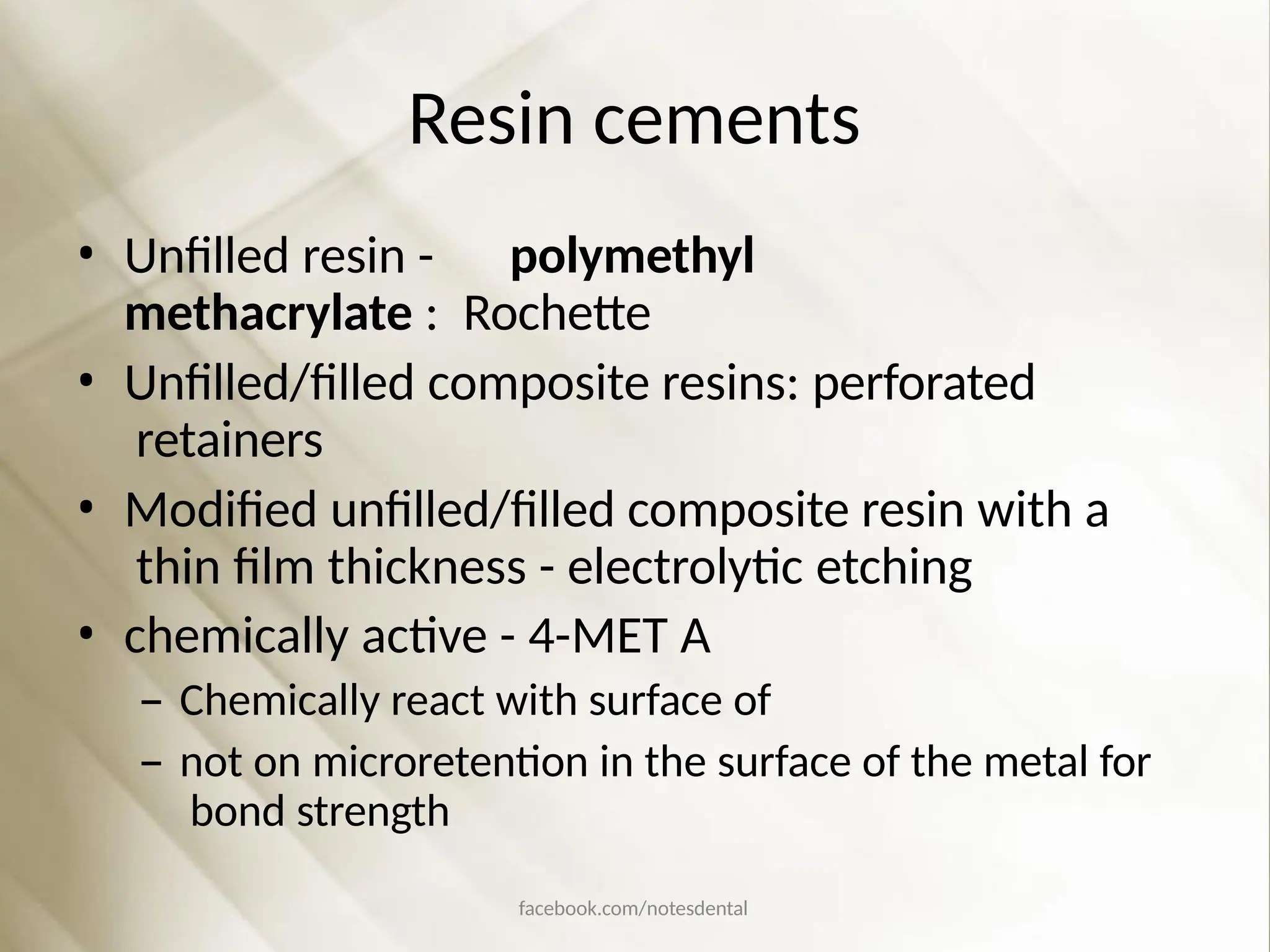
Resin cements
facebook.com/notesdental
• Unfilledresin - polymethyl
methacrylate : Rochette
• Unfilled/filled composite resins: perforated
retainers
• Modified unfilled/filled composite resin with a
thin film thickness - electrolytic etching
• chemically active - 4-MET A
– Chemically react with surface of
– not on microretention in the surface of the metal for
bond strength
20.
Advantag
e
facebook.com/notesdental
• Reduced cost
–not as significant as was first thought when little
or no preparation was involved
• No anesthetic needed
• Supragingival margins
• Rebonding Possible
• Minimal tooth preparation
– More conservative and less likely to create
problems in unblemished abutment teeth
21.
Disadvantages
facebook.com/notesdental
• Irreversible
• UncertainLongevity : some concern about the
longevity of this type of prosthesis
• No Space Correction: edentulous space is
significantly wider than the mesiodistal width
of the tooth that would normally occupy the
space
• No Alignment Correction
• Difficult Temporlzation
22.
Indications
• Replacement ofmissing
anterior teeth in
children and
adolescents
• Caries free abutment
teeth or unrestored
abutments
• Mandibular incisor
replacement
facebook.com/notesdental
23.
• Maxillary incisor
replacement
•Periodontal
splints
• Post orthodontic
stabilisation
• Prolonged placement of
interim prosthesis
facebook.com/notesdental
24.
• Prolonged placementof
interim prosthesis
• Single posterior tooth
replacement
• Significant clinical crown
length
• Excellent moisture
control
facebook.com/notesdental
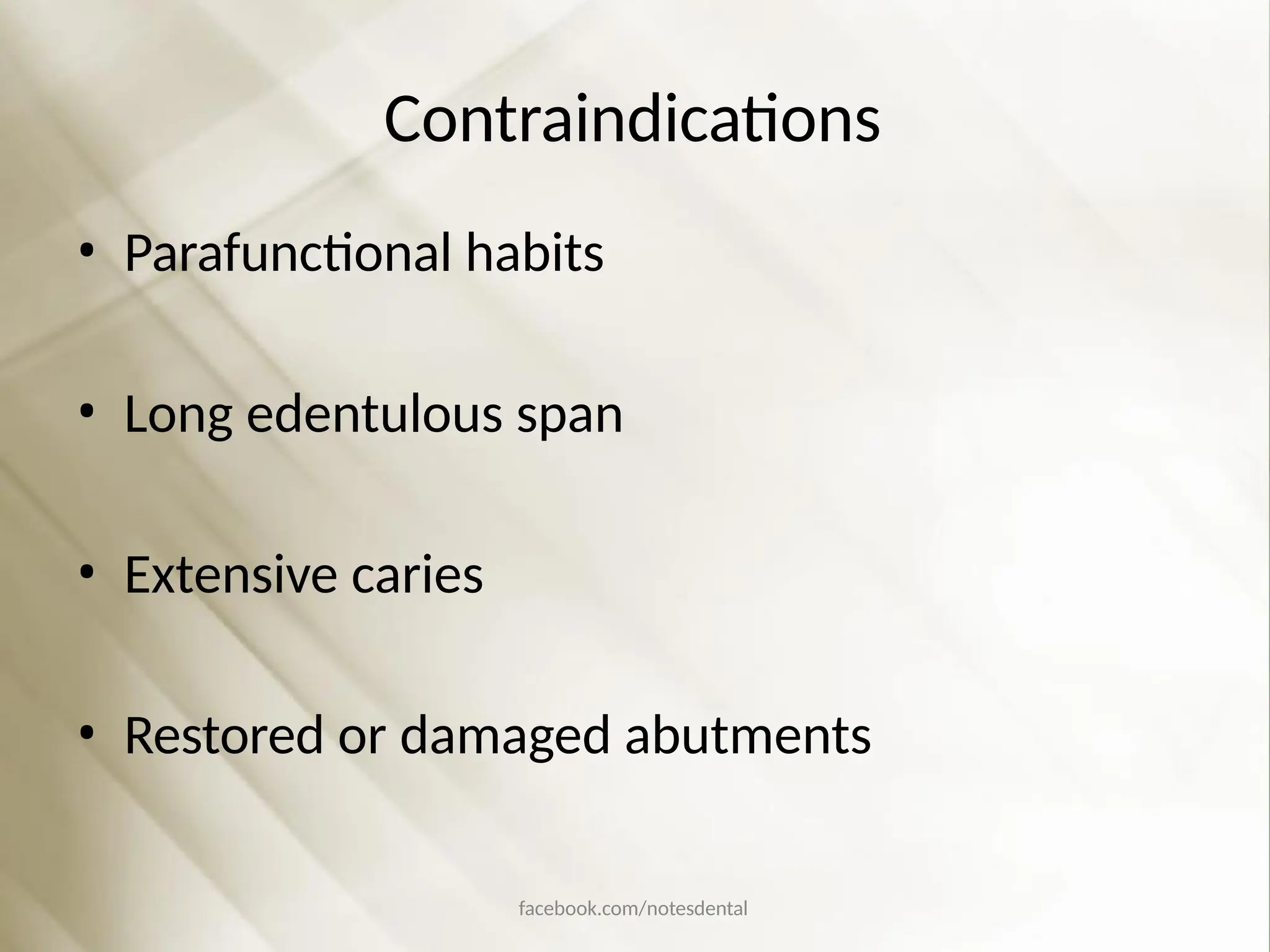
• Compromised enamel
•Nickel sensitivity
• Deep vertical overbite
• Incisors with thin faciolingual dimensions
facebook.com/notesdental
27.
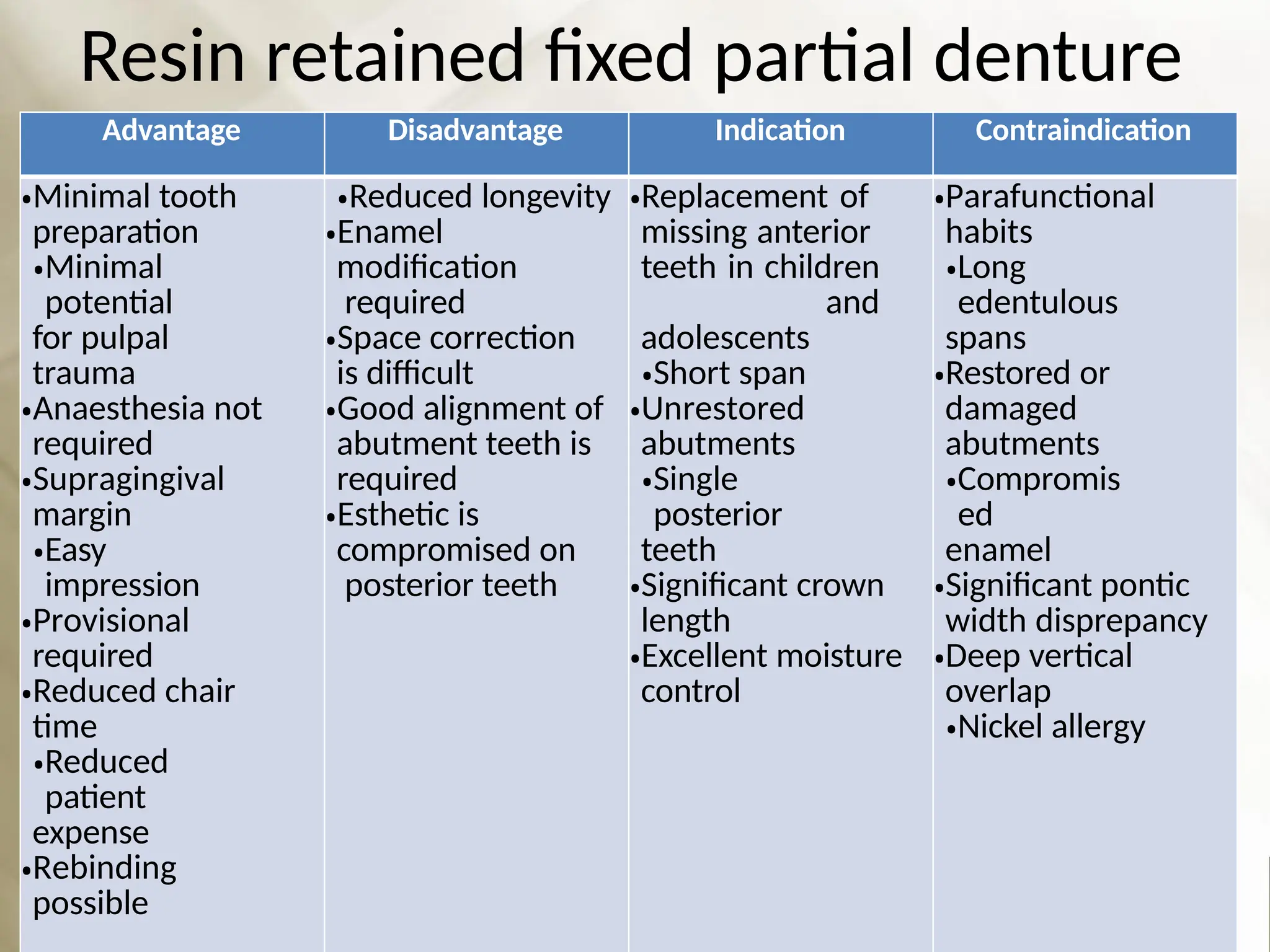
Resin retained fixedpartial denture
facebook.com/notesdental
Advantage Disadvantage Indication Contraindication
•Minimal tooth
preparation
•Minimal
potential
for pulpal
trauma
•Anaesthesia not
required
•Supragingival
margin
•Easy
impression
•Provisional
required
•Reduced chair
time
•Reduced
patient
expense
•Rebinding
possible
•Reduced longevity
•Enamel
modification
required
•Space correction
is difficult
•Good alignment of
abutment teeth is
required
•Esthetic is
compromised on
posterior teeth
•Replacement of
missing anterior
teeth in children
and
adolescents
•Short span
•Unrestored
abutments
•Single
posterior
teeth
•Significant crown
length
•Excellent moisture
control
•Parafunctional
habits
•Long
edentulous
spans
•Restored or
damaged
abutments
•Compromis
ed
enamel
•Significant pontic
width disprepancy
•Deep vertical
overlap
•Nickel allergy
28.
Refrences
facebook.com/notesdental
• T. Shillinburg.Fundamentals of Fixed
Prosthodontics, III edition
• T. Shillinburg. Fundamentals of Fixed
Prosthodontics, IV edition
• Rosenstiel, Land, Fujimoto. Contemperory
Fixed Prosthodontics, III edition