1.NEGATIVE NUMBERS 
A CARD GAME 
A game is played with black and white cards. Each player takes any tIme cards and then 
subtracts the number of black cards from the number of white cards. 
(Remember playing this game in thelesson Negative Numbers in class 7) 
For example, suppose one gets 6 white cards and 4 black cards. 
Then the number got is 
6 - 4 = 2 
What if the situation is reversed and one gets 4 white cards and 6 black cards? 
The number is 4 - 6 = -2 
NEGATIVE MULTIPLICATION 
Another game with black and white cards. The cards areall shuffled and kept face down. Players draw 
one card inturn. A white card adds 10 points to the current score,while a black card subtracts 5 points 
from the score. Thefirst to get 25 points (should be exactly 25) wins. 
Can you find their scores? 
Also find how many points each needs to win. 
Ammu first got a white and then a black. What was her score then? 
10 - 5 = 5 
This can be put another way: a black card gives -5 points and so Ammu’s score is 
10 + (-5) = 10 - 5 = 5 
Appu got both black in the first two draws. The first drawgave him -5 points. 
And then what happened to his scorewhen he drew the next black? 
-5 - 5 = -(5 + 5) = -10 
Appu’s score can be calculated like this also:
(-5) + (-5) = -(5 + 5) = -10 
Now we write 5 + 5 as 2 × 5. 
Like this, we can also write 
2 ´ (-5) = (-5) + (-5) = -10 
We have seen that 
(-5) + (-5) = -(5 + 5) 
Now, we can write this as 
2 ´ (-5) = -(5 + 5) = -(2 ´ 5) = -10 
So, what is the meaning of 3 ´ (-5)? 
3 ´ (-5) = -(3 ´ 5) = -15 
All these we can condense into a single algebraic statement: 
x ´ (-y) = -(xy), for all positive numbers x and y. 
ORDER IN MULTIPLICATION 
We know that 2 × 3 and 3 × 2 both give 6; that is, addingtwo 3’s or three 2’s give the same result, 6. 
In mathematical symbols, 
2 × 3 = 3 × 2 
Like this, are 2 × (-3) and (-3) × 2 equal? 
Let’s first see what each of these means. 
2 × (-3) meansadding two -3’s; that is (-3) + (-3). 
But what is (-3) × 2? 
There is no meaning in saying “minus three 2’s added together”. 
We have to give a new meaning to this operation. In the multiplication of natural numbers, 
we can take numbers in any order (for example, 2 × 3 = 3 × 2); so in this type of 
products also, it is convenient to have things that way.
So, we define (-3) × 2 as -6; that is 
(-3) × 2 = 2 × (-3) = -6 
In general, we define 
(-x) × y = -(xy), for all positive numbers x, y. 
SUMS AND PRODUCTS 
How much is (3 ´ 12) + (7 ´ 12)? 
There is an easier way than finding the two products and then adding, remember? 
(See the mental arithmetic problems at the end of the lesson, Shorthand Math in class 7.) 
(3 ´ 12) + (7 ´ 12) = (3 + 7) ´ 12 
= 10 ´ 12 
= 120 
What is the general principle that we used in all these? 
xz + yz = (x + y)z for all positive numbers x, y, z 
Can we do (3 ´ (-12)) + (7 ´ (-12)) like this? 
This means, first add -12 three times and then add -12seven times and finally add these. 
Instead we can add -12 ten times at one stroke, right? 
That is, 
(3 ´ (-12)) + (7 ´ (-12)) = (3 + 7) ´ (-12) 
= 10 ´ (-12) 
= -120 
Another multiplication 
What is (6 + (-4)) ´ 5? 
6 + (-4) = 6 - 4 = 2 , isn’t it? So, 
(6 + (-4)) ´ 5 = (6 - 4) ´ 5 = 2 ´ 5 = 10 
As before, if we multiply 6 and -4 separately by 5 andadd, will we get the same answer?
Let’s see: 
6 ´ 5 = 30 
(-4) ´ 5 = -(4 ´ 5) = -20 
So that 
(6 ´ 5) + (-4) ´ 5 = 30 + -20 = 30 - 20 = 10 
It turns out right, doesn’t it? 
That is, 
(6 + (-4)) ´ 5 = (6 ´ 5) + ((-4) ´ 5) 
Will this be right, if we take -5 instead 5? 
Let’s check. First let’s see what we get when we multiply the sum of 6 and -4 by -5: 
(6 + (-4)) ´ (-5) = 2 ´ (-5) = -10 
Now we must check whether this is equal to (6 ´ (-5)) + 
((-4) ´ (-5)). 
We have seen that 6 ´ (-5) = -(6 ´ 5) = -30 
But what is the meaning of (-4) ´ (-5)? 
We cannot define this as repeated addition; nor can wedefine the reversed product (-5) ´ (-4) as 
repeated addition. 
So we must give a new meaning to (-5) ´ (-4). 
And this new meaning must be such that (6 + (-4)) ´ (-5) 
and (6 ´ (-5)) + ((-4) ´(-5)) are equal. 
We have found the first of these expressions as 
(6 + (-4)) ´ (-5)= -10 
And in the second expression, we have found the first product 
6 ´ (-5) = -30 
GENERAL PRINCIPLES
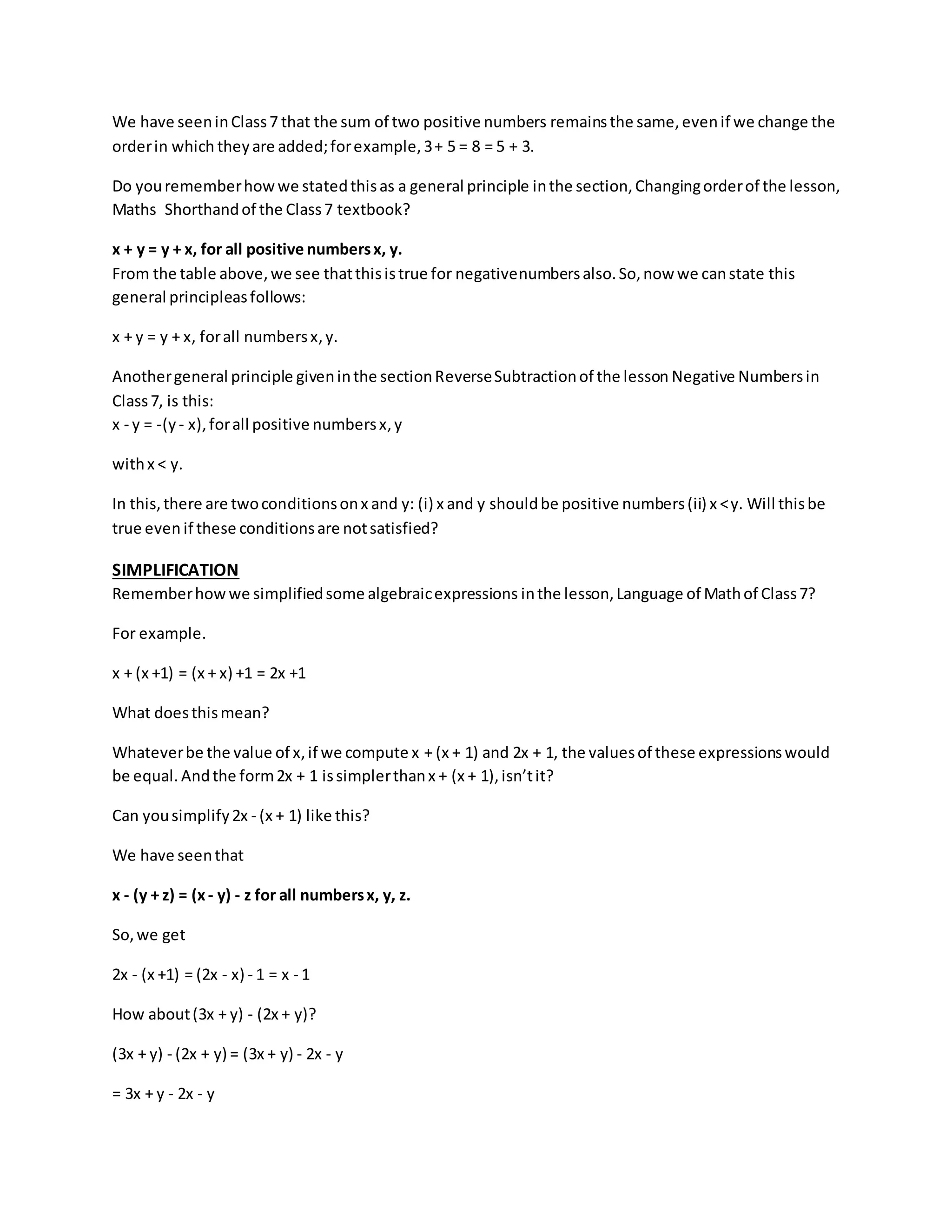
We have seen in Class 7 that the sum of two positive numbers remains the same, even if we change the 
order in which they are added; for example, 3 + 5 = 8 = 5 + 3. 
Do you remember how we stated this as a general principle in the section, Changing order of the lesson, 
Maths Shorthand of the Class 7 textbook? 
x + y = y + x, for all positive numbers x, y. 
From the table above, we see that this is true for negativenumbers also. So, now we can state this 
general principleas follows: 
x + y = y + x, for all numbers x, y. 
Another general principle given in the section Reverse Subtraction of the lesson Negative Numbers in 
Class 7, is this: 
x - y = -(y - x), for all positive numbers x, y 
with x < y. 
In this, there are two conditions on x and y: (i) x and y should be positive numbers (ii) x < y. Will this be 
true even if these conditions are not satisfied? 
SIMPLIFICATION 
Remember how we simplified some algebraic expressions in the lesson, Language of Math of Class 7? 
For example. 
x + (x +1) = (x + x) +1 = 2x +1 
What does this mean? 
Whatever be the value of x, if we compute x + (x + 1) and 2x + 1, the values of these expressions would 
be equal. And the form 2x + 1 is simpler than x + (x + 1), isn’t it? 
Can you simplify 2x - (x + 1) like this? 
We have seen that 
x - (y + z) = (x - y) - z for all numbers x, y, z. 
So, we get 
2x - (x +1) = (2x - x) - 1 = x - 1 
How about (3x + y) - (2x + y)? 
(3x + y) - (2x + y) = (3x + y) - 2x - y 
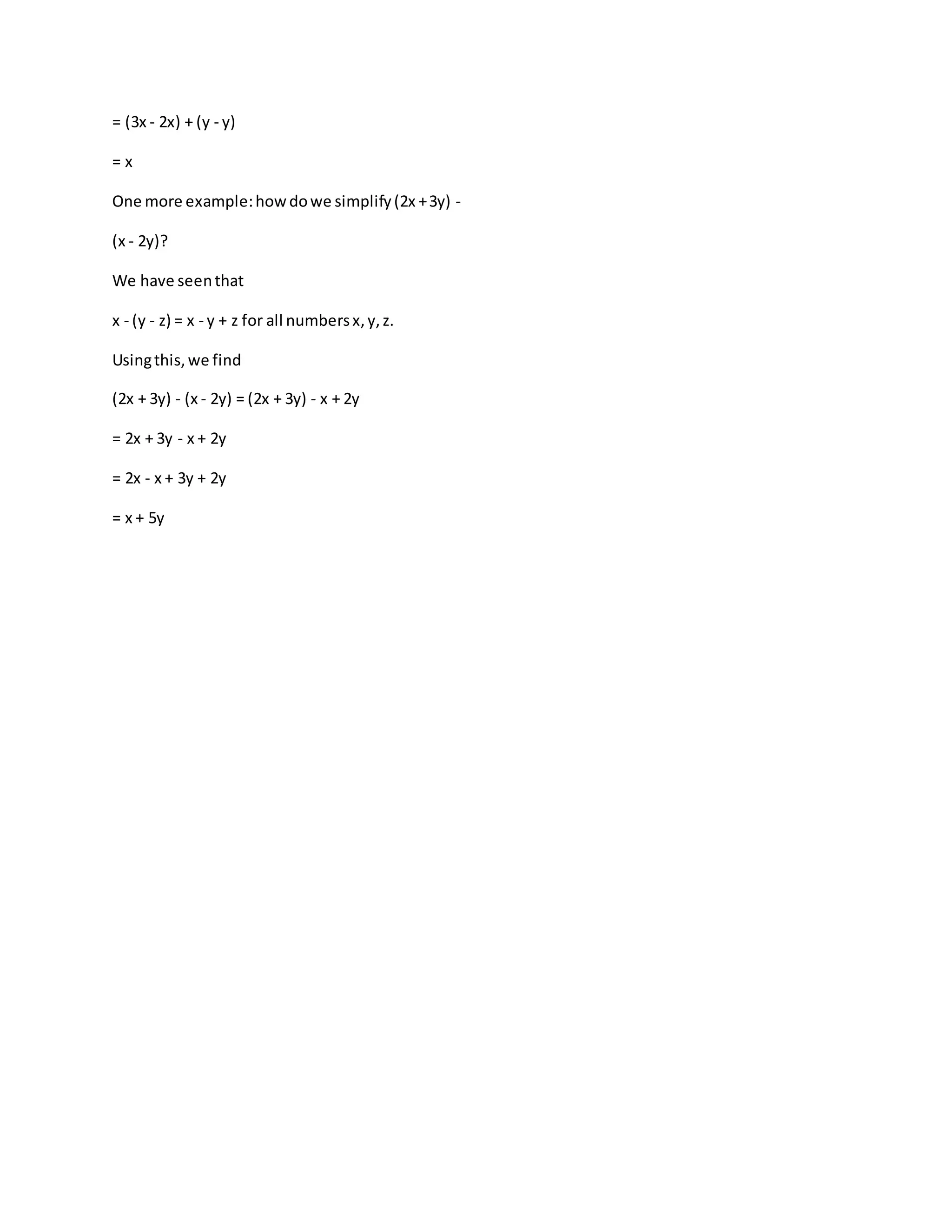
= 3x + y - 2x - y
= (3x - 2x) + (y - y) 
= x 
One more example: how do we simplify (2x + 3y) - 
(x - 2y)? 
We have seen that 
x - (y - z) = x - y + z for all numbers x, y, z. 
Using this, we find 
(2x + 3y) - (x - 2y) = (2x + 3y) - x + 2y 
= 2x + 3y - x + 2y 
= 2x - x + 3y + 2y 
= x + 5y

Reshma digital textbook

  • 1.
    1.NEGATIVE NUMBERS ACARD GAME A game is played with black and white cards. Each player takes any tIme cards and then subtracts the number of black cards from the number of white cards. (Remember playing this game in thelesson Negative Numbers in class 7) For example, suppose one gets 6 white cards and 4 black cards. Then the number got is 6 - 4 = 2 What if the situation is reversed and one gets 4 white cards and 6 black cards? The number is 4 - 6 = -2 NEGATIVE MULTIPLICATION Another game with black and white cards. The cards areall shuffled and kept face down. Players draw one card inturn. A white card adds 10 points to the current score,while a black card subtracts 5 points from the score. Thefirst to get 25 points (should be exactly 25) wins. Can you find their scores? Also find how many points each needs to win. Ammu first got a white and then a black. What was her score then? 10 - 5 = 5 This can be put another way: a black card gives -5 points and so Ammu’s score is 10 + (-5) = 10 - 5 = 5 Appu got both black in the first two draws. The first drawgave him -5 points. And then what happened to his scorewhen he drew the next black? -5 - 5 = -(5 + 5) = -10 Appu’s score can be calculated like this also:
  • 2.
    (-5) + (-5)= -(5 + 5) = -10 Now we write 5 + 5 as 2 × 5. Like this, we can also write 2 ´ (-5) = (-5) + (-5) = -10 We have seen that (-5) + (-5) = -(5 + 5) Now, we can write this as 2 ´ (-5) = -(5 + 5) = -(2 ´ 5) = -10 So, what is the meaning of 3 ´ (-5)? 3 ´ (-5) = -(3 ´ 5) = -15 All these we can condense into a single algebraic statement: x ´ (-y) = -(xy), for all positive numbers x and y. ORDER IN MULTIPLICATION We know that 2 × 3 and 3 × 2 both give 6; that is, addingtwo 3’s or three 2’s give the same result, 6. In mathematical symbols, 2 × 3 = 3 × 2 Like this, are 2 × (-3) and (-3) × 2 equal? Let’s first see what each of these means. 2 × (-3) meansadding two -3’s; that is (-3) + (-3). But what is (-3) × 2? There is no meaning in saying “minus three 2’s added together”. We have to give a new meaning to this operation. In the multiplication of natural numbers, we can take numbers in any order (for example, 2 × 3 = 3 × 2); so in this type of products also, it is convenient to have things that way.
  • 3.
    So, we define(-3) × 2 as -6; that is (-3) × 2 = 2 × (-3) = -6 In general, we define (-x) × y = -(xy), for all positive numbers x, y. SUMS AND PRODUCTS How much is (3 ´ 12) + (7 ´ 12)? There is an easier way than finding the two products and then adding, remember? (See the mental arithmetic problems at the end of the lesson, Shorthand Math in class 7.) (3 ´ 12) + (7 ´ 12) = (3 + 7) ´ 12 = 10 ´ 12 = 120 What is the general principle that we used in all these? xz + yz = (x + y)z for all positive numbers x, y, z Can we do (3 ´ (-12)) + (7 ´ (-12)) like this? This means, first add -12 three times and then add -12seven times and finally add these. Instead we can add -12 ten times at one stroke, right? That is, (3 ´ (-12)) + (7 ´ (-12)) = (3 + 7) ´ (-12) = 10 ´ (-12) = -120 Another multiplication What is (6 + (-4)) ´ 5? 6 + (-4) = 6 - 4 = 2 , isn’t it? So, (6 + (-4)) ´ 5 = (6 - 4) ´ 5 = 2 ´ 5 = 10 As before, if we multiply 6 and -4 separately by 5 andadd, will we get the same answer?
  • 4.
    Let’s see: 6´ 5 = 30 (-4) ´ 5 = -(4 ´ 5) = -20 So that (6 ´ 5) + (-4) ´ 5 = 30 + -20 = 30 - 20 = 10 It turns out right, doesn’t it? That is, (6 + (-4)) ´ 5 = (6 ´ 5) + ((-4) ´ 5) Will this be right, if we take -5 instead 5? Let’s check. First let’s see what we get when we multiply the sum of 6 and -4 by -5: (6 + (-4)) ´ (-5) = 2 ´ (-5) = -10 Now we must check whether this is equal to (6 ´ (-5)) + ((-4) ´ (-5)). We have seen that 6 ´ (-5) = -(6 ´ 5) = -30 But what is the meaning of (-4) ´ (-5)? We cannot define this as repeated addition; nor can wedefine the reversed product (-5) ´ (-4) as repeated addition. So we must give a new meaning to (-5) ´ (-4). And this new meaning must be such that (6 + (-4)) ´ (-5) and (6 ´ (-5)) + ((-4) ´(-5)) are equal. We have found the first of these expressions as (6 + (-4)) ´ (-5)= -10 And in the second expression, we have found the first product 6 ´ (-5) = -30 GENERAL PRINCIPLES
  • 5.
    We have seenin Class 7 that the sum of two positive numbers remains the same, even if we change the order in which they are added; for example, 3 + 5 = 8 = 5 + 3. Do you remember how we stated this as a general principle in the section, Changing order of the lesson, Maths Shorthand of the Class 7 textbook? x + y = y + x, for all positive numbers x, y. From the table above, we see that this is true for negativenumbers also. So, now we can state this general principleas follows: x + y = y + x, for all numbers x, y. Another general principle given in the section Reverse Subtraction of the lesson Negative Numbers in Class 7, is this: x - y = -(y - x), for all positive numbers x, y with x < y. In this, there are two conditions on x and y: (i) x and y should be positive numbers (ii) x < y. Will this be true even if these conditions are not satisfied? SIMPLIFICATION Remember how we simplified some algebraic expressions in the lesson, Language of Math of Class 7? For example. x + (x +1) = (x + x) +1 = 2x +1 What does this mean? Whatever be the value of x, if we compute x + (x + 1) and 2x + 1, the values of these expressions would be equal. And the form 2x + 1 is simpler than x + (x + 1), isn’t it? Can you simplify 2x - (x + 1) like this? We have seen that x - (y + z) = (x - y) - z for all numbers x, y, z. So, we get 2x - (x +1) = (2x - x) - 1 = x - 1 How about (3x + y) - (2x + y)? (3x + y) - (2x + y) = (3x + y) - 2x - y = 3x + y - 2x - y
  • 6.
    = (3x -2x) + (y - y) = x One more example: how do we simplify (2x + 3y) - (x - 2y)? We have seen that x - (y - z) = x - y + z for all numbers x, y, z. Using this, we find (2x + 3y) - (x - 2y) = (2x + 3y) - x + 2y = 2x + 3y - x + 2y = 2x - x + 3y + 2y = x + 5y