RESERVOIR FLUID
CLASSIFICATION
BY: HASHIR ALI SIDDIQUI
PG-30
RESERVOIR FLUID TYPES
• Black Oils
• Volatile Oils
• Condensate (Retrograde Gas)
• Wet Gas (Rich Gas)
• Dry Gas
BLACK OILS
Black oils are made up of a variety of components including large, heavy,
and non-volatile hydrocarbons.
Black oils are dark in color indicating the presence of heavy
hydrocarbons.
It is characterized as having initial gas-oil ratios of 2000 scf/stb or less,
and the stock tank gravity is usually 45° API or less.
VOLATILE OIL
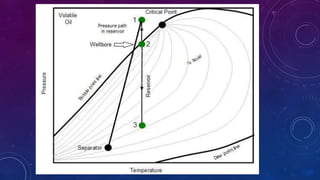
Volatile oils contain fewer heavy molecules and more intermediate
components (ethane through hexane) than black oils.
Volatile oils generally have initial gas-oil ratios in the 2000 to 3300
scf/Bbl range, and the stock tank gravity is usually 40° API or
higher.
The color is generally lighter than black oil – brown, orange, or
green. Gas associated with volatile oils tends to be very rich and
similar to retrograde condensate gas.
CONDENSATE (RETROGRADE GAS)
Condensate gas is very similar to volatile oils in terms of the colour
(green, orange, brown, even clear)
It is characterized as having initial gas-oil ratios is equal to 3300 scf/stb
or greater and stock tank oil gravity is in between (40° to 60° API).
 However, the reservoir temperature of a condensate gas reservoir is
greater than the critical temperature of the fluid, and so where a
volatile oil is a liquid at original reservoir pressure and temperature, a
condensate gas is a gas.
WET GAS (RICH GAS)
Natural gas that contains significant heavy hydrocarbons such as propane,
butane and other liquid hydrocarbons is known as wet gas or rich gas
The general rule of thumb is if the gas contains less methane (typically less
than 85% methane) and more ethane, and other more complex
hydrocarbons, it is labelled as wet gas.
Wet GOR are very high ( > 50000 scf/stb) for wet gases. However, the gravity
of the stock tank liquid does not change during the life of the
reservoir(remains constant).
DRY GAS
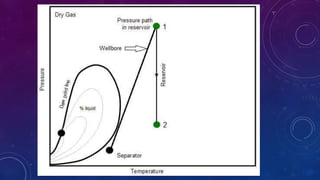
Natural gas that occurs in the absence of condensate or liquid
hydrocarbons, or gas that had condensable hydrocarbons
removed, is called dry gas.
 It is primarily methane with some intermediates.
The hydrocarbon mixture is solely gas in the reservoir and there is
no liquid (condensate surface liquid) formed either in the reservoir
or at surface.
THANK YOU

Reservoir fluid classification

  • 1.
  • 2.
    RESERVOIR FLUID TYPES •Black Oils • Volatile Oils • Condensate (Retrograde Gas) • Wet Gas (Rich Gas) • Dry Gas
  • 3.
    BLACK OILS Black oilsare made up of a variety of components including large, heavy, and non-volatile hydrocarbons. Black oils are dark in color indicating the presence of heavy hydrocarbons. It is characterized as having initial gas-oil ratios of 2000 scf/stb or less, and the stock tank gravity is usually 45° API or less.
  • 5.
    VOLATILE OIL Volatile oilscontain fewer heavy molecules and more intermediate components (ethane through hexane) than black oils. Volatile oils generally have initial gas-oil ratios in the 2000 to 3300 scf/Bbl range, and the stock tank gravity is usually 40° API or higher. The color is generally lighter than black oil – brown, orange, or green. Gas associated with volatile oils tends to be very rich and similar to retrograde condensate gas.
  • 7.
    CONDENSATE (RETROGRADE GAS) Condensategas is very similar to volatile oils in terms of the colour (green, orange, brown, even clear) It is characterized as having initial gas-oil ratios is equal to 3300 scf/stb or greater and stock tank oil gravity is in between (40° to 60° API).  However, the reservoir temperature of a condensate gas reservoir is greater than the critical temperature of the fluid, and so where a volatile oil is a liquid at original reservoir pressure and temperature, a condensate gas is a gas.
  • 9.
    WET GAS (RICHGAS) Natural gas that contains significant heavy hydrocarbons such as propane, butane and other liquid hydrocarbons is known as wet gas or rich gas The general rule of thumb is if the gas contains less methane (typically less than 85% methane) and more ethane, and other more complex hydrocarbons, it is labelled as wet gas. Wet GOR are very high ( > 50000 scf/stb) for wet gases. However, the gravity of the stock tank liquid does not change during the life of the reservoir(remains constant).
  • 11.
    DRY GAS Natural gasthat occurs in the absence of condensate or liquid hydrocarbons, or gas that had condensable hydrocarbons removed, is called dry gas.  It is primarily methane with some intermediates. The hydrocarbon mixture is solely gas in the reservoir and there is no liquid (condensate surface liquid) formed either in the reservoir or at surface.
  • 13.