
Begin with your topic
Choose a topic first.
Do not create a narrowly focused thesis
statement before you begin your research.
Why not? Because you may not find enough
information to support your narrow thesis
statement.
Instead, think of a research question.

For example
Let’s say for your research paper, you decide to
explore the topic of sharks.
Since it’s an argumentative paper, you write
your thesis statement this way, “Sharks are a
clear danger to people who swim in the ocean,
so sharks should be exterminated from the
ocean and only allowed to live in aquariums.”

For example (cont.)
You begin your research and find that sharks
attack people in the U.S. an average of 19 times
per year, and there is only a fatality every
couple of years.
In addition, apparently toilets, buckets, and air
fresheners cause more human injury per year
than do sharks.

For example (cont.)
So in your original thesis statement, you have
identified a problem that is not as pervasive as
you originally thought, and your method for
solving the problem is overly aggressive.
Now you have to re-think both your thesis
statement and your research sources.

Research tip: Create a
research question.
Instead of starting with a thesis statement,
begin with a research question.
For example: “What are some problems in the
world associated with sharks?”

Research Question:
Problems with Sharks
In your research, you find that the real problem
is not the danger sharks pose to humans but the
danger humans pose to sharks.
You find that sharks are endangered because
their fins are valued as an ingredient in soup.
Now you have a research topic: “sharks
endangered because of their fins.”

Resources for Research
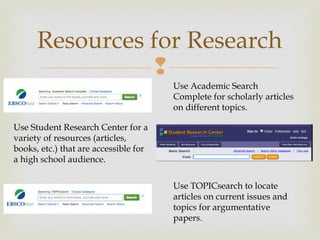
Use Academic Search
Complete for scholarly articles
on different topics.
Use Student Research Center for a
variety of resources (articles,
books, etc.) that are accessible for
a high school audience.
Use TOPICsearch to locate
articles on current issues and
topics for argumentative
papers.

Resources for Research
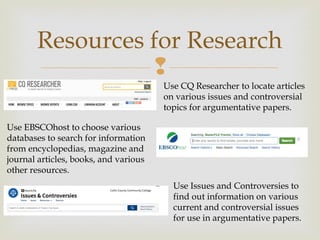
Use CQ Researcher to locate articles
on various issues and controversial
topics for argumentative papers.
Use EBSCOhost to choose various
databases to search for information
from encyclopedias, magazine and
journal articles, books, and various
other resources.
Use Issues and Controversies to
find out information on various
current and controversial issues
for use in argumentative papers.

Resources for Research
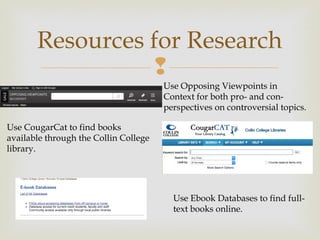
Use Opposing Viewpoints in
Context for both pro- and con-
perspectives on controversial topics.
Use CougarCat to find books
available through the Collin College
library.
Use Ebook Databases to find full-
text books online.

Research tip: Use one of the nine
resources listed before consulting
Google!
Why?
•Because professors are skeptical of information
found using a Google search
•Because the information you find using a
Google search is more likely to be biased or
unreliable than the information you find using a
library resource

Begin your research
Let’s revisit our topic about sharks as an
endangered animal because their fins are used in
soups. We’ll use some of the resources listed
previously to find information.

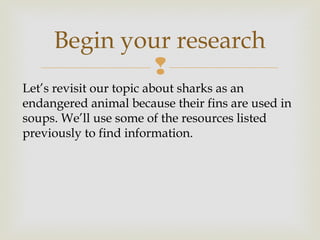
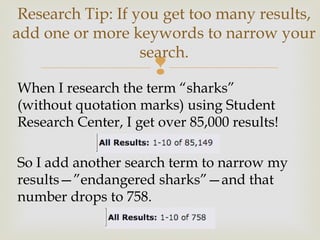
When I research the term “sharks”
(without quotation marks) using Student
Research Center, I get over 85,000 results!
So I add another search term to narrow my
results—”endangered sharks”—and that
number drops to 758.
Research Tip: If you get too many results,
add one or more keywords to narrow your
search.

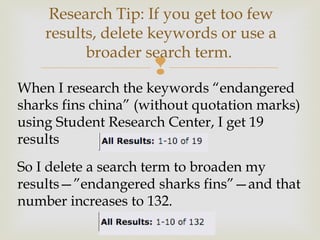
When I research the keywords “endangered
sharks fins china” (without quotation marks)
using Student Research Center, I get 19
results
So I delete a search term to broaden my
results—”endangered sharks fins”—and that
number increases to 132.
Research Tip: If you get too few
results, delete keywords or use a
broader search term.

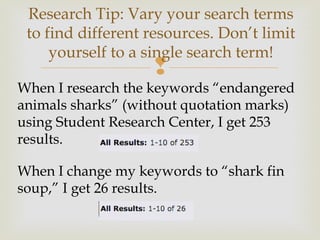
When I research the keywords “endangered
animals sharks” (without quotation marks)
using Student Research Center, I get 253
results.
When I change my keywords to “shark fin
soup,” I get 26 results.
Research Tip: Vary your search terms
to find different resources. Don’t limit
yourself to a single search term!

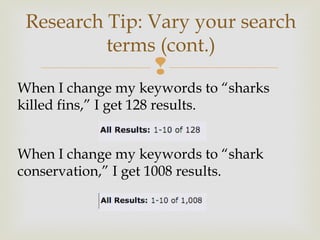
When I change my keywords to “sharks
killed fins,” I get 128 results.
When I change my keywords to “shark
conservation,” I get 1008 results.
Research Tip: Vary your search
terms (cont.)

If you can’t think of multiple keywords to use
in your search,
•Use your research to come up with new
keywords.
•Ask your professor for ideas for new
keywords.
•Ask a librarian for ideas for new keywords.
Research Tip: Get help if
you need it.

Research Tip: Read the article abstract
if there is one or scan the article itself.
Why?
Because an article may pop up in your
search that has nothing to do with your
topic. Just because it is in your results page
doesn’t mean it is directly related to your
topic.

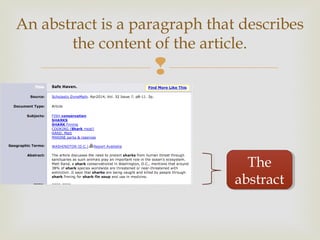
An abstract is a paragraph that describes
the content of the article.
The
abstract
The
abstract

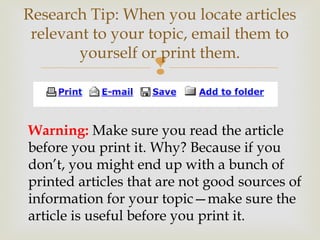
Research Tip: When you locate articles
relevant to your topic, email them to
yourself or print them.
Warning: Make sure you read the article
before you print it. Why? Because if you
don’t, you might end up with a bunch of
printed articles that are not good sources of
information for your topic—make sure the
article is useful before you print it.

Research Tip: Scan articles for
useful quotes.
Just because the overall article is not
directly related to your topic doesn’t mean
that you can’t find useful sentences or
paragraphs in the article that you can quote
in your paper.
Remember, you don’t have to use an entire
article. You can just quote parts of it in your
paper.

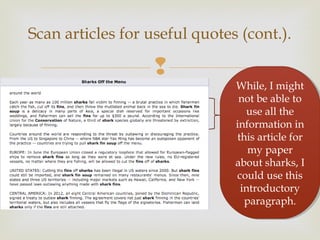
Scan articles for useful quotes (cont.).
While, I might
not be able to
use all the
information in
this article for
my paper
about sharks, I
could use this
introductory
paragraph.
While, I might
not be able to
use all the
information in
this article for
my paper
about sharks, I
could use this
introductory
paragraph.

Research Tips
• Begin with a research question instead of
a thesis statement.
• Use a library database to do your research
instead of relying on Google.
• If you get too many results, add one or
more keywords to narrow your search.
• If you get too few results, delete keywords
or use a broader search term.

Research Tips (Cont.)
• Try different search terms (i.e. keywords)
to find different resources.
• Get help if you need it.
• Read the article abstract if there is one or
scan the article itself.
• Scan articles for useful quotes.

Questions
• Ask a knowledgeable peer for help.
• Ask a teacher for help.
• Ask a librarian for help.
• Ask your professor for help.
• Use Google to ask a specific question.

Research strategies

  • 2.
     Begin with yourtopic Choose a topic first. Do not create a narrowly focused thesis statement before you begin your research. Why not? Because you may not find enough information to support your narrow thesis statement. Instead, think of a research question.
  • 3.
     For example Let’s sayfor your research paper, you decide to explore the topic of sharks. Since it’s an argumentative paper, you write your thesis statement this way, “Sharks are a clear danger to people who swim in the ocean, so sharks should be exterminated from the ocean and only allowed to live in aquariums.”
  • 4.
     For example (cont.) Youbegin your research and find that sharks attack people in the U.S. an average of 19 times per year, and there is only a fatality every couple of years. In addition, apparently toilets, buckets, and air fresheners cause more human injury per year than do sharks.
  • 5.
     For example (cont.) Soin your original thesis statement, you have identified a problem that is not as pervasive as you originally thought, and your method for solving the problem is overly aggressive. Now you have to re-think both your thesis statement and your research sources.
  • 6.
     Research tip: Createa research question. Instead of starting with a thesis statement, begin with a research question. For example: “What are some problems in the world associated with sharks?”
  • 7.
     Research Question: Problems withSharks In your research, you find that the real problem is not the danger sharks pose to humans but the danger humans pose to sharks. You find that sharks are endangered because their fins are valued as an ingredient in soup. Now you have a research topic: “sharks endangered because of their fins.”
  • 8.
     Resources for Research UseAcademic Search Complete for scholarly articles on different topics. Use Student Research Center for a variety of resources (articles, books, etc.) that are accessible for a high school audience. Use TOPICsearch to locate articles on current issues and topics for argumentative papers.
  • 9.
     Resources for Research UseCQ Researcher to locate articles on various issues and controversial topics for argumentative papers. Use EBSCOhost to choose various databases to search for information from encyclopedias, magazine and journal articles, books, and various other resources. Use Issues and Controversies to find out information on various current and controversial issues for use in argumentative papers.
  • 10.
     Resources for Research UseOpposing Viewpoints in Context for both pro- and con- perspectives on controversial topics. Use CougarCat to find books available through the Collin College library. Use Ebook Databases to find full- text books online.
  • 11.
     Research tip: Useone of the nine resources listed before consulting Google! Why? •Because professors are skeptical of information found using a Google search •Because the information you find using a Google search is more likely to be biased or unreliable than the information you find using a library resource
  • 12.
     Begin your research Let’srevisit our topic about sharks as an endangered animal because their fins are used in soups. We’ll use some of the resources listed previously to find information.
  • 13.
     When I researchthe term “sharks” (without quotation marks) using Student Research Center, I get over 85,000 results! So I add another search term to narrow my results—”endangered sharks”—and that number drops to 758. Research Tip: If you get too many results, add one or more keywords to narrow your search.
  • 14.
     When I researchthe keywords “endangered sharks fins china” (without quotation marks) using Student Research Center, I get 19 results So I delete a search term to broaden my results—”endangered sharks fins”—and that number increases to 132. Research Tip: If you get too few results, delete keywords or use a broader search term.
  • 15.
     When I researchthe keywords “endangered animals sharks” (without quotation marks) using Student Research Center, I get 253 results. When I change my keywords to “shark fin soup,” I get 26 results. Research Tip: Vary your search terms to find different resources. Don’t limit yourself to a single search term!
  • 16.
     When I changemy keywords to “sharks killed fins,” I get 128 results. When I change my keywords to “shark conservation,” I get 1008 results. Research Tip: Vary your search terms (cont.)
  • 17.
     If you can’tthink of multiple keywords to use in your search, •Use your research to come up with new keywords. •Ask your professor for ideas for new keywords. •Ask a librarian for ideas for new keywords. Research Tip: Get help if you need it.
  • 18.
     Research Tip: Readthe article abstract if there is one or scan the article itself. Why? Because an article may pop up in your search that has nothing to do with your topic. Just because it is in your results page doesn’t mean it is directly related to your topic.
  • 19.
     An abstract isa paragraph that describes the content of the article. The abstract The abstract
  • 20.
     Research Tip: Whenyou locate articles relevant to your topic, email them to yourself or print them. Warning: Make sure you read the article before you print it. Why? Because if you don’t, you might end up with a bunch of printed articles that are not good sources of information for your topic—make sure the article is useful before you print it.
  • 21.
     Research Tip: Scanarticles for useful quotes. Just because the overall article is not directly related to your topic doesn’t mean that you can’t find useful sentences or paragraphs in the article that you can quote in your paper. Remember, you don’t have to use an entire article. You can just quote parts of it in your paper.
  • 22.
     Scan articles foruseful quotes (cont.). While, I might not be able to use all the information in this article for my paper about sharks, I could use this introductory paragraph. While, I might not be able to use all the information in this article for my paper about sharks, I could use this introductory paragraph.
  • 23.
     Research Tips • Beginwith a research question instead of a thesis statement. • Use a library database to do your research instead of relying on Google. • If you get too many results, add one or more keywords to narrow your search. • If you get too few results, delete keywords or use a broader search term.
  • 24.
     Research Tips (Cont.) •Try different search terms (i.e. keywords) to find different resources. • Get help if you need it. • Read the article abstract if there is one or scan the article itself. • Scan articles for useful quotes.
  • 25.
     Questions • Ask aknowledgeable peer for help. • Ask a teacher for help. • Ask a librarian for help. • Ask your professor for help. • Use Google to ask a specific question.