WHAT IS
RESEARCH?
RESEARCH DEFINED:
“systematic inquiry that is
designed to collect, analyze, and
interpret data to understand,
describe, or predict phenomenon”
Mertens (2015).
RESEARCH DEFINED:
“the formal and disciplined
application of scientific inquiry to
the study of problems” Navarro
and Santos (2011).
IMPORTANCE OF RESEARCH
Gather Relevant Information
Used as a springboard
Improve Quality of Life
Major breakthroughs
IMPORTANCE OF RESEARCH
Understand History
Providing possible solutions
Personal & Professional
Development
Widen perspective
More challenging & exciting world
of learning
Introduction to Qualitative Research Essential
LESSON 1:
NATURE & IMPORTANCE
OF RESEARCH
PERSONAL & PRACTICAL BENEFITS
Good decision maker
Good problem solver
Good critical and creative
thinker
Good contributor of knowledge
CHARACTERISTICS OF A GOOD RESEARCH
Research is EMPIRICAL.
Thorough investigation
Research is ANALYTICAL.
Arrives to a conclusion
CHARACTERISTICS OF A GOOD RESEARCH
Research is SYSTEMATIC.
Obtain objective data
Research is CYCLICAL.
Steps in research process
CHARACTERISTICS OF A GOOD RESEARCH
Research is ORIGINAL.
Novel ideas
RESEARCH PROCESS
 DEFINE YOUR TOPIC
 WRITE YOUR PROBLEM STATEMENT
 MAKE AN OUTLINE
 DEVELOP A RESEARCH STRATEGY
 EVALUATE YOUR SOURCES
 WRITE & REVISE YOUR PAPER
 DOCUMENT YOUR SOURCES
RESEARCH PROCESS
 DEFINE YOUR TOPIC
 Chosen topic will directly affect the research process.
 To lessen your time in gathering data, choose your topic
wisely.
RESEARCH PROCESS
 WRITE YOUR PROBLEM
STATEMENT
 Describes what is to be tested during the entire research
process or questions that the research aim to answer.
RESEARCH PROCESS
 MAKE AN OUTLINE
 Write down all the relevant data, then logically organize your
answer.
RESEARCH PROCESS
 DEVELOP A RESEARCH STRATEGY
 Minimizes the time and effort you will be putting on your
paper.
 Serves as a guide in setting out the objectives and priorities.
RESEARCH PROCESS
 EVALUATE YOUR SOURCES
 Check the quality and credibility of the sources to be used in
the study.
RESEARCH PROCESS
 WRITE & REVISE YOUR PAPER
 Contents are in line with the chosen topic
 DOCUMENT YOUR SOURCES
 It shows the credibility of the writer.
ETHICS IN RESEARCH
 Honesty
 Objectivity
 Integrity
 Carefulness
 Openness
 Respect for
Intellectual
Property
 Confidentiality
 Social Responsibility
 Competence
 Legality
 Animal Care
 Human Subject
Protection
ETHICS IN RESEARCH
HONESTY
Strive for honesty in all scientific
communications;
Reports data, results methods and
procedures and publication status;
Do not fabricate, falsify, or misinterpret
data.
ETHICS IN RESEARCH
OBJECTIVITY
Strive to avoid bias in experimental design,
data analysis, data interpretation, peer review,
personal decision, grant writing, expert
testimony, and other aspects of research where
objectivity is expected or required.
Avoid or minimize bias or self-deception.
ETHICS IN RESEARCH
INTEGRITY
Keep your promises and agreements;
acts with sincerity; strive for
consistency of thought and action.
ETHICS IN RESEARCH
CAREFULNESS
Avoid careless errors and negligence;
carefully and critically examine your own
work.
Keep good records of research activities
such as data collection, research design, and
correspondence with agencies.
ETHICS IN RESEARCH
OPENNESS
Share data, results, ideas, tools,
resources.
Be open to criticism and new ideas.
ETHICS IN RESEARCH
RESPECT FOR INTELLECTUAL
PROPERTY
Honor patents, copyrights, and other
forms of intellectual property.
Do not use unpublished data,
methods, or results without permission.
Give credit where credit is due.
Never plagarize.
ETHICS IN RESEARCH
CONFIDENTIALITY
Protect confidential communications
and personal information f your
respondents, if any.
ETHICS IN RESEARCH
SOCIAL RESPONSIBILTY
Strive to promote social good and
prevent or mitigate social harms
through research, public education, and
advocacy.
ETHICS IN RESEARCH
COMPETENCE
Maintain and improve your own
professional competence and expertise
through lifelong education, and
advocacy.
ETHICS IN RESEARCH
LEGALITY
Know and obey relevant laws and
institutional and governmental policies.
ETHICS IN RESEARCH
ANIMAL CARE
Show proper respect and care for
animals when using them in research.
Do not conduct unnecessary or poorly
designed animal experiments.
ETHICS IN RESEARCH
HUMAN SUBJECTS
PROTECTION
Minimize harm and risks and maximize
benefits; respect human dignity, privacy,
and autonomy; take special precaution
with vulnerable populations; and strive
to distribute the benefits and burdens of
research fairly.
LESSON 2:
QUALITATIVE
VERSUS
QUANTITATIVE
RESEARCH
QUALITATIVE RESEACH
Collect data in the form of words or
statements
Qualitative observation
Use of senses
Researchers are the instruments
QUANTITATIVE RESEARCH
 Collect data in the from of numbers
 Quantitative observation
 Age, sex, height, weight
 Use of statistical tools
 Researchers use survey questionnaires
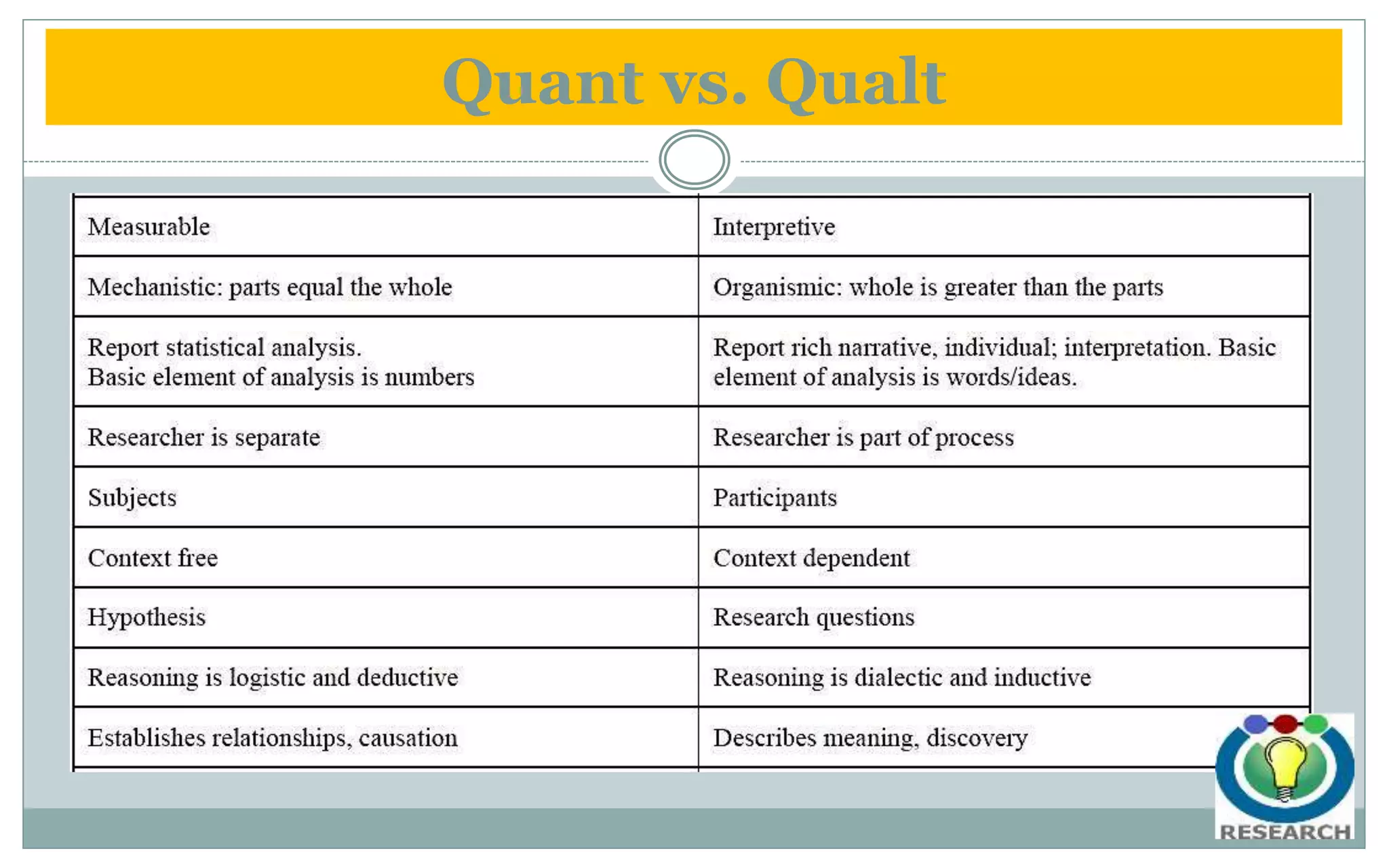
Quant vs. Qualt
Quant vs. Qualt
LESSON 3:
CLOSER LOOK ON
QUALITATIVE
RESEARCH
QUALITATIVE RESEACH
Studies that investigate the quality
of relationship, activities,
situations or materials. (Fraenkel
and Wallen, 2010)
CHARACTERISTICS OF QUALITATIVE RESEARCH
The RESEARCHER has an important role in
qualitative research.
 Directly goes to the place of research
 Interview, observe, & take down notes
 Paper, pen, audio recorder, video camera
 Setting is the primary source of data
 Participants should be protected and treated with
respect.
CHARACTERISTICS OF QUALITATIVE RESEARCH
Qualitative data are gathered and prescribed
in a form of words, description, pictures, or
meanings , and not in numbers.
 Keen observer
 Take note every detail (body language)
 Collect notes, photographs, anecdotes, and
comments
CHARACTERISTICS OF QUALITATIVE RESEARCH
Qualitative researcher is concerned with the
process involved.
 Concern for the participant’s interaction
 Interactions convey meaning and symbols which can
be interpreted into words or ideas.
 Researcher take note of these clearly to get
substantial information.
CHARACTERISTICS OF QUALITATIVE RESEARCH
Inductive reasoning is used in analyzing
qualitative data.
 Not expected to formulate hypothesis at the start of
the study.
 Hypotheses are defined and formulated as the study
progresses.
 Construct concepts and meaning based on
interpretation
CHARACTERISTICS OF QUALITATIVE RESEARCH
Qualitative researcher is concerned with
meanings and interpretations.
 Aim to determine the perceptions and thoughts of
the participants.
 Give reasons to these meanings through interview
and observation.
STRENGTHS OF QUALITATIVE RESEARCH
 Issues can be examined in detail and in
depth.
 Interviews are not restricted to specific
questions and can be guided/ redirected.
STRENGTHS OF QUALITATIVE RESEARCH
 Framework and direction can be quickly revised as
new information emerges.
 Data based on human experiences that is obtained is
powerful and sometimes more compelling than
quantitative data.
STRENGTHS OF QUALITATIVE RESEARCH
 Subtleties and complexities about the research
subjects and or topics are discovered that are often
missed by more positivistic enquiries.
STRENGTHS OF QUALITATIVE RESEARCH
 Data usually are collected from a few cases or
individuals so findings cannot be generalized to a
larger population. Findings can however be
transferable to another setting.
LIMITATIONS OF QUALITATIVE RESEARCH
 Heavily dependent on the individuals skills of the
research and more easily influenced by the
researcher’s personal biases and idiosyncrasy.
 Rigor is more difficult to maintain, assess, and
demonstrate.
LIMITATIONS OF QUALITATIVE RESEARCH
 The volume of data makes analysis and
interpretation time consuming.
 It is sometimes not as well understood and accepted
as quantitative research with in the scientific
community.
LIMITATIONS OF QUALITATIVE RESEARCH
 The researcher’s presence during data gathering
which is often unavoidable in quantitative
research, can affect the subject’s responses.
LIMITATIONS OF QUALITATIVE RESEARCH
 Issues of anonymity and confidentiality can present
problems when presenting findings.
 Findings can be more difficult and time consuming
to characterize in a visual way.
QUALITATIVE RESEARCH APPROACHES
ETHNOGRAPHY
 Derived from anthropology
 Studies the entire culture of a particular group.
 Researcher becomes immersed in the culture under
study as an active participant, taking extensive notes
about observation and impression.
QUALITATIVE RESEARCH APPROACHES
PHENOMENOLOGY
 Explores the world of the participants by gaining
thoughts, insight, and perceptions to a particular
phenomenon.
 Investigates an individual’s thoughts and
perceptions and find the common ground to every
experience.
QUALITATIVE RESEARCH APPROACHES
NARRATIVE
 Narrates life experiences of an individual
 Highlights special events in the individual’s life
 Either be biography or autibiography
 Biography-narrates the experiences of the person
 Autobiography- written accounts of the individual who is the
subject of the study
QUALITATIVE RESEARCH APPROACHES
GROUNDED THEORY
 Aims to generate a theory from the data which are
analyzed and interpreted inductively.
QUALITATIVE RESEARCH APPROACHES
CASE STUDY
 Detailed analysis of a specific case
 Individual or one group of people or one school
 Focuses only on one particular case
LESSON 4:
IMPORTANCE OF AND
STEPS IN DOING
QUALITATIVE RESEARCH
STEPS IN QUALITATIVE RESEARCH
IDENTIFCATION OF TH EPHENOMENON TO
BE STUDIED
 PHENOMENON- something such as an interesting
facts or event) that can be observed and studied and
that typically is unusual or difficult to understand or
explain fully.
STEPS IN QUALITATIVE RESEARCH
IDENTIFICATION OF THE PARTICIPANTS IN
THE STUDY
 Participants of the study are to be observed or
interviewed by the researcher.
 sample is usually selected purposively.
STEPS IN QUALITATIVE RESEARCH
GENERATION OF HYPOTHESIS
 It is not usually formulated at the beginning of the
study
 Emerges from the data collected
 This can be discarded, modified, or refined as the
study progresses.
STEPS IN QUALITATIVE RESEARCH
DATA COLLECTION
 Manipulation of data is not observed
 Studies participants in their setting as they are
 Continuous process until data is sufficient, and
relevant information is obtained
STEPS IN QUALITATIVE RESEARCH
DATA ANALYSIS
 Inductive reasoning is used in the collected data
 Simple statistics (e.g. mean and percentage)
STEPS IN QUALITATIVE RESEARCH
INTERPRETATION AND CONCLUSIONS
 Crucial in process and this is done continuously all
throughout the study.

RESEARCH PROJECT.pptx

  • 1.
  • 2.
    RESEARCH DEFINED: “systematic inquirythat is designed to collect, analyze, and interpret data to understand, describe, or predict phenomenon” Mertens (2015).
  • 3.
    RESEARCH DEFINED: “the formaland disciplined application of scientific inquiry to the study of problems” Navarro and Santos (2011).
  • 4.
    IMPORTANCE OF RESEARCH GatherRelevant Information Used as a springboard Improve Quality of Life Major breakthroughs
  • 5.
    IMPORTANCE OF RESEARCH UnderstandHistory Providing possible solutions Personal & Professional Development Widen perspective More challenging & exciting world of learning
  • 7.
    Introduction to QualitativeResearch Essential LESSON 1: NATURE & IMPORTANCE OF RESEARCH
  • 8.
    PERSONAL & PRACTICALBENEFITS Good decision maker Good problem solver Good critical and creative thinker Good contributor of knowledge
  • 9.
    CHARACTERISTICS OF AGOOD RESEARCH Research is EMPIRICAL. Thorough investigation Research is ANALYTICAL. Arrives to a conclusion
  • 10.
    CHARACTERISTICS OF AGOOD RESEARCH Research is SYSTEMATIC. Obtain objective data Research is CYCLICAL. Steps in research process
  • 11.
    CHARACTERISTICS OF AGOOD RESEARCH Research is ORIGINAL. Novel ideas
  • 12.
    RESEARCH PROCESS  DEFINEYOUR TOPIC  WRITE YOUR PROBLEM STATEMENT  MAKE AN OUTLINE  DEVELOP A RESEARCH STRATEGY  EVALUATE YOUR SOURCES  WRITE & REVISE YOUR PAPER  DOCUMENT YOUR SOURCES
  • 13.
    RESEARCH PROCESS  DEFINEYOUR TOPIC  Chosen topic will directly affect the research process.  To lessen your time in gathering data, choose your topic wisely.
  • 14.
    RESEARCH PROCESS  WRITEYOUR PROBLEM STATEMENT  Describes what is to be tested during the entire research process or questions that the research aim to answer.
  • 15.
    RESEARCH PROCESS  MAKEAN OUTLINE  Write down all the relevant data, then logically organize your answer.
  • 16.
    RESEARCH PROCESS  DEVELOPA RESEARCH STRATEGY  Minimizes the time and effort you will be putting on your paper.  Serves as a guide in setting out the objectives and priorities.
  • 17.
    RESEARCH PROCESS  EVALUATEYOUR SOURCES  Check the quality and credibility of the sources to be used in the study.
  • 18.
    RESEARCH PROCESS  WRITE& REVISE YOUR PAPER  Contents are in line with the chosen topic  DOCUMENT YOUR SOURCES  It shows the credibility of the writer.
  • 19.
    ETHICS IN RESEARCH Honesty  Objectivity  Integrity  Carefulness  Openness  Respect for Intellectual Property  Confidentiality  Social Responsibility  Competence  Legality  Animal Care  Human Subject Protection
  • 20.
    ETHICS IN RESEARCH HONESTY Strivefor honesty in all scientific communications; Reports data, results methods and procedures and publication status; Do not fabricate, falsify, or misinterpret data.
  • 21.
    ETHICS IN RESEARCH OBJECTIVITY Striveto avoid bias in experimental design, data analysis, data interpretation, peer review, personal decision, grant writing, expert testimony, and other aspects of research where objectivity is expected or required. Avoid or minimize bias or self-deception.
  • 22.
    ETHICS IN RESEARCH INTEGRITY Keepyour promises and agreements; acts with sincerity; strive for consistency of thought and action.
  • 23.
    ETHICS IN RESEARCH CAREFULNESS Avoidcareless errors and negligence; carefully and critically examine your own work. Keep good records of research activities such as data collection, research design, and correspondence with agencies.
  • 24.
    ETHICS IN RESEARCH OPENNESS Sharedata, results, ideas, tools, resources. Be open to criticism and new ideas.
  • 25.
    ETHICS IN RESEARCH RESPECTFOR INTELLECTUAL PROPERTY Honor patents, copyrights, and other forms of intellectual property. Do not use unpublished data, methods, or results without permission. Give credit where credit is due. Never plagarize.
  • 26.
    ETHICS IN RESEARCH CONFIDENTIALITY Protectconfidential communications and personal information f your respondents, if any.
  • 27.
    ETHICS IN RESEARCH SOCIALRESPONSIBILTY Strive to promote social good and prevent or mitigate social harms through research, public education, and advocacy.
  • 28.
    ETHICS IN RESEARCH COMPETENCE Maintainand improve your own professional competence and expertise through lifelong education, and advocacy.
  • 29.
    ETHICS IN RESEARCH LEGALITY Knowand obey relevant laws and institutional and governmental policies.
  • 30.
    ETHICS IN RESEARCH ANIMALCARE Show proper respect and care for animals when using them in research. Do not conduct unnecessary or poorly designed animal experiments.
  • 31.
    ETHICS IN RESEARCH HUMANSUBJECTS PROTECTION Minimize harm and risks and maximize benefits; respect human dignity, privacy, and autonomy; take special precaution with vulnerable populations; and strive to distribute the benefits and burdens of research fairly.
  • 32.
  • 33.
    QUALITATIVE RESEACH Collect datain the form of words or statements Qualitative observation Use of senses Researchers are the instruments
  • 34.
    QUANTITATIVE RESEARCH  Collectdata in the from of numbers  Quantitative observation  Age, sex, height, weight  Use of statistical tools  Researchers use survey questionnaires
  • 35.
  • 36.
  • 37.
    LESSON 3: CLOSER LOOKON QUALITATIVE RESEARCH
  • 38.
    QUALITATIVE RESEACH Studies thatinvestigate the quality of relationship, activities, situations or materials. (Fraenkel and Wallen, 2010)
  • 39.
    CHARACTERISTICS OF QUALITATIVERESEARCH The RESEARCHER has an important role in qualitative research.  Directly goes to the place of research  Interview, observe, & take down notes  Paper, pen, audio recorder, video camera  Setting is the primary source of data  Participants should be protected and treated with respect.
  • 40.
    CHARACTERISTICS OF QUALITATIVERESEARCH Qualitative data are gathered and prescribed in a form of words, description, pictures, or meanings , and not in numbers.  Keen observer  Take note every detail (body language)  Collect notes, photographs, anecdotes, and comments
  • 41.
    CHARACTERISTICS OF QUALITATIVERESEARCH Qualitative researcher is concerned with the process involved.  Concern for the participant’s interaction  Interactions convey meaning and symbols which can be interpreted into words or ideas.  Researcher take note of these clearly to get substantial information.
  • 42.
    CHARACTERISTICS OF QUALITATIVERESEARCH Inductive reasoning is used in analyzing qualitative data.  Not expected to formulate hypothesis at the start of the study.  Hypotheses are defined and formulated as the study progresses.  Construct concepts and meaning based on interpretation
  • 43.
    CHARACTERISTICS OF QUALITATIVERESEARCH Qualitative researcher is concerned with meanings and interpretations.  Aim to determine the perceptions and thoughts of the participants.  Give reasons to these meanings through interview and observation.
  • 44.
    STRENGTHS OF QUALITATIVERESEARCH  Issues can be examined in detail and in depth.  Interviews are not restricted to specific questions and can be guided/ redirected.
  • 45.
    STRENGTHS OF QUALITATIVERESEARCH  Framework and direction can be quickly revised as new information emerges.  Data based on human experiences that is obtained is powerful and sometimes more compelling than quantitative data.
  • 46.
    STRENGTHS OF QUALITATIVERESEARCH  Subtleties and complexities about the research subjects and or topics are discovered that are often missed by more positivistic enquiries.
  • 47.
    STRENGTHS OF QUALITATIVERESEARCH  Data usually are collected from a few cases or individuals so findings cannot be generalized to a larger population. Findings can however be transferable to another setting.
  • 48.
    LIMITATIONS OF QUALITATIVERESEARCH  Heavily dependent on the individuals skills of the research and more easily influenced by the researcher’s personal biases and idiosyncrasy.  Rigor is more difficult to maintain, assess, and demonstrate.
  • 49.
    LIMITATIONS OF QUALITATIVERESEARCH  The volume of data makes analysis and interpretation time consuming.  It is sometimes not as well understood and accepted as quantitative research with in the scientific community.
  • 50.
    LIMITATIONS OF QUALITATIVERESEARCH  The researcher’s presence during data gathering which is often unavoidable in quantitative research, can affect the subject’s responses.
  • 51.
    LIMITATIONS OF QUALITATIVERESEARCH  Issues of anonymity and confidentiality can present problems when presenting findings.  Findings can be more difficult and time consuming to characterize in a visual way.
  • 52.
    QUALITATIVE RESEARCH APPROACHES ETHNOGRAPHY Derived from anthropology  Studies the entire culture of a particular group.  Researcher becomes immersed in the culture under study as an active participant, taking extensive notes about observation and impression.
  • 53.
    QUALITATIVE RESEARCH APPROACHES PHENOMENOLOGY Explores the world of the participants by gaining thoughts, insight, and perceptions to a particular phenomenon.  Investigates an individual’s thoughts and perceptions and find the common ground to every experience.
  • 54.
    QUALITATIVE RESEARCH APPROACHES NARRATIVE Narrates life experiences of an individual  Highlights special events in the individual’s life  Either be biography or autibiography  Biography-narrates the experiences of the person  Autobiography- written accounts of the individual who is the subject of the study
  • 55.
    QUALITATIVE RESEARCH APPROACHES GROUNDEDTHEORY  Aims to generate a theory from the data which are analyzed and interpreted inductively.
  • 56.
    QUALITATIVE RESEARCH APPROACHES CASESTUDY  Detailed analysis of a specific case  Individual or one group of people or one school  Focuses only on one particular case
  • 57.
    LESSON 4: IMPORTANCE OFAND STEPS IN DOING QUALITATIVE RESEARCH
  • 58.
    STEPS IN QUALITATIVERESEARCH IDENTIFCATION OF TH EPHENOMENON TO BE STUDIED  PHENOMENON- something such as an interesting facts or event) that can be observed and studied and that typically is unusual or difficult to understand or explain fully.
  • 59.
    STEPS IN QUALITATIVERESEARCH IDENTIFICATION OF THE PARTICIPANTS IN THE STUDY  Participants of the study are to be observed or interviewed by the researcher.  sample is usually selected purposively.
  • 60.
    STEPS IN QUALITATIVERESEARCH GENERATION OF HYPOTHESIS  It is not usually formulated at the beginning of the study  Emerges from the data collected  This can be discarded, modified, or refined as the study progresses.
  • 61.
    STEPS IN QUALITATIVERESEARCH DATA COLLECTION  Manipulation of data is not observed  Studies participants in their setting as they are  Continuous process until data is sufficient, and relevant information is obtained
  • 62.
    STEPS IN QUALITATIVERESEARCH DATA ANALYSIS  Inductive reasoning is used in the collected data  Simple statistics (e.g. mean and percentage)
  • 63.
    STEPS IN QUALITATIVERESEARCH INTERPRETATION AND CONCLUSIONS  Crucial in process and this is done continuously all throughout the study.