Compostable biobased
  food service ware

              Brenda Platt
              SBC Co-Chair
    Institute for Local Self-Reliance
              May 12, 2011
Responsible Purchasing Network Webinar


                                         www.sustainablebiomaterials.org
Overview

 Why use compostable food service ware?
 Understanding difference between biobased vs
  biodegradable vs compostable
 Programs utilizing compostable products
 Compostable alone ≠ sustainable
 Criteria for environmentally preferable
  biobased food service ware


                                                 www.sustainablebiomaterials.org
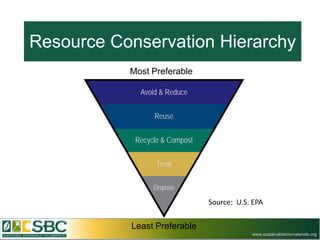
Resource Conservation Hierarchy
           Most Preferable

             Avoid & Reduce


                 Reuse


            Recycle & Compost


                  Treat

                 Dispose

                                Source: U.S. EPA

           Least Preferable
                                            www.sustainablebiomaterials.org
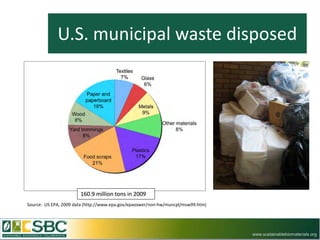
U.S. municipal waste disposed


                       160.9 million tons in 2009
Source: US EPA, 2009 data (http://www.epa.gov/epaoswer/non-hw/muncpl/msw99.htm)


                                                                                  www.sustainablebiomaterials.org
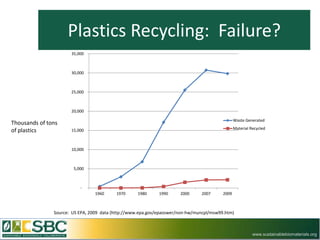
Plastics Recycling: Failure?
                      35,000


                      30,000


                      25,000


                      20,000

                                                                                                Waste Generated
Thousands of tons
                                                                                                Material Recycled
of plastics           15,000


                      10,000


                       5,000


                          -
                                 1960     1970     1980      1990     2000     2007      2009


               Source: US EPA, 2009 data (http://www.epa.gov/epaoswer/non-hw/muncpl/msw99.htm)


                                                                                                          www.sustainablebiomaterials.org
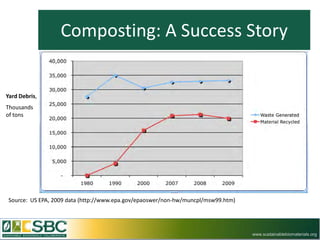
Composting: A Success Story


Yard Debris,
Thousands
of tons


 Source: US EPA, 2009 data (http://www.epa.gov/epaoswer/non-hw/muncpl/msw99.htm)


                                                                                   www.sustainablebiomaterials.org
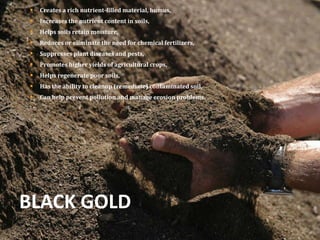
   Creates a rich nutrient-filled material, humus,
   Increases the nutrient content in soils,
   Helps soils retain moisture,
   Reduces or eliminate the need for chemical fertilizers,
   Suppresses plant diseases and pests,
   Promotes higher yields of agricultural crops,
   Helps regenerate poor soils,
   Has the ability to cleanup (remediate) contaminated soil,
   Can help prevent pollution and manage erosion problems.


BLACK GOLD
Benefits of Biobased Alternatives
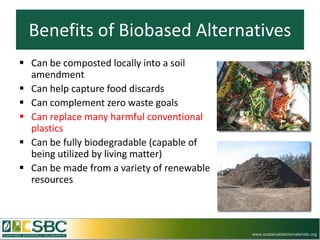
 Can be composted locally into a soil
  amendment
 Can help capture food discards
 Can complement zero waste goals
 Can replace many harmful conventional
  plastics
 Can be fully biodegradable (capable of
  being utilized by living matter)
 Can be made from a variety of renewable
  resources


                                            www.sustainablebiomaterials.org
How Exposure to Polystyrene
  Affects the Human Body

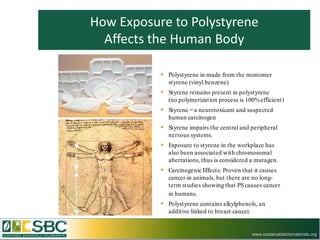
            Polystyrene in made from the monomer
              styrene (vinyl benzene)
            Styrene remains present in polystyrene
              (no polymerization process is 100% efficient)
            Styrene = a neurotoxicant and suspected
              human carcinogen
            Styrene impairs the central and peripheral
              nervous systems.
            Exposure to styrene in the workplace has
              also been associated with chromosomal
              aberrations, thus is considered a mutagen.
            Carcinogenic Effects: Proven that it causes
              cancer in animals, but there are no long-
              term studies showing that PS causes cancer
              in humans.
            Polystyrene contains alkylphenols, an
              additive linked to breast cancer.


                                                  www.sustainablebiomaterials.org
Styrene Leaches into Food

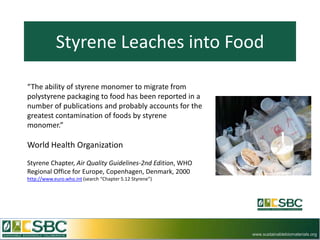
“The ability of styrene monomer to migrate from
polystyrene packaging to food has been reported in a
number of publications and probably accounts for the
greatest contamination of foods by styrene
monomer.”

World Health Organization
Styrene Chapter, Air Quality Guidelines-2nd Edition, WHO
Regional Office for Europe, Copenhagen, Denmark, 2000
http://www.euro.who.int (search “Chapter 5.12 Styrene”)


                                                           www.sustainablebiomaterials.org
The Good News on Biobased Alternatives

  Variety of resins & products available
  Performance improving
  Experience and R&D growing
  Growth expected
  The federal biobased procurement
   program – BioPreferred – will open up
   new markets
  Standards in place
  Price competitiveness improving
  Demand increasing

                                     www.sustainablebiomaterials.org
ASTM Standards & 3rd-party certifiers
 D 6866 – defines and quantifies biobased content
 D 6400 – specification for biodegradation in commercial
  composting systems
 D 7081 – specification for biodegradation in the marine
  environment
 D 5988 – test method for biodegradation in soil
 D 5511 – test method for biodegradation in anaerobic
  digesters


                        www.bpiworld.org


                                                    www.sustainablebiomaterials.org
Degradable Vs. Biodegradable

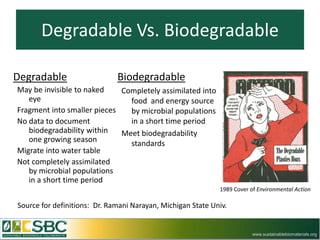
Degradable                    Biodegradable
May be invisible to naked    Completely assimilated into
   eye                         food and energy source
Fragment into smaller pieces   by microbial populations
No data to document            in a short time period
   biodegradability within   Meet biodegradability
   one growing season          standards
Migrate into water table
Not completely assimilated
   by microbial populations
   in a short time period
                                                             1989 Cover of Environmental Action

Source for definitions: Dr. Ramani Narayan, Michigan State Univ.


                                                                         www.sustainablebiomaterials.org
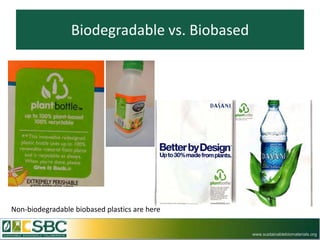
Biodegradable vs. Biobased


Non-biodegradable biobased plastics are here

                                               www.sustainablebiomaterials.org
Biodegradability alone is not an
     environmental goal

         Products should be:
          Reusable,
          Recyclable, or
          Compostable
    Purchasers can use their purchasing power to drive
    the market toward more environmentally preferable
    products


                                                         www.sustainablebiomaterials.org
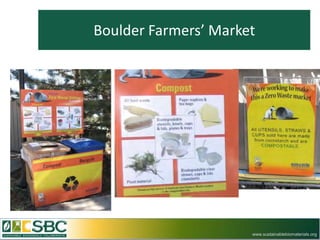
Boulder Farmers’ Market


                      www.sustainablebiomaterials.org
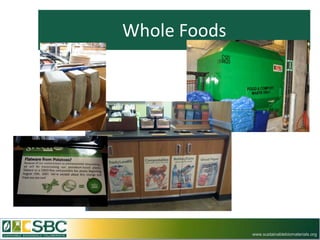
Whole Foods


              www.sustainablebiomaterials.org
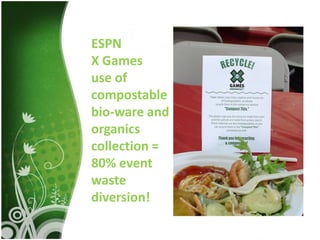
ESPN
           X Games
           use of
           compostable
           bio-ware and
           organics
           collection =
           80% event
           waste
           diversion!
© Disney
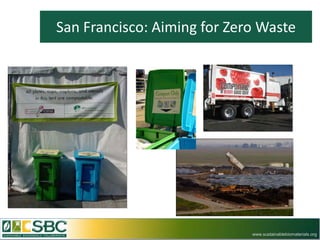
San Francisco: Aiming for Zero Waste


                             www.sustainablebiomaterials.org
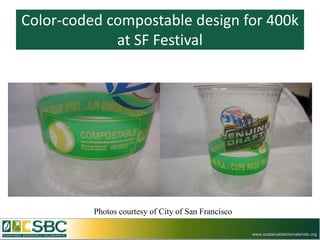
Color-coded compostable design for 400k
             at SF Festival


          Photos courtesy of City of San Francisco

                                                     www.sustainablebiomaterials.org
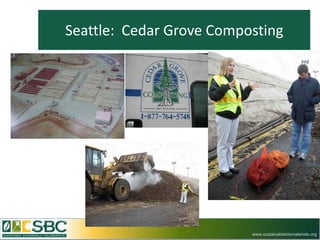
Seattle: Cedar Grove Composting


                          www.sustainablebiomaterials.org
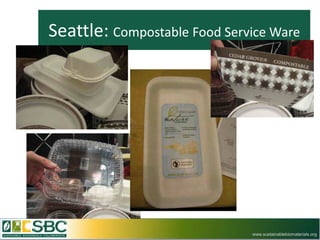
Seattle: Compostable Food Service Ware


                              www.sustainablebiomaterials.org
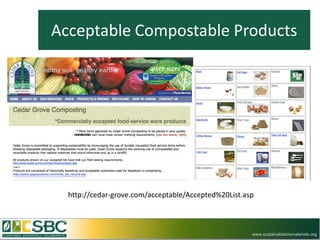
Acceptable Compostable Products


  http://cedar-grove.com/acceptable/Accepted%20List.asp


                                                      www.sustainablebiomaterials.org
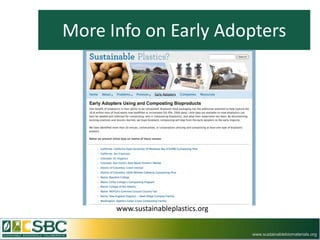
More Info on Early Adopters


      www.sustainableplastics.org


                                    www.sustainablebiomaterials.org
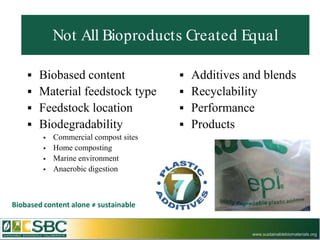
Not All Bioproducts Created Equal

     Biobased content                   Additives and blends
     Material feedstock type            Recyclability
     Feedstock location                 Performance
     Biodegradability                   Products
            Commercial compost sites
            Home composting
            Marine environment
            Anaerobic digestion


Biobased content alone ≠ sustainable


                                                     www.sustainablebiomaterials.org
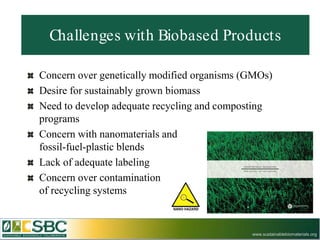
Challenges with Biobased Products

Concern over genetically modified organisms (GMOs)
Desire for sustainably grown biomass
Need to develop adequate recycling and composting
programs
Concern with nanomaterials and
fossil-fuel-plastic blends
Lack of adequate labeling
Concern over contamination
of recycling systems


                                             www.sustainablebiomaterials.org
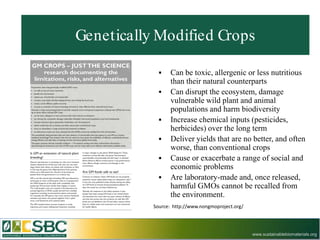
Genetically Modified Crops

                 Can be toxic, allergenic or less nutritious
                  than their natural counterparts
                 Can disrupt the ecosystem, damage
                  vulnerable wild plant and animal
                  populations and harm biodiversity
                 Increase chemical inputs (pesticides,
                  herbicides) over the long term
                 Deliver yields that are no better, and often
                  worse, than conventional crops
                 Cause or exacerbate a range of social and
                  economic problems
                 Are laboratory-made and, once released,
                  harmful GMOs cannot be recalled from
                  the environment.
           Source: http://www.nongmoproject.org/


                                                   www.sustainablebiomaterials.org
What We Put Into Corn…
 Average of over 120 lbs.
  nitrogen fertilizer per
  acre
 Among the highest levels
  of herbicide and
  pesticide use for
  conventional crops
 Irrigation water
 Proprietary hybrids

                                 www.sustainablebiomaterials.org
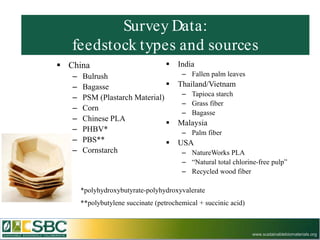
Survey Data:
   feedstock types and sources
 China                                India
   –   Bulrush                           – Fallen palm leaves
   –   Bagasse                         Thailand/Vietnam
                                         – Tapioca starch
   –   PSM (Plastarch Material)
                                         – Grass fiber
   –   Corn
                                         – Bagasse
   –   Chinese PLA
                                       Malaysia
   –   PHBV*                             – Palm fiber
   –   PBS**                           USA
   –   Cornstarch                        – NatureWorks PLA
                                         – “Natural total chlorine-free pulp”
                                         – Recycled wood fiber

       *polyhydroxybutyrate-polyhydroxyvalerate
       **polybutylene succinate (petrochemical + succinic acid)


                                                                  www.sustainablebiomaterials.org
Path from Field to Producer

 “The source product is from Brazil,
then turned into cornstarch in China,
      then the starch is used in
    our manufacturer’s facility.”


                   “Feedstocks grown in Midwestern US.
                           Manufacture the resin
                         in Hawthorne, CA today,
                          but plan to manufacture
                          in Seymour, IN shortly.”

                                               www.sustainablebiomaterials.org
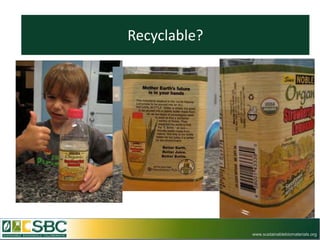
Recyclable?


              www.sustainablebiomaterials.org
Sustainable Biomaterials Collaborative
                                                         As You Sow
The Sustainable Biomaterials           Center for Health, Environment and Justice
Collaborative is a network of                    Clean Production Action *
                                               Environmental Health Fund *
organizations working together to               Green Harvest Technologies
                                                 Green Purchasing Institute
spur the introduction and use of                 Health Care Without Harm
                                                 Healthy Building Network
biomaterials that are sustainable      Institute for Agriculture and Trade Policy *
from cradle to cradle. The                   Institute for Local Self-Reliance*
                                       Lowell Center for Sustainable Production *
Collaborative is creating                       Sustainable Research Group
                                                       Pure Strategies
sustainability guidelines,                        RecycleWorld Consulting
engaging markets, and promoting              Responsible Purchasing Network
                                        Science & Environmental Health Network
policy initiatives.                                 Seventh Generation
                                         National Campaign for Sustainable Ag.
                                                        Whole Foods
                                                    City of San Francisco

                                    * Steering committee


                                                                   www.sustainablebiomaterials.org
Defining Sustainable Life Cycles by Principles

    Sustainable feedstocks /
     Sustainable agriculture
    Green chemistry /
     Clean production
    Closed loop systems /
     cradle to cradle /
     zero waste

“Just because it’s biobased, doesn’t make it green”


                                                      www.sustainablebiomaterials.org
Biomass Feedstock
   Avoid hazardous chemicals
   Avoid GMOs
   Conserve soil & nutrients
   Biological diversity
   Sustainable agriculture plan
   Protect workers


                                   www.sustainablebiomaterials.org
Manufacturing
   Support sustainable feedstock
   Reduce fossil energy use
   Avoid problematic blends & additives
   Avoid untested chemicals and engineered nano
    particles
   Design for recycling & composting
   Maximize process safety/reduce emissions
   Green chemistry
   Protect workers


                  35
                                      www.sustainablebiomaterials.org
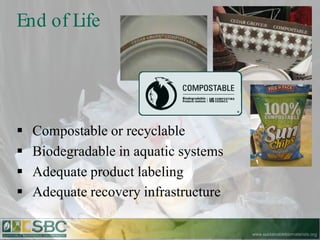
End of Life


   Compostable or recyclable
   Biodegradable in aquatic systems
   Adequate product labeling
   Adequate recovery infrastructure

                                       www.sustainablebiomaterials.org
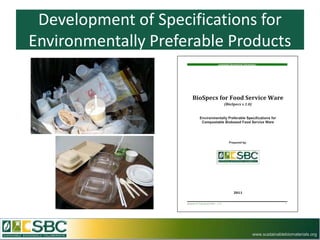
Development of Specifications for
Environmentally Preferable Products


                             www.sustainablebiomaterials.org
Next Steps
 Vetted List of Products
   Clear process for manufacturers to assess
    conformance to criteria
   Beta-test conformance process
 Green Purchasing Institute finalize sample
  purchasing bid specifications and documents
 Work with purchasers to beta-test bid specs


                                            www.sustainablebiomaterials.org
Contact


             Brenda Platt
               SBC, Co-Chair
Institute for Local Self-Reliance, Co-Director
               bplatt@ilsr.org
           202-898-1610 ext 230


  www.sustainablebiomaterials.org                www.sustainablebiomaterials.org

2011 0512 platt rpn_webinar_may12_2011 v2

  • 1.
    Compostable biobased food service ware Brenda Platt SBC Co-Chair Institute for Local Self-Reliance May 12, 2011 Responsible Purchasing Network Webinar www.sustainablebiomaterials.org
  • 2.
    Overview  Why usecompostable food service ware?  Understanding difference between biobased vs biodegradable vs compostable  Programs utilizing compostable products  Compostable alone ≠ sustainable  Criteria for environmentally preferable biobased food service ware www.sustainablebiomaterials.org
  • 3.
    Resource Conservation Hierarchy Most Preferable Avoid & Reduce Reuse Recycle & Compost Treat Dispose Source: U.S. EPA Least Preferable www.sustainablebiomaterials.org
  • 4.
    U.S. municipal wastedisposed 160.9 million tons in 2009 Source: US EPA, 2009 data (http://www.epa.gov/epaoswer/non-hw/muncpl/msw99.htm) www.sustainablebiomaterials.org
  • 5.
    Plastics Recycling: Failure? 35,000 30,000 25,000 20,000 Waste Generated Thousands of tons Material Recycled of plastics 15,000 10,000 5,000 - 1960 1970 1980 1990 2000 2007 2009 Source: US EPA, 2009 data (http://www.epa.gov/epaoswer/non-hw/muncpl/msw99.htm) www.sustainablebiomaterials.org
  • 6.
    Composting: A SuccessStory Yard Debris, Thousands of tons Source: US EPA, 2009 data (http://www.epa.gov/epaoswer/non-hw/muncpl/msw99.htm) www.sustainablebiomaterials.org
  • 7.
    Creates a rich nutrient-filled material, humus,  Increases the nutrient content in soils,  Helps soils retain moisture,  Reduces or eliminate the need for chemical fertilizers,  Suppresses plant diseases and pests,  Promotes higher yields of agricultural crops,  Helps regenerate poor soils,  Has the ability to cleanup (remediate) contaminated soil,  Can help prevent pollution and manage erosion problems. BLACK GOLD
  • 8.
    Benefits of BiobasedAlternatives  Can be composted locally into a soil amendment  Can help capture food discards  Can complement zero waste goals  Can replace many harmful conventional plastics  Can be fully biodegradable (capable of being utilized by living matter)  Can be made from a variety of renewable resources www.sustainablebiomaterials.org
  • 9.
    How Exposure toPolystyrene Affects the Human Body  Polystyrene in made from the monomer styrene (vinyl benzene)  Styrene remains present in polystyrene (no polymerization process is 100% efficient)  Styrene = a neurotoxicant and suspected human carcinogen  Styrene impairs the central and peripheral nervous systems.  Exposure to styrene in the workplace has also been associated with chromosomal aberrations, thus is considered a mutagen.  Carcinogenic Effects: Proven that it causes cancer in animals, but there are no long- term studies showing that PS causes cancer in humans.  Polystyrene contains alkylphenols, an additive linked to breast cancer. www.sustainablebiomaterials.org
  • 10.
    Styrene Leaches intoFood “The ability of styrene monomer to migrate from polystyrene packaging to food has been reported in a number of publications and probably accounts for the greatest contamination of foods by styrene monomer.” World Health Organization Styrene Chapter, Air Quality Guidelines-2nd Edition, WHO Regional Office for Europe, Copenhagen, Denmark, 2000 http://www.euro.who.int (search “Chapter 5.12 Styrene”) www.sustainablebiomaterials.org
  • 11.
    The Good Newson Biobased Alternatives  Variety of resins & products available  Performance improving  Experience and R&D growing  Growth expected  The federal biobased procurement program – BioPreferred – will open up new markets  Standards in place  Price competitiveness improving  Demand increasing www.sustainablebiomaterials.org
  • 12.
    ASTM Standards &3rd-party certifiers  D 6866 – defines and quantifies biobased content  D 6400 – specification for biodegradation in commercial composting systems  D 7081 – specification for biodegradation in the marine environment  D 5988 – test method for biodegradation in soil  D 5511 – test method for biodegradation in anaerobic digesters www.bpiworld.org www.sustainablebiomaterials.org
  • 13.
    Degradable Vs. Biodegradable Degradable Biodegradable May be invisible to naked Completely assimilated into eye food and energy source Fragment into smaller pieces by microbial populations No data to document in a short time period biodegradability within Meet biodegradability one growing season standards Migrate into water table Not completely assimilated by microbial populations in a short time period 1989 Cover of Environmental Action Source for definitions: Dr. Ramani Narayan, Michigan State Univ. www.sustainablebiomaterials.org
  • 14.
    Biodegradable vs. Biobased Non-biodegradablebiobased plastics are here www.sustainablebiomaterials.org
  • 15.
    Biodegradability alone isnot an environmental goal Products should be:  Reusable,  Recyclable, or  Compostable Purchasers can use their purchasing power to drive the market toward more environmentally preferable products www.sustainablebiomaterials.org
  • 16.
    Boulder Farmers’ Market www.sustainablebiomaterials.org
  • 17.
    Whole Foods www.sustainablebiomaterials.org
  • 18.
    ESPN X Games use of compostable bio-ware and organics collection = 80% event waste diversion! © Disney
  • 19.
    San Francisco: Aimingfor Zero Waste www.sustainablebiomaterials.org
  • 20.
    Color-coded compostable designfor 400k at SF Festival Photos courtesy of City of San Francisco www.sustainablebiomaterials.org
  • 21.
    Seattle: Cedar GroveComposting www.sustainablebiomaterials.org
  • 22.
    Seattle: Compostable FoodService Ware www.sustainablebiomaterials.org
  • 23.
    Acceptable Compostable Products http://cedar-grove.com/acceptable/Accepted%20List.asp www.sustainablebiomaterials.org
  • 24.
    More Info onEarly Adopters www.sustainableplastics.org www.sustainablebiomaterials.org
  • 25.
    Not All BioproductsCreated Equal  Biobased content  Additives and blends  Material feedstock type  Recyclability  Feedstock location  Performance  Biodegradability  Products  Commercial compost sites  Home composting  Marine environment  Anaerobic digestion Biobased content alone ≠ sustainable www.sustainablebiomaterials.org
  • 26.
    Challenges with BiobasedProducts Concern over genetically modified organisms (GMOs) Desire for sustainably grown biomass Need to develop adequate recycling and composting programs Concern with nanomaterials and fossil-fuel-plastic blends Lack of adequate labeling Concern over contamination of recycling systems www.sustainablebiomaterials.org
  • 27.
    Genetically Modified Crops  Can be toxic, allergenic or less nutritious than their natural counterparts  Can disrupt the ecosystem, damage vulnerable wild plant and animal populations and harm biodiversity  Increase chemical inputs (pesticides, herbicides) over the long term  Deliver yields that are no better, and often worse, than conventional crops  Cause or exacerbate a range of social and economic problems  Are laboratory-made and, once released, harmful GMOs cannot be recalled from the environment. Source: http://www.nongmoproject.org/ www.sustainablebiomaterials.org
  • 28.
    What We PutInto Corn…  Average of over 120 lbs. nitrogen fertilizer per acre  Among the highest levels of herbicide and pesticide use for conventional crops  Irrigation water  Proprietary hybrids www.sustainablebiomaterials.org
  • 29.
    Survey Data: feedstock types and sources  China  India – Bulrush – Fallen palm leaves – Bagasse  Thailand/Vietnam – Tapioca starch – PSM (Plastarch Material) – Grass fiber – Corn – Bagasse – Chinese PLA  Malaysia – PHBV* – Palm fiber – PBS**  USA – Cornstarch – NatureWorks PLA – “Natural total chlorine-free pulp” – Recycled wood fiber *polyhydroxybutyrate-polyhydroxyvalerate **polybutylene succinate (petrochemical + succinic acid) www.sustainablebiomaterials.org
  • 30.
    Path from Fieldto Producer “The source product is from Brazil, then turned into cornstarch in China, then the starch is used in our manufacturer’s facility.” “Feedstocks grown in Midwestern US. Manufacture the resin in Hawthorne, CA today, but plan to manufacture in Seymour, IN shortly.” www.sustainablebiomaterials.org
  • 31.
    Recyclable? www.sustainablebiomaterials.org
  • 32.
    Sustainable Biomaterials Collaborative As You Sow The Sustainable Biomaterials Center for Health, Environment and Justice Collaborative is a network of Clean Production Action * Environmental Health Fund * organizations working together to Green Harvest Technologies Green Purchasing Institute spur the introduction and use of Health Care Without Harm Healthy Building Network biomaterials that are sustainable Institute for Agriculture and Trade Policy * from cradle to cradle. The Institute for Local Self-Reliance* Lowell Center for Sustainable Production * Collaborative is creating Sustainable Research Group Pure Strategies sustainability guidelines, RecycleWorld Consulting engaging markets, and promoting Responsible Purchasing Network Science & Environmental Health Network policy initiatives. Seventh Generation National Campaign for Sustainable Ag. Whole Foods City of San Francisco * Steering committee www.sustainablebiomaterials.org
  • 33.
    Defining Sustainable LifeCycles by Principles  Sustainable feedstocks / Sustainable agriculture  Green chemistry / Clean production  Closed loop systems / cradle to cradle / zero waste “Just because it’s biobased, doesn’t make it green” www.sustainablebiomaterials.org
  • 34.
    Biomass Feedstock  Avoid hazardous chemicals  Avoid GMOs  Conserve soil & nutrients  Biological diversity  Sustainable agriculture plan  Protect workers www.sustainablebiomaterials.org
  • 35.
    Manufacturing  Support sustainable feedstock  Reduce fossil energy use  Avoid problematic blends & additives  Avoid untested chemicals and engineered nano particles  Design for recycling & composting  Maximize process safety/reduce emissions  Green chemistry  Protect workers 35 www.sustainablebiomaterials.org
  • 36.
    End of Life  Compostable or recyclable  Biodegradable in aquatic systems  Adequate product labeling  Adequate recovery infrastructure www.sustainablebiomaterials.org
  • 37.
    Development of Specificationsfor Environmentally Preferable Products www.sustainablebiomaterials.org
  • 38.
    Next Steps  VettedList of Products  Clear process for manufacturers to assess conformance to criteria  Beta-test conformance process  Green Purchasing Institute finalize sample purchasing bid specifications and documents  Work with purchasers to beta-test bid specs www.sustainablebiomaterials.org
  • 39.
    Contact Brenda Platt SBC, Co-Chair Institute for Local Self-Reliance, Co-Director bplatt@ilsr.org 202-898-1610 ext 230 www.sustainablebiomaterials.org www.sustainablebiomaterials.org