Institute of Psychology 
Report writing
Definition 
• A research report is: 
a written document or oral presentation based on a written document that communicates the 
purpose, scope, objective(s), hypotheses, methodology, findings, limitations and finally, 
recommendations of a research project to others. 
 The basic orientation of a research report depends on its audience. Before writing the 
report 
the researcher must know his or her audience; 
he/she may have to make assumptions about the composition, background and 
interests of the readers. 
11/18/2014 Report Writing II 2
Guidelines for Effective Writing 
 Know Your Audience. 
If you assume your readers know more than they actually do, they’ll be 
confused. 
If you underestimate your readers, they’ll be bored with unnecessary details. 
Err on the side of underestimating your readers. 
 Identify Your Purpose. 
Research manuscripts use expository writing. 
The principal purposes of a research manuscript are to describe and to 
convince. 
11/18/2014 Report Writing II 3
Guidelines (continued) 
 Be concise. 
 Say only what needs to be said. 
 Short words and short sentences are easier to understand. 
 Write several drafts of your manuscript; decrease wordiness as you edit your drafts. 
 Be precise. 
 Choose the right word for what you want to say. 
 Follow grammatical rules. 
 Failure to adhere to grammatical rules distracts the reader and introduces unnecessary 
ambiguity. 
 Grammatical errors decrease the credibility of your persuasive argument. 
11/18/2014 Report Writing II 4
Guidelines (continued) 
Write fairly. 
Choose words and sentence constructions that avoid bias on the 
basis of gender, sexual orientation, racial or ethnic group, disability, 
or age. 
Describe persons at the appropriate level of specificity (e.g., 
describe men and women participants rather than the generic term 
man when referring to human beings). 
Be sensitive to labels used to describe racial and ethnic groups. 
 11/18/2A014void the term “subjects” Rwephoret Wnri tdinge IsI cribing human participants. 5
Guidelines (continued) 
Write an interesting report. 
Present ideas and findings directly, but in an interesting and compelling 
manner that reflects your involvement with the research problem. 
Strive to tell a good story about your research. 
Do not tell your readers about yourself. 
11/18/2014 Report Writing II 6
Structure of a Research Report 
• A research report consists of the following sections (the main body of the 
report is in bold): 
– Title Page ■ References 
– Abstract ■ Appendixes 
– Introduction 
– Literature Review 
– Method 
– Results 
– Discussion 
– Conclusion 
11/18/2014 Report Writing II 7
Structure of a Research Report (continued) 
• Title page 
The title page contains the title of the research, the authors’ names, where the 
research was done (i.e., the authors’ affiliation), a brief heading to describe the 
subject of the research (the “running head”), and a short title (the first 3 words 
of the title) with the page number. 
The title should be a concise statement of the main topic of the research and 
should identify the variables or theoretical issues in the research. 
11/18/2014 Report Writing II 8
Structure of a Research Report (continued) 
 Abstract 
 The abstract is a one-paragraph summary of the content and purpose of the research 
report. 
 The abstract should be 100-200 words. 
 Four main elements should be included: 
The problem under investigation, 
Highlights of the experimental method, 
The main findings, and 
The conclusions and implications of the findings. 
 Write the Abstract last! 
11/18/2014 Report Writing II 9
Structure of a Research Report (continued) 
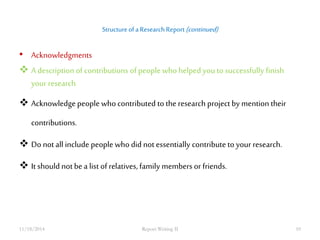
• Acknowledgments 
 A description of contributions of people who helped you to successfully finish 
your research 
 Acknowledge people who contributed to the research project by mention their 
contributions. 
 Do not all include people who did not essentially contribute to your research. 
 It should not be a list of relatives, family members or friends. 
11/18/2014 Report Writing II 10
Structure of a Research Report (continued) 
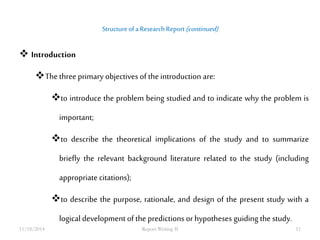
 Introduction 
The three primary objectives of the introduction are: 
to introduce the problem being studied and to indicate why the problem is 
important; 
to describe the theoretical implications of the study and to summarize 
briefly the relevant background literature related to the study (including 
appropriate citations); 
to describe the purpose, rationale, and design of the present study with a 
logical development of the predictions or hypotheses guiding the study. 
11/18/2014 Report Writing II 11
Structure of a Research Report (continued) 
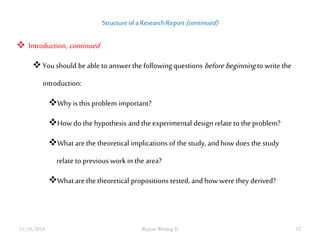
 Introduction, continued 
 You should be able to answer the following questions before beginning to write the 
introduction: 
Why is this problem important? 
How do the hypothesis and the experimental design relate to the problem? 
What are the theoretical implications of the study, and how does the study 
relate to previous work in the area? 
What are the theoretical propositions tested, and how were they derived? 
11/18/2014 Report Writing II 12
Structure of a Research Report (continued) 
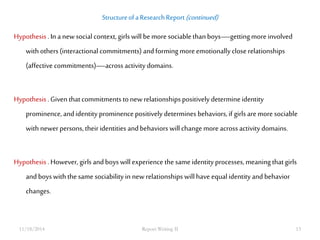
Hypothesis . In a new social context, girls will be more sociable than boys—getting more involved 
with others (interactional commitments) and forming more emotionally close relationships 
(affective commitments)—across activity domains. 
Hypothesis . Given that commitments to new relationships positively determine identity 
prominence, and identity prominence positively determines behaviors, if girls are more sociable 
with newer persons, their identities and behaviors will change more across activity domains. 
Hypothesis . However, girls and boys will experience the same identity processes, meaning that girls 
and boys with the same sociability in new relationships will have equal identity and behavior 
changes. 
11/18/2014 Report Writing II 13
Structure of a Research Report (continued) 
Review of Literature 
 The literature review tells the reader what other researchers have discovered about the paper’s 
topic or tells the reader about other research that is relevant to the topic. 
 A literature review should shape the way readers think about a topic. 
 it educates readers about what the community of scholars says about a topic and its surrounding 
issues. 
 Along the way it states facts and ideas about the physical social worlds and supports those facts 
and ideas with evidence for from where they came . 
11/18/2014 Report Writing II 14
Structure of a Research Report (continued) 
 Literature reviews have parenthetical citations running throughout. These are 
part of a systematic way to document where facts and ideas came from, allowing 
the skeptical reader to look up anything that is questionable. 
 Parenthetical citation is our way of substantiating the claims in our paper, 
without breaking our flow. 
 Each citation directs the reader to the references where complete details on 
sources can be found. Therefore, information such as authors’ first names or 
titles of works do not need to be written into the text. 
11/18/2014 Report Writing II 15
Structure of a Research Report (continued) 
Method 
The purpose of the Method section is to describe, in detail, how the study was 
conducted. Based on the Method section, a reader should be able to replicate the 
study. 
The three most common subsections of the Method section are: 
Research design ( survey or experiment etc.) 
Participants, 
Materials (or video tape recorders ), 
Procedure. 
11/18/2014 Report Writing II 16
Structure of a Research Report (continued) 
 Citations consist of authors’ last names and the year of publication. One finds 
complete information on sources by looking up last names and dates in 
alphabetized references—so there’s no need to put all that information in the 
text. 
 We have conventions that allow the reader to figure out from where 
information is coming . Here are some examples of the conventions for citing 
in text of the literature review: 
 Just pointing out where info came from: 
 Example: … the gays are different (Lee 2004). 
 More than one article in the same year: 
 Example: …are different (Lee 2004a), but are more pickled (Lee 2004b) 
11/18/2014 Report Writing II 17
Structure of a Research Report (continued) 
We have conventions that allow the reader to figure out from where 
information is coming . Here are some examples of the conventions for citing 
in text of the literature review: 
 Using the author’s name in a sentence: 
Example: Lee (2004) claims that girls will rule the world… 
 Quoting a person and using their name: 
Example: Lee (2004: 341) says, “Girls are more likely to rule the 
world…” 
 Review of Literature 
 If an idea is used, but cannot be substantiated by the community of 
sociologists, the literature review clearly shows that the author is 
speculating and details the logic of the speculation. 
11/18/2014 Report Writing II 18
Structure of a Research Report (continued) 
• Method, continued 
• Procedure: 
This is the most critical component of the Method section. 
Describe what happened from the beginning to the end of the 
sessions in which you tested your participants. 
Include enough detail so that a researcher could replicate the 
essential aspects of your study. 
11/18/2014 Report Writing II 19
Structure of a Research Report (continued) 
 Method, continued 
Participants: When humans are the participants, report: 
the procedures for recruiting and compensating them, 
major demographic characteristics (e.g., gender, age, race/ethnicity), total 
number of participants, 
the number assigned to each condition of the experiment, and describe any 
attrition. 
Materials: Describe any materials that are critical to the design and implementation 
of the study variables; be sure to cite other researchers appropriately. 
11/18/2014 Report Writing II 20
Structure of a Research Report (continued) 
Results 
The results section contains the climax of the report — the actual 
findings of the study. 
Answer the questions raised in the introduction, but “stick to the facts” 
— leave any interpretation of the findings for the Discussion section. 
11/18/2014 Report Writing II 21
Structure of a Research Report (continued) 
 Results, continued 
 The structure of a typical paragraph in the Results section is as follows: 
 State the purpose of the analysis. 
 Identify the descriptive statistic to be used to summarize the results. 
 Present a summary of this descriptive statistic across conditions in the text 
itself, in a table, or in a figure. 
11/18/2014 Report Writing II 22
Structure of a Research Report (continued) 
 The structure of a typical paragraph in the Results section is as 
follows (continued): 
If a table or figure is used, point out the major findings on 
which the reader should focus. 
Present the reasons for, and the results of confidence 
intervals, effect sizes, and inferential statistic 
 State the conclusion that follows from each test, but do not 
discuss implications. These belong in the Discussion section. 
11/18/2014 Report Writing II 23
Structure of a Research Report (continued) 
 Result : 
 The results section describes the outcome of the statistical analyses, assessing whether 
your hypotheses were correct and why or why not. 
 The narrative and tables are complementary. 
 The narrative discusses ONLY VERY IMPORTANT Results and leaves details 
for tables. 
 As different outcomes are described in the narrative, reference is made to 
where the detailed information can be found in the tables. 
 The tables contain almost all statistical information so that the author does 
not have to write a narrative for every detail in the analysis. 
11/18/2014 Report Writing II 24
Structure of a Research Report (continued) 
• Discussion 
The Discussion section includes: 
A clear and concise statement of the essential findings. 
A clear presentation of how the findings support or refute the hypotheses. 
A description of how the results are similar to or different from previous 
research. 
Limitations or problems in the research. 
Specific ideas for additional research based on the findings. 
11/18/2014 Report Writing II 25
Conclusions and recommendation 
• Conclusions: explain what the research findings mean in relation to the challenge. 
• Conclusion answers the question, “why will your recommendation work?” 
• Conclusions are clearly drawn from the presented research (“based on....”) 
• Recommendations regarding actions that should be taken or 
considered in light of the research results. 
 Recommendations: Start with a verb and suggest actions to address challenge. 
11/18/2014 Report Writing II 26
Structure of a Research Report (continued) 
 References 
The References section includes the complete citation for each source cited in 
the research manuscript. 
References are listed in alphabetical order according to the last name of the 
first author of each source. 
11/18/2014 Report Writing II 27
Structure of a Research Report (continued) 
• Examples of Reference Citations 
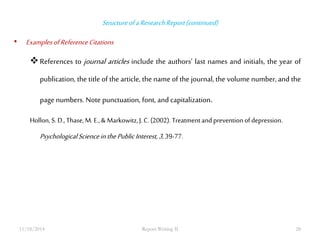
 References to journal articles include the authors’ last names and initials, the year of 
publication, the title of the article, the name of the journal, the volume number, and the 
page numbers. Note punctuation, font, and capitalization. 
Hollon, S. D., Thase, M. E., & Markowitz, J. C. (2002). Treatment and prevention of depression. 
Psychological Science in the Public Interest, 3, 39-77. 
11/18/2014 Report Writing II 28
Structure of a Research Report (continued) 
• Examples of Reference Citations, continued 
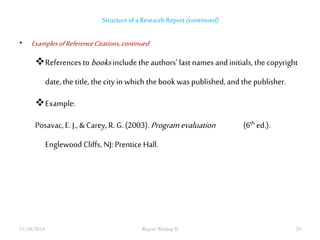
References to books include the authors’ last names and initials, the copyright 
date, the title, the city in which the book was published, and the publisher. 
Example: 
Posavac, E. J., & Carey, R. G. (2003). Program evaluation (6th ed.). 
Englewood Cliffs, NJ: Prentice Hall. 
11/18/2014 Report Writing II 29
Structure of a Research Report (continued) 
• Examples of Reference Citations, continued 
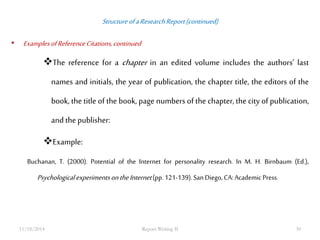
The reference for a chapter in an edited volume includes the authors’ last 
names and initials, the year of publication, the chapter title, the editors of the 
book, the title of the book, page numbers of the chapter, the city of publication, 
and the publisher: 
Example: 
Buchanan, T. (2000). Potential of the Internet for personality research. In M. H. Birnbaum (Ed.), 
Psychological experiments on the Internet (pp. 121-139). San Diego, CA: Academic Press. 
11/18/2014 Report Writing II 30
Structure of a Research Report (continued) 
 Examples of Reference Citations, continued 
The citation for an electronic journal identifies the specific Internet address: 
Kirsch, I., & Sapirstein, G. (1998). Listening to Prozac but hearing placebo: A meta-analysis 
of antidepressant medication. Prevention and Treatment [On-line serial], 1. 
Available: journals.apa.org/prevention/volume1/pre0010002a.html. 
11/18/2014 Report Writing II 31
Structure of a Research Report (continued ) 
 Appendixes 
Although appendixes are rare in published research reports, they may be required 
by instructors for class research projects. 
An appendix is sometimes used to provide a verbatim copy of instructions to 
participants or a copy of particular materials used in a research study. 
11/18/2014 Report Writing II 32
Structure of a Research Report (continued) 
 Author Note 
The author note includes: 
Any sources of financial support for the research, 
Acknowledgment of people who contributed to the research project, 
Contact information should an interested reader desire more information, 
The name and departmental affiliation of each author. 
11/18/2014 Report Writing II 33
Structure of a Research Report (continued) 
 Footnotes 
Footnotes are rare in research manuscripts. 
There are two types of footnotes: 
Copyright permission footnotes that acknowledge a source of a quotation 
(when copyright permission must be acknowledged). 
Content footnotes that supplement or expand on the text material 
Note that footnotes appear on a separate page near the end of the manuscript, 
not at the bottom of a text page. 
11/18/2014 Report Writing II 34
Structure of a Research Report (continued) 
 Tables and Figures 
Any tables or figures cited in the text are attached at the end of the research 
manuscript. 
Place only one table or figure on a page. 
If figures are included, a separate “Figure Captions” page precedes the figures; 
the titles of the figures are presented on the page. 
11/18/2014 Report Writing II 35
Research Paper Format (continued) 
The written research paper follows the general format of the research manuscript: 
Abstract 
Aknowledgment 
Introduction 
Literature Review 
Method 
Results 
Discussion 
Conclusions 
Recommendations 
References 
Appendix 
11/18/2014 Report Writing II 36
End 
• Questions 
• Comments 
11/18/2014 Report Writing II 37

Research paper format ii

  • 1.
    Institute of Psychology Report writing
  • 2.
    Definition • Aresearch report is: a written document or oral presentation based on a written document that communicates the purpose, scope, objective(s), hypotheses, methodology, findings, limitations and finally, recommendations of a research project to others.  The basic orientation of a research report depends on its audience. Before writing the report the researcher must know his or her audience; he/she may have to make assumptions about the composition, background and interests of the readers. 11/18/2014 Report Writing II 2
  • 3.
    Guidelines for EffectiveWriting  Know Your Audience. If you assume your readers know more than they actually do, they’ll be confused. If you underestimate your readers, they’ll be bored with unnecessary details. Err on the side of underestimating your readers.  Identify Your Purpose. Research manuscripts use expository writing. The principal purposes of a research manuscript are to describe and to convince. 11/18/2014 Report Writing II 3
  • 4.
    Guidelines (continued) Be concise.  Say only what needs to be said.  Short words and short sentences are easier to understand.  Write several drafts of your manuscript; decrease wordiness as you edit your drafts.  Be precise.  Choose the right word for what you want to say.  Follow grammatical rules.  Failure to adhere to grammatical rules distracts the reader and introduces unnecessary ambiguity.  Grammatical errors decrease the credibility of your persuasive argument. 11/18/2014 Report Writing II 4
  • 5.
    Guidelines (continued) Writefairly. Choose words and sentence constructions that avoid bias on the basis of gender, sexual orientation, racial or ethnic group, disability, or age. Describe persons at the appropriate level of specificity (e.g., describe men and women participants rather than the generic term man when referring to human beings). Be sensitive to labels used to describe racial and ethnic groups.  11/18/2A014void the term “subjects” Rwephoret Wnri tdinge IsI cribing human participants. 5
  • 6.
    Guidelines (continued) Writean interesting report. Present ideas and findings directly, but in an interesting and compelling manner that reflects your involvement with the research problem. Strive to tell a good story about your research. Do not tell your readers about yourself. 11/18/2014 Report Writing II 6
  • 7.
    Structure of aResearch Report • A research report consists of the following sections (the main body of the report is in bold): – Title Page ■ References – Abstract ■ Appendixes – Introduction – Literature Review – Method – Results – Discussion – Conclusion 11/18/2014 Report Writing II 7
  • 8.
    Structure of aResearch Report (continued) • Title page The title page contains the title of the research, the authors’ names, where the research was done (i.e., the authors’ affiliation), a brief heading to describe the subject of the research (the “running head”), and a short title (the first 3 words of the title) with the page number. The title should be a concise statement of the main topic of the research and should identify the variables or theoretical issues in the research. 11/18/2014 Report Writing II 8
  • 9.
    Structure of aResearch Report (continued)  Abstract  The abstract is a one-paragraph summary of the content and purpose of the research report.  The abstract should be 100-200 words.  Four main elements should be included: The problem under investigation, Highlights of the experimental method, The main findings, and The conclusions and implications of the findings.  Write the Abstract last! 11/18/2014 Report Writing II 9
  • 10.
    Structure of aResearch Report (continued) • Acknowledgments  A description of contributions of people who helped you to successfully finish your research  Acknowledge people who contributed to the research project by mention their contributions.  Do not all include people who did not essentially contribute to your research.  It should not be a list of relatives, family members or friends. 11/18/2014 Report Writing II 10
  • 11.
    Structure of aResearch Report (continued)  Introduction The three primary objectives of the introduction are: to introduce the problem being studied and to indicate why the problem is important; to describe the theoretical implications of the study and to summarize briefly the relevant background literature related to the study (including appropriate citations); to describe the purpose, rationale, and design of the present study with a logical development of the predictions or hypotheses guiding the study. 11/18/2014 Report Writing II 11
  • 12.
    Structure of aResearch Report (continued)  Introduction, continued  You should be able to answer the following questions before beginning to write the introduction: Why is this problem important? How do the hypothesis and the experimental design relate to the problem? What are the theoretical implications of the study, and how does the study relate to previous work in the area? What are the theoretical propositions tested, and how were they derived? 11/18/2014 Report Writing II 12
  • 13.
    Structure of aResearch Report (continued) Hypothesis . In a new social context, girls will be more sociable than boys—getting more involved with others (interactional commitments) and forming more emotionally close relationships (affective commitments)—across activity domains. Hypothesis . Given that commitments to new relationships positively determine identity prominence, and identity prominence positively determines behaviors, if girls are more sociable with newer persons, their identities and behaviors will change more across activity domains. Hypothesis . However, girls and boys will experience the same identity processes, meaning that girls and boys with the same sociability in new relationships will have equal identity and behavior changes. 11/18/2014 Report Writing II 13
  • 14.
    Structure of aResearch Report (continued) Review of Literature  The literature review tells the reader what other researchers have discovered about the paper’s topic or tells the reader about other research that is relevant to the topic.  A literature review should shape the way readers think about a topic.  it educates readers about what the community of scholars says about a topic and its surrounding issues.  Along the way it states facts and ideas about the physical social worlds and supports those facts and ideas with evidence for from where they came . 11/18/2014 Report Writing II 14
  • 15.
    Structure of aResearch Report (continued)  Literature reviews have parenthetical citations running throughout. These are part of a systematic way to document where facts and ideas came from, allowing the skeptical reader to look up anything that is questionable.  Parenthetical citation is our way of substantiating the claims in our paper, without breaking our flow.  Each citation directs the reader to the references where complete details on sources can be found. Therefore, information such as authors’ first names or titles of works do not need to be written into the text. 11/18/2014 Report Writing II 15
  • 16.
    Structure of aResearch Report (continued) Method The purpose of the Method section is to describe, in detail, how the study was conducted. Based on the Method section, a reader should be able to replicate the study. The three most common subsections of the Method section are: Research design ( survey or experiment etc.) Participants, Materials (or video tape recorders ), Procedure. 11/18/2014 Report Writing II 16
  • 17.
    Structure of aResearch Report (continued)  Citations consist of authors’ last names and the year of publication. One finds complete information on sources by looking up last names and dates in alphabetized references—so there’s no need to put all that information in the text.  We have conventions that allow the reader to figure out from where information is coming . Here are some examples of the conventions for citing in text of the literature review:  Just pointing out where info came from:  Example: … the gays are different (Lee 2004).  More than one article in the same year:  Example: …are different (Lee 2004a), but are more pickled (Lee 2004b) 11/18/2014 Report Writing II 17
  • 18.
    Structure of aResearch Report (continued) We have conventions that allow the reader to figure out from where information is coming . Here are some examples of the conventions for citing in text of the literature review:  Using the author’s name in a sentence: Example: Lee (2004) claims that girls will rule the world…  Quoting a person and using their name: Example: Lee (2004: 341) says, “Girls are more likely to rule the world…”  Review of Literature  If an idea is used, but cannot be substantiated by the community of sociologists, the literature review clearly shows that the author is speculating and details the logic of the speculation. 11/18/2014 Report Writing II 18
  • 19.
    Structure of aResearch Report (continued) • Method, continued • Procedure: This is the most critical component of the Method section. Describe what happened from the beginning to the end of the sessions in which you tested your participants. Include enough detail so that a researcher could replicate the essential aspects of your study. 11/18/2014 Report Writing II 19
  • 20.
    Structure of aResearch Report (continued)  Method, continued Participants: When humans are the participants, report: the procedures for recruiting and compensating them, major demographic characteristics (e.g., gender, age, race/ethnicity), total number of participants, the number assigned to each condition of the experiment, and describe any attrition. Materials: Describe any materials that are critical to the design and implementation of the study variables; be sure to cite other researchers appropriately. 11/18/2014 Report Writing II 20
  • 21.
    Structure of aResearch Report (continued) Results The results section contains the climax of the report — the actual findings of the study. Answer the questions raised in the introduction, but “stick to the facts” — leave any interpretation of the findings for the Discussion section. 11/18/2014 Report Writing II 21
  • 22.
    Structure of aResearch Report (continued)  Results, continued  The structure of a typical paragraph in the Results section is as follows:  State the purpose of the analysis.  Identify the descriptive statistic to be used to summarize the results.  Present a summary of this descriptive statistic across conditions in the text itself, in a table, or in a figure. 11/18/2014 Report Writing II 22
  • 23.
    Structure of aResearch Report (continued)  The structure of a typical paragraph in the Results section is as follows (continued): If a table or figure is used, point out the major findings on which the reader should focus. Present the reasons for, and the results of confidence intervals, effect sizes, and inferential statistic  State the conclusion that follows from each test, but do not discuss implications. These belong in the Discussion section. 11/18/2014 Report Writing II 23
  • 24.
    Structure of aResearch Report (continued)  Result :  The results section describes the outcome of the statistical analyses, assessing whether your hypotheses were correct and why or why not.  The narrative and tables are complementary.  The narrative discusses ONLY VERY IMPORTANT Results and leaves details for tables.  As different outcomes are described in the narrative, reference is made to where the detailed information can be found in the tables.  The tables contain almost all statistical information so that the author does not have to write a narrative for every detail in the analysis. 11/18/2014 Report Writing II 24
  • 25.
    Structure of aResearch Report (continued) • Discussion The Discussion section includes: A clear and concise statement of the essential findings. A clear presentation of how the findings support or refute the hypotheses. A description of how the results are similar to or different from previous research. Limitations or problems in the research. Specific ideas for additional research based on the findings. 11/18/2014 Report Writing II 25
  • 26.
    Conclusions and recommendation • Conclusions: explain what the research findings mean in relation to the challenge. • Conclusion answers the question, “why will your recommendation work?” • Conclusions are clearly drawn from the presented research (“based on....”) • Recommendations regarding actions that should be taken or considered in light of the research results.  Recommendations: Start with a verb and suggest actions to address challenge. 11/18/2014 Report Writing II 26
  • 27.
    Structure of aResearch Report (continued)  References The References section includes the complete citation for each source cited in the research manuscript. References are listed in alphabetical order according to the last name of the first author of each source. 11/18/2014 Report Writing II 27
  • 28.
    Structure of aResearch Report (continued) • Examples of Reference Citations  References to journal articles include the authors’ last names and initials, the year of publication, the title of the article, the name of the journal, the volume number, and the page numbers. Note punctuation, font, and capitalization. Hollon, S. D., Thase, M. E., & Markowitz, J. C. (2002). Treatment and prevention of depression. Psychological Science in the Public Interest, 3, 39-77. 11/18/2014 Report Writing II 28
  • 29.
    Structure of aResearch Report (continued) • Examples of Reference Citations, continued References to books include the authors’ last names and initials, the copyright date, the title, the city in which the book was published, and the publisher. Example: Posavac, E. J., & Carey, R. G. (2003). Program evaluation (6th ed.). Englewood Cliffs, NJ: Prentice Hall. 11/18/2014 Report Writing II 29
  • 30.
    Structure of aResearch Report (continued) • Examples of Reference Citations, continued The reference for a chapter in an edited volume includes the authors’ last names and initials, the year of publication, the chapter title, the editors of the book, the title of the book, page numbers of the chapter, the city of publication, and the publisher: Example: Buchanan, T. (2000). Potential of the Internet for personality research. In M. H. Birnbaum (Ed.), Psychological experiments on the Internet (pp. 121-139). San Diego, CA: Academic Press. 11/18/2014 Report Writing II 30
  • 31.
    Structure of aResearch Report (continued)  Examples of Reference Citations, continued The citation for an electronic journal identifies the specific Internet address: Kirsch, I., & Sapirstein, G. (1998). Listening to Prozac but hearing placebo: A meta-analysis of antidepressant medication. Prevention and Treatment [On-line serial], 1. Available: journals.apa.org/prevention/volume1/pre0010002a.html. 11/18/2014 Report Writing II 31
  • 32.
    Structure of aResearch Report (continued )  Appendixes Although appendixes are rare in published research reports, they may be required by instructors for class research projects. An appendix is sometimes used to provide a verbatim copy of instructions to participants or a copy of particular materials used in a research study. 11/18/2014 Report Writing II 32
  • 33.
    Structure of aResearch Report (continued)  Author Note The author note includes: Any sources of financial support for the research, Acknowledgment of people who contributed to the research project, Contact information should an interested reader desire more information, The name and departmental affiliation of each author. 11/18/2014 Report Writing II 33
  • 34.
    Structure of aResearch Report (continued)  Footnotes Footnotes are rare in research manuscripts. There are two types of footnotes: Copyright permission footnotes that acknowledge a source of a quotation (when copyright permission must be acknowledged). Content footnotes that supplement or expand on the text material Note that footnotes appear on a separate page near the end of the manuscript, not at the bottom of a text page. 11/18/2014 Report Writing II 34
  • 35.
    Structure of aResearch Report (continued)  Tables and Figures Any tables or figures cited in the text are attached at the end of the research manuscript. Place only one table or figure on a page. If figures are included, a separate “Figure Captions” page precedes the figures; the titles of the figures are presented on the page. 11/18/2014 Report Writing II 35
  • 36.
    Research Paper Format(continued) The written research paper follows the general format of the research manuscript: Abstract Aknowledgment Introduction Literature Review Method Results Discussion Conclusions Recommendations References Appendix 11/18/2014 Report Writing II 36
  • 37.
    End • Questions • Comments 11/18/2014 Report Writing II 37