Implementing a  School-wide  Research  Model By Amanda Paterson
 
Why use  a  research  model? "The best thing we can be teaching our children today is  how to teach themselves.”(Warlick, 2007) To view quote in slideshow context click here
What  is  the  OSLA  research  model? Stages  of  research Roles  to  play
Stages  of  research Preparing for Research Accessing Resources Processing Information Transferring Learning
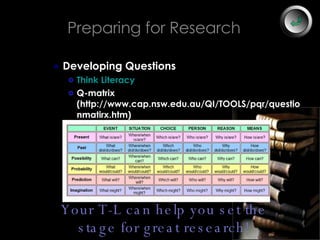
Preparing for Research Developing Questions Think Literacy Q-matrix (http://www.cap.nsw.edu.au/QI/TOOLS/pqr/questionmatirx.htm) Your T-L can help you set the stage for great research!
Accessing Resources Watch this great video about misinformation Learning to  evaluate  resources Your T-L can help you teach information gathering! (Jackson, 2008)
Processing Information Graphic Organizers Note taking Your T-L can help you teach sorting and analyzing !
Transferring Learning Differentiating   product 100 product possibilities (Ohio Valley, 2006) Your T-L is a media expert that can help you differentiate product! create a model  create a political cartoon create a slogan or bumper sticker write a news report make a calendar do a pantomime have a panel discussion write a new law prepare and serve ethnic food write and produce a play make a list make a game make a relief map make a learning center write a biography make a photo album make a transparency draw a set of blueprints make a travel poster create a musical instrument create a slide show make a tape recording compile a newspaper write a letter to the editor write a song demonstrate preparation of food collect pictures write a poem write a book draw a graph make a map invite a speaker make a collage write an autobiography keep a diary design and construct a new product hold a press conference create a filmstrip compile a booklet make a dictionary collect and analyze water samples make a mural submit items to a magazine draft and circulate a petition present a mock trial write a story paint a picture develop a set of study prints make a puzzle develop and use a questionnaire write a letter develop a display make a lithograph make a simulation game illustrate a story draw a diagram make a time line make a mobile conduct an interview plan a journey write a computer program design and make costumes design a needlework do puppet show create a word-play game make a video make a piece of art compile a portfolio of sketches take a survey formulate a scientific theory make an animated movie write and tape a conversation create an advertisement create a radio program conduct a debate prepare a TV program design an experiment make a collection of ... make an etching create a dance teach a lesson make a diorama create a bulletin board conduct a training session produce a film write an opinion article make a slide/tape presentation design a wall hanging build a planetarium give a demonstration  give a speech make a discovery be a mentor
Roles  to  play Teacher-Librarian Classroom Teacher Principal
Teacher-Librarian
Classroom Teacher
Principal
Implementing  the  Research  Model Points to consider Lesson  planning  resources Assessment  Resources
Points to Consider  for Research @ your Library Ensure that you have left sufficient and even extra time to teach and model the skills needed (Dinnin, 2003) Ensure that the instruction of research skills is meaningfully integrated into the context of a project (Davis, 2000)
Lesson  Planning  Resources Collaborative planning and teaching organizer Read Write Think  collection of student materials Sample partnering units from  DDSB
Assessment  Resources Rubistar  is my favourite evaluation resource; generate your own specific rubrics Kathy Schrock  maintains a great list of pre-formed rubrics – including multimedia rubrics
References Dinnin, C. (2003). Get organized! Get thinking! Get going!.  Teacher librarian , 31(2), 12-16.   Doiron, R., & Davies, J. (1998).  Partners in learning: students, teachers, and the school library.  Englewood, COL: Teacher Ideas Press, A Division of Greenwood Publishing Group, Inc.   Dreher, J., Davis, K., Waynant, P., & Clewell, S. (2000).  Easy steps to writing fantastic research reports . New York, N.Y.: Scholastic.  Jackson, C., and J. Kallas. &quot;Avoiding Fake Websites.&quot;  District 214 Library Services . 22 Mar. 2008 <http://whs.d214.org/results/whslibspecial/researchhelps/fakewebsites.htm>.  Osla. &quot;OSLA Information Studies.&quot;  Accessola . 1999. 19 Mar. 2008 <http://www.accessola.com/action/positions/info_studies/>.  Ovesc. &quot;Differentiation.&quot;  Ohio Valley Educational Service Center . 2006. 22 Mar. 2008 <http://www.ovesc.k12.oh.us/ovtemplate/site/differentiation.html>.  Page, C. (1999). Information skills in the curriculum: developing a school-based curriculum. In K. Haycock (Ed.),  Foundations for effective school library media programs  (pp. 122-129). Littleton, COL: Libraries Unlimited. Schrock, Kathy. &quot;Kathy Schrock's Guide for Educators.&quot;  Discovery School . 2008. 20 Mar. 2008 <http://school.discoveryeducation.com/schrockguide/assess.html>.  Scotchburn, Greg. &quot;DDSB Information Literacy Skills Continuum.&quot;  Durham District School Board . 2008. <http://programs.durham.edu.on.ca/ddsbinfoli/>.

Research Model - Teacher Librarian

  • 1.
    Implementing a School-wide Research Model By Amanda Paterson
  • 2.
  • 3.
    Why use a research model? &quot;The best thing we can be teaching our children today is how to teach themselves.”(Warlick, 2007) To view quote in slideshow context click here
  • 4.
    What is the OSLA research model? Stages of research Roles to play
  • 5.
    Stages of research Preparing for Research Accessing Resources Processing Information Transferring Learning
  • 6.
    Preparing for ResearchDeveloping Questions Think Literacy Q-matrix (http://www.cap.nsw.edu.au/QI/TOOLS/pqr/questionmatirx.htm) Your T-L can help you set the stage for great research!
  • 7.
    Accessing Resources Watchthis great video about misinformation Learning to evaluate resources Your T-L can help you teach information gathering! (Jackson, 2008)
  • 8.
    Processing Information GraphicOrganizers Note taking Your T-L can help you teach sorting and analyzing !
  • 9.
    Transferring Learning Differentiating product 100 product possibilities (Ohio Valley, 2006) Your T-L is a media expert that can help you differentiate product! create a model  create a political cartoon create a slogan or bumper sticker write a news report make a calendar do a pantomime have a panel discussion write a new law prepare and serve ethnic food write and produce a play make a list make a game make a relief map make a learning center write a biography make a photo album make a transparency draw a set of blueprints make a travel poster create a musical instrument create a slide show make a tape recording compile a newspaper write a letter to the editor write a song demonstrate preparation of food collect pictures write a poem write a book draw a graph make a map invite a speaker make a collage write an autobiography keep a diary design and construct a new product hold a press conference create a filmstrip compile a booklet make a dictionary collect and analyze water samples make a mural submit items to a magazine draft and circulate a petition present a mock trial write a story paint a picture develop a set of study prints make a puzzle develop and use a questionnaire write a letter develop a display make a lithograph make a simulation game illustrate a story draw a diagram make a time line make a mobile conduct an interview plan a journey write a computer program design and make costumes design a needlework do puppet show create a word-play game make a video make a piece of art compile a portfolio of sketches take a survey formulate a scientific theory make an animated movie write and tape a conversation create an advertisement create a radio program conduct a debate prepare a TV program design an experiment make a collection of ... make an etching create a dance teach a lesson make a diorama create a bulletin board conduct a training session produce a film write an opinion article make a slide/tape presentation design a wall hanging build a planetarium give a demonstration give a speech make a discovery be a mentor
  • 10.
    Roles to play Teacher-Librarian Classroom Teacher Principal
  • 11.
  • 12.
  • 13.
  • 14.
    Implementing the Research Model Points to consider Lesson planning resources Assessment Resources
  • 15.
    Points to Consider for Research @ your Library Ensure that you have left sufficient and even extra time to teach and model the skills needed (Dinnin, 2003) Ensure that the instruction of research skills is meaningfully integrated into the context of a project (Davis, 2000)
  • 16.
    Lesson Planning Resources Collaborative planning and teaching organizer Read Write Think collection of student materials Sample partnering units from DDSB
  • 17.
    Assessment ResourcesRubistar is my favourite evaluation resource; generate your own specific rubrics Kathy Schrock maintains a great list of pre-formed rubrics – including multimedia rubrics
  • 18.
    References Dinnin, C.(2003). Get organized! Get thinking! Get going!. Teacher librarian , 31(2), 12-16.   Doiron, R., & Davies, J. (1998). Partners in learning: students, teachers, and the school library. Englewood, COL: Teacher Ideas Press, A Division of Greenwood Publishing Group, Inc.   Dreher, J., Davis, K., Waynant, P., & Clewell, S. (2000). Easy steps to writing fantastic research reports . New York, N.Y.: Scholastic. Jackson, C., and J. Kallas. &quot;Avoiding Fake Websites.&quot; District 214 Library Services . 22 Mar. 2008 <http://whs.d214.org/results/whslibspecial/researchhelps/fakewebsites.htm>. Osla. &quot;OSLA Information Studies.&quot; Accessola . 1999. 19 Mar. 2008 <http://www.accessola.com/action/positions/info_studies/>. Ovesc. &quot;Differentiation.&quot; Ohio Valley Educational Service Center . 2006. 22 Mar. 2008 <http://www.ovesc.k12.oh.us/ovtemplate/site/differentiation.html>. Page, C. (1999). Information skills in the curriculum: developing a school-based curriculum. In K. Haycock (Ed.), Foundations for effective school library media programs (pp. 122-129). Littleton, COL: Libraries Unlimited. Schrock, Kathy. &quot;Kathy Schrock's Guide for Educators.&quot; Discovery School . 2008. 20 Mar. 2008 <http://school.discoveryeducation.com/schrockguide/assess.html>. Scotchburn, Greg. &quot;DDSB Information Literacy Skills Continuum.&quot; Durham District School Board . 2008. <http://programs.durham.edu.on.ca/ddsbinfoli/>.