NOT PROTECTIVELY MARKED
Research Methods: An
introduction
Dr. P Johnson
SS30013 Dissertation/Evaluative
Methods in Criminology
NOT PROTECTIVELY MARKED
Selecting Texts
Searching literature can be time consuming.
You need to be organised.
If you have too few texts – broaden your
search – think again.
If you have too many texts – narrow your
search – think again, be more specific.
NOT PROTECTIVELY MARKED
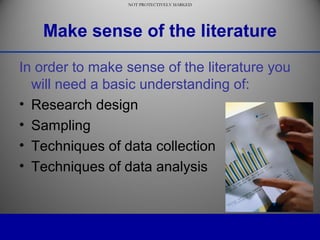
Make sense of the literature
In order to make sense of the literature you
will need a basic understanding of:
• Research design
• Sampling
• Techniques of data collection
• Techniques of data analysis
NOT PROTECTIVELY MARKED
Research Design and
Sampling
Research Design –
This refers to the overall plan for collecting
and analysing data.
There are two broad approaches which we
will concern ourselves with –
1. Quantitative research design and
2. Qualitative research design.
NOT PROTECTIVELY MARKED
Research Design
• Quantative research refers to studies in
which the researcher collects data which
can be measured and summarised
numerically.
• Qualitative studies often involve people
responding to a researchers questions in
their own words and it is these words that
are analysed and interpreted.
NOT PROTECTIVELY MARKED
Quantitative Research
This approach relies on:
• Objectivity – the researcher collects data in a way
that is distant from practice.
• “hard” data – this is data which can be measured
and quantified in some way
• Statistics – the results from studies following the
quantitative approach to research are presented in
numerical form and are interpreted on the basis of
the statistics calculated.
NOT PROTECTIVELY MARKED
Quantitative Research
For example if we analyse data by age
group we can identify how many people in
each age group we have in our study.
In this case we are using a numerical
figure to indicate what we have found in
this part of the data.
NOT PROTECTIVELY MARKED
Quantitative Research
Quantitative research represents what
might be described as a traditional view of
science – that is measuring hard data and
accounting for the results in statistical
terms.
To do this in a sound and reliable way the
data collected must be objective and not
biased.
NOT PROTECTIVELY MARKED
Qualitative Research
Qualitative research searches for meaning in a given
situation and therefore collects data in the form of
words – the medium by which most of us normally
explore meaning.
This is known as an “inductive” approach to research –
the purpose of the research being to find out what
people think and to bring that knowledge into view.
The inductive approach seeks to generate ideas rather
than test existing ideas.
NOT PROTECTIVELY MARKED
Quantitative or Qualitative
Researches will often prefer one method over
the other.
Quantitative v Qualitative
Many would say that both have their place.
Consider horse racing as an example. We can
gather hard facts, Quantitative, material that
tells us about the horse, its age, gender, results,
handicap. This is a useful guide to selecting a
horse to bet on However…
NOT PROTECTIVELY MARKED
Quantitative or Qualitative
What other information might we like to have?
Would seeing the horse help us?
Who might we want to talk to about the horse?
NOT PROTECTIVELY MARKED
Quantitative or Qualitative
The fact is our chances of a winning bet will be greater when
we have more knowledge.
To this end we will want both Quantitative data – perhaps
gathered from published facts and statistics and we will want to
add Qualitative information perhaps gathered from the owner
or the jockey or an experts observations.
NOT PROTECTIVELY MARKED
Qualitative or Quantitative
• Qualitative research
• Focuses on unknown
• Data in words
• Searches for
meanings
• Researcher interacts
with people being
studied
• Quantitative research
• Focuses on known
issues
• Data in numbers
• Identifies trends
• Researcher distant
from people being
studied
NOT PROTECTIVELY MARKED
Triangulation
• Triangulation – is the use of more than
one method of collecting or interpreting
data,
• E.g. using observation and interviews
or
• Structured questionnaires and
interviews
NOT PROTECTIVELY MARKED
Quantitative or Qualitative
We can see that Quantitative and Qualitative
are not mutually exclusive. In many studies
people will use a mix of both in their
approaches to collecting data.
Hence we have Triangulation – a mix of
methods which assists in stronger verification
of the research.
NOT PROTECTIVELY MARKED
Assessing Probabilities
• Harry was very creative as a child and
loved attention. He didn’t always feel ‘part
of the gang’ and this led to a desire to try
to impress others with his talents. He went
through school rather self-obsessed, and
tried his hand at any creative field. He
really enjoyed any opportunity to give a
presentation or to show off in front of an
audience.
NOT PROTECTIVELY MARKED
Take a look at the following statements regarding Harry as an
adult, and place them in order of most likely to least likely:
• A Harry is an accountant.
• B Harry is a professional actor.
• C Harry enjoys going to classical
concerts.
• D Harry is a professional actor and
enjoys going to classical concerts.
NOT PROTECTIVELY MARKED
The power of numbers?
• A terrible disease is reported and although it
affects only 1:10 000 people it is absolutely
lethal. You are worried about contracting it so go
to see your doctor to take a test to see if you
have it. No medical test is ever 100% accurate
and your doctor explains that this one is 99%
reliable. In other words it will give a correct
positive (or negative) result 99% of the time. You
take the test and a blood sample is taken and
sent away and you are told you will receive the
results in the post.
NOT PROTECTIVELY MARKED
How worried should you be?
• A week later you receive the results and
after opening the envelope see that the
test is positive, you have the lethal
disease.
• What are the chances of you having it?
• But....
NOT PROTECTIVELY MARKED
Quantitative or Qualitative
Any Questions?

Research Methods - an overview

  • 1.
    NOT PROTECTIVELY MARKED NOTPROTECTIVELY MARKED Research Methods: An introduction Dr. P Johnson SS30013 Dissertation/Evaluative Methods in Criminology
  • 2.
    NOT PROTECTIVELY MARKED NOTPROTECTIVELY MARKED Selecting Texts Searching literature can be time consuming. You need to be organised. If you have too few texts – broaden your search – think again. If you have too many texts – narrow your search – think again, be more specific.
  • 3.
    NOT PROTECTIVELY MARKED NOTPROTECTIVELY MARKED Make sense of the literature In order to make sense of the literature you will need a basic understanding of: • Research design • Sampling • Techniques of data collection • Techniques of data analysis
  • 4.
    NOT PROTECTIVELY MARKED NOTPROTECTIVELY MARKED Research Design and Sampling Research Design – This refers to the overall plan for collecting and analysing data. There are two broad approaches which we will concern ourselves with – 1. Quantitative research design and 2. Qualitative research design.
  • 5.
    NOT PROTECTIVELY MARKED NOTPROTECTIVELY MARKED Research Design • Quantative research refers to studies in which the researcher collects data which can be measured and summarised numerically. • Qualitative studies often involve people responding to a researchers questions in their own words and it is these words that are analysed and interpreted.
  • 6.
    NOT PROTECTIVELY MARKED NOTPROTECTIVELY MARKED Quantitative Research This approach relies on: • Objectivity – the researcher collects data in a way that is distant from practice. • “hard” data – this is data which can be measured and quantified in some way • Statistics – the results from studies following the quantitative approach to research are presented in numerical form and are interpreted on the basis of the statistics calculated.
  • 7.
    NOT PROTECTIVELY MARKED NOTPROTECTIVELY MARKED Quantitative Research For example if we analyse data by age group we can identify how many people in each age group we have in our study. In this case we are using a numerical figure to indicate what we have found in this part of the data.
  • 8.
    NOT PROTECTIVELY MARKED NOTPROTECTIVELY MARKED Quantitative Research Quantitative research represents what might be described as a traditional view of science – that is measuring hard data and accounting for the results in statistical terms. To do this in a sound and reliable way the data collected must be objective and not biased.
  • 9.
    NOT PROTECTIVELY MARKED NOTPROTECTIVELY MARKED Qualitative Research Qualitative research searches for meaning in a given situation and therefore collects data in the form of words – the medium by which most of us normally explore meaning. This is known as an “inductive” approach to research – the purpose of the research being to find out what people think and to bring that knowledge into view. The inductive approach seeks to generate ideas rather than test existing ideas.
  • 10.
    NOT PROTECTIVELY MARKED NOTPROTECTIVELY MARKED Quantitative or Qualitative Researches will often prefer one method over the other. Quantitative v Qualitative Many would say that both have their place. Consider horse racing as an example. We can gather hard facts, Quantitative, material that tells us about the horse, its age, gender, results, handicap. This is a useful guide to selecting a horse to bet on However…
  • 11.
    NOT PROTECTIVELY MARKED NOTPROTECTIVELY MARKED Quantitative or Qualitative What other information might we like to have? Would seeing the horse help us? Who might we want to talk to about the horse?
  • 12.
    NOT PROTECTIVELY MARKED NOTPROTECTIVELY MARKED Quantitative or Qualitative The fact is our chances of a winning bet will be greater when we have more knowledge. To this end we will want both Quantitative data – perhaps gathered from published facts and statistics and we will want to add Qualitative information perhaps gathered from the owner or the jockey or an experts observations.
  • 13.
    NOT PROTECTIVELY MARKED NOTPROTECTIVELY MARKED Qualitative or Quantitative • Qualitative research • Focuses on unknown • Data in words • Searches for meanings • Researcher interacts with people being studied • Quantitative research • Focuses on known issues • Data in numbers • Identifies trends • Researcher distant from people being studied
  • 14.
    NOT PROTECTIVELY MARKED NOTPROTECTIVELY MARKED Triangulation • Triangulation – is the use of more than one method of collecting or interpreting data, • E.g. using observation and interviews or • Structured questionnaires and interviews
  • 15.
    NOT PROTECTIVELY MARKED NOTPROTECTIVELY MARKED Quantitative or Qualitative We can see that Quantitative and Qualitative are not mutually exclusive. In many studies people will use a mix of both in their approaches to collecting data. Hence we have Triangulation – a mix of methods which assists in stronger verification of the research.
  • 16.
    NOT PROTECTIVELY MARKED NOTPROTECTIVELY MARKED Assessing Probabilities • Harry was very creative as a child and loved attention. He didn’t always feel ‘part of the gang’ and this led to a desire to try to impress others with his talents. He went through school rather self-obsessed, and tried his hand at any creative field. He really enjoyed any opportunity to give a presentation or to show off in front of an audience.
  • 17.
    NOT PROTECTIVELY MARKED NOTPROTECTIVELY MARKED Take a look at the following statements regarding Harry as an adult, and place them in order of most likely to least likely: • A Harry is an accountant. • B Harry is a professional actor. • C Harry enjoys going to classical concerts. • D Harry is a professional actor and enjoys going to classical concerts.
  • 18.
    NOT PROTECTIVELY MARKED NOTPROTECTIVELY MARKED The power of numbers? • A terrible disease is reported and although it affects only 1:10 000 people it is absolutely lethal. You are worried about contracting it so go to see your doctor to take a test to see if you have it. No medical test is ever 100% accurate and your doctor explains that this one is 99% reliable. In other words it will give a correct positive (or negative) result 99% of the time. You take the test and a blood sample is taken and sent away and you are told you will receive the results in the post.
  • 19.
    NOT PROTECTIVELY MARKED NOTPROTECTIVELY MARKED How worried should you be? • A week later you receive the results and after opening the envelope see that the test is positive, you have the lethal disease. • What are the chances of you having it? • But....
  • 20.
    NOT PROTECTIVELY MARKED NOTPROTECTIVELY MARKED Quantitative or Qualitative Any Questions?