CHAPTER ONE
NATURE OF OPERATIONS MANAGEMENT
What is Operations Management?
Operations management is the set of activities that creates goods
and services through the transformation of inputs into outputs.
Operations management is the study of decision-making in the
operations function. Three points in this definition deserve emphasis:
1.Decisions- Decision-making has four major decision responsibilities
in operations management i.e. Process, Quality, Capacity and
Inventory
2.Function- Operations is a major function in any organization.
Cont…
The operations function is responsible for supplying or producing
products and services for the business.
In a manufacturing company, the operations function is called the
manufacturing or production department.
In service organizations, the operations function is called the
operations department.
In general the term “operations” refers to the function that
produces goods or services.
3. System- It is the transformation process that produce goods and services in
the organization
Components of transformation model
1. Inputs: Some inputs are used up in the process of creation
of goods and services, while others play a part in the creation
process but are not used up.
To distinguish between these inputs resources, usually
classified as:
Transformed resources for example material, information
Transforming resource example staffs, land, building,
machines, and equipment's
Cont.….
2. Out Puts
Output is goods and services resulting from the transformation process.
In these OM is responsible for minimizing wastes, protecting the health and
safety of the employees and ethical behavior in relation to social impact of
transformation process.
3. Transformation process
It Is any activity or group of activities that takes one or more inputs and
transform and add values to them and provides out puts for customers and
clients.
4. Feedback Information used to control the operation process by adjusting
the inputs and transformation process that are used to achieve desired out
comes.
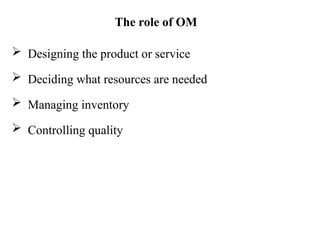
The role of OM
 Designing the product or service
 Deciding what resources are needed
 Managing inventory
 Controlling quality
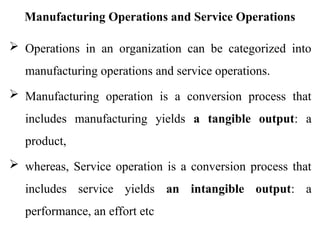
Manufacturing Operations and Service Operations
 Operations in an organization can be categorized into
manufacturing operations and service operations.
 Manufacturing operation is a conversion process that
includes manufacturing yields a tangible output: a
product,
 whereas, Service operation is a conversion process that
includes service yields an intangible output: a
performance, an effort etc
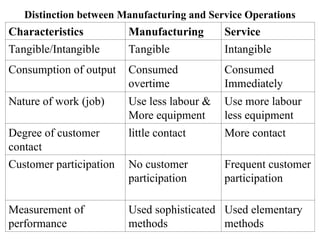
Distinction between Manufacturing and Service Operations
Characteristics Manufacturing Service
Tangible/Intangible Tangible Intangible
Consumption of output Consumed
overtime
Consumed
Immediately
Nature of work (job) Use less labour &
More equipment
Use more labour
less equipment
Degree of customer
contact
little contact More contact
Customer participation No customer
participation
Frequent customer
participation
Measurement of
performance
Used sophisticated
methods
Used elementary
methods
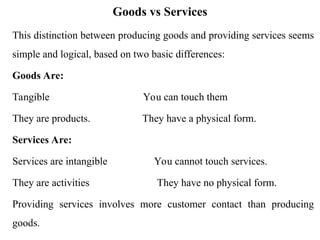
Goods vs Services
This distinction between producing goods and providing services seems
simple and logical, based on two basic differences:
Goods Are:
Tangible You can touch them
They are products. They have a physical form.
Services Are:
Services are intangible You cannot touch services.
They are activities They have no physical form.
Providing services involves more customer contact than producing
goods.
Operations Decisions
An operation has responsibility for five major decision areas:
process, capacity, inventory, work force, and quality.
1.Process: Determining the physical process (equipment and
technology) used to produce the product or service.
2.Capacity: Providing the right amount of capacity at right
place at the right time.
3.Inventory: It is the decisions of determining what to order,
how much to order, and when to order. They manage the flow
of materials within the firm.
Cont.…
4. Work force: It is the decision of managing the
work force in a productive and humane way.
5. Quality: It is the decision of determining
standard for quality to attract and satisfy the needs
of customers.
Productivity
 The creation of goods and service requires changing
resources into goods and services.
 Productivity is the ratio of outputs (goods and services)
divided by the inputs (resources, such as labor and
capital).
 Productivity is defined in terms of utilization of resources,
like material and labor.
 In simple terms, productivity is the ratio of output to
input.
Productivity Analysis
For the purposes of productivity improvement, the following analysis
can be carried out:
1. Trend analysis: Studying productivity changes over a period of
time.
2. Horizontal analysis: Studying productivity in comparison with
other firms of the same size and engaged in similar business.
3. Vertical analysis: Studying productivity in comparison with other
industries and other firms of different sizes in the same industry.
4. Budgetary analysis: Setting a budget for productivity for a future
period.
FACTORS AFFECTING PRODUCTIVITY
1. Capital/labour ratio: It is a measure of investment is being made in
plant, machinery, and tools to make effective use of labour hours.
2. Scarcity of some resources: Resources such as energy, water and
number of metals will create productivity problems.
3. Work-force changes: Change in work-force effect productivity to a
larger extent, because of the labour turnover.
4. Innovations and technology: This is the major cause of increasing
productivity.
5. Regulatory effects: These impose substantial constraints on some
firms, which lead to change in productivity.
Cont….
6. Bargaining power: Bargaining power of organized
labour to command wage increases excess of output
increases has had a detrimental effect on productivity.
7. Managerial factors: Managerial factors are the ways an
organization benefits from the unique planning and
managerial skills of its manager.
8.Quality of work life: It is a term that describes the
organizational culture, and the extent to which it motivates
and satisfies employees
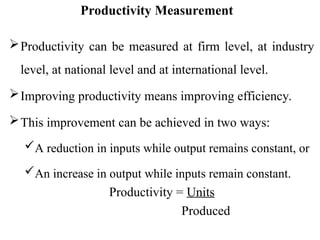
Productivity Measurement
Productivity can be measured at firm level, at industry
level, at national level and at international level.
Improving productivity means improving efficiency.
This improvement can be achieved in two ways:
A reduction in inputs while output remains constant, or
An increase in output while inputs remain constant.
Productivity = Units
Produced
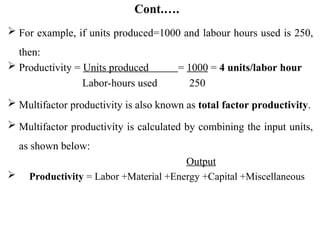
Cont.….
 For example, if units produced=1000 and labour hours used is 250,
then:
 Productivity = Units produced = 1000 = 4 units/labor hour
Labor-hours used 250
 Multifactor productivity is also known as total factor productivity.
 Multifactor productivity is calculated by combining the input units,
as shown below:
Output
 Productivity = Labor +Material +Energy +Capital +Miscellaneous
CONT….
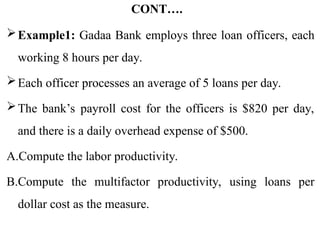
Example1: Gadaa Bank employs three loan officers, each
working 8 hours per day.
Each officer processes an average of 5 loans per day.
The bank’s payroll cost for the officers is $820 per day,
and there is a daily overhead expense of $500.
A.Compute the labor productivity.
B.Compute the multifactor productivity, using loans per
dollar cost as the measure.
CONT…. Example1
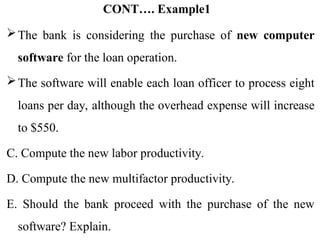
The bank is considering the purchase of new computer
software for the loan operation.
The software will enable each loan officer to process eight
loans per day, although the overhead expense will increase
to $550.
C. Compute the new labor productivity.
D. Compute the new multifactor productivity.
E. Should the bank proceed with the purchase of the new
software? Explain.
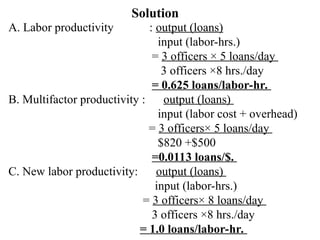
Solution
A. Labor productivity : output (loans)
input (labor-hrs.)
= 3 officers × 5 loans/day
3 officers ×8 hrs./day
= 0.625 loans/labor-hr.
B. Multifactor productivity : output (loans)
input (labor cost + overhead)
= 3 officers× 5 loans/day
$820 +$500
=0.0113 loans/$.
C. New labor productivity: output (loans)
input (labor-hrs.)
= 3 officers× 8 loans/day
3 officers ×8 hrs./day
= 1.0 loans/labor-hr.
Solution
D. New multifactor productivity: output (loans)
input (labor cost + overhead)
= 3 officers× 8 loans/day
$820 +$550
=0.0175 loans/$.
=0.0175 loans/$.
E. Purchasing the new software would increase the labor
productivity by 60 percent (= [1.0−0.625]/0.625) and would
increase the multifactor productivity by 55 percent (=
[0.0175 − 0.0113]/0.0113), so it is certainly worth the added
overhead.
Chapter Two
Operations Strategy For Competitive Advantage
Each of a firm’s strategies should be established in light of:
 The threats and opportunities in the environment and
 The strengths and weaknesses of the organization
What is the meaning Missions and Strategies
Mission can be defined as organization’s purpose―what it will
contribute to society.
The mission states the rationale for the organization’s existence.
Developing a good strategy is difficult, but it is much easier if the
mission has been well defined.
CONT….
Strategy is an organization’s action plan to achieve the
mission.
These strategies exploit opportunities and strengths,
neutralize threats, and avoid weaknesses.
Firms achieve missions in three conceptual ways: (1)
differentiation, (2) cost leadership, and (3) quick response.
Operations managers translate these strategic concepts into
tangible tasks to be accomplished.
Strategies and Tactics
 Strategies are plans for achieving goals. If you think of goals
as destinations, then strategies are the road maps for
reaching the destinations. Strategies provide focus for
decision-making.
 Tactics are the methods and actions used to accomplish strategies.
 They are more specific in nature than strategies
 They provide guidance and direction for carrying out actual
operations, Tactics indicate how to reach the destination, following
the strategy but operations are the actual “doing” part of the
process.
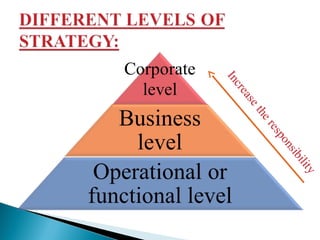
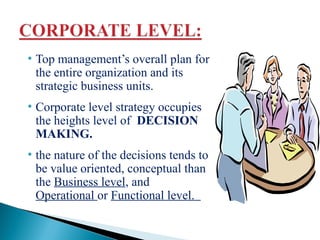
• Top management’s overall plan for
the entire organization and its
strategic business units.
• Corporate level strategy occupies
the heights level of DECISION
MAKING.
• the nature of the decisions tends to
be value oriented, conceptual than
the Business level, and
Operational or Functional level.
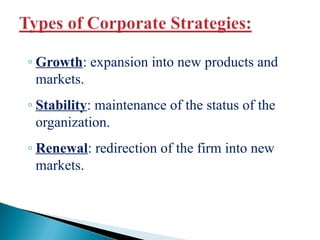
◦ Growth: expansion into new products and
markets.
◦ Stability: maintenance of the status of the
organization.
◦ Renewal: redirection of the firm into new
markets.
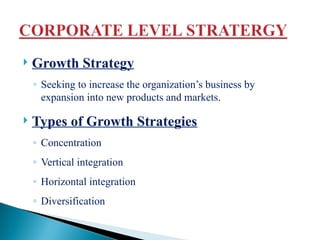
 Growth Strategy
◦ Seeking to increase the organization’s business by
expansion into new products and markets.
 Types of Growth Strategies
◦ Concentration
◦ Vertical integration
◦ Horizontal integration
◦ Diversification
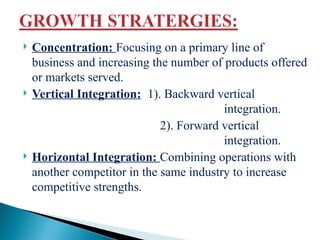
 Concentration: Focusing on a primary line of
business and increasing the number of products offered
or markets served.
 Vertical Integration: 1). Backward vertical
integration.
2). Forward vertical
integration.
 Horizontal Integration: Combining operations with
another competitor in the same industry to increase
competitive strengths.
 Stability Strategy: A strategy that seeks to
maintain the status with the uncertainty of the
environment, when the industry is experiencing slow-
or no-growth conditions.
 Renewal Strategy: Developing strategies to
counter organization weaknesses that are leading to
performance declines.
 A strategy that seeks to determine how an
organization should compete in each of its SBUs
(strategic business units).
 At Business-level ALLOCATION of re-sources
among Functional-level COORDINATE with the
Corporate level to the ACHIEVEMENT of the
Corporate level OBJECTIVES.
 Cost leadership: Attaining, then using the lowest total
cost basis as a competitive advantage.
 Differentiation: Using product features or services to
distinguish the firm’s offerings from its competitors.
 Market focus: Concentrating competitively on
a specific market segment.
 Focus is on improving the effectiveness of operations
within a company.
 Which is done by:
◦ Manufacturing
◦ Marketing
◦ Materials management
◦ Research and development
◦ Human resources
2-34
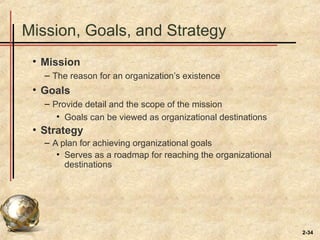
Mission, Goals, and Strategy
• Mission
– The reason for an organization’s existence
• Goals
– Provide detail and the scope of the mission
• Goals can be viewed as organizational destinations
• Strategy
– A plan for achieving organizational goals
• Serves as a roadmap for reaching the organizational
destinations
2-35
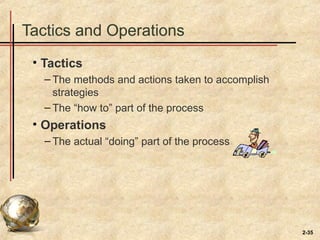
Tactics and Operations
• Tactics
– The methods and actions taken to accomplish
strategies
– The “how to” part of the process
• Operations
– The actual “doing” part of the process
2-36
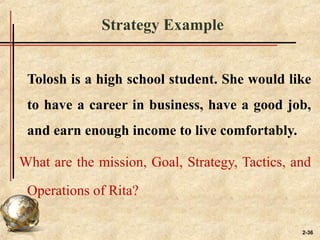
Strategy Example
Tolosh is a high school student. She would like
to have a career in business, have a good job,
and earn enough income to live comfortably.
What are the mission, Goal, Strategy, Tactics, and
Operations of Rita?
2-37
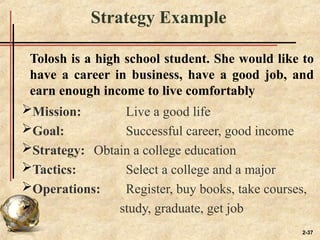
Strategy Example
Tolosh is a high school student. She would like to
have a career in business, have a good job, and
earn enough income to live comfortably
Mission: Live a good life
Goal: Successful career, good income
Strategy: Obtain a college education
Tactics: Select a college and a major
Operations: Register, buy books, take courses,
 study, graduate, get job
2-38
Strategy Formulation
Effective strategy formulation requires taking
into account:
 Core( distinctive ) competencies
 Environmental scanning
• SWOT
Successful strategy formulation also requires
taking into account:
 Order qualifiers
 Order winners
Strategy Formulation
To formulate an effective strategy, senior management must
take into account the distinctive competencies of the
organization, and they must scan the environment.
They must determine what competitors are doing, or
planning to do, and take that into account.
They must critically examine the SWOT Analysis approach
(strengths, weaknesses, opportunities, and threats).
In formulating a successful strategy, organizations must take
into account order qualifiers and order winners.
CONT….
Distinctive Competencies
Distinctive competencies are those special attributes or abilities
possessed by an organization that give it a competitive edge.
These can include price (low costs of resources); quality (high
performance or consistent quality); time (on-time delivery); flexibility
(variety of volume); customer service and location.
Competitive advantage
It implies the creation of a system that has a unique advantage over
competitors.
Managers achieve competitive advantage through differentiation,
low cost, and response.
CONT….
Competing on Differentiation: Differentiation is concerned
with providing uniqueness.
A low-cost strategy is an optimal facility that is effectively
utilized.
Low-cost leadership entails achieving maximum value as
defined by your customer.
A low-cost strategy does not imply low value or low quality.
Competing on Response: It also refers to reliable and quick
response.

Teaching Materials Operation Management chapter Two

  • 1.
    CHAPTER ONE NATURE OFOPERATIONS MANAGEMENT What is Operations Management? Operations management is the set of activities that creates goods and services through the transformation of inputs into outputs. Operations management is the study of decision-making in the operations function. Three points in this definition deserve emphasis: 1.Decisions- Decision-making has four major decision responsibilities in operations management i.e. Process, Quality, Capacity and Inventory 2.Function- Operations is a major function in any organization.
  • 2.
    Cont… The operations functionis responsible for supplying or producing products and services for the business. In a manufacturing company, the operations function is called the manufacturing or production department. In service organizations, the operations function is called the operations department. In general the term “operations” refers to the function that produces goods or services. 3. System- It is the transformation process that produce goods and services in the organization
  • 3.
    Components of transformationmodel 1. Inputs: Some inputs are used up in the process of creation of goods and services, while others play a part in the creation process but are not used up. To distinguish between these inputs resources, usually classified as: Transformed resources for example material, information Transforming resource example staffs, land, building, machines, and equipment's
  • 4.
    Cont.…. 2. Out Puts Outputis goods and services resulting from the transformation process. In these OM is responsible for minimizing wastes, protecting the health and safety of the employees and ethical behavior in relation to social impact of transformation process. 3. Transformation process It Is any activity or group of activities that takes one or more inputs and transform and add values to them and provides out puts for customers and clients. 4. Feedback Information used to control the operation process by adjusting the inputs and transformation process that are used to achieve desired out comes.
  • 5.
    The role ofOM  Designing the product or service  Deciding what resources are needed  Managing inventory  Controlling quality
  • 6.
    Manufacturing Operations andService Operations  Operations in an organization can be categorized into manufacturing operations and service operations.  Manufacturing operation is a conversion process that includes manufacturing yields a tangible output: a product,  whereas, Service operation is a conversion process that includes service yields an intangible output: a performance, an effort etc
  • 7.
    Distinction between Manufacturingand Service Operations Characteristics Manufacturing Service Tangible/Intangible Tangible Intangible Consumption of output Consumed overtime Consumed Immediately Nature of work (job) Use less labour & More equipment Use more labour less equipment Degree of customer contact little contact More contact Customer participation No customer participation Frequent customer participation Measurement of performance Used sophisticated methods Used elementary methods
  • 8.
    Goods vs Services Thisdistinction between producing goods and providing services seems simple and logical, based on two basic differences: Goods Are: Tangible You can touch them They are products. They have a physical form. Services Are: Services are intangible You cannot touch services. They are activities They have no physical form. Providing services involves more customer contact than producing goods.
  • 9.
    Operations Decisions An operationhas responsibility for five major decision areas: process, capacity, inventory, work force, and quality. 1.Process: Determining the physical process (equipment and technology) used to produce the product or service. 2.Capacity: Providing the right amount of capacity at right place at the right time. 3.Inventory: It is the decisions of determining what to order, how much to order, and when to order. They manage the flow of materials within the firm.
  • 10.
    Cont.… 4. Work force:It is the decision of managing the work force in a productive and humane way. 5. Quality: It is the decision of determining standard for quality to attract and satisfy the needs of customers.
  • 11.
    Productivity  The creationof goods and service requires changing resources into goods and services.  Productivity is the ratio of outputs (goods and services) divided by the inputs (resources, such as labor and capital).  Productivity is defined in terms of utilization of resources, like material and labor.  In simple terms, productivity is the ratio of output to input.
  • 12.
    Productivity Analysis For thepurposes of productivity improvement, the following analysis can be carried out: 1. Trend analysis: Studying productivity changes over a period of time. 2. Horizontal analysis: Studying productivity in comparison with other firms of the same size and engaged in similar business. 3. Vertical analysis: Studying productivity in comparison with other industries and other firms of different sizes in the same industry. 4. Budgetary analysis: Setting a budget for productivity for a future period.
  • 13.
    FACTORS AFFECTING PRODUCTIVITY 1.Capital/labour ratio: It is a measure of investment is being made in plant, machinery, and tools to make effective use of labour hours. 2. Scarcity of some resources: Resources such as energy, water and number of metals will create productivity problems. 3. Work-force changes: Change in work-force effect productivity to a larger extent, because of the labour turnover. 4. Innovations and technology: This is the major cause of increasing productivity. 5. Regulatory effects: These impose substantial constraints on some firms, which lead to change in productivity.
  • 14.
    Cont…. 6. Bargaining power:Bargaining power of organized labour to command wage increases excess of output increases has had a detrimental effect on productivity. 7. Managerial factors: Managerial factors are the ways an organization benefits from the unique planning and managerial skills of its manager. 8.Quality of work life: It is a term that describes the organizational culture, and the extent to which it motivates and satisfies employees
  • 15.
    Productivity Measurement Productivity canbe measured at firm level, at industry level, at national level and at international level. Improving productivity means improving efficiency. This improvement can be achieved in two ways: A reduction in inputs while output remains constant, or An increase in output while inputs remain constant. Productivity = Units Produced
  • 16.
    Cont.….  For example,if units produced=1000 and labour hours used is 250, then:  Productivity = Units produced = 1000 = 4 units/labor hour Labor-hours used 250  Multifactor productivity is also known as total factor productivity.  Multifactor productivity is calculated by combining the input units, as shown below: Output  Productivity = Labor +Material +Energy +Capital +Miscellaneous
  • 17.
    CONT…. Example1: Gadaa Bankemploys three loan officers, each working 8 hours per day. Each officer processes an average of 5 loans per day. The bank’s payroll cost for the officers is $820 per day, and there is a daily overhead expense of $500. A.Compute the labor productivity. B.Compute the multifactor productivity, using loans per dollar cost as the measure.
  • 18.
    CONT…. Example1 The bankis considering the purchase of new computer software for the loan operation. The software will enable each loan officer to process eight loans per day, although the overhead expense will increase to $550. C. Compute the new labor productivity. D. Compute the new multifactor productivity. E. Should the bank proceed with the purchase of the new software? Explain.
  • 19.
    Solution A. Labor productivity: output (loans) input (labor-hrs.) = 3 officers × 5 loans/day 3 officers ×8 hrs./day = 0.625 loans/labor-hr. B. Multifactor productivity : output (loans) input (labor cost + overhead) = 3 officers× 5 loans/day $820 +$500 =0.0113 loans/$. C. New labor productivity: output (loans) input (labor-hrs.) = 3 officers× 8 loans/day 3 officers ×8 hrs./day = 1.0 loans/labor-hr.
  • 20.
    Solution D. New multifactorproductivity: output (loans) input (labor cost + overhead) = 3 officers× 8 loans/day $820 +$550 =0.0175 loans/$. =0.0175 loans/$. E. Purchasing the new software would increase the labor productivity by 60 percent (= [1.0−0.625]/0.625) and would increase the multifactor productivity by 55 percent (= [0.0175 − 0.0113]/0.0113), so it is certainly worth the added overhead.
  • 21.
    Chapter Two Operations StrategyFor Competitive Advantage Each of a firm’s strategies should be established in light of:  The threats and opportunities in the environment and  The strengths and weaknesses of the organization What is the meaning Missions and Strategies Mission can be defined as organization’s purpose―what it will contribute to society. The mission states the rationale for the organization’s existence. Developing a good strategy is difficult, but it is much easier if the mission has been well defined.
  • 22.
    CONT…. Strategy is anorganization’s action plan to achieve the mission. These strategies exploit opportunities and strengths, neutralize threats, and avoid weaknesses. Firms achieve missions in three conceptual ways: (1) differentiation, (2) cost leadership, and (3) quick response. Operations managers translate these strategic concepts into tangible tasks to be accomplished.
  • 23.
    Strategies and Tactics Strategies are plans for achieving goals. If you think of goals as destinations, then strategies are the road maps for reaching the destinations. Strategies provide focus for decision-making.  Tactics are the methods and actions used to accomplish strategies.  They are more specific in nature than strategies  They provide guidance and direction for carrying out actual operations, Tactics indicate how to reach the destination, following the strategy but operations are the actual “doing” part of the process.
  • 25.
    • Top management’soverall plan for the entire organization and its strategic business units. • Corporate level strategy occupies the heights level of DECISION MAKING. • the nature of the decisions tends to be value oriented, conceptual than the Business level, and Operational or Functional level.
  • 26.
    ◦ Growth: expansioninto new products and markets. ◦ Stability: maintenance of the status of the organization. ◦ Renewal: redirection of the firm into new markets.
  • 27.
     Growth Strategy ◦Seeking to increase the organization’s business by expansion into new products and markets.  Types of Growth Strategies ◦ Concentration ◦ Vertical integration ◦ Horizontal integration ◦ Diversification
  • 28.
     Concentration: Focusingon a primary line of business and increasing the number of products offered or markets served.  Vertical Integration: 1). Backward vertical integration. 2). Forward vertical integration.  Horizontal Integration: Combining operations with another competitor in the same industry to increase competitive strengths.
  • 30.
     Stability Strategy:A strategy that seeks to maintain the status with the uncertainty of the environment, when the industry is experiencing slow- or no-growth conditions.  Renewal Strategy: Developing strategies to counter organization weaknesses that are leading to performance declines.
  • 31.
     A strategythat seeks to determine how an organization should compete in each of its SBUs (strategic business units).  At Business-level ALLOCATION of re-sources among Functional-level COORDINATE with the Corporate level to the ACHIEVEMENT of the Corporate level OBJECTIVES.
  • 32.
     Cost leadership:Attaining, then using the lowest total cost basis as a competitive advantage.  Differentiation: Using product features or services to distinguish the firm’s offerings from its competitors.  Market focus: Concentrating competitively on a specific market segment.
  • 33.
     Focus ison improving the effectiveness of operations within a company.  Which is done by: ◦ Manufacturing ◦ Marketing ◦ Materials management ◦ Research and development ◦ Human resources
  • 34.
    2-34 Mission, Goals, andStrategy • Mission – The reason for an organization’s existence • Goals – Provide detail and the scope of the mission • Goals can be viewed as organizational destinations • Strategy – A plan for achieving organizational goals • Serves as a roadmap for reaching the organizational destinations
  • 35.
    2-35 Tactics and Operations •Tactics – The methods and actions taken to accomplish strategies – The “how to” part of the process • Operations – The actual “doing” part of the process
  • 36.
    2-36 Strategy Example Tolosh isa high school student. She would like to have a career in business, have a good job, and earn enough income to live comfortably. What are the mission, Goal, Strategy, Tactics, and Operations of Rita?
  • 37.
    2-37 Strategy Example Tolosh isa high school student. She would like to have a career in business, have a good job, and earn enough income to live comfortably Mission: Live a good life Goal: Successful career, good income Strategy: Obtain a college education Tactics: Select a college and a major Operations: Register, buy books, take courses,  study, graduate, get job
  • 38.
    2-38 Strategy Formulation Effective strategyformulation requires taking into account:  Core( distinctive ) competencies  Environmental scanning • SWOT Successful strategy formulation also requires taking into account:  Order qualifiers  Order winners
  • 39.
    Strategy Formulation To formulatean effective strategy, senior management must take into account the distinctive competencies of the organization, and they must scan the environment. They must determine what competitors are doing, or planning to do, and take that into account. They must critically examine the SWOT Analysis approach (strengths, weaknesses, opportunities, and threats). In formulating a successful strategy, organizations must take into account order qualifiers and order winners.
  • 40.
  • 41.
    Distinctive Competencies Distinctive competenciesare those special attributes or abilities possessed by an organization that give it a competitive edge. These can include price (low costs of resources); quality (high performance or consistent quality); time (on-time delivery); flexibility (variety of volume); customer service and location. Competitive advantage It implies the creation of a system that has a unique advantage over competitors. Managers achieve competitive advantage through differentiation, low cost, and response.
  • 42.
    CONT…. Competing on Differentiation:Differentiation is concerned with providing uniqueness. A low-cost strategy is an optimal facility that is effectively utilized. Low-cost leadership entails achieving maximum value as defined by your customer. A low-cost strategy does not imply low value or low quality. Competing on Response: It also refers to reliable and quick response.