Lingga Wardhana (11P2155) M Farhan Lucky (11P2156)
Novita Vilianty (11P2160) Prasasti Rinta Dewi (11P2161)
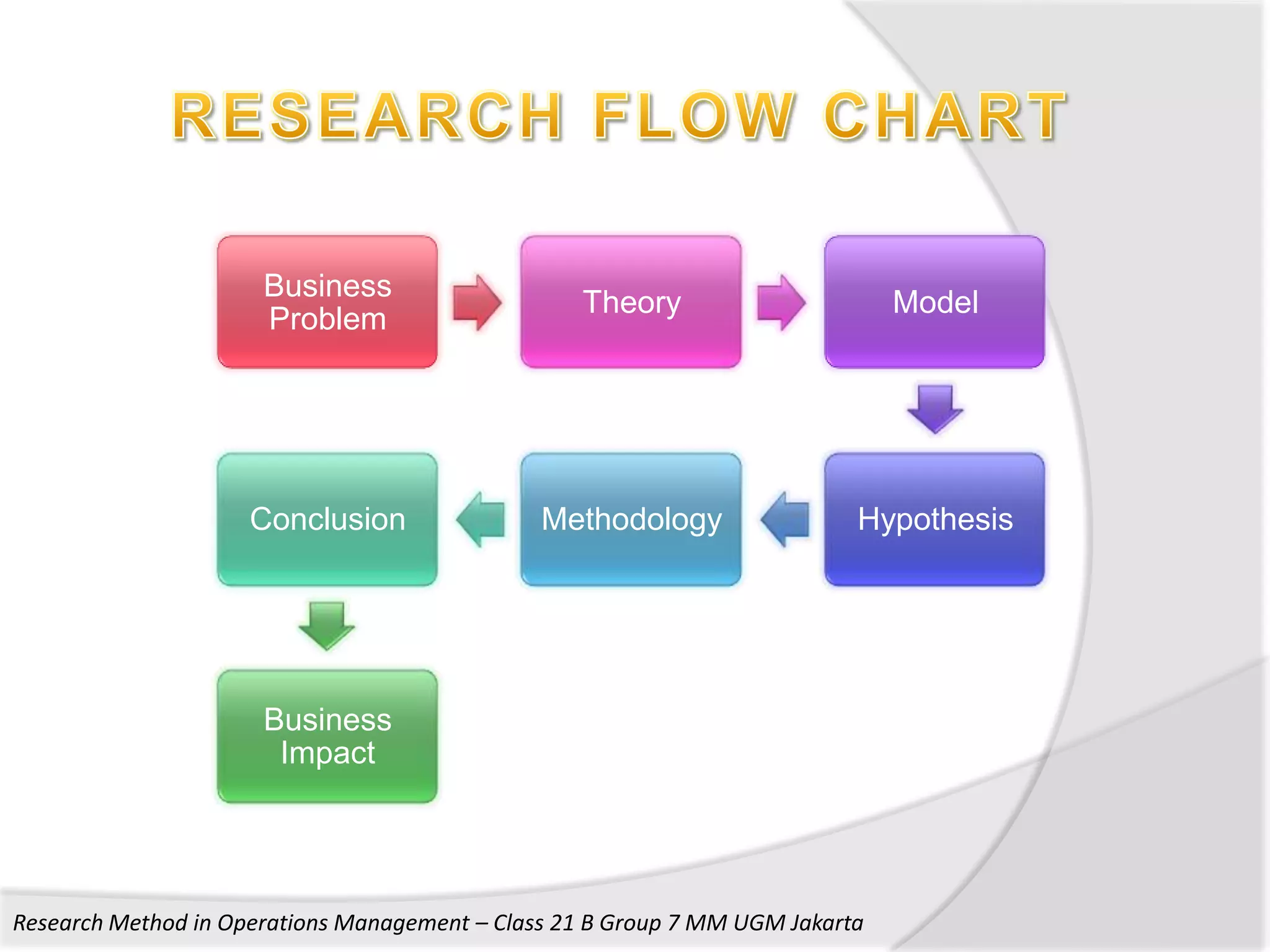
Business
                                                  Theory                       Model
                      Problem


                     Conclusion                Methodology                 Hypothesis


                      Business
                       Impact


Research Method in Operations Management – Class 21 B Group 7 MM UGM Jakarta
“Before doing your research I want to share my dogmas.
              Methodology is there to make it credible to the reader that
             you have planned and carried through your study as well as
            analysed and drawn conclusions in a way that we can rely on
                                  what you write.”

                                 Professor Christer Karlsson


Research Method in Operations Management – Class 21 B Group 7 MM UGM Jakarta
The collection of information from individuals about
            themselves or about the social units to which they
            belong (Rossi et al., 1983)
            Exploratory survey research:
            Early stages of research into a phenomenon to gain preliminary
            insight on a topic, and provides the basis for more in-depth survey.

            Confirmatory (or theory testing or explanatory) survey research
            Knowledge of a phenomenon has been articulated in a theoretical
            form using well-defined concepts, models and propositions.

            Descriptive survey research
            Understanding the relevance of a certain phenomenon and
            describing the distribution of the phenomenon in a population.


Research Method in Operations Management – Class 21 B Group 7 MM UGM Jakarta
Advantages :                              Disadvantages :
                a. Relatively short period of             a. Poor survey can undermine
                     time                                     otherwise well-designed
                b. Less expensive                             studies.
                c. Created quickly &                      b. May be not accurate
                     administered easily                      depend on participant feels
                d. Wide range of things :                 c. Response rates can bias in
                     personal facts, attitudes,               random sampling
                     past behaviors and
                     opinions


Research Method in Operations Management – Class 21 B Group 7 MM UGM Jakarta
   Mail - An example might include an alumni survey
               distributed via direct mail by your almamater.

              Telephone - An example of a telephone survey would
               be a market research call about your experiences with
               a certain consumer product.

              Online - Online surveys might focus on your
               experience with a particular retailer, product or website.

              At home interviews - The U.S. Census is a good
               example of an at-home interview survey administration.

Research Method in Operations Management – Class 21 B Group 7 MM UGM Jakarta
   Exploration: To build new theory

         Theory Building: To identify linkage between
          variables, to find out “why” the relationships
          exist

         Theory Testing: Testing theories in previous
          stage to predict future outcomes

         Theory extension/refinement: To better
          structure the theories in light of the observed
          results

Research Method in Operations Management – Class 21 B Group 7 MM UGM Jakarta
   When to use case research : when researcher wants to seek
          phenomenon happen in the past or current with primary or
          secondary data mining

         Developing the research framework, construct, and
          questions : Building a conceptual framework will force the
          researcher to think carefully and selectively about the construct
          and variables to be included in study

         Choosing cases : What is the ideal number of cases,
          longitudinal or retrospectives cases, case selection and
          sampling, sample controls

         Developing research instruments and protocols : broad
          open ended questions for interviews, single or multiple
          respondents and viewpoints


Research Method in Operations Management – Class 21 B Group 7 MM UGM Jakarta
   Conducting the field research : who to contact: better be
          senior in organizations for easy access to information, field data
          collection: usage of different methods to study same
          phenomenon, conducting interviews, single or multiple
          investigators,    collecting  objective    data,    administering
          questionnaires, recording the data, seeking convergence and
          clarification,    determining      sequence       (cause       and
          effects), challenges of observers bias, when to stop, summary.

         Data documentation and coding : Documentations, coding

         Data analysis, hypotesis development and testing : Analysis
          data within cases , hypothesis development and
          testing, shaping hypotheses, testing hypotheses, enfolding
          literature


Research Method in Operations Management – Class 21 B Group 7 MM UGM Jakarta
Reliability and Validity in Case Research

         Construct Validity : establishment of correct operational measures for the
          concept being studied

         Discriminant Validity : If the construct as measured can be differentiated
          from other construct

         Internal Validity: The extent to which we can establish a causal
          relationship, where by certain condition are shown to lead to other
          conditions, as distinguished from spurious relationship

         External Validity: Knowing whether a study’s finding can be generalized
          beyond the immediate case study

         Reliability: The extend to which a study’s operations can be repeated, with
          the same result


Research Method in Operations Management – Class 21 B Group 7 MM UGM Jakarta
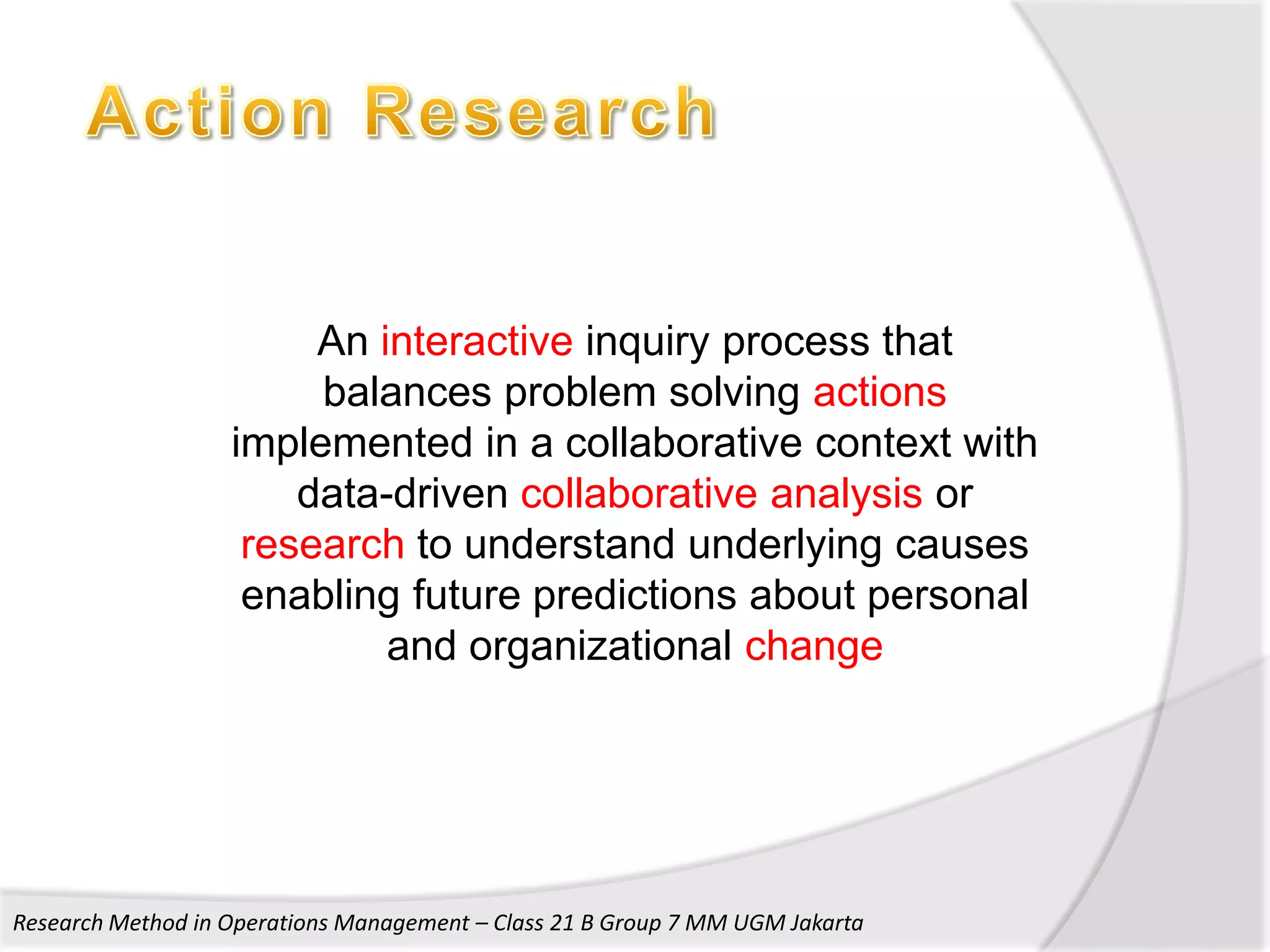
An interactive inquiry process that
                        balances problem solving actions
                   implemented in a collaborative context with
                       data-driven collaborative analysis or
                    research to understand underlying causes
                    enabling future predictions about personal
                            and organizational change


Research Method in Operations Management – Class 21 B Group 7 MM UGM Jakarta
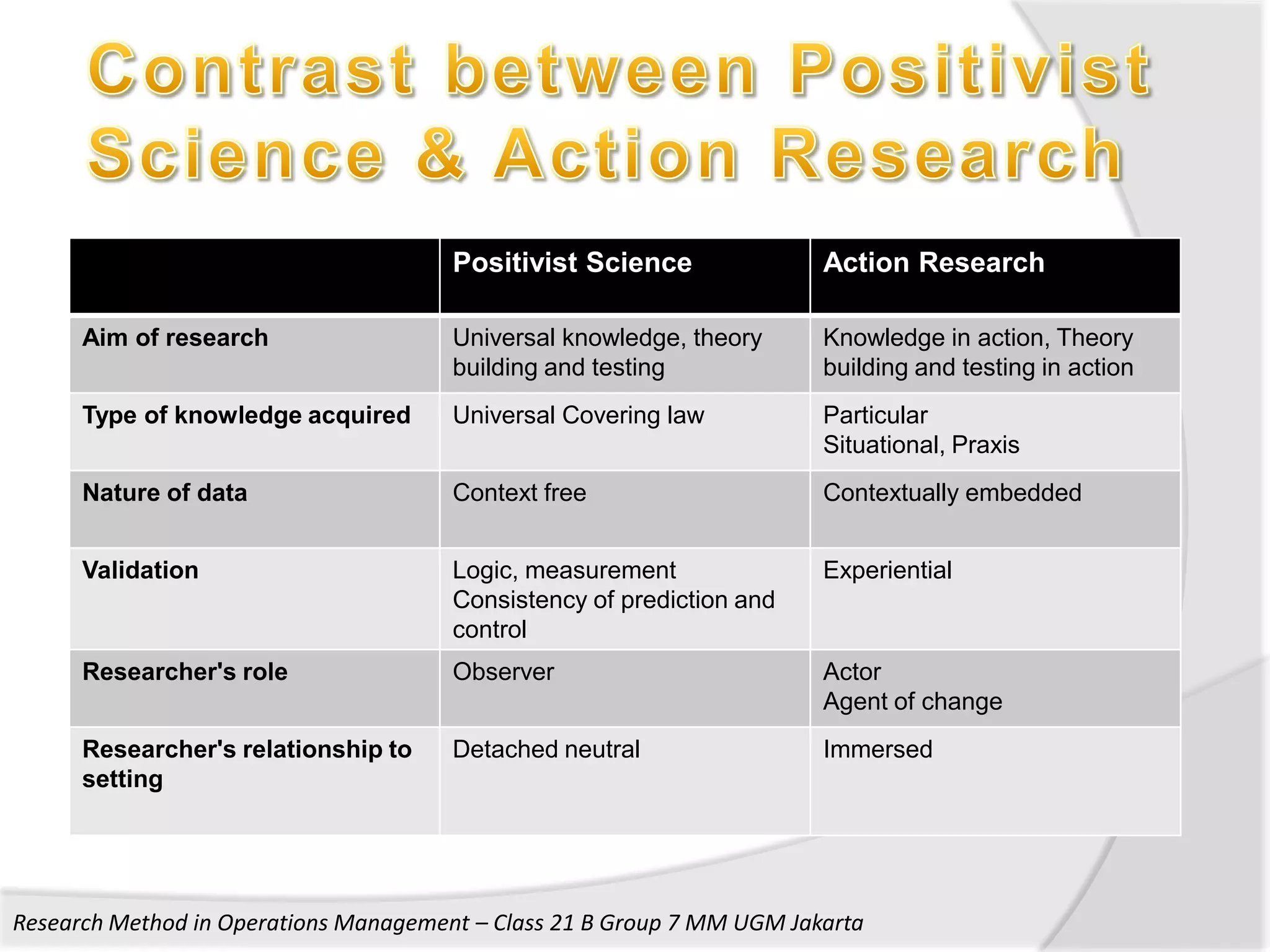
Positivist Science               Action Research

      Aim of research                  Universal knowledge, theory      Knowledge in action, Theory
                                       building and testing             building and testing in action
      Type of knowledge acquired       Universal Covering law           Particular
                                                                        Situational, Praxis
      Nature of data                   Context free                     Contextually embedded


      Validation                       Logic, measurement               Experiential
                                       Consistency of prediction and
                                       control
      Researcher's role                Observer                         Actor
                                                                        Agent of change
      Researcher's relationship to     Detached neutral                 Immersed
      setting


Research Method in Operations Management – Class 21 B Group 7 MM UGM Jakarta
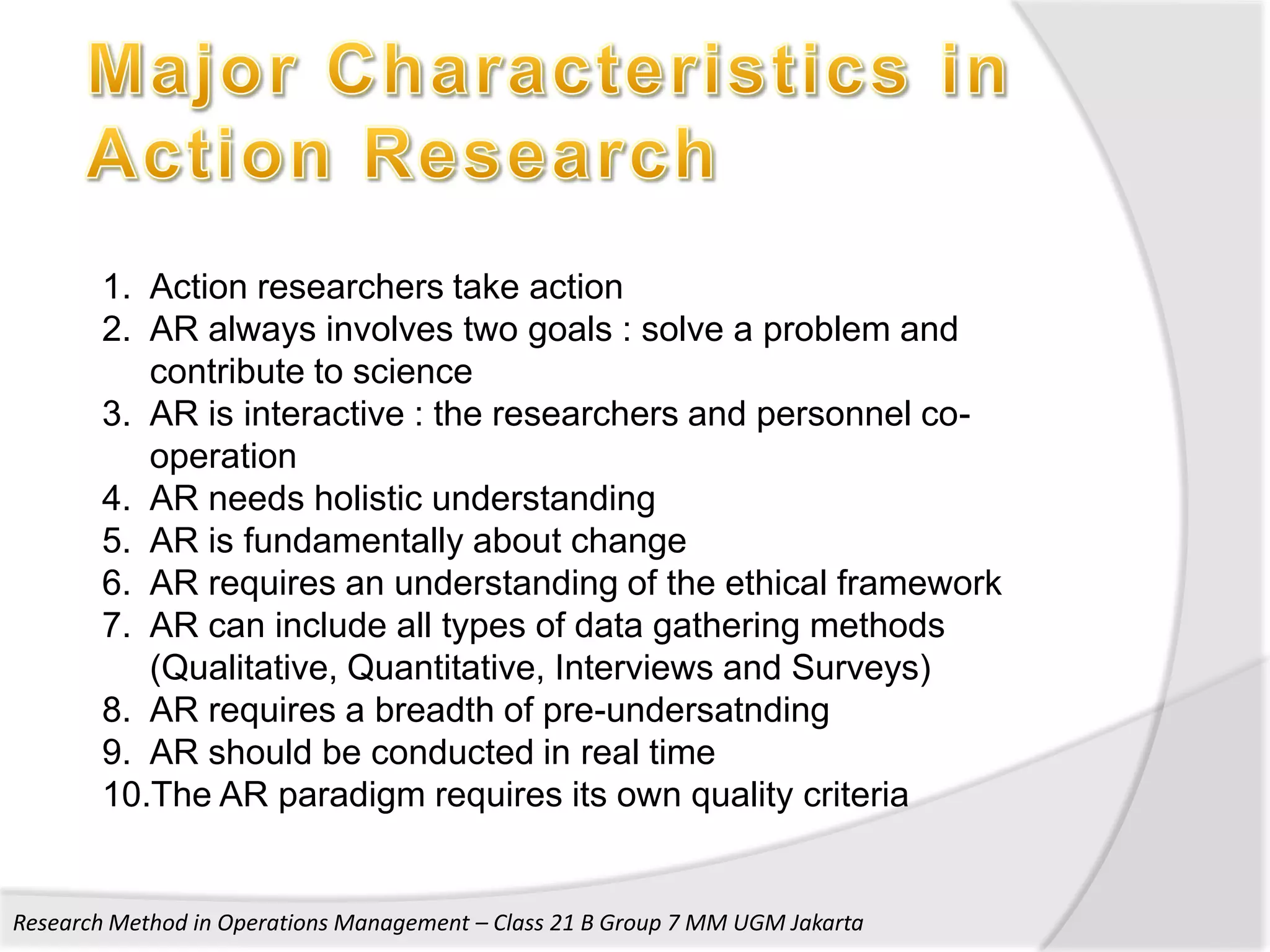
1. Action researchers take action
       2. AR always involves two goals : solve a problem and
          contribute to science
       3. AR is interactive : the researchers and personnel co-
          operation
       4. AR needs holistic understanding
       5. AR is fundamentally about change
       6. AR requires an understanding of the ethical framework
       7. AR can include all types of data gathering methods
          (Qualitative, Quantitative, Interviews and Surveys)
       8. AR requires a breadth of pre-undersatnding
       9. AR should be conducted in real time
       10.The AR paradigm requires its own quality criteria


Research Method in Operations Management – Class 21 B Group 7 MM UGM Jakarta
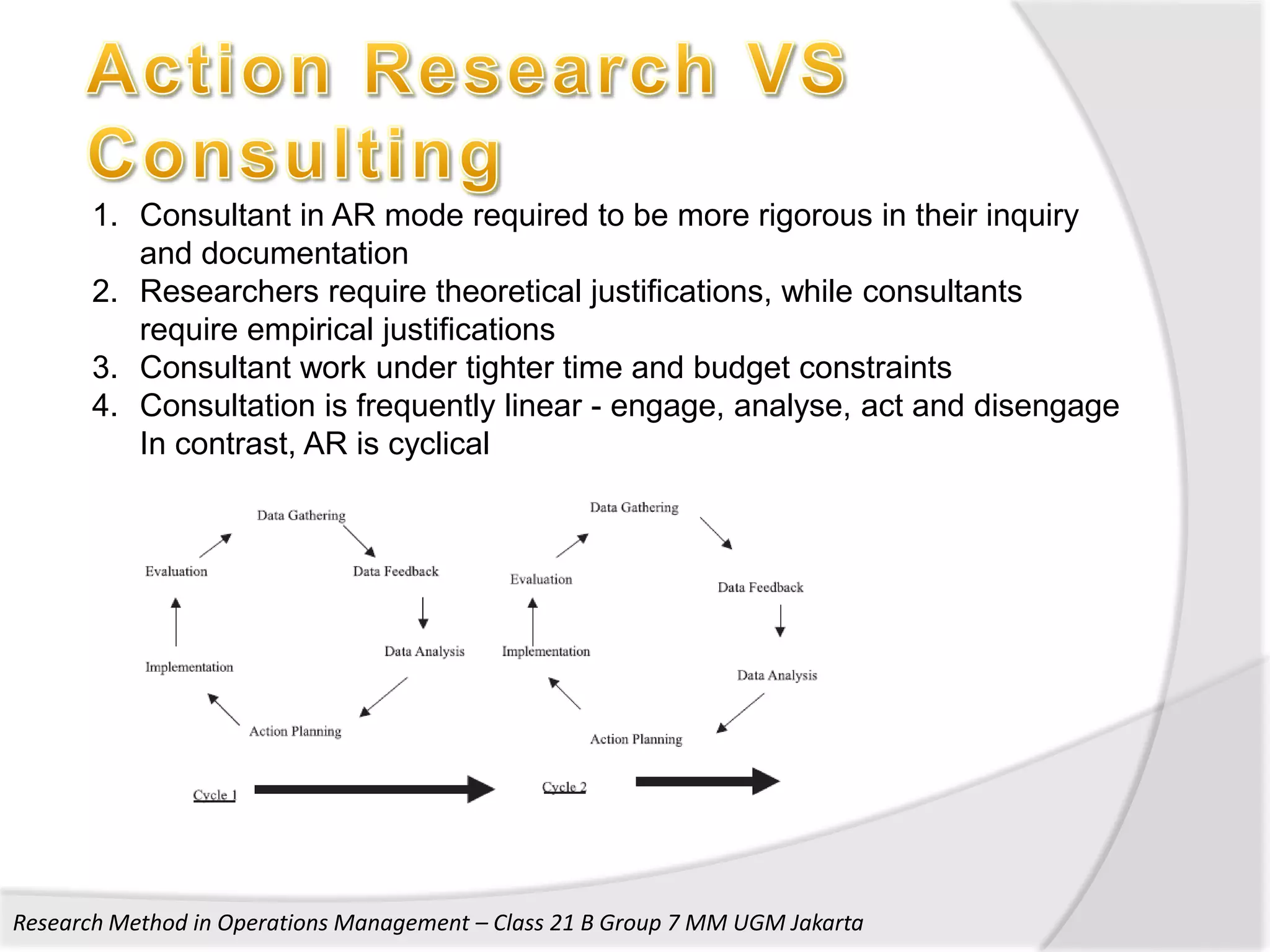
1. Consultant in AR mode required to be more rigorous in their inquiry
          and documentation
       2. Researchers require theoretical justifications, while consultants
          require empirical justifications
       3. Consultant work under tighter time and budget constraints
       4. Consultation is frequently linear - engage, analyse, act and disengage
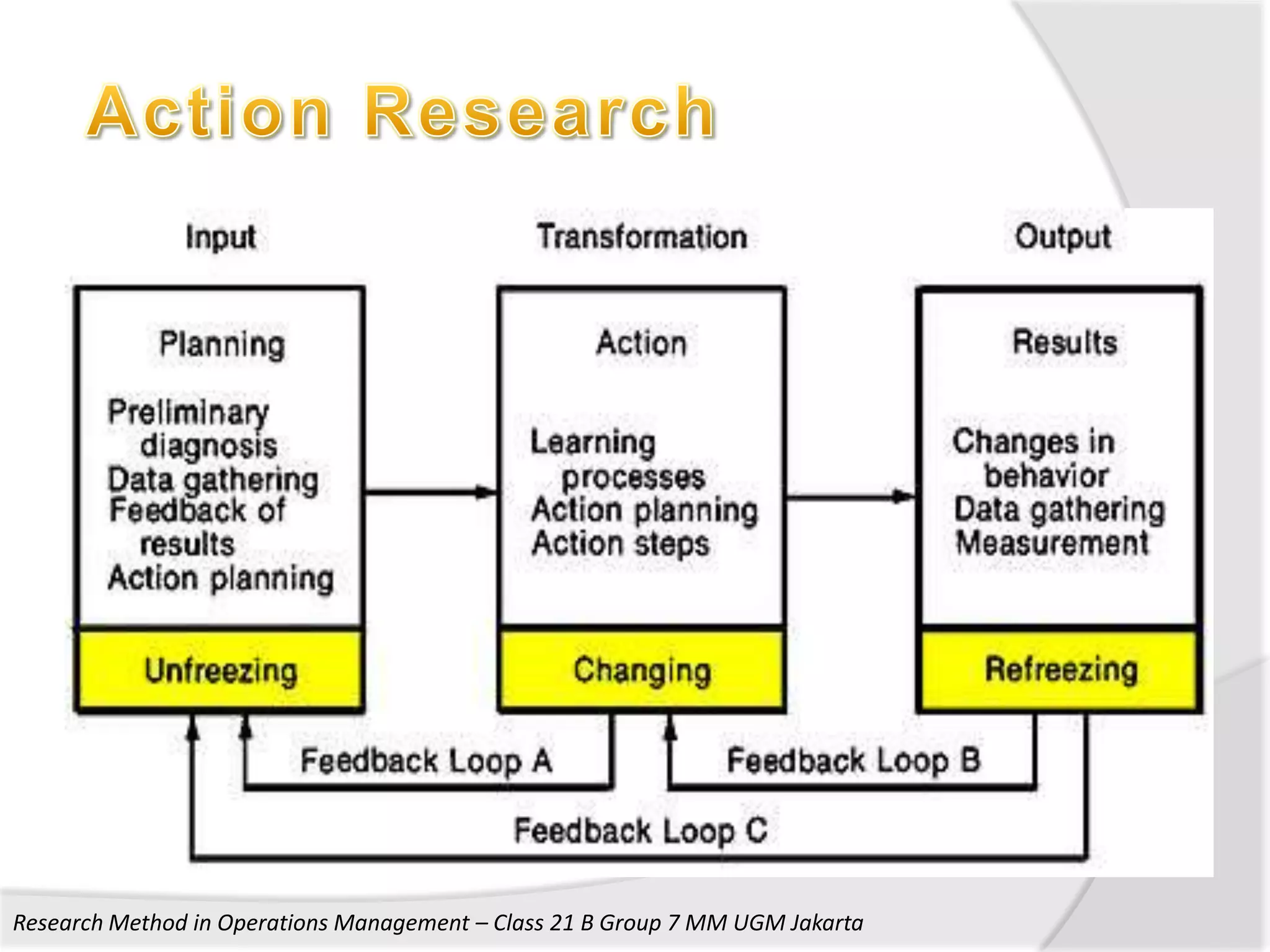
          In contrast, AR is cyclical


Research Method in Operations Management – Class 21 B Group 7 MM UGM Jakarta
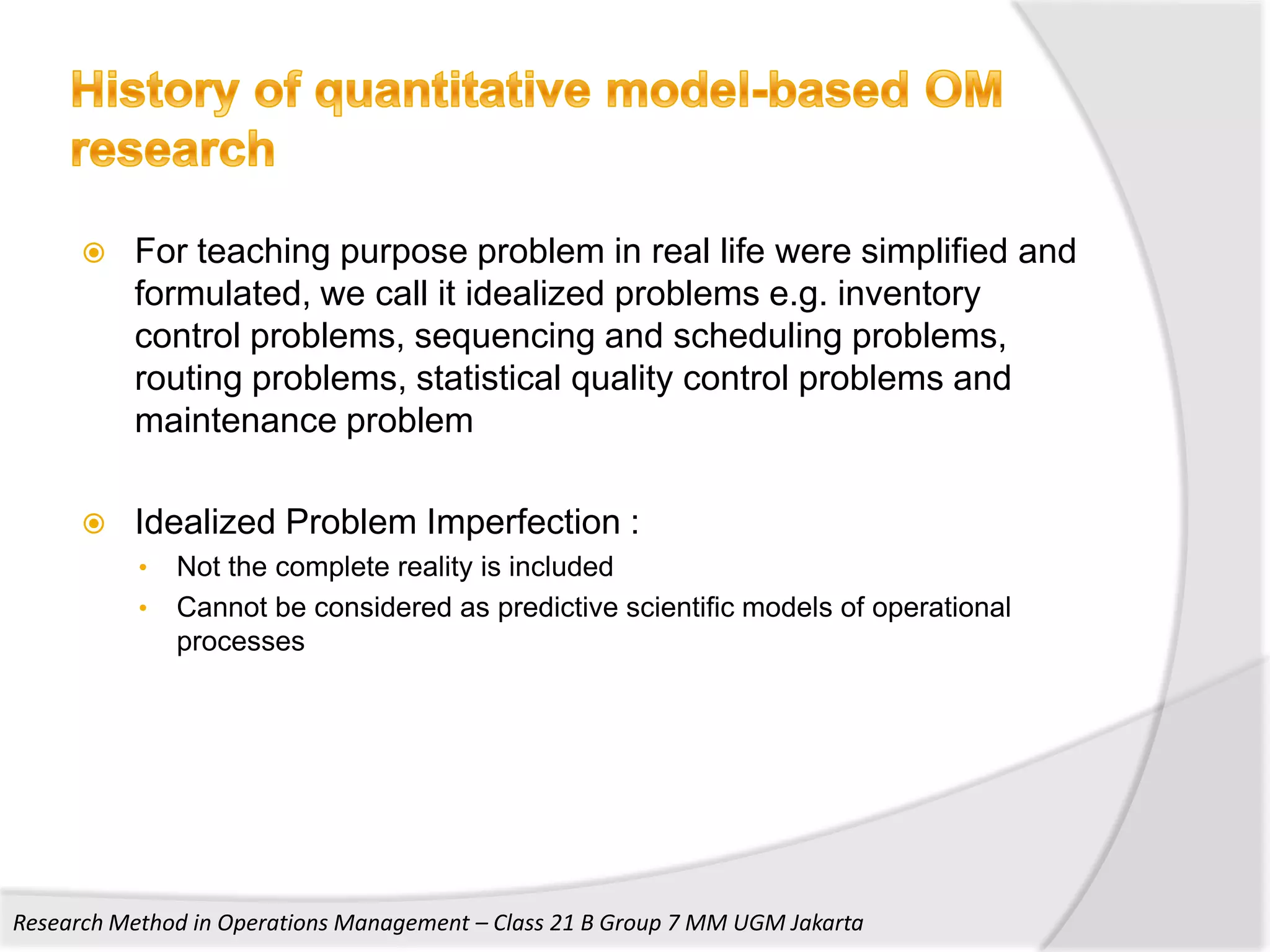
   For teaching purpose problem in real life were simplified and
          formulated, we call it idealized problems e.g. inventory
          control problems, sequencing and scheduling problems,
          routing problems, statistical quality control problems and
          maintenance problem

         Idealized Problem Imperfection :
           •   Not the complete reality is included
           •   Cannot be considered as predictive scientific models of operational
               processes


Research Method in Operations Management – Class 21 B Group 7 MM UGM Jakarta
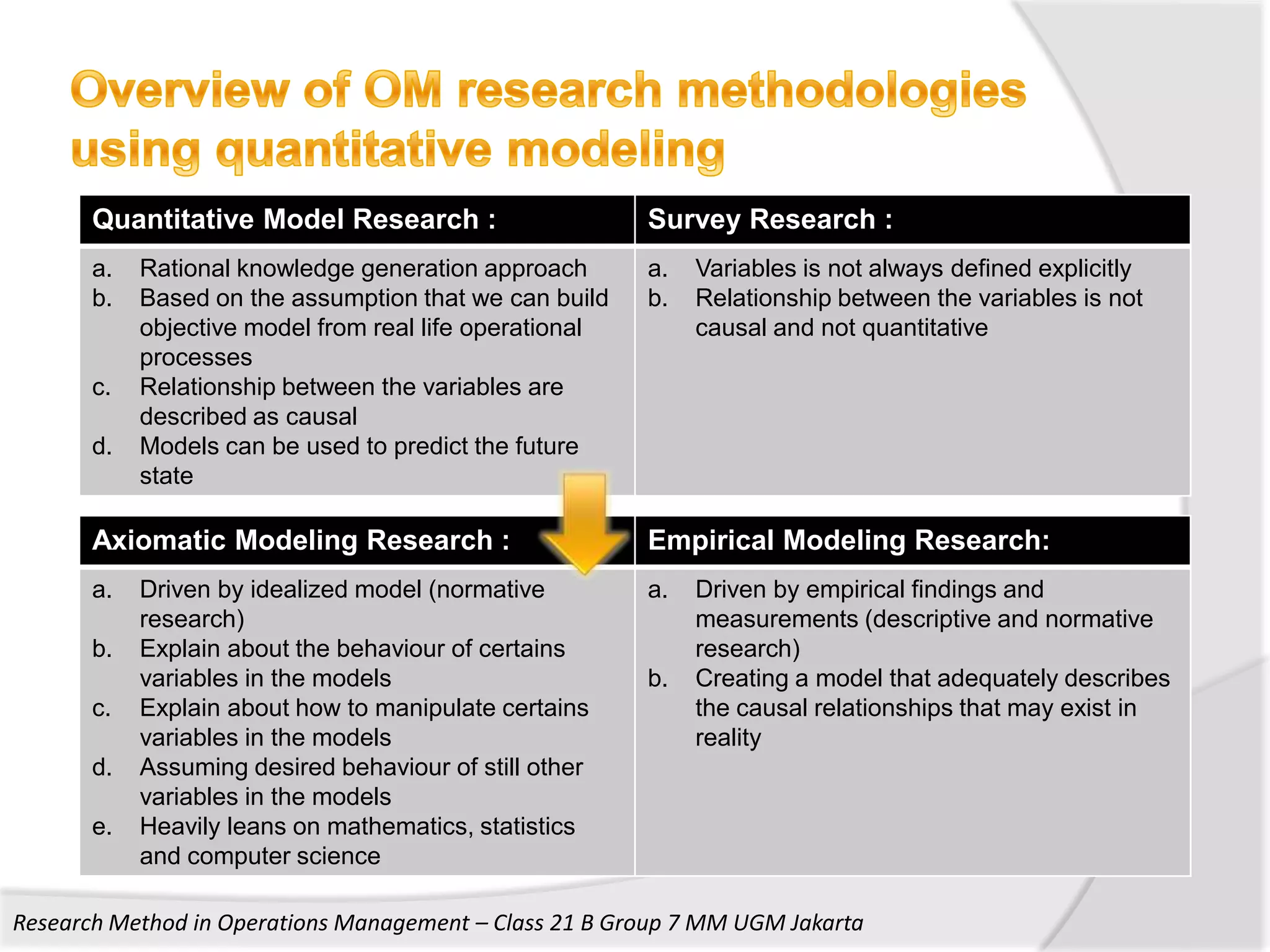
Quantitative Model Research :                     Survey Research :
       a.   Rational knowledge generation approach       a.   Variables is not always defined explicitly
       b.   Based on the assumption that we can build    b.   Relationship between the variables is not
            objective model from real life operational        causal and not quantitative
            processes
       c.   Relationship between the variables are
            described as causal
       d.   Models can be used to predict the future
            state

       Axiomatic Modeling Research :                     Empirical Modeling Research:
       a.   Driven by idealized model (normative         a.   Driven by empirical findings and
            research)                                         measurements (descriptive and normative
       b.   Explain about the behaviour of certains           research)
            variables in the models                      b.   Creating a model that adequately describes
       c.   Explain about how to manipulate certains          the causal relationships that may exist in
            variables in the models                           reality
       d.   Assuming desired behaviour of still other
            variables in the models
       e.   Heavily leans on mathematics, statistics
            and computer science

Research Method in Operations Management – Class 21 B Group 7 MM UGM Jakarta
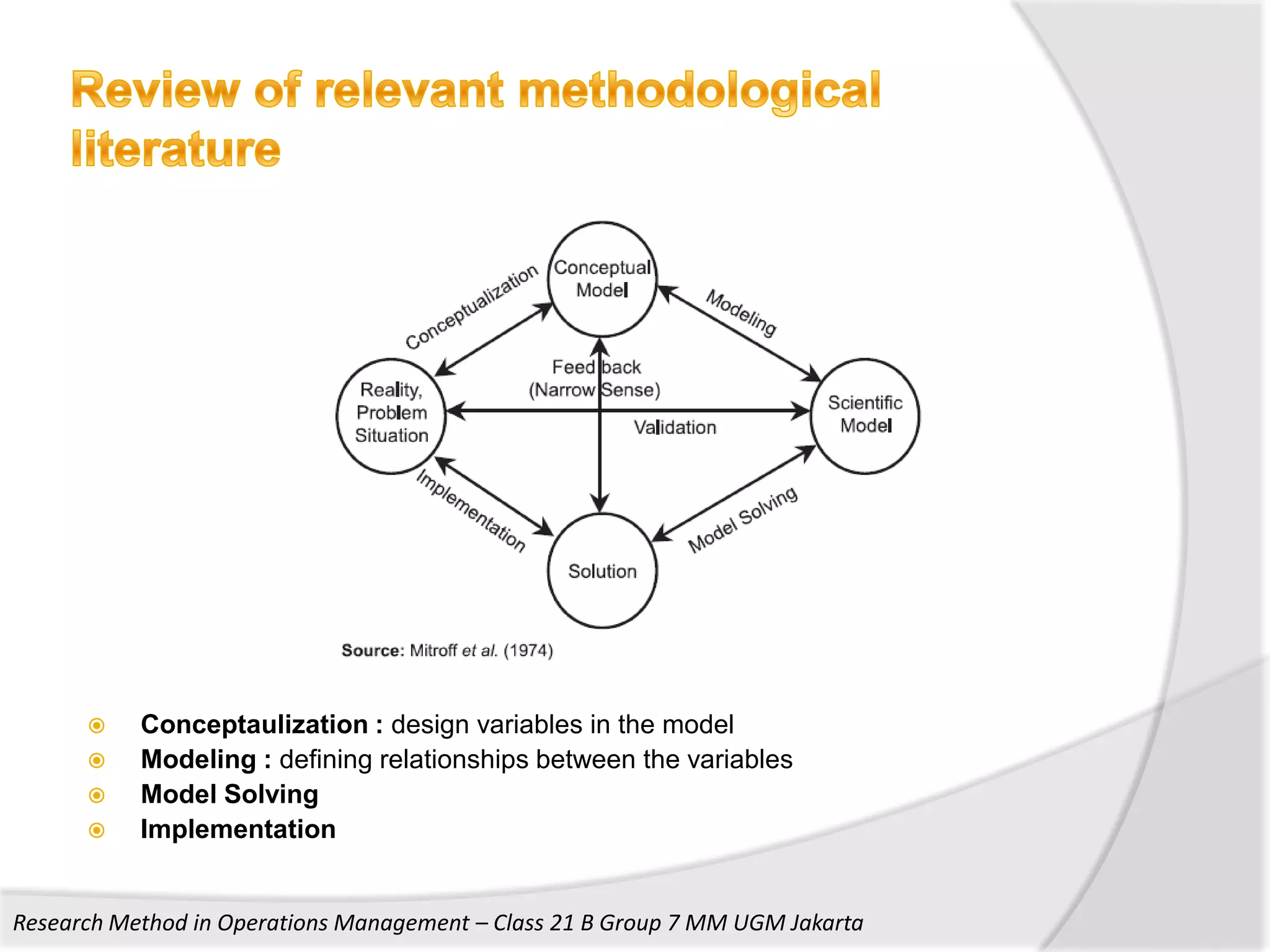
    Conceptaulization : design variables in the model
          Modeling : defining relationships between the variables
          Model Solving
          Implementation


Research Method in Operations Management – Class 21 B Group 7 MM UGM Jakarta
   Please just doing your thesis! And get
          graduated


Research Method in Operations Management – Class 21 B Group 7 MM UGM Jakarta

Research method in operations management final

  • 1.
    Lingga Wardhana (11P2155)M Farhan Lucky (11P2156) Novita Vilianty (11P2160) Prasasti Rinta Dewi (11P2161)
  • 2.
    Business Theory Model Problem Conclusion Methodology Hypothesis Business Impact Research Method in Operations Management – Class 21 B Group 7 MM UGM Jakarta
  • 3.
    “Before doing yourresearch I want to share my dogmas. Methodology is there to make it credible to the reader that you have planned and carried through your study as well as analysed and drawn conclusions in a way that we can rely on what you write.” Professor Christer Karlsson Research Method in Operations Management – Class 21 B Group 7 MM UGM Jakarta
  • 4.
    Research Method inOperations Management – Class 21 B Group 7 MM UGM Jakarta
  • 5.
    The collection ofinformation from individuals about themselves or about the social units to which they belong (Rossi et al., 1983) Exploratory survey research: Early stages of research into a phenomenon to gain preliminary insight on a topic, and provides the basis for more in-depth survey. Confirmatory (or theory testing or explanatory) survey research Knowledge of a phenomenon has been articulated in a theoretical form using well-defined concepts, models and propositions. Descriptive survey research Understanding the relevance of a certain phenomenon and describing the distribution of the phenomenon in a population. Research Method in Operations Management – Class 21 B Group 7 MM UGM Jakarta
  • 6.
    Advantages : Disadvantages : a. Relatively short period of a. Poor survey can undermine time otherwise well-designed b. Less expensive studies. c. Created quickly & b. May be not accurate administered easily depend on participant feels d. Wide range of things : c. Response rates can bias in personal facts, attitudes, random sampling past behaviors and opinions Research Method in Operations Management – Class 21 B Group 7 MM UGM Jakarta
  • 7.
    Mail - An example might include an alumni survey distributed via direct mail by your almamater.  Telephone - An example of a telephone survey would be a market research call about your experiences with a certain consumer product.  Online - Online surveys might focus on your experience with a particular retailer, product or website.  At home interviews - The U.S. Census is a good example of an at-home interview survey administration. Research Method in Operations Management – Class 21 B Group 7 MM UGM Jakarta
  • 8.
    Research Method inOperations Management – Class 21 B Group 7 MM UGM Jakarta
  • 9.
    Exploration: To build new theory  Theory Building: To identify linkage between variables, to find out “why” the relationships exist  Theory Testing: Testing theories in previous stage to predict future outcomes  Theory extension/refinement: To better structure the theories in light of the observed results Research Method in Operations Management – Class 21 B Group 7 MM UGM Jakarta
  • 10.
    When to use case research : when researcher wants to seek phenomenon happen in the past or current with primary or secondary data mining  Developing the research framework, construct, and questions : Building a conceptual framework will force the researcher to think carefully and selectively about the construct and variables to be included in study  Choosing cases : What is the ideal number of cases, longitudinal or retrospectives cases, case selection and sampling, sample controls  Developing research instruments and protocols : broad open ended questions for interviews, single or multiple respondents and viewpoints Research Method in Operations Management – Class 21 B Group 7 MM UGM Jakarta
  • 11.
    Conducting the field research : who to contact: better be senior in organizations for easy access to information, field data collection: usage of different methods to study same phenomenon, conducting interviews, single or multiple investigators, collecting objective data, administering questionnaires, recording the data, seeking convergence and clarification, determining sequence (cause and effects), challenges of observers bias, when to stop, summary.  Data documentation and coding : Documentations, coding  Data analysis, hypotesis development and testing : Analysis data within cases , hypothesis development and testing, shaping hypotheses, testing hypotheses, enfolding literature Research Method in Operations Management – Class 21 B Group 7 MM UGM Jakarta
  • 12.
    Reliability and Validityin Case Research  Construct Validity : establishment of correct operational measures for the concept being studied  Discriminant Validity : If the construct as measured can be differentiated from other construct  Internal Validity: The extent to which we can establish a causal relationship, where by certain condition are shown to lead to other conditions, as distinguished from spurious relationship  External Validity: Knowing whether a study’s finding can be generalized beyond the immediate case study  Reliability: The extend to which a study’s operations can be repeated, with the same result Research Method in Operations Management – Class 21 B Group 7 MM UGM Jakarta
  • 13.
    Research Method inOperations Management – Class 21 B Group 7 MM UGM Jakarta
  • 14.
    An interactive inquiryprocess that balances problem solving actions implemented in a collaborative context with data-driven collaborative analysis or research to understand underlying causes enabling future predictions about personal and organizational change Research Method in Operations Management – Class 21 B Group 7 MM UGM Jakarta
  • 15.
    Positivist Science Action Research Aim of research Universal knowledge, theory Knowledge in action, Theory building and testing building and testing in action Type of knowledge acquired Universal Covering law Particular Situational, Praxis Nature of data Context free Contextually embedded Validation Logic, measurement Experiential Consistency of prediction and control Researcher's role Observer Actor Agent of change Researcher's relationship to Detached neutral Immersed setting Research Method in Operations Management – Class 21 B Group 7 MM UGM Jakarta
  • 16.
    Research Method inOperations Management – Class 21 B Group 7 MM UGM Jakarta
  • 17.
    1. Action researcherstake action 2. AR always involves two goals : solve a problem and contribute to science 3. AR is interactive : the researchers and personnel co- operation 4. AR needs holistic understanding 5. AR is fundamentally about change 6. AR requires an understanding of the ethical framework 7. AR can include all types of data gathering methods (Qualitative, Quantitative, Interviews and Surveys) 8. AR requires a breadth of pre-undersatnding 9. AR should be conducted in real time 10.The AR paradigm requires its own quality criteria Research Method in Operations Management – Class 21 B Group 7 MM UGM Jakarta
  • 18.
    1. Consultant inAR mode required to be more rigorous in their inquiry and documentation 2. Researchers require theoretical justifications, while consultants require empirical justifications 3. Consultant work under tighter time and budget constraints 4. Consultation is frequently linear - engage, analyse, act and disengage In contrast, AR is cyclical Research Method in Operations Management – Class 21 B Group 7 MM UGM Jakarta
  • 19.
    Research Method inOperations Management – Class 21 B Group 7 MM UGM Jakarta
  • 20.
    For teaching purpose problem in real life were simplified and formulated, we call it idealized problems e.g. inventory control problems, sequencing and scheduling problems, routing problems, statistical quality control problems and maintenance problem  Idealized Problem Imperfection : • Not the complete reality is included • Cannot be considered as predictive scientific models of operational processes Research Method in Operations Management – Class 21 B Group 7 MM UGM Jakarta
  • 21.
    Quantitative Model Research: Survey Research : a. Rational knowledge generation approach a. Variables is not always defined explicitly b. Based on the assumption that we can build b. Relationship between the variables is not objective model from real life operational causal and not quantitative processes c. Relationship between the variables are described as causal d. Models can be used to predict the future state Axiomatic Modeling Research : Empirical Modeling Research: a. Driven by idealized model (normative a. Driven by empirical findings and research) measurements (descriptive and normative b. Explain about the behaviour of certains research) variables in the models b. Creating a model that adequately describes c. Explain about how to manipulate certains the causal relationships that may exist in variables in the models reality d. Assuming desired behaviour of still other variables in the models e. Heavily leans on mathematics, statistics and computer science Research Method in Operations Management – Class 21 B Group 7 MM UGM Jakarta
  • 22.
    Conceptaulization : design variables in the model  Modeling : defining relationships between the variables  Model Solving  Implementation Research Method in Operations Management – Class 21 B Group 7 MM UGM Jakarta
  • 23.
    Please just doing your thesis! And get graduated Research Method in Operations Management – Class 21 B Group 7 MM UGM Jakarta