Source: von Frank, V. (2013, Summer). Crossing the Digital Divide. ToolsforLearning
Schools8(4). (p.p. 1-3).
Title
Body
Crossing the
digital divide
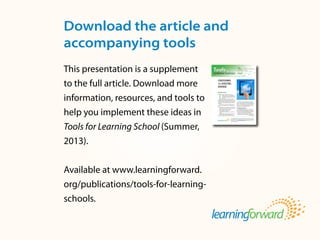
This presentation is a supplement
to the full article. Download more
information, resources, and tools to
help you implement these ideas in
Tools for Learning School (Summer,
2013).
Available at www.learningforward.
org/publications/tools-for-learning-
schools.
Download the article and
accompanying tools
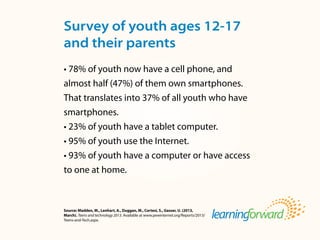
Survey of youth ages 12-17
and their parents
Source: Madden, M., Lenhart, A., Duggan, M., Cortesi, S., Gasser, U. (2013,
March). Teens and technology 2013. Available at www.pewinternet.org/Reports/2013/
Teens-and-Tech.aspx.
• 78% of youth now have a cell phone, and
almost half (47%) of them own smartphones.
That translates into 37% of all youth who have
smartphones.
• 23% of youth have a tablet computer.
• 95% of youth use the Internet.
• 93% of youth have a computer or have access
to one at home.
Source: von Frank, V. (2013, Summer). Crossing the Digital Divide. ToolsforLearning
Schools8(4). (p.p. 1-3).
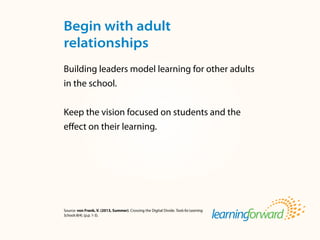
Building leaders model learning for other adults
in the school.
Keep the vision focused on students and the
effect on their learning.
Begin with adult
relationships
Source: von Frank, V. (2013, Summer). Crossing the Digital Divide. ToolsforLearning
Schools8(4). (p.p. 1-3).
Look for those who have
•	 interest,
•	 willingness to learn, and
•	 motivation.
Make use of the trailblazers
Source: von Frank, V. (2013, Summer). Crossing the Digital Divide. ToolsforLearning
Schools8(4). (p.p. 1-3).
Teachers need to know not just how to use the
technologies available, but how to determine
which technology supports the lesson
objective.
Think of technology only after a clear objective
for the lesson has been identified.
Focus on the lesson, not the
technology
Source: von Frank, V. (2013, Summer). Crossing the Digital Divide. ToolsforLearning
Schools8(4). (p.p. 1-3).
Students may help teachers understand what
tools can support the lesson and help teachers
envision a new landscape for learning.
The teacher’s role as facilitators of learning is to
show students how to be creators, how to learn,
and how to use personal learning networks.
Recognize that everyone is a
learner
Source: von Frank, V. (2013, Summer). Crossing the Digital Divide. ToolsforLearning
Schools8(4). (p.p. 1-3).
Experiment with making use of what you have
and what students own and can bring to class.
Use what you have
Source: von Frank, V. (2013, Summer). Crossing the Digital Divide. ToolsforLearning
Schools8(4). (p.p. 1-3).
Teachers realize the power of social networking,
so district policy needs to follow.
Support edcuators connecting with others in
the same job across counties, states, and more
Find a personal learning
network
Learn more with
Learn more about professional learning at all
levels of education with Learning Forward, an
international nonprofit association of learning
educators:
www.learningforward.org
Membership in Learning Forward gives you
access to a wide range of publications, tools,
and opportunities to advance professional
learning for student success.

Crossing the digital divide

  • 1.
    Source: von Frank,V. (2013, Summer). Crossing the Digital Divide. ToolsforLearning Schools8(4). (p.p. 1-3). Title Body Crossing the digital divide
  • 2.
    This presentation isa supplement to the full article. Download more information, resources, and tools to help you implement these ideas in Tools for Learning School (Summer, 2013). Available at www.learningforward. org/publications/tools-for-learning- schools. Download the article and accompanying tools
  • 3.
    Survey of youthages 12-17 and their parents Source: Madden, M., Lenhart, A., Duggan, M., Cortesi, S., Gasser, U. (2013, March). Teens and technology 2013. Available at www.pewinternet.org/Reports/2013/ Teens-and-Tech.aspx. • 78% of youth now have a cell phone, and almost half (47%) of them own smartphones. That translates into 37% of all youth who have smartphones. • 23% of youth have a tablet computer. • 95% of youth use the Internet. • 93% of youth have a computer or have access to one at home.
  • 4.
    Source: von Frank,V. (2013, Summer). Crossing the Digital Divide. ToolsforLearning Schools8(4). (p.p. 1-3). Building leaders model learning for other adults in the school. Keep the vision focused on students and the effect on their learning. Begin with adult relationships
  • 5.
    Source: von Frank,V. (2013, Summer). Crossing the Digital Divide. ToolsforLearning Schools8(4). (p.p. 1-3). Look for those who have • interest, • willingness to learn, and • motivation. Make use of the trailblazers
  • 6.
    Source: von Frank,V. (2013, Summer). Crossing the Digital Divide. ToolsforLearning Schools8(4). (p.p. 1-3). Teachers need to know not just how to use the technologies available, but how to determine which technology supports the lesson objective. Think of technology only after a clear objective for the lesson has been identified. Focus on the lesson, not the technology
  • 7.
    Source: von Frank,V. (2013, Summer). Crossing the Digital Divide. ToolsforLearning Schools8(4). (p.p. 1-3). Students may help teachers understand what tools can support the lesson and help teachers envision a new landscape for learning. The teacher’s role as facilitators of learning is to show students how to be creators, how to learn, and how to use personal learning networks. Recognize that everyone is a learner
  • 8.
    Source: von Frank,V. (2013, Summer). Crossing the Digital Divide. ToolsforLearning Schools8(4). (p.p. 1-3). Experiment with making use of what you have and what students own and can bring to class. Use what you have
  • 9.
    Source: von Frank,V. (2013, Summer). Crossing the Digital Divide. ToolsforLearning Schools8(4). (p.p. 1-3). Teachers realize the power of social networking, so district policy needs to follow. Support edcuators connecting with others in the same job across counties, states, and more Find a personal learning network
  • 10.
    Learn more with Learnmore about professional learning at all levels of education with Learning Forward, an international nonprofit association of learning educators: www.learningforward.org Membership in Learning Forward gives you access to a wide range of publications, tools, and opportunities to advance professional learning for student success.