
iPad for
Early Childhood Education
By Monika Tavernier
Why is this study necessary?
 Information and Communication Technologies
(ICT) are all around us and children at any age are
exposed to it every day
 Many young children have access to ICT in their
leisure time and use it
 Early Childhood Education (ECE) has not yet
introduced ICT as a “practical life experience” in
its curriculum
 There is very little research done on how young
children interact and use ICT constructively
What did the study do?
 Introduce children between 4 and 5 years
to the iPad through teacher centered
lessons
 Give the children opportunities to
familiarize, experiment and proactively
use the iPad during class time
 Provide children the opportunity to self-
initiate the use of the iPad under the
supervision of the researcher
Theoretical Framework
 Social Constructionism children learn in
social settings, through
collaboration, interaction, sharing of
information and creating artifacts
 4 stages of “Bloom’s Digital Taxonomy”
(Churches, 2008)
 „Key steps to successfully evaluating
Educational Technology‟ (McMains and
Gunnewig‟s (2012) )
Which tools have been used in
the study?
 Parent Questionnaire
 Qualitative Case Study:
 Student Observation
 Video Recording of students
 Classifying student‟s iPAD literacy based on
their interaction with the iPad, their learning
approach and the outcome of their iPAD
activities
Why an iPad?
An iPad merges several devices into one:
- Digital camera
- Video Camera
- Laptop/Desktop to access the internet, play
educational games, write notes
- HiFi/DVD Player/TV to listen to music, watch
films
- Books to read electronic story books
Trepanier-Street et al. (2011)
Application Selection
McManis and Grunnewig (2012) suggest
that a software (in this case applications)
has an educational impact on children, if it
engages the learner, is child-friendly (in its
design and navigation), involves interactivity
between the child and the program and
monitor‟s a child‟s progress.
Determiners for planning Activities
& Application Evaluation:
 Establish learning goals for the children
 Identify the hardware or device(s) you
have or would like to have
 Analyse features and content of the
software/program in meeting learning
goals
 Plan how the educational technology will
be integrated into the curriculum.
McMains and Gunnewig (2012)
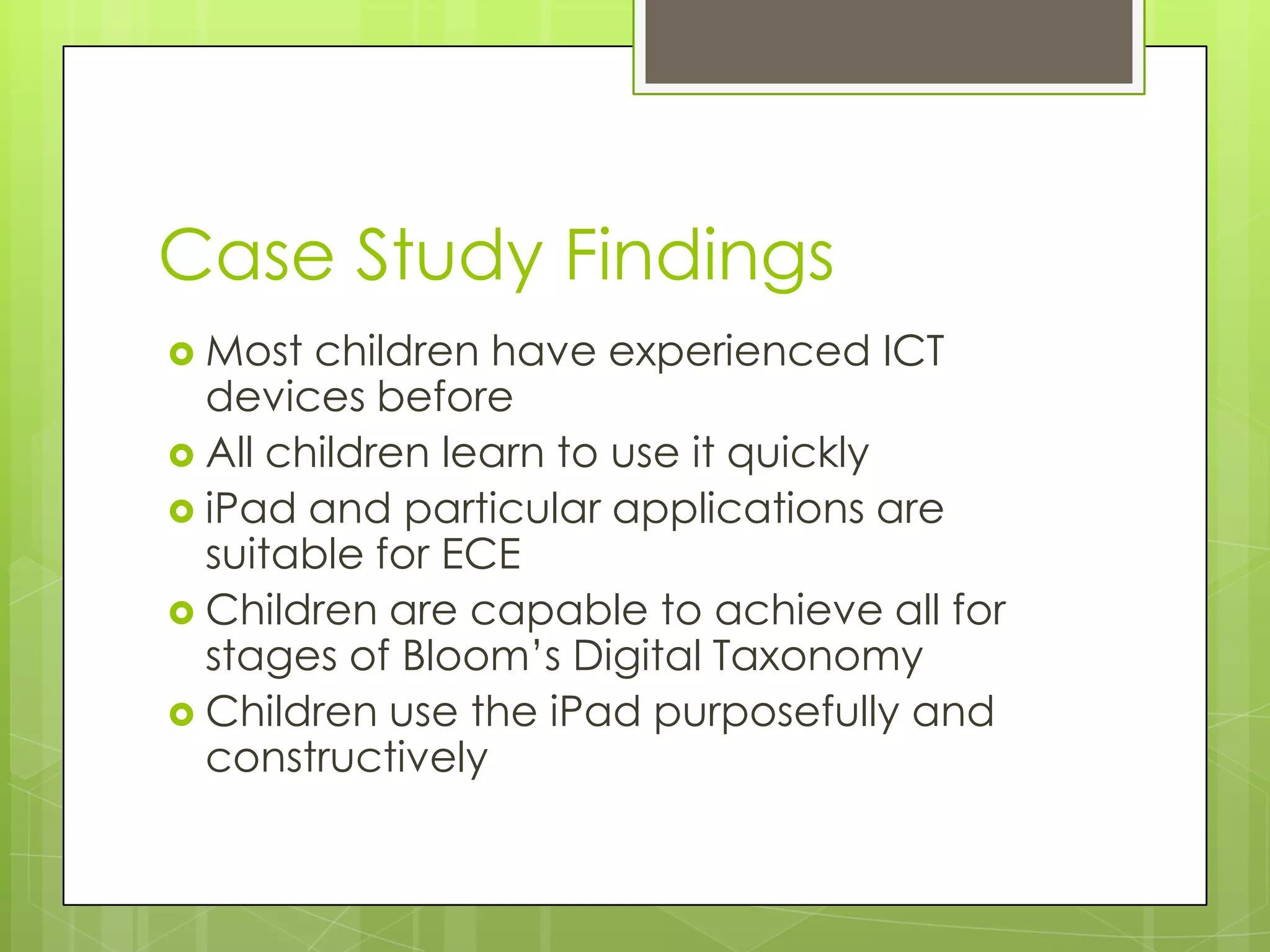
Case Study Findings
 Most children have experienced ICT
devices before
 All children learn to use it quickly
 iPad and particular applications are
suitable for ECE
 Children are capable to achieve all for
stages of Bloom‟s Digital Taxonomy
 Children use the iPad purposefully and
constructively
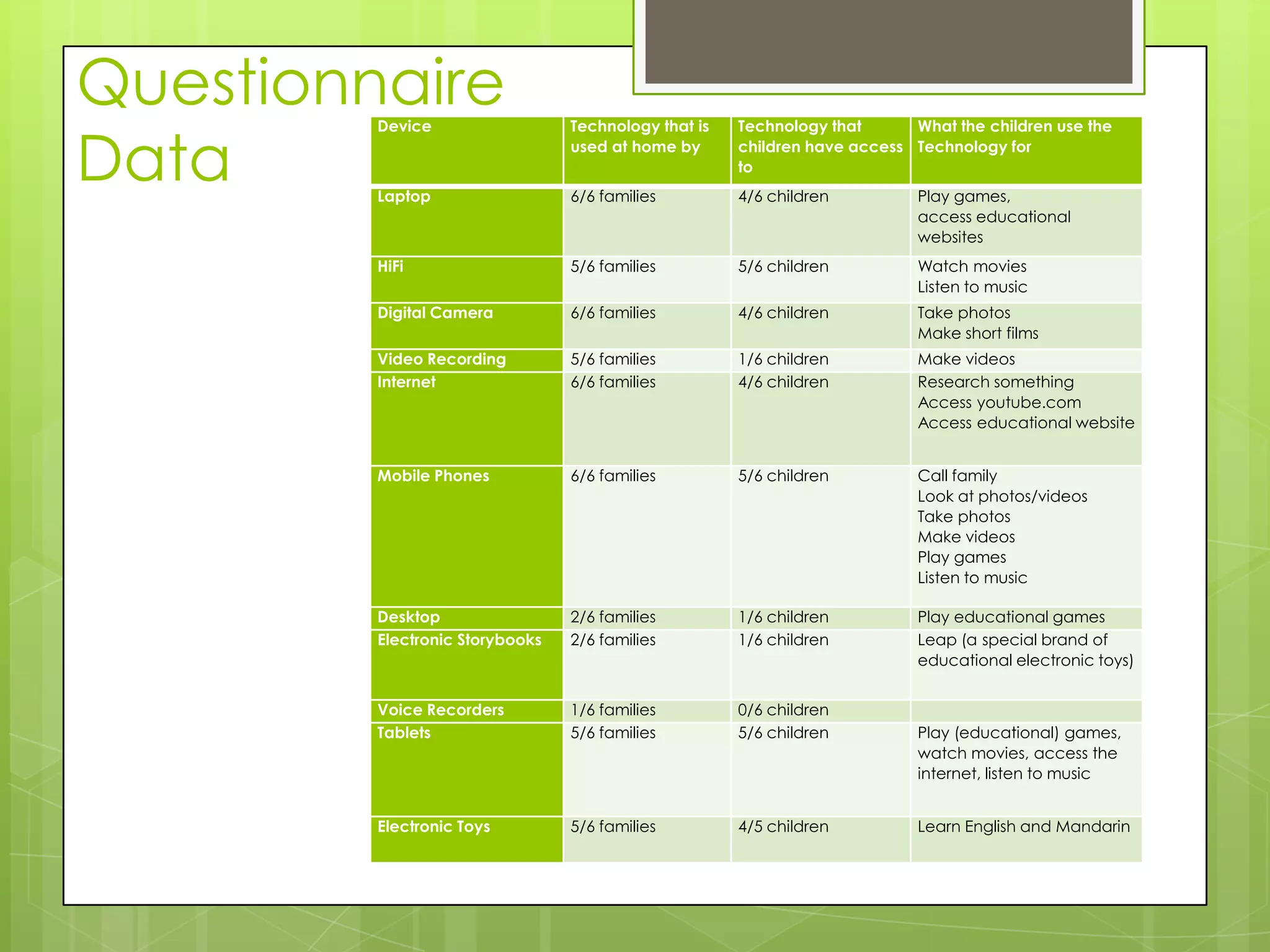
Questionnaire
Data
Device Technology that is
used at home by
Technology that
children have access
to
What the children use the
Technology for
Laptop 6/6 families 4/6 children Play games,
access educational
websites
HiFi 5/6 families 5/6 children Watch movies
Listen to music
Digital Camera 6/6 families 4/6 children Take photos
Make short films
Video Recording 5/6 families 1/6 children Make videos
Internet 6/6 families 4/6 children Research something
Access youtube.com
Access educational website
Mobile Phones 6/6 families 5/6 children Call family
Look at photos/videos
Take photos
Make videos
Play games
Listen to music
Desktop 2/6 families 1/6 children Play educational games
Electronic Storybooks 2/6 families 1/6 children Leap (a special brand of
educational electronic toys)
Voice Recorders 1/6 families 0/6 children
Tablets 5/6 families 5/6 children Play (educational) games,
watch movies, access the
internet, listen to music
Electronic Toys 5/6 families 4/5 children Learn English and Mandarin
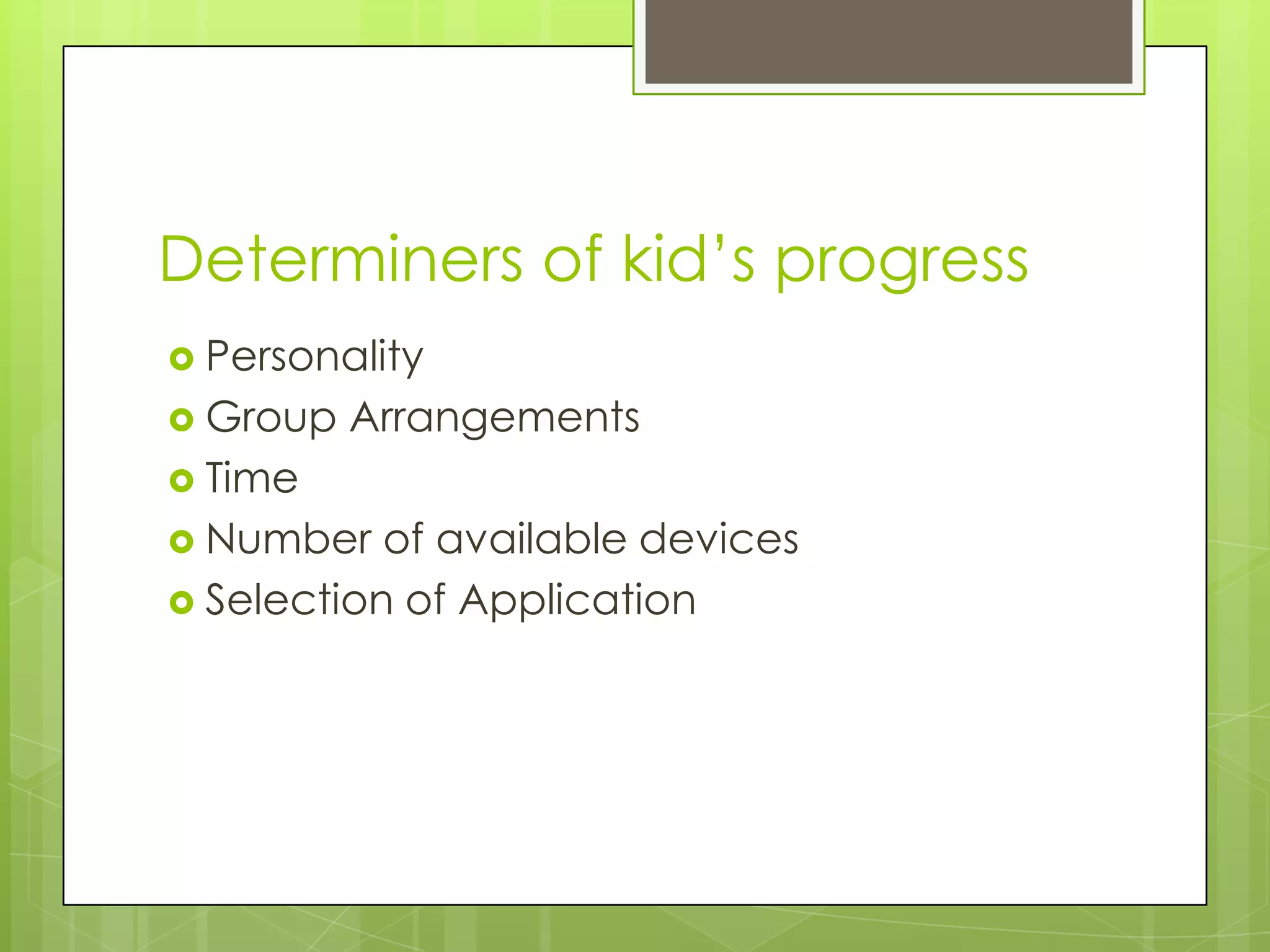
Determiners of kid‟s progress
 Personality
 Group Arrangements
 Time
 Number of available devices
 Selection of Application
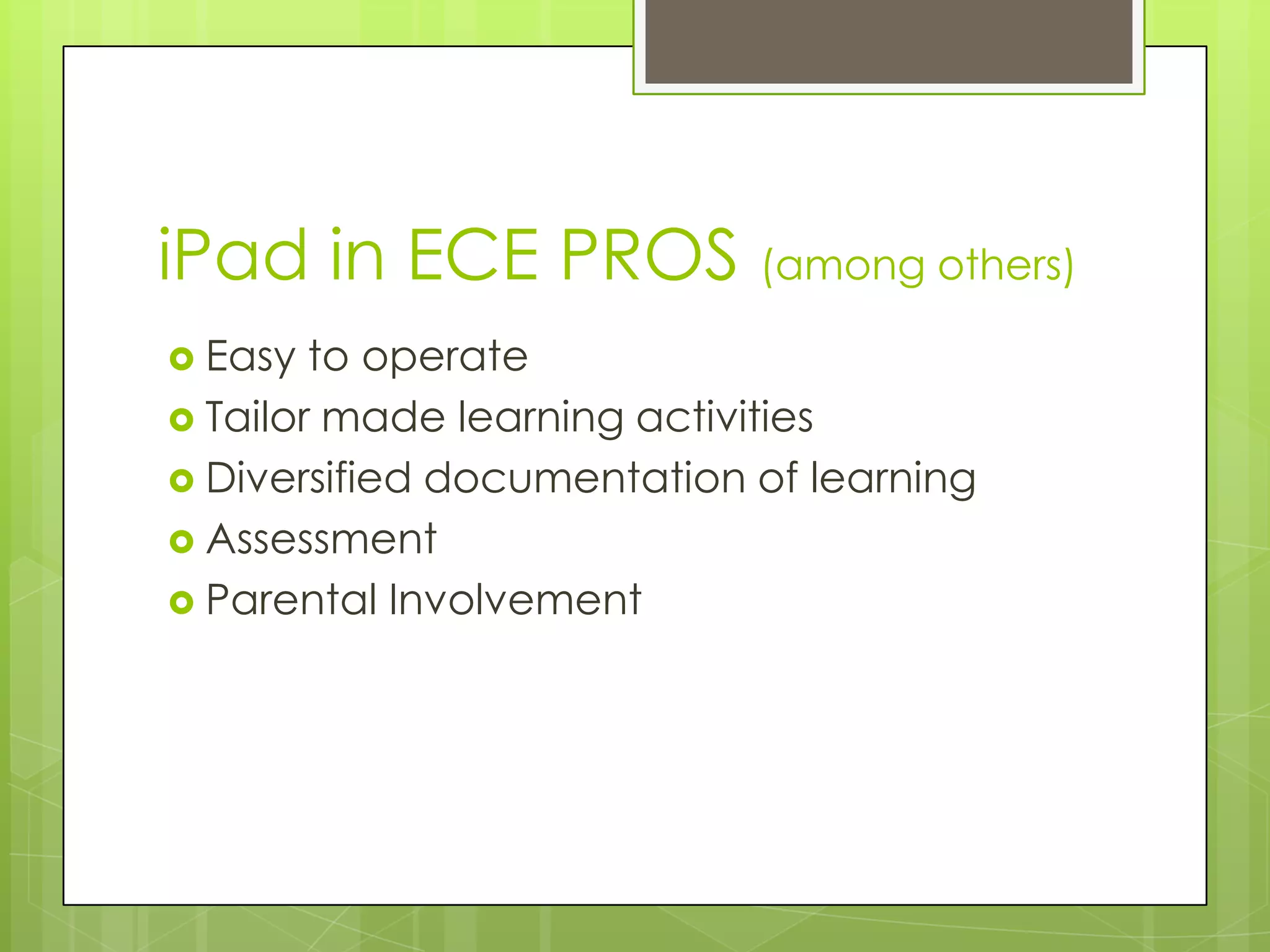
iPad in ECE PROS (among others)
 Easy to operate
 Tailor made learning activities
 Diversified documentation of learning
 Assessment
 Parental Involvement
iPads in ECE CONS (among
others)
 Time constraints
 Man power
 Curriculum Compatibility
 Financial Resources
Case Study Videos
 Summary of children using the iPad and
the 5 selected applications
 Kid‟s creations:
 Sock Puppets
 Story Creator
References
 McManis, L.D. &Gunnewig, S.B. (2012).Finding
the Education in Educational Technology with
early Learners. Young Children (May
2012), PP. 14-24
 Churches, A. (2008)Bloom‟s Digital Taxonomy
v2.12.retrieved from:
http://www.scribd.com/doc/8000050/
Blooms-Digital-Taxonomy-v212.
 Trepanier-Street, M.L., Hong, S.B., & Bauer, J.C.
(2001).Using technology in Reggio-Inspired
long-term projects.Early Childhood Education
Journal, Vol. 28 (3), pp. 161-168
Questions & Answers
Thank you for listening. Should you have
questions, please share them now.

Pre-School Children Learn to Use the iPad to Learn, Document, Assess and Create Content

  • 1.
    iPad for Early ChildhoodEducation By Monika Tavernier
  • 2.
    Why is thisstudy necessary?  Information and Communication Technologies (ICT) are all around us and children at any age are exposed to it every day  Many young children have access to ICT in their leisure time and use it  Early Childhood Education (ECE) has not yet introduced ICT as a “practical life experience” in its curriculum  There is very little research done on how young children interact and use ICT constructively
  • 3.
    What did thestudy do?  Introduce children between 4 and 5 years to the iPad through teacher centered lessons  Give the children opportunities to familiarize, experiment and proactively use the iPad during class time  Provide children the opportunity to self- initiate the use of the iPad under the supervision of the researcher
  • 4.
    Theoretical Framework  SocialConstructionism children learn in social settings, through collaboration, interaction, sharing of information and creating artifacts  4 stages of “Bloom’s Digital Taxonomy” (Churches, 2008)  „Key steps to successfully evaluating Educational Technology‟ (McMains and Gunnewig‟s (2012) )
  • 5.
    Which tools havebeen used in the study?  Parent Questionnaire  Qualitative Case Study:  Student Observation  Video Recording of students  Classifying student‟s iPAD literacy based on their interaction with the iPad, their learning approach and the outcome of their iPAD activities
  • 6.
    Why an iPad? AniPad merges several devices into one: - Digital camera - Video Camera - Laptop/Desktop to access the internet, play educational games, write notes - HiFi/DVD Player/TV to listen to music, watch films - Books to read electronic story books Trepanier-Street et al. (2011)
  • 7.
    Application Selection McManis andGrunnewig (2012) suggest that a software (in this case applications) has an educational impact on children, if it engages the learner, is child-friendly (in its design and navigation), involves interactivity between the child and the program and monitor‟s a child‟s progress.
  • 8.
    Determiners for planningActivities & Application Evaluation:  Establish learning goals for the children  Identify the hardware or device(s) you have or would like to have  Analyse features and content of the software/program in meeting learning goals  Plan how the educational technology will be integrated into the curriculum. McMains and Gunnewig (2012)
  • 9.
    Case Study Findings Most children have experienced ICT devices before  All children learn to use it quickly  iPad and particular applications are suitable for ECE  Children are capable to achieve all for stages of Bloom‟s Digital Taxonomy  Children use the iPad purposefully and constructively
  • 10.
    Questionnaire Data Device Technology thatis used at home by Technology that children have access to What the children use the Technology for Laptop 6/6 families 4/6 children Play games, access educational websites HiFi 5/6 families 5/6 children Watch movies Listen to music Digital Camera 6/6 families 4/6 children Take photos Make short films Video Recording 5/6 families 1/6 children Make videos Internet 6/6 families 4/6 children Research something Access youtube.com Access educational website Mobile Phones 6/6 families 5/6 children Call family Look at photos/videos Take photos Make videos Play games Listen to music Desktop 2/6 families 1/6 children Play educational games Electronic Storybooks 2/6 families 1/6 children Leap (a special brand of educational electronic toys) Voice Recorders 1/6 families 0/6 children Tablets 5/6 families 5/6 children Play (educational) games, watch movies, access the internet, listen to music Electronic Toys 5/6 families 4/5 children Learn English and Mandarin
  • 11.
    Determiners of kid‟sprogress  Personality  Group Arrangements  Time  Number of available devices  Selection of Application
  • 12.
    iPad in ECEPROS (among others)  Easy to operate  Tailor made learning activities  Diversified documentation of learning  Assessment  Parental Involvement
  • 13.
    iPads in ECECONS (among others)  Time constraints  Man power  Curriculum Compatibility  Financial Resources
  • 14.
    Case Study Videos Summary of children using the iPad and the 5 selected applications  Kid‟s creations:  Sock Puppets  Story Creator
  • 15.
    References  McManis, L.D.&Gunnewig, S.B. (2012).Finding the Education in Educational Technology with early Learners. Young Children (May 2012), PP. 14-24  Churches, A. (2008)Bloom‟s Digital Taxonomy v2.12.retrieved from: http://www.scribd.com/doc/8000050/ Blooms-Digital-Taxonomy-v212.  Trepanier-Street, M.L., Hong, S.B., & Bauer, J.C. (2001).Using technology in Reggio-Inspired long-term projects.Early Childhood Education Journal, Vol. 28 (3), pp. 161-168
  • 16.
    Questions & Answers Thankyou for listening. Should you have questions, please share them now.