Preliminary steps BEFORE
you start your research
Created by Carrie Gaxiola
Great Basin College Library
Research is a skill that you will get
better at with practice
Follow this guide for preliminary steps,
it will help you get organized
FIRST: THE ASSIGNMENT
•Read the assignment carefully
•Highlight requirements and main guidelines
•When is it due?
•Do not wait, start early!
the assignment cont…
• How long should this be?
• How many pages? (again, read directions
carefully)
• How much information will you need?
How many sources?
next… subject, topic of research
• Chose your subject for your research
Or does the professor have one assigned for you? Does the
topic need approval from your professor?
• Formulate your subject into a question(s):
What do you need to know?
• e.g., Does culture effect health of
the population?
subject cont…
• What do you already know? Where are the gaps in knowledge?
• If you know very little of your topic, get familiar with the terms used by
professionals in the field. Write down other influencing or similar topics
regarding your topic. You must know basics in order to research the topic!
Please do not skip getting to know the background of your topic, it is critical
to good research. TAKE NOTES DURING THIS PROCESS!
For background information
• Infoplease.com (infoplease.com)
• Online Encyclopedias (GBC Subject Guide for
Encyclopedias)
• Internet Public Library (www.ipl.org)
• Wikipedia (Wikipedia.org)
background information cont…
• Blogs (blogger.com, blog.com, wordpress.com…)
• Google Scholar (google scholar)
• Archive.org (archive.org)
• Pew Research Center (pewresearch.org)
Write down terms used, like terms, associations you spot, any
other interesting information that might assist your searching later.
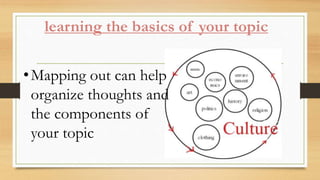
learning the basics of your topic
•Mapping out can help
organize thoughts and
the components of
your topic
determine your information needs
•Please refer back to assignment requirements to
see what types of data you need.
Do you need primary? Secondary? Tertiary?
•Articles from journals? (Databases)
•Books? Newspapers?
Types
of
data:
Pin down the required sources!
Source information above: Slideshare: Dilip Barad, Professor at Maharaja Krishnakumarsinhji Bhavnagar University at Bhavnagar University,
Bhavnagar,India
identify where you will get your data
• Consult the subject guides on the library website for
recommended databases (journal articles)
• Use the GBC Library catalog to find books if needed.
If you are distant education student, we will send the
requested book(s) to you!
identify where you will get your data
Statistics (links are live, click!)
Census data
Gallup.com
Center for Disease Control
Bureau of Labor Statistics
USA Data and Statistics
Or consult this guide: Pathfinder for statistics
identify where you will get your data
Primary Sources, Diaries or Historical Information: Although you can get
this data via databases or even the library catalog most of the time, also
check out: archive.org
Library of Congress Archive findingaids.loc.gov
Search historic newspapers
Search for libraries who have digitized manuscripts on your topic!
other tips for sources!!
References/works cited page of books, articles, or other
research!
• Read the references the author used and you can
find great sources this way!
Don’t forget, if GBC does
not have a source you need,
let us know! We will see
if our library partners can lend it to you!
other tips for sources!!
Techniques for database searching is located in a separate tab on this guide.
Please read it because this information will help you!
• When you search databases, use filters that are usually
located at the side. You can filter out non-scholarly articles, you
can choose what dates of publication are suitable for your
research, and much more!
Also, when you find a good article,
note the SUBJECT terms used.
Use them in your searches!
other tips for sources!!
Serendipity: If you are in the library, look at
books around the one you chose! Library of
Congress call numbers are arranged by
SUBJECT so you can browse!
Remember…
• Read the next tabs for guidance on database searching strategies,
evaluating information, and citing your sources
• GBC wants you to succeed! ASK for help if you need clarification on
anything!
• If you need help, please ask your professor or a librarian
• Take your time, focus, and have fun learning!!!
You are READY to get started!
Library Information:
Monday – Thursday 8am-7pm (PST)
Friday 8am-5pm
Main Phone: 775-753-2222
Main Email: gbc-library@gbcnv.edu
Library Staff:
Eric Walsh, Reference Librarian &
Interim Director
Eric.Walsh@gbcnv.edu
Carrie Gaxiola, Circulation Manager
Carrie.Gaxiola@gbcnv.edu
Christina Park, Library Tech II
Christina.Park@gbcnv.edu

Research Help

  • 1.
    Preliminary steps BEFORE youstart your research Created by Carrie Gaxiola Great Basin College Library
  • 2.
    Research is askill that you will get better at with practice Follow this guide for preliminary steps, it will help you get organized
  • 3.
    FIRST: THE ASSIGNMENT •Readthe assignment carefully •Highlight requirements and main guidelines •When is it due? •Do not wait, start early!
  • 4.
    the assignment cont… •How long should this be? • How many pages? (again, read directions carefully) • How much information will you need? How many sources?
  • 5.
    next… subject, topicof research • Chose your subject for your research Or does the professor have one assigned for you? Does the topic need approval from your professor? • Formulate your subject into a question(s): What do you need to know? • e.g., Does culture effect health of the population?
  • 6.
    subject cont… • Whatdo you already know? Where are the gaps in knowledge? • If you know very little of your topic, get familiar with the terms used by professionals in the field. Write down other influencing or similar topics regarding your topic. You must know basics in order to research the topic! Please do not skip getting to know the background of your topic, it is critical to good research. TAKE NOTES DURING THIS PROCESS!
  • 7.
    For background information •Infoplease.com (infoplease.com) • Online Encyclopedias (GBC Subject Guide for Encyclopedias) • Internet Public Library (www.ipl.org) • Wikipedia (Wikipedia.org)
  • 8.
    background information cont… •Blogs (blogger.com, blog.com, wordpress.com…) • Google Scholar (google scholar) • Archive.org (archive.org) • Pew Research Center (pewresearch.org) Write down terms used, like terms, associations you spot, any other interesting information that might assist your searching later.
  • 9.
    learning the basicsof your topic •Mapping out can help organize thoughts and the components of your topic
  • 10.
    determine your informationneeds •Please refer back to assignment requirements to see what types of data you need. Do you need primary? Secondary? Tertiary? •Articles from journals? (Databases) •Books? Newspapers?
  • 11.
    Types of data: Pin down therequired sources! Source information above: Slideshare: Dilip Barad, Professor at Maharaja Krishnakumarsinhji Bhavnagar University at Bhavnagar University, Bhavnagar,India
  • 12.
    identify where youwill get your data • Consult the subject guides on the library website for recommended databases (journal articles) • Use the GBC Library catalog to find books if needed. If you are distant education student, we will send the requested book(s) to you!
  • 13.
    identify where youwill get your data Statistics (links are live, click!) Census data Gallup.com Center for Disease Control Bureau of Labor Statistics USA Data and Statistics Or consult this guide: Pathfinder for statistics
  • 14.
    identify where youwill get your data Primary Sources, Diaries or Historical Information: Although you can get this data via databases or even the library catalog most of the time, also check out: archive.org Library of Congress Archive findingaids.loc.gov Search historic newspapers Search for libraries who have digitized manuscripts on your topic!
  • 15.
    other tips forsources!! References/works cited page of books, articles, or other research! • Read the references the author used and you can find great sources this way! Don’t forget, if GBC does not have a source you need, let us know! We will see if our library partners can lend it to you!
  • 16.
    other tips forsources!! Techniques for database searching is located in a separate tab on this guide. Please read it because this information will help you! • When you search databases, use filters that are usually located at the side. You can filter out non-scholarly articles, you can choose what dates of publication are suitable for your research, and much more! Also, when you find a good article, note the SUBJECT terms used. Use them in your searches!
  • 17.
    other tips forsources!! Serendipity: If you are in the library, look at books around the one you chose! Library of Congress call numbers are arranged by SUBJECT so you can browse!
  • 18.
    Remember… • Read thenext tabs for guidance on database searching strategies, evaluating information, and citing your sources • GBC wants you to succeed! ASK for help if you need clarification on anything! • If you need help, please ask your professor or a librarian • Take your time, focus, and have fun learning!!!
  • 19.
    You are READYto get started! Library Information: Monday – Thursday 8am-7pm (PST) Friday 8am-5pm Main Phone: 775-753-2222 Main Email: gbc-library@gbcnv.edu Library Staff: Eric Walsh, Reference Librarian & Interim Director Eric.Walsh@gbcnv.edu Carrie Gaxiola, Circulation Manager Carrie.Gaxiola@gbcnv.edu Christina Park, Library Tech II Christina.Park@gbcnv.edu