N E VA DA
P U B L I C
R E C O R D S
AC T
A N OV E RV I E W * B AC K G R O U N D * PA S T & P R E S E N T N E W S
G OV E R N M E N T I N I T I AT I V E S
C A R R I E G A X I O L A  M A R A 2 1 1  F A L L 2 0 1 8
STATE LAWNEVADA REVISED STATUES
CHAPTER 239, 2017
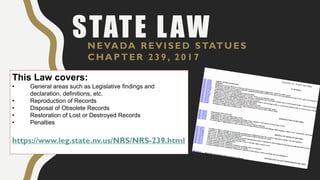
This Law covers:
• General areas such as Legislative findings and
declaration, definitions, etc.
• Reproduction of Records
• Disposal of Obsolete Records
• Restoration of Lost or Destroyed Records
• Penalties
https://www.leg.state.nv.us/NRS/NRS-239.html
AN OVERVIEW• Why?
– Transparency, support open access, and offer a liberal constriction for public to have access
• What is a public record
– all public books and public records of a government entity, the contents of which are not otherwise declared by law to
be confidential (NRS 239.010)
– information is by default public record unless specific confidentiality restrictions apply
– Any state agency generated records! Emails, reports, etc.
• Request of Records
– Verbal; OR in writing
• UNLESS it is an extraordinary request (NRS 239.055) then request must be in writing.
What is extraordinary? Ask to see the definition on the Public Records Policy of that agency.
– Requestor is not required to identify one-self or reason for request
– The agency of request has the duty to give you the information; if it is not available they have five days to give a
response as to why, in writing, when it will be available, or what other agency has the record(s) (NRS 239.0107(1)
BALANCE. Not all information is open access for public use.
What if the requested record
is not available due to
confidentiality?
• The agency is required to give the requestor a written response within FIVE
days, with the statue or other record that deems the information confidential
(NRS 239.0107(d)
• The requestor may ask the agency for a notes or the log of records being
held (NRS 239.0107(d)
• IF the requestor does not agree, s/he can take this request to District Court
• State employees are able to withhold records based upon their judgement of
public need balance of confidentiality
This Photo by Unknown Author is licensed under CC
BY-SA
Basics: In March 1986, the court acquitted a man on charges of contributing to the
delinquency of a minor.
The Reno Police Department did not agree with this decision and launched its own investigation
and a report was produced.
The Reno journalist (Donrey) requested the report. The request was denied.
In April 1986 a petition to District Court was filed and denied concluding that the report was an
investigative report (deemed under balance as confidential -outweighing public need).
(The case does go on in appeals about only 15% of the report was really investigative and
further legal arguments were of topic. Chapter 179A of the NRS is regarding the balance –
subject legislature of criminal records.)
Source: Justia Legal Resources. (2018). Donrey of Nevada, Inc. v. Bradshaw. https://law.justia.com/cases/nevada/supreme-court/1990/20057-1.html
History/background; Chapter 239 of the Nevada Revised
Statues (NRS): public records act
[1911 C&P § 83; RL § 6348; NCL § 10032]—(NRSA 1967, 533; 1995, 1264)
DONREY OF NEVADA, INC., and Reno Newspapers,Appellants, v. Robert BRADSHAW, Reno
Police Department
Supreme Court of Nevada. September 19, 1990.
Why is this important?
Because the case shows BALANCE of public need and confidentiality.
BALANCE!
• A state agent or employee may decline and refuse information of the requestor (and NOT be
held personally liable) if they deem the information not appropriate for release due to safety,
confidentiality, or other.
• However, since 1990, the Nevada Supreme Court requires a “balance test” (Donrey v. Bradshaw,
106 Nev. 630 (1990)) see previous slide.
• It is called the Bradshaw Balancing Test
• Weighing the agency interests in non-disclosure against the general policy in favor of open
government and the requestor's fundamental right to access public records
• The responsibility is upon the agency to explain with specific evidence why the records are
being with-held
• The government interest in the withholding must clearly outweigh the public interest in
disclosure
Source: Nevada Attorney General’s Office. (2012). Document Uploads. Retrieved from
http://ag.nv.gov/uploadedFiles/agnvgov/Content/Issues/2018_BC_TRNG_NV_Public_Records_Act.pdf
IMPORTANCE OF RECORD RETENTION
AND ARCHIVING
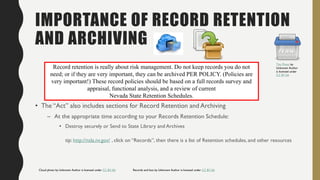
• The “Act” also includes sections for Record Retention and Archiving
– At the appropriate time according to your Records Retention Schedule:
• Destroy securely or Send to State Library and Archives
tip: http://nsla.nv.gov/ , click on “Records”, then there is a list of Retention schedules, and other resources
Record retention is really about risk management. Do not keep records you do not
need; or if they are very important, they can be archived PER POLICY. (Policies are
very important!) These record policies should be based on a full records survey and
appraisal, functional analysis, and a review of current
Nevada State Retention Schedules.
This Photo by
Unknown Author
is licensed under
CC BY-SA
Cloud photo by Unknown Author is licensed under CC BY-SA Records and box by Unknown Author is licensed under CC BY-SA
IN THE NEWS
FROM DIFFERENT VIEWSLINKS TO EVERY ARTICLE ARE ON A SEPARATE SLIDE
• The Nevada Independent, March 13, 2018
According to the group's website, it focuses on news coverage of
"the statehouse and politics in Nevada. We adhere to no political
philosophy other than a belief in fair reporting and open,
transparent government at all levels."
– Article reviews Sunshine Week and the focus on openness.
– Reviews what confidential information is redacted: e.g.,
Minutes of a closed meeting by the Nevada Commission on
Homeland Security to discuss responses to terrorism; Identity
of a narcotics addict by the state, a rehab clinic or a hospital;
Information turned over to the Gaming Control Board on why a
casino employee was fired.
– Claims, “…the Nevada Legislature, which has exempted itself
from both the state’s open-meeting and public-records laws…
has set a tone that transparency is secondary to politics, an
attitude I see reflected in too many local governments.”
– Concluding, the article suggests to trust the State of
Nevada but follow-up and verify because there is no
incentive for the government to be forthcoming.
• Organization: American Civil Liberties Union, ACLU, April 11, 2018
• Article reviews the law as needing improvement and are endorsing
“2019 Silver State Sunshine Act.”
• Claims the school district changed their policies “secretly” and they did
not (and should have) in these policies, waived all fees for record
requests; defined what “extraordinary” request are.
• The article says the District “very rigidly and harshly and have made
these changes to the Washoe School District Public Records Policy
without stakeholder support or notification.”
– The definitions and further details were not stated therefore
could not be judged as ridged or acceptable.
• Conclusion: The Union is obviously an advocate to more access
to information; however no conclusion can be asserted of the
Washoe School District due to vagueness of the report.
Newspapers are often the first draft of history and offer a
glimpse into what people are thinking! and allows trend tracking!
• Above picture by Unknown Author is licensed under CC BY-SA
IN THE NEWS
FROM DIFFERENT VIEWS• Las Vegas Sun (Known as “Liberal” news outlet) Links to every article are on a separate slide
• August 22, 1996, Bill Received Early OK Regarding Public Records. This article describes that more records were opened to public access, defines what
documents will be open to public, e.g., from personnel records, police reports, to historical documents; also reports that a government employee can now deny
access to a record and a person must go to court to request it be opened. Passed with no qualms.
• March 20, 1997: A fight over revision of Pubic Records Law expected again between the public and government employees. A Bill introduced is expected
to be controversial: it aims to define what a record is, and laws similar were struck down in 1993 and 1995.
• August 19, 2013: Access to Teachers’ Emails Denied (Think Tank as the Requestor): A Clark County district judge ruled today that schoolteachers’ work email
addresses are not considered a matter of public record. Nevada’s Eighth Judicial District Judge Douglas Smith dismissed Nevada Policy Research Institute’s
public records lawsuit against the Clark County School District, ruling that the “requested email database is confidential” and “not a public book or a public
record….The court concludes that CCSD’s interests in nondisclosure clearly outweigh the interest in access in this narrow case,” Smith [the judge] said in his
decision.” The paper’s coverage displayed sentiment that this decision was a dangerous strike against right to records.
• March 2015: The Cost Associated with Records Requests. The Nevada Association of Cities and Municipalities supports the Senate Bill 28, which aims to
clarify the cost and also better define what is extraordinary in terms of the Public Records NRS 239. Some felt that charging fees was a violation against the right
to access records, and others expressed that the agency that must redact and copy records has a right to recover costs of the request. A lawyer who represents
the Police Department claimed even having to go to court for access to records is a barrier; and a lawyer for Associated Press of Las Vegas and other media
outlets stated the judge at the Nevada Supreme Court usually releases records and gives the court an “A” for interpretation of the statues. The paper showed both
sides of this issue for the reader to decide. (I was swayed that there should be a cap fee, ok to charge though- and some way to better use work resources of large
requests!)
• December 10, 2015. Experts say the Governor Should Make Text Messages with Nevada Energy Public. The article argues that Governor Brian Sandoval
has text messages with the leadership of Nevada Energy and a Solar Power Company had requested these. The law does not clarify text messages specifically,
however in other states it is clearly a record (Washington State courts declared text messages regarding public duty, regardless if device is private or not, is indeed
a public record). Experts interviewed within the article said Sandoval should release the text messages or he is threatening democracy and rights of citizens. (Later
we see in Nevada, the court rules devices and texts of public business is subject to public record rules. )
Above picture by Unknown Author is licensed under CC BY-SA
.
Newspapers are often the first draft of history and offer a
glimpse into what people are thinking and allows trend tracking!
IN THE NEWS
FROM DIFFERENT VIEWS• Las Vegas Review Journal (Known as “Conservative” news outlet) Links to every article are on a separate slide
• March 29, 2018, Nevada High Court Rules Private Devices Subject to Open Records Law. This article describes the court Justice and all
others presiding unanimously ruled that the server or device used by a public employee is subject to inspection of public record. The ruling
overturns a decision by Washoe County District Court Judge Steven Kosach determining that records on personal devices and accounts are not
subject to public inspection because records on personal devices are outside the control of public agency.
• January 18, 2018, Three Ways to Put More Teeth in the Public Records Law. The reporter emphasizes that the public is the “boss” of the
government and that the “boss” (public) has a right to know what their staff are doing at any time. He claims that the government is hiding
information and there are ways to fix this: (1) Award triple attorney fees to requestor of records if they win in District Court; (2) Fine agencies
withholding the records, even hundreds per day, per record so that fighting a lawsuit would be too expensive, and (3) hold the public servant
liable, personally, when denying records – do this by withholding a percent out of their salary. Reporter was for the “Right Take” (meaning the
conservative take, since the use of the color red and other visual cues were present). I feel all three of the above proposed solutions are unfair.
• Further articles of relevance were not retrieved via Review Journal portal: this is not claiming there are no others available, the search was not
exhaustive, but they are obviously sparse.
____________________________________________________________________________________________________________________
In conclusion, it appears the Las Vegas local main news from known Conservative and Liberal outlets are both are in favor of
Public Records open access; however the Sun did present more of a view of acceptance of the process (go to court if denied,
records will be redacted at times, etc.) when compared to the Review Journal’s statement of “the government is hiding
information and the law needs “teeth.””
Note: this conclusion is based on a very low sample number, therefore cannot be considered statistically valid- an insight only.
• Above picture by Unknown Author is licensed under CC BY-SA
Newspapers are often the first draft of history and offer a
glimpse into what people are thinking and allows trend tracking!
GOVERNMENT INITIATIVES AND
COMPLIANCE
• The State of Nevada Government has tried to become more transparent in the Information Age and the below are a review of
websites that show their initiatives and compliance:
• This website : State of Nevada Public Records http://admin.nv.gov/Newsroom/Public_Records_Requests/
– Statement of commitment to transparency of information
– Provides a link to:
• NRS 239
• Pages that hold government reports
• Helpful links, such as research databases, manual of the Public Records Act, Grants, Nevada State Library, Archives, and Public
Records Office, and an OPTIONAL Information Request form (remember, the law states verbal is acceptable for requesting
information)
• Fees: if legal redaction required, number of pages, electronic or paper, personnel or computer programmers time, and fee caps
• Some other important State of Nevada Information Access Portals links below:
• http://open.nv.gov/ : Prominent display of Economic, Budget, and Financial access portals; offers more access
• http://admin.nv.gov/ : Department of Administration – serves as a starting point portal for accessing the correct state agency for need
• http://admin.nv.gov/Documents/ : Policies, procedures, and forms
Nevada photo by Unknown Author is licensed under CC BY-SA
• All other source citations are located on the slide | Images from Creative Commons used for educational purpose; citation provided
• Ritter, K. (March 16, 2015). Confusion, cost apply to open records in Nevada. LasVegas Sun. Retrieved from
https://lasvegassun.com/news/2015/mar/16/confusion-cost-apply-records-nevada/
• Takahashi, P. (August 19, 2013). Judge rules against think tank in bid for access to teacher emails. LasVegas Sun. Retrieved
from https://lasvegassun.com/news/2013/aug/19/judge-rules-against-think-tank-bid-access-teacher-/
• Lucas, S. (December 10, 2015). Sandoval’s text messages to NV Energy should be made public, experts. LasVegas Sun.
Retrieved from https://lasvegassun.com/news/2015/dec/10/sandoval-text-messages-to-nv-energy-should-be-made/
• (March 20, 1997). Open-records fight expected. LasVegas Sun. Retrieved from
https://lasvegassun.com/news/1997/mar/20/open-records-fight-expected/
• (August 22, 1996). Open records bill receives early OK. LasVegas Sun. Retrieved from
https://lasvegassun.com/news/1996/aug/22/open-records-bill-receives-early-ok/
• Lochhead, C. (March 29, 2018). Nevada high court rules private devices subject to open records law. The LasVegas Review
Journal. Retrieved from https://www.reviewjournal.com/news/politics-and-government/nevada/nevada-high-court-rules-
private-devices-subject-to-open-records-law/
• Juhl,W. (April 11, 2018).Washoe County School District undermines the Nevada Public Records Act. Nevada ACLU.
Retrieved from https://www.aclunv.org/en/news/washoe-county-school-district-undermines-nevada-public-records-act
• Smith, B. (March 13, 2018).Too many exceptions to Nevada’s public-records law. The Nevada Independent. Retrieved from
https://thenevadaindependent.com/article/too-many-exceptions-to-nevadas-public-records-law/
Newspaper citations, in order of appearance on slides
FIN.
• I hope this slideshow allowed a better understanding of the Public Records Law of the Nevada
Revised Statues, Chapter 239 through the information gathered and presented.
• The audience now should feel comfortable with the principles of NRS 239:
– The procedures governing the public records and why
– How to request information;
background information about the
process and in the event of a declined request
– What activity this law has had (in the news; a sample)
This Photo by Unknown Author
is licensed under CC BY-SA
Carrie Gaxiola, 09/14/2018,
Carrie.Gaxiola@sjsu.edu

Nevada Public Records Act

  • 1.
    N E VADA P U B L I C R E C O R D S AC T A N OV E RV I E W * B AC K G R O U N D * PA S T & P R E S E N T N E W S G OV E R N M E N T I N I T I AT I V E S C A R R I E G A X I O L A M A R A 2 1 1 F A L L 2 0 1 8
  • 2.
    STATE LAWNEVADA REVISEDSTATUES CHAPTER 239, 2017 This Law covers: • General areas such as Legislative findings and declaration, definitions, etc. • Reproduction of Records • Disposal of Obsolete Records • Restoration of Lost or Destroyed Records • Penalties https://www.leg.state.nv.us/NRS/NRS-239.html
  • 3.
    AN OVERVIEW• Why? –Transparency, support open access, and offer a liberal constriction for public to have access • What is a public record – all public books and public records of a government entity, the contents of which are not otherwise declared by law to be confidential (NRS 239.010) – information is by default public record unless specific confidentiality restrictions apply – Any state agency generated records! Emails, reports, etc. • Request of Records – Verbal; OR in writing • UNLESS it is an extraordinary request (NRS 239.055) then request must be in writing. What is extraordinary? Ask to see the definition on the Public Records Policy of that agency. – Requestor is not required to identify one-self or reason for request – The agency of request has the duty to give you the information; if it is not available they have five days to give a response as to why, in writing, when it will be available, or what other agency has the record(s) (NRS 239.0107(1) BALANCE. Not all information is open access for public use.
  • 4.
    What if therequested record is not available due to confidentiality? • The agency is required to give the requestor a written response within FIVE days, with the statue or other record that deems the information confidential (NRS 239.0107(d) • The requestor may ask the agency for a notes or the log of records being held (NRS 239.0107(d) • IF the requestor does not agree, s/he can take this request to District Court • State employees are able to withhold records based upon their judgement of public need balance of confidentiality This Photo by Unknown Author is licensed under CC BY-SA
  • 5.
    Basics: In March1986, the court acquitted a man on charges of contributing to the delinquency of a minor. The Reno Police Department did not agree with this decision and launched its own investigation and a report was produced. The Reno journalist (Donrey) requested the report. The request was denied. In April 1986 a petition to District Court was filed and denied concluding that the report was an investigative report (deemed under balance as confidential -outweighing public need). (The case does go on in appeals about only 15% of the report was really investigative and further legal arguments were of topic. Chapter 179A of the NRS is regarding the balance – subject legislature of criminal records.) Source: Justia Legal Resources. (2018). Donrey of Nevada, Inc. v. Bradshaw. https://law.justia.com/cases/nevada/supreme-court/1990/20057-1.html History/background; Chapter 239 of the Nevada Revised Statues (NRS): public records act [1911 C&P § 83; RL § 6348; NCL § 10032]—(NRSA 1967, 533; 1995, 1264) DONREY OF NEVADA, INC., and Reno Newspapers,Appellants, v. Robert BRADSHAW, Reno Police Department Supreme Court of Nevada. September 19, 1990. Why is this important? Because the case shows BALANCE of public need and confidentiality.
  • 6.
    BALANCE! • A stateagent or employee may decline and refuse information of the requestor (and NOT be held personally liable) if they deem the information not appropriate for release due to safety, confidentiality, or other. • However, since 1990, the Nevada Supreme Court requires a “balance test” (Donrey v. Bradshaw, 106 Nev. 630 (1990)) see previous slide. • It is called the Bradshaw Balancing Test • Weighing the agency interests in non-disclosure against the general policy in favor of open government and the requestor's fundamental right to access public records • The responsibility is upon the agency to explain with specific evidence why the records are being with-held • The government interest in the withholding must clearly outweigh the public interest in disclosure Source: Nevada Attorney General’s Office. (2012). Document Uploads. Retrieved from http://ag.nv.gov/uploadedFiles/agnvgov/Content/Issues/2018_BC_TRNG_NV_Public_Records_Act.pdf
  • 7.
    IMPORTANCE OF RECORDRETENTION AND ARCHIVING • The “Act” also includes sections for Record Retention and Archiving – At the appropriate time according to your Records Retention Schedule: • Destroy securely or Send to State Library and Archives tip: http://nsla.nv.gov/ , click on “Records”, then there is a list of Retention schedules, and other resources Record retention is really about risk management. Do not keep records you do not need; or if they are very important, they can be archived PER POLICY. (Policies are very important!) These record policies should be based on a full records survey and appraisal, functional analysis, and a review of current Nevada State Retention Schedules. This Photo by Unknown Author is licensed under CC BY-SA Cloud photo by Unknown Author is licensed under CC BY-SA Records and box by Unknown Author is licensed under CC BY-SA
  • 8.
    IN THE NEWS FROMDIFFERENT VIEWSLINKS TO EVERY ARTICLE ARE ON A SEPARATE SLIDE • The Nevada Independent, March 13, 2018 According to the group's website, it focuses on news coverage of "the statehouse and politics in Nevada. We adhere to no political philosophy other than a belief in fair reporting and open, transparent government at all levels." – Article reviews Sunshine Week and the focus on openness. – Reviews what confidential information is redacted: e.g., Minutes of a closed meeting by the Nevada Commission on Homeland Security to discuss responses to terrorism; Identity of a narcotics addict by the state, a rehab clinic or a hospital; Information turned over to the Gaming Control Board on why a casino employee was fired. – Claims, “…the Nevada Legislature, which has exempted itself from both the state’s open-meeting and public-records laws… has set a tone that transparency is secondary to politics, an attitude I see reflected in too many local governments.” – Concluding, the article suggests to trust the State of Nevada but follow-up and verify because there is no incentive for the government to be forthcoming. • Organization: American Civil Liberties Union, ACLU, April 11, 2018 • Article reviews the law as needing improvement and are endorsing “2019 Silver State Sunshine Act.” • Claims the school district changed their policies “secretly” and they did not (and should have) in these policies, waived all fees for record requests; defined what “extraordinary” request are. • The article says the District “very rigidly and harshly and have made these changes to the Washoe School District Public Records Policy without stakeholder support or notification.” – The definitions and further details were not stated therefore could not be judged as ridged or acceptable. • Conclusion: The Union is obviously an advocate to more access to information; however no conclusion can be asserted of the Washoe School District due to vagueness of the report. Newspapers are often the first draft of history and offer a glimpse into what people are thinking! and allows trend tracking! • Above picture by Unknown Author is licensed under CC BY-SA
  • 9.
    IN THE NEWS FROMDIFFERENT VIEWS• Las Vegas Sun (Known as “Liberal” news outlet) Links to every article are on a separate slide • August 22, 1996, Bill Received Early OK Regarding Public Records. This article describes that more records were opened to public access, defines what documents will be open to public, e.g., from personnel records, police reports, to historical documents; also reports that a government employee can now deny access to a record and a person must go to court to request it be opened. Passed with no qualms. • March 20, 1997: A fight over revision of Pubic Records Law expected again between the public and government employees. A Bill introduced is expected to be controversial: it aims to define what a record is, and laws similar were struck down in 1993 and 1995. • August 19, 2013: Access to Teachers’ Emails Denied (Think Tank as the Requestor): A Clark County district judge ruled today that schoolteachers’ work email addresses are not considered a matter of public record. Nevada’s Eighth Judicial District Judge Douglas Smith dismissed Nevada Policy Research Institute’s public records lawsuit against the Clark County School District, ruling that the “requested email database is confidential” and “not a public book or a public record….The court concludes that CCSD’s interests in nondisclosure clearly outweigh the interest in access in this narrow case,” Smith [the judge] said in his decision.” The paper’s coverage displayed sentiment that this decision was a dangerous strike against right to records. • March 2015: The Cost Associated with Records Requests. The Nevada Association of Cities and Municipalities supports the Senate Bill 28, which aims to clarify the cost and also better define what is extraordinary in terms of the Public Records NRS 239. Some felt that charging fees was a violation against the right to access records, and others expressed that the agency that must redact and copy records has a right to recover costs of the request. A lawyer who represents the Police Department claimed even having to go to court for access to records is a barrier; and a lawyer for Associated Press of Las Vegas and other media outlets stated the judge at the Nevada Supreme Court usually releases records and gives the court an “A” for interpretation of the statues. The paper showed both sides of this issue for the reader to decide. (I was swayed that there should be a cap fee, ok to charge though- and some way to better use work resources of large requests!) • December 10, 2015. Experts say the Governor Should Make Text Messages with Nevada Energy Public. The article argues that Governor Brian Sandoval has text messages with the leadership of Nevada Energy and a Solar Power Company had requested these. The law does not clarify text messages specifically, however in other states it is clearly a record (Washington State courts declared text messages regarding public duty, regardless if device is private or not, is indeed a public record). Experts interviewed within the article said Sandoval should release the text messages or he is threatening democracy and rights of citizens. (Later we see in Nevada, the court rules devices and texts of public business is subject to public record rules. ) Above picture by Unknown Author is licensed under CC BY-SA . Newspapers are often the first draft of history and offer a glimpse into what people are thinking and allows trend tracking!
  • 10.
    IN THE NEWS FROMDIFFERENT VIEWS• Las Vegas Review Journal (Known as “Conservative” news outlet) Links to every article are on a separate slide • March 29, 2018, Nevada High Court Rules Private Devices Subject to Open Records Law. This article describes the court Justice and all others presiding unanimously ruled that the server or device used by a public employee is subject to inspection of public record. The ruling overturns a decision by Washoe County District Court Judge Steven Kosach determining that records on personal devices and accounts are not subject to public inspection because records on personal devices are outside the control of public agency. • January 18, 2018, Three Ways to Put More Teeth in the Public Records Law. The reporter emphasizes that the public is the “boss” of the government and that the “boss” (public) has a right to know what their staff are doing at any time. He claims that the government is hiding information and there are ways to fix this: (1) Award triple attorney fees to requestor of records if they win in District Court; (2) Fine agencies withholding the records, even hundreds per day, per record so that fighting a lawsuit would be too expensive, and (3) hold the public servant liable, personally, when denying records – do this by withholding a percent out of their salary. Reporter was for the “Right Take” (meaning the conservative take, since the use of the color red and other visual cues were present). I feel all three of the above proposed solutions are unfair. • Further articles of relevance were not retrieved via Review Journal portal: this is not claiming there are no others available, the search was not exhaustive, but they are obviously sparse. ____________________________________________________________________________________________________________________ In conclusion, it appears the Las Vegas local main news from known Conservative and Liberal outlets are both are in favor of Public Records open access; however the Sun did present more of a view of acceptance of the process (go to court if denied, records will be redacted at times, etc.) when compared to the Review Journal’s statement of “the government is hiding information and the law needs “teeth.”” Note: this conclusion is based on a very low sample number, therefore cannot be considered statistically valid- an insight only. • Above picture by Unknown Author is licensed under CC BY-SA Newspapers are often the first draft of history and offer a glimpse into what people are thinking and allows trend tracking!
  • 11.
    GOVERNMENT INITIATIVES AND COMPLIANCE •The State of Nevada Government has tried to become more transparent in the Information Age and the below are a review of websites that show their initiatives and compliance: • This website : State of Nevada Public Records http://admin.nv.gov/Newsroom/Public_Records_Requests/ – Statement of commitment to transparency of information – Provides a link to: • NRS 239 • Pages that hold government reports • Helpful links, such as research databases, manual of the Public Records Act, Grants, Nevada State Library, Archives, and Public Records Office, and an OPTIONAL Information Request form (remember, the law states verbal is acceptable for requesting information) • Fees: if legal redaction required, number of pages, electronic or paper, personnel or computer programmers time, and fee caps • Some other important State of Nevada Information Access Portals links below: • http://open.nv.gov/ : Prominent display of Economic, Budget, and Financial access portals; offers more access • http://admin.nv.gov/ : Department of Administration – serves as a starting point portal for accessing the correct state agency for need • http://admin.nv.gov/Documents/ : Policies, procedures, and forms Nevada photo by Unknown Author is licensed under CC BY-SA
  • 12.
    • All othersource citations are located on the slide | Images from Creative Commons used for educational purpose; citation provided • Ritter, K. (March 16, 2015). Confusion, cost apply to open records in Nevada. LasVegas Sun. Retrieved from https://lasvegassun.com/news/2015/mar/16/confusion-cost-apply-records-nevada/ • Takahashi, P. (August 19, 2013). Judge rules against think tank in bid for access to teacher emails. LasVegas Sun. Retrieved from https://lasvegassun.com/news/2013/aug/19/judge-rules-against-think-tank-bid-access-teacher-/ • Lucas, S. (December 10, 2015). Sandoval’s text messages to NV Energy should be made public, experts. LasVegas Sun. Retrieved from https://lasvegassun.com/news/2015/dec/10/sandoval-text-messages-to-nv-energy-should-be-made/ • (March 20, 1997). Open-records fight expected. LasVegas Sun. Retrieved from https://lasvegassun.com/news/1997/mar/20/open-records-fight-expected/ • (August 22, 1996). Open records bill receives early OK. LasVegas Sun. Retrieved from https://lasvegassun.com/news/1996/aug/22/open-records-bill-receives-early-ok/ • Lochhead, C. (March 29, 2018). Nevada high court rules private devices subject to open records law. The LasVegas Review Journal. Retrieved from https://www.reviewjournal.com/news/politics-and-government/nevada/nevada-high-court-rules- private-devices-subject-to-open-records-law/ • Juhl,W. (April 11, 2018).Washoe County School District undermines the Nevada Public Records Act. Nevada ACLU. Retrieved from https://www.aclunv.org/en/news/washoe-county-school-district-undermines-nevada-public-records-act • Smith, B. (March 13, 2018).Too many exceptions to Nevada’s public-records law. The Nevada Independent. Retrieved from https://thenevadaindependent.com/article/too-many-exceptions-to-nevadas-public-records-law/ Newspaper citations, in order of appearance on slides
  • 13.
    FIN. • I hopethis slideshow allowed a better understanding of the Public Records Law of the Nevada Revised Statues, Chapter 239 through the information gathered and presented. • The audience now should feel comfortable with the principles of NRS 239: – The procedures governing the public records and why – How to request information; background information about the process and in the event of a declined request – What activity this law has had (in the news; a sample) This Photo by Unknown Author is licensed under CC BY-SA Carrie Gaxiola, 09/14/2018, Carrie.Gaxiola@sjsu.edu