Basics of patent specification drafting
By
Nitin Nair
Object of patent law
• The object of Patent Law is to encourage scientific research,
new technology and industrial progress. The price of the grant
of the monopoly is the disclosure of the invention at the Patent
Office, which after the expiry of the fixed period of the
monopoly, passes into the public domain.
Biswanath Prasad Radhey Shyam vs Hindustan Metal Industries on 13 December, 1978
Form of patent application
• Patent Application
• Form of Application
• Provisional Application (Provisional Specification
+ Filing documents)
• Non Provisional/Complete Application (Complete
specification + Filing documents)
• Priority Date- filing date of the first application
in a chain of applications
Indian Patent Act
• Section 7(4)- Every such application….shall be
accompanied by a provisional or complete specification
• Section 10(1) Every application…shall describe the
invention and…begin with a title…
• Section 10 (4)- every complete specification shall
• Fully and particularly describe the invention
• Disclose the best method
• End with a claim
• Be accompanied by an abstract
Specification contents
• Title
• Preamble of the invention
• Technical field
• Background
• Objects
• Statement of the invention
• Brief description of the drawings
• Detailed description
• Claims
• Abstract
• Drawings
Title
• Should be provided in the first page of Form-2
• Should indicate the subject matter
• Should not be more than 15 words
• Should be free from fancy expression or
ambiguity
• Inventor’s name, the word “patent”, words in
other languages and so on should not be
used
Title
• Should correspond to the broadest claim
• Should embrace all variants of the invention
(apparatus and method)
Pre-amble
• Should be provided in the first page of Form-
2
• Provisional Specification
• The following specification describes the
invention
• Complete Specification
• The following specification particularly describes
the invention and the manner in which it is to be
performed
Technical field
• Provided in page 2 of Form-2
• Should indicate general art to which the
invention belongs
• Areas of application may be mentioned
Background
• Distinguish the invention from what is already
existing in the field
• Should not describe the claimed Invention
• Should use drawings to explain any prior art
• If the latest art in the field (prior to the invention
at hand) is Applicants own work , then such
work should not be described here
• Do not exaggerate/criticize the disadvantages
of prior art
Objects
• Should set forth broad objectives
• Acts as a pointer while drafting detailed
description
Statement of invention
• Usually drafted when omnibus claims are
intended to be introduced.
• According to new manual of patent office
practice and procedure (MPPP), Omnibus
claim should be avoided.
• Paraphrasing of independent claims
Brief description of drawings
• Should clearly indicate that the drawings are
showing embodiments of the invention and
not the invention itself
• Should start with “…The invention is illustrated in
the accompanying drawings, throughout which like
reference letters indicate corresponding parts in the
various figures. The embodiments herein will be
better understood from the following description with
reference to the drawings, in which:…”
Detailed description
• Should provide sufficient details of the
invention
• The making and using of the invention
should be explained in depth so as to enable
a person having ordinary skill in the art to
practice the invention
• Details of the invention should be explained
with reference to drawings
• Should disclose best mode
Detailed description
• Should provide sufficient details of the
invention
• The making and using of the invention
should be explained in depth so as to enable
a person having ordinary skill in the art to
practice the invention
• Details of the invention should be explained
with reference to drawings
• Should disclose best mode
Detailed description
• The terminology should be consistent
• Should be well organized and easily
understandable
• Start with a general overview and proceed
with increasing levels of detail
• Should set forth several, if not all,
alternative working examples even if only
one embodiment is illustrated in the
drawings
Claims
• Should start in a different page
• Should start with Preamble I/We Claim
• Define the scope of protection
• Every claim has a date associated with it
• Every claim is an invention
• What is not claimed in the “claims” stands
disclaimed
Claims
• Parts of a claim
• Preamble
• Transitional phrase
• Body
• Example Preamble Transitional Phrase
• A system for……., said system
comprising:
• element A;
• element B; and Body
• element C.
Claims
• Independent claim
• Stand alone
• usually broad
Example
1. A system for….., said system comprising:
element A;
element B; and
element C.
Claims
• Dependent claim
• Dependent on independent claim or another
dependent claim
• Narrow scope
Example
1. The system as claimed in claim 1, wherein
element A comprises element D.
Claims
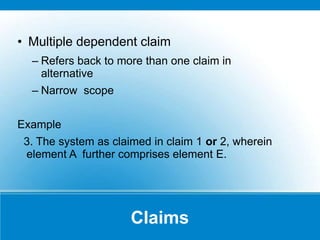
• Multiple dependent claim
– Refers back to more than one claim in
alternative
– Narrow scope
Example
3. The system as claimed in claim 1 or 2, wherein
element A further comprises element E.
Claim Drafting - tips
• Draft a broadest independent claim with
at least one novel point and then proceed
with drafting dependent claims
• Do not include unnecessary limitation in
the independent claim
• Claim an apparatus in non-operational
state
• Do not include multiple dependent claims
Claims
• Example
1. A chair comprising a seat and a back
rest. Said chair further having four legs.
1. A chair comprising:
a seat;
a backrest; and
at least one leg.
Claims
• Example:
1. A fan comprising:
a rotating hub; and
three wings attached to said hub.
1. A fan comprising:
a hub configured to rotate; and
at least one wing attached to said hub.
Claims
• Example:
A method for performing rain water harvesting
comprising digging a hole with a length of 10
meters, a width of 5 meters and a depth of 15
meters on a slope of 20 degrees; lining the
hole with a blue tarpaulin; and filling the hole
with water absorbent clay.
Claims
• Example:
Claims
• Example:
Abstract
• Should be in a separate sheet
• Start with the title of the invention
• Should not exceed 150 words
• Should indicate the figure which needs to
be published with it
Drawings
• Should be accurately referenced and
described
• Should show every feature of the
invention
Drafting approach
• Title
• Sequence of drawings
• First draft of Claims
• Technical field
• Background
• Object
• Brief description of drawings
• Detailed description
• Final claims
• Abstract
Thank you
Nitin Nair
nitin@bananaip.com
www.bananaip.com
Blog: www.sinapseblog.com

Patent Drafting

  • 1.
    Basics of patentspecification drafting By Nitin Nair
  • 2.
    Object of patentlaw • The object of Patent Law is to encourage scientific research, new technology and industrial progress. The price of the grant of the monopoly is the disclosure of the invention at the Patent Office, which after the expiry of the fixed period of the monopoly, passes into the public domain. Biswanath Prasad Radhey Shyam vs Hindustan Metal Industries on 13 December, 1978
  • 3.
    Form of patentapplication • Patent Application • Form of Application • Provisional Application (Provisional Specification + Filing documents) • Non Provisional/Complete Application (Complete specification + Filing documents) • Priority Date- filing date of the first application in a chain of applications
  • 4.
    Indian Patent Act •Section 7(4)- Every such application….shall be accompanied by a provisional or complete specification • Section 10(1) Every application…shall describe the invention and…begin with a title… • Section 10 (4)- every complete specification shall • Fully and particularly describe the invention • Disclose the best method • End with a claim • Be accompanied by an abstract
  • 5.
    Specification contents • Title •Preamble of the invention • Technical field • Background • Objects • Statement of the invention • Brief description of the drawings • Detailed description • Claims • Abstract • Drawings
  • 6.
    Title • Should beprovided in the first page of Form-2 • Should indicate the subject matter • Should not be more than 15 words • Should be free from fancy expression or ambiguity • Inventor’s name, the word “patent”, words in other languages and so on should not be used
  • 7.
    Title • Should correspondto the broadest claim • Should embrace all variants of the invention (apparatus and method)
  • 8.
    Pre-amble • Should beprovided in the first page of Form- 2 • Provisional Specification • The following specification describes the invention • Complete Specification • The following specification particularly describes the invention and the manner in which it is to be performed
  • 9.
    Technical field • Providedin page 2 of Form-2 • Should indicate general art to which the invention belongs • Areas of application may be mentioned
  • 10.
    Background • Distinguish theinvention from what is already existing in the field • Should not describe the claimed Invention • Should use drawings to explain any prior art • If the latest art in the field (prior to the invention at hand) is Applicants own work , then such work should not be described here • Do not exaggerate/criticize the disadvantages of prior art
  • 11.
    Objects • Should setforth broad objectives • Acts as a pointer while drafting detailed description
  • 12.
    Statement of invention •Usually drafted when omnibus claims are intended to be introduced. • According to new manual of patent office practice and procedure (MPPP), Omnibus claim should be avoided. • Paraphrasing of independent claims
  • 13.
    Brief description ofdrawings • Should clearly indicate that the drawings are showing embodiments of the invention and not the invention itself • Should start with “…The invention is illustrated in the accompanying drawings, throughout which like reference letters indicate corresponding parts in the various figures. The embodiments herein will be better understood from the following description with reference to the drawings, in which:…”
  • 14.
    Detailed description • Shouldprovide sufficient details of the invention • The making and using of the invention should be explained in depth so as to enable a person having ordinary skill in the art to practice the invention • Details of the invention should be explained with reference to drawings • Should disclose best mode
  • 15.
    Detailed description • Shouldprovide sufficient details of the invention • The making and using of the invention should be explained in depth so as to enable a person having ordinary skill in the art to practice the invention • Details of the invention should be explained with reference to drawings • Should disclose best mode
  • 16.
    Detailed description • Theterminology should be consistent • Should be well organized and easily understandable • Start with a general overview and proceed with increasing levels of detail • Should set forth several, if not all, alternative working examples even if only one embodiment is illustrated in the drawings
  • 17.
    Claims • Should startin a different page • Should start with Preamble I/We Claim • Define the scope of protection • Every claim has a date associated with it • Every claim is an invention • What is not claimed in the “claims” stands disclaimed
  • 18.
    Claims • Parts ofa claim • Preamble • Transitional phrase • Body • Example Preamble Transitional Phrase • A system for……., said system comprising: • element A; • element B; and Body • element C.
  • 19.
    Claims • Independent claim •Stand alone • usually broad Example 1. A system for….., said system comprising: element A; element B; and element C.
  • 20.
    Claims • Dependent claim •Dependent on independent claim or another dependent claim • Narrow scope Example 1. The system as claimed in claim 1, wherein element A comprises element D.
  • 21.
    Claims • Multiple dependentclaim – Refers back to more than one claim in alternative – Narrow scope Example 3. The system as claimed in claim 1 or 2, wherein element A further comprises element E.
  • 22.
    Claim Drafting -tips • Draft a broadest independent claim with at least one novel point and then proceed with drafting dependent claims • Do not include unnecessary limitation in the independent claim • Claim an apparatus in non-operational state • Do not include multiple dependent claims
  • 23.
    Claims • Example 1. Achair comprising a seat and a back rest. Said chair further having four legs. 1. A chair comprising: a seat; a backrest; and at least one leg.
  • 24.
    Claims • Example: 1. Afan comprising: a rotating hub; and three wings attached to said hub. 1. A fan comprising: a hub configured to rotate; and at least one wing attached to said hub.
  • 25.
    Claims • Example: A methodfor performing rain water harvesting comprising digging a hole with a length of 10 meters, a width of 5 meters and a depth of 15 meters on a slope of 20 degrees; lining the hole with a blue tarpaulin; and filling the hole with water absorbent clay.
  • 26.
  • 27.
  • 28.
    Abstract • Should bein a separate sheet • Start with the title of the invention • Should not exceed 150 words • Should indicate the figure which needs to be published with it
  • 29.
    Drawings • Should beaccurately referenced and described • Should show every feature of the invention
  • 30.
    Drafting approach • Title •Sequence of drawings • First draft of Claims • Technical field • Background • Object • Brief description of drawings • Detailed description • Final claims • Abstract
  • 31.