CHAPTER 4
RESEARCH PROBLEM
Dr. Musaab Riyadh Abdulrazzaq
Computer Science Departement
Mustansiriyah University
M. SC. 2019-2010
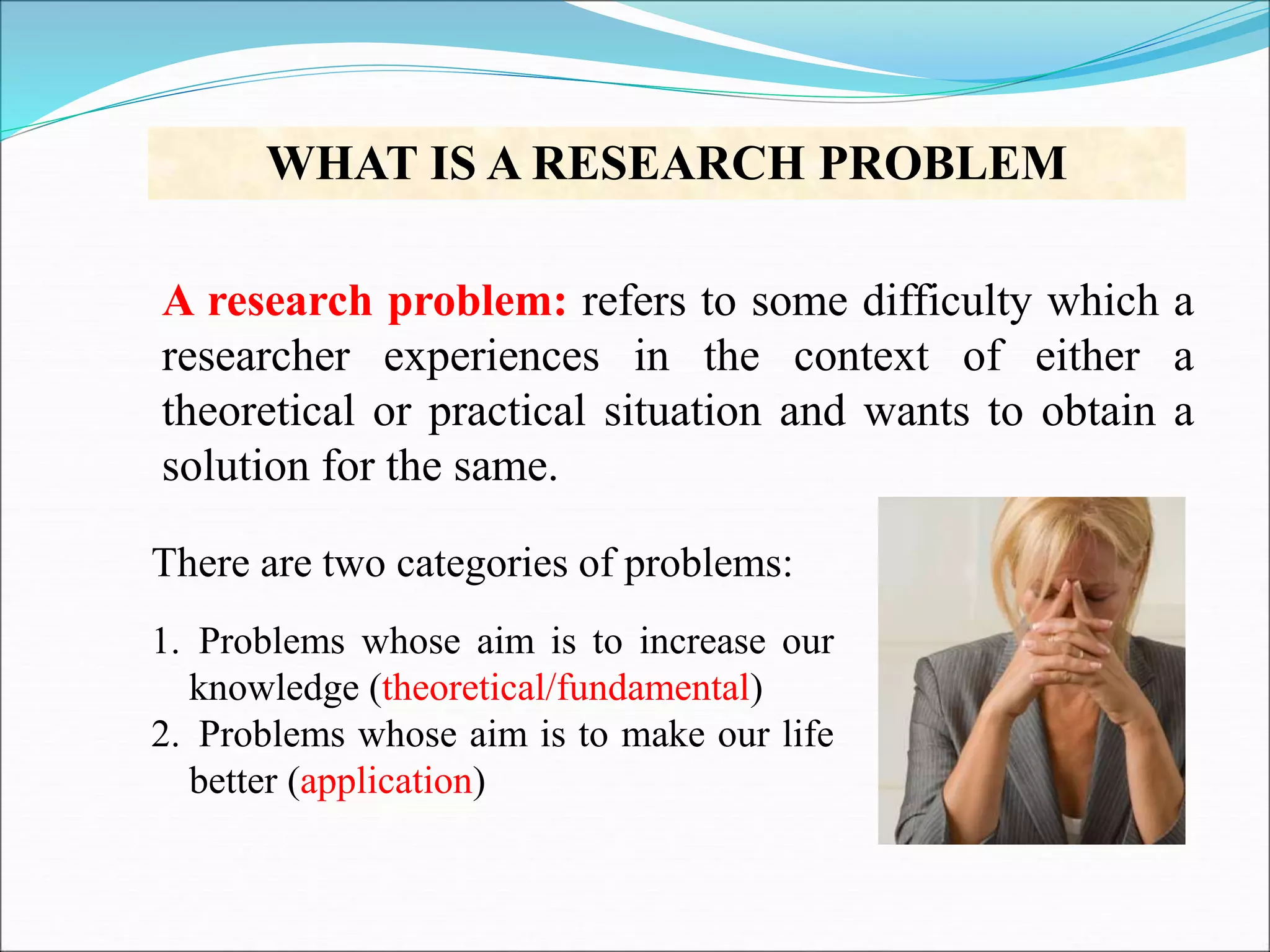
WHAT IS A RESEARCH PROBLEM
A research problem: refers to some difficulty which a
researcher experiences in the context of either a
theoretical or practical situation and wants to obtain a
solution for the same.
There are two categories of problems:
1. Problems whose aim is to increase our
knowledge (theoretical/fundamental)
2. Problems whose aim is to make our life
better (application)
Keeping the Research Process in Focus
• Many students find it difficult to find and formulate an
acceptable research problem
• But Scientific Method requires formulation of research
problem as the first requirement.
• Research problem must also be justified its existent
• Thus, the first responsibility is to formulate a problem
that is carefully phrased and represent the single goal of
the total research effort
Criteria in selecting a good research problem.
A good criteria which are keep in your mind when selecting a
research problem are:
• The researcher should have interest in the problem area.
• The selected problem should be of theoretical importance
and fill gaps in literature.
• Data should be accessible.
• Peer recognition of its importance.
• The problem should enhance and broaden researchers’
knowledge and skills In research.
Criteria in selecting a good research problem.
• The research problem should of sufficient magnitude
and scope to fulfill the requirements that motivate the
study.
• The solution to the research problem should be
practicable.
• The research problem should have enough variables.
• It should contribute to the advancement of knowledge
• It should meet publication standards.
HOW TO JUSTIFY A RESEARCH
PROBLEM?
What is NOT a Research Problem?
• Certain problems are not suitable for research because
they lack of:
 Justification (based on Literature Review)
 “interpretation of data” requirement
• Avoid four situations when considering a problem for
research:
1. Self-enlightenment
2. Comparing data
3. Finding coefficient of correlation
4. Problem with Yes and No answers
1. Not Self-Enlightenment
• Don’t use a problem as a way for achieving self
enlightenment :
 Students may find gathering facts and dissipating their own
informational deficiency gratifying
 Example, “ the problem of this research is to learn more about
the way the SMP system is developed”
 Here, the effort will provide only the satisfaction having gain
more information about SMP not solution of THE PROBLEM
2. Not Comparing Data
• Example “This research project will compare the
increase in the number of women students over 10 years
from 2000 to 2010 with the men students over the same
time span.”
• We can do that without any effort, in two lines
2000 2010
Women 1234 2567
Men 1567 1600
• It is a research if we put the questions:
 1. Why did this happened?
 2. What will be the solution to the problem.
3. Not Finding Coefficient of Correlation
• Finding correlation between two sets of data to show
relationship is not an acceptable problem.
• Correlation coefficient acts as a signpost/indicator to
look deeper into the cause of the relationship that exists
between two sets of data
• Thus, to find the answer of the cause of the relationship
is research.
4. Problems that Result in a Yes or No Answer
• Example, “ Does children like tablet?”
• Not researchable problem : give the tablet to children
see what happens.
• It is researchable problem if “is there benefit and
drawback of tablet for children learning mathematics?”
4. Problems that Result in a Yes or No Answer
• Answers to these questions would enlarge our findings:
1. What mathematical software run on tablet promotes
intelligent and learning.
2. Which tablet is more suitable?
3. How fast can the children learn?
4. Does children too dependent with tablet?
5. Does tablet distract attention to children?
6. What GUI more suitable to children?
• This demand full power of the scientific method and
ancillary help of statistics, computerization,
discriminative and analytical thinking, and creative
research methodology
Guidelines For Finding A Legitimate Problem
• Appropriate research projects don’t fall out of trees and
hit you on the head.
• Must be sufficiently knowledgeable about your topic of
interest to know what projects might make important
contributions to the field.
• The government may come up with specific vision for
the country and suggested several projects for the
country.
• SIX guidelines to formulate an important and useful
research project are listed below.
1. Look Around You
• In many disciplines, questions that need answers –
phenomena that need explanation - are everywhere.
• Example: In 17th. century, Galileo was trying to make
sense of why large bodies of water (but not small ones)
rise and fall in the form of tides twice a day?
• Others: Isac Newton, Einstein, etc,
• Great scientist’s way?
• BUT not to suggest that novice researchers should take
on such monumental questions.
• Concentrate on smaller problems – continually ask
questions about what you hear and see.
• Why does such–and–such happen? What makes such–
and–such happened?
2. Read the Literature (Literature Review)
• What is Literature Review?
• What to review? How to review? (case study at the end of slide)
• Where to get the materials?
• By doing review, we will know:
A. what already known – don’t reinvent the wheel
B. what is NOT known in the area – in other words, what still needs to
be done.
• After doing the LR, you may have the following ideas:
A. Address the suggestions for future works that another researcher has
offered.
B. Replicate a research project in a different setting or with a different
users.
C. Apply an existing perspective or explanation to a new situation
D. Apply different techniques (examples; mathematics, logic, models,
framework, algorithms, combination of different techniques, etc.)
E. Study for unexpected or contradictory findings in previous studies.
F. Challenge research findings that seem to contradict what you
know or believe to be true.
Other advantages :
• Provides theoretical base on which to build a rationale
for your study
• Provides potential research methodologies and
methods of measurement
• Help you interpret your results and relate them to what
is already known in the field
2. Read the Literature (LR)
• Researchers present latest findings in the national and
international conferences.
• Learn “what is hot and what is not” in their field
• Novice researchers can make contacts with experts in their
field, ask questions, share ideas, exchange e-mail addresses
with more experienced and knowledgeable individuals
3. Attend Professional Conferences
4. Seek the Advice of Experts
• Another simple yet highly effective strategy for
identifying a research problem is simply to ask an
expert:
A. What needs to be done?
B. What burning questions are still out there?
C. What previous research findings seemingly don’t make sense?
D. What’s the direction of the research?
• Check with professional reports (Gartner’s report) ,
white paper reports (IBM, etc.)
5. Choose a Topic that Motivates You
• Reading literature, attend conferences, talk with
experts, will uncover a number of potential research
problems
• Pick just one, based on what you want to learn more
about
• Some guide
• Must believe that it is worth your time and effort.
• Saying “You’re going to be married to it, so you might as
well enjoy it.”
6. Choose a Topic That Others Will Find
Interesting and Worthy of Attention
At the end of the study:
• you want to share findings with a larger audience and
continue as researcher (not only end with thesis).
• Present what you have done at a international or
national conference, publish an article in a
professional journal, or both.
• Future employers, too, are also interested in your
thesis topic if in your research, you are pursuing an
issue of broad scientific or social concern or, more
generally, a hot topic in your field.
Stating the Research Problem
• After identifying a research problem, therefore, you must
articulate it in such a way that it is carefully phrased and
represents the single objective of the total research effort.
• Following are some general guidelines to help you do just
that:
• Always state the problem in one or more grammatically
complete sentences
• If the problem is not stated with such clarity, then you
are merely deceiving yourself that you know what the
problem is.
1. State the Problem Clearly and Completely
The Problem Statement
• Bad habits:
 try to state a research problem by jotting down meaningless
groups of words, verbal fragments
 cannot see the problem clearly
• Examples: half-statements, mere verbal blobs that only
hint at the problem but do not state it
 A) Software metrics and the quality of software
 B) Mobile devices in daily live
 C) ICT promotes English in school
 D) Security in computer network
The Problem Statement
• Must limit the area of study to a manageable size
• Example:
 metric and quality
 what metrics?
 which quality attribute?
 and more importantly what domain of the software you want
to investigate? By specifying the domain you are narrowing
down the metric and the quality attribute
2. Think through the Feasibility of the Project that
the Problem Implies
• Don’t rush into problem without thinking through its
implications.
• “This study proposes an investigation of the effect of
mobile devices (tablet, smart phones) in teaching
mathematics and science in Iraqi primary schools?”.
• Think about the implications:
 How many primary schools all over Malaysia?
 How to contact?
 Personal visit?
 What is the financial outlay?
 Mail survey?
 Printing and postage cost?
3. Say Precisely What You Mean
• Correct the problem statement right up front, no place for
evasion (trying to avoid something), equivocation (having a
doubtful or double meaning), or mental reservation in
research
• Must mean what you say, cannot assume others will know
what is in your mind, they will take your words at their face
value: You mean what you say. That’s it.
• Some researcher talks about the problem but never actually
states what the problem is.
• Some researcher launches into a generalized discussion,
continually obscuring (not easily seen or understood) the
problem, never clearly articulating (able to express his/her
opinions clearly in words) it
Where is the Problem Statement?
• None:
 that is articulated with sufficient clarity
 No orientation essay
• What should be:
 The problem is stated in the very first words of an abstract such
as “The purpose of this study is to …”
 No background buildup necessary
 Straightforward plunge into the business at hand
4. Edit your Work
• Difficulties can be avoided by carefully editing your
words. Editing is sharpening a thought to a gemlike point,
and eliminating useless verbiage (wordiness). By
choosing words precisely will clarify your writing
• Editing improves your thinking and your prose (ordinary
written or spoken language). Many students think that any
words that approximately express a thought are adequate
to be conveyed to others
• Approximation is never precision
• Need to be rigorous (careful and detailed) with the words
• Punctuation will help
• Cliches (idea or expression that is used so often that it no
longer has any meaning), colloquialisms (word or phrase
suitable for normal conversation: not formal or literary),
slang (words, phrases, etc. used in very informal
conversation, not suitable for formal situations), jargon
(special or technical words used by a particular group of
people), and the gibberish (meaningless talk; nonsense) of
any group obscure (not easily seen or understood) thought
• Jargon shows lazy mind
• They feel impressive or add importance
• Thought is clearest when clothed in simple words,
concrete nouns, and active, expressive verbs
4. Edit your Work
Basic Guidelines for Clear Writing
• Express thought fully with least words possible
• Use a thesaurus: help find the exact word
• Economize on syllable
• Keep the sentence short
• Look critically at each thought. Do the words say exactly
what you want them to say? Read carefully phrase by
phrase. Throw out superfluous (more than is needed and
wanted) and unnecessary words
• Sub problems are the subparts of the main problem
• The researcher must distinguish subproblems that are an
integral part of the main problem from things that look like
problems but are nothing more than procedural issues
(pseudo-subproblem)
• The latter, which are called pseudo-subproblems, involve
decisions the researcher must make (also knowledge he
should acquire) before he or she can resolve the research
problem and its subproblems.
• Pseudo-subproblems are not researchable problems
• Pseudo-subproblems = Problems for researcher BUT not
part of the research problem
Pseudo-Subproblems
• Consider the following as examples, what are they?
• What is the best way to choose a sample?
• How large should a representative sample of a population
be?
• What instruments or methods should be used to gather the
data?
• What statistical procedures should be used to analyse the
data?
• How do I find the subproblems within the main problem?
Subproblems Versus Pseudo-Subproblems
There are four key characteristics of subproblems:
1. Each subproblem should be a completely researchable
unit:
• A subproblem should constitute a logical subarea of
the larger research undertaking.
• Each subproblem might be researched as a separate
subproject within the larger research goal
• The solutions to the subproblems, taken together,
combine to resolve the main problem
Characteristics of Subproblems
2. Each subproblem can be verified independently or must be
clearly tied to the interpretation of the data (verifyable)
• At some point in the statement of the subproblem – as
within the main problem – the fact that data will be
interpreted must be clearly evident
• This fact may be expressed as a part of each subproblem
statement, or it may occupy an entirely separate
subproblem
Characteristics of Subproblems
3. The subproblems must add up to the totality of the
problem
• After the subproblems have been stated, check them
against the statement of the main problem to see that
• nothing in excess of the coverage of the main problem is
included and that
• all significant areas of the main problem are covered by
the subproblems
4. Subproblems should be small in number
• If the main problem is carefully stated and properly limited to a
feasible research effort, the researcher will find that it usually contains
two to six subproblems
• Sometimes, the inexperienced researcher will come up with as many
as 10, 15, or 20 subproblems
• If this happens, it may fall into one of the following:
 Some are actually procedural issues (pseudo-subproblems);
 Some might reasonably be combined into larger subproblems; or
 The main problem is more complex than you originally believed.
If the last of these is true, you may want to reconsider whether the
solution to the overall research problem is actually achievable given
the time and resources you have
Characteristics of Subproblems
• To comprehend fully the meaning of the problem, the
researcher should eliminate any possibility of
misunderstanding by:
 Stating the hypotheses and/or research questions: Describing the
specific hypotheses being tested or questions being asked.
 Delimiting the research: Fully disclosing what the researcher
intends to do and, conversely, does not intend to do.
 Defining the terms: Giving the meanings of all terms in the
statements of the problem and subproblems that have any
possibility of being misunderstood.
 Stating the assumptions: Presenting a clear statement of all
assumptions on which the research will rest.
• These matters facilitate understanding of the research –
called the setting of the problem/Problem statement
Every Problem Needs Further Enhancement
Stating the Hypotheses/proposed solution
• Hypotheses are tentative, intelligent guesses (proposed
solution) posited for the purpose of directing one’s
thinking toward the solution of the problem
• Necessary in deciding for verification method (RM) and
searching for relevant data.
• Hypotheses are neither proved nor disproved. They are
set forth to assist in guiding the investigation of a
problem or to provide possible explanations for the
observations made
Accept/Reject Hypotheses
• Hypotheses is NOT a solution but just a proposed
solution to the problem that need verification
• Their acceptance or rejection is dependent on the
success of verification (mathematical, logical, data
analysis)
• Hypotheses may originate in the subproblem
• Hypothesis provides a position from which a researcher
begins to initiate an exploration of problem and
subproblems and checkpoints to test the findings
This might happen after the study:
Accept/Reject Hypotheses
• If the data do not support the research hypothesis, don’t
be disturbed – it merely means that the educated guess
about the outcome of the investigation was incorrect
• Frequently, rejected hypotheses are a source of genuine
and gratifying surprise – truly made unexpected
discovery.
• Positive thinking: It might be an opportunity to set
better hypothesis.
• Know PRECISELY what the researcher intends to DO
and does NOT intend to do (the scope, the boundary of
the study).
• What the researcher intends to do is stated in the
problem statement
• What the researcher is not going to do is in the
delimitations
• Distinguish between what is relevant and what is not
relevant to the problem
• All irrelevancies to the problem must be firmly ruled out
in the statement of delimitations
Delimiting the Research
• Without knowing explicitly what a term means, we
cannot evaluate the research or determine whether the
researcher has carried out what was proposed in the
problem statement
• Need not necessarily agree with such a definition, but as
long as we know what the researcher means when using
the term, we are able to understand and appraise it
appropriately
Defining The Terms
Defining The Terms
• Example; To make the software more USER-FRIENDLY
• The researcher must be careful to avoid circular
definitions, in which the terms to be defined are used in
the definitions themselves
• Example; “an apps is any app used by a user”.
Stating the Assumptions
• Assumptions are those things we take for granted in the
study:
• statements by the researcher that certain elements of
the research are understood to be true.
• Assumptions in theory: Ex. Big Bang theory, Game
theory, chaos theory, etc.
• Assumption in phenomena: Ex, one might measure
student success by test scores, graduation rates, or
employment after completion
Stating the Assumptions
• Assumptions are what researchers take for granted with
respect to the problem and agreed by other researchers
• If others know the assumptions a researcher makes,
they are better prepared to evaluate the conclusions
that result from such assumptions
• In research, try to leave nothing to chance in the hope
of preventing any misunderstanding
• In the thesis or research reports, researchers frequently
set forth their reasons for undertaking the study
• In a research proposal, such a discussion may be
especially important (to convince to get financial
support)
• Some studies seem to go far beyond any relationship to
the practical world (difficult to show immediate benefit
of the study)
• Of such research efforts, one might asks “Of what use is
it? What practical value does the study have?”
• For example, the time, money, effort spent on early
space exploration flights
Importance of the Study
Summary
• What is not researchable problem
• What is researchable problem
• Where to find the problem (4)
• How to write the problem statement
• Write the hypothesis
• Define the term properly
• Set the delimitation
• State the assumption
• Justify (the important) your study
THANK YOU

6_2019_10_31!10_52_47_PM.PPT

  • 1.
    CHAPTER 4 RESEARCH PROBLEM Dr.Musaab Riyadh Abdulrazzaq Computer Science Departement Mustansiriyah University M. SC. 2019-2010
  • 2.
    WHAT IS ARESEARCH PROBLEM A research problem: refers to some difficulty which a researcher experiences in the context of either a theoretical or practical situation and wants to obtain a solution for the same. There are two categories of problems: 1. Problems whose aim is to increase our knowledge (theoretical/fundamental) 2. Problems whose aim is to make our life better (application)
  • 3.
    Keeping the ResearchProcess in Focus • Many students find it difficult to find and formulate an acceptable research problem • But Scientific Method requires formulation of research problem as the first requirement. • Research problem must also be justified its existent • Thus, the first responsibility is to formulate a problem that is carefully phrased and represent the single goal of the total research effort
  • 4.
    Criteria in selectinga good research problem. A good criteria which are keep in your mind when selecting a research problem are: • The researcher should have interest in the problem area. • The selected problem should be of theoretical importance and fill gaps in literature. • Data should be accessible. • Peer recognition of its importance. • The problem should enhance and broaden researchers’ knowledge and skills In research.
  • 5.
    Criteria in selectinga good research problem. • The research problem should of sufficient magnitude and scope to fulfill the requirements that motivate the study. • The solution to the research problem should be practicable. • The research problem should have enough variables. • It should contribute to the advancement of knowledge • It should meet publication standards.
  • 6.
    HOW TO JUSTIFYA RESEARCH PROBLEM?
  • 7.
    What is NOTa Research Problem? • Certain problems are not suitable for research because they lack of:  Justification (based on Literature Review)  “interpretation of data” requirement • Avoid four situations when considering a problem for research: 1. Self-enlightenment 2. Comparing data 3. Finding coefficient of correlation 4. Problem with Yes and No answers
  • 8.
    1. Not Self-Enlightenment •Don’t use a problem as a way for achieving self enlightenment :  Students may find gathering facts and dissipating their own informational deficiency gratifying  Example, “ the problem of this research is to learn more about the way the SMP system is developed”  Here, the effort will provide only the satisfaction having gain more information about SMP not solution of THE PROBLEM
  • 9.
    2. Not ComparingData • Example “This research project will compare the increase in the number of women students over 10 years from 2000 to 2010 with the men students over the same time span.” • We can do that without any effort, in two lines 2000 2010 Women 1234 2567 Men 1567 1600 • It is a research if we put the questions:  1. Why did this happened?  2. What will be the solution to the problem.
  • 10.
    3. Not FindingCoefficient of Correlation • Finding correlation between two sets of data to show relationship is not an acceptable problem. • Correlation coefficient acts as a signpost/indicator to look deeper into the cause of the relationship that exists between two sets of data • Thus, to find the answer of the cause of the relationship is research.
  • 11.
    4. Problems thatResult in a Yes or No Answer • Example, “ Does children like tablet?” • Not researchable problem : give the tablet to children see what happens. • It is researchable problem if “is there benefit and drawback of tablet for children learning mathematics?”
  • 12.
    4. Problems thatResult in a Yes or No Answer • Answers to these questions would enlarge our findings: 1. What mathematical software run on tablet promotes intelligent and learning. 2. Which tablet is more suitable? 3. How fast can the children learn? 4. Does children too dependent with tablet? 5. Does tablet distract attention to children? 6. What GUI more suitable to children? • This demand full power of the scientific method and ancillary help of statistics, computerization, discriminative and analytical thinking, and creative research methodology
  • 13.
    Guidelines For FindingA Legitimate Problem • Appropriate research projects don’t fall out of trees and hit you on the head. • Must be sufficiently knowledgeable about your topic of interest to know what projects might make important contributions to the field. • The government may come up with specific vision for the country and suggested several projects for the country. • SIX guidelines to formulate an important and useful research project are listed below.
  • 14.
    1. Look AroundYou • In many disciplines, questions that need answers – phenomena that need explanation - are everywhere. • Example: In 17th. century, Galileo was trying to make sense of why large bodies of water (but not small ones) rise and fall in the form of tides twice a day? • Others: Isac Newton, Einstein, etc, • Great scientist’s way? • BUT not to suggest that novice researchers should take on such monumental questions. • Concentrate on smaller problems – continually ask questions about what you hear and see. • Why does such–and–such happen? What makes such– and–such happened?
  • 15.
    2. Read theLiterature (Literature Review) • What is Literature Review? • What to review? How to review? (case study at the end of slide) • Where to get the materials? • By doing review, we will know: A. what already known – don’t reinvent the wheel B. what is NOT known in the area – in other words, what still needs to be done. • After doing the LR, you may have the following ideas: A. Address the suggestions for future works that another researcher has offered. B. Replicate a research project in a different setting or with a different users. C. Apply an existing perspective or explanation to a new situation D. Apply different techniques (examples; mathematics, logic, models, framework, algorithms, combination of different techniques, etc.)
  • 16.
    E. Study forunexpected or contradictory findings in previous studies. F. Challenge research findings that seem to contradict what you know or believe to be true. Other advantages : • Provides theoretical base on which to build a rationale for your study • Provides potential research methodologies and methods of measurement • Help you interpret your results and relate them to what is already known in the field 2. Read the Literature (LR)
  • 17.
    • Researchers presentlatest findings in the national and international conferences. • Learn “what is hot and what is not” in their field • Novice researchers can make contacts with experts in their field, ask questions, share ideas, exchange e-mail addresses with more experienced and knowledgeable individuals 3. Attend Professional Conferences
  • 18.
    4. Seek theAdvice of Experts • Another simple yet highly effective strategy for identifying a research problem is simply to ask an expert: A. What needs to be done? B. What burning questions are still out there? C. What previous research findings seemingly don’t make sense? D. What’s the direction of the research? • Check with professional reports (Gartner’s report) , white paper reports (IBM, etc.)
  • 19.
    5. Choose aTopic that Motivates You • Reading literature, attend conferences, talk with experts, will uncover a number of potential research problems • Pick just one, based on what you want to learn more about • Some guide • Must believe that it is worth your time and effort. • Saying “You’re going to be married to it, so you might as well enjoy it.”
  • 20.
    6. Choose aTopic That Others Will Find Interesting and Worthy of Attention At the end of the study: • you want to share findings with a larger audience and continue as researcher (not only end with thesis). • Present what you have done at a international or national conference, publish an article in a professional journal, or both. • Future employers, too, are also interested in your thesis topic if in your research, you are pursuing an issue of broad scientific or social concern or, more generally, a hot topic in your field.
  • 21.
    Stating the ResearchProblem • After identifying a research problem, therefore, you must articulate it in such a way that it is carefully phrased and represents the single objective of the total research effort. • Following are some general guidelines to help you do just that:
  • 22.
    • Always statethe problem in one or more grammatically complete sentences • If the problem is not stated with such clarity, then you are merely deceiving yourself that you know what the problem is. 1. State the Problem Clearly and Completely
  • 23.
    The Problem Statement •Bad habits:  try to state a research problem by jotting down meaningless groups of words, verbal fragments  cannot see the problem clearly • Examples: half-statements, mere verbal blobs that only hint at the problem but do not state it  A) Software metrics and the quality of software  B) Mobile devices in daily live  C) ICT promotes English in school  D) Security in computer network
  • 24.
    The Problem Statement •Must limit the area of study to a manageable size • Example:  metric and quality  what metrics?  which quality attribute?  and more importantly what domain of the software you want to investigate? By specifying the domain you are narrowing down the metric and the quality attribute
  • 25.
    2. Think throughthe Feasibility of the Project that the Problem Implies • Don’t rush into problem without thinking through its implications. • “This study proposes an investigation of the effect of mobile devices (tablet, smart phones) in teaching mathematics and science in Iraqi primary schools?”. • Think about the implications:  How many primary schools all over Malaysia?  How to contact?  Personal visit?  What is the financial outlay?  Mail survey?  Printing and postage cost?
  • 26.
    3. Say PreciselyWhat You Mean • Correct the problem statement right up front, no place for evasion (trying to avoid something), equivocation (having a doubtful or double meaning), or mental reservation in research • Must mean what you say, cannot assume others will know what is in your mind, they will take your words at their face value: You mean what you say. That’s it. • Some researcher talks about the problem but never actually states what the problem is. • Some researcher launches into a generalized discussion, continually obscuring (not easily seen or understood) the problem, never clearly articulating (able to express his/her opinions clearly in words) it
  • 27.
    Where is theProblem Statement? • None:  that is articulated with sufficient clarity  No orientation essay • What should be:  The problem is stated in the very first words of an abstract such as “The purpose of this study is to …”  No background buildup necessary  Straightforward plunge into the business at hand
  • 28.
    4. Edit yourWork • Difficulties can be avoided by carefully editing your words. Editing is sharpening a thought to a gemlike point, and eliminating useless verbiage (wordiness). By choosing words precisely will clarify your writing • Editing improves your thinking and your prose (ordinary written or spoken language). Many students think that any words that approximately express a thought are adequate to be conveyed to others • Approximation is never precision • Need to be rigorous (careful and detailed) with the words
  • 29.
    • Punctuation willhelp • Cliches (idea or expression that is used so often that it no longer has any meaning), colloquialisms (word or phrase suitable for normal conversation: not formal or literary), slang (words, phrases, etc. used in very informal conversation, not suitable for formal situations), jargon (special or technical words used by a particular group of people), and the gibberish (meaningless talk; nonsense) of any group obscure (not easily seen or understood) thought • Jargon shows lazy mind • They feel impressive or add importance • Thought is clearest when clothed in simple words, concrete nouns, and active, expressive verbs 4. Edit your Work
  • 30.
    Basic Guidelines forClear Writing • Express thought fully with least words possible • Use a thesaurus: help find the exact word • Economize on syllable • Keep the sentence short • Look critically at each thought. Do the words say exactly what you want them to say? Read carefully phrase by phrase. Throw out superfluous (more than is needed and wanted) and unnecessary words
  • 31.
    • Sub problemsare the subparts of the main problem • The researcher must distinguish subproblems that are an integral part of the main problem from things that look like problems but are nothing more than procedural issues (pseudo-subproblem) • The latter, which are called pseudo-subproblems, involve decisions the researcher must make (also knowledge he should acquire) before he or she can resolve the research problem and its subproblems. • Pseudo-subproblems are not researchable problems • Pseudo-subproblems = Problems for researcher BUT not part of the research problem Pseudo-Subproblems
  • 32.
    • Consider thefollowing as examples, what are they? • What is the best way to choose a sample? • How large should a representative sample of a population be? • What instruments or methods should be used to gather the data? • What statistical procedures should be used to analyse the data? • How do I find the subproblems within the main problem? Subproblems Versus Pseudo-Subproblems
  • 33.
    There are fourkey characteristics of subproblems: 1. Each subproblem should be a completely researchable unit: • A subproblem should constitute a logical subarea of the larger research undertaking. • Each subproblem might be researched as a separate subproject within the larger research goal • The solutions to the subproblems, taken together, combine to resolve the main problem Characteristics of Subproblems
  • 34.
    2. Each subproblemcan be verified independently or must be clearly tied to the interpretation of the data (verifyable) • At some point in the statement of the subproblem – as within the main problem – the fact that data will be interpreted must be clearly evident • This fact may be expressed as a part of each subproblem statement, or it may occupy an entirely separate subproblem Characteristics of Subproblems
  • 35.
    Characteristics of Subproblems 3.The subproblems must add up to the totality of the problem • After the subproblems have been stated, check them against the statement of the main problem to see that • nothing in excess of the coverage of the main problem is included and that • all significant areas of the main problem are covered by the subproblems
  • 36.
    4. Subproblems shouldbe small in number • If the main problem is carefully stated and properly limited to a feasible research effort, the researcher will find that it usually contains two to six subproblems • Sometimes, the inexperienced researcher will come up with as many as 10, 15, or 20 subproblems • If this happens, it may fall into one of the following:  Some are actually procedural issues (pseudo-subproblems);  Some might reasonably be combined into larger subproblems; or  The main problem is more complex than you originally believed. If the last of these is true, you may want to reconsider whether the solution to the overall research problem is actually achievable given the time and resources you have Characteristics of Subproblems
  • 37.
    • To comprehendfully the meaning of the problem, the researcher should eliminate any possibility of misunderstanding by:  Stating the hypotheses and/or research questions: Describing the specific hypotheses being tested or questions being asked.  Delimiting the research: Fully disclosing what the researcher intends to do and, conversely, does not intend to do.  Defining the terms: Giving the meanings of all terms in the statements of the problem and subproblems that have any possibility of being misunderstood.  Stating the assumptions: Presenting a clear statement of all assumptions on which the research will rest. • These matters facilitate understanding of the research – called the setting of the problem/Problem statement Every Problem Needs Further Enhancement
  • 38.
    Stating the Hypotheses/proposedsolution • Hypotheses are tentative, intelligent guesses (proposed solution) posited for the purpose of directing one’s thinking toward the solution of the problem • Necessary in deciding for verification method (RM) and searching for relevant data. • Hypotheses are neither proved nor disproved. They are set forth to assist in guiding the investigation of a problem or to provide possible explanations for the observations made
  • 39.
    Accept/Reject Hypotheses • Hypothesesis NOT a solution but just a proposed solution to the problem that need verification • Their acceptance or rejection is dependent on the success of verification (mathematical, logical, data analysis) • Hypotheses may originate in the subproblem • Hypothesis provides a position from which a researcher begins to initiate an exploration of problem and subproblems and checkpoints to test the findings
  • 40.
    This might happenafter the study: Accept/Reject Hypotheses • If the data do not support the research hypothesis, don’t be disturbed – it merely means that the educated guess about the outcome of the investigation was incorrect • Frequently, rejected hypotheses are a source of genuine and gratifying surprise – truly made unexpected discovery. • Positive thinking: It might be an opportunity to set better hypothesis.
  • 41.
    • Know PRECISELYwhat the researcher intends to DO and does NOT intend to do (the scope, the boundary of the study). • What the researcher intends to do is stated in the problem statement • What the researcher is not going to do is in the delimitations • Distinguish between what is relevant and what is not relevant to the problem • All irrelevancies to the problem must be firmly ruled out in the statement of delimitations Delimiting the Research
  • 42.
    • Without knowingexplicitly what a term means, we cannot evaluate the research or determine whether the researcher has carried out what was proposed in the problem statement • Need not necessarily agree with such a definition, but as long as we know what the researcher means when using the term, we are able to understand and appraise it appropriately Defining The Terms
  • 43.
    Defining The Terms •Example; To make the software more USER-FRIENDLY • The researcher must be careful to avoid circular definitions, in which the terms to be defined are used in the definitions themselves • Example; “an apps is any app used by a user”.
  • 44.
    Stating the Assumptions •Assumptions are those things we take for granted in the study: • statements by the researcher that certain elements of the research are understood to be true. • Assumptions in theory: Ex. Big Bang theory, Game theory, chaos theory, etc. • Assumption in phenomena: Ex, one might measure student success by test scores, graduation rates, or employment after completion
  • 45.
    Stating the Assumptions •Assumptions are what researchers take for granted with respect to the problem and agreed by other researchers • If others know the assumptions a researcher makes, they are better prepared to evaluate the conclusions that result from such assumptions • In research, try to leave nothing to chance in the hope of preventing any misunderstanding
  • 46.
    • In thethesis or research reports, researchers frequently set forth their reasons for undertaking the study • In a research proposal, such a discussion may be especially important (to convince to get financial support) • Some studies seem to go far beyond any relationship to the practical world (difficult to show immediate benefit of the study) • Of such research efforts, one might asks “Of what use is it? What practical value does the study have?” • For example, the time, money, effort spent on early space exploration flights Importance of the Study
  • 47.
    Summary • What isnot researchable problem • What is researchable problem • Where to find the problem (4) • How to write the problem statement • Write the hypothesis • Define the term properly • Set the delimitation • State the assumption • Justify (the important) your study
  • 48.