EPO @ TechHub Bucharest - 11 Sept. 2014 
 The European Patent Office and the patent system 
 The European (EP) grant procedure and the International (PCT) route 
 Patentability and Interacting with a patent examiner: Granting and 
Koen Lievens 
Andrei Stefan 
(September 2014) 
refusing of patent applications 
 File inspection examples
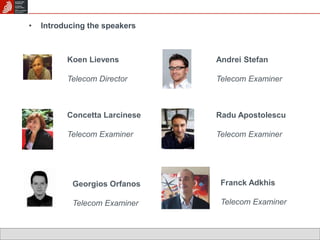
• Introducing the speakers 
Koen Lievens 
Telecom Director 
Concetta Larcinese 
Telecom Examiner 
Andrei Stefan 
Telecom Examiner 
Radu Apostolescu 
Telecom Examiner 
Franck Adkhis 
Telecom Examiner 
Georgios Orfanos 
Telecom Examiner
The European Patent Office 
An introduction to the EPO and the European patent system 
EPO @ Tech hub 11 September 2014
• The European Patent Office and the patent system 
• The patent system 
• Basics 
• About us 
• Granting and publishing patents 
• Quality patents 
• Patents for the public 
• Training and awareness-raising events 
• The unitary patent 
• Statistics 
• Contact
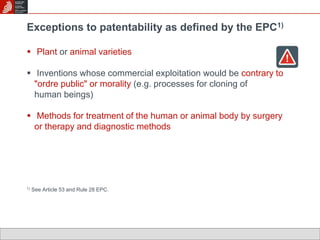
Exceptions to patentability as defined by the EPC1) 
 Plant or animal varieties 
 Inventions whose commercial exploitation would be contrary to 
"ordre public" or morality (e.g. processes for cloning of 
human beings) 
 Methods for treatment of the human or animal body by surgery 
or therapy and diagnostic methods 
1) See Article 53 and Rule 28 EPC.
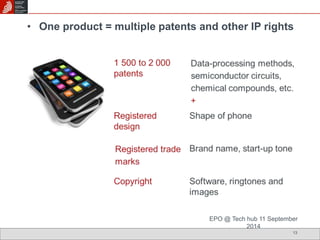
• One product = multiple patents and other IP rights 
EPO @ Tech hub 11 September 
13 
2014
• The European Patent Office and the patent system 
• The patent system 
• Basics 
• About us 
• Granting and publishing patents 
• Quality patents 
• Patents for the public 
• Training and awareness-raising events 
• The unitary patent 
• Statistics 
• Contact
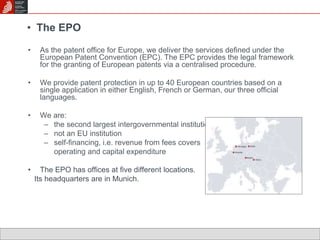
• The EPO 
• As the patent office for Europe, we deliver the services defined under the 
European Patent Convention (EPC). The EPC provides the legal framework 
for the granting of European patents via a centralised procedure. 
• We provide patent protection in up to 40 European countries based on a 
single application in either English, French or German, our three official 
languages. 
• We are: 
– the second largest intergovernmental institution in Europe 
– not an EU institution 
– self-financing, i.e. revenue from fees covers 
operating and capital expenditure 
• The EPO has offices at five different locations. 
Its headquarters are in Munich.
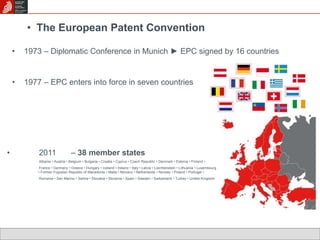
• The European Patent Convention 
• 1973 – Diplomatic Conference in Munich ► EPC signed by 16 countries 
• 1977 – EPC enters into force in seven countries 
• 2011 – 38 member states 
Albania • Austria • Belgium • Bulgaria • Croatia • Cyprus • Czech Republic • Denmark • Estonia • Finland • 
France • Germany • Greece • Hungary • Iceland • Ireland • Italy • Latvia • Liechtenstein • Lithuania • Luxembourg 
• Former Yugoslav Republic of Macedonia • Malta • Monaco • Netherlands • Norway • Poland • Portugal • 
Romania • San Marino • Serbia • Slovakia • Slovenia • Spain • Sweden • Switzerland • Turkey • United Kingdom
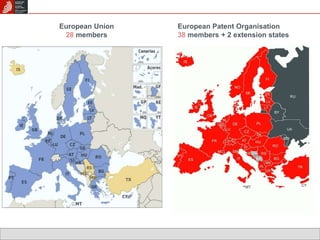
European Union 
28 members 
European Patent Organisation 
38 members + 2 extension states
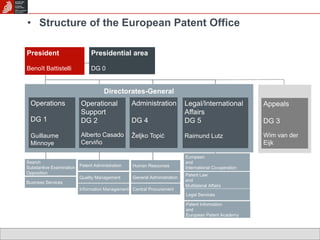
• Structure of the European Patent Office 
Directorates-General 
Operations 
DG 1 
Guillaume 
Minnoye 
Administration 
DG 4 
Željko Topić 
Legal/International 
Affairs 
DG 5 
Raimund Lutz 
President 
Benoît Battistelli 
Presidential area 
DG 0 
Patent Administration 
Quality Management 
Information Management 
Human Resources 
General Administration 
Central Procurement 
European 
and 
International Co-operation 
Patent Law 
and 
Multilateral Affairs 
Legal Services 
Search 
Substantive Examination 
Opposition 
Business Services 
Operational 
Support 
DG 2 
Alberto Casado 
Cerviño 
Appeals 
DG 3 
Wim van der 
Eijk 
Patent Information 
and 
European Patent Academy
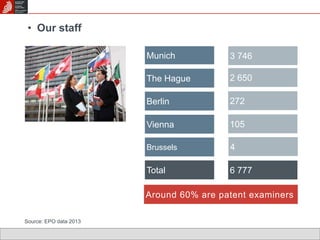
• Our staff 
Munich 
The Hague 
Berlin 
Vienna 
Brussels 
Total 
3 746 
2 650 
272 
105 
4 
6 777 
Around 60% are patent examiners 
Source: EPO data 2013
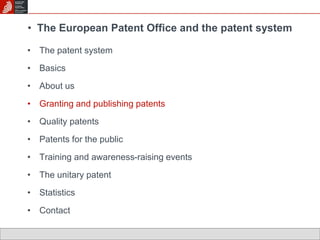
• The European Patent Office and the patent system 
• The patent system 
• Basics 
• About us 
• Granting and publishing patents 
• Quality patents 
• Patents for the public 
• Training and awareness-raising events 
• The unitary patent 
• Statistics 
• Contact
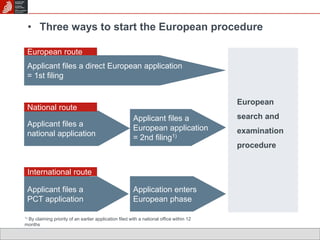
• Three ways to start the European procedure 
European 
search and 
examination 
procedure 
European route 
Applicant files a direct European application 
= 1st filing 
National route 
Applicant files a 
national application 
International route 
Applicant files a 
PCT application 
Applicant files a 
European application 
= 2nd filing1) 
Application enters 
European phase 
European route 
National route 
International route 
1) By claiming priority of an earlier application filed with a national office within 12 
months
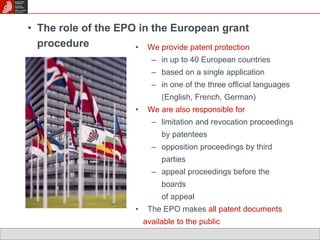
• The role of the EPO in the European grant 
procedure • We provide patent protection 
– in up to 40 European countries 
– based on a single application 
– in one of the three official languages 
(English, French, German) 
• We are also responsible for 
– limitation and revocation proceedings 
by patentees 
– opposition proceedings by third 
parties 
– appeal proceedings before the 
boards 
of appeal 
• The EPO makes all patent documents 
available to the public
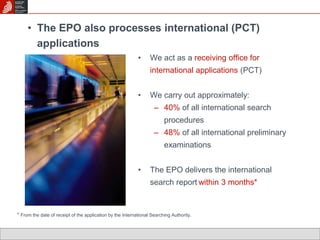
• The EPO also processes international (PCT) 
applications 
• We act as a receiving office for 
international applications (PCT) 
• We carry out approximately: 
– 40% of all international search 
procedures 
– 48% of all international preliminary 
examinations 
• The EPO delivers the international 
search report within 3 months* 
* From the date of receipt of the application by the International Searching Authority.
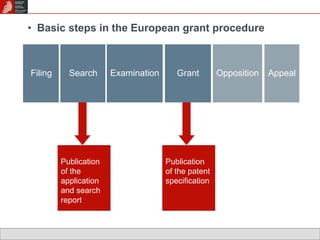
• Basic steps in the European grant procedure 
Filing Search 
Examination Grant Opposition Appeal 
Publication 
of the 
application 
and search 
report 
Publication 
of the patent 
specification
• The European Patent Office and the patent system 
• The patent system 
• Basics 
• About us 
• Granting and publishing patents 
• Quality patents 
• Patents for the public 
• Training and awareness-raising events 
• The unitary patent 
• Statistics 
• Contact
• Number one patent office for quality 
Annual IP benchmarking survey 2012 conducted by IAM and 
Thomson Reuters 
• Sample: 
700 patent attorneys working in private practice or industry 
• Private practice: 
For 68%, the EPO's quality is "very good" or "excellent" 
• Industry: 
For 92%, the EPO's quality is either "good", "very good" or 
"excellent"
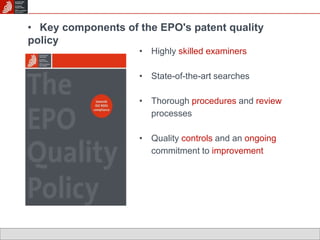
• Key components of the EPO's patent quality 
policy 
• Highly skilled examiners 
• State-of-the-art searches 
• Thorough procedures and review 
processes 
• Quality controls and an ongoing 
commitment to improvement
• Highly skilled examiners 
• Top-level engineers and scientists 
– high degree of technical expertise and 
personal responsibility 
– knowledge of the EPO's three official languages 
• Training during first two years 
– extensive legal and procedural training 
– individual coaching by experienced examiners 
• Continuing professional development throughout career
• State-of-the-art searches 
• World's largest collection of documents 
– 800 million records of patent and non-patent 
literature documents in over 120 databases 
– more than 7 000 journals 
– databases updated daily 
• High-performance EPOQUE search tool 
– used by examiners 
– a worldwide benchmark 
– used by over 40 patent offices, including Australia, 
Brazil, Canada and China 
• Machine translation to extend the range of easily 
accessible information
• Thorough procedures and review processes 
• Single procedure 
– The EPC provides the legal framework for the 
granting procedure. 
• Systematic approach 
– Each application is examined by a division of 
three technically qualified examiners. 
• Review processes 
– Oppositions are examined by three technically 
qualified examiners, at least two of whom will not 
have been involved in the grant proceedings for 
the patent. 
– Appeals are heard by an independent second-instance 
judiciary (boards of appeal).
• Quality controls and commitment to improvement 
• Guidelines and instructions for examiners 
• Spot-checks on search reports and examination quality 
• Internal quality audits 
• Preparation for ISO 9001 certification
• The European Patent Office and the patent system 
• The patent system 
• Basics 
• About us 
• Granting and publishing patents 
• Quality patents 
• Patents for the public 
• Training and awareness-raising events 
• The unitary patent 
• Statistics 
• Contact
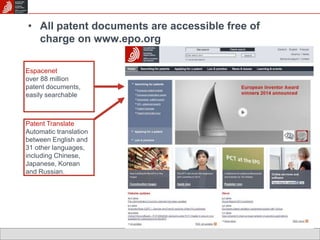
• All patent documents are accessible free of 
charge on www.epo.org 
Espacenet 
over 88 million 
patent documents, 
easily searchable 
Patent Translate 
Automatic translation 
between English and 
31 other languages, 
including Chinese, 
Japanese, Korean 
and Russian.
Key facts about Espacenet 
• Most visited area of our website 
– around 20 million visits every year 
• A worldwide collection of patent data 
• For beginners and experts 
– smart search using key words 
– advanced search using combined search information, 
classification, etc. 
• Translation of documents in one click 
– covers now translation between English and 31 other 
languages, including Chinese, Japanese, Korean and 
Russian.
• The European Patent Office and the patent system 
• The patent system 
• Basics 
• About us 
• Granting and publishing patents 
• Quality patents 
• Patents for the public 
• Training and awareness-raising events 
• The unitary patent 
• Statistics 
• Contact
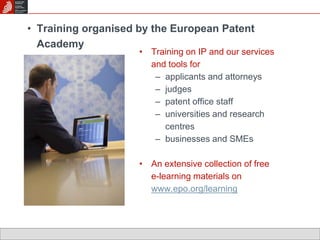
• Training organised by the European Patent 
Academy 
• Training on IP and our services 
and tools for 
– applicants and attorneys 
– judges 
– patent office staff 
– universities and research 
centres 
– businesses and SMEs 
• An extensive collection of free 
e-learning materials on 
www.epo.org/learning
• The European Patent Office and the patent system 
• The patent system 
• Basics 
• About us 
• Granting and publishing patents 
• Quality patents 
• Patents for the public 
• Training and awareness-raising events 
• The unitary patent 
• Statistics 
• Contact
• Objectives of the unitary patent 
A less expensive 
and less cumbersome 
patent system for Europe 
 Facilitates access to patent protection 
for SMEs and research centres 
 Makes Europe more attractive for 
innovation and investors 
 Boosts Europe's competitiveness
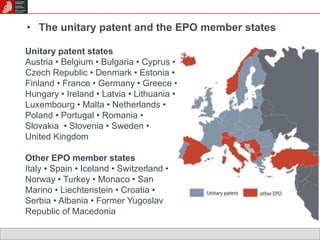
• The unitary patent and the EPO member states 
Unitary patent states 
Austria • Belgium • Bulgaria • Cyprus • 
Czech Republic • Denmark • Estonia • 
Finland • France • Germany • Greece • 
Hungary • Ireland • Latvia • Lithuania • 
Luxembourg • Malta • Netherlands • 
Poland • Portugal • Romania • 
Slovakia • Slovenia • Sweden • 
United Kingdom 
Other EPO member states 
Italy • Spain • Iceland • Switzerland • 
Norway • Turkey • Monaco • San 
Marino • Liechtenstein • Croatia • 
Serbia • Albania • Former Yugoslav 
Republic of Macedonia
• Basic principles of the unitary patent 
• A European patent, granted by the EPO under the EPC 
• Unitary effect extends to the 25 EU member states currently 
participating, at the patent proprietor's request 
• Registered by the EPO in one single administrative step 
• An additional option for patent proprietors, alongside the existing 
European and national patent systems 
• Can be combined with the European patent to cover up to 
40 European countries 
• Uniform litigation system
• Concrete benefits 
• Protection in one single step for the 25 states currently 
participating 
• Simplified registration procedure instead of 25 different 
validations 
• Simplified and cost-effective renewal fee payment 
• No post-grant translation required (after initial transition period) 
• Centralised register maintained by the EPO 
• Uniform litigation system affording greater legal certainty
• Language arrangements for post-grant translations 
• For a transitional period of up to 12 years: 
– If the patent is granted in French or German, 
a translation into English will be required 
– If the patent is granted in English, 
a translation into one of any of the EU languages will be 
required 
• At the end of the transitional period: 
– No translation required anymore 
– Patent Translate will provide free machine translation in 
32 languages
• Language arrangements for applications 
Translation costs will be reimbursed 
 for SMEs, universities, public 
research organisations from the EU 
 if the application is filed in an EU 
language other than English, French 
or German
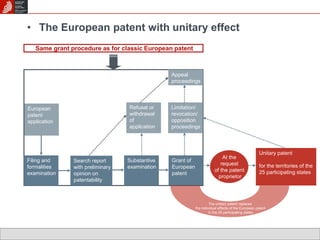
• The European patent with unitary effect 
Same grant procedure as for classic European patent 
European 
patent 
application 
Filing and 
formalities 
examination 
Search report 
with preliminary 
opinion on 
patentability 
Appeal 
proceedings 
Grant of 
European 
patent 
Refusal or 
withdrawal 
of 
application 
Substantive 
examination 
At the 
request 
of the patent 
proprietor 
Limitation/ 
revocation/ 
opposition 
proceedings 
The unitary patent replaces 
the individual effects of the European patent 
in the 25 participating states 
Unitary patent 
for the territories of the 
25 participating states
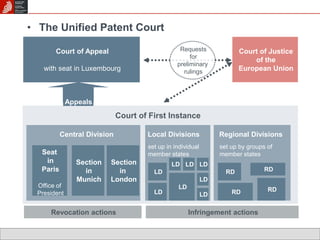
• The Unified Patent Court 
with seat in Luxembourg 
Court of First Instance 
Court of Appeal 
Appeals 
Central Division 
Seat 
in 
Paris 
Office of 
President 
Section 
in 
Munich 
Section 
in 
London 
Local Divisions 
LD 
LD 
LD 
LD 
LD 
LD 
set up in individual 
member states 
LD 
Court of Justice 
of the 
European Union 
Regional Divisions 
set up by groups of 
member states 
RD 
RD 
RD 
RD 
Requests 
for 
preliminary 
rulings 
LD 
Revocation actions Infringement actions
• When will it all start? 
• European applications already "in the pipeline" today 
might be given unitary effect if granted after the system 
starts 
• Minimum of 13 states − including GB, France, Germany 
− must ratify the agreement on a Unified Patent Court 
(expected 2015) 
• First unitary patents will cover only the states which have 
ratified the agreement, then more as states accede
• The European Patent Office and the patent system 
• The patent system 
• Basics 
• About us 
• Granting and publishing patents 
• Quality patents 
• Patents for the public 
• Training and awareness-raising events 
• The unitary patent 
• Statistics 
• Contact points
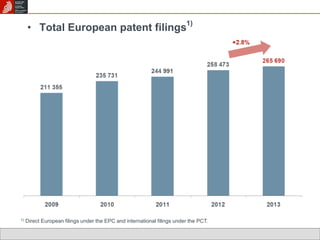
• Total European patent filings1) 
1) Direct European filings under the EPC and international filings under the PCT.
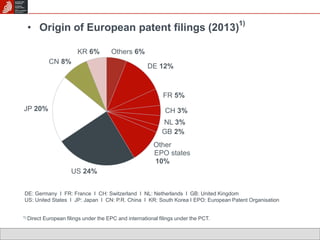
• Origin of European patent filings (2013)1) 
Others 6% 
DE 12% 
FR 5% 
CH 3% 
NL 3% 
GB 2% 
Other 
EPO states 
10% 
US 24% 
JP 20% 
CN 8% 
KR 6% 
DE: Germany I FR: France I CH: Switzerland I NL: Netherlands I GB: United Kingdom 
US: United States I JP: Japan I CN: P.R. China I KR: South Korea I EPO: European Patent Organisation 
1) Direct European filings under the EPC and international filings under the PCT.
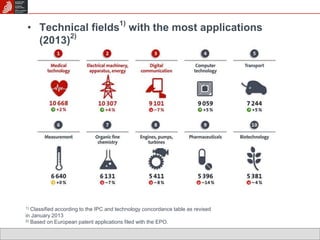
• Technical fields1) with the most applications 
(2013)2) 
1) Classified according to the IPC and technology concordance table as revised 
in January 2013 
2) Based on European patent applications filed with the EPO.
• The European Patent Office and the patent system 
• The patent system 
• Basics 
• About us 
• Granting and publishing patents 
• Quality patents 
• Patents for the public 
• Training and awareness-raising events 
• The unitary patent 
• Statistics 
• Contact
• Need more information? 
• Visit www.epo.org 
• Follow us on 
www.facebook.com/europeanpatentoffice 
twitter.com/EPOorg 
www.youtube.com/EPOfilms 
www.linkedin.com/company/european-patent-office 
• Contact us via www.epo.org/contact
Thank you 
slide 
European 
Patent Office 
Thank you for your attention !

European Patent Office - general presentation

  • 1.
    EPO @ TechHubBucharest - 11 Sept. 2014  The European Patent Office and the patent system  The European (EP) grant procedure and the International (PCT) route  Patentability and Interacting with a patent examiner: Granting and Koen Lievens Andrei Stefan (September 2014) refusing of patent applications  File inspection examples
  • 2.
    • Introducing thespeakers Koen Lievens Telecom Director Concetta Larcinese Telecom Examiner Andrei Stefan Telecom Examiner Radu Apostolescu Telecom Examiner Franck Adkhis Telecom Examiner Georgios Orfanos Telecom Examiner
  • 3.
    The European PatentOffice An introduction to the EPO and the European patent system EPO @ Tech hub 11 September 2014
  • 4.
    • The EuropeanPatent Office and the patent system • The patent system • Basics • About us • Granting and publishing patents • Quality patents • Patents for the public • Training and awareness-raising events • The unitary patent • Statistics • Contact
  • 5.
    Exceptions to patentabilityas defined by the EPC1)  Plant or animal varieties  Inventions whose commercial exploitation would be contrary to "ordre public" or morality (e.g. processes for cloning of human beings)  Methods for treatment of the human or animal body by surgery or therapy and diagnostic methods 1) See Article 53 and Rule 28 EPC.
  • 6.
    • One product= multiple patents and other IP rights EPO @ Tech hub 11 September 13 2014
  • 7.
    • The EuropeanPatent Office and the patent system • The patent system • Basics • About us • Granting and publishing patents • Quality patents • Patents for the public • Training and awareness-raising events • The unitary patent • Statistics • Contact
  • 8.
    • The EPO • As the patent office for Europe, we deliver the services defined under the European Patent Convention (EPC). The EPC provides the legal framework for the granting of European patents via a centralised procedure. • We provide patent protection in up to 40 European countries based on a single application in either English, French or German, our three official languages. • We are: – the second largest intergovernmental institution in Europe – not an EU institution – self-financing, i.e. revenue from fees covers operating and capital expenditure • The EPO has offices at five different locations. Its headquarters are in Munich.
  • 9.
    • The EuropeanPatent Convention • 1973 – Diplomatic Conference in Munich ► EPC signed by 16 countries • 1977 – EPC enters into force in seven countries • 2011 – 38 member states Albania • Austria • Belgium • Bulgaria • Croatia • Cyprus • Czech Republic • Denmark • Estonia • Finland • France • Germany • Greece • Hungary • Iceland • Ireland • Italy • Latvia • Liechtenstein • Lithuania • Luxembourg • Former Yugoslav Republic of Macedonia • Malta • Monaco • Netherlands • Norway • Poland • Portugal • Romania • San Marino • Serbia • Slovakia • Slovenia • Spain • Sweden • Switzerland • Turkey • United Kingdom
  • 10.
    European Union 28members European Patent Organisation 38 members + 2 extension states
  • 11.
    • Structure ofthe European Patent Office Directorates-General Operations DG 1 Guillaume Minnoye Administration DG 4 Željko Topić Legal/International Affairs DG 5 Raimund Lutz President Benoît Battistelli Presidential area DG 0 Patent Administration Quality Management Information Management Human Resources General Administration Central Procurement European and International Co-operation Patent Law and Multilateral Affairs Legal Services Search Substantive Examination Opposition Business Services Operational Support DG 2 Alberto Casado Cerviño Appeals DG 3 Wim van der Eijk Patent Information and European Patent Academy
  • 12.
    • Our staff Munich The Hague Berlin Vienna Brussels Total 3 746 2 650 272 105 4 6 777 Around 60% are patent examiners Source: EPO data 2013
  • 13.
    • The EuropeanPatent Office and the patent system • The patent system • Basics • About us • Granting and publishing patents • Quality patents • Patents for the public • Training and awareness-raising events • The unitary patent • Statistics • Contact
  • 14.
    • Three waysto start the European procedure European search and examination procedure European route Applicant files a direct European application = 1st filing National route Applicant files a national application International route Applicant files a PCT application Applicant files a European application = 2nd filing1) Application enters European phase European route National route International route 1) By claiming priority of an earlier application filed with a national office within 12 months
  • 15.
    • The roleof the EPO in the European grant procedure • We provide patent protection – in up to 40 European countries – based on a single application – in one of the three official languages (English, French, German) • We are also responsible for – limitation and revocation proceedings by patentees – opposition proceedings by third parties – appeal proceedings before the boards of appeal • The EPO makes all patent documents available to the public
  • 16.
    • The EPOalso processes international (PCT) applications • We act as a receiving office for international applications (PCT) • We carry out approximately: – 40% of all international search procedures – 48% of all international preliminary examinations • The EPO delivers the international search report within 3 months* * From the date of receipt of the application by the International Searching Authority.
  • 17.
    • Basic stepsin the European grant procedure Filing Search Examination Grant Opposition Appeal Publication of the application and search report Publication of the patent specification
  • 18.
    • The EuropeanPatent Office and the patent system • The patent system • Basics • About us • Granting and publishing patents • Quality patents • Patents for the public • Training and awareness-raising events • The unitary patent • Statistics • Contact
  • 19.
    • Number onepatent office for quality Annual IP benchmarking survey 2012 conducted by IAM and Thomson Reuters • Sample: 700 patent attorneys working in private practice or industry • Private practice: For 68%, the EPO's quality is "very good" or "excellent" • Industry: For 92%, the EPO's quality is either "good", "very good" or "excellent"
  • 20.
    • Key componentsof the EPO's patent quality policy • Highly skilled examiners • State-of-the-art searches • Thorough procedures and review processes • Quality controls and an ongoing commitment to improvement
  • 21.
    • Highly skilledexaminers • Top-level engineers and scientists – high degree of technical expertise and personal responsibility – knowledge of the EPO's three official languages • Training during first two years – extensive legal and procedural training – individual coaching by experienced examiners • Continuing professional development throughout career
  • 22.
    • State-of-the-art searches • World's largest collection of documents – 800 million records of patent and non-patent literature documents in over 120 databases – more than 7 000 journals – databases updated daily • High-performance EPOQUE search tool – used by examiners – a worldwide benchmark – used by over 40 patent offices, including Australia, Brazil, Canada and China • Machine translation to extend the range of easily accessible information
  • 23.
    • Thorough proceduresand review processes • Single procedure – The EPC provides the legal framework for the granting procedure. • Systematic approach – Each application is examined by a division of three technically qualified examiners. • Review processes – Oppositions are examined by three technically qualified examiners, at least two of whom will not have been involved in the grant proceedings for the patent. – Appeals are heard by an independent second-instance judiciary (boards of appeal).
  • 24.
    • Quality controlsand commitment to improvement • Guidelines and instructions for examiners • Spot-checks on search reports and examination quality • Internal quality audits • Preparation for ISO 9001 certification
  • 25.
    • The EuropeanPatent Office and the patent system • The patent system • Basics • About us • Granting and publishing patents • Quality patents • Patents for the public • Training and awareness-raising events • The unitary patent • Statistics • Contact
  • 26.
    • All patentdocuments are accessible free of charge on www.epo.org Espacenet over 88 million patent documents, easily searchable Patent Translate Automatic translation between English and 31 other languages, including Chinese, Japanese, Korean and Russian.
  • 27.
    Key facts aboutEspacenet • Most visited area of our website – around 20 million visits every year • A worldwide collection of patent data • For beginners and experts – smart search using key words – advanced search using combined search information, classification, etc. • Translation of documents in one click – covers now translation between English and 31 other languages, including Chinese, Japanese, Korean and Russian.
  • 28.
    • The EuropeanPatent Office and the patent system • The patent system • Basics • About us • Granting and publishing patents • Quality patents • Patents for the public • Training and awareness-raising events • The unitary patent • Statistics • Contact
  • 29.
    • Training organisedby the European Patent Academy • Training on IP and our services and tools for – applicants and attorneys – judges – patent office staff – universities and research centres – businesses and SMEs • An extensive collection of free e-learning materials on www.epo.org/learning
  • 30.
    • The EuropeanPatent Office and the patent system • The patent system • Basics • About us • Granting and publishing patents • Quality patents • Patents for the public • Training and awareness-raising events • The unitary patent • Statistics • Contact
  • 31.
    • Objectives ofthe unitary patent A less expensive and less cumbersome patent system for Europe  Facilitates access to patent protection for SMEs and research centres  Makes Europe more attractive for innovation and investors  Boosts Europe's competitiveness
  • 32.
    • The unitarypatent and the EPO member states Unitary patent states Austria • Belgium • Bulgaria • Cyprus • Czech Republic • Denmark • Estonia • Finland • France • Germany • Greece • Hungary • Ireland • Latvia • Lithuania • Luxembourg • Malta • Netherlands • Poland • Portugal • Romania • Slovakia • Slovenia • Sweden • United Kingdom Other EPO member states Italy • Spain • Iceland • Switzerland • Norway • Turkey • Monaco • San Marino • Liechtenstein • Croatia • Serbia • Albania • Former Yugoslav Republic of Macedonia
  • 33.
    • Basic principlesof the unitary patent • A European patent, granted by the EPO under the EPC • Unitary effect extends to the 25 EU member states currently participating, at the patent proprietor's request • Registered by the EPO in one single administrative step • An additional option for patent proprietors, alongside the existing European and national patent systems • Can be combined with the European patent to cover up to 40 European countries • Uniform litigation system
  • 34.
    • Concrete benefits • Protection in one single step for the 25 states currently participating • Simplified registration procedure instead of 25 different validations • Simplified and cost-effective renewal fee payment • No post-grant translation required (after initial transition period) • Centralised register maintained by the EPO • Uniform litigation system affording greater legal certainty
  • 35.
    • Language arrangementsfor post-grant translations • For a transitional period of up to 12 years: – If the patent is granted in French or German, a translation into English will be required – If the patent is granted in English, a translation into one of any of the EU languages will be required • At the end of the transitional period: – No translation required anymore – Patent Translate will provide free machine translation in 32 languages
  • 36.
    • Language arrangementsfor applications Translation costs will be reimbursed  for SMEs, universities, public research organisations from the EU  if the application is filed in an EU language other than English, French or German
  • 37.
    • The Europeanpatent with unitary effect Same grant procedure as for classic European patent European patent application Filing and formalities examination Search report with preliminary opinion on patentability Appeal proceedings Grant of European patent Refusal or withdrawal of application Substantive examination At the request of the patent proprietor Limitation/ revocation/ opposition proceedings The unitary patent replaces the individual effects of the European patent in the 25 participating states Unitary patent for the territories of the 25 participating states
  • 38.
    • The UnifiedPatent Court with seat in Luxembourg Court of First Instance Court of Appeal Appeals Central Division Seat in Paris Office of President Section in Munich Section in London Local Divisions LD LD LD LD LD LD set up in individual member states LD Court of Justice of the European Union Regional Divisions set up by groups of member states RD RD RD RD Requests for preliminary rulings LD Revocation actions Infringement actions
  • 39.
    • When willit all start? • European applications already "in the pipeline" today might be given unitary effect if granted after the system starts • Minimum of 13 states − including GB, France, Germany − must ratify the agreement on a Unified Patent Court (expected 2015) • First unitary patents will cover only the states which have ratified the agreement, then more as states accede
  • 40.
    • The EuropeanPatent Office and the patent system • The patent system • Basics • About us • Granting and publishing patents • Quality patents • Patents for the public • Training and awareness-raising events • The unitary patent • Statistics • Contact points
  • 41.
    • Total Europeanpatent filings1) 1) Direct European filings under the EPC and international filings under the PCT.
  • 42.
    • Origin ofEuropean patent filings (2013)1) Others 6% DE 12% FR 5% CH 3% NL 3% GB 2% Other EPO states 10% US 24% JP 20% CN 8% KR 6% DE: Germany I FR: France I CH: Switzerland I NL: Netherlands I GB: United Kingdom US: United States I JP: Japan I CN: P.R. China I KR: South Korea I EPO: European Patent Organisation 1) Direct European filings under the EPC and international filings under the PCT.
  • 43.
    • Technical fields1)with the most applications (2013)2) 1) Classified according to the IPC and technology concordance table as revised in January 2013 2) Based on European patent applications filed with the EPO.
  • 44.
    • The EuropeanPatent Office and the patent system • The patent system • Basics • About us • Granting and publishing patents • Quality patents • Patents for the public • Training and awareness-raising events • The unitary patent • Statistics • Contact
  • 45.
    • Need moreinformation? • Visit www.epo.org • Follow us on www.facebook.com/europeanpatentoffice twitter.com/EPOorg www.youtube.com/EPOfilms www.linkedin.com/company/european-patent-office • Contact us via www.epo.org/contact
  • 46.
    Thank you slide European Patent Office Thank you for your attention !