Patent search
Dr Urmila Aswar,
Sinhgad Institute of Pharmacy
Search Benefits for Inventors
• Better prepared to discuss ideas confidentially.
• Avoid infringement.
• Track research and development.
• Access to wealth of information.
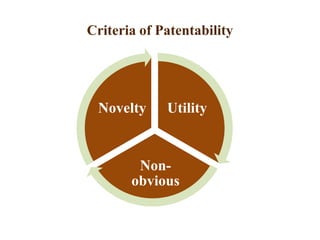
Criteria of Patentability
Utility
Non-
obvious
Novelty
What Is Prior Art?
Art = Technology
Conditions for Patentability
Novelty and Loss of Right to Patent
All information that has been disclosed to the public in
any form about an invention before a given date.
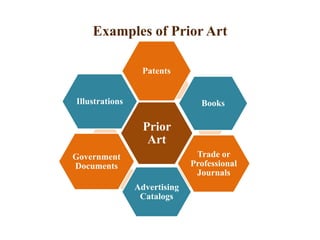
Examples of Prior Art
Prior
Art
Patents
Books
Trade or
Professional
Journals
Advertising
Catalogs
Government
Documents
Illustrations
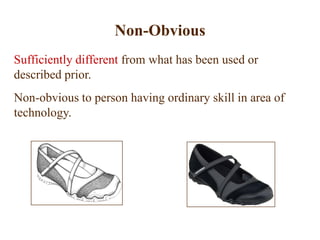
Non-Obvious
Sufficiently different from what has been used or
described prior.
Non-obvious to person having ordinary skill in area of
technology.
Where to begin?
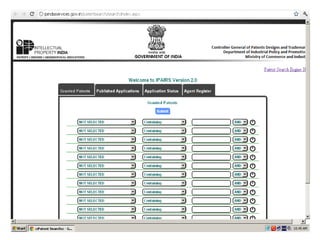
• Patent Application Information Retrieval
system (PAIR):
• Public PAIR: only displays issued or published
application status.
• Private PAIR: provides secure real-time access
to pending application status
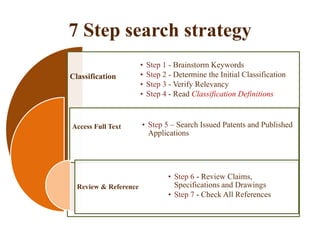
7 Step search strategy
Classification
Access Full Text
Review & Reference
• Step 1 - Brainstorm Keywords
• Step 2 - Determine the Initial Classification
• Step 3 - Verify Relevancy
• Step 4 - Read Classification Definitions
• Step 5 – Search Issued Patents and Published
Applications
• Step 6 - Review Claims,
Specifications and Drawings
• Step 7 - Check All References
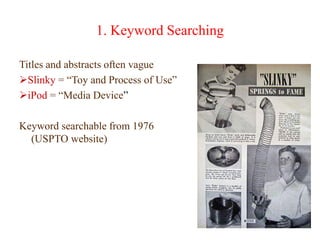
1. Keyword Searching
Titles and abstracts often vague
Slinky = “Toy and Process of Use”
iPod = “Media Device”
Keyword searchable from 1976
(USPTO website)
Disadvantages of key word search
• Keyword searching can often lead to very misleading results.
• For example, patents may be written in vague or inconsistent
terminology. The patent titled “Toy and Process of Use”
(Patent 2,415,012) is actually the “Slinky” spring toy.
• Terminology may change over time with some words
becoming obsolete. a stereo was often referred to as a “Hi-Fi”,
a bathroom has also been called a “water closet.”
• Words can also have very different meanings in different
industries.
• Mouse
2. U.S. Patent Classification System
• Recommended method
of searching:
• USPC
• 460+ classes and
150,000+ subclasses
• Eg 002: apparels
• 004: baths
• 005:beds
• 019: textiles
• 015: brush
• Use keywords to obtain the subclasses using the
Classification Definitions.
• Once you have discovered the most relevant
subclasses,
• Access the complete patent documents and published
applications by classification.
• Review the claims, specifications and drawings of
the documents retrieved to judge their relevancy.
• Then for the documents that are judged to be the
most relevant, expand on the search to retrieve and
review cited references
Cooperative Patent Classification
• MANAGED AND MAINTAINED BY EPO AND
USPTO
• Bilateral classification system.
• Incorporates classification of EPO and USPTO.
• Consists of over 2,50,000 subdivisions.
• Launched in January 2013
EPO classifies in CPC only.
USPTO – classifies in both USPC and CPC.
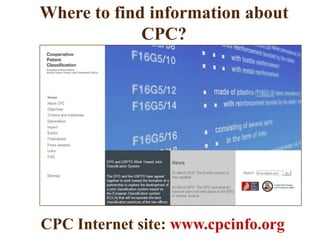
Where to find information about
CPC?
CPC Internet site: www.cpcinfo.org
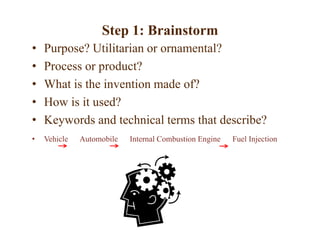
Step 1: Brainstorm
• Purpose? Utilitarian or ornamental?
• Process or product?
• What is the invention made of?
• How is it used?
• Keywords and technical terms that describe?
• Vehicle Automobile Internal Combustion Engine Fuel Injection
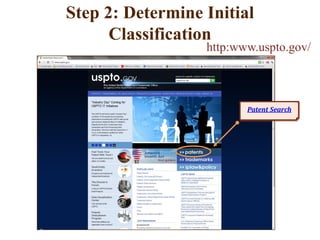
Step 2: Determine Initial
Classification
http:www.uspto.gov/
Patent Search
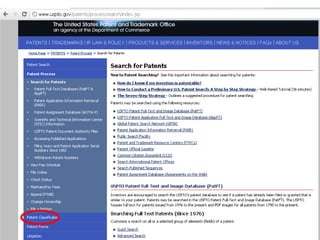
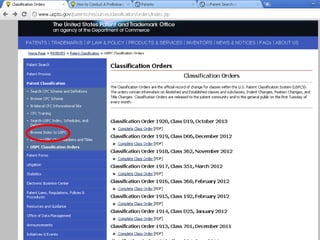
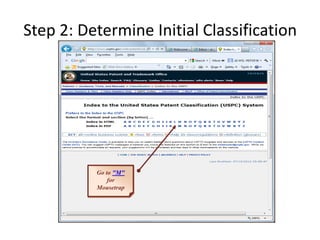
Step 2: Determine Initial Classification
Go to "M"
for
Mousetrap
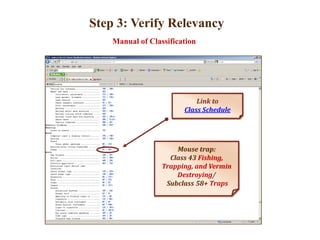
Step 3: Verify Relevancy
Mouse trap:
Class 43 Fishing,
Trapping, and Vermin
Destroying/
Subclass 58+ Traps
Link to
Class Schedule
Manual of Classification
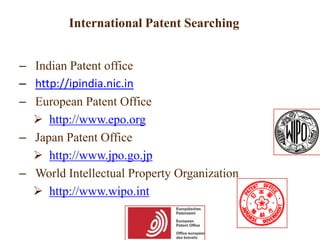
International Patent Searching
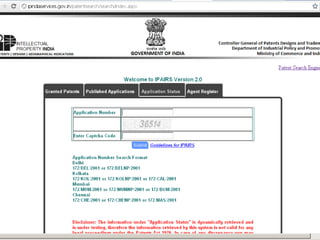
– Indian Patent office
– http://ipindia.nic.in
– European Patent Office
 http://www.epo.org
– Japan Patent Office
 http://www.jpo.go.jp
– World Intellectual Property Organization
 http://www.wipo.int

Patent search

  • 1.
    Patent search Dr UrmilaAswar, Sinhgad Institute of Pharmacy
  • 2.
    Search Benefits forInventors • Better prepared to discuss ideas confidentially. • Avoid infringement. • Track research and development. • Access to wealth of information.
  • 3.
  • 4.
    What Is PriorArt? Art = Technology Conditions for Patentability Novelty and Loss of Right to Patent All information that has been disclosed to the public in any form about an invention before a given date.
  • 5.
    Examples of PriorArt Prior Art Patents Books Trade or Professional Journals Advertising Catalogs Government Documents Illustrations
  • 6.
    Non-Obvious Sufficiently different fromwhat has been used or described prior. Non-obvious to person having ordinary skill in area of technology.
  • 7.
    Where to begin? •Patent Application Information Retrieval system (PAIR): • Public PAIR: only displays issued or published application status. • Private PAIR: provides secure real-time access to pending application status
  • 10.
    7 Step searchstrategy Classification Access Full Text Review & Reference • Step 1 - Brainstorm Keywords • Step 2 - Determine the Initial Classification • Step 3 - Verify Relevancy • Step 4 - Read Classification Definitions • Step 5 – Search Issued Patents and Published Applications • Step 6 - Review Claims, Specifications and Drawings • Step 7 - Check All References
  • 11.
    1. Keyword Searching Titlesand abstracts often vague Slinky = “Toy and Process of Use” iPod = “Media Device” Keyword searchable from 1976 (USPTO website)
  • 12.
    Disadvantages of keyword search • Keyword searching can often lead to very misleading results. • For example, patents may be written in vague or inconsistent terminology. The patent titled “Toy and Process of Use” (Patent 2,415,012) is actually the “Slinky” spring toy. • Terminology may change over time with some words becoming obsolete. a stereo was often referred to as a “Hi-Fi”, a bathroom has also been called a “water closet.” • Words can also have very different meanings in different industries. • Mouse
  • 13.
    2. U.S. PatentClassification System • Recommended method of searching: • USPC • 460+ classes and 150,000+ subclasses • Eg 002: apparels • 004: baths • 005:beds • 019: textiles • 015: brush
  • 14.
    • Use keywordsto obtain the subclasses using the Classification Definitions. • Once you have discovered the most relevant subclasses, • Access the complete patent documents and published applications by classification. • Review the claims, specifications and drawings of the documents retrieved to judge their relevancy. • Then for the documents that are judged to be the most relevant, expand on the search to retrieve and review cited references
  • 15.
    Cooperative Patent Classification •MANAGED AND MAINTAINED BY EPO AND USPTO • Bilateral classification system. • Incorporates classification of EPO and USPTO. • Consists of over 2,50,000 subdivisions. • Launched in January 2013 EPO classifies in CPC only. USPTO – classifies in both USPC and CPC.
  • 16.
    Where to findinformation about CPC? CPC Internet site: www.cpcinfo.org
  • 17.
    Step 1: Brainstorm •Purpose? Utilitarian or ornamental? • Process or product? • What is the invention made of? • How is it used? • Keywords and technical terms that describe? • Vehicle Automobile Internal Combustion Engine Fuel Injection
  • 18.
    Step 2: DetermineInitial Classification http:www.uspto.gov/ Patent Search
  • 21.
    Step 2: DetermineInitial Classification Go to "M" for Mousetrap
  • 22.
    Step 3: VerifyRelevancy Mouse trap: Class 43 Fishing, Trapping, and Vermin Destroying/ Subclass 58+ Traps Link to Class Schedule Manual of Classification
  • 23.
    International Patent Searching –Indian Patent office – http://ipindia.nic.in – European Patent Office  http://www.epo.org – Japan Patent Office  http://www.jpo.go.jp – World Intellectual Property Organization  http://www.wipo.int