“In Search of a Unified Theory of the New Methodologies for the 21st Century” project
How students learn better contents and how they increase more 21st
century Skills.
We assess these improvement both in short-term memory and long-
term memory.
RESEARCH TOPIC
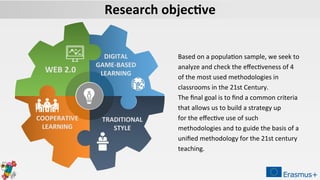
WEB 2.0
DIGITAL
GAME-BASED
LEARNING
TRADITIONAL
STYLE
COOPERATIVE
LEARNING
Based on a population sample, we seek to
analyze and check the effectiveness of 4
of the most used methodologies in
classrooms in the 21st Century.
The final goal is to find a common criteria
that allows us to build a strategy up
for the effective use of such
methodologies and to guide the basis of a
unified methodology for the 21st century
teaching.
Research objective
CONTENTS WE WANT STUDENTS TO LEARN
SKILLS WE WANT STUDENTS TO IMPROVE: Science, 1st Grade.
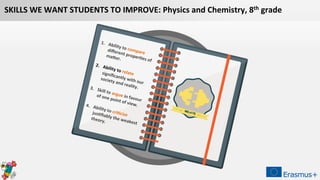
SKILLS WE WANT STUDENTS TO IMPROVE: Physics and Chemistry, 8th grade
SKILLS WE WANT STUDENTS TO IMPROVE: Philosophy, 11th grade
GROUPS
METHODOLOGY
METHODOLOGIES
ASSESSMENT
All students have the
same time and all of
them fill the
assessment text at the
same time
Students are divided
in 4 groups.
It is done randomly
Each group will work
with a different
methodology.
They don´t choose.
The methodologies are:
1- Cooperative learning
2. Digital Game-based Learning
3. Traditional style
4. Web 2.0 tools
METHODOLOGY
No student had previously
worked the contents of the
research.
COOPERATIVE LEARNING
A worksheet was prepared by the teacher so that, by doing it, students had to
research and understand the contents expected to be learnt.
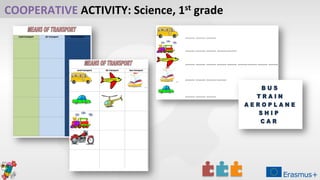
• Science, 1st Grade: Students had to do 2 exercises, with 2 different cooperative
informal techniques: 1-2-4 and Revolving sheet.
• Physics and Chemistry, 8th Grade: Students worked and understood the contents
with one activity that followed the cooperative informal techniques experts
groups.
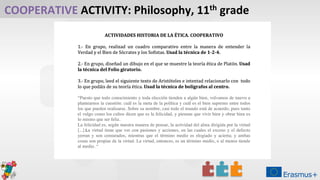
• Philosophy, 11th Grade: Students had to do 3 exercises, with 3 different
cooperative informal techniques (1-2-4, Pencils to the center and Revolving
sheet.
Through the exercises students had to compare, relate, interpret and understand.
The teacher didn´t explain anything to students, they learnt all by working
together.
COOPERATIVE ACTIVITY
COOPERATIVE ACTIVITY: Science, 1st grade
COOPERATIVE ACTIVITY: Physics and Chemistry, 8th grade
Experts Groups
Cooperative technique.
COOPERATIVE ACTIVITY: Philosophy, 11th grade
Philosophy: The teacher created a videogame with all the contents of the
unit. Students played it individually as many times as they wanted.
The game has a duration of 20-25 minutes.
Physics and Chemistry: The teacher used some interactive simulations of
University of Colorado about light and radiation. Pupils worked with the
simulations during 20 minutes.
Science: Students learnt the contents through an interactive game hosted in
Learn English Kid and carried out by the British Council.
The teacher didn´t explain anything to students, they learnt all by playing.
DIGITAL GAME-BASED LEARNING ACTIVITIES
DIGITAL GAME-BASED LEARNING ACTIVITY
WEB 2.0 TOOLS
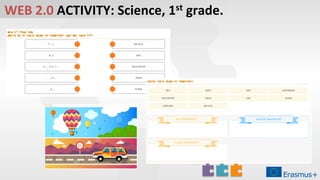
Science, 1st grade: Students had to do 8 exercises with Wizer.me Tool. In
these activities they had to relate, match, watch didactic videos, organize,
write and draw about the contents.
Physics and Chemistry, 8th grade: Students had to choose any Web 2.0 tool
and create a presentation-abstract about the contents of the unit .
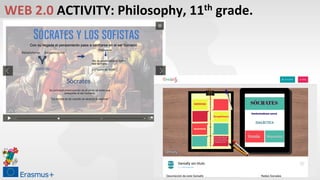
Philosophy, 11th grade: Students had to choose any Web 2.0 tool and
create a presentation-abstract about the contents of the unit . They also
had to make a mind-map with a Web 2.0 tool.
The teacher didn´t explain anything to students, they learnt all by
researching and working with 2.0 tools.
WEB 2.0 ACTIVITY
WEB 2.0 ACTIVITY: Science, 1st grade.
WEB 2.0 ACTIVITY: Physics and Chemistry, 8th grade.
WEB 2.0 ACTIVITY: Philosophy, 11th grade.
TRADITIONAL METHODOLOGY
The teacher explained all the
contents with a blackboard and a
chalk, trying to do it in the better
way, with examples,
clarifications…
TRADITIONAL EXPLANATION
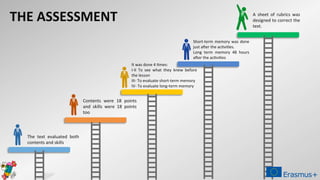
The text evaluated both
contents and skills
Contents were 18 points
and skills were 18 points
too
It was done 4 times:
I-II To see what they knew before
the lesson
III- To evaluate short-term memory
IV- To evaluate long-term memory
Short-term memory was done
just after the activities.
Long term memory 48 hours
after the activities
THE ASSESSMENT A sheet of rubrics was
designed to correct the
text.
ASSESSMENT TEXT, 1st Grade, Science
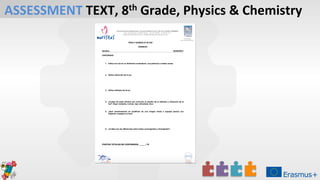
ASSESSMENT TEXT, 8th Grade, Physics & Chemistry
ASSESSMENT TEXT, 11th Grade, Philosophy
RUBRICS 1st GRADE, Science
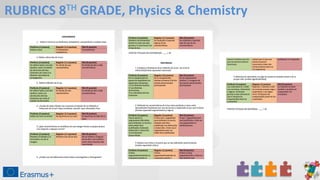
RUBRICS 8TH GRADE, Physics & Chemistry
RUBRICS 11th GRADE, Philosophy
WHAT HAPPENS WITH THE RESULTS?
We have studied and
compared all the data,
calculating medias, and
finding the following
results…
Building results…
Calculating skills
acquisition…
Calculating learnt
content…
Outcomes in short-term
memory…
Outcomes in long-term
memory…
11th Grade
SHORT-TERM MEMORY CONTENTS
1st Grade
8th Grade
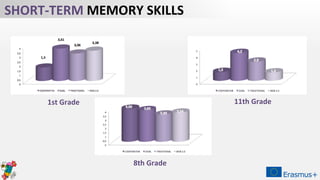
1st Grade 11th Grade
8th Grade
SHORT-TERM MEMORY SKILLS
TOTAL AMOUNT OF ADQUIRED KNOWLEDGE:
SHORT-TERM MEMORY
1st Grade 11th Grade
8th Grade
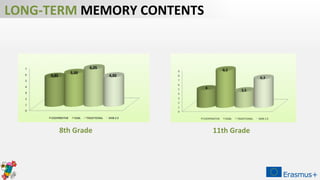
LONG-TERM MEMORY CONTENTS
11th Grade8th Grade
LONG-TERM MEMORY SKILLS
11th Grade8th Grade
TOTAL AMOUNT OF ADQUIRED KNOWLEDGE:
LONG-TERM MEMORY
11th Grade
8th Grade
DGBL
9,1  12,6 (+3,5)
Cooperative
6,4  8,4 (+2)
Web 2.0
7,3  8,2 (+0,9)
Traditional
8,6  7,1 (-1,5)
Knowledge Evolution
The traditional methodology doesn´t look bad (2nd place) when we
look upon the contents students acquire at the moment (short-
term memory). However, in the long-term results the three active
methodologies surpass the traditional methodology.
Web 2.0, cooperation and gamification help students
to have a significantly knowledge (developing skills
like relating, comparing, arguing, clasifying… ).
Cooperative learning have some critical problems. Some
students learn a lot and some others nearly nothing.
Some conclusions
All the active methodologies have better results with long-term
memory than with short-term. It´s like if they had processed the
information after a time and they can use better the
knowledge.
The best of these four methodologies to learn contents
and also skills (both short and long term memory) is
Digital Game-Based Learning. At least in this study.
AND NOW… WHAT? ( FUTURE PERSPECTIVES)

Research about new methodologies

  • 1.
    “In Search ofa Unified Theory of the New Methodologies for the 21st Century” project
  • 2.
    How students learnbetter contents and how they increase more 21st century Skills. We assess these improvement both in short-term memory and long- term memory. RESEARCH TOPIC
  • 3.
    WEB 2.0 DIGITAL GAME-BASED LEARNING TRADITIONAL STYLE COOPERATIVE LEARNING Based ona population sample, we seek to analyze and check the effectiveness of 4 of the most used methodologies in classrooms in the 21st Century. The final goal is to find a common criteria that allows us to build a strategy up for the effective use of such methodologies and to guide the basis of a unified methodology for the 21st century teaching. Research objective
  • 4.
    CONTENTS WE WANTSTUDENTS TO LEARN
  • 5.
    SKILLS WE WANTSTUDENTS TO IMPROVE: Science, 1st Grade.
  • 6.
    SKILLS WE WANTSTUDENTS TO IMPROVE: Physics and Chemistry, 8th grade
  • 7.
    SKILLS WE WANTSTUDENTS TO IMPROVE: Philosophy, 11th grade
  • 8.
    GROUPS METHODOLOGY METHODOLOGIES ASSESSMENT All students havethe same time and all of them fill the assessment text at the same time Students are divided in 4 groups. It is done randomly Each group will work with a different methodology. They don´t choose. The methodologies are: 1- Cooperative learning 2. Digital Game-based Learning 3. Traditional style 4. Web 2.0 tools METHODOLOGY No student had previously worked the contents of the research.
  • 9.
  • 10.
    A worksheet wasprepared by the teacher so that, by doing it, students had to research and understand the contents expected to be learnt. • Science, 1st Grade: Students had to do 2 exercises, with 2 different cooperative informal techniques: 1-2-4 and Revolving sheet. • Physics and Chemistry, 8th Grade: Students worked and understood the contents with one activity that followed the cooperative informal techniques experts groups. • Philosophy, 11th Grade: Students had to do 3 exercises, with 3 different cooperative informal techniques (1-2-4, Pencils to the center and Revolving sheet. Through the exercises students had to compare, relate, interpret and understand. The teacher didn´t explain anything to students, they learnt all by working together. COOPERATIVE ACTIVITY
  • 11.
  • 12.
    COOPERATIVE ACTIVITY: Physicsand Chemistry, 8th grade Experts Groups Cooperative technique.
  • 13.
  • 15.
    Philosophy: The teachercreated a videogame with all the contents of the unit. Students played it individually as many times as they wanted. The game has a duration of 20-25 minutes. Physics and Chemistry: The teacher used some interactive simulations of University of Colorado about light and radiation. Pupils worked with the simulations during 20 minutes. Science: Students learnt the contents through an interactive game hosted in Learn English Kid and carried out by the British Council. The teacher didn´t explain anything to students, they learnt all by playing. DIGITAL GAME-BASED LEARNING ACTIVITIES
  • 16.
  • 17.
  • 18.
  • 19.
  • 20.
    Science, 1st grade:Students had to do 8 exercises with Wizer.me Tool. In these activities they had to relate, match, watch didactic videos, organize, write and draw about the contents. Physics and Chemistry, 8th grade: Students had to choose any Web 2.0 tool and create a presentation-abstract about the contents of the unit . Philosophy, 11th grade: Students had to choose any Web 2.0 tool and create a presentation-abstract about the contents of the unit . They also had to make a mind-map with a Web 2.0 tool. The teacher didn´t explain anything to students, they learnt all by researching and working with 2.0 tools. WEB 2.0 ACTIVITY
  • 21.
    WEB 2.0 ACTIVITY:Science, 1st grade.
  • 22.
    WEB 2.0 ACTIVITY:Physics and Chemistry, 8th grade.
  • 23.
    WEB 2.0 ACTIVITY:Philosophy, 11th grade.
  • 24.
  • 25.
    The teacher explainedall the contents with a blackboard and a chalk, trying to do it in the better way, with examples, clarifications… TRADITIONAL EXPLANATION
  • 26.
    The text evaluatedboth contents and skills Contents were 18 points and skills were 18 points too It was done 4 times: I-II To see what they knew before the lesson III- To evaluate short-term memory IV- To evaluate long-term memory Short-term memory was done just after the activities. Long term memory 48 hours after the activities THE ASSESSMENT A sheet of rubrics was designed to correct the text.
  • 27.
    ASSESSMENT TEXT, 1stGrade, Science
  • 28.
    ASSESSMENT TEXT, 8thGrade, Physics & Chemistry
  • 29.
    ASSESSMENT TEXT, 11thGrade, Philosophy
  • 30.
  • 31.
    RUBRICS 8TH GRADE,Physics & Chemistry
  • 32.
  • 33.
    WHAT HAPPENS WITHTHE RESULTS? We have studied and compared all the data, calculating medias, and finding the following results…
  • 34.
    Building results… Calculating skills acquisition… Calculatinglearnt content… Outcomes in short-term memory… Outcomes in long-term memory…
  • 35.
    11th Grade SHORT-TERM MEMORYCONTENTS 1st Grade 8th Grade
  • 36.
    1st Grade 11thGrade 8th Grade SHORT-TERM MEMORY SKILLS
  • 37.
    TOTAL AMOUNT OFADQUIRED KNOWLEDGE: SHORT-TERM MEMORY 1st Grade 11th Grade 8th Grade
  • 38.
  • 39.
  • 40.
    TOTAL AMOUNT OFADQUIRED KNOWLEDGE: LONG-TERM MEMORY 11th Grade 8th Grade
  • 41.
    DGBL 9,1  12,6(+3,5) Cooperative 6,4  8,4 (+2) Web 2.0 7,3  8,2 (+0,9) Traditional 8,6  7,1 (-1,5) Knowledge Evolution
  • 42.
    The traditional methodologydoesn´t look bad (2nd place) when we look upon the contents students acquire at the moment (short- term memory). However, in the long-term results the three active methodologies surpass the traditional methodology. Web 2.0, cooperation and gamification help students to have a significantly knowledge (developing skills like relating, comparing, arguing, clasifying… ). Cooperative learning have some critical problems. Some students learn a lot and some others nearly nothing. Some conclusions All the active methodologies have better results with long-term memory than with short-term. It´s like if they had processed the information after a time and they can use better the knowledge. The best of these four methodologies to learn contents and also skills (both short and long term memory) is Digital Game-Based Learning. At least in this study.
  • 43.
    AND NOW… WHAT?( FUTURE PERSPECTIVES)