Chapter Two: Research Methods – Notes Summary
Lesson One
Why is replication of research important in psychology?
Create a “word problem” and select both the Independent variable and dependent variable in your
example.
Example:
• IV:
• DV:
What is a good way to remember the difference between IV and DV?
Population: Sample Population:
Why is random selection important in research?
Why is it important to have both an experimental and a control group?
How can confounding variables decrease the effectiveness of your research?
Lesson Two:
Types of Experimentation:
Types of
Experimentation
Description / Examples Positives Negatives
Naturalistic
Observation
Surveys/Tests
Controlled
Experiment
Case Study
What is the difference between:
• Reliability –
• Validity -
Why are none of the above types of experimentation the same as a controlled experiment?
Lesson Three:
Ways to Eliminate Confounding Variables:
Way to Eliminate
Confounding Variables:
BIG IDEA
Single-Blind Procedure
Double-Blind Procedure
Placebo
Counterbalancing
Do you think the placebo effect happens to people on a regular basis? List and describe several
examples:
1.
2.
3.
Lesson Four:
Studies that lead to APA Ethical Guideline Practices:
Research Study Why it Would be Considered Unethical Today
Harlow’s Attachment Study
Stanford Prison
Experiment
Milgram’s Obedience
Research
APA’s Rules for Animal Research:
1.
2.
3.
APA’s Rules for Human Research:
1.
2.
3.
4.
Why do you think it is important for the APA to have rules regarding animal and human research?
What is your view on animal research?
What is the job of the Institutional Review Board?
Lesson Five:
What is the difference between:
• Quantitative Research –
• Qualitative Research –
Types of Scales:
Type of Scale: Description:
Nominal
Ordinal
Interval
Ratio:
Ways to View Descriptive Statistics:
Way to View
Descriptive
Statistics:
What it Looks Like:
Frequency
Distribution
Histogram
Frequency
Polygon
Measures of Central Tendency and Variability:
Measure of
Central
Tendency:
Description:
Mode
Median
Mean
Range
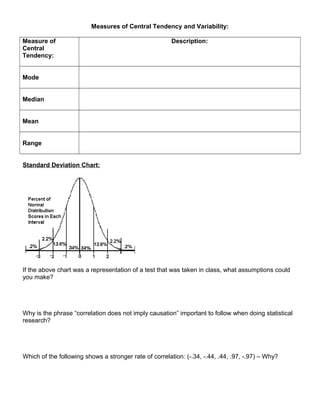
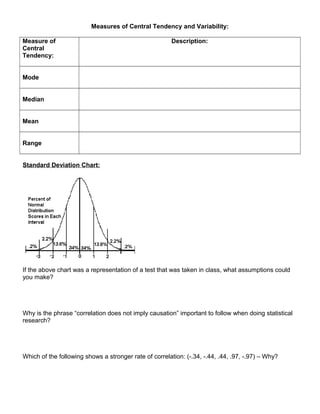
Standard Deviation Chart:
If the above chart was a representation of a test that was taken in class, what assumptions could
you make?
Why is the phrase “correlation does not imply causation” important to follow when doing statistical
research?
Which of the following shows a stronger rate of correlation: (-.34, -.44, .44, .97, -.97) – Why?
Measures of Central Tendency and Variability:
Measure of
Central
Tendency:
Description:
Mode
Median
Mean
Range
Standard Deviation Chart:
If the above chart was a representation of a test that was taken in class, what assumptions could
you make?
Why is the phrase “correlation does not imply causation” important to follow when doing statistical
research?
Which of the following shows a stronger rate of correlation: (-.34, -.44, .44, .97, -.97) – Why?

Research

  • 1.
    Chapter Two: ResearchMethods – Notes Summary Lesson One Why is replication of research important in psychology? Create a “word problem” and select both the Independent variable and dependent variable in your example. Example: • IV: • DV: What is a good way to remember the difference between IV and DV? Population: Sample Population: Why is random selection important in research? Why is it important to have both an experimental and a control group? How can confounding variables decrease the effectiveness of your research?
  • 2.
    Lesson Two: Types ofExperimentation: Types of Experimentation Description / Examples Positives Negatives Naturalistic Observation Surveys/Tests Controlled Experiment Case Study What is the difference between: • Reliability – • Validity - Why are none of the above types of experimentation the same as a controlled experiment?
  • 3.
    Lesson Three: Ways toEliminate Confounding Variables: Way to Eliminate Confounding Variables: BIG IDEA Single-Blind Procedure Double-Blind Procedure Placebo Counterbalancing Do you think the placebo effect happens to people on a regular basis? List and describe several examples: 1. 2. 3. Lesson Four: Studies that lead to APA Ethical Guideline Practices: Research Study Why it Would be Considered Unethical Today Harlow’s Attachment Study Stanford Prison Experiment Milgram’s Obedience Research
  • 4.
    APA’s Rules forAnimal Research: 1. 2. 3. APA’s Rules for Human Research: 1. 2. 3. 4. Why do you think it is important for the APA to have rules regarding animal and human research? What is your view on animal research? What is the job of the Institutional Review Board?
  • 5.
    Lesson Five: What isthe difference between: • Quantitative Research – • Qualitative Research – Types of Scales: Type of Scale: Description: Nominal Ordinal Interval Ratio: Ways to View Descriptive Statistics: Way to View Descriptive Statistics: What it Looks Like: Frequency Distribution Histogram Frequency Polygon
  • 6.
    Measures of CentralTendency and Variability: Measure of Central Tendency: Description: Mode Median Mean Range Standard Deviation Chart: If the above chart was a representation of a test that was taken in class, what assumptions could you make? Why is the phrase “correlation does not imply causation” important to follow when doing statistical research? Which of the following shows a stronger rate of correlation: (-.34, -.44, .44, .97, -.97) – Why?
  • 7.
    Measures of CentralTendency and Variability: Measure of Central Tendency: Description: Mode Median Mean Range Standard Deviation Chart: If the above chart was a representation of a test that was taken in class, what assumptions could you make? Why is the phrase “correlation does not imply causation” important to follow when doing statistical research? Which of the following shows a stronger rate of correlation: (-.34, -.44, .44, .97, -.97) – Why?