REPRODUCTIVE
SYSTEM
AND
REPRODUCTION
6th grade
Year 2018/2019
By: Gloria H.
As we grow, our body changes and our
reproductive organs develop. Our
reproductive system makes it possible
for us to have babies. While the other
body systems are the same for men
and women, the reproductive systems
are different. The two reproductive
systems need to work together so that
we can reproduce.
REPRODUCTIVE
SYSTEMS
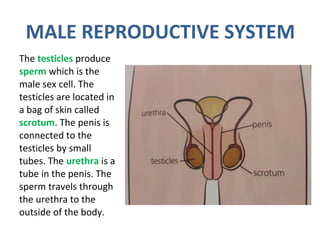
MALE REPRODUCTIVE SYSTEM
The testicles produce
sperm which is the
male sex cell. The
testicles are located in
a bag of skin called
scrotum. The penis is
connected to the
testicles by small
tubes. The urethra is a
tube in the penis. The
sperm travels through
the urethra to the
outside of the body.
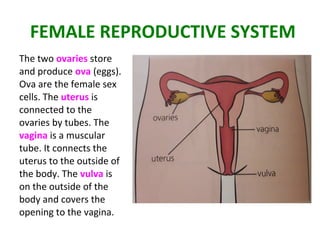
FEMALE REPRODUCTIVE SYSTEM
The two ovaries store
and produce ova (eggs).
Ova are the female sex
cells. The uterus is
connected to the
ovaries by tubes. The
vagina is a muscular
tube. It connects the
uterus to the outside of
the body. The vulva is
on the outside of the
body and covers the
opening to the vagina.
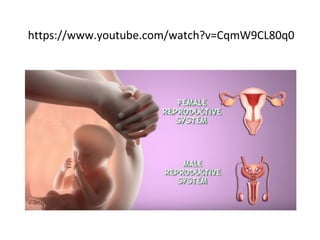
https://www.youtube.com/watch?v=CqmW9CL80q0
https://kidsbiology.com/human-biology/reproductive-system/
REPRODUCTION
https://www.youtube.com/watch?v=IeBLVBXeuno
HOW WE ARE BORN
Reproduction is one of the human
vitals functions. Human are
viviparous because humans are
reproduced via internal fertilization.
The egg implants in the uterine wall
while it develops. Unlike some
viviparous animals, humans are born
when they are fully developed.
Reproduction begins with fertilization.
This is when a sperm cell joins an ovum
cell. The next stage is pregnancy. This
is the time when the fertilised ovum
develops into a baby in the uterus. A
human pregnancy lasts nine months.
Last part is the childbirth through the
vagina.
FERTILIZATION:
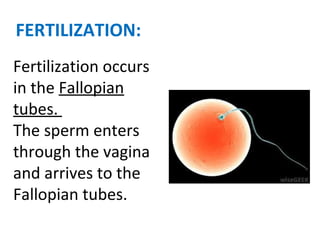
Fertilization occurs
in the Fallopian
tubes.
The sperm enters
through the vagina
and arrives to the
Fallopian tubes.
FERTILIZATION:
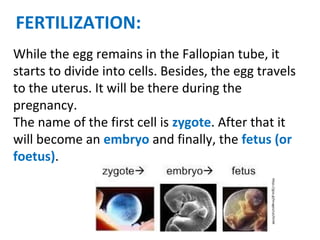
While the egg remains in the Fallopian tube, it
starts to divide into cells. Besides, the egg travels
to the uterus. It will be there during the
pregnancy.
The name of the first cell is zygote. After that it
will become an embryo and finally, the fetus (or
foetus).
https://goo.gl/images/cyU5mM
PREGNANCY
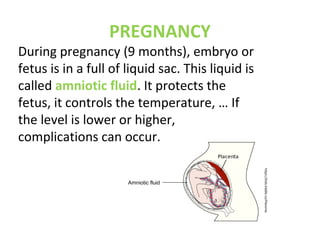
During pregnancy (9 months), embryo or
fetus is in a full of liquid sac. This liquid is
called amniotic fluid. It protects the
fetus, it controls the temperature, … If
the level is lower or higher,
complications can occur.
https://kids.kiddle.co/Placenta
Amniotic fluid
PREGNANCY
https://kids.kiddle.co/Placenta
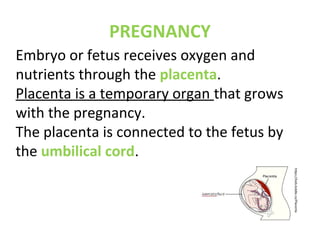
Embryo or fetus receives oxygen and
nutrients through the placenta.
Placenta is a temporary organ that grows
with the pregnancy.
The placenta is connected to the fetus by
the umbilical cord.
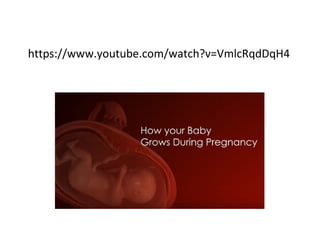
https://www.youtube.com/watch?v=VmlcRqdDqH4
CHILDBIRTH
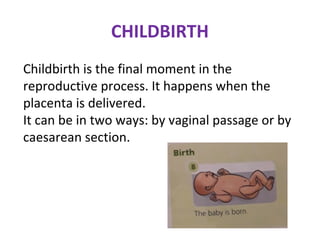
Childbirth is the final moment in the
reproductive process. It happens when the
placenta is delivered.
It can be in two ways: by vaginal passage or by
caesarean section.
CHILDBIRTH
Childbirth has 3 steps:
1st
stage: When contractions gradually open the
cervix until it is completely dilated (aprox
10cm.).
2nd
stage: woman pushes her baby out into the
world.
3rd
stage: when woman delivers the placenta.
Find out how nutrients pass from
the mother to the foetus.
Why smoking is
not avoided during
pregnancy?
TWINS
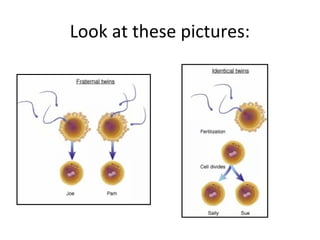
Look at these pictures:
FRATERNAL TWINS
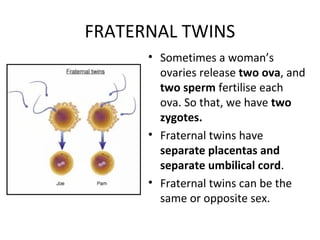
• Sometimes a woman’s
ovaries release two ova, and
two sperm fertilise each
ova. So that, we have two
zygotes.
• Fraternal twins have
separate placentas and
separate umbilical cord.
• Fraternal twins can be the
same or opposite sex.
IDENTICAL TWINS
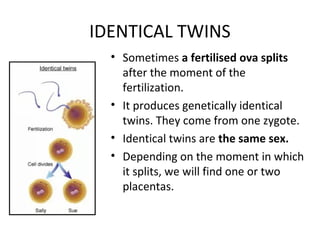
• Sometimes a fertilised ova splits
after the moment of the
fertilization.
• It produces genetically identical
twins. They come from one zygote.
• Identical twins are the same sex.
• Depending on the moment in which
it splits, we will find one or two
placentas.
ASSISTED
REPRODUCTION
WAYS OF ASSISTED REPRODUCTION
IN VITRO FERTILIZATION
(IVF):
• In IVF, ova is removed from
the ovaries and mixed with
a sperm in a laboratory.
• Doctors check if the ova has
been fertilised and, then, is
transferred back to the
uterus.
ARTIFICIAL
INSEMINATION:
• It is when sperm is put into
the cervix/vagina to make
the woman pregnant.
• It makes the trip shorter for
the sperm and gets around
any obstructions.

Reproductive system web

  • 1.
  • 2.
    As we grow,our body changes and our reproductive organs develop. Our reproductive system makes it possible for us to have babies. While the other body systems are the same for men and women, the reproductive systems are different. The two reproductive systems need to work together so that we can reproduce.
  • 3.
  • 4.
    MALE REPRODUCTIVE SYSTEM Thetesticles produce sperm which is the male sex cell. The testicles are located in a bag of skin called scrotum. The penis is connected to the testicles by small tubes. The urethra is a tube in the penis. The sperm travels through the urethra to the outside of the body.
  • 5.
    FEMALE REPRODUCTIVE SYSTEM Thetwo ovaries store and produce ova (eggs). Ova are the female sex cells. The uterus is connected to the ovaries by tubes. The vagina is a muscular tube. It connects the uterus to the outside of the body. The vulva is on the outside of the body and covers the opening to the vagina.
  • 6.
  • 7.
  • 10.
  • 11.
  • 12.
    HOW WE AREBORN Reproduction is one of the human vitals functions. Human are viviparous because humans are reproduced via internal fertilization. The egg implants in the uterine wall while it develops. Unlike some viviparous animals, humans are born when they are fully developed.
  • 13.
    Reproduction begins withfertilization. This is when a sperm cell joins an ovum cell. The next stage is pregnancy. This is the time when the fertilised ovum develops into a baby in the uterus. A human pregnancy lasts nine months. Last part is the childbirth through the vagina.
  • 14.
    FERTILIZATION: Fertilization occurs in theFallopian tubes. The sperm enters through the vagina and arrives to the Fallopian tubes.
  • 15.
    FERTILIZATION: While the eggremains in the Fallopian tube, it starts to divide into cells. Besides, the egg travels to the uterus. It will be there during the pregnancy. The name of the first cell is zygote. After that it will become an embryo and finally, the fetus (or foetus). https://goo.gl/images/cyU5mM
  • 16.
    PREGNANCY During pregnancy (9months), embryo or fetus is in a full of liquid sac. This liquid is called amniotic fluid. It protects the fetus, it controls the temperature, … If the level is lower or higher, complications can occur. https://kids.kiddle.co/Placenta Amniotic fluid
  • 17.
    PREGNANCY https://kids.kiddle.co/Placenta Embryo or fetusreceives oxygen and nutrients through the placenta. Placenta is a temporary organ that grows with the pregnancy. The placenta is connected to the fetus by the umbilical cord.
  • 18.
  • 19.
    CHILDBIRTH Childbirth is thefinal moment in the reproductive process. It happens when the placenta is delivered. It can be in two ways: by vaginal passage or by caesarean section.
  • 20.
    CHILDBIRTH Childbirth has 3steps: 1st stage: When contractions gradually open the cervix until it is completely dilated (aprox 10cm.). 2nd stage: woman pushes her baby out into the world. 3rd stage: when woman delivers the placenta.
  • 21.
    Find out hownutrients pass from the mother to the foetus.
  • 22.
    Why smoking is notavoided during pregnancy?
  • 23.
  • 24.
    Look at thesepictures:
  • 25.
    FRATERNAL TWINS • Sometimesa woman’s ovaries release two ova, and two sperm fertilise each ova. So that, we have two zygotes. • Fraternal twins have separate placentas and separate umbilical cord. • Fraternal twins can be the same or opposite sex.
  • 26.
    IDENTICAL TWINS • Sometimesa fertilised ova splits after the moment of the fertilization. • It produces genetically identical twins. They come from one zygote. • Identical twins are the same sex. • Depending on the moment in which it splits, we will find one or two placentas.
  • 27.
  • 28.
    WAYS OF ASSISTEDREPRODUCTION IN VITRO FERTILIZATION (IVF): • In IVF, ova is removed from the ovaries and mixed with a sperm in a laboratory. • Doctors check if the ova has been fertilised and, then, is transferred back to the uterus. ARTIFICIAL INSEMINATION: • It is when sperm is put into the cervix/vagina to make the woman pregnant. • It makes the trip shorter for the sperm and gets around any obstructions.