Chapter 12
Care of the Patient with a
Reproductive Disorder
Mosby items and derived items © 2011, 2007 by Mosby, Inc., an affiliate of Elsevier Inc.
Slide 2
Mosby items and derived items © 2011, 2007 by Mosby, Inc., an affiliate of Elsevier Inc.
Overview of Anatomy and
Physiology
• Male reproductive system
 Testes
 Ductal system
• Epididymis
• Ductus deferens (vas deferens)
• Ejaculatory duct and urethra
 Accessory glands
• Seminal vesicles
• Prostate gland
• Cowper’s glands
 Urethra and penis
 Sperm
Slide 3
Mosby items and derived items © 2011, 2007 by Mosby, Inc., an affiliate of Elsevier Inc.
Figure 12-1
Longitudinal section of the male pelvis showing the location of the
male reproductive organs.
(From Thibodeau, G.A., Patton, K.T. [2007]. Anatomy and physiology. [6th ed.]. St. Louis: Mosby.)
Slide 4
Mosby items and derived items © 2011, 2007 by Mosby, Inc., an affiliate of Elsevier Inc.
Figure 12-2
Male sex cell (spermatozoon) greatly enlarged (left). Female sex cell
(ovum) surrounded by sperm at time of fertilization (right).
(From Thibodeau, G.A., Patton, K.T. [2007]. Anatomy and physiology. [6th ed.]. St. Louis: Mosby.)
Slide 5
Mosby items and derived items © 2011, 2007 by Mosby, Inc., an affiliate of Elsevier Inc.
Overview of Anatomy and
Physiology
• Female reproductive system
 Ovaries
 Fallopian tubes
 Uterus
 Vagina
 External genitalia
 Accessory glands
• Skene’s glands
• Bartholin’s glands
 Perineum
 Mammary glands (breasts)
Slide 6
Mosby items and derived items © 2011, 2007 by Mosby, Inc., an affiliate of Elsevier Inc.
Figure 12-3
Longitudinal section of the female pelvis showing the location of the
female reproductive organs.
(From Thibodeau, G.A., Patton, K.T. [2007]. Anatomy and physiology. [6th ed.]. St. Louis: Mosby.)
Slide 7
Mosby items and derived items © 2011, 2007 by Mosby, Inc., an affiliate of Elsevier Inc.
Figure 12-4
Sectioned view of the uterus showing relationship to the ovaries and
vagina.
(From Thibodeau, G.A., Patton, K.T. [2008]. Structure and function of the body. [13th ed.]. St. Louis: Mosby.)
Slide 8
Mosby items and derived items © 2011, 2007 by Mosby, Inc., an affiliate of Elsevier Inc.
Figure 12-6
Lateral view of the breast (sagittal section).
(From Thibodeau, G.A., Patton, K.T. [2007]. Anatomy and physiology. [6th ed.]. St. Louis: Mosby.)
Slide 9
Mosby items and derived items © 2011, 2007 by Mosby, Inc., an affiliate of Elsevier Inc.
Figure 12-7
Mammalian ovary showing successive stages of ovarian (graafian)
follicle and ovum development.
(From Thibodeau, G.A., Patton, K.T. [2007]. Anatomy and physiology. [6th ed.]. St. Louis: Mosby.)
Slide 10
Mosby items and derived items © 2011, 2007 by Mosby, Inc., an affiliate of Elsevier Inc.
Figure 12-14
A, Lymph nodes of the axilla. B, Lymphatic drainage of the breast.
(From Seidel, H.M., Ball, J.W., Dains, J.E., Benedict, G.W. [2003]. Mosby’s guide to physical
examination. [5th ed.]. St. Louis: Mosby.)
Slide 11
Mosby items and derived items © 2011, 2007 by Mosby, Inc., an affiliate of Elsevier Inc.
Human Sexuality
• Sexual identity
 The sense of being feminine or masculine
• Influences on sexual health
 Overall wellness includes sexual health, and sexuality
should be part of the health care program
• Illness and sexuality
 Illness may cause changes in a patient’s self-concept
and result in an inability to function sexually
Slide 12
Mosby items and derived items © 2011, 2007 by Mosby, Inc., an affiliate of Elsevier Inc.
Laboratory and Diagnostic
Examinations
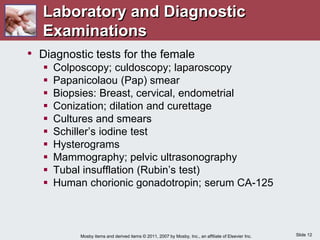
• Diagnostic tests for the female
 Colposcopy; culdoscopy; laparoscopy
 Papanicolaou (Pap) smear
 Biopsies: Breast, cervical, endometrial
 Conization; dilation and curettage
 Cultures and smears
 Schiller’s iodine test
 Hysterograms
 Mammography; pelvic ultrasonography
 Tubal insufflation (Rubin’s test)
 Human chorionic gonadotropin; serum CA-125
Slide 13
Mosby items and derived items © 2011, 2007 by Mosby, Inc., an affiliate of Elsevier Inc.
Laboratory and Diagnostic
Examinations
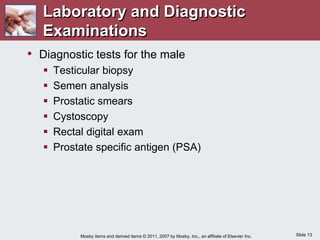
• Diagnostic tests for the male
 Testicular biopsy
 Semen analysis
 Prostatic smears
 Cystoscopy
 Rectal digital exam
 Prostate specific antigen (PSA)
Slide 14
Mosby items and derived items © 2011, 2007 by Mosby, Inc., an affiliate of Elsevier Inc.
The Reproductive Cycle
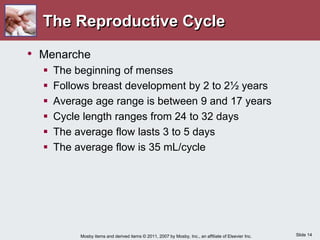
• Menarche
 The beginning of menses
 Follows breast development by 2 to 2½ years
 Average age range is between 9 and 17 years
 Cycle length ranges from 24 to 32 days
 The average flow lasts 3 to 5 days
 The average flow is 35 mL/cycle
Slide 15
Mosby items and derived items © 2011, 2007 by Mosby, Inc., an affiliate of Elsevier Inc.
The Reproductive Cycle
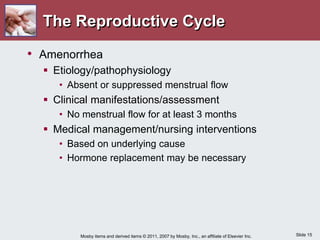
• Amenorrhea
 Etiology/pathophysiology
• Absent or suppressed menstrual flow
 Clinical manifestations/assessment
• No menstrual flow for at least 3 months
 Medical management/nursing interventions
• Based on underlying cause
• Hormone replacement may be necessary
Slide 16
Mosby items and derived items © 2011, 2007 by Mosby, Inc., an affiliate of Elsevier Inc.
• Dysmenorrhea
 Etiology/pathophysiology
• Uterine pain with menstruation
 Clinical manifestations/assessment
• Breast tenderness; headache
• Abdominal distention; nausea and vomiting
• Vertigo
• Palpitations
• Excessive perspiration
• Colicky, cyclic pain; dull pain in the lower pelvis
The Reproductive Cycle
Slide 17
Mosby items and derived items © 2011, 2007 by Mosby, Inc., an affiliate of Elsevier Inc.
The Reproductive Cycle
• Dysmenorrhea (continued)
 Medical management/nursing interventions
• Exercise
• Nutritious foods, high in fiber
• Heat to pelvic area
• Mild analgesics
• Prostaglandin inhibitors
Slide 18
Mosby items and derived items © 2011, 2007 by Mosby, Inc., an affiliate of Elsevier Inc.
The Reproductive Cycle
• Abnormal uterine bleeding
 Menorrhagia
• Excessive bleeding during the regular menstrual flow
• Causes: Endocrine disorders; inflammatory
disturbances; uterine tumors
 Metrorrhagia
• Uterine bleeding between regular menstrual periods or
after menopause
• May indicate cancer or benign tumors of the uterus
Slide 19
Mosby items and derived items © 2011, 2007 by Mosby, Inc., an affiliate of Elsevier Inc.
The Reproductive Cycle
• Premenstrual syndrome (PMS)
 Etiology/pathophysiology
• Believed to be related to the neuroendocrine events
occurring within the anterior pituitary gland
 Clinical manifestations/assessment
• Irritability, lethargy, and fatigue
• Sleep disturbances; depression
• Headache; backache; breast tenderness
• Vertigo
• Abdominal distention
• Acne
Slide 20
Mosby items and derived items © 2011, 2007 by Mosby, Inc., an affiliate of Elsevier Inc.
The Reproductive Cycle
• Premenstrual syndrome (PMS) (continued)
 Medical management/nursing interventions
• Pharmacological management
 Analgesics; diuretics; progesterone
• Dietary recommendations
 High in complex carbohydrates
 Moderate in protein
 Low in refined sugar and sodium
 Limit caffeine, chocolate, and alcohol
• Reduce or eliminate smoking
• Exercise; adequate rest, sleep, and relaxation
Slide 21
Mosby items and derived items © 2011, 2007 by Mosby, Inc., an affiliate of Elsevier Inc.
The Reproductive Cycle
• Menopause
 Etiology/pathophysiology
• The normal decline of ovarian function resulting from
the aging process
• May be induced by irradiation of the ovaries or surgical
removal of both ovaries
• Not considered complete until 1 year after the last
menstrual period
Slide 22
Mosby items and derived items © 2011, 2007 by Mosby, Inc., an affiliate of Elsevier Inc.
The Reproductive Cycle
• Menopause
 Clinical manifestations/assessment
• Decrease in frequency, amount, and duration of the
normal menstrual flow
• Shrinkage of vulval structures; shortening of the vagina
• Dryness of the vaginal wall; pelvic relaxation
• Loss of skin turgor and elasticity
• Increased subcutaneous fat; decreased breast tissue;
thinning of hair
• Osteoporosis
Slide 23
Mosby items and derived items © 2011, 2007 by Mosby, Inc., an affiliate of Elsevier Inc.
The Reproductive Cycle
• Menopause (continued)
 Medical management/nursing interventions
• Estrogen therapy
 Premarin
 Provera
• Calcium supplements
Slide 24
Mosby items and derived items © 2011, 2007 by Mosby, Inc., an affiliate of Elsevier Inc.
The Reproductive Cycle
• Male climacteric
 Etiology/pathophysiology
• Gradual decrease of testosterone levels and seminal
fluid production; 55 to 70 years of age
 Clinical manifestations/assessment
• Decreased erections; decreased seminal fluid
• Enlarged prostate gland; decreased muscle tone
• Loss or thinning of hair
 Medical management/nursing interventions
• Emotional support; treatment for impotence
Slide 25
Mosby items and derived items © 2011, 2007 by Mosby, Inc., an affiliate of Elsevier Inc.
The Reproductive Cycle
• Erectile dysfunction
 Etiology/pathophysiology
• Inability of an adult man to achieve penile erection
• Types
 Functional
 Anatomical
 Atonic
 Medical management/nursing interventions
• Remove cause if possible
• Treat diseases
• Viagra
• Mechanical devices: penile prosthesis
Slide 26
Mosby items and derived items © 2011, 2007 by Mosby, Inc., an affiliate of Elsevier Inc.
The Reproductive Cycle
• Infertility
 Etiology/pathophysiology
• Inability to conceive after 1 year of sexual intercourse
without birth control
 Medical management/nursing interventions
• Depends on the cause
• Hormone therapy
• Repair occlusion
• Intrauterine insemination
• In vitro fertilization
Slide 27
Mosby items and derived items © 2011, 2007 by Mosby, Inc., an affiliate of Elsevier Inc.
Infections of the Female
Reproductive Tract
• Simple vaginitis
 Etiology/pathophysiology
• Common vaginal infection
• Causative organisms: E. coli; staphylococcal;
streptococcal; T. vaginalis; C. albicans; Gardnerella
 Clinical manifestations/assessment
• Inflammation of the vagina
• Yellow, white, or grayish white, curd-like discharge
• Pruritus and vaginal burning
Slide 28
Mosby items and derived items © 2011, 2007 by Mosby, Inc., an affiliate of Elsevier Inc.
• Simple vaginitis (continued)
 Medical management/nursing interventions
• Douching
• Vaginal suppositories, ointments, and creams
 Organism-specific
• Sitz baths
• Abstain from sexual intercourse during treatment
• Treat partner if necessary
Infections of the Female
Reproductive Tract
Slide 29
Mosby items and derived items © 2011, 2007 by Mosby, Inc., an affiliate of Elsevier Inc.
• Cervicitis
 Etiology/pathophysiology
• Infection of the cervix
 Clinical manifestations/assessment
• Backache
• Whitish exudate
• Menstrual irregularities
 Medical management/nursing interventions
• Vaginal suppositories, ointments, and creams;
organism-specific
Infections of the Female
Reproductive Tract
Slide 30
Mosby items and derived items © 2011, 2007 by Mosby, Inc., an affiliate of Elsevier Inc.
• Pelvic inflammatory disease (PID)
 Etiology/pathophysiology
• Any acute, subacute, recurrent, or chronic infection of
the cervix, uterus, fallopian tubes, and ovaries that has
extended to the connective tissues
• Most common causative organisms
 Gonorrhea; streptococcus; staphylococcus; Chlamydia;
tubercle bacilli
• High risk: Surgical and examination procedures; sexual
intercourse (especially with multiple partners);
pregnancy
Infections of the Female
Reproductive Tract
Slide 31
Mosby items and derived items © 2011, 2007 by Mosby, Inc., an affiliate of Elsevier Inc.
• Pelvic inflammatory disease (PID) (continued)
 Clinical manifestations/assessment
• Fever and chills
• Severe abdominal pain
• Malaise
• Nausea and vomiting
• Malodorous purulent vaginal exudate
 Medical management/nursing interventions
• Antibiotics; analgesics
• Bed rest
Infections of the Female
Reproductive Tract
Slide 32
Mosby items and derived items © 2011, 2007 by Mosby, Inc., an affiliate of Elsevier Inc.
• Toxic shock syndrome
 Etiology/pathophysiology
• Acute bacterial infection caused by Staphylococcus
aureus
• Usually occurs in women who are menstruating and
using tampons
Infections of the Female
Reproductive Tract
Slide 33
Mosby items and derived items © 2011, 2007 by Mosby, Inc., an affiliate of Elsevier Inc.
• Toxic shock syndrome (continued)
 Clinical manifestations/assessment
• Usually occurs between days 2 and 4 of the menstrual
period
• Flu-like symptoms; sore throat; headache
• Red macular palmar or diffuse rash
• Decreased urinary output; BUN elevated
• Pulmonary edema
 Medical management/nursing interventions
• Antibiotics; IV fluid therapy; oxygen
Infections of the Female
Reproductive Tract
Slide 34
Mosby items and derived items © 2011, 2007 by Mosby, Inc., an affiliate of Elsevier Inc.
Disorders of the Female
Reproductive System
• Endometriosis
 Etiology/pathophysiology
• Endometrial tissue appears outside the uterus
• The tissue responds to the normal stimulation of the
ovaries; bleeds each month
 Clinical manifestations/assessment
• Lower abdominal and pelvic pain
• May radiate to lower back, legs, and groin
 Medical management/nursing interventions
• Antiovulatory medications; pregnancy
• Laparoscopy; total hysterectomy
Slide 35
Mosby items and derived items © 2011, 2007 by Mosby, Inc., an affiliate of Elsevier Inc.
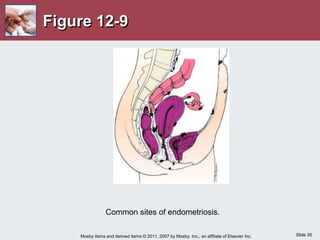
Figure 12-9
Common sites of endometriosis.
Slide 36
Mosby items and derived items © 2011, 2007 by Mosby, Inc., an affiliate of Elsevier Inc.
• Vaginal fistula
 Etiology/pathophysiology
• Abnormal opening between the vagina and another
organ
 Clinical manifestations/assessment
• Urine and/or feces being expelled from vagina
 Medical management/nursing interventions
• Oral or parenteral antibiotics
• Diet: high protein; increase vitamin C
• Surgery: Repair fistula; urinary or fecal diversion
Disorders of the Female
Reproductive System
Slide 37
Mosby items and derived items © 2011, 2007 by Mosby, Inc., an affiliate of Elsevier Inc.
Figure 12-10
Types of fistulas that may develop in the vagina and uterus.
(From Herbst, A.L., et al. [1998]. Comprehensive gynecology. [3rd ed.]. St. Louis: Mosby.)
Slide 38
Mosby items and derived items © 2011, 2007 by Mosby, Inc., an affiliate of Elsevier Inc.
• Displaced uterus
 Etiology/pathophysiology
• Congenital
• Childbirth
• Backward displacement
 Retroversion
 Retroflexion
Disorders of the Female
Reproductive System
Slide 39
Mosby items and derived items © 2011, 2007 by Mosby, Inc., an affiliate of Elsevier Inc.
• Displaced uterus (continued)
 Clinical manifestations/assessment
• Backache
• Muscle strain
• Leukorrheal discharge
• Heaviness in the pelvic area
 Medical management/nursing interventions
• Pessary
• Uterine suspension
Disorders of the Female
Reproductive System
Slide 40
Mosby items and derived items © 2011, 2007 by Mosby, Inc., an affiliate of Elsevier Inc.
• Uterine prolapse
 Etiology/pathophysiology
• Prolapse of the uterus through the pelvic floor and
vaginal opening
 Clinical manifestations/assessment
• Fullness in vaginal area
• Backache
• Bowel or bladder problems
• Protrusion of cervix and vaginal walls in perineal area
Disorders of the Female
Reproductive System
Slide 41
Mosby items and derived items © 2011, 2007 by Mosby, Inc., an affiliate of Elsevier Inc.
Figure 12-11
Uterine prolapse.
(From Seidel, H.M., Ball, J.W., Dains, J.E., Benedict, G.W. [2003]. Mosby’s guide to physical
examination. [5th ed.]. St. Louis: Mosby.)
Slide 42
Mosby items and derived items © 2011, 2007 by Mosby, Inc., an affiliate of Elsevier Inc.
• Uterine prolapse (continued)
 Medical management/nursing interventions
• Pessary
• Surgery
 Vaginal hysterectomy
 Anteroposterior colporrhaphy
Disorders of the Female
Reproductive System
Slide 43
Mosby items and derived items © 2011, 2007 by Mosby, Inc., an affiliate of Elsevier Inc.
• Cystocele and rectocele
 Etiology/pathophysiology
• Cystocele
 Displacement of the bladder into the vagina
• Rectocele
 Rectum moves toward posterior vaginal wall
Disorders of the Female
Reproductive System
Slide 44
Mosby items and derived items © 2011, 2007 by Mosby, Inc., an affiliate of Elsevier Inc.
Figure 12-12
A, Cystocele. B, Rectocele.
(From Lewis, S.M., Heitkemper, M.M., Dirksen, S.R. [2007]. Medical-surgical nursing: assessment and
management of clinical problems. [7th ed.]. St. Louis: Mosby.)
Slide 45
Mosby items and derived items © 2011, 2007 by Mosby, Inc., an affiliate of Elsevier Inc.
• Cystocele and rectocele (continued)
 Clinical manifestations/assessment
• Cystocele
 Urinary urgency, frequency, and incontinence; pelvic
pressure
• Rectocele
 Constipation; rectal pressure; hemorrhoids
 Medical management/nursing interventions
• Surgical repair
 Anteroposterior colporrhaphy; bladder suspension
Disorders of the Female
Reproductive System
Slide 46
Mosby items and derived items © 2011, 2007 by Mosby, Inc., an affiliate of Elsevier Inc.
• Leiomyomas of the uterus (fibroids, myomas)
 Etiology/pathophysiology
• Arise from the muscle tissue of the uterus
• Stimulated by ovarian hormones
 Clinical manifestations/assessment
• Pelvic pressure; pain; backache
• Dysmenorrhea; menorrhagia
• Constipation; urinary symptoms
 Medical management/nursing interventions
• Surgery: Myomectomy; hysterectomy
Disorders of the Female
Reproductive System
Slide 47
Mosby items and derived items © 2011, 2007 by Mosby, Inc., an affiliate of Elsevier Inc.
Figure 12-13
Leiomyomas.
(Redrawn from Novak, E. R., Woodruff, J. D., eds. [1967]. Novak’s gynecologic and obstetric pathology.
[6th ed.]. Philadelphia, Saunders. In McCance, K.L., & Huether, S.E. [2002]. Pathophysiology: the
biologic basis for disease in adults and children. [4th ed.]. St. Louis: Mosby.)
Slide 48
Mosby items and derived items © 2011, 2007 by Mosby, Inc., an affiliate of Elsevier Inc.
• Ovarian cysts
 Etiology/pathophysiology
• Benign tumors that arise from dermoid cells of the ovary
 Clinical manifestations/assessment
• May be no symptoms
• Palpable on examination
• Disturbance of menstruation
• Pelvic heaviness; pain
 Medical management/nursing interventions
• Ovarian cystectomy
Disorders of the Female
Reproductive System
Slide 49
Mosby items and derived items © 2011, 2007 by Mosby, Inc., an affiliate of Elsevier Inc.
Cancer of the Female
Reproductive Tract
• Cancer of the cervix
 Etiology/pathophysiology
• Squamous cell carcinoma
• Carcinoma in situ
• If untreated, invades the vagina, pelvic wall, bladder,
rectum, and regional lymph nodes
• High risk
 Sexually active during teens
 Multiple sexual partners
 Multiple births
 Chronic cervical infections
Slide 50
Mosby items and derived items © 2011, 2007 by Mosby, Inc., an affiliate of Elsevier Inc.
• Cancer of the cervix (continued)
 Clinical manifestations/assessment
• Few symptoms in early stages
• Leukorrhea
• Irregular vaginal bleeding; spotting
• Advanced
 Pain in the back, upper thighs, and legs
Cancer of the Female
Reproductive Tract
Slide 51
Mosby items and derived items © 2011, 2007 by Mosby, Inc., an affiliate of Elsevier Inc.
• Cancer of the cervix (continued)
 Medical management/nursing interventions
• Carcinoma in situ
 Removal of the affected area
• Early carcinoma
 Hysterectomy
 Intracavitary radiation
• Advanced carcinoma
 Radical hysterectomy with pelvic lymph node dissection
Cancer of the Female
Reproductive Tract
Slide 52
Mosby items and derived items © 2011, 2007 by Mosby, Inc., an affiliate of Elsevier Inc.
• Cancer of the endometrium
 Etiology/pathophysiology
• Adenocarcinoma of the uterus
 Clinical manifestations/assessment
• Postmenopausal bleeding (50% will have cancer)
• Abdominal pressure; pelvic fullness
 Medical management/nursing interventions
• Surgery: total abdominal hysterectomy with bilateral
salpingo-oophorectomy (TAH-BSO)
• Radiation; chemotherapy
Cancer of the Female
Reproductive Tract
Slide 53
Mosby items and derived items © 2011, 2007 by Mosby, Inc., an affiliate of Elsevier Inc.
• Cancer of the ovary
 Etiology/pathophysiology
• Fourth most common cause of cancer death in women
• High risk: infertile; anovulatory; nulliparous; habitual
aborters; high-fat diet; exposure to industrial chemicals
Cancer of the Female
Reproductive Tract
Slide 54
Mosby items and derived items © 2011, 2007 by Mosby, Inc., an affiliate of Elsevier Inc.
• Cancer of the ovary (continued)
 Clinical manifestations/assessment
• Early
 Vague abdominal discomfort
 Flatulence; mild gastric disturbance
• Advanced
 Enlarged abdominal girth
 Flatulence; constipation
 Urinary frequency
 Nausea and vomiting
 Weight loss
Cancer of the Female
Reproductive Tract
Slide 55
Mosby items and derived items © 2011, 2007 by Mosby, Inc., an affiliate of Elsevier Inc.
• Cancer of the ovary (continued)
 Medical management/nursing interventions
• Surgery
 TAH-BSO and omentectomy
• Radiation and/or chemotherapy
Cancer of the Female
Reproductive Tract
Slide 56
Mosby items and derived items © 2011, 2007 by Mosby, Inc., an affiliate of Elsevier Inc.
Hysterectomy
• Total hysterectomy
 Removal of the uterus including the cervix
• TAH-BSO
 Removal of the uterus, fallopian tubes, and ovaries
• Radical hysterectomy
 TAH-BSO with removal of the pelvic lymph nodes
• Vaginal hysterectomy
 The uterus is removed through the vagina
• Abdominal hysterectomy
 Abdominal incision is made to perform procedure
Slide 57
Mosby items and derived items © 2011, 2007 by Mosby, Inc., an affiliate of Elsevier Inc.
Disorders of the Female Breast
• Fibrocystic breast condition
 Etiology/pathophysiology
• Hyperplasia and cystic formation in mammary ducts
 Clinical manifestations/assessment
• Cysts are soft, well-differentiated, tender, and freely
moveable; often bilateral and multiple
 Medical management/nursing interventions
• Eliminate methylxanthines
• Danazol (danocrine); vitamin E
Slide 58
Mosby items and derived items © 2011, 2007 by Mosby, Inc., an affiliate of Elsevier Inc.
Disorders of the Female Breast
• Acute mastitis
 Etiology/pathophysiology
• Acute bacterial infection of the breast
 Clinical manifestations/assessment
• Breasts are tender, inflamed, and engorged
 Medical management/nursing interventions
• Keep breasts clean
• Application of warm packs
• Support: Well-fitting bra
• Systemic antibiotics
Slide 59
Mosby items and derived items © 2011, 2007 by Mosby, Inc., an affiliate of Elsevier Inc.
Disorders of the Female Breast
• Chronic mastitis
 Etiology/pathophysiology
• Fibrosis and cysts in the breast
 Clinical manifestations/assessment
• Tender, painful, and palpable cysts
• Usually unilateral
 Medical management/nursing interventions
• Same as for acute mastitis
Slide 60
Mosby items and derived items © 2011, 2007 by Mosby, Inc., an affiliate of Elsevier Inc.
Disorders of the Female Breast
• Breast cancer
 Etiology/pathophysiology
• Unknown cause; usually adenocarcinoma
 Clinical manifestations/assessment
• Small, solitary, irregular-shaped, firm, non-tender, and
non-mobile tumor
• Change in skin color
• Puckering or dimpling of tissue
• Nipple discharge; retraction of nipple
• Axillary tenderness
Slide 61
Mosby items and derived items © 2011, 2007 by Mosby, Inc., an affiliate of Elsevier Inc.
Disorders of the Female Breast
• Breast cancer (continued)
 Medical management/nursing interventions
• Depends on the stage
 Radiation
 Chemotherapy
 Surgery
o Lumpectomy
o Mastectomy—simple, radical
Slide 62
Mosby items and derived items © 2011, 2007 by Mosby, Inc., an affiliate of Elsevier Inc.
Inflammatory Disorders of the Male
Reproductive System
• Prostatitis
 Etiology/pathophysiology
• Acute or chronic infection of the prostate gland
 Clinical manifestations/assessment
• Chills and fever
• Dysuria; urgency and frequency of urination
• Cloudy urine
• Perineal fullness; lower back pain
• Arthralgia; myalgia
• Tenderness, edema, and firmness of the prostate
Slide 63
Mosby items and derived items © 2011, 2007 by Mosby, Inc., an affiliate of Elsevier Inc.
• Prostatitis (continued)
 Medical management/nursing interventions
• Antibiotics
• Digital massage of the prostate
• Sitz baths
• Monitor I&O
Inflammatory Disorders of the Male
Reproductive System
Slide 64
Mosby items and derived items © 2011, 2007 by Mosby, Inc., an affiliate of Elsevier Inc.
• Epididymitis
 Etiology/pathophysiology
• Infection of the epididymis
 Clinical manifestations/assessment
• Scrotal pain and edema
• Pyuria; chills and fever
 Medical management/nursing interventions
• Bed rest
• Elevate scrotum; cold compresses
• Antibiotics
Inflammatory Disorders of the
Male Reproductive System
Slide 65
Mosby items and derived items © 2011, 2007 by Mosby, Inc., an affiliate of Elsevier Inc.
Disorders of Male Genital Organs
• Phimosis
 Etiology/pathophysiology
• Prepuce is too small to allow retraction of the foreskin
over the glans
• Usually congenital; may be due to inflammation or
disease
 Clinical manifestations/assessment
• Infection of foreskin and glans penis
• Occasionally causes obstruction of urine flow
 Medical management/nursing interventions
• Circumcision
Slide 66
Mosby items and derived items © 2011, 2007 by Mosby, Inc., an affiliate of Elsevier Inc.
Disorders of the Male Genital
Organs
• Paraphimosis
 Etiology and pathophysiology
• An edematous condition of the retracted uncircumcised
foreskin preventing a normal return over the glans
 Medical management/nursing interventions
• Warm compresses
• Circumcision
Slide 67
Mosby items and derived items © 2011, 2007 by Mosby, Inc., an affiliate of Elsevier Inc.
Disorders of Male Genital Organs
• Hydrocele
 Etiology/pathophysiology
• Accumulation of fluid between the membranes of the
testes
 Clinical manifestations/assessment
• Enlargement of the scrotum; pain
 Medical management/nursing interventions
• Aspiration of fluid
• Surgical removal of testicular sac
• Bed rest; elevate scrotum; cold compresses
Slide 68
Mosby items and derived items © 2011, 2007 by Mosby, Inc., an affiliate of Elsevier Inc.
Disorders of Male Genital Organs
• Varicocele
 Etiology/pathophysiology
• Dilation of scrotal veins causing obstruction and
malfunction of circulation
 Clinical manifestations/assessment
• Engorgement and elongation of the scrotum
• Pulling sensation in scrotum; dull, aching pain
 Medical management/nursing interventions
• Surgery: Removal of obstruction
• Bed rest
• Elevate scrotum; cold compresses
Slide 69
Mosby items and derived items © 2011, 2007 by Mosby, Inc., an affiliate of Elsevier Inc.
Cancer of the Male Reproductive
Tract
• Cancer of the testis
 Etiology/pathophysiology
• Cause unknown
 Clinical manifestations/assessment
• Enlarged scrotum; feeling of heaviness
• Firm, painless, smooth mass
 Medical management/nursing interventions
• Radical inguinal orchiectomy
• Radiation and/or chemotherapy
• Teach testicular self-examination
Slide 70
Mosby items and derived items © 2011, 2007 by Mosby, Inc., an affiliate of Elsevier Inc.
Cancer of the Male Reproductive
Tract
• Cancer of the penis
 Etiology/pathophysiology
• Very rare
 Clinical manifestations/assessment
• Painless, wart-like growth or ulceration, usually on the
glans penis
 Medical management/nursing interventions
• Surgery
 Removal of tissue
 Partial or total amputation of the penis
 Metastasis: Radical surgical procedures
Slide 71
Mosby items and derived items © 2011, 2007 by Mosby, Inc., an affiliate of Elsevier Inc.
Sexually Transmitted Diseases
• Genital herpes (HSV)
 Etiology/pathophysiology
• Infectious viral disease; usually acquired sexually
 Clinical manifestations/assessment
• Fluid-filled vesicles
• Eventually rupture and develop shallow, painful ulcers
• Fever; malaise
• Dysuria
• Leukorrhea (female)
Slide 72
Mosby items and derived items © 2011, 2007 by Mosby, Inc., an affiliate of Elsevier Inc.
Figure 12-19
Herpes simplex virus type II in a male and female patient.
(From Beare, P.G., Myers, J.L. [1998]. Adult health nursing. [3rd ed.]. St. Louis: Mosby.)
Slide 73
Mosby items and derived items © 2011, 2007 by Mosby, Inc., an affiliate of Elsevier Inc.
Sexually Transmitted Diseases
• Genital herpes (HSV) (continued)
 Medical management/nursing interventions
• No cure; treat symptoms
• Acyclovir (Zovirax)
• Sitz baths
• Local anesthetic; analgesics
• Keep lesions clean and dry
• GOOD handwashing
• No sexual contact while lesions are present
• Encourage use of condoms
Slide 74
Mosby items and derived items © 2011, 2007 by Mosby, Inc., an affiliate of Elsevier Inc.
Sexually Transmitted Diseases
• Syphilis
 Etiology/pathophysiology
• Treponema pallidum organism
• Transmission occurs primarily with sexual contact
 Clinical manifestations/assessment
• Incubation period
 No symptoms
• Primary stage
 Chancre; headaches; enlarged lymph nodes
Slide 75
Mosby items and derived items © 2011, 2007 by Mosby, Inc., an affiliate of Elsevier Inc.
Sexually Transmitted Diseases
• Syphilis (continued)
 Clinical manifestations/assessment
• Secondary stage
 Rash on palms of hands and soles of feet
 Generalized enlargement of lymph nodes
• Latent stage
 No symptoms
• Tertiary or late stage
 Lesions may affect many different systems; may be fatal
Slide 76
Mosby items and derived items © 2011, 2007 by Mosby, Inc., an affiliate of Elsevier Inc.
Sexually Transmitted Diseases
• Syphilis (continued)
 Medical management/nursing interventions
• Pharmacological management
 Penicillin
 Tetracycline or erythromycin, if allergic to penicillin
• May be treated in any stage; damage from previous
stages will not be reversed
• Treat all sexual contacts
Slide 77
Mosby items and derived items © 2011, 2007 by Mosby, Inc., an affiliate of Elsevier Inc.
Sexually Transmitted Diseases
• Gonorrhea
 Etiology/pathophysiology
• N. gonorrhoeae
• Transmitted by sexual contact
 Clinical manifestations/assessment
• Vaginal (female)
 Urinary frequency and pain
 Yellowish discharge
 Nausea and vomiting
Slide 78
Mosby items and derived items © 2011, 2007 by Mosby, Inc., an affiliate of Elsevier Inc.
Sexually Transmitted Diseases
• Gonorrhea (continued)
 Clinical manifestations/assessment (continued)
• Urethra (male)
 Urethral discomfort; dysuria
 Yellowish discharge containing pus
 Red and swollen meatus
• Rectal (male and female)
 Perineal discomfort; purulent rectal discharge
• Pharyngitis (male and female)
 Sore throat and swallowing discomfort
 Edema of the throat
Slide 79
Mosby items and derived items © 2011, 2007 by Mosby, Inc., an affiliate of Elsevier Inc.
Sexually Transmitted Diseases
• Gonorrhea (continued)
 Medical management/nursing interventions
• Pharmacological management
 Penicillin
 Rocephin
 Doxycycline or tetracycline
• Patient education
• TREAT ALL SEXUAL CONTACTS
Slide 80
Mosby items and derived items © 2011, 2007 by Mosby, Inc., an affiliate of Elsevier Inc.
Sexually Transmitted Diseases
• Trichomoniasis
 Etiology/pathophysiology
• T. vaginalis protozoan
• Usually sexually transmitted
 Clinical manifestations/assessment
• Most are asymptomatic
• Male: Urethritis, dysuria, urinary frequency, pruritus,
and purulent exudate
Slide 81
Mosby items and derived items © 2011, 2007 by Mosby, Inc., an affiliate of Elsevier Inc.
Sexually Transmitted Diseases
• Trichomoniasis (continued)
 Clinical manifestations/assessment (continued)
• Female
 Frothy, gray, green, or yellow malodorous discharge
 Pruritus
 Edema
 Tenderness of vagina
 Dysuria and urinary frequency
 Spotting; menorrhagia; dysmenorrhea
Slide 82
Mosby items and derived items © 2011, 2007 by Mosby, Inc., an affiliate of Elsevier Inc.
Sexually Transmitted Diseases
• Trichomoniasis (continued)
 Medical management/nursing interventions
• Pharmacological management
 Metronidazole (Flagyl)
• Patient education
• TREAT ALL SEXUAL CONTACTS
Slide 83
Mosby items and derived items © 2011, 2007 by Mosby, Inc., an affiliate of Elsevier Inc.
Sexually Transmitted Diseases
• Candidiasis
 Etiology/pathophysiology
• C. albicans and C. tropicalis
 Clinical manifestations/assessment
• Mouth: Edema; white patches
• Nails: Edematous, darkened, erythematous nail base;
purulent exudate
• Vaginal: Cheesy, tenacious white discharge; pruritus;
inflammation of the vagina
• Penis: Purulent exudate
• Systemic: Chills; fever; general malaise
Slide 84
Mosby items and derived items © 2011, 2007 by Mosby, Inc., an affiliate of Elsevier Inc.
Sexually Transmitted Diseases
• Candidiasis (continued)
 Medical management/nursing interventions
• Pharmacological management
 Nystatin (Mycostatin)
 Topical amphotericin B
• Treat underlying condition
Slide 85
Mosby items and derived items © 2011, 2007 by Mosby, Inc., an affiliate of Elsevier Inc.
Sexually Transmitted Diseases
• Chlamydia
 Etiology/pathophysiology
• Chlamydia trachomatis
 Clinical manifestations/assessment
• Usually asymptomatic
• Male
 Scanty white or clear exudate
 Burning or pruritus
 Urinary frequency; mild dysuria
Slide 86
Mosby items and derived items © 2011, 2007 by Mosby, Inc., an affiliate of Elsevier Inc.
Sexually Transmitted Diseases
• Chlamydia (continued)
 Clinical manifestations/assessment
• Female
 Vaginal pruritus or burning
 Dull pelvic pain
 Low-grade fever
 Vaginal discharge; irregular bleeding
 Medical management/nursing interventions
• Pharmacological management
 Tetracycline; doxycycline; Zithromax
• TREAT ALL SEXUAL CONTACTS
Slide 87
Mosby items and derived items © 2011, 2007 by Mosby, Inc., an affiliate of Elsevier Inc.
Nursing Process
• Nursing diagnoses
 Anxiety
 Body image, disturbed
 Coping, ineffective
 Fear
 Fluid volume, deficient
 Health maintenance,
ineffective
 Infection, risk for
 Knowledge, deficient
 Pain, acute and
chronic
 Self-esteem,
situational low
 Sexual dysfunction
 Skin integrity, impaired
 Tissue perfusion,
ineffective
 Urinary elimination,
impaired
Sex Hormones
 Production influenced by the anterior pituitary
 Male: testosterone; androgens
 Female: estrogen; progesterone
88
Copyright © 2013, 2010, 2006, 2003, 2000, 1995, 1991 by Mosby, an imprint of Elsevier Inc.
Androgens
Actions
 Development of secondary sex characteristics; tissue
building
Uses
 Hypogonadism, hypopituitarism, dwarfism, eunuchism,
cryptorchidism, oligospermia, and male androgen
deficiency
Adverse Reactions
 Edema due to sodium retention, acne, hirsutism, male
pattern baldness, cholestatic hepatitis with jaundice,
buccal irritation, nausea and vomiting, diarrhea
89
Copyright © 2013, 2010, 2006, 2003, 2000, 1995, 1991 by Mosby, an imprint of Elsevier Inc.
Androgens (cont.)
Drug Interactions
 Increased effects – anticoagulants, antidiabetic agents,
and other drugs
 Decreased effects – barbiturates
 Concurrent use with corticosteroids increase edema
Nursing Implications
 Assessment, diagnosis, planning, implementation, and
evaluation
Drug Table 21-9
90
Copyright © 2013, 2010, 2006, 2003, 2000, 1995, 1991 by Mosby, an imprint of Elsevier Inc.
Androgens (cont.)
Patient and Family Teaching
 Administration
 Response time
 Diet
 Symptoms to report
 Administration considerations
91
Copyright © 2013, 2010, 2006, 2003, 2000, 1995, 1991 by Mosby, an imprint of Elsevier Inc.
Female Sex Hormones
 Estrogens
 Progestins
 Table 21-10
92
Copyright © 2013, 2010, 2006, 2003, 2000, 1995, 1991 by Mosby, an imprint of Elsevier Inc.
Estrogens
Action and Uses
 Used for hormone replacement therapy in menopause
and other conditions (ovarian failure); infertility work-
ups; palliative breast cancer treatment
Adverse Reactions
Drug Interactions
93
Copyright © 2013, 2010, 2006, 2003, 2000, 1995, 1991 by Mosby, an imprint of Elsevier Inc.
Progestins
Action
Uses
 Contraception, control excessive uterine bleeding,
treatment of secondary amenorrhea, dysmenorrhea,
premenstrual tension, and control of pain in
endometriosis
Drug Interactions
Nursing Implications and Patient Teaching
94
Copyright © 2013, 2010, 2006, 2003, 2000, 1995, 1991 by Mosby, an imprint of Elsevier Inc.
Oral Contraceptives
Combination Drugs: Estrogen and Progestin
 Table 21-11
Action
 Prevent ovulation
Use
 Contraception
Adverse Reactions
 Estrogen excess, progestin excess, androgen excess,
estrogen deficiency, progestin deficiency
Contraindications for Oral Contraceptives
95
Copyright © 2013, 2010, 2006, 2003, 2000, 1995, 1991 by Mosby, an imprint of Elsevier Inc.

reproductive disorder.pptx

  • 1.
    Chapter 12 Care ofthe Patient with a Reproductive Disorder Mosby items and derived items © 2011, 2007 by Mosby, Inc., an affiliate of Elsevier Inc.
  • 2.
    Slide 2 Mosby itemsand derived items © 2011, 2007 by Mosby, Inc., an affiliate of Elsevier Inc. Overview of Anatomy and Physiology • Male reproductive system  Testes  Ductal system • Epididymis • Ductus deferens (vas deferens) • Ejaculatory duct and urethra  Accessory glands • Seminal vesicles • Prostate gland • Cowper’s glands  Urethra and penis  Sperm
  • 3.
    Slide 3 Mosby itemsand derived items © 2011, 2007 by Mosby, Inc., an affiliate of Elsevier Inc. Figure 12-1 Longitudinal section of the male pelvis showing the location of the male reproductive organs. (From Thibodeau, G.A., Patton, K.T. [2007]. Anatomy and physiology. [6th ed.]. St. Louis: Mosby.)
  • 4.
    Slide 4 Mosby itemsand derived items © 2011, 2007 by Mosby, Inc., an affiliate of Elsevier Inc. Figure 12-2 Male sex cell (spermatozoon) greatly enlarged (left). Female sex cell (ovum) surrounded by sperm at time of fertilization (right). (From Thibodeau, G.A., Patton, K.T. [2007]. Anatomy and physiology. [6th ed.]. St. Louis: Mosby.)
  • 5.
    Slide 5 Mosby itemsand derived items © 2011, 2007 by Mosby, Inc., an affiliate of Elsevier Inc. Overview of Anatomy and Physiology • Female reproductive system  Ovaries  Fallopian tubes  Uterus  Vagina  External genitalia  Accessory glands • Skene’s glands • Bartholin’s glands  Perineum  Mammary glands (breasts)
  • 6.
    Slide 6 Mosby itemsand derived items © 2011, 2007 by Mosby, Inc., an affiliate of Elsevier Inc. Figure 12-3 Longitudinal section of the female pelvis showing the location of the female reproductive organs. (From Thibodeau, G.A., Patton, K.T. [2007]. Anatomy and physiology. [6th ed.]. St. Louis: Mosby.)
  • 7.
    Slide 7 Mosby itemsand derived items © 2011, 2007 by Mosby, Inc., an affiliate of Elsevier Inc. Figure 12-4 Sectioned view of the uterus showing relationship to the ovaries and vagina. (From Thibodeau, G.A., Patton, K.T. [2008]. Structure and function of the body. [13th ed.]. St. Louis: Mosby.)
  • 8.
    Slide 8 Mosby itemsand derived items © 2011, 2007 by Mosby, Inc., an affiliate of Elsevier Inc. Figure 12-6 Lateral view of the breast (sagittal section). (From Thibodeau, G.A., Patton, K.T. [2007]. Anatomy and physiology. [6th ed.]. St. Louis: Mosby.)
  • 9.
    Slide 9 Mosby itemsand derived items © 2011, 2007 by Mosby, Inc., an affiliate of Elsevier Inc. Figure 12-7 Mammalian ovary showing successive stages of ovarian (graafian) follicle and ovum development. (From Thibodeau, G.A., Patton, K.T. [2007]. Anatomy and physiology. [6th ed.]. St. Louis: Mosby.)
  • 10.
    Slide 10 Mosby itemsand derived items © 2011, 2007 by Mosby, Inc., an affiliate of Elsevier Inc. Figure 12-14 A, Lymph nodes of the axilla. B, Lymphatic drainage of the breast. (From Seidel, H.M., Ball, J.W., Dains, J.E., Benedict, G.W. [2003]. Mosby’s guide to physical examination. [5th ed.]. St. Louis: Mosby.)
  • 11.
    Slide 11 Mosby itemsand derived items © 2011, 2007 by Mosby, Inc., an affiliate of Elsevier Inc. Human Sexuality • Sexual identity  The sense of being feminine or masculine • Influences on sexual health  Overall wellness includes sexual health, and sexuality should be part of the health care program • Illness and sexuality  Illness may cause changes in a patient’s self-concept and result in an inability to function sexually
  • 12.
    Slide 12 Mosby itemsand derived items © 2011, 2007 by Mosby, Inc., an affiliate of Elsevier Inc. Laboratory and Diagnostic Examinations • Diagnostic tests for the female  Colposcopy; culdoscopy; laparoscopy  Papanicolaou (Pap) smear  Biopsies: Breast, cervical, endometrial  Conization; dilation and curettage  Cultures and smears  Schiller’s iodine test  Hysterograms  Mammography; pelvic ultrasonography  Tubal insufflation (Rubin’s test)  Human chorionic gonadotropin; serum CA-125
  • 13.
    Slide 13 Mosby itemsand derived items © 2011, 2007 by Mosby, Inc., an affiliate of Elsevier Inc. Laboratory and Diagnostic Examinations • Diagnostic tests for the male  Testicular biopsy  Semen analysis  Prostatic smears  Cystoscopy  Rectal digital exam  Prostate specific antigen (PSA)
  • 14.
    Slide 14 Mosby itemsand derived items © 2011, 2007 by Mosby, Inc., an affiliate of Elsevier Inc. The Reproductive Cycle • Menarche  The beginning of menses  Follows breast development by 2 to 2½ years  Average age range is between 9 and 17 years  Cycle length ranges from 24 to 32 days  The average flow lasts 3 to 5 days  The average flow is 35 mL/cycle
  • 15.
    Slide 15 Mosby itemsand derived items © 2011, 2007 by Mosby, Inc., an affiliate of Elsevier Inc. The Reproductive Cycle • Amenorrhea  Etiology/pathophysiology • Absent or suppressed menstrual flow  Clinical manifestations/assessment • No menstrual flow for at least 3 months  Medical management/nursing interventions • Based on underlying cause • Hormone replacement may be necessary
  • 16.
    Slide 16 Mosby itemsand derived items © 2011, 2007 by Mosby, Inc., an affiliate of Elsevier Inc. • Dysmenorrhea  Etiology/pathophysiology • Uterine pain with menstruation  Clinical manifestations/assessment • Breast tenderness; headache • Abdominal distention; nausea and vomiting • Vertigo • Palpitations • Excessive perspiration • Colicky, cyclic pain; dull pain in the lower pelvis The Reproductive Cycle
  • 17.
    Slide 17 Mosby itemsand derived items © 2011, 2007 by Mosby, Inc., an affiliate of Elsevier Inc. The Reproductive Cycle • Dysmenorrhea (continued)  Medical management/nursing interventions • Exercise • Nutritious foods, high in fiber • Heat to pelvic area • Mild analgesics • Prostaglandin inhibitors
  • 18.
    Slide 18 Mosby itemsand derived items © 2011, 2007 by Mosby, Inc., an affiliate of Elsevier Inc. The Reproductive Cycle • Abnormal uterine bleeding  Menorrhagia • Excessive bleeding during the regular menstrual flow • Causes: Endocrine disorders; inflammatory disturbances; uterine tumors  Metrorrhagia • Uterine bleeding between regular menstrual periods or after menopause • May indicate cancer or benign tumors of the uterus
  • 19.
    Slide 19 Mosby itemsand derived items © 2011, 2007 by Mosby, Inc., an affiliate of Elsevier Inc. The Reproductive Cycle • Premenstrual syndrome (PMS)  Etiology/pathophysiology • Believed to be related to the neuroendocrine events occurring within the anterior pituitary gland  Clinical manifestations/assessment • Irritability, lethargy, and fatigue • Sleep disturbances; depression • Headache; backache; breast tenderness • Vertigo • Abdominal distention • Acne
  • 20.
    Slide 20 Mosby itemsand derived items © 2011, 2007 by Mosby, Inc., an affiliate of Elsevier Inc. The Reproductive Cycle • Premenstrual syndrome (PMS) (continued)  Medical management/nursing interventions • Pharmacological management  Analgesics; diuretics; progesterone • Dietary recommendations  High in complex carbohydrates  Moderate in protein  Low in refined sugar and sodium  Limit caffeine, chocolate, and alcohol • Reduce or eliminate smoking • Exercise; adequate rest, sleep, and relaxation
  • 21.
    Slide 21 Mosby itemsand derived items © 2011, 2007 by Mosby, Inc., an affiliate of Elsevier Inc. The Reproductive Cycle • Menopause  Etiology/pathophysiology • The normal decline of ovarian function resulting from the aging process • May be induced by irradiation of the ovaries or surgical removal of both ovaries • Not considered complete until 1 year after the last menstrual period
  • 22.
    Slide 22 Mosby itemsand derived items © 2011, 2007 by Mosby, Inc., an affiliate of Elsevier Inc. The Reproductive Cycle • Menopause  Clinical manifestations/assessment • Decrease in frequency, amount, and duration of the normal menstrual flow • Shrinkage of vulval structures; shortening of the vagina • Dryness of the vaginal wall; pelvic relaxation • Loss of skin turgor and elasticity • Increased subcutaneous fat; decreased breast tissue; thinning of hair • Osteoporosis
  • 23.
    Slide 23 Mosby itemsand derived items © 2011, 2007 by Mosby, Inc., an affiliate of Elsevier Inc. The Reproductive Cycle • Menopause (continued)  Medical management/nursing interventions • Estrogen therapy  Premarin  Provera • Calcium supplements
  • 24.
    Slide 24 Mosby itemsand derived items © 2011, 2007 by Mosby, Inc., an affiliate of Elsevier Inc. The Reproductive Cycle • Male climacteric  Etiology/pathophysiology • Gradual decrease of testosterone levels and seminal fluid production; 55 to 70 years of age  Clinical manifestations/assessment • Decreased erections; decreased seminal fluid • Enlarged prostate gland; decreased muscle tone • Loss or thinning of hair  Medical management/nursing interventions • Emotional support; treatment for impotence
  • 25.
    Slide 25 Mosby itemsand derived items © 2011, 2007 by Mosby, Inc., an affiliate of Elsevier Inc. The Reproductive Cycle • Erectile dysfunction  Etiology/pathophysiology • Inability of an adult man to achieve penile erection • Types  Functional  Anatomical  Atonic  Medical management/nursing interventions • Remove cause if possible • Treat diseases • Viagra • Mechanical devices: penile prosthesis
  • 26.
    Slide 26 Mosby itemsand derived items © 2011, 2007 by Mosby, Inc., an affiliate of Elsevier Inc. The Reproductive Cycle • Infertility  Etiology/pathophysiology • Inability to conceive after 1 year of sexual intercourse without birth control  Medical management/nursing interventions • Depends on the cause • Hormone therapy • Repair occlusion • Intrauterine insemination • In vitro fertilization
  • 27.
    Slide 27 Mosby itemsand derived items © 2011, 2007 by Mosby, Inc., an affiliate of Elsevier Inc. Infections of the Female Reproductive Tract • Simple vaginitis  Etiology/pathophysiology • Common vaginal infection • Causative organisms: E. coli; staphylococcal; streptococcal; T. vaginalis; C. albicans; Gardnerella  Clinical manifestations/assessment • Inflammation of the vagina • Yellow, white, or grayish white, curd-like discharge • Pruritus and vaginal burning
  • 28.
    Slide 28 Mosby itemsand derived items © 2011, 2007 by Mosby, Inc., an affiliate of Elsevier Inc. • Simple vaginitis (continued)  Medical management/nursing interventions • Douching • Vaginal suppositories, ointments, and creams  Organism-specific • Sitz baths • Abstain from sexual intercourse during treatment • Treat partner if necessary Infections of the Female Reproductive Tract
  • 29.
    Slide 29 Mosby itemsand derived items © 2011, 2007 by Mosby, Inc., an affiliate of Elsevier Inc. • Cervicitis  Etiology/pathophysiology • Infection of the cervix  Clinical manifestations/assessment • Backache • Whitish exudate • Menstrual irregularities  Medical management/nursing interventions • Vaginal suppositories, ointments, and creams; organism-specific Infections of the Female Reproductive Tract
  • 30.
    Slide 30 Mosby itemsand derived items © 2011, 2007 by Mosby, Inc., an affiliate of Elsevier Inc. • Pelvic inflammatory disease (PID)  Etiology/pathophysiology • Any acute, subacute, recurrent, or chronic infection of the cervix, uterus, fallopian tubes, and ovaries that has extended to the connective tissues • Most common causative organisms  Gonorrhea; streptococcus; staphylococcus; Chlamydia; tubercle bacilli • High risk: Surgical and examination procedures; sexual intercourse (especially with multiple partners); pregnancy Infections of the Female Reproductive Tract
  • 31.
    Slide 31 Mosby itemsand derived items © 2011, 2007 by Mosby, Inc., an affiliate of Elsevier Inc. • Pelvic inflammatory disease (PID) (continued)  Clinical manifestations/assessment • Fever and chills • Severe abdominal pain • Malaise • Nausea and vomiting • Malodorous purulent vaginal exudate  Medical management/nursing interventions • Antibiotics; analgesics • Bed rest Infections of the Female Reproductive Tract
  • 32.
    Slide 32 Mosby itemsand derived items © 2011, 2007 by Mosby, Inc., an affiliate of Elsevier Inc. • Toxic shock syndrome  Etiology/pathophysiology • Acute bacterial infection caused by Staphylococcus aureus • Usually occurs in women who are menstruating and using tampons Infections of the Female Reproductive Tract
  • 33.
    Slide 33 Mosby itemsand derived items © 2011, 2007 by Mosby, Inc., an affiliate of Elsevier Inc. • Toxic shock syndrome (continued)  Clinical manifestations/assessment • Usually occurs between days 2 and 4 of the menstrual period • Flu-like symptoms; sore throat; headache • Red macular palmar or diffuse rash • Decreased urinary output; BUN elevated • Pulmonary edema  Medical management/nursing interventions • Antibiotics; IV fluid therapy; oxygen Infections of the Female Reproductive Tract
  • 34.
    Slide 34 Mosby itemsand derived items © 2011, 2007 by Mosby, Inc., an affiliate of Elsevier Inc. Disorders of the Female Reproductive System • Endometriosis  Etiology/pathophysiology • Endometrial tissue appears outside the uterus • The tissue responds to the normal stimulation of the ovaries; bleeds each month  Clinical manifestations/assessment • Lower abdominal and pelvic pain • May radiate to lower back, legs, and groin  Medical management/nursing interventions • Antiovulatory medications; pregnancy • Laparoscopy; total hysterectomy
  • 35.
    Slide 35 Mosby itemsand derived items © 2011, 2007 by Mosby, Inc., an affiliate of Elsevier Inc. Figure 12-9 Common sites of endometriosis.
  • 36.
    Slide 36 Mosby itemsand derived items © 2011, 2007 by Mosby, Inc., an affiliate of Elsevier Inc. • Vaginal fistula  Etiology/pathophysiology • Abnormal opening between the vagina and another organ  Clinical manifestations/assessment • Urine and/or feces being expelled from vagina  Medical management/nursing interventions • Oral or parenteral antibiotics • Diet: high protein; increase vitamin C • Surgery: Repair fistula; urinary or fecal diversion Disorders of the Female Reproductive System
  • 37.
    Slide 37 Mosby itemsand derived items © 2011, 2007 by Mosby, Inc., an affiliate of Elsevier Inc. Figure 12-10 Types of fistulas that may develop in the vagina and uterus. (From Herbst, A.L., et al. [1998]. Comprehensive gynecology. [3rd ed.]. St. Louis: Mosby.)
  • 38.
    Slide 38 Mosby itemsand derived items © 2011, 2007 by Mosby, Inc., an affiliate of Elsevier Inc. • Displaced uterus  Etiology/pathophysiology • Congenital • Childbirth • Backward displacement  Retroversion  Retroflexion Disorders of the Female Reproductive System
  • 39.
    Slide 39 Mosby itemsand derived items © 2011, 2007 by Mosby, Inc., an affiliate of Elsevier Inc. • Displaced uterus (continued)  Clinical manifestations/assessment • Backache • Muscle strain • Leukorrheal discharge • Heaviness in the pelvic area  Medical management/nursing interventions • Pessary • Uterine suspension Disorders of the Female Reproductive System
  • 40.
    Slide 40 Mosby itemsand derived items © 2011, 2007 by Mosby, Inc., an affiliate of Elsevier Inc. • Uterine prolapse  Etiology/pathophysiology • Prolapse of the uterus through the pelvic floor and vaginal opening  Clinical manifestations/assessment • Fullness in vaginal area • Backache • Bowel or bladder problems • Protrusion of cervix and vaginal walls in perineal area Disorders of the Female Reproductive System
  • 41.
    Slide 41 Mosby itemsand derived items © 2011, 2007 by Mosby, Inc., an affiliate of Elsevier Inc. Figure 12-11 Uterine prolapse. (From Seidel, H.M., Ball, J.W., Dains, J.E., Benedict, G.W. [2003]. Mosby’s guide to physical examination. [5th ed.]. St. Louis: Mosby.)
  • 42.
    Slide 42 Mosby itemsand derived items © 2011, 2007 by Mosby, Inc., an affiliate of Elsevier Inc. • Uterine prolapse (continued)  Medical management/nursing interventions • Pessary • Surgery  Vaginal hysterectomy  Anteroposterior colporrhaphy Disorders of the Female Reproductive System
  • 43.
    Slide 43 Mosby itemsand derived items © 2011, 2007 by Mosby, Inc., an affiliate of Elsevier Inc. • Cystocele and rectocele  Etiology/pathophysiology • Cystocele  Displacement of the bladder into the vagina • Rectocele  Rectum moves toward posterior vaginal wall Disorders of the Female Reproductive System
  • 44.
    Slide 44 Mosby itemsand derived items © 2011, 2007 by Mosby, Inc., an affiliate of Elsevier Inc. Figure 12-12 A, Cystocele. B, Rectocele. (From Lewis, S.M., Heitkemper, M.M., Dirksen, S.R. [2007]. Medical-surgical nursing: assessment and management of clinical problems. [7th ed.]. St. Louis: Mosby.)
  • 45.
    Slide 45 Mosby itemsand derived items © 2011, 2007 by Mosby, Inc., an affiliate of Elsevier Inc. • Cystocele and rectocele (continued)  Clinical manifestations/assessment • Cystocele  Urinary urgency, frequency, and incontinence; pelvic pressure • Rectocele  Constipation; rectal pressure; hemorrhoids  Medical management/nursing interventions • Surgical repair  Anteroposterior colporrhaphy; bladder suspension Disorders of the Female Reproductive System
  • 46.
    Slide 46 Mosby itemsand derived items © 2011, 2007 by Mosby, Inc., an affiliate of Elsevier Inc. • Leiomyomas of the uterus (fibroids, myomas)  Etiology/pathophysiology • Arise from the muscle tissue of the uterus • Stimulated by ovarian hormones  Clinical manifestations/assessment • Pelvic pressure; pain; backache • Dysmenorrhea; menorrhagia • Constipation; urinary symptoms  Medical management/nursing interventions • Surgery: Myomectomy; hysterectomy Disorders of the Female Reproductive System
  • 47.
    Slide 47 Mosby itemsand derived items © 2011, 2007 by Mosby, Inc., an affiliate of Elsevier Inc. Figure 12-13 Leiomyomas. (Redrawn from Novak, E. R., Woodruff, J. D., eds. [1967]. Novak’s gynecologic and obstetric pathology. [6th ed.]. Philadelphia, Saunders. In McCance, K.L., & Huether, S.E. [2002]. Pathophysiology: the biologic basis for disease in adults and children. [4th ed.]. St. Louis: Mosby.)
  • 48.
    Slide 48 Mosby itemsand derived items © 2011, 2007 by Mosby, Inc., an affiliate of Elsevier Inc. • Ovarian cysts  Etiology/pathophysiology • Benign tumors that arise from dermoid cells of the ovary  Clinical manifestations/assessment • May be no symptoms • Palpable on examination • Disturbance of menstruation • Pelvic heaviness; pain  Medical management/nursing interventions • Ovarian cystectomy Disorders of the Female Reproductive System
  • 49.
    Slide 49 Mosby itemsand derived items © 2011, 2007 by Mosby, Inc., an affiliate of Elsevier Inc. Cancer of the Female Reproductive Tract • Cancer of the cervix  Etiology/pathophysiology • Squamous cell carcinoma • Carcinoma in situ • If untreated, invades the vagina, pelvic wall, bladder, rectum, and regional lymph nodes • High risk  Sexually active during teens  Multiple sexual partners  Multiple births  Chronic cervical infections
  • 50.
    Slide 50 Mosby itemsand derived items © 2011, 2007 by Mosby, Inc., an affiliate of Elsevier Inc. • Cancer of the cervix (continued)  Clinical manifestations/assessment • Few symptoms in early stages • Leukorrhea • Irregular vaginal bleeding; spotting • Advanced  Pain in the back, upper thighs, and legs Cancer of the Female Reproductive Tract
  • 51.
    Slide 51 Mosby itemsand derived items © 2011, 2007 by Mosby, Inc., an affiliate of Elsevier Inc. • Cancer of the cervix (continued)  Medical management/nursing interventions • Carcinoma in situ  Removal of the affected area • Early carcinoma  Hysterectomy  Intracavitary radiation • Advanced carcinoma  Radical hysterectomy with pelvic lymph node dissection Cancer of the Female Reproductive Tract
  • 52.
    Slide 52 Mosby itemsand derived items © 2011, 2007 by Mosby, Inc., an affiliate of Elsevier Inc. • Cancer of the endometrium  Etiology/pathophysiology • Adenocarcinoma of the uterus  Clinical manifestations/assessment • Postmenopausal bleeding (50% will have cancer) • Abdominal pressure; pelvic fullness  Medical management/nursing interventions • Surgery: total abdominal hysterectomy with bilateral salpingo-oophorectomy (TAH-BSO) • Radiation; chemotherapy Cancer of the Female Reproductive Tract
  • 53.
    Slide 53 Mosby itemsand derived items © 2011, 2007 by Mosby, Inc., an affiliate of Elsevier Inc. • Cancer of the ovary  Etiology/pathophysiology • Fourth most common cause of cancer death in women • High risk: infertile; anovulatory; nulliparous; habitual aborters; high-fat diet; exposure to industrial chemicals Cancer of the Female Reproductive Tract
  • 54.
    Slide 54 Mosby itemsand derived items © 2011, 2007 by Mosby, Inc., an affiliate of Elsevier Inc. • Cancer of the ovary (continued)  Clinical manifestations/assessment • Early  Vague abdominal discomfort  Flatulence; mild gastric disturbance • Advanced  Enlarged abdominal girth  Flatulence; constipation  Urinary frequency  Nausea and vomiting  Weight loss Cancer of the Female Reproductive Tract
  • 55.
    Slide 55 Mosby itemsand derived items © 2011, 2007 by Mosby, Inc., an affiliate of Elsevier Inc. • Cancer of the ovary (continued)  Medical management/nursing interventions • Surgery  TAH-BSO and omentectomy • Radiation and/or chemotherapy Cancer of the Female Reproductive Tract
  • 56.
    Slide 56 Mosby itemsand derived items © 2011, 2007 by Mosby, Inc., an affiliate of Elsevier Inc. Hysterectomy • Total hysterectomy  Removal of the uterus including the cervix • TAH-BSO  Removal of the uterus, fallopian tubes, and ovaries • Radical hysterectomy  TAH-BSO with removal of the pelvic lymph nodes • Vaginal hysterectomy  The uterus is removed through the vagina • Abdominal hysterectomy  Abdominal incision is made to perform procedure
  • 57.
    Slide 57 Mosby itemsand derived items © 2011, 2007 by Mosby, Inc., an affiliate of Elsevier Inc. Disorders of the Female Breast • Fibrocystic breast condition  Etiology/pathophysiology • Hyperplasia and cystic formation in mammary ducts  Clinical manifestations/assessment • Cysts are soft, well-differentiated, tender, and freely moveable; often bilateral and multiple  Medical management/nursing interventions • Eliminate methylxanthines • Danazol (danocrine); vitamin E
  • 58.
    Slide 58 Mosby itemsand derived items © 2011, 2007 by Mosby, Inc., an affiliate of Elsevier Inc. Disorders of the Female Breast • Acute mastitis  Etiology/pathophysiology • Acute bacterial infection of the breast  Clinical manifestations/assessment • Breasts are tender, inflamed, and engorged  Medical management/nursing interventions • Keep breasts clean • Application of warm packs • Support: Well-fitting bra • Systemic antibiotics
  • 59.
    Slide 59 Mosby itemsand derived items © 2011, 2007 by Mosby, Inc., an affiliate of Elsevier Inc. Disorders of the Female Breast • Chronic mastitis  Etiology/pathophysiology • Fibrosis and cysts in the breast  Clinical manifestations/assessment • Tender, painful, and palpable cysts • Usually unilateral  Medical management/nursing interventions • Same as for acute mastitis
  • 60.
    Slide 60 Mosby itemsand derived items © 2011, 2007 by Mosby, Inc., an affiliate of Elsevier Inc. Disorders of the Female Breast • Breast cancer  Etiology/pathophysiology • Unknown cause; usually adenocarcinoma  Clinical manifestations/assessment • Small, solitary, irregular-shaped, firm, non-tender, and non-mobile tumor • Change in skin color • Puckering or dimpling of tissue • Nipple discharge; retraction of nipple • Axillary tenderness
  • 61.
    Slide 61 Mosby itemsand derived items © 2011, 2007 by Mosby, Inc., an affiliate of Elsevier Inc. Disorders of the Female Breast • Breast cancer (continued)  Medical management/nursing interventions • Depends on the stage  Radiation  Chemotherapy  Surgery o Lumpectomy o Mastectomy—simple, radical
  • 62.
    Slide 62 Mosby itemsand derived items © 2011, 2007 by Mosby, Inc., an affiliate of Elsevier Inc. Inflammatory Disorders of the Male Reproductive System • Prostatitis  Etiology/pathophysiology • Acute or chronic infection of the prostate gland  Clinical manifestations/assessment • Chills and fever • Dysuria; urgency and frequency of urination • Cloudy urine • Perineal fullness; lower back pain • Arthralgia; myalgia • Tenderness, edema, and firmness of the prostate
  • 63.
    Slide 63 Mosby itemsand derived items © 2011, 2007 by Mosby, Inc., an affiliate of Elsevier Inc. • Prostatitis (continued)  Medical management/nursing interventions • Antibiotics • Digital massage of the prostate • Sitz baths • Monitor I&O Inflammatory Disorders of the Male Reproductive System
  • 64.
    Slide 64 Mosby itemsand derived items © 2011, 2007 by Mosby, Inc., an affiliate of Elsevier Inc. • Epididymitis  Etiology/pathophysiology • Infection of the epididymis  Clinical manifestations/assessment • Scrotal pain and edema • Pyuria; chills and fever  Medical management/nursing interventions • Bed rest • Elevate scrotum; cold compresses • Antibiotics Inflammatory Disorders of the Male Reproductive System
  • 65.
    Slide 65 Mosby itemsand derived items © 2011, 2007 by Mosby, Inc., an affiliate of Elsevier Inc. Disorders of Male Genital Organs • Phimosis  Etiology/pathophysiology • Prepuce is too small to allow retraction of the foreskin over the glans • Usually congenital; may be due to inflammation or disease  Clinical manifestations/assessment • Infection of foreskin and glans penis • Occasionally causes obstruction of urine flow  Medical management/nursing interventions • Circumcision
  • 66.
    Slide 66 Mosby itemsand derived items © 2011, 2007 by Mosby, Inc., an affiliate of Elsevier Inc. Disorders of the Male Genital Organs • Paraphimosis  Etiology and pathophysiology • An edematous condition of the retracted uncircumcised foreskin preventing a normal return over the glans  Medical management/nursing interventions • Warm compresses • Circumcision
  • 67.
    Slide 67 Mosby itemsand derived items © 2011, 2007 by Mosby, Inc., an affiliate of Elsevier Inc. Disorders of Male Genital Organs • Hydrocele  Etiology/pathophysiology • Accumulation of fluid between the membranes of the testes  Clinical manifestations/assessment • Enlargement of the scrotum; pain  Medical management/nursing interventions • Aspiration of fluid • Surgical removal of testicular sac • Bed rest; elevate scrotum; cold compresses
  • 68.
    Slide 68 Mosby itemsand derived items © 2011, 2007 by Mosby, Inc., an affiliate of Elsevier Inc. Disorders of Male Genital Organs • Varicocele  Etiology/pathophysiology • Dilation of scrotal veins causing obstruction and malfunction of circulation  Clinical manifestations/assessment • Engorgement and elongation of the scrotum • Pulling sensation in scrotum; dull, aching pain  Medical management/nursing interventions • Surgery: Removal of obstruction • Bed rest • Elevate scrotum; cold compresses
  • 69.
    Slide 69 Mosby itemsand derived items © 2011, 2007 by Mosby, Inc., an affiliate of Elsevier Inc. Cancer of the Male Reproductive Tract • Cancer of the testis  Etiology/pathophysiology • Cause unknown  Clinical manifestations/assessment • Enlarged scrotum; feeling of heaviness • Firm, painless, smooth mass  Medical management/nursing interventions • Radical inguinal orchiectomy • Radiation and/or chemotherapy • Teach testicular self-examination
  • 70.
    Slide 70 Mosby itemsand derived items © 2011, 2007 by Mosby, Inc., an affiliate of Elsevier Inc. Cancer of the Male Reproductive Tract • Cancer of the penis  Etiology/pathophysiology • Very rare  Clinical manifestations/assessment • Painless, wart-like growth or ulceration, usually on the glans penis  Medical management/nursing interventions • Surgery  Removal of tissue  Partial or total amputation of the penis  Metastasis: Radical surgical procedures
  • 71.
    Slide 71 Mosby itemsand derived items © 2011, 2007 by Mosby, Inc., an affiliate of Elsevier Inc. Sexually Transmitted Diseases • Genital herpes (HSV)  Etiology/pathophysiology • Infectious viral disease; usually acquired sexually  Clinical manifestations/assessment • Fluid-filled vesicles • Eventually rupture and develop shallow, painful ulcers • Fever; malaise • Dysuria • Leukorrhea (female)
  • 72.
    Slide 72 Mosby itemsand derived items © 2011, 2007 by Mosby, Inc., an affiliate of Elsevier Inc. Figure 12-19 Herpes simplex virus type II in a male and female patient. (From Beare, P.G., Myers, J.L. [1998]. Adult health nursing. [3rd ed.]. St. Louis: Mosby.)
  • 73.
    Slide 73 Mosby itemsand derived items © 2011, 2007 by Mosby, Inc., an affiliate of Elsevier Inc. Sexually Transmitted Diseases • Genital herpes (HSV) (continued)  Medical management/nursing interventions • No cure; treat symptoms • Acyclovir (Zovirax) • Sitz baths • Local anesthetic; analgesics • Keep lesions clean and dry • GOOD handwashing • No sexual contact while lesions are present • Encourage use of condoms
  • 74.
    Slide 74 Mosby itemsand derived items © 2011, 2007 by Mosby, Inc., an affiliate of Elsevier Inc. Sexually Transmitted Diseases • Syphilis  Etiology/pathophysiology • Treponema pallidum organism • Transmission occurs primarily with sexual contact  Clinical manifestations/assessment • Incubation period  No symptoms • Primary stage  Chancre; headaches; enlarged lymph nodes
  • 75.
    Slide 75 Mosby itemsand derived items © 2011, 2007 by Mosby, Inc., an affiliate of Elsevier Inc. Sexually Transmitted Diseases • Syphilis (continued)  Clinical manifestations/assessment • Secondary stage  Rash on palms of hands and soles of feet  Generalized enlargement of lymph nodes • Latent stage  No symptoms • Tertiary or late stage  Lesions may affect many different systems; may be fatal
  • 76.
    Slide 76 Mosby itemsand derived items © 2011, 2007 by Mosby, Inc., an affiliate of Elsevier Inc. Sexually Transmitted Diseases • Syphilis (continued)  Medical management/nursing interventions • Pharmacological management  Penicillin  Tetracycline or erythromycin, if allergic to penicillin • May be treated in any stage; damage from previous stages will not be reversed • Treat all sexual contacts
  • 77.
    Slide 77 Mosby itemsand derived items © 2011, 2007 by Mosby, Inc., an affiliate of Elsevier Inc. Sexually Transmitted Diseases • Gonorrhea  Etiology/pathophysiology • N. gonorrhoeae • Transmitted by sexual contact  Clinical manifestations/assessment • Vaginal (female)  Urinary frequency and pain  Yellowish discharge  Nausea and vomiting
  • 78.
    Slide 78 Mosby itemsand derived items © 2011, 2007 by Mosby, Inc., an affiliate of Elsevier Inc. Sexually Transmitted Diseases • Gonorrhea (continued)  Clinical manifestations/assessment (continued) • Urethra (male)  Urethral discomfort; dysuria  Yellowish discharge containing pus  Red and swollen meatus • Rectal (male and female)  Perineal discomfort; purulent rectal discharge • Pharyngitis (male and female)  Sore throat and swallowing discomfort  Edema of the throat
  • 79.
    Slide 79 Mosby itemsand derived items © 2011, 2007 by Mosby, Inc., an affiliate of Elsevier Inc. Sexually Transmitted Diseases • Gonorrhea (continued)  Medical management/nursing interventions • Pharmacological management  Penicillin  Rocephin  Doxycycline or tetracycline • Patient education • TREAT ALL SEXUAL CONTACTS
  • 80.
    Slide 80 Mosby itemsand derived items © 2011, 2007 by Mosby, Inc., an affiliate of Elsevier Inc. Sexually Transmitted Diseases • Trichomoniasis  Etiology/pathophysiology • T. vaginalis protozoan • Usually sexually transmitted  Clinical manifestations/assessment • Most are asymptomatic • Male: Urethritis, dysuria, urinary frequency, pruritus, and purulent exudate
  • 81.
    Slide 81 Mosby itemsand derived items © 2011, 2007 by Mosby, Inc., an affiliate of Elsevier Inc. Sexually Transmitted Diseases • Trichomoniasis (continued)  Clinical manifestations/assessment (continued) • Female  Frothy, gray, green, or yellow malodorous discharge  Pruritus  Edema  Tenderness of vagina  Dysuria and urinary frequency  Spotting; menorrhagia; dysmenorrhea
  • 82.
    Slide 82 Mosby itemsand derived items © 2011, 2007 by Mosby, Inc., an affiliate of Elsevier Inc. Sexually Transmitted Diseases • Trichomoniasis (continued)  Medical management/nursing interventions • Pharmacological management  Metronidazole (Flagyl) • Patient education • TREAT ALL SEXUAL CONTACTS
  • 83.
    Slide 83 Mosby itemsand derived items © 2011, 2007 by Mosby, Inc., an affiliate of Elsevier Inc. Sexually Transmitted Diseases • Candidiasis  Etiology/pathophysiology • C. albicans and C. tropicalis  Clinical manifestations/assessment • Mouth: Edema; white patches • Nails: Edematous, darkened, erythematous nail base; purulent exudate • Vaginal: Cheesy, tenacious white discharge; pruritus; inflammation of the vagina • Penis: Purulent exudate • Systemic: Chills; fever; general malaise
  • 84.
    Slide 84 Mosby itemsand derived items © 2011, 2007 by Mosby, Inc., an affiliate of Elsevier Inc. Sexually Transmitted Diseases • Candidiasis (continued)  Medical management/nursing interventions • Pharmacological management  Nystatin (Mycostatin)  Topical amphotericin B • Treat underlying condition
  • 85.
    Slide 85 Mosby itemsand derived items © 2011, 2007 by Mosby, Inc., an affiliate of Elsevier Inc. Sexually Transmitted Diseases • Chlamydia  Etiology/pathophysiology • Chlamydia trachomatis  Clinical manifestations/assessment • Usually asymptomatic • Male  Scanty white or clear exudate  Burning or pruritus  Urinary frequency; mild dysuria
  • 86.
    Slide 86 Mosby itemsand derived items © 2011, 2007 by Mosby, Inc., an affiliate of Elsevier Inc. Sexually Transmitted Diseases • Chlamydia (continued)  Clinical manifestations/assessment • Female  Vaginal pruritus or burning  Dull pelvic pain  Low-grade fever  Vaginal discharge; irregular bleeding  Medical management/nursing interventions • Pharmacological management  Tetracycline; doxycycline; Zithromax • TREAT ALL SEXUAL CONTACTS
  • 87.
    Slide 87 Mosby itemsand derived items © 2011, 2007 by Mosby, Inc., an affiliate of Elsevier Inc. Nursing Process • Nursing diagnoses  Anxiety  Body image, disturbed  Coping, ineffective  Fear  Fluid volume, deficient  Health maintenance, ineffective  Infection, risk for  Knowledge, deficient  Pain, acute and chronic  Self-esteem, situational low  Sexual dysfunction  Skin integrity, impaired  Tissue perfusion, ineffective  Urinary elimination, impaired
  • 88.
    Sex Hormones  Productioninfluenced by the anterior pituitary  Male: testosterone; androgens  Female: estrogen; progesterone 88 Copyright © 2013, 2010, 2006, 2003, 2000, 1995, 1991 by Mosby, an imprint of Elsevier Inc.
  • 89.
    Androgens Actions  Development ofsecondary sex characteristics; tissue building Uses  Hypogonadism, hypopituitarism, dwarfism, eunuchism, cryptorchidism, oligospermia, and male androgen deficiency Adverse Reactions  Edema due to sodium retention, acne, hirsutism, male pattern baldness, cholestatic hepatitis with jaundice, buccal irritation, nausea and vomiting, diarrhea 89 Copyright © 2013, 2010, 2006, 2003, 2000, 1995, 1991 by Mosby, an imprint of Elsevier Inc.
  • 90.
    Androgens (cont.) Drug Interactions Increased effects – anticoagulants, antidiabetic agents, and other drugs  Decreased effects – barbiturates  Concurrent use with corticosteroids increase edema Nursing Implications  Assessment, diagnosis, planning, implementation, and evaluation Drug Table 21-9 90 Copyright © 2013, 2010, 2006, 2003, 2000, 1995, 1991 by Mosby, an imprint of Elsevier Inc.
  • 91.
    Androgens (cont.) Patient andFamily Teaching  Administration  Response time  Diet  Symptoms to report  Administration considerations 91 Copyright © 2013, 2010, 2006, 2003, 2000, 1995, 1991 by Mosby, an imprint of Elsevier Inc.
  • 92.
    Female Sex Hormones Estrogens  Progestins  Table 21-10 92 Copyright © 2013, 2010, 2006, 2003, 2000, 1995, 1991 by Mosby, an imprint of Elsevier Inc.
  • 93.
    Estrogens Action and Uses Used for hormone replacement therapy in menopause and other conditions (ovarian failure); infertility work- ups; palliative breast cancer treatment Adverse Reactions Drug Interactions 93 Copyright © 2013, 2010, 2006, 2003, 2000, 1995, 1991 by Mosby, an imprint of Elsevier Inc.
  • 94.
    Progestins Action Uses  Contraception, controlexcessive uterine bleeding, treatment of secondary amenorrhea, dysmenorrhea, premenstrual tension, and control of pain in endometriosis Drug Interactions Nursing Implications and Patient Teaching 94 Copyright © 2013, 2010, 2006, 2003, 2000, 1995, 1991 by Mosby, an imprint of Elsevier Inc.
  • 95.
    Oral Contraceptives Combination Drugs:Estrogen and Progestin  Table 21-11 Action  Prevent ovulation Use  Contraception Adverse Reactions  Estrogen excess, progestin excess, androgen excess, estrogen deficiency, progestin deficiency Contraindications for Oral Contraceptives 95 Copyright © 2013, 2010, 2006, 2003, 2000, 1995, 1991 by Mosby, an imprint of Elsevier Inc.