GROUP # 3
READING AND WRITING
Leader: Triztan Paul Duran
Member: Dexter Deleon
Dave Abren
Draven Flores
Carlo O Marcos
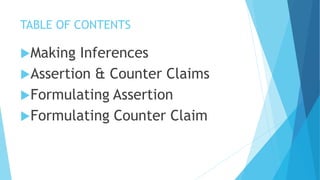
TABLE OF CONTENTS
Making Inferences
Assertion & Counter Claims
Formulating Assertion
Formulating Counter Claim
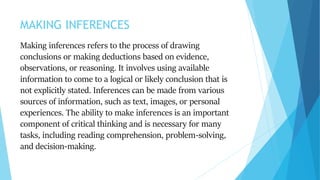
MAKING INFERENCES
Making inferences refers to the process of drawing
conclusions or making deductions based on evidence,
observations, or reasoning. It involves using available
information to come to a logical or likely conclusion that is
not explicitly stated. Inferences can be made from various
sources of information, such as text, images, or personal
experiences. The ability to make inferences is an important
component of critical thinking and is necessary for many
tasks, including reading comprehension, problem-solving,
and decision-making.
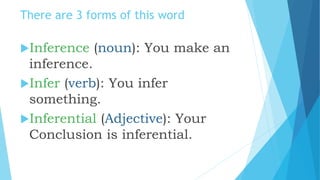
There are 3 forms of this word
Inference (noun): You make an
inference.
Infer (verb): You infer
something.
Inferential (Adjective): Your
Conclusion is inferential.
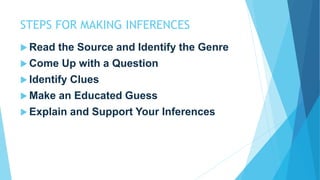
STEPS FOR MAKING INFERENCES
 Read the Source and Identify the Genre
 Come Up with a Question
 Identify Clues
 Make an Educated Guess
 Explain and Support Your Inferences
TYPES OF MAKING INFERENCES
 Deductive inference: This type of inference involves starting with a general rule or
premise and using it to draw a specific conclusion. For example, if you know that all
cats have fur and you see a creature with fur, you can infer that it is a cat.
 Inductive inference: In this type of inference, you draw a general conclusion based
on specific observations or evidence. For example, if you see several cats with fur,
you can infer that all cats have fur.
 Abductive inference: Also known as "inference to the best explanation," this type of
inference involves using the most likely explanation to make a conclusion. For
example, if you see that the grass is wet, you might infer that it rained recently.
 Predictive inference: This type of inference involves making a guess about what will
happen in the future based on past observations or evidence. For example, if you
notice that it gets dark earlier in the evening, you might predict that winter is
approaching.
 Analogical inference: This type of inference involves using similarities between two
situations to draw a conclusion. For example, if you know that a plant needs sunlight
and water to grow, you might infer that a different plant also needs sunlight and
water to grow.
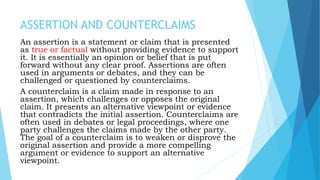
ASSERTION AND COUNTERCLAIMS
An assertion is a statement or claim that is presented
as true or factual without providing evidence to support
it. It is essentially an opinion or belief that is put
forward without any clear proof. Assertions are often
used in arguments or debates, and they can be
challenged or questioned by counterclaims.
A counterclaim is a claim made in response to an
assertion, which challenges or opposes the original
claim. It presents an alternative viewpoint or evidence
that contradicts the initial assertion. Counterclaims are
often used in debates or legal proceedings, where one
party challenges the claims made by the other party.
The goal of a counterclaim is to weaken or disprove the
original assertion and provide a more compelling
argument or evidence to support an alternative
viewpoint.
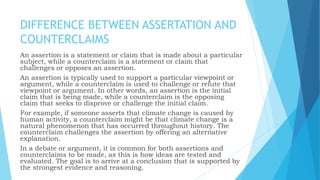
DIFFERENCE BETWEEN ASSERTATION AND
COUNTERCLAIMS
An assertion is a statement or claim that is made about a particular
subject, while a counterclaim is a statement or claim that
challenges or opposes an assertion.
An assertion is typically used to support a particular viewpoint or
argument, while a counterclaim is used to challenge or refute that
viewpoint or argument. In other words, an assertion is the initial
claim that is being made, while a counterclaim is the opposing
claim that seeks to disprove or challenge the initial claim.
For example, if someone asserts that climate change is caused by
human activity, a counterclaim might be that climate change is a
natural phenomenon that has occurred throughout history. The
counterclaim challenges the assertion by offering an alternative
explanation.
In a debate or argument, it is common for both assertions and
counterclaims to be made, as this is how ideas are tested and
evaluated. The goal is to arrive at a conclusion that is supported by
the strongest evidence and reasoning.
TYPES OF ASSERTIONS
• Basic Assertion: is a straightforward statement that expresses a belief, feeling,
opinion, or preference. For example: “I would like to finish this email before we have
our conversation.” or “I would like you to wait until I have finished speaking.”
• Emphatic Assertion: occurs when the speaker or writer conveys sympathy or
recognition of the other person’s position or feelings. This acknowledgement is then
followed by a statement that conveys the speaker’s own beliefs. For example: “I
recognize you are busy with multiple projects, but I still need a response to my email
by Thursday.”
• Escalating Assertion: begins with an assertion that doesn’t receive a response. The
speaker or writer then escalates by making a second assertion that states their
position more forcefully. For example, “If I do not hear back from you by Thursday, I
will have to hire someone else to work on this project.”
• Language Assertion: are frequently used during interpersonal conflict to defuse the
situation. As the term’s name indicates, these statements rely on the first person
pronoun I. An I-language assertion requires a description of the other person’s
behavior followed by how it affects the speaker, a description of their feelings, and a
statement indicating what the speaker wants. For example: “When you are late to a
meeting, I become irritable because I feel as if you do not value our work enough to be
on time. Therefore, I would like you to arrive on time for our meetings.”
• Positive Assertion: occur when speakers asserts positive feelings about themselves or
others. For example, “My presentation went very well today.” or “You used a wonderful
analogy in your essay.”
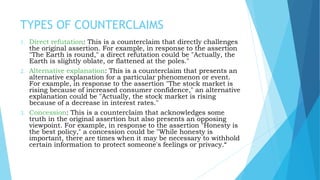
TYPES OF COUNTERCLAIMS
1. Direct refutation: This is a counterclaim that directly challenges
the original assertion. For example, in response to the assertion
"The Earth is round," a direct refutation could be "Actually, the
Earth is slightly oblate, or flattened at the poles."
2. Alternative explanation: This is a counterclaim that presents an
alternative explanation for a particular phenomenon or event.
For example, in response to the assertion "The stock market is
rising because of increased consumer confidence," an alternative
explanation could be "Actually, the stock market is rising
because of a decrease in interest rates."
3. Concession: This is a counterclaim that acknowledges some
truth in the original assertion but also presents an opposing
viewpoint. For example, in response to the assertion "Honesty is
the best policy," a concession could be "While honesty is
important, there are times when it may be necessary to withhold
certain information to protect someone's feelings or privacy.“
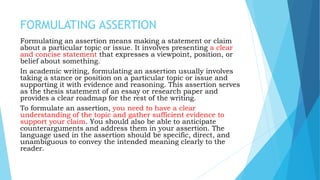
FORMULATING ASSERTION
Formulating an assertion means making a statement or claim
about a particular topic or issue. It involves presenting a clear
and concise statement that expresses a viewpoint, position, or
belief about something.
In academic writing, formulating an assertion usually involves
taking a stance or position on a particular topic or issue and
supporting it with evidence and reasoning. This assertion serves
as the thesis statement of an essay or research paper and
provides a clear roadmap for the rest of the writing.
To formulate an assertion, you need to have a clear
understanding of the topic and gather sufficient evidence to
support your claim. You should also be able to anticipate
counterarguments and address them in your assertion. The
language used in the assertion should be specific, direct, and
unambiguous to convey the intended meaning clearly to the
reader.
We need to formulate assertions for
several reasons, including:
> To communicate our ideas and beliefs: Formulating an assertion allows us to
articulate our thoughts and beliefs in a clear and concise manner. By putting our
ideas into words, we can better communicate our perspective and share it with
others.
> To support our arguments: Assertions are often used to support an argument or
point of view. By providing evidence and reasoning to support our assertion, we can
make a more compelling case for our position.
> To initiate discussions and debates: Formulating an assertion can be a way to
start a conversation or debate about a particular topic. By presenting a clear and
concise assertion, we can encourage others to engage in a discussion and share
their own perspectives.
> To challenge existing beliefs and ideas: Assertions can also be used to challenge
existing beliefs and ideas. By presenting a new perspective or viewpoint, we can
encourage critical thinking and open up new avenues for exploration and discovery.
In summary, formulating an assertion is an important tool for communication,
argumentation, and critical thinking. It allows us to express our ideas, support our
arguments, initiate discussions and debates, and challenge existing beliefs and
ideas.
FORMULATING COUNTERCLAIMS
Formulating counterclaims involves creating statements or
arguments that oppose or challenge an assertion or claim made by
someone else. Counterclaims are used in debates, discussions, and
arguments to provide an alternative perspective or to challenge the
validity of an assertion.
When formulating a counterclaim, it is important to consider the
evidence and reasoning that supports the initial assertion. A strong
counterclaim should be based on credible evidence and sound
reasoning, and it should be presented in a clear and concise
manner.
Counterclaims can be useful in promoting critical thinking and
encouraging a deeper examination of ideas and arguments. By
presenting an alternative viewpoint, counterclaims can help to
identify weaknesses in an argument and promote a more thorough
analysis of the evidence and reasoning presented.
Overall, formulating counterclaims is an important skill in
communication and argumentation, as it allows individuals to
engage in productive discussions and debates that lead to a deeper
understanding of complex issues.
We need to formulate counterclaims for
several reasons, including:
To challenge assumptions: Counterclaims can be used to challenge assumptions and beliefs
that may be taken for granted. By presenting an alternative perspective or argument, we can
encourage critical thinking and promote a deeper examination of ideas.
promote a more thorough analysis of evidence: Counterclaims can help to identify weaknesses
in an argument and encourage a more thorough analysis of the evidence and reasoning
presented. By considering alternative perspectives and arguments, we can gain a more complete
understanding of complex issues.
To test the strength of an argument: Counterclaims can be used to test the strength of an
argument and to identify any flaws or weaknesses in the reasoning or evidence presented. By
presenting a counterclaim, we can encourage the presenter of the initial claim to address any
weaknesses and strengthen their argument.
To encourage productive discussion and debate: Counterclaims can be used to encourage
productive discussion and debate on complex issues. By presenting alternative viewpoints and
arguments, we can engage in a constructive exchange of ideas that leads to a deeper
understanding of the topic.
Overall, formulating counterclaims is an important skill in communication and argumentation,
as it allows individuals to engage in productive discussions and debates that lead to a deeper
understanding of complex issues. By challenging assumptions, promoting a more thorough
analysis of evidence, testing the strength of an argument, and encouraging productive
discussion and debate, counterclaims help to promote critical thinking and advance knowledge
and understanding.
THIS IS OUR
PRESENTATION IN
READING AND
WRITING
reportingrw.pptx

reportingrw.pptx

  • 1.
    GROUP # 3 READINGAND WRITING Leader: Triztan Paul Duran Member: Dexter Deleon Dave Abren Draven Flores Carlo O Marcos
  • 2.
    TABLE OF CONTENTS MakingInferences Assertion & Counter Claims Formulating Assertion Formulating Counter Claim
  • 3.
    MAKING INFERENCES Making inferencesrefers to the process of drawing conclusions or making deductions based on evidence, observations, or reasoning. It involves using available information to come to a logical or likely conclusion that is not explicitly stated. Inferences can be made from various sources of information, such as text, images, or personal experiences. The ability to make inferences is an important component of critical thinking and is necessary for many tasks, including reading comprehension, problem-solving, and decision-making.
  • 4.
    There are 3forms of this word Inference (noun): You make an inference. Infer (verb): You infer something. Inferential (Adjective): Your Conclusion is inferential.
  • 5.
    STEPS FOR MAKINGINFERENCES  Read the Source and Identify the Genre  Come Up with a Question  Identify Clues  Make an Educated Guess  Explain and Support Your Inferences
  • 6.
    TYPES OF MAKINGINFERENCES  Deductive inference: This type of inference involves starting with a general rule or premise and using it to draw a specific conclusion. For example, if you know that all cats have fur and you see a creature with fur, you can infer that it is a cat.  Inductive inference: In this type of inference, you draw a general conclusion based on specific observations or evidence. For example, if you see several cats with fur, you can infer that all cats have fur.  Abductive inference: Also known as "inference to the best explanation," this type of inference involves using the most likely explanation to make a conclusion. For example, if you see that the grass is wet, you might infer that it rained recently.  Predictive inference: This type of inference involves making a guess about what will happen in the future based on past observations or evidence. For example, if you notice that it gets dark earlier in the evening, you might predict that winter is approaching.  Analogical inference: This type of inference involves using similarities between two situations to draw a conclusion. For example, if you know that a plant needs sunlight and water to grow, you might infer that a different plant also needs sunlight and water to grow.
  • 7.
    ASSERTION AND COUNTERCLAIMS Anassertion is a statement or claim that is presented as true or factual without providing evidence to support it. It is essentially an opinion or belief that is put forward without any clear proof. Assertions are often used in arguments or debates, and they can be challenged or questioned by counterclaims. A counterclaim is a claim made in response to an assertion, which challenges or opposes the original claim. It presents an alternative viewpoint or evidence that contradicts the initial assertion. Counterclaims are often used in debates or legal proceedings, where one party challenges the claims made by the other party. The goal of a counterclaim is to weaken or disprove the original assertion and provide a more compelling argument or evidence to support an alternative viewpoint.
  • 8.
    DIFFERENCE BETWEEN ASSERTATIONAND COUNTERCLAIMS An assertion is a statement or claim that is made about a particular subject, while a counterclaim is a statement or claim that challenges or opposes an assertion. An assertion is typically used to support a particular viewpoint or argument, while a counterclaim is used to challenge or refute that viewpoint or argument. In other words, an assertion is the initial claim that is being made, while a counterclaim is the opposing claim that seeks to disprove or challenge the initial claim. For example, if someone asserts that climate change is caused by human activity, a counterclaim might be that climate change is a natural phenomenon that has occurred throughout history. The counterclaim challenges the assertion by offering an alternative explanation. In a debate or argument, it is common for both assertions and counterclaims to be made, as this is how ideas are tested and evaluated. The goal is to arrive at a conclusion that is supported by the strongest evidence and reasoning.
  • 9.
    TYPES OF ASSERTIONS •Basic Assertion: is a straightforward statement that expresses a belief, feeling, opinion, or preference. For example: “I would like to finish this email before we have our conversation.” or “I would like you to wait until I have finished speaking.” • Emphatic Assertion: occurs when the speaker or writer conveys sympathy or recognition of the other person’s position or feelings. This acknowledgement is then followed by a statement that conveys the speaker’s own beliefs. For example: “I recognize you are busy with multiple projects, but I still need a response to my email by Thursday.” • Escalating Assertion: begins with an assertion that doesn’t receive a response. The speaker or writer then escalates by making a second assertion that states their position more forcefully. For example, “If I do not hear back from you by Thursday, I will have to hire someone else to work on this project.” • Language Assertion: are frequently used during interpersonal conflict to defuse the situation. As the term’s name indicates, these statements rely on the first person pronoun I. An I-language assertion requires a description of the other person’s behavior followed by how it affects the speaker, a description of their feelings, and a statement indicating what the speaker wants. For example: “When you are late to a meeting, I become irritable because I feel as if you do not value our work enough to be on time. Therefore, I would like you to arrive on time for our meetings.” • Positive Assertion: occur when speakers asserts positive feelings about themselves or others. For example, “My presentation went very well today.” or “You used a wonderful analogy in your essay.”
  • 10.
    TYPES OF COUNTERCLAIMS 1.Direct refutation: This is a counterclaim that directly challenges the original assertion. For example, in response to the assertion "The Earth is round," a direct refutation could be "Actually, the Earth is slightly oblate, or flattened at the poles." 2. Alternative explanation: This is a counterclaim that presents an alternative explanation for a particular phenomenon or event. For example, in response to the assertion "The stock market is rising because of increased consumer confidence," an alternative explanation could be "Actually, the stock market is rising because of a decrease in interest rates." 3. Concession: This is a counterclaim that acknowledges some truth in the original assertion but also presents an opposing viewpoint. For example, in response to the assertion "Honesty is the best policy," a concession could be "While honesty is important, there are times when it may be necessary to withhold certain information to protect someone's feelings or privacy.“
  • 11.
    FORMULATING ASSERTION Formulating anassertion means making a statement or claim about a particular topic or issue. It involves presenting a clear and concise statement that expresses a viewpoint, position, or belief about something. In academic writing, formulating an assertion usually involves taking a stance or position on a particular topic or issue and supporting it with evidence and reasoning. This assertion serves as the thesis statement of an essay or research paper and provides a clear roadmap for the rest of the writing. To formulate an assertion, you need to have a clear understanding of the topic and gather sufficient evidence to support your claim. You should also be able to anticipate counterarguments and address them in your assertion. The language used in the assertion should be specific, direct, and unambiguous to convey the intended meaning clearly to the reader.
  • 12.
    We need toformulate assertions for several reasons, including: > To communicate our ideas and beliefs: Formulating an assertion allows us to articulate our thoughts and beliefs in a clear and concise manner. By putting our ideas into words, we can better communicate our perspective and share it with others. > To support our arguments: Assertions are often used to support an argument or point of view. By providing evidence and reasoning to support our assertion, we can make a more compelling case for our position. > To initiate discussions and debates: Formulating an assertion can be a way to start a conversation or debate about a particular topic. By presenting a clear and concise assertion, we can encourage others to engage in a discussion and share their own perspectives. > To challenge existing beliefs and ideas: Assertions can also be used to challenge existing beliefs and ideas. By presenting a new perspective or viewpoint, we can encourage critical thinking and open up new avenues for exploration and discovery. In summary, formulating an assertion is an important tool for communication, argumentation, and critical thinking. It allows us to express our ideas, support our arguments, initiate discussions and debates, and challenge existing beliefs and ideas.
  • 13.
    FORMULATING COUNTERCLAIMS Formulating counterclaimsinvolves creating statements or arguments that oppose or challenge an assertion or claim made by someone else. Counterclaims are used in debates, discussions, and arguments to provide an alternative perspective or to challenge the validity of an assertion. When formulating a counterclaim, it is important to consider the evidence and reasoning that supports the initial assertion. A strong counterclaim should be based on credible evidence and sound reasoning, and it should be presented in a clear and concise manner. Counterclaims can be useful in promoting critical thinking and encouraging a deeper examination of ideas and arguments. By presenting an alternative viewpoint, counterclaims can help to identify weaknesses in an argument and promote a more thorough analysis of the evidence and reasoning presented. Overall, formulating counterclaims is an important skill in communication and argumentation, as it allows individuals to engage in productive discussions and debates that lead to a deeper understanding of complex issues.
  • 14.
    We need toformulate counterclaims for several reasons, including: To challenge assumptions: Counterclaims can be used to challenge assumptions and beliefs that may be taken for granted. By presenting an alternative perspective or argument, we can encourage critical thinking and promote a deeper examination of ideas. promote a more thorough analysis of evidence: Counterclaims can help to identify weaknesses in an argument and encourage a more thorough analysis of the evidence and reasoning presented. By considering alternative perspectives and arguments, we can gain a more complete understanding of complex issues. To test the strength of an argument: Counterclaims can be used to test the strength of an argument and to identify any flaws or weaknesses in the reasoning or evidence presented. By presenting a counterclaim, we can encourage the presenter of the initial claim to address any weaknesses and strengthen their argument. To encourage productive discussion and debate: Counterclaims can be used to encourage productive discussion and debate on complex issues. By presenting alternative viewpoints and arguments, we can engage in a constructive exchange of ideas that leads to a deeper understanding of the topic. Overall, formulating counterclaims is an important skill in communication and argumentation, as it allows individuals to engage in productive discussions and debates that lead to a deeper understanding of complex issues. By challenging assumptions, promoting a more thorough analysis of evidence, testing the strength of an argument, and encouraging productive discussion and debate, counterclaims help to promote critical thinking and advance knowledge and understanding.
  • 15.
    THIS IS OUR PRESENTATIONIN READING AND WRITING