At the endof the session, students will be able to:
1. Formulate assertions about the
content and properties of a text
read; and
2. Formulate meaningful counterclaims
in response to claims made in a text
read
Objectives:
1. ASSERTION
Is whensomeone makes a
statement investing his strong
belief in it, as if it is true though it
may not be. He/she is making an
assertion.
5.
Examples of Assertions
•Studies show that excessive social media use can lead
to poor mental health among students.
• Most parents believe that getting high grades leads to
a successful career.
• I think standardized tests do not accurately measure a
student's intelligence.
• I prefer using Instagram over Facebook because of its
visual content.
6.
Four types ofAssertion
a. Fact
This is a statement that can be proven objectively by direct
experience, testimonies or witnesses, verified
observations, or the results of research, because
statements of fact can be double-checked for accuracy,
there is general agreement about the truth they posit.
7.
Example
:
Studies show thatexcessive social media use
can lead to poor mental health among
students.
This statement is a fact because it is based on research or
statistics than can be proven true
8.
Four types ofAssertion
b. Convention
A convention is a way in which something is done,
similar to traditions and norms. Conventions depend on
historical precedent, laws, rules, usage, and customs.
Thus, their truthfulness is verified by how commonly
held definitions and beliefs are interpreted.
9.
Example
:
Most parents believethat getting high
grades leads to a successful career.
This statement is a convention because it reflects common societal
expectations or beliefs, though they may not be universally true..
10.
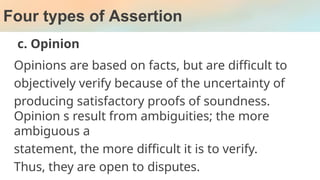
Four types ofAssertion
c. Opinion
Opinions are based on facts, but are difficult to
objectively verify because of the uncertainty of
producing satisfactory proofs of soundness.
Opinion s result from ambiguities; the more
ambiguous a
statement, the more difficult it is to verify.
Thus, they are open to disputes.
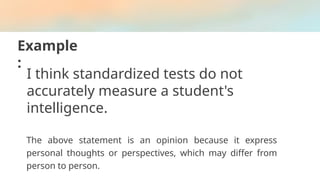
11.
Example
:
I think standardizedtests do not
accurately measure a student's
intelligence.
The above statement is an opinion because it express
personal thoughts or perspectives, which may differ from
person to person.
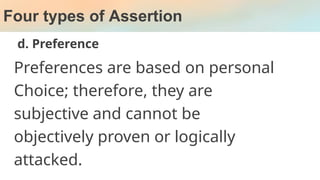
12.
Four types ofAssertion
d. Preference
Preferences are based on personal
Choice; therefore, they are
subjective and cannot be
objectively proven or logically
attacked.
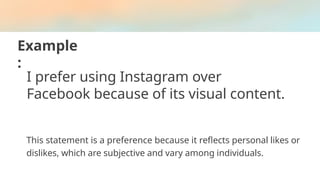
13.
Example
:
I prefer usingInstagram over
Facebook because of its visual content.
This statement is a preference because it reflects personal likes or
dislikes, which are subjective and vary among individuals.
14.
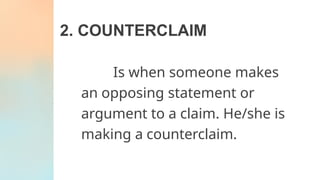
2. COUNTERCLAIM
Is whensomeone makes
an opposing statement or
argument to a claim. He/she is
making a counterclaim.
15.
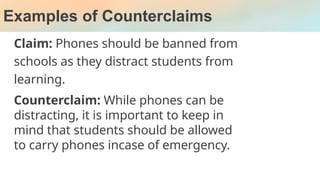
Examples of Counterclaims
Claim:Phones should be banned from
schools as they distract students from
learning.
Counterclaim: While phones can be
distracting, it is important to keep in
mind that students should be allowed
to carry phones incase of emergency.
16.
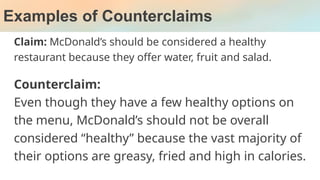
Examples of Counterclaims
Claim:McDonald’s should be considered a healthy
restaurant because they offer water, fruit and salad.
Counterclaim:
Even though they have a few healthy options on
the menu, McDonald’s should not be overall
considered “healthy” because the vast majority of
their options are greasy, fried and high in calories.
17.
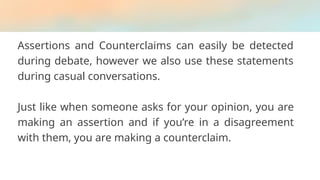
Assertions and Counterclaimscan easily be detected
during debate, however we also use these statements
during casual conversations.
Just like when someone asks for your opinion, you are
making an assertion and if you’re in a disagreement
with them, you are making a counterclaim.