Learning Outcomes
Write acritique of a selected text
on the basis of its context and
properties as a written material
Formulate evaluative statements
about the text read
Determine how textual evidence
is used in validating assertions
and counterclaims
3.
• Which ofthe following would you like to
receive as a reward for getting good grades?
• If you were
your
parents,
what would
you think
they would
tell you after
knowing you
• refers tothe making of a
value judgment.
• make value judgment to
support the position once you
have taken a position in a
controversy.
• certain criteria are involved
What Is
EVALUATIO
N?
7.
• “An evaluativestatement is an objective
and tactful way of reacting to a text. It
represents a judgment based on a set of
criteria.” (Hernandez, 2017)
• can be used to show your opinions,
judgments, and points of view in a clear
concise manner.
• is a way of giving a better explanation to
show the strengths and weaknesses of
something through writing.
What Is
EVALUATIV
E
STATEMEN
T?
8.
• helps usstrengthen our
critical thinking and assess
the overall quality of the
text.
• one can develop own
opinions and skills after
gauging and balancing the
positives and the negatives
of any argument.
why is it
important?
evaluative
statements
9.
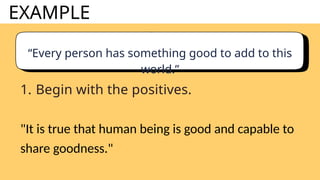
EXAMPLE
“Every person hassomething good to add to this
world.”
1. Begin with the positives.
"It is true that human being is good and capable to
share goodness."
10.
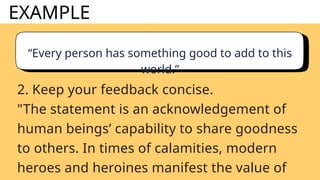
EXAMPLE
“Every person hassomething good to add to this
world.”
2. Keep your feedback concise.
"The statement is an acknowledgement of
human beings’ capability to share goodness
to others. In times of calamities, modern
heroes and heroines manifest the value of
11.
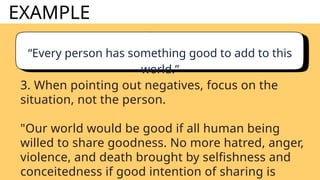
EXAMPLE
“Every person hassomething good to add to this
world.”
3. When pointing out negatives, focus on the
situation, not the person.
"Our world would be good if all human being
willed to share goodness. No more hatred, anger,
violence, and death brought by selfishness and
conceitedness if good intention of sharing is
12.
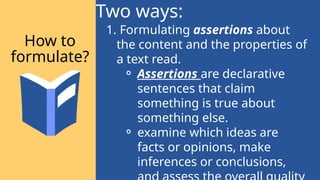
1. Formulating assertionsabout
the content and the properties of
a text read.
⚬ Assertions are declarative
sentences that claim
something is true about
something else.
⚬ examine which ideas are
facts or opinions, make
inferences or conclusions,
Two ways:
How to
formulate?
13.
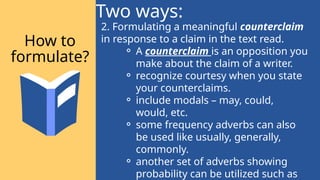
2. Formulating ameaningful counterclaim
in response to a claim in the text read.
⚬ A counterclaim is an opposition you
make about the claim of a writer.
⚬ recognize courtesy when you state
your counterclaims.
⚬ include modals – may, could,
would, etc.
⚬ some frequency adverbs can also
be used like usually, generally,
commonly.
⚬ another set of adverbs showing
probability can be utilized such as
Two ways:
How to
formulate?
14.
EXAMPLE
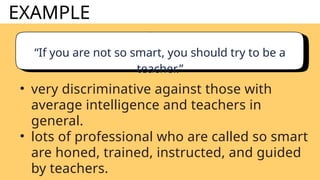
“If you arenot so smart, you should try to be a
teacher.”
• very discriminative against those with
average intelligence and teachers in
general.
• lots of professional who are called so smart
are honed, trained, instructed, and guided
by teachers.
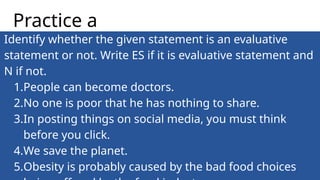
Identify whether thegiven statement is an evaluative
statement or not. Write ES if it is evaluative statement and
N if not.
1.People can become doctors.
2.No one is poor that he has nothing to share.
3.In posting things on social media, you must think
before you click.
4.We save the planet.
5.Obesity is probably caused by the bad food choices
Practice a
17.
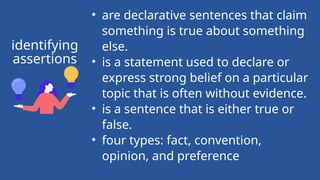
• are declarativesentences that claim
something is true about something
else.
• is a statement used to declare or
express strong belief on a particular
topic that is often without evidence.
• is a sentence that is either true or
false.
• four types: fact, convention,
opinion, and preference
identifying
assertions
18.
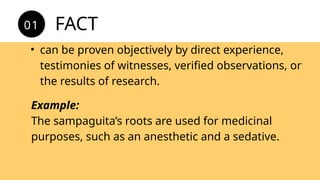
• can beproven objectively by direct experience,
testimonies of witnesses, verified observations, or
the results of research.
FACT
01
Example:
The sampaguita’s roots are used for medicinal
purposes, such as an anesthetic and a sedative.
19.
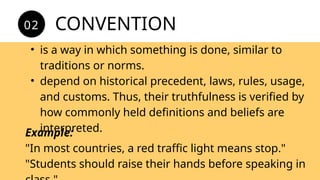
• is away in which something is done, similar to
traditions or norms.
• depend on historical precedent, laws, rules, usage,
and customs. Thus, their truthfulness is verified by
how commonly held definitions and beliefs are
interpreted.
CONVENTION
02
Example:
"In most countries, a red traffic light means stop."
"Students should raise their hands before speaking in
20.
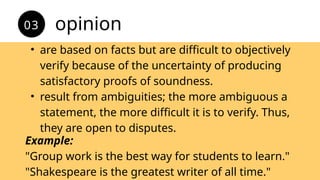
• are basedon facts but are difficult to objectively
verify because of the uncertainty of producing
satisfactory proofs of soundness.
• result from ambiguities; the more ambiguous a
statement, the more difficult it is to verify. Thus,
they are open to disputes.
opinion
03
Example:
"Group work is the best way for students to learn."
"Shakespeare is the greatest writer of all time."
21.
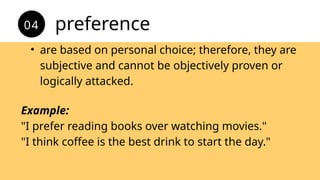
• are basedon personal choice; therefore, they are
subjective and cannot be objectively proven or
logically attacked.
preference
04
Example:
"I prefer reading books over watching movies."
"I think coffee is the best drink to start the day."
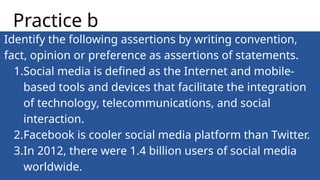
Identify the followingassertions by writing convention,
fact, opinion or preference as assertions of statements.
1.Social media is defined as the Internet and mobile-
based tools and devices that facilitate the integration
of technology, telecommunications, and social
interaction.
2.Facebook is cooler social media platform than Twitter.
3.In 2012, there were 1.4 billion users of social media
worldwide.
Practice b
24.
4. Teachers shoulduse social media in their lessons to get
more students interested.
5. Another name for social media is “Web 2.0” because
both terms emphasize the social aspects of the internet as
avenues for communication, collaboration, and creative
expression.
Practice b
25.
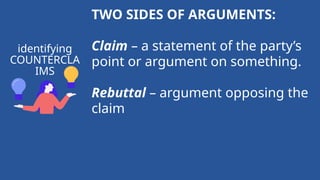
TWO SIDES OFARGUMENTS:
Claim – a statement of the party’s
point or argument on something.
Rebuttal – argument opposing the
claim
identifying
COUNTERCLA
IMS
26.
What is
counterclaim?
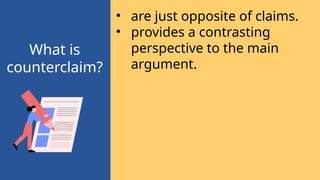
• arejust opposite of claims.
• provides a contrasting
perspective to the main
argument.
27.
Marsha is abusy design consultant for a home décor
and renovation company. Her job frequently takes
her out of the office to visit clients’ homes and offices
to formulate a redecoration plan, personally pick out
supplies, and to personally check up on the
construction or installation. Marsha’s phone is
constantly ringing, as she fields phone calls
throughout the day, regardless of her location.
Marsha desperately wants to separate her stressful
job from her personal life, so she tells her employer,
Ralph, that she needs a company cell phone. Ralph,
EXAMPLE
28.
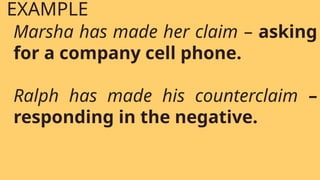
Marsha has madeher claim – asking
for a company cell phone.
Ralph has made his counterclaim –
responding in the negative.
EXAMPLE
29.
COUNTERCLA
IMS
• you showa deep competence
and familiarity with the writer’s
topic
• you are examining different
perspectives and not just
passively accepting the writer’s
claims
• you have thoroughly considered
the topic and are willing to
engage different viewpoints from
your own, thus remaining
objective.
30.
The opposing viewis
that….
Critiques argue that…
While it may be true
that…
It is often thought that….
It is easy to think that….
Some people think…
ntroducing A COUNTERCLAIM
31.
• What arethe major points on which
you and the author can disagree?
• What is the strongest argument?
• What did they say to defend their
position?
• What are the merits of their view?
• What are the weaknesses or
shortcomings in their argument?
• Are there any hidden assumptions?
• Which lines from the text best
support the counterclaim you have
Questions will help
formulate a counterclaim
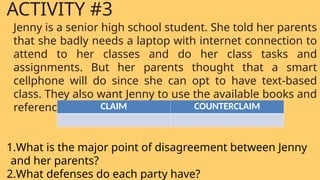
Jenny is asenior high school student. She told her parents
that she badly needs a laptop with internet connection to
attend to her classes and do her class tasks and
assignments. But her parents thought that a smart
cellphone will do since she can opt to have text-based
class. They also want Jenny to use the available books and
references at home.
1.What is the major point of disagreement between Jenny
and her parents?
2.What defenses do each party have?
ACTIVITY #3
CLAIM COUNTERCLAIM
#3 1. Which of the following would you like to receive as a reward for getting good grades would you like to have a a new Gadget a boarding pass for a vacation cold cash or a shopping spree now how did you choose your preferred gift?
2. if you were your parents what would you think they would tell you after knowing your choice?
#4 For sure you have your own basis and considerations for your own choice in the situation. You may have evaluated each option for you to come up with the best one at the same time you may have considered your needs and interests as well as the usefulness and the value of each offer.
The same rule applies when you evaluate any reading texts you also need to consider your basis as evidence to validate or verify your assertions or Claim about what you read
#5 For the second question your parents may have given you evaluative statements that express their assessment of the choice you have made.
How you made your own choice is related to our topic today formulating evaluative statements.
#6 We always want to be satisfied whenever we read any material. The craving of our personal, social, intellectual, and / or spiritual aspects is satiated when we read. This happened when we are focused and discerned through critical thinking. It entails looking closely on the context, content, semantics, language used, syntax, and significance in the reading process.
* Once you have taken a position in a controversy involves value judgment. To support the position, we must make value judgments as well. In doing this, certain criteria are involved.
#7 It presents a value judgment based on a set of criteria. This value judgement is based on the evidenced gathered. It explains the reason of both strength and weakness as they are.
An evaluative statement manifests the objectivity of reaction to a text read and analyzed.
Evaluative statements must be fair, factual, and substantial. It must be written carefully because people may believe in them, and we must not be unfair or cruel to authors of texts. Providing well-crafted justification exhibit how critically the argument is treated and researched.
#8 The accuracy of the information from the material read is put into question if there is the absence of evaluation.
By evaluating, one is carrying out in-depth research of the different sides of arguments, understanding the perspective of the author based on what you are reading, summarizing it, and rewriting it in the same flow of the authors intention.
#9 1. Remember that your evaluative statement should be factual, substantial and unbiased so when giving your negative feedback it should not sound insulting on the part of the person being evaluated. "It is true that human being is good and capable to share goodness."
2. "The statement is an acknowledgement of human beings’ capability to share goodness to others. In times of calamities, modern heroes and heroines manifest the value of sharing goodness to others."
3. "Our world would be good if all human being willed to share goodness.
No more hatred, anger, violence, and death brought by selfishness and
conceitedness if good intention of sharing is emancipated." carefully express your evaluation with diligence, otherwise you might be influencing other readers with your biased feedback
#10 1. Remember that your evaluative statement should be factual, substantial and unbiased so when giving your negative feedback it should not sound insulting on the part of the person being evaluated. "It is true that human being is good and capable to share goodness."
2. "The statement is an acknowledgement of human beings’ capability to share goodness to others. In times of calamities, modern heroes and heroines manifest the value of sharing goodness to others."
3. "Our world would be good if all human being willed to share goodness.
No more hatred, anger, violence, and death brought by selfishness and
conceitedness if good intention of sharing is emancipated." carefully express your evaluation with diligence, otherwise you might be influencing other readers with your biased feedback
#11 1. Remember that your evaluative statement should be factual, substantial and unbiased so when giving your negative feedback it should not sound insulting on the part of the person being evaluated. "It is true that human being is good and capable to share goodness."
2. "The statement is an acknowledgement of human beings’ capability to share goodness to others. In times of calamities, modern heroes and heroines manifest the value of sharing goodness to others."
3. "Our world would be good if all human being willed to share goodness. No more hatred, anger, violence, and death brought by selfishness and conceitedness if good intention of sharing is emancipated." carefully express your evaluation with diligence, otherwise you might be influencing other readers with your biased feedback
#12 Evaluative statement is about your judgement of the text’s content and property. This judgement came from your exercise of critical thinking and careful study of the gathered evidence. This evidence can lead you to support or not the claim of the writer. From it, you can decide crafting your own stand or opinion in an argument supported by research or valid reasons.
**These assertions usually hold evaluative languages such as useful, significant, important, insightful, detailed, up-to-date, comprehensive, practical, etc.
#17 Becoming a good critical reader means that you are able to logically evaluate the claims of the writer. Any writer would want the reader to consider the claims that he puts forward. In expository writing, assertions become the primary channel for a reader to assent to a claim.
#18 Because statements of fact can be double-checked for accuracy, there is general agreement about the truth they assert.
EXAMPLE: This statement is a fact because it can be directly verified by experience or reliable research reports.
#19 Something to note about conventions is that they may sound factual due to their being derived from customs, but because they are socially accepted ways of doing things, they cannot be verified objectively by measurements
This is a conventional assertion because it is based on an agreed-upon rule rather than a natural law. The meaning of traffic signals is established by societal norms and legal conventions rather than an inherent truth of the universe.
This is a conventional assertion because it is a widely accepted classroom rule rather than a natural or scientific fact.
#20 This is an opinion because learning styles vary, and some may prefer individual study over group work.
While Shakespeare is highly influential, literary greatness is a matter of personal and cultural perspective.
#21 This is a preference assertion because it expresses a personal choice or liking rather than a fact. Others may prefer movies over books, making it subjective.
Others may prefer tea or juice instead.
#25 To be an effective critical thinker, it is not enough just to be able to identify claims and assertions. The ability to analyze an argument is essential to understanding the text more deeply, but understanding the claim is not the only facet of the argument. You must also learn how to analyze the counterclaims and evidence provided by the text.
Being able to recognize and formulate counterclaims in reaction to an argument is a characteristic of a good critical reader. Counterclaims are made to rebut a previous claim. They provide contrasting perspective to the main argument.
There are two sides to every argument: (1) the “claim,” and (2) the “counterclaim.” The first is a statement of the party’s point, or argument for something. The second is a rebuttal, or argument opposing the claim.
#26 Once the parties have made their claims and counterclaims, they introduce the reasoning behind their arguments, and present evidence to support those claims.
The claim or counterclaim system is used to make points in everything from essays and scientific papers, to litigation.
#28 By being able to locate and provide counterclaims to an argument, you show a deep competence and familiarity with the writer’s topic. It shows that you are examining different perspectives and not just passively accepting the writer’s claims. It shows that you have thoroughly considered the topic and are willing to engage different viewpoints from your own, thus remaining objective. It also helps you clarify what your personal position is on the topic.
#29 By being able to locate and provide counterclaims to an argument, you show a deep competence and familiarity with the writer’s topic.
#30 When you introduce the counterclaim, talk about why people believe it – do not talk about if it is wrong or right.
#31 Do not introduce your counterclaim in the introductory paragraph
#33 What is the major point of disagreement between Jenny and her parents?
What defenses do each party have?
Who has the strongest argument?