REPORTED SPEECH
Reporting affirmative
statements
REPORTED SPEECH
What is it ? How do you use it?
It is the grammar we use if we want to tell another person about
a conversation that took place in the past (e.g telephone call,
news or story that someone told us etc.)
Where’s
Tom?
He said he
was feeling
ill.
My favourite film is on TV
tonight. I love comedies.
Mrs Brown said that her favourite film was
on TV that night. She said that she loved
comedies.
Look at the example.
What has changed?
Pronoun: My her
I she
Tense: am was
love loved
Time words: tonight that nightbecomes
becomes
becomes
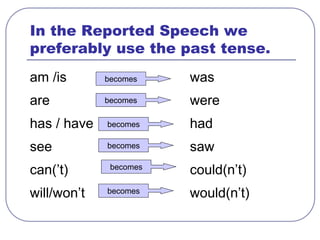
In the Reported Speech we
preferably use the past tense.
am /is was
are were
has / have had
see saw
can(’t) could(n’t)
will/won’t would(n’t)
becomes
becomes
becomes
becomes
becomes
becomes
Changes in verb tenses
do did
(Present Simple) (Past Simple)
am /is doing was doing
(Present Continuous) (Past Continuous)
are doing were doing
(Present Continuous) (Past Continuous)
has / havedone had done
(Present Perfect) (Past Perfect)
becomes
becomes
becomes
becomes
If we want to report a sentence that
is already in the Past Tense, we
normally use the Past Perfect.
I saw the film last week.
He said he had seen the film the
week before.
Changes
Time Place
now then here there
today that day this that
this week that week these those
tomorrow the next day
yesterday the day before
last week the week before
EXERCISES.
A comedy show called “Don’t look
now!” has just closed after five years
at a theatre in London’s West End.
This is what the critics said when it
opened five years ago.
Exercises
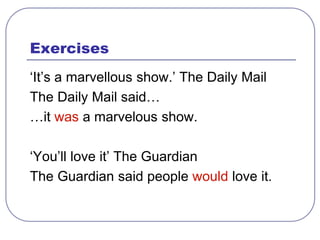
‘It’s a marvellous show.’ The Daily Mail
The Daily Mail said…
…it was a marvelous show.
‘You’ll love it’ The Guardian
The Guardian said people would love it.
Exercises
‘The production is brilliant’ The Times
The Times said the production was
brilliant.
‘It’s the funniest show I’ve ever seen’
Joan Proctor
Joan Proctor said it was the funniest
show she had ever seen.
Exercises
‘It made me laugh’ Ben Walsh
Ben Walsh said it had made him laugh.
‘You shouldn’t miss it’ Time Out
Time Out said people shouldn’t miss it.
Links
 http://www.bbc.co.uk/worldservice/learningenglish/grammar/ask_about_english/reported
_speech.shtml
 https://learnenglish.britishcouncil.org/en/grammar-reference/reported-speech-1
 http://www.learnenglish.de/grammar/reportedspeech.html
 http://www.infoescola.com/ingles/direct-and-indirect-speech/
 http://www.englisch-hilfen.de/en/exercises_list/reported.htm
 http://www.myenglishpages.com/site_php_files/grammar-exercise-reported-
speech.php#.VRHLFvx4rl8
 https://www.ego4u.com/en/cram-up/grammar/reported-speech/exercises?10
 https://www.englishgrammar.org/direct-indirect-speech-exercise-6/
 https://www.englishgrammar.org/direct-indirect-speech-exercise/
 https://www.learnenglishfeelgood.com/reported-speech-mixed3.html
 http://a4esl.org/q/h/9901/tm-reported1.html
Reported speech

Reported speech

  • 1.
  • 2.
    REPORTED SPEECH What isit ? How do you use it? It is the grammar we use if we want to tell another person about a conversation that took place in the past (e.g telephone call, news or story that someone told us etc.) Where’s Tom? He said he was feeling ill.
  • 3.
    My favourite filmis on TV tonight. I love comedies. Mrs Brown said that her favourite film was on TV that night. She said that she loved comedies. Look at the example.
  • 4.
    What has changed? Pronoun:My her I she Tense: am was love loved Time words: tonight that nightbecomes becomes becomes
  • 5.
    In the ReportedSpeech we preferably use the past tense. am /is was are were has / have had see saw can(’t) could(n’t) will/won’t would(n’t) becomes becomes becomes becomes becomes becomes
  • 6.
    Changes in verbtenses do did (Present Simple) (Past Simple) am /is doing was doing (Present Continuous) (Past Continuous) are doing were doing (Present Continuous) (Past Continuous) has / havedone had done (Present Perfect) (Past Perfect) becomes becomes becomes becomes
  • 7.
    If we wantto report a sentence that is already in the Past Tense, we normally use the Past Perfect. I saw the film last week. He said he had seen the film the week before.
  • 8.
    Changes Time Place now thenhere there today that day this that this week that week these those tomorrow the next day yesterday the day before last week the week before
  • 9.
    EXERCISES. A comedy showcalled “Don’t look now!” has just closed after five years at a theatre in London’s West End. This is what the critics said when it opened five years ago.
  • 10.
    Exercises ‘It’s a marvellousshow.’ The Daily Mail The Daily Mail said… …it was a marvelous show. ‘You’ll love it’ The Guardian The Guardian said people would love it.
  • 11.
    Exercises ‘The production isbrilliant’ The Times The Times said the production was brilliant. ‘It’s the funniest show I’ve ever seen’ Joan Proctor Joan Proctor said it was the funniest show she had ever seen.
  • 12.
    Exercises ‘It made melaugh’ Ben Walsh Ben Walsh said it had made him laugh. ‘You shouldn’t miss it’ Time Out Time Out said people shouldn’t miss it.
  • 13.
    Links  http://www.bbc.co.uk/worldservice/learningenglish/grammar/ask_about_english/reported _speech.shtml  https://learnenglish.britishcouncil.org/en/grammar-reference/reported-speech-1 http://www.learnenglish.de/grammar/reportedspeech.html  http://www.infoescola.com/ingles/direct-and-indirect-speech/  http://www.englisch-hilfen.de/en/exercises_list/reported.htm  http://www.myenglishpages.com/site_php_files/grammar-exercise-reported- speech.php#.VRHLFvx4rl8  https://www.ego4u.com/en/cram-up/grammar/reported-speech/exercises?10  https://www.englishgrammar.org/direct-indirect-speech-exercise-6/  https://www.englishgrammar.org/direct-indirect-speech-exercise/  https://www.learnenglishfeelgood.com/reported-speech-mixed3.html  http://a4esl.org/q/h/9901/tm-reported1.html