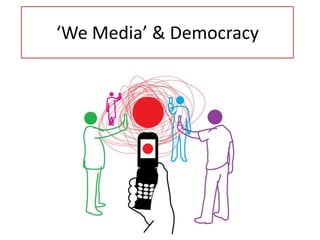
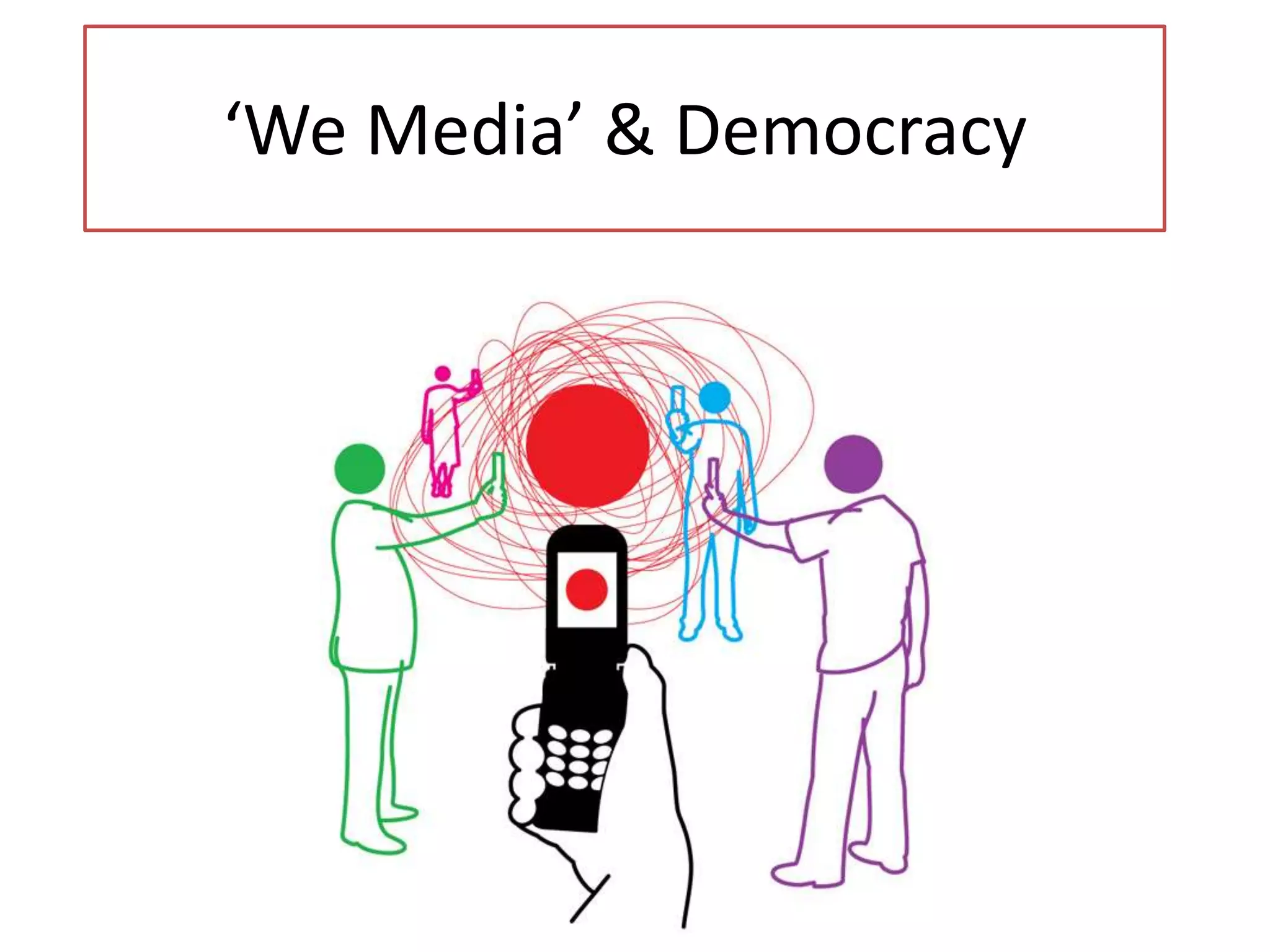
‘We Media’ & Democracy
Topic Points:
• What are ‘We Media’?
• Where / how has ‘We Media’ emerged?
• In what way are the contemporary media more democratic
than before?
• In what ways are the contemporary media less democratic
than before?
In The Exam:
• Historical – dependent on the requirements of
the topic, candidates must summarise the
development of the media forms in question in
theoretical contexts.
• Contemporary – current issues within the topic
area.
• Future – candidates must demonstrate personal
engagement with debates about the future of the
media forms / issues that the topic relates to.
Theorists/Theories
• Marxist
Theory/Gramsci/Frankfurt
School
• Chomsky – Media Control
• David Gauntlett
• Dan Gillmor
• Fourth Estate
• Chris Anderson – The Long
Tail
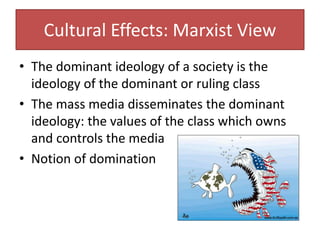
Cultural Effects: Marxist View
• The dominant ideology of a society is the
ideology of the dominant or ruling class
• The mass media disseminates the dominant
ideology: the values of the class which owns
and controls the media
• Notion of domination
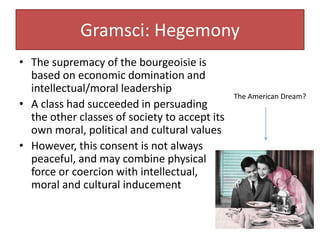
Gramsci: Hegemony
• The supremacy of the bourgeoisie is
based on economic domination and
intellectual/moral leadership
• A class had succeeded in persuading
the other classes of society to accept its
own moral, political and cultural values
• However, this consent is not always
peaceful, and may combine physical
force or coercion with intellectual,
moral and cultural inducement
The American Dream?
Can the working class achieve
hegemony?
• If the working class is to achieve hegemony,
it needs patiently to build up a network of
alliances with social minorities.
• These new coalitions must respect the
autonomy of the movement, so that each
group can make its own special
contribution toward a new socialist society.
• The working class must unite popular
democratic struggles with its own conflict
against the capital class, so as to strengthen
a national popular collective will.
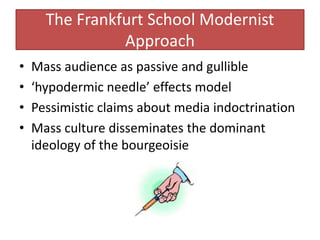
The Frankfurt School Modernist
Approach
• Mass audience as passive and gullible
• ‘hypodermic needle’ effects model
• Pessimistic claims about media indoctrination
• Mass culture disseminates the dominant
ideology of the bourgeoisie
Chomsky: Manufacturing Consent
• The main aim of a media company is to make
money
• Newspapers achieve this through advertising
revenue
• This has an impact on the news values and
news selection
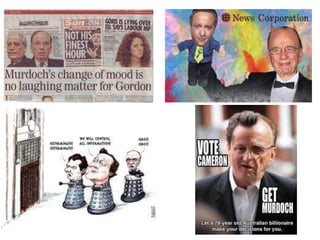
• Can lead to editorial bias
• News businesses that favour profit over public
interest succeed
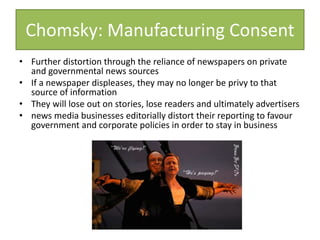
Chomsky: Manufacturing Consent
• Further distortion through the reliance of newspapers on private
and governmental news sources
• If a newspaper displeases, they may no longer be privy to that
source of information
• They will lose out on stories, lose readers and ultimately advertisers
• news media businesses editorially distort their reporting to favour
government and corporate policies in order to stay in business
Editorial Bias: Five Filters
1. Size, Ownership, and Profit Orientation
2. The Advertising License to Do Business
3. Sourcing Mass Media News
4. Flak and the Enforcers
5. Anti-Communism
Size, Ownership and Profit Orientation
• The dominant mass-media outlets are large
corporations which are run for profit
• Therefore they must cater to the financial
interest of their owners
The Advertising License to do Business
• Since the majority of the revenue of major media
outlets derives from advertising advertisers have
acquired a "de-facto licensing authority".
• Media outlets are not commercially viable
without the support of advertisers.
• News media must therefore cater to the political
prejudices and economic desires of their
advertisers.
• This has weakened the working-class press
Sourcing Mass Media News
• The large bureaucracies of the powerful subsidise
the mass media, and gain special access to the
news, by their contribution to reducing the
media’s costs of acquiring and producing, news.
• The large entities that provide this subsidy
become 'routine' news sources and have
privileged access to the gates.
• Non-routine sources must struggle for access,
and may be ignored by the arbitrary decision of
the gatekeepers
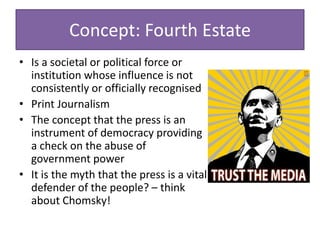
Concept: Fourth Estate
• Is a societal or political force or
institution whose influence is not
consistently or officially recognised
• Print Journalism
• The concept that the press is an
instrument of democracy providing
a check on the abuse of
government power
• It is the myth that the press is a vital
defender of the people? – think
about Chomsky!
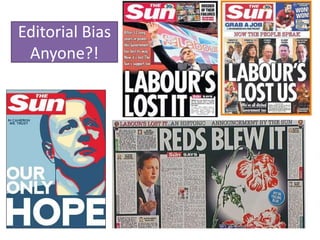
Editorial Bias
Anyone?!
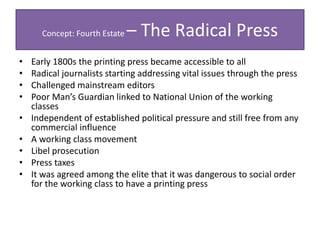
Concept: Fourth Estate – The Radical Press
• Early 1800s the printing press became accessible to all
• Radical journalists starting addressing vital issues through the press
• Challenged mainstream editors
• Poor Man’s Guardian linked to National Union of the working
classes
• Independent of established political pressure and still free from any
commercial influence
• A working class movement
• Libel prosecution
• Press taxes
• It was agreed among the elite that it was dangerous to social order
for the working class to have a printing press
Key Thinking Points
• Do we have a free press?
• What constraints do journalists face when
working for a corporation?
• How far is news media controlled or
constrained by those in power?
• Are newspapers really the Fourth Estate?
David Gauntlett: Web 2.0
• Tim Berner’s Lee invented the Internet with the vision that
people would be connected and creative
• “He imagined that browsing the Web would be a matter of
writing and editing, not just searching and reading” –
Gauntlett
• Web 2.0 invites users to play
• We are seeing a shift away from a ‘sit back and be told’
culture towards more of a ‘making and doing’ culture
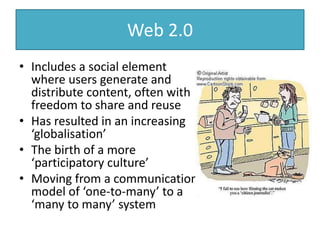
Web 2.0
• Includes a social element
where users generate and
distribute content, often with
freedom to share and reuse
• Has resulted in an increasing
‘globalisation’
• The birth of a more
‘participatory culture’
• Moving from a communication
model of ‘one-to-many’ to a
‘many to many’ system
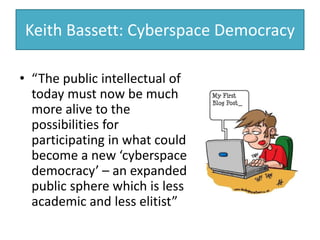
Keith Bassett: Cyberspace Democracy
• “The public intellectual of
today must now be much
more alive to the
possibilities for
participating in what could
become a new ‘cyberspace
democracy’ – an expanded
public sphere which is less
academic and less elitist”
David Gauntlett: Web 2.0
• In the case of the media, there is
obviously the shift towards internet-
based interactivity
• At least 3/4th of UK population are
regular internet users
• More than 1/3rd of people have a
Facebook account
• More and more people are writing
blogs, participating in online
discussions, sharing information,
music and photo, and uploading
video.
New Media
• Increased interactivity of audiences
• Poststructuralist theory sees the audience as
active participators in the creation of
meaning
• In a postmodern world consumption is seen as
a positive and participatory act
• An increased ‘democratisation’?
Citizen Journalism
• Theorist Mark Poster says the internet
provides a ‘Habermasian public sphere’ – a
cyberdemocratic network for communicating
information and points of view that will
eventually transform into public opinion.
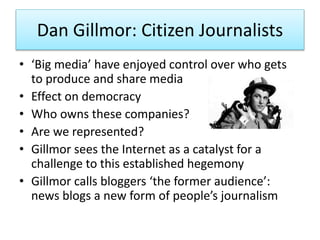
Dan Gillmor: Citizen Journalists
• ‘Big media’ have enjoyed control over who gets
to produce and share media
• Effect on democracy
• Who owns these companies?
• Are we represented?
• Gillmor sees the Internet as a catalyst for a
challenge to this established hegemony
• Gillmor calls bloggers ‘the former audience’:
news blogs a new form of people’s journalism
Citizen Journalism in Iraq
• Blogs offered an alternative to the Western
media’s accounts
• Collaboration of wikispaces, children’s news
blogs and Persian networkers using the Net for
a collective voice in a country where free
speech is curtailed
Chris Anderson: The Long Tail
• How the Internet has transformed economics,
commerce and consumption
• Revenue from niche products now adds up to
the same as from blockbuster products
• Internet allows people to look for and share a
wider variety of products
• Range of filtering services
• Broadband allows us to behave in ways that fit
our instincts
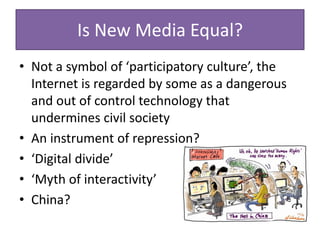
Is New Media Equal?
• Not a symbol of ‘participatory culture’, the
Internet is regarded by some as a dangerous
and out of control technology that
undermines civil society
• An instrument of repression?
• ‘Digital divide’
• ‘Myth of interactivity’
• China?
Utopians
• One side sees the internet as a technology
of freedom that is empowering humankind
• making accessible the world’s knowledge,
building ‘emancipated subjectivities’,
promoting a
new progressive global politics, and laying
the foundation of the ‘new economy’.
• The other sees the internet as an over-
hyped technology whose potential value
has been undermined by ‘digital capitalism’
and
social inequality
Dystopians
• The internet came to exhibit
incongruent features.
• It is still a decentralised system in which
information is transmitted via
independent variable pathways through
dispersed computer power.
• But on top of this is
imposed a new technology of
commercial surveillance which enables
commercial operators – and potentially
governments – to monitor what
people do online
For The Exam
• Explore both sides of the argument that media
is becoming more democratic
• Explore the difference that ‘we media’ makes
to citizens
• You must explore two types of media e.g.
news and social networkin

A2 media revision

  • 1.
  • 2.
    Topic Points: • Whatare ‘We Media’? • Where / how has ‘We Media’ emerged? • In what way are the contemporary media more democratic than before? • In what ways are the contemporary media less democratic than before?
  • 3.
    In The Exam: •Historical – dependent on the requirements of the topic, candidates must summarise the development of the media forms in question in theoretical contexts. • Contemporary – current issues within the topic area. • Future – candidates must demonstrate personal engagement with debates about the future of the media forms / issues that the topic relates to.
  • 4.
    Theorists/Theories • Marxist Theory/Gramsci/Frankfurt School • Chomsky– Media Control • David Gauntlett • Dan Gillmor • Fourth Estate • Chris Anderson – The Long Tail
  • 5.
    Cultural Effects: MarxistView • The dominant ideology of a society is the ideology of the dominant or ruling class • The mass media disseminates the dominant ideology: the values of the class which owns and controls the media • Notion of domination
  • 6.
    Gramsci: Hegemony • Thesupremacy of the bourgeoisie is based on economic domination and intellectual/moral leadership • A class had succeeded in persuading the other classes of society to accept its own moral, political and cultural values • However, this consent is not always peaceful, and may combine physical force or coercion with intellectual, moral and cultural inducement The American Dream?
  • 7.
    Can the workingclass achieve hegemony? • If the working class is to achieve hegemony, it needs patiently to build up a network of alliances with social minorities. • These new coalitions must respect the autonomy of the movement, so that each group can make its own special contribution toward a new socialist society. • The working class must unite popular democratic struggles with its own conflict against the capital class, so as to strengthen a national popular collective will.
  • 8.
    The Frankfurt SchoolModernist Approach • Mass audience as passive and gullible • ‘hypodermic needle’ effects model • Pessimistic claims about media indoctrination • Mass culture disseminates the dominant ideology of the bourgeoisie
  • 9.
    Chomsky: Manufacturing Consent •The main aim of a media company is to make money • Newspapers achieve this through advertising revenue • This has an impact on the news values and news selection • Can lead to editorial bias • News businesses that favour profit over public interest succeed
  • 10.
    Chomsky: Manufacturing Consent •Further distortion through the reliance of newspapers on private and governmental news sources • If a newspaper displeases, they may no longer be privy to that source of information • They will lose out on stories, lose readers and ultimately advertisers • news media businesses editorially distort their reporting to favour government and corporate policies in order to stay in business
  • 11.
    Editorial Bias: FiveFilters 1. Size, Ownership, and Profit Orientation 2. The Advertising License to Do Business 3. Sourcing Mass Media News 4. Flak and the Enforcers 5. Anti-Communism
  • 12.
    Size, Ownership andProfit Orientation • The dominant mass-media outlets are large corporations which are run for profit • Therefore they must cater to the financial interest of their owners
  • 13.
    The Advertising Licenseto do Business • Since the majority of the revenue of major media outlets derives from advertising advertisers have acquired a "de-facto licensing authority". • Media outlets are not commercially viable without the support of advertisers. • News media must therefore cater to the political prejudices and economic desires of their advertisers. • This has weakened the working-class press
  • 14.
    Sourcing Mass MediaNews • The large bureaucracies of the powerful subsidise the mass media, and gain special access to the news, by their contribution to reducing the media’s costs of acquiring and producing, news. • The large entities that provide this subsidy become 'routine' news sources and have privileged access to the gates. • Non-routine sources must struggle for access, and may be ignored by the arbitrary decision of the gatekeepers
  • 15.
    Concept: Fourth Estate •Is a societal or political force or institution whose influence is not consistently or officially recognised • Print Journalism • The concept that the press is an instrument of democracy providing a check on the abuse of government power • It is the myth that the press is a vital defender of the people? – think about Chomsky!
  • 16.
  • 18.
    Concept: Fourth Estate– The Radical Press • Early 1800s the printing press became accessible to all • Radical journalists starting addressing vital issues through the press • Challenged mainstream editors • Poor Man’s Guardian linked to National Union of the working classes • Independent of established political pressure and still free from any commercial influence • A working class movement • Libel prosecution • Press taxes • It was agreed among the elite that it was dangerous to social order for the working class to have a printing press
  • 19.
    Key Thinking Points •Do we have a free press? • What constraints do journalists face when working for a corporation? • How far is news media controlled or constrained by those in power? • Are newspapers really the Fourth Estate?
  • 20.
    David Gauntlett: Web2.0 • Tim Berner’s Lee invented the Internet with the vision that people would be connected and creative • “He imagined that browsing the Web would be a matter of writing and editing, not just searching and reading” – Gauntlett • Web 2.0 invites users to play • We are seeing a shift away from a ‘sit back and be told’ culture towards more of a ‘making and doing’ culture
  • 21.
    Web 2.0 • Includesa social element where users generate and distribute content, often with freedom to share and reuse • Has resulted in an increasing ‘globalisation’ • The birth of a more ‘participatory culture’ • Moving from a communication model of ‘one-to-many’ to a ‘many to many’ system
  • 22.
    Keith Bassett: CyberspaceDemocracy • “The public intellectual of today must now be much more alive to the possibilities for participating in what could become a new ‘cyberspace democracy’ – an expanded public sphere which is less academic and less elitist”
  • 23.
    David Gauntlett: Web2.0 • In the case of the media, there is obviously the shift towards internet- based interactivity • At least 3/4th of UK population are regular internet users • More than 1/3rd of people have a Facebook account • More and more people are writing blogs, participating in online discussions, sharing information, music and photo, and uploading video.
  • 24.
    New Media • Increasedinteractivity of audiences • Poststructuralist theory sees the audience as active participators in the creation of meaning • In a postmodern world consumption is seen as a positive and participatory act • An increased ‘democratisation’?
  • 25.
    Citizen Journalism • TheoristMark Poster says the internet provides a ‘Habermasian public sphere’ – a cyberdemocratic network for communicating information and points of view that will eventually transform into public opinion.
  • 26.
    Dan Gillmor: CitizenJournalists • ‘Big media’ have enjoyed control over who gets to produce and share media • Effect on democracy • Who owns these companies? • Are we represented? • Gillmor sees the Internet as a catalyst for a challenge to this established hegemony • Gillmor calls bloggers ‘the former audience’: news blogs a new form of people’s journalism
  • 27.
    Citizen Journalism inIraq • Blogs offered an alternative to the Western media’s accounts • Collaboration of wikispaces, children’s news blogs and Persian networkers using the Net for a collective voice in a country where free speech is curtailed
  • 28.
    Chris Anderson: TheLong Tail • How the Internet has transformed economics, commerce and consumption • Revenue from niche products now adds up to the same as from blockbuster products • Internet allows people to look for and share a wider variety of products • Range of filtering services • Broadband allows us to behave in ways that fit our instincts
  • 29.
    Is New MediaEqual? • Not a symbol of ‘participatory culture’, the Internet is regarded by some as a dangerous and out of control technology that undermines civil society • An instrument of repression? • ‘Digital divide’ • ‘Myth of interactivity’ • China?
  • 30.
    Utopians • One sidesees the internet as a technology of freedom that is empowering humankind • making accessible the world’s knowledge, building ‘emancipated subjectivities’, promoting a new progressive global politics, and laying the foundation of the ‘new economy’. • The other sees the internet as an over- hyped technology whose potential value has been undermined by ‘digital capitalism’ and social inequality
  • 31.
    Dystopians • The internetcame to exhibit incongruent features. • It is still a decentralised system in which information is transmitted via independent variable pathways through dispersed computer power. • But on top of this is imposed a new technology of commercial surveillance which enables commercial operators – and potentially governments – to monitor what people do online
  • 32.
    For The Exam •Explore both sides of the argument that media is becoming more democratic • Explore the difference that ‘we media’ makes to citizens • You must explore two types of media e.g. news and social networkin