Prepared by
Sameh Hamzawy
MESC Master Student
2012 - 2014
Renewable Energy
2
1. What is Energy ?
2. Energy Consumption Statistics.
3. Types of Energy Sources.
4. Renewable Vs. Non- Renewable Energy
5. Why Renewable Energy?
6. Renewable Energy Resources.
7. Conclusion
Outline
What is Energy ?
3
Energy makes change; it does things for us.
 It moves cars along the road and boats over the
water.
 It bakes a cake in the oven and keeps ice frozen in
the freezer.
 It plays our favorite songs on the radio and lights
our homes.
 It makes our bodies grow and allows our minds to
think.
…….
4
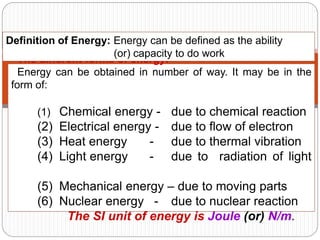
The different forms of energy:
Energy can be obtained in number of way. It may be in the
form of:
(1) Chemical energy - due to chemical reaction
(2) Electrical energy - due to flow of electron
(3) Heat energy - due to thermal vibration
(4) Light energy - due to radiation of light
(5) Mechanical energy – due to moving parts
(6) Nuclear energy - due to nuclear reaction
The SI unit of energy is Joule (or) N/m.
Definition of Energy: Energy can be defined as the ability
(or) capacity to do work
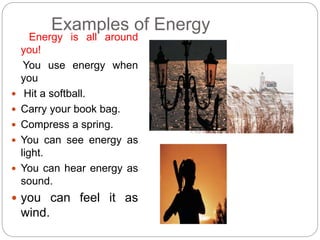
Examples of Energy
Energy is all around
you!
You use energy when
you
 Hit a softball.
 Carry your book bag.
 Compress a spring.
 You can see energy as
light.
 You can hear energy as
sound.
 you can feel it as
wind.
ENERGY STATISTICS
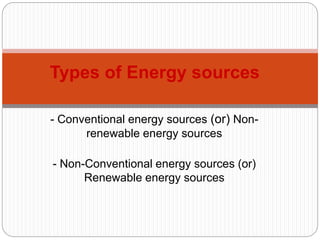
- Conventional energy sources (or) Non-
renewable energy sources
- Non-Conventional energy sources (or)
Renewable energy sources
Types of Energy sources
Non-Conventional energy (or)
Renewable energy
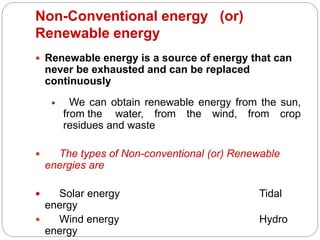
 Renewable energy is a source of energy that can
never be exhausted and can be replaced
continuously
 We can obtain renewable energy from the sun,
from the water, from the wind, from crop
residues and waste
 The types of Non-conventional (or) Renewable
energies are
 Solar energy Tidal
energy
 Wind energy Hydro
energy
Conventional energy (or) Non-
renewable energy
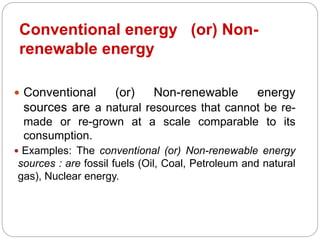
 Conventional (or) Non-renewable energy
sources are a natural resources that cannot be re-
made or re-grown at a scale comparable to its
consumption.
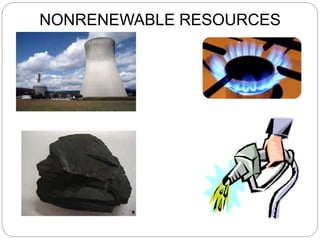
 Examples: The conventional (or) Non-renewable energy
sources : are fossil fuels (Oil, Coal, Petroleum and natural
gas), Nuclear energy.
NONRENEWABLE RESOURCES
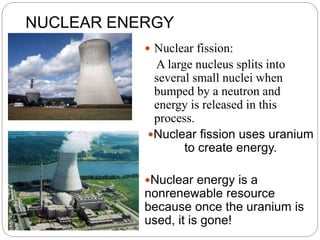
NUCLEAR ENERGY
 Nuclear fission:
A large nucleus splits into
several small nuclei when
bumped by a neutron and
energy is released in this
process.
Nuclear fission uses uranium
to create energy.
Nuclear energy is a
nonrenewable resource
because once the uranium is
used, it is gone!
Why
Renewable
Energy
???????
Why is there a need for renewable
energy?
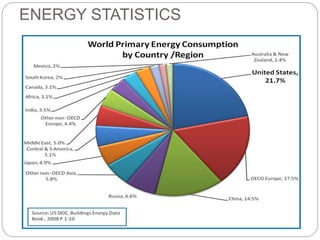
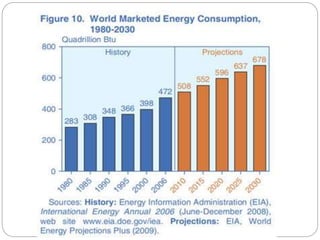
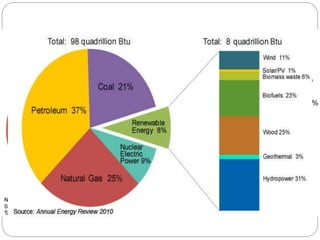
 The graph that we showed it , explain how much we
rely on fossil fuels
 90 percent of the worlds energy supply’s come from
fossil fuels and nuclear energy.
 Conventional fuels, such as used in coal, oil, or gas-
fired boilers or transportation, will increase in price as
supplies reduced.
 That’s the law of supply and demand!
 Imagine, how much longer can we depend on fossil
fuels?
 “Oil has 50 – 100 years left”
HMMMM....
In 1960 they said this
too! !!!!!!!!!!!!!!!
- what has happened
is that we have found
new reserves of oil and
new technology has
made the oil we use
last longer.
:Advantages of Renewable energy resources
1. It is fact that the consumption of non-
renewable sources of energy has caused
more environmental damage than any
other human activity.
2. The use of fossil fuels such as oil and coal
produce high concentration harmful gases
in the atmosphere and creates so many
problems such as global warming.
3. The renewable sources, such as the sun
and wind, can never be exhausted -they
will always be available - and therefore are
4- They cause fewer emissions (they are more cleaner
than non-renewable resources ) and are available
locally. In addition, they will not damage the Earth.
5- There are several types – so one or more of them is
present in each country.
6- Most natural sources can be used on a small scale
and serve local needs therefore cutting costs of
transmitting the energy.
7- Burning fossil fuels has increased atmospheric
pollution
8 -Vehicle exhausts contribute to acid rain more so
than power stations burning coal.
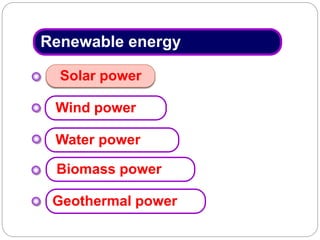
Renewable Energy Sources
Renewable energy
Solar power
Biomass power
Geothermal power
Water power
Wind power
SOLAR ENERGY
23
Solar
Energy
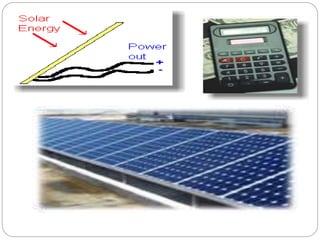
• Solar energy comes from the light of the sun,
which means it is a renewable source of
energy. We can use the sun light to create free
electricity .
• Solar energy is best suited for sunny places to
be able to save enough to ever pay off the
equipment investment
Other possible locations might be where utility
power isn’t available.
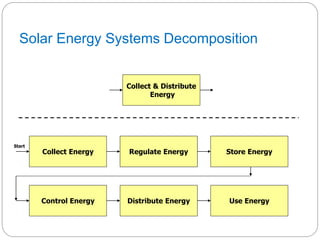
Solar Energy Systems Decomposition
Collect & Distribute
Energy
Store EnergyRegulate EnergyCollect Energy
Use EnergyDistribute EnergyControl Energy
Store EnergyRegulate Energy
Start
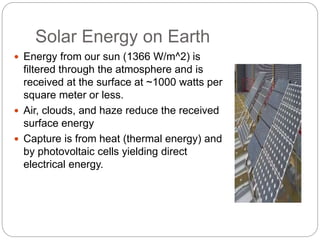
Solar Energy on Earth
 Energy from our sun (1366 W/m^2) is
filtered through the atmosphere and is
received at the surface at ~1000 watts per
square meter or less.
 Air, clouds, and haze reduce the received
surface energy
 Capture is from heat (thermal energy) and
by photovoltaic cells yielding direct
electrical energy.
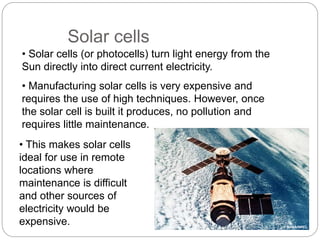
• Solar cells (or photocells) turn light energy from the
Sun directly into direct current electricity.
• Manufacturing solar cells is very expensive and
requires the use of high techniques. However, once
the solar cell is built it produces, no pollution and
requires little maintenance.
• This makes solar cells
ideal for use in remote
locations where
maintenance is difficult
and other sources of
electricity would be
expensive.
Solar cells
© NASA/NREL
27
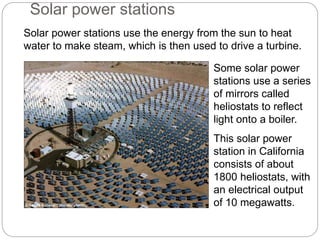
Solar power stations use the energy from the sun to heat
water to make steam, which is then used to drive a turbine.
Some solar power
stations use a series
of mirrors called
heliostats to reflect
light onto a boiler.
This solar power
station in California
consists of about
1800 heliostats, with
an electrical output
of 10 megawatts.
Solar power stations
© Sandia National Laboratory/NREL
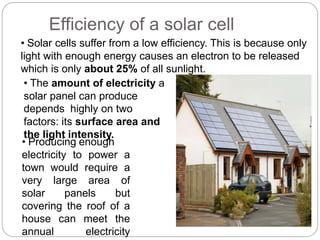
• Solar cells suffer from a low efficiency. This is because only
light with enough energy causes an electron to be released
which is only about 25% of all sunlight.
• The amount of electricity a
solar panel can produce
depends highly on two
factors: its surface area and
the light intensity.
• Producing enough
electricity to power a
town would require a
very large area of
solar panels but
covering the roof of a
house can meet the
annual electricity
Efficiency of a solar cell
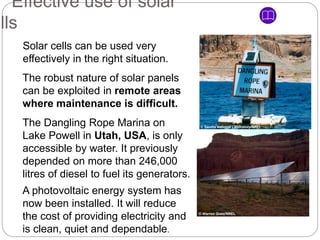
Solar cells can be used very
effectively in the right situation.
The robust nature of solar panels
can be exploited in remote areas
where maintenance is difficult.
The Dangling Rope Marina on
Lake Powell in Utah, USA, is only
accessible by water. It previously
depended on more than 246,000
litres of diesel to fuel its generators.
A photovoltaic energy system has
now been installed. It will reduce
the cost of providing electricity and
is clean, quiet and dependable.
Effective use of solar
ells
© Warren Gretz/NREL
© Sandia National Laboratory/NREL
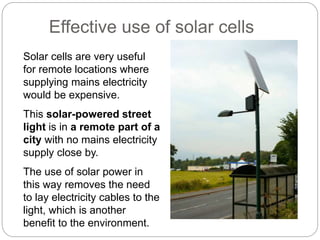
Solar cells are very useful
for remote locations where
supplying mains electricity
would be expensive.
This solar-powered street
light is in a remote part of a
city with no mains electricity
supply close by.
The use of solar power in
this way removes the need
to lay electricity cables to the
light, which is another
benefit to the environment.
Effective use of solar cells
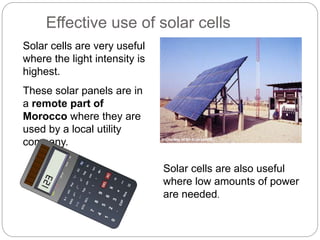
Solar cells are very useful
where the light intensity is
highest.
These solar panels are in
a remote part of
Morocco where they are
used by a local utility
company.
Solar cells are also useful
where low amounts of power
are needed.
© Courtesy of BP Solarex/NREL
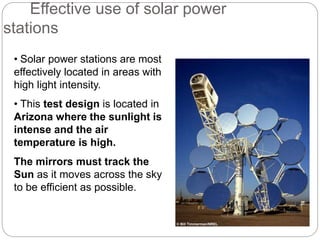
• Solar power stations are most
effectively located in areas with
high light intensity.
• This test design is located in
Arizona where the sunlight is
intense and the air
temperature is high.
The mirrors must track the
Sun as it moves across the sky
to be efficient as possible.
Effective use of solar power
stations
© Bill Timmerman/NREL
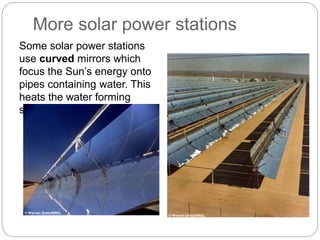
Some solar power stations
use curved mirrors which
focus the Sun’s energy onto
pipes containing water. This
heats the water forming
steam.
More solar power stations
© Warren Gretz/NREL
© Warren Gretz/NREL
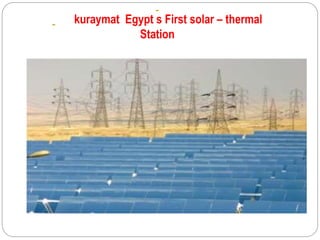
kuraymat Egypt s First solar – thermal
Station
Conclusion
 Fossil-fuel energy will deplete in the future; it
took millions of years to create that much fuel.
 Increasing oil, gas, and coal prices will ensure
that the transition to renewable energy will
occur.
 Renewable energy emits no pollution or carbon
dioxide (although the building of the energy
conversion components does)
 Renewable energy will eventually become
mandatory, and our lifestyles will have to
change to adapt
 The transition to increased renewable energy
080101
Thank you!
Questions ??????

Renewable Energy

  • 1.
    Prepared by Sameh Hamzawy MESCMaster Student 2012 - 2014 Renewable Energy
  • 2.
    2 1. What isEnergy ? 2. Energy Consumption Statistics. 3. Types of Energy Sources. 4. Renewable Vs. Non- Renewable Energy 5. Why Renewable Energy? 6. Renewable Energy Resources. 7. Conclusion Outline

  • 3.
    What is Energy? 3 Energy makes change; it does things for us.  It moves cars along the road and boats over the water.  It bakes a cake in the oven and keeps ice frozen in the freezer.  It plays our favorite songs on the radio and lights our homes.  It makes our bodies grow and allows our minds to think. …….
  • 4.
    4 The different formsof energy: Energy can be obtained in number of way. It may be in the form of: (1) Chemical energy - due to chemical reaction (2) Electrical energy - due to flow of electron (3) Heat energy - due to thermal vibration (4) Light energy - due to radiation of light (5) Mechanical energy – due to moving parts (6) Nuclear energy - due to nuclear reaction The SI unit of energy is Joule (or) N/m. Definition of Energy: Energy can be defined as the ability (or) capacity to do work
  • 5.
    Examples of Energy Energyis all around you! You use energy when you  Hit a softball.  Carry your book bag.  Compress a spring.  You can see energy as light.  You can hear energy as sound.  you can feel it as wind.
  • 6.
  • 10.
    - Conventional energysources (or) Non- renewable energy sources - Non-Conventional energy sources (or) Renewable energy sources Types of Energy sources
  • 11.
    Non-Conventional energy (or) Renewableenergy  Renewable energy is a source of energy that can never be exhausted and can be replaced continuously  We can obtain renewable energy from the sun, from the water, from the wind, from crop residues and waste  The types of Non-conventional (or) Renewable energies are  Solar energy Tidal energy  Wind energy Hydro energy
  • 12.
    Conventional energy (or)Non- renewable energy  Conventional (or) Non-renewable energy sources are a natural resources that cannot be re- made or re-grown at a scale comparable to its consumption.  Examples: The conventional (or) Non-renewable energy sources : are fossil fuels (Oil, Coal, Petroleum and natural gas), Nuclear energy.
  • 13.
  • 14.
    NUCLEAR ENERGY  Nuclearfission: A large nucleus splits into several small nuclei when bumped by a neutron and energy is released in this process. Nuclear fission uses uranium to create energy. Nuclear energy is a nonrenewable resource because once the uranium is used, it is gone!
  • 15.
  • 16.
    Why is therea need for renewable energy?  The graph that we showed it , explain how much we rely on fossil fuels  90 percent of the worlds energy supply’s come from fossil fuels and nuclear energy.  Conventional fuels, such as used in coal, oil, or gas- fired boilers or transportation, will increase in price as supplies reduced.  That’s the law of supply and demand!  Imagine, how much longer can we depend on fossil fuels?  “Oil has 50 – 100 years left”
  • 17.
    HMMMM.... In 1960 theysaid this too! !!!!!!!!!!!!!!! - what has happened is that we have found new reserves of oil and new technology has made the oil we use last longer.
  • 18.
    :Advantages of Renewableenergy resources 1. It is fact that the consumption of non- renewable sources of energy has caused more environmental damage than any other human activity. 2. The use of fossil fuels such as oil and coal produce high concentration harmful gases in the atmosphere and creates so many problems such as global warming. 3. The renewable sources, such as the sun and wind, can never be exhausted -they will always be available - and therefore are
  • 19.
    4- They causefewer emissions (they are more cleaner than non-renewable resources ) and are available locally. In addition, they will not damage the Earth. 5- There are several types – so one or more of them is present in each country. 6- Most natural sources can be used on a small scale and serve local needs therefore cutting costs of transmitting the energy. 7- Burning fossil fuels has increased atmospheric pollution 8 -Vehicle exhausts contribute to acid rain more so than power stations burning coal.
  • 20.
  • 21.
    Renewable energy Solar power Biomasspower Geothermal power Water power Wind power
  • 22.
  • 23.
    23 Solar Energy • Solar energycomes from the light of the sun, which means it is a renewable source of energy. We can use the sun light to create free electricity . • Solar energy is best suited for sunny places to be able to save enough to ever pay off the equipment investment Other possible locations might be where utility power isn’t available.
  • 24.
    Solar Energy SystemsDecomposition Collect & Distribute Energy Store EnergyRegulate EnergyCollect Energy Use EnergyDistribute EnergyControl Energy Store EnergyRegulate Energy Start
  • 25.
    Solar Energy onEarth  Energy from our sun (1366 W/m^2) is filtered through the atmosphere and is received at the surface at ~1000 watts per square meter or less.  Air, clouds, and haze reduce the received surface energy  Capture is from heat (thermal energy) and by photovoltaic cells yielding direct electrical energy.
  • 26.
    • Solar cells(or photocells) turn light energy from the Sun directly into direct current electricity. • Manufacturing solar cells is very expensive and requires the use of high techniques. However, once the solar cell is built it produces, no pollution and requires little maintenance. • This makes solar cells ideal for use in remote locations where maintenance is difficult and other sources of electricity would be expensive. Solar cells © NASA/NREL
  • 27.
  • 28.
    Solar power stationsuse the energy from the sun to heat water to make steam, which is then used to drive a turbine. Some solar power stations use a series of mirrors called heliostats to reflect light onto a boiler. This solar power station in California consists of about 1800 heliostats, with an electrical output of 10 megawatts. Solar power stations © Sandia National Laboratory/NREL
  • 29.
    • Solar cellssuffer from a low efficiency. This is because only light with enough energy causes an electron to be released which is only about 25% of all sunlight. • The amount of electricity a solar panel can produce depends highly on two factors: its surface area and the light intensity. • Producing enough electricity to power a town would require a very large area of solar panels but covering the roof of a house can meet the annual electricity Efficiency of a solar cell
  • 30.
    Solar cells canbe used very effectively in the right situation. The robust nature of solar panels can be exploited in remote areas where maintenance is difficult. The Dangling Rope Marina on Lake Powell in Utah, USA, is only accessible by water. It previously depended on more than 246,000 litres of diesel to fuel its generators. A photovoltaic energy system has now been installed. It will reduce the cost of providing electricity and is clean, quiet and dependable. Effective use of solar ells © Warren Gretz/NREL © Sandia National Laboratory/NREL
  • 31.
    Solar cells arevery useful for remote locations where supplying mains electricity would be expensive. This solar-powered street light is in a remote part of a city with no mains electricity supply close by. The use of solar power in this way removes the need to lay electricity cables to the light, which is another benefit to the environment. Effective use of solar cells
  • 32.
    Effective use ofsolar cells Solar cells are very useful where the light intensity is highest. These solar panels are in a remote part of Morocco where they are used by a local utility company. Solar cells are also useful where low amounts of power are needed. © Courtesy of BP Solarex/NREL
  • 33.
    • Solar powerstations are most effectively located in areas with high light intensity. • This test design is located in Arizona where the sunlight is intense and the air temperature is high. The mirrors must track the Sun as it moves across the sky to be efficient as possible. Effective use of solar power stations © Bill Timmerman/NREL
  • 34.
    Some solar powerstations use curved mirrors which focus the Sun’s energy onto pipes containing water. This heats the water forming steam. More solar power stations © Warren Gretz/NREL © Warren Gretz/NREL
  • 35.
    kuraymat Egypt sFirst solar – thermal Station
  • 36.
    Conclusion  Fossil-fuel energywill deplete in the future; it took millions of years to create that much fuel.  Increasing oil, gas, and coal prices will ensure that the transition to renewable energy will occur.  Renewable energy emits no pollution or carbon dioxide (although the building of the energy conversion components does)  Renewable energy will eventually become mandatory, and our lifestyles will have to change to adapt  The transition to increased renewable energy
  • 37.
  • 38.