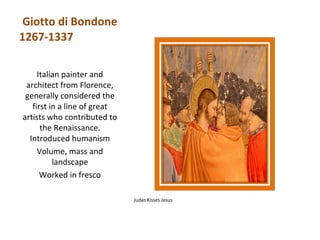
Giotto di Bondone
1267-1337

     Italian painter and
 architect from Florence,
 generally considered the
   first in a line of great
artists who contributed to
      the Renaissance.
  Introduced humanism
     Volume, mass and
          landscape
      Worked in fresco

                              Judas Kisses Jesus
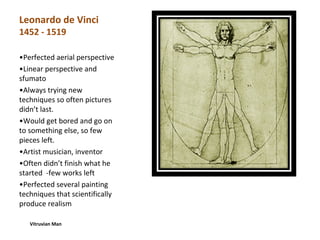
Leonardo de Vinci
1452 - 1519

•Perfected aerial perspective
•Linear perspective and
sfumato
•Always trying new
techniques so often pictures
didn’t last.
•Would get bored and go on
to something else, so few
pieces left.
•Artist musician, inventor
•Often didn’t finish what he
started -few works left
•Perfected several painting
techniques that scientifically
produce realism

   Vitruvian Man
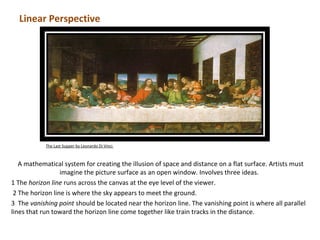
Linear Perspective


            The Last Supper by Leonardo Di Vinci


   A mathematical system for creating the illusion of space and distance on a flat surface. Artists must
                  imagine the picture surface as an open window. Involves three ideas.
1 The horizon line runs across the canvas at the eye level of the viewer.
 2 The horizon line is where the sky appears to meet the ground.
3 The vanishing point should be located near the horizon line. The vanishing point is where all parallel
lines that run toward the horizon line come together like train tracks in the distance.
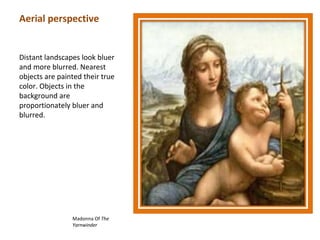
Aerial perspective


Distant landscapes look bluer
and more blurred. Nearest
objects are painted their true
color. Objects in the
background are
proportionately bluer and
blurred.


                Madonna Of The
                Yarnwinder
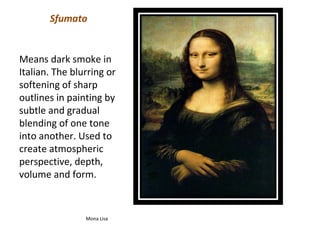
Sfumato


Means dark smoke in
Italian. The blurring or
softening of sharp
outlines in painting by
subtle and gradual
blending of one tone
into another. Used to
create atmospheric
perspective, depth,
volume and form.


                Mona Lisa
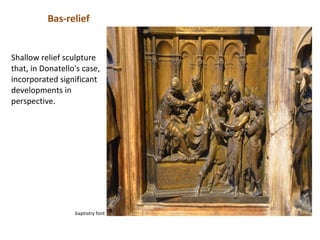
Bas-relief


Shallow relief sculpture
that, in Donatello's case,
incorporated significant
developments in
perspective.


                  baptistry font
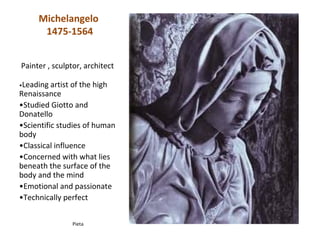
Michelangelo
      1475-1564


Painter , sculptor, architect

•Leading  artist of the high
Renaissance
•Studied Giotto and
Donatello
•Scientific studies of human
body
•Classical influence
•Concerned with what lies
beneath the surface of the
body and the mind
•Emotional and passionate
•Technically perfect


                Pieta
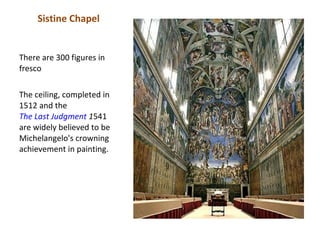
Sistine Chapel


There are 300 figures in
fresco

The ceiling, completed in
1512 and the
The Last Judgment 1541
are widely believed to be
Michelangelo's crowning
achievement in painting.
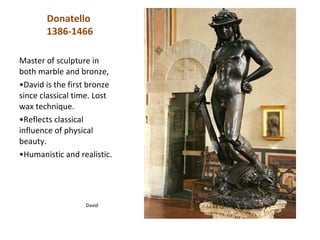
Donatello
       1386-1466

Master of sculpture in
both marble and bronze,
•David is the first bronze
since classical time. Lost
wax technique.
•Reflects classical
influence of physical
beauty.
•Humanistic and realistic.


                  David
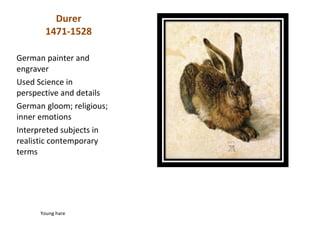
Durer
        1471-1528

German painter and
engraver
Used Science in
perspective and details
German gloom; religious;
inner emotions
Interpreted subjects in
realistic contemporary
terms


      Young hare
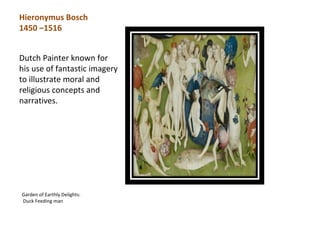
Hieronymus Bosch
1450 –1516


Dutch Painter known for
his use of fantastic imagery
to illustrate moral and
religious concepts and
narratives.


Garden of Earthly Delights:
Duck Feeding man
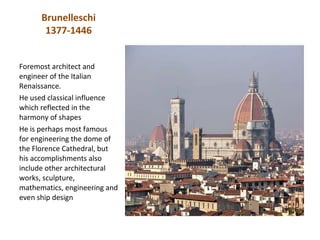
Brunelleschi
       1377-1446


Foremost architect and
engineer of the Italian
Renaissance.
He used classical influence
which reflected in the
harmony of shapes
He is perhaps most famous
for engineering the dome of
the Florence Cathedral, but
his accomplishments also
include other architectural
works, sculpture,
mathematics, engineering and
even ship design
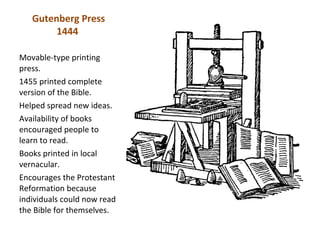
Gutenberg Press
        1444

Movable-type printing
press.
1455 printed complete
version of the Bible.
Helped spread new ideas.
Availability of books
encouraged people to
learn to read.
Books printed in local
vernacular.
Encourages the Protestant
Reformation because
individuals could now read
the Bible for themselves.
William Shakespeare
        1564-1616


The spread of books
allowed for the written
word to take on an
immortal life through;
literature, plays, poetry.
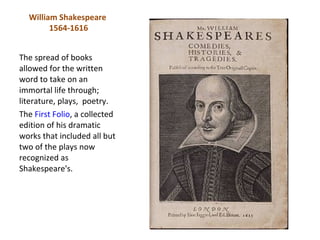
The First Folio, a collected
edition of his dramatic
works that included all but
two of the plays now
recognized as
Shakespeare's.
Miguel de Cervantes
       1547-1616


Spanish novelist, poet, and
playwright. His work, Don
Quixote, is considered to be
the first modern European
novel, and regarded amongst
the best works of fiction ever
written.[

His influence on the Spanish
language has been so great
that the language is often
called la lengua de Cervantes.


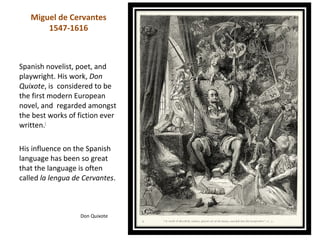
                   Don Quixote
Scientific Revolution

                                      Influenced by:
                        •   Classical writers (Socratic method)
                                      •    Muslim science
                              •       Protestant Reformation
                                  •       Era of Exploration.


                                          Methods:
                •       Careful Observation of the natural world
                    •       Questions about accepted theories
         •   Answers to practical problems in scientific observation
                                  •       Experimentation.
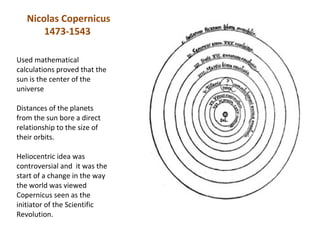
Nicolas Copernicus
       1473-1543

Used mathematical
calculations proved that the
sun is the center of the
universe

Distances of the planets
from the sun bore a direct
relationship to the size of
their orbits.

Heliocentric idea was
controversial and it was the
start of a change in the way
the world was viewed
Copernicus seen as the
initiator of the Scientific
Revolution.
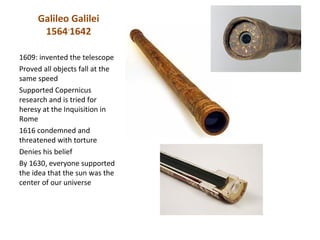
Galileo Galilei
      1564-1642

1609: invented the telescope
Proved all objects fall at the
same speed
Supported Copernicus
research and is tried for
heresy at the Inquisition in
Rome
1616 condemned and
threatened with torture
Denies his belief
By 1630, everyone supported
the idea that the sun was the
center of our universe
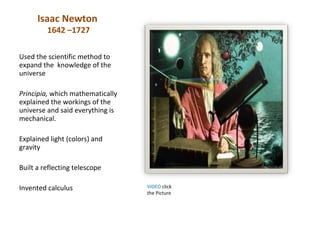
Isaac Newton
         1642 –1727

Used the scientific method to
expand the knowledge of the
universe

Principia, which mathematically
explained the workings of the
universe and said everything is
mechanical.

Explained light (colors) and
gravity

Built a reflecting telescope

Invented calculus                 VIDEO click
                                  the Picture
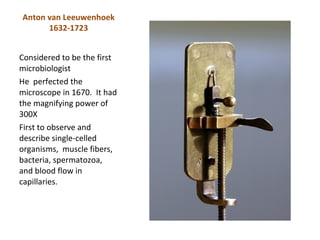
Anton van Leeuwenhoek
      1632-1723


Considered to be the first
microbiologist
He perfected the
microscope in 1670. It had
the magnifying power of
300X
First to observe and
describe single-celled
organisms, muscle fibers,
bacteria, spermatozoa,
and blood flow in
capillaries.
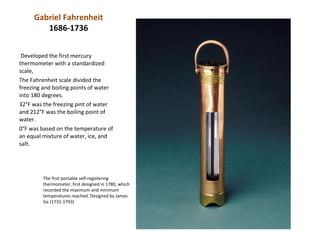
Gabriel Fahrenheit
        1686-1736


 Developed the first mercury
thermometer with a standardized
scale,
The Fahrenheit scale divided the
freezing and boiling points of water
into 180 degrees.
32°F was the freezing pint of water
and 212°F was the boiling point of
water.
0°F was based on the temperature of
an equal mixture of water, ice, and
salt.


         The first portable self-registering
         thermometer, first designed in 1780, which
         recorded the maximum and minimum
         temperatures reached. Designed by James
         Six (1731-1793)
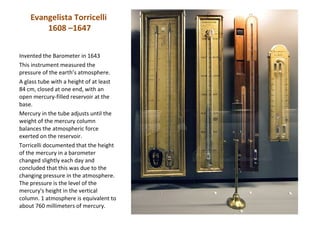
Evangelista Torricelli
        1608 –1647


Invented the Barometer in 1643
This instrument measured the
pressure of the earth’s atmosphere.
A glass tube with a height of at least
84 cm, closed at one end, with an
open mercury-filled reservoir at the
base.
Mercury in the tube adjusts until the
weight of the mercury column
balances the atmospheric force
exerted on the reservoir.
Torricelli documented that the height
of the mercury in a barometer
changed slightly each day and
concluded that this was due to the
changing pressure in the atmosphere.
The pressure is the level of the
mercury's height in the vertical
column. 1 atmosphere is equivalent to
about 760 millimeters of mercury.
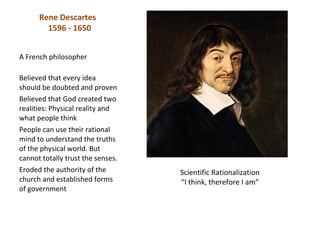
Rene Descartes
        1596 - 1650


A French philosopher

Believed that every idea
should be doubted and proven
Believed that God created two
realities: Physical reality and
what people think
People can use their rational
mind to understand the truths
of the physical world. But
cannot totally trust the senses.
Eroded the authority of the        Scientific Rationalization
church and established forms       “I think, therefore I am”
of government
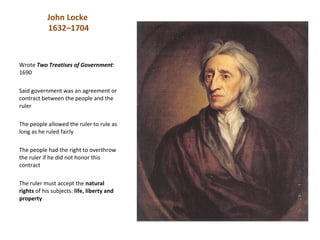
John Locke
            1632–1704


Wrote Two Treatises of Government:
1690

Said government was an agreement or
contract between the people and the
ruler

The people allowed the ruler to rule as
long as he ruled fairly

The people had the right to overthrow
the ruler if he did not honor this
contract

The ruler must accept the natural
rights of his subjects: life, liberty and
property
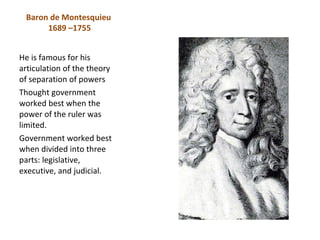
Baron de Montesquieu
      1689 –1755


He is famous for his
articulation of the theory
of separation of powers
Thought government
worked best when the
power of the ruler was
limited.
Government worked best
when divided into three
parts: legislative,
executive, and judicial.
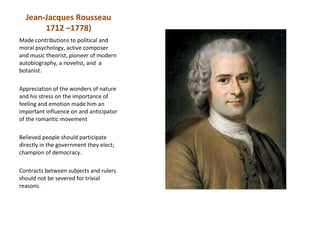
Jean-Jacques Rousseau
       1712 –1778)
Made contributions to political and
moral psychology, active composer
and music theorist, pioneer of modern
autobiography, a novelist, and a
botanist.

Appreciation of the wonders of nature
and his stress on the importance of
feeling and emotion made him an
important influence on and anticipator
of the romantic movement

Believed people should participate
directly in the government they elect;
champion of democracy.

Contracts between subjects and rulers
should not be severed for trivial
reasons.

Renaissance museum walk

  • 2.
    Giotto di Bondone 1267-1337 Italian painter and architect from Florence, generally considered the first in a line of great artists who contributed to the Renaissance. Introduced humanism Volume, mass and landscape Worked in fresco Judas Kisses Jesus
  • 3.
    Leonardo de Vinci 1452- 1519 •Perfected aerial perspective •Linear perspective and sfumato •Always trying new techniques so often pictures didn’t last. •Would get bored and go on to something else, so few pieces left. •Artist musician, inventor •Often didn’t finish what he started -few works left •Perfected several painting techniques that scientifically produce realism Vitruvian Man
  • 4.
    Linear Perspective The Last Supper by Leonardo Di Vinci A mathematical system for creating the illusion of space and distance on a flat surface. Artists must imagine the picture surface as an open window. Involves three ideas. 1 The horizon line runs across the canvas at the eye level of the viewer. 2 The horizon line is where the sky appears to meet the ground. 3 The vanishing point should be located near the horizon line. The vanishing point is where all parallel lines that run toward the horizon line come together like train tracks in the distance.
  • 5.
    Aerial perspective Distant landscapeslook bluer and more blurred. Nearest objects are painted their true color. Objects in the background are proportionately bluer and blurred. Madonna Of The Yarnwinder
  • 6.
    Sfumato Means dark smokein Italian. The blurring or softening of sharp outlines in painting by subtle and gradual blending of one tone into another. Used to create atmospheric perspective, depth, volume and form. Mona Lisa
  • 7.
    Bas-relief Shallow relief sculpture that,in Donatello's case, incorporated significant developments in perspective. baptistry font
  • 8.
    Michelangelo 1475-1564 Painter , sculptor, architect •Leading artist of the high Renaissance •Studied Giotto and Donatello •Scientific studies of human body •Classical influence •Concerned with what lies beneath the surface of the body and the mind •Emotional and passionate •Technically perfect Pieta
  • 9.
    Sistine Chapel There are300 figures in fresco The ceiling, completed in 1512 and the The Last Judgment 1541 are widely believed to be Michelangelo's crowning achievement in painting.
  • 10.
    Donatello 1386-1466 Master of sculpture in both marble and bronze, •David is the first bronze since classical time. Lost wax technique. •Reflects classical influence of physical beauty. •Humanistic and realistic. David
  • 11.
    Durer 1471-1528 German painter and engraver Used Science in perspective and details German gloom; religious; inner emotions Interpreted subjects in realistic contemporary terms Young hare
  • 12.
    Hieronymus Bosch 1450 –1516 DutchPainter known for his use of fantastic imagery to illustrate moral and religious concepts and narratives. Garden of Earthly Delights: Duck Feeding man
  • 13.
    Brunelleschi 1377-1446 Foremost architect and engineer of the Italian Renaissance. He used classical influence which reflected in the harmony of shapes He is perhaps most famous for engineering the dome of the Florence Cathedral, but his accomplishments also include other architectural works, sculpture, mathematics, engineering and even ship design
  • 14.
    Gutenberg Press 1444 Movable-type printing press. 1455 printed complete version of the Bible. Helped spread new ideas. Availability of books encouraged people to learn to read. Books printed in local vernacular. Encourages the Protestant Reformation because individuals could now read the Bible for themselves.
  • 15.
    William Shakespeare 1564-1616 The spread of books allowed for the written word to take on an immortal life through; literature, plays, poetry. The First Folio, a collected edition of his dramatic works that included all but two of the plays now recognized as Shakespeare's.
  • 16.
    Miguel de Cervantes 1547-1616 Spanish novelist, poet, and playwright. His work, Don Quixote, is considered to be the first modern European novel, and regarded amongst the best works of fiction ever written.[ His influence on the Spanish language has been so great that the language is often called la lengua de Cervantes. Don Quixote
  • 17.
    Scientific Revolution Influenced by: • Classical writers (Socratic method) • Muslim science • Protestant Reformation • Era of Exploration. Methods: • Careful Observation of the natural world • Questions about accepted theories • Answers to practical problems in scientific observation • Experimentation.
  • 18.
    Nicolas Copernicus 1473-1543 Used mathematical calculations proved that the sun is the center of the universe Distances of the planets from the sun bore a direct relationship to the size of their orbits. Heliocentric idea was controversial and it was the start of a change in the way the world was viewed Copernicus seen as the initiator of the Scientific Revolution.
  • 19.
    Galileo Galilei 1564-1642 1609: invented the telescope Proved all objects fall at the same speed Supported Copernicus research and is tried for heresy at the Inquisition in Rome 1616 condemned and threatened with torture Denies his belief By 1630, everyone supported the idea that the sun was the center of our universe
  • 20.
    Isaac Newton 1642 –1727 Used the scientific method to expand the knowledge of the universe Principia, which mathematically explained the workings of the universe and said everything is mechanical. Explained light (colors) and gravity Built a reflecting telescope Invented calculus VIDEO click the Picture
  • 21.
    Anton van Leeuwenhoek 1632-1723 Considered to be the first microbiologist He perfected the microscope in 1670. It had the magnifying power of 300X First to observe and describe single-celled organisms, muscle fibers, bacteria, spermatozoa, and blood flow in capillaries.
  • 22.
    Gabriel Fahrenheit 1686-1736 Developed the first mercury thermometer with a standardized scale, The Fahrenheit scale divided the freezing and boiling points of water into 180 degrees. 32°F was the freezing pint of water and 212°F was the boiling point of water. 0°F was based on the temperature of an equal mixture of water, ice, and salt. The first portable self-registering thermometer, first designed in 1780, which recorded the maximum and minimum temperatures reached. Designed by James Six (1731-1793)
  • 23.
    Evangelista Torricelli 1608 –1647 Invented the Barometer in 1643 This instrument measured the pressure of the earth’s atmosphere. A glass tube with a height of at least 84 cm, closed at one end, with an open mercury-filled reservoir at the base. Mercury in the tube adjusts until the weight of the mercury column balances the atmospheric force exerted on the reservoir. Torricelli documented that the height of the mercury in a barometer changed slightly each day and concluded that this was due to the changing pressure in the atmosphere. The pressure is the level of the mercury's height in the vertical column. 1 atmosphere is equivalent to about 760 millimeters of mercury.
  • 24.
    Rene Descartes 1596 - 1650 A French philosopher Believed that every idea should be doubted and proven Believed that God created two realities: Physical reality and what people think People can use their rational mind to understand the truths of the physical world. But cannot totally trust the senses. Eroded the authority of the Scientific Rationalization church and established forms “I think, therefore I am” of government
  • 25.
    John Locke 1632–1704 Wrote Two Treatises of Government: 1690 Said government was an agreement or contract between the people and the ruler The people allowed the ruler to rule as long as he ruled fairly The people had the right to overthrow the ruler if he did not honor this contract The ruler must accept the natural rights of his subjects: life, liberty and property
  • 26.
    Baron de Montesquieu 1689 –1755 He is famous for his articulation of the theory of separation of powers Thought government worked best when the power of the ruler was limited. Government worked best when divided into three parts: legislative, executive, and judicial.
  • 27.
    Jean-Jacques Rousseau 1712 –1778) Made contributions to political and moral psychology, active composer and music theorist, pioneer of modern autobiography, a novelist, and a botanist. Appreciation of the wonders of nature and his stress on the importance of feeling and emotion made him an important influence on and anticipator of the romantic movement Believed people should participate directly in the government they elect; champion of democracy. Contracts between subjects and rulers should not be severed for trivial reasons.