
www.facebook/dentalji
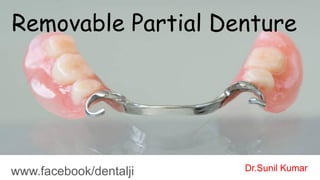
Removable Partial Denture
Dr.Sunil Kumar
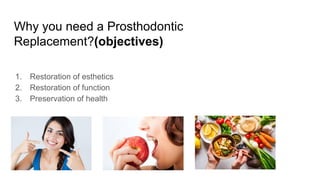
Why you need a Prosthodontic
Replacement?(objectives)
1. Restoration of esthetics
2. Restoration of function
3. Preservation of health
Definition
RPD- Any prosthesis that replace some teeth in partially dentate arch. It can be
removed from the mouth and replaced by the patient himself-also called partial
removable dental prosthesis-(GPT-8)
Video Lecture of that
Slide
Available on
Facebook-. www.facebook/dentalji
YouTube - Dental ji
Instagram - @dental_ji
2 Types of RPD
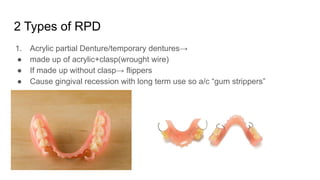
1. Acrylic partial Denture/temporary dentures→
● made up of acrylic+clasp(wrought wire)
● If made up without clasp→ flippers
● Cause gingival recession with long term use so a/c “gum strippers”
Temporary removable Partial Denture
Types
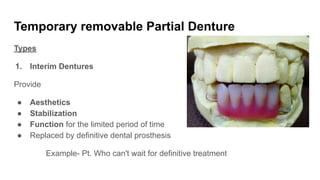
1. Interim Dentures
Provide
● Aesthetics
● Stabilization
● Function for the limited period of time
● Replaced by definitive dental prosthesis
Example- Pt. Who can't wait for definitive treatment
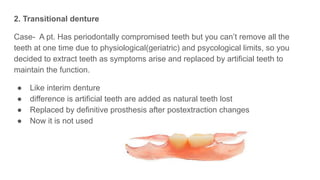
2. Transitional denture
Case- A pt. Has periodontally compromised teeth but you can’t remove all the
teeth at one time due to physiological(geriatric) and psycological limits, so you
decided to extract teeth as symptoms arise and replaced by artificial teeth to
maintain the function.
● Like interim denture
● difference is artificial teeth are added as natural teeth lost
● Replaced by definitive prosthesis after postextraction changes
● Now it is not used
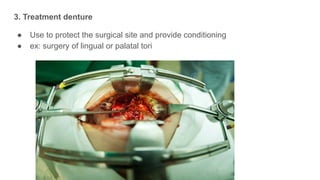
3. Treatment denture
● Use to protect the surgical site and provide conditioning
● ex: surgery of lingual or palatal tori
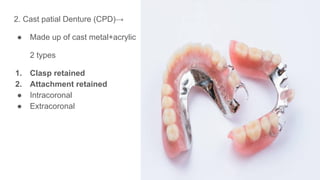
2. Cast patial Denture (CPD)→
● Made up of cast metal+acrylic
2 types
1. Clasp retained
2. Attachment retained
● Intracoronal
● Extracoronal
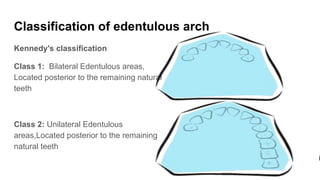
Classification of edentulous arch
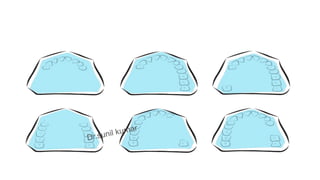
Kennedy's classification
Class 1: Bilateral Edentulous areas,
Located posterior to the remaining natural
teeth
Class 2: Unilateral Edentulous
areas,Located posterior to the remaining
natural teeth
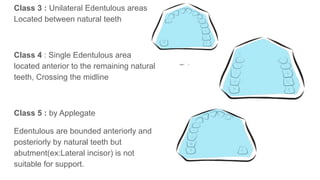
Class 3 : Unilateral Edentulous areas
Located between natural teeth
Class 4 : Single Edentulous area
located anterior to the remaining natural
teeth, Crossing the midline
Class 5 : by Applegate
Edentulous are bounded anteriorly and
posteriorly by natural teeth but
abutment(ex:Lateral incisor) is not
suitable for support.
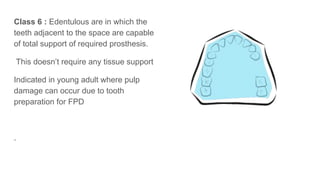
Class 6 : Edentulous are in which the
teeth adjacent to the space are capable
of total support of required prosthesis.
This doesn’t require any tissue support
Indicated in young adult where pulp
damage can occur due to tooth
preparation for FPD
.
Dr.sunil kumar
Applegate Rules for Kennedy's Classification
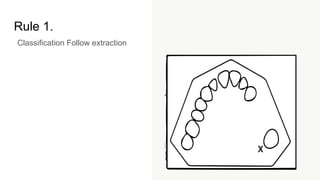
Rule 1.
Classification Follow extraction
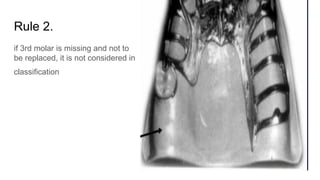
Rule 2.
if 3rd molar is missing and not to
be replaced, it is not considered in
classification
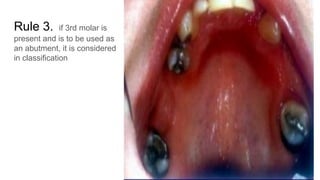
Rule 3. if 3rd molar is
present and is to be used as
an abutment, it is considered
in classification
Rule 4. if 2nd molar is missing and is not to be replaced ,it is not
considered in classification
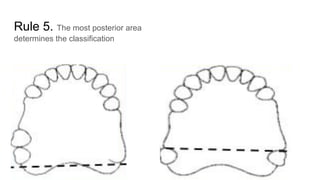
Rule 5. The most posterior area
determines the classification
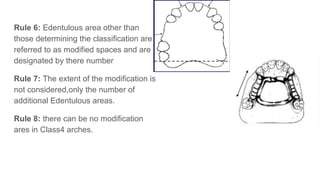
Rule 6: Edentulous area other than
those determining the classification are
referred to as modified spaces and are
designated by there number
Rule 7: The extent of the modification is
not considered,only the number of
additional Edentulous areas.
Rule 8: there can be no modification
ares in Class4 arches.
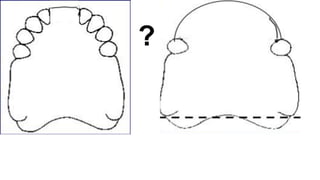
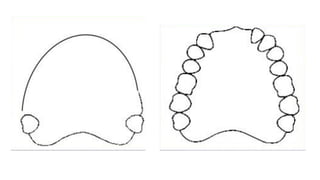
?
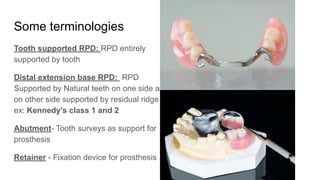
Some terminologies
Tooth supported RPD: RPD entirely
supported by tooth
Distal extension base RPD: RPD
Supported by Natural teeth on one side and
on other side supported by residual ridge
ex: Kennedy's class 1 and 2
Abutment- Tooth surveys as support for
prosthesis
Retainer - Fixation device for prosthesis
You tube - Dental ji
Facebook- www.facebook/dentalji
Instagram - @dental_ji

Removable partial denture introduction (part 1)

  • 1.
  • 2.
    Why you needa Prosthodontic Replacement?(objectives) 1. Restoration of esthetics 2. Restoration of function 3. Preservation of health
  • 3.
    Definition RPD- Any prosthesisthat replace some teeth in partially dentate arch. It can be removed from the mouth and replaced by the patient himself-also called partial removable dental prosthesis-(GPT-8)
  • 4.
    Video Lecture ofthat Slide Available on Facebook-. www.facebook/dentalji YouTube - Dental ji Instagram - @dental_ji
  • 5.
    2 Types ofRPD 1. Acrylic partial Denture/temporary dentures→ ● made up of acrylic+clasp(wrought wire) ● If made up without clasp→ flippers ● Cause gingival recession with long term use so a/c “gum strippers”
  • 6.
    Temporary removable PartialDenture Types 1. Interim Dentures Provide ● Aesthetics ● Stabilization ● Function for the limited period of time ● Replaced by definitive dental prosthesis Example- Pt. Who can't wait for definitive treatment
  • 7.
    2. Transitional denture Case-A pt. Has periodontally compromised teeth but you can’t remove all the teeth at one time due to physiological(geriatric) and psycological limits, so you decided to extract teeth as symptoms arise and replaced by artificial teeth to maintain the function. ● Like interim denture ● difference is artificial teeth are added as natural teeth lost ● Replaced by definitive prosthesis after postextraction changes ● Now it is not used
  • 8.
    3. Treatment denture ●Use to protect the surgical site and provide conditioning ● ex: surgery of lingual or palatal tori
  • 9.
    2. Cast patialDenture (CPD)→ ● Made up of cast metal+acrylic 2 types 1. Clasp retained 2. Attachment retained ● Intracoronal ● Extracoronal
  • 10.
    Classification of edentulousarch Kennedy's classification Class 1: Bilateral Edentulous areas, Located posterior to the remaining natural teeth Class 2: Unilateral Edentulous areas,Located posterior to the remaining natural teeth
  • 11.
    Class 3 :Unilateral Edentulous areas Located between natural teeth Class 4 : Single Edentulous area located anterior to the remaining natural teeth, Crossing the midline Class 5 : by Applegate Edentulous are bounded anteriorly and posteriorly by natural teeth but abutment(ex:Lateral incisor) is not suitable for support.
  • 12.
    Class 6 :Edentulous are in which the teeth adjacent to the space are capable of total support of required prosthesis. This doesn’t require any tissue support Indicated in young adult where pulp damage can occur due to tooth preparation for FPD .
  • 13.
  • 14.
    Applegate Rules forKennedy's Classification
  • 15.
  • 16.
    Rule 2. if 3rdmolar is missing and not to be replaced, it is not considered in classification
  • 17.
    Rule 3. if3rd molar is present and is to be used as an abutment, it is considered in classification
  • 18.
    Rule 4. if2nd molar is missing and is not to be replaced ,it is not considered in classification
  • 19.
    Rule 5. Themost posterior area determines the classification
  • 20.
    Rule 6: Edentulousarea other than those determining the classification are referred to as modified spaces and are designated by there number Rule 7: The extent of the modification is not considered,only the number of additional Edentulous areas. Rule 8: there can be no modification ares in Class4 arches.
  • 21.
  • 23.
    Some terminologies Tooth supportedRPD: RPD entirely supported by tooth Distal extension base RPD: RPD Supported by Natural teeth on one side and on other side supported by residual ridge ex: Kennedy's class 1 and 2 Abutment- Tooth surveys as support for prosthesis Retainer - Fixation device for prosthesis
  • 24.
    You tube -Dental ji Facebook- www.facebook/dentalji Instagram - @dental_ji