Lecturer: Dr. Abdirahman Derajo, BDS
Frantz Fanon University, Hargeisa.
1
INTRDOUCTION AND CLASSIFICATION
PARTIAL DENTURE
1
Objectives
• By the end of this lecture, students will be able to
understand:
1. Introduction to prosthetics.
2. Branches of Prosthodontics.
3. Common Terminologies Used in Removable Partial
Denture.
4. Indications for Removable Partial Dentures.
5. Classification of Partially Edentulous Arches.
6. Parts of a Removable Partial Denture.
7. Steps in the Fabrication of a Removable Partial
Denture.
2
3
4
5
Introduction
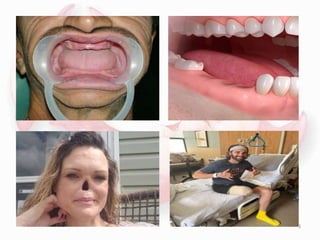
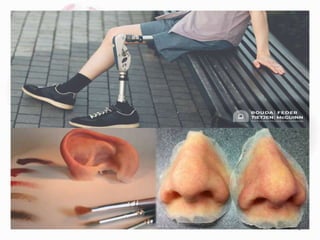
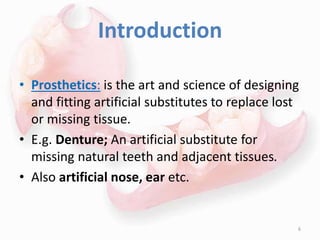
• Prosthetics: is the art and science of designing
and fitting artificial substitutes to replace lost
or missing tissue.
• E.g. Denture; An artificial substitute for
missing natural teeth and adjacent tissues.
• Also artificial nose, ear etc.
6
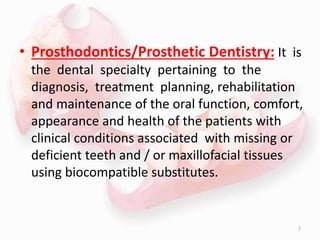
• Prosthodontics/Prosthetic Dentistry: It is
the dental specialty pertaining to the
diagnosis, treatment planning, rehabilitation
and maintenance of the oral function, comfort,
appearance and health of the patients with
clinical conditions associated with missing or
deficient teeth and / or maxillofacial tissues
using biocompatible substitutes.
7
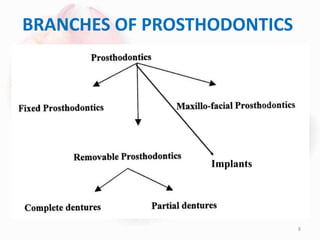
BRANCHES OF PROSTHODONTICS
8
Implants
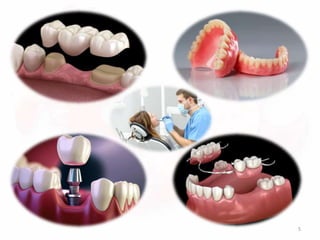
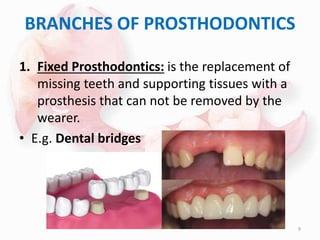
1. Fixed Prosthodontics: is the replacement of
missing teeth and supporting tissues with a
prosthesis that can not be removed by the
wearer.
• E.g. Dental bridges
9
BRANCHES OF PROSTHODONTICS
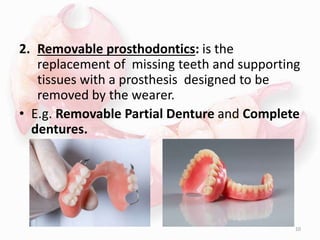
2. Removable prosthodontics: is the
replacement of missing teeth and supporting
tissues with a prosthesis designed to be
removed by the wearer.
• E.g. Removable Partial Denture and Complete
dentures.
10
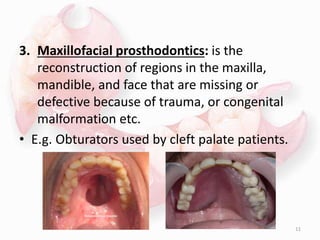
3. Maxillofacial prosthodontics: is the
reconstruction of regions in the maxilla,
mandible, and face that are missing or
defective because of trauma, or congenital
malformation etc.
• E.g. Obturators used by cleft palate patients.
11
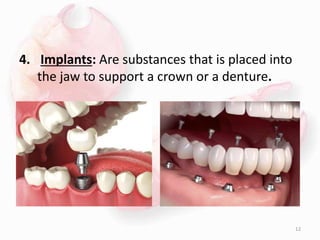
4. Implants: Are substances that is placed into
the jaw to support a crown or a denture.
12
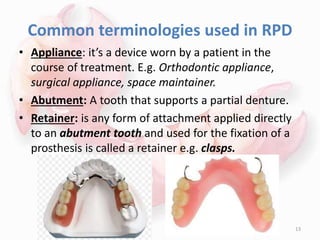
Common terminologies used in RPD
• Appliance: it’s a device worn by a patient in the
course of treatment. E.g. Orthodontic appliance,
surgical appliance, space maintainer.
• Abutment: A tooth that supports a partial denture.
• Retainer: is any form of attachment applied directly
to an abutment tooth and used for the fixation of a
prosthesis is called a retainer e.g. clasps.
13
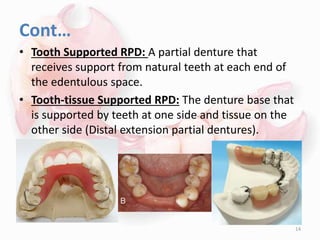
Cont…
• Tooth Supported RPD: A partial denture that
receives support from natural teeth at each end of
the edentulous space.
• Tooth-tissue Supported RPD: The denture base that
is supported by teeth at one side and tissue on the
other side (Distal extension partial dentures).
14
Cont…
• Definitive RPDs: After extensive diagnosis &
treatment planning and through preparation of
teeth and tissue.
• Interim RPD: It is a temporary partial denture
used for a short period to fulfil aesthetics or
mastication until a more definitive form of
treatment can be rendered.

15
Cont…
• Temporary RPD: They are used in patients
where tissue changes are expected, where a
permanent prosthesis cannot be fabricated till
the tissues stabilize.
• Treatment RPD: It is used as a carrier for
treatment material, like medications.
16
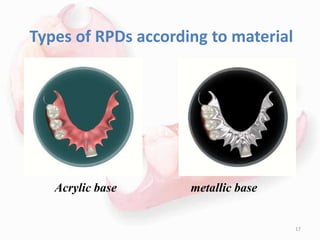
Types of RPDs according to material
Acrylic base metallic base
17
Indications of RPD
• The following should be considered before planning any
treatment for a patient:
1. Length of Edentulous Span
2. Age
3. Abutment teeth
4. Periodontal support of remaining teeth
5. Cross arch stabilization
6. Excessive bone loss
7. Aesthetics
8. Immediate teeth replacement after extraction
9. Emotional problems
10.Patient desire
18
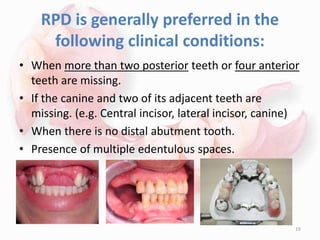
RPD is generally preferred in the
following clinical conditions:
• When more than two posterior teeth or four anterior
teeth are missing.
• If the canine and two of its adjacent teeth are
missing. (e.g. Central incisor, lateral incisor, canine)
• When there is no distal abutment tooth.
• Presence of multiple edentulous spaces.
19
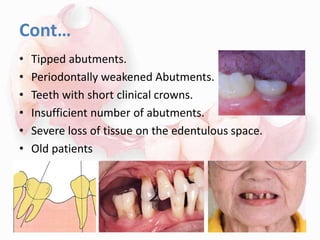
Cont…
• Tipped abutments.
• Periodontally weakened Abutments.
• Teeth with short clinical crowns.
• Insufficient number of abutments.
• Severe loss of tissue on the edentulous space.
• Old patients
20
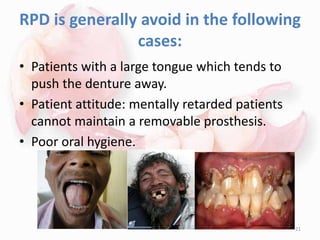
RPD is generally avoid in the following
cases:
• Patients with a large tongue which tends to
push the denture away.
• Patient attitude: mentally retarded patients
cannot maintain a removable prosthesis.
• Poor oral hygiene.
21
22
Classification of partially edentulous
arches
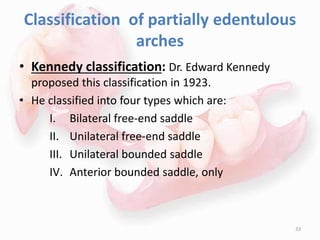
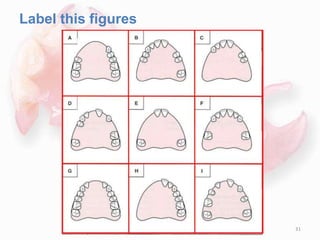
• Kennedy classification: Dr. Edward Kennedy
proposed this classification in 1923.
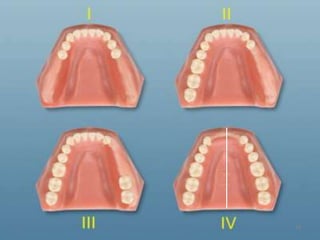
• He classified into four types which are:
I. Bilateral free-end saddle
II. Unilateral free-end saddle
III. Unilateral bounded saddle
IV. Anterior bounded saddle, only
23
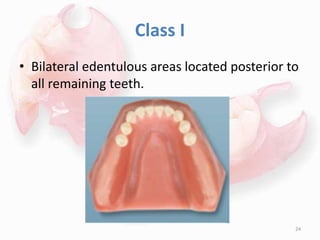
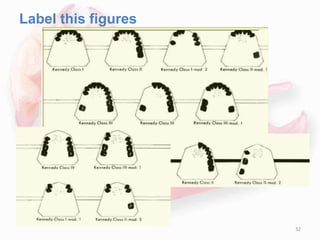
Class I
• Bilateral edentulous areas located posterior to
all remaining teeth.
24
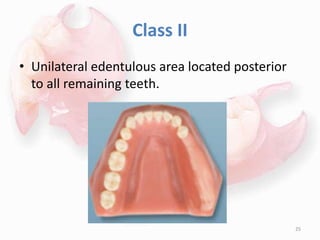
Class II
• Unilateral edentulous area located posterior
to all remaining teeth.
25
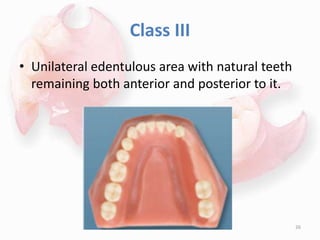
Class III
• Unilateral edentulous area with natural teeth
remaining both anterior and posterior to it.
26
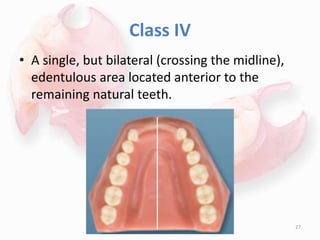
Class IV
• A single, but bilateral (crossing the midline),
edentulous area located anterior to the
remaining natural teeth.
27
28
Applegate's Rules for Applying the
Kennedy Classification
• Rule 1: Classification should follow rather than
precede extraction.
• Rule 2: If the 3rd molar is missing and not to
be replaced, it is not considered in the
classification.
• Rule 3: If the 3rd molar is present and to be
used as an abutment, it is considered in the
classification.
29
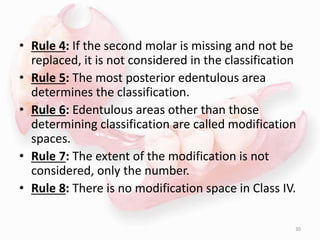
• Rule 4: If the second molar is missing and not be
replaced, it is not considered in the classification
• Rule 5: The most posterior edentulous area
determines the classification.
• Rule 6: Edentulous areas other than those
determining classification are called modification
spaces.
• Rule 7: The extent of the modification is not
considered, only the number.
• Rule 8: There is no modification space in Class IV.
30
31
Label this figures
32
Label this figures
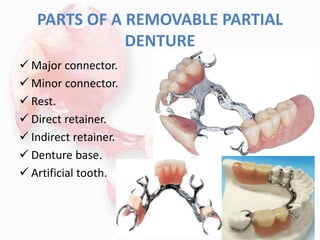
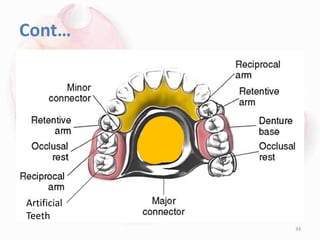
PARTS OF A REMOVABLE PARTIAL
DENTURE
 Major connector.
 Minor connector.
 Rest.
 Direct retainer.
 Indirect retainer.
 Denture base.
 Artificial tooth.
33
Cont…
34
Artificial
Teeth
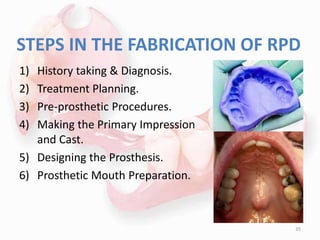
STEPS IN THE FABRICATION OF RPD
1) History taking & Diagnosis.
2) Treatment Planning.
3) Pre-prosthetic Procedures.
4) Making the Primary Impression
and Cast.
5) Designing the Prosthesis.
6) Prosthetic Mouth Preparation.
35
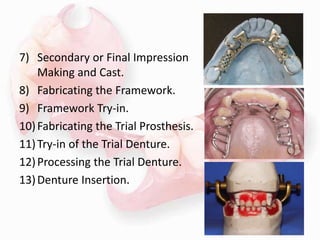
7) Secondary or Final Impression
Making and Cast.
8) Fabricating the Framework.
9) Framework Try-in.
10)Fabricating the Trial Prosthesis.
11)Try-in of the Trial Denture.
12)Processing the Trial Denture.
13)Denture Insertion.
36
37
For further information: drderajo@gmail.com or +252 634478206

01- INTRODUCTION AND CLASSIFICATION PARTIAL DENTURE.pptx

  • 1.
    Lecturer: Dr. AbdirahmanDerajo, BDS Frantz Fanon University, Hargeisa. 1 INTRDOUCTION AND CLASSIFICATION PARTIAL DENTURE 1
  • 2.
    Objectives • By theend of this lecture, students will be able to understand: 1. Introduction to prosthetics. 2. Branches of Prosthodontics. 3. Common Terminologies Used in Removable Partial Denture. 4. Indications for Removable Partial Dentures. 5. Classification of Partially Edentulous Arches. 6. Parts of a Removable Partial Denture. 7. Steps in the Fabrication of a Removable Partial Denture. 2
  • 3.
  • 4.
  • 5.
  • 6.
    Introduction • Prosthetics: isthe art and science of designing and fitting artificial substitutes to replace lost or missing tissue. • E.g. Denture; An artificial substitute for missing natural teeth and adjacent tissues. • Also artificial nose, ear etc. 6
  • 7.
    • Prosthodontics/Prosthetic Dentistry:It is the dental specialty pertaining to the diagnosis, treatment planning, rehabilitation and maintenance of the oral function, comfort, appearance and health of the patients with clinical conditions associated with missing or deficient teeth and / or maxillofacial tissues using biocompatible substitutes. 7
  • 8.
  • 9.
    1. Fixed Prosthodontics:is the replacement of missing teeth and supporting tissues with a prosthesis that can not be removed by the wearer. • E.g. Dental bridges 9 BRANCHES OF PROSTHODONTICS
  • 10.
    2. Removable prosthodontics:is the replacement of missing teeth and supporting tissues with a prosthesis designed to be removed by the wearer. • E.g. Removable Partial Denture and Complete dentures. 10
  • 11.
    3. Maxillofacial prosthodontics:is the reconstruction of regions in the maxilla, mandible, and face that are missing or defective because of trauma, or congenital malformation etc. • E.g. Obturators used by cleft palate patients. 11
  • 12.
    4. Implants: Aresubstances that is placed into the jaw to support a crown or a denture. 12
  • 13.
    Common terminologies usedin RPD • Appliance: it’s a device worn by a patient in the course of treatment. E.g. Orthodontic appliance, surgical appliance, space maintainer. • Abutment: A tooth that supports a partial denture. • Retainer: is any form of attachment applied directly to an abutment tooth and used for the fixation of a prosthesis is called a retainer e.g. clasps. 13
  • 14.
    Cont… • Tooth SupportedRPD: A partial denture that receives support from natural teeth at each end of the edentulous space. • Tooth-tissue Supported RPD: The denture base that is supported by teeth at one side and tissue on the other side (Distal extension partial dentures). 14
  • 15.
    Cont… • Definitive RPDs:After extensive diagnosis & treatment planning and through preparation of teeth and tissue. • Interim RPD: It is a temporary partial denture used for a short period to fulfil aesthetics or mastication until a more definitive form of treatment can be rendered. 15
  • 16.
    Cont… • Temporary RPD:They are used in patients where tissue changes are expected, where a permanent prosthesis cannot be fabricated till the tissues stabilize. • Treatment RPD: It is used as a carrier for treatment material, like medications. 16
  • 17.
    Types of RPDsaccording to material Acrylic base metallic base 17
  • 18.
    Indications of RPD •The following should be considered before planning any treatment for a patient: 1. Length of Edentulous Span 2. Age 3. Abutment teeth 4. Periodontal support of remaining teeth 5. Cross arch stabilization 6. Excessive bone loss 7. Aesthetics 8. Immediate teeth replacement after extraction 9. Emotional problems 10.Patient desire 18
  • 19.
    RPD is generallypreferred in the following clinical conditions: • When more than two posterior teeth or four anterior teeth are missing. • If the canine and two of its adjacent teeth are missing. (e.g. Central incisor, lateral incisor, canine) • When there is no distal abutment tooth. • Presence of multiple edentulous spaces. 19
  • 20.
    Cont… • Tipped abutments. •Periodontally weakened Abutments. • Teeth with short clinical crowns. • Insufficient number of abutments. • Severe loss of tissue on the edentulous space. • Old patients 20
  • 21.
    RPD is generallyavoid in the following cases: • Patients with a large tongue which tends to push the denture away. • Patient attitude: mentally retarded patients cannot maintain a removable prosthesis. • Poor oral hygiene. 21
  • 22.
  • 23.
    Classification of partiallyedentulous arches • Kennedy classification: Dr. Edward Kennedy proposed this classification in 1923. • He classified into four types which are: I. Bilateral free-end saddle II. Unilateral free-end saddle III. Unilateral bounded saddle IV. Anterior bounded saddle, only 23
  • 24.
    Class I • Bilateraledentulous areas located posterior to all remaining teeth. 24
  • 25.
    Class II • Unilateraledentulous area located posterior to all remaining teeth. 25
  • 26.
    Class III • Unilateraledentulous area with natural teeth remaining both anterior and posterior to it. 26
  • 27.
    Class IV • Asingle, but bilateral (crossing the midline), edentulous area located anterior to the remaining natural teeth. 27
  • 28.
  • 29.
    Applegate's Rules forApplying the Kennedy Classification • Rule 1: Classification should follow rather than precede extraction. • Rule 2: If the 3rd molar is missing and not to be replaced, it is not considered in the classification. • Rule 3: If the 3rd molar is present and to be used as an abutment, it is considered in the classification. 29
  • 30.
    • Rule 4:If the second molar is missing and not be replaced, it is not considered in the classification • Rule 5: The most posterior edentulous area determines the classification. • Rule 6: Edentulous areas other than those determining classification are called modification spaces. • Rule 7: The extent of the modification is not considered, only the number. • Rule 8: There is no modification space in Class IV. 30
  • 31.
  • 32.
  • 33.
    PARTS OF AREMOVABLE PARTIAL DENTURE  Major connector.  Minor connector.  Rest.  Direct retainer.  Indirect retainer.  Denture base.  Artificial tooth. 33
  • 34.
  • 35.
    STEPS IN THEFABRICATION OF RPD 1) History taking & Diagnosis. 2) Treatment Planning. 3) Pre-prosthetic Procedures. 4) Making the Primary Impression and Cast. 5) Designing the Prosthesis. 6) Prosthetic Mouth Preparation. 35
  • 36.
    7) Secondary orFinal Impression Making and Cast. 8) Fabricating the Framework. 9) Framework Try-in. 10)Fabricating the Trial Prosthesis. 11)Try-in of the Trial Denture. 12)Processing the Trial Denture. 13)Denture Insertion. 36
  • 37.
    37 For further information:drderajo@gmail.com or +252 634478206